
Understanding EKGs A Practical Approach FOURTH EDITION CHAPTER

- Slides: 45
Understanding EKGs A Practical Approach FOURTH EDITION CHAPTER 6 Interpretation of an EKG Strip Understanding EKGs: A Practical Approach, 4 th edition Brenda M Beasley Copyright © 2014 by Pearson Education, Inc. All Rights Reserved
Interpretation of an EKG Strip • Objectives § Recall the general rules to use when correctly identifying heart rhythms § Describe the basic approach to interpretation of EKG strips § Discuss the five steps used in interpretation of EKG strips Understanding EKGs: A Practical Approach, 4 th edition Brenda M Beasley Copyright © 2014 by Pearson Education, Inc. All Rights Reserved
Interpretation of an EKG Strip • Objectives § Explain how to calculate heart rate, given a 6 -second strip § Name four causes of artifact Understanding EKGs: A Practical Approach, 4 th edition Brenda M Beasley Copyright © 2014 by Pearson Education, Inc. All Rights Reserved
General Rules • First and most important, look at your patient • Read EVERY strip from left to right, starting at the beginning of the strip • Apply the five-step systematic approach that you will learn in this chapter • Avoid shortcuts and assumptions Understanding EKGs: A Practical Approach, 4 th edition Brenda M Beasley Copyright © 2014 by Pearson Education, Inc. All Rights Reserved
General Rules • A quick glance at a strip will often lead to an incorrect interpretation • Ask and answer each question in the five-step approach in the order that is presented here… this is important for consistency Understanding EKGs: A Practical Approach, 4 th edition Brenda M Beasley Copyright © 2014 by Pearson Education, Inc. All Rights Reserved
General Rules • Master the accepted parameters for each dysrhythmia and apply them to each of the five steps when analyzing the strip Understanding EKGs: A Practical Approach, 4 th edition Brenda M Beasley Copyright © 2014 by Pearson Education, Inc. All Rights Reserved
The Five-Step Approach • This five-step approach, in order of application, includes analysis of the following § § § Step Step 1: 2: 3: 4: 5: Heart rate Heart rhythm P wave PR interval QRS complex Understanding EKGs: A Practical Approach, 4 th edition Brenda M Beasley Copyright © 2014 by Pearson Education, Inc. All Rights Reserved
Step 1: Heart Rate • Number of electrical impulses as represented by PQRST complexes conducted through the myocardium in 60 seconds (1 min) • Atrial rate § Counting the number of P waves noted • Ventricular rate § Counting the number of QRS complexes noted Understanding EKGs: A Practical Approach, 4 th edition Brenda M Beasley Copyright © 2014 by Pearson Education, Inc. All Rights Reserved
Heart Rate • SA node discharges impulses at a rate of 60– 100 times per minute • Bradycardia § Heart rate less than 60 BPM • Tachycardia § Heart rate greater than 100 BPM Understanding EKGs: A Practical Approach, 4 th edition Brenda M Beasley Copyright © 2014 by Pearson Education, Inc. All Rights Reserved
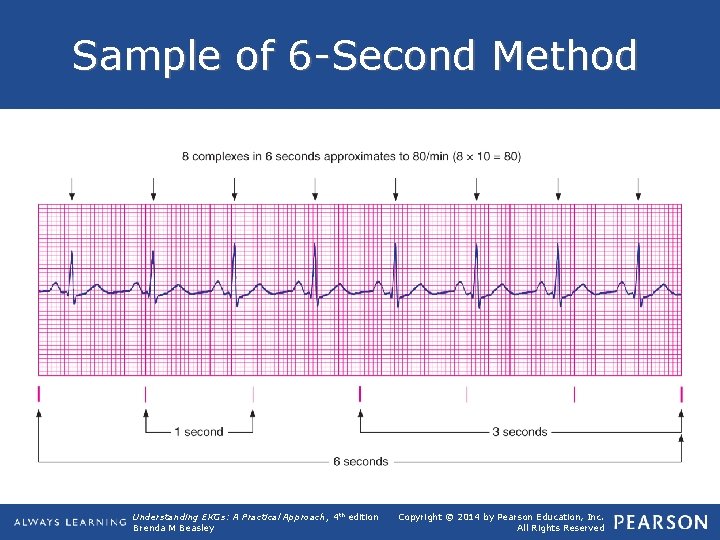
Heart Rate Determination • Two methods of determination of the heart rate 1. The 6 -second method • Denotes a 6 -second interval on EKG strip • Strip is marked by 3 -or 6 -second tick marks on the top or bottom of graph paper • Count the number of QRS complexes occurring within the 6 -second interval and then multiply that number by 10 Understanding EKGs: A Practical Approach, 4 th edition Brenda M Beasley Copyright © 2014 by Pearson Education, Inc. All Rights Reserved
Sample of 6 -Second Method Understanding EKGs: A Practical Approach, 4 th edition Brenda M Beasley Copyright © 2014 by Pearson Education, Inc. All Rights Reserved
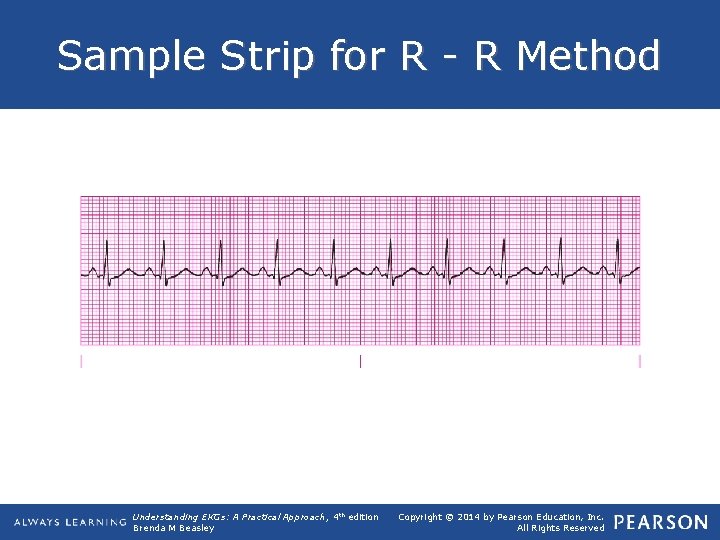
Two Methods to Determine Heart Rate • Two methods of determination of the heart rate 2. Second method is the R-R interval method • Most accurate if heart rate is regular • An estimation of the heart rate Understanding EKGs: A Practical Approach, 4 th edition Brenda M Beasley Copyright © 2014 by Pearson Education, Inc. All Rights Reserved
Two Methods to Determine Heart Rate • Two methods of determination of the heart rate 2. Second method is the R-R interval method • Look at QRS complex that falls on a heavy line on the strip, count number of large boxes between this R wave and the next R wave • Divide this number into 300 Understanding EKGs: A Practical Approach, 4 th edition Brenda M Beasley Copyright © 2014 by Pearson Education, Inc. All Rights Reserved
Sample Strip for R - R Method Understanding EKGs: A Practical Approach, 4 th edition Brenda M Beasley Copyright © 2014 by Pearson Education, Inc. All Rights Reserved
STEP 2: Heart Rhythm • Rhythm § Sequential beating of the heart as a result of the generation of electrical impulses Understanding EKGs: A Practical Approach, 4 th edition Brenda M Beasley Copyright © 2014 by Pearson Education, Inc. All Rights Reserved
STEP 2: Heart Rhythm • Classified as § Regular pattern • Intervals between R waves are regular § Irregular pattern • Intervals between R waves are not regular Understanding EKGs: A Practical Approach, 4 th edition Brenda M Beasley Copyright © 2014 by Pearson Education, Inc. All Rights Reserved
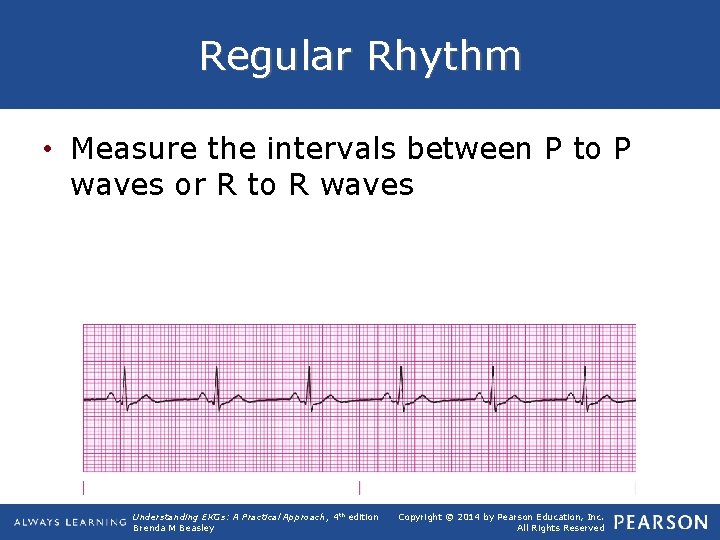
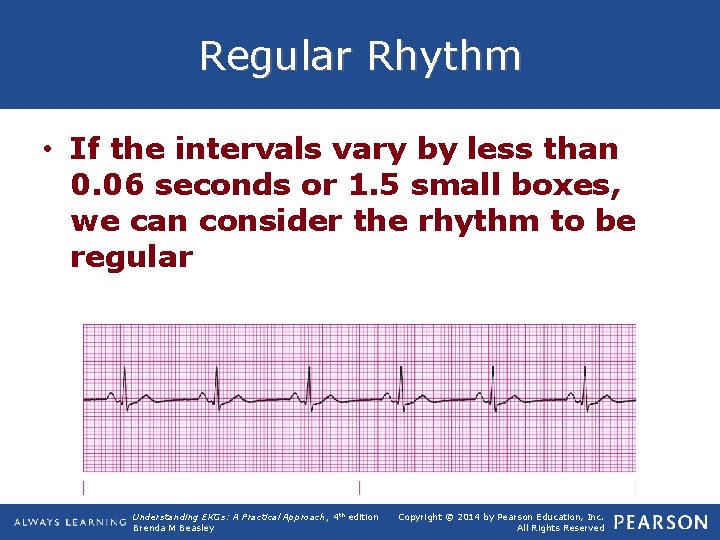
Regular Rhythm • Measure the intervals between P to P waves or R to R waves Understanding EKGs: A Practical Approach, 4 th edition Brenda M Beasley Copyright © 2014 by Pearson Education, Inc. All Rights Reserved
Regular Rhythm • If the intervals vary by less than 0. 06 seconds or 1. 5 small boxes, we can consider the rhythm to be regular Understanding EKGs: A Practical Approach, 4 th edition Brenda M Beasley Copyright © 2014 by Pearson Education, Inc. All Rights Reserved
Irregular Rhythm • If the intervals between the P to P waves or R to R waves are variable by greater than 0. 06 seconds, rhythm is considered irregular § Regularly irregular • Irregular rhythms that occur in a pattern § Occasionally irregular • Intervals of only one or two R to R are uneven Understanding EKGs: A Practical Approach, 4 th edition Brenda M Beasley Copyright © 2014 by Pearson Education, Inc. All Rights Reserved
Irregular Rhythm • If the intervals between the P to P waves or R to R waves are variable by greater than 0. 06 seconds, rhythm is considered irregular § Irregularly irregular • R to R intervals exhibit no similarity Understanding EKGs: A Practical Approach, 4 th edition Brenda M Beasley Copyright © 2014 by Pearson Education, Inc. All Rights Reserved
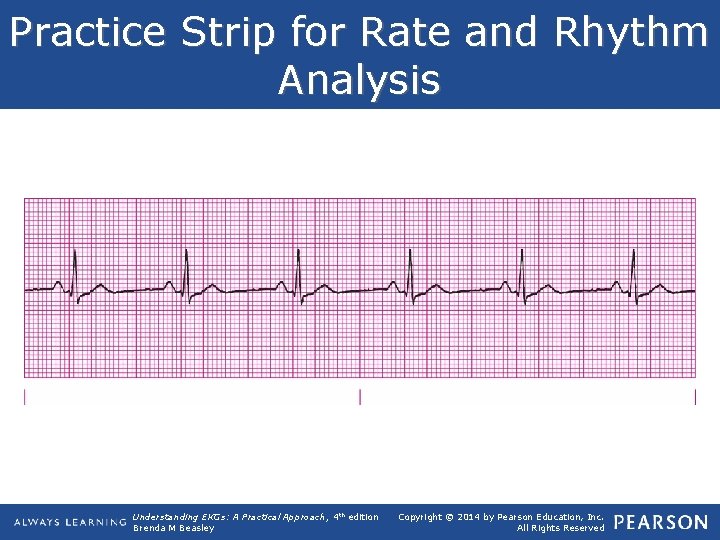
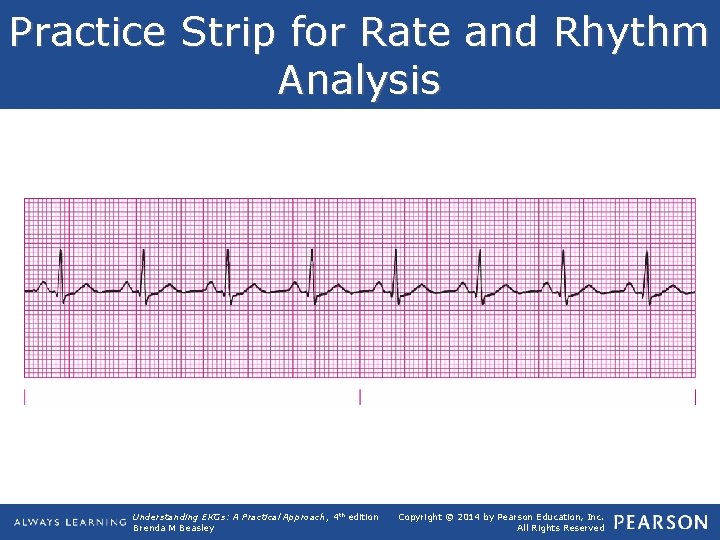
Practice Strip for Rate and Rhythm Analysis Understanding EKGs: A Practical Approach, 4 th edition Brenda M Beasley Copyright © 2014 by Pearson Education, Inc. All Rights Reserved
Practice Strip for Rate and Rhythm Analysis Understanding EKGs: A Practical Approach, 4 th edition Brenda M Beasley Copyright © 2014 by Pearson Education, Inc. All Rights Reserved
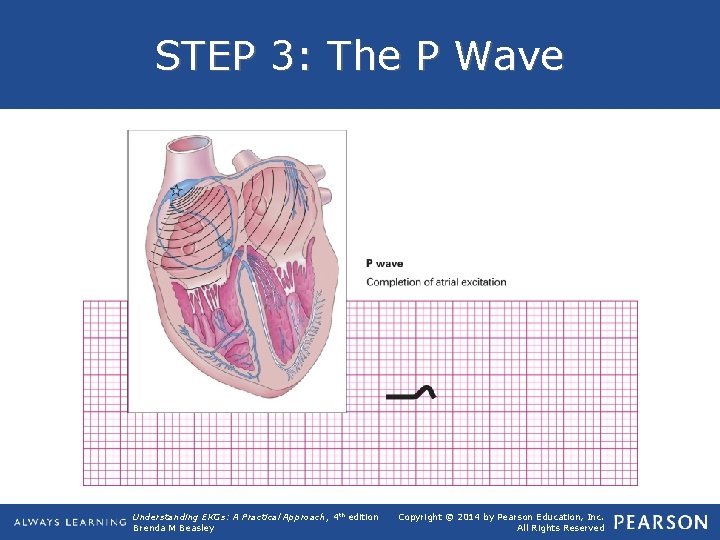
STEP 3: The P Wave • P wave is produced when the right and left atria depolarize • First deviation from the isoelectric line • Should be rounded and upright • P wave is SA node pacing or firing at regular intervals • This pattern is referred to as a sinus rhythm Understanding EKGs: A Practical Approach, 4 th edition Brenda M Beasley Copyright © 2014 by Pearson Education, Inc. All Rights Reserved
STEP 3: The P Wave Understanding EKGs: A Practical Approach, 4 th edition Brenda M Beasley Copyright © 2014 by Pearson Education, Inc. All Rights Reserved
P Wave: Five Questions to Ask • Step 1: Are P waves present? • Step 2: Are P waves occurring regularly? • Step 3: Is there one P wave present for each QRS complex present and/or is there a QRS for each P wave present? Understanding EKGs: A Practical Approach, 4 th edition Brenda M Beasley Copyright © 2014 by Pearson Education, Inc. All Rights Reserved
P Wave: Five Questions to Ask • Step 4: Are the P waves smooth, rounded, and upright in appearance, or are they inverted? • Step 5: Do all P waves look similar? Understanding EKGs: A Practical Approach, 4 th edition Brenda M Beasley Copyright © 2014 by Pearson Education, Inc. All Rights Reserved
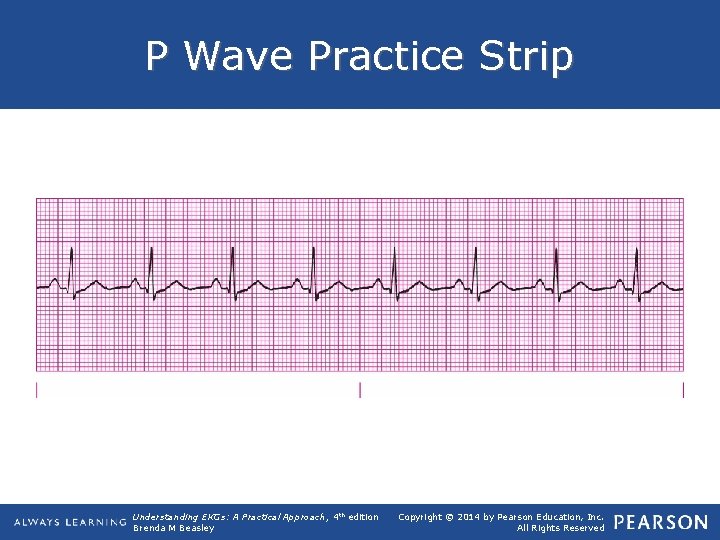
P Wave Practice Strip Understanding EKGs: A Practical Approach, 4 th edition Brenda M Beasley Copyright © 2014 by Pearson Education, Inc. All Rights Reserved
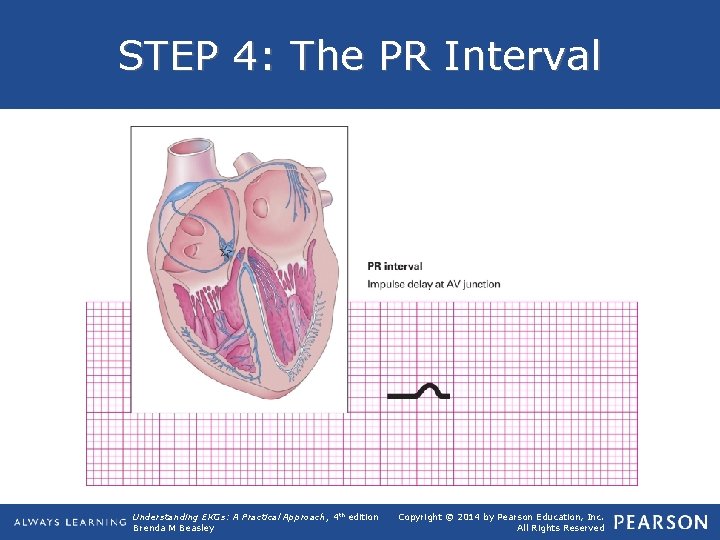
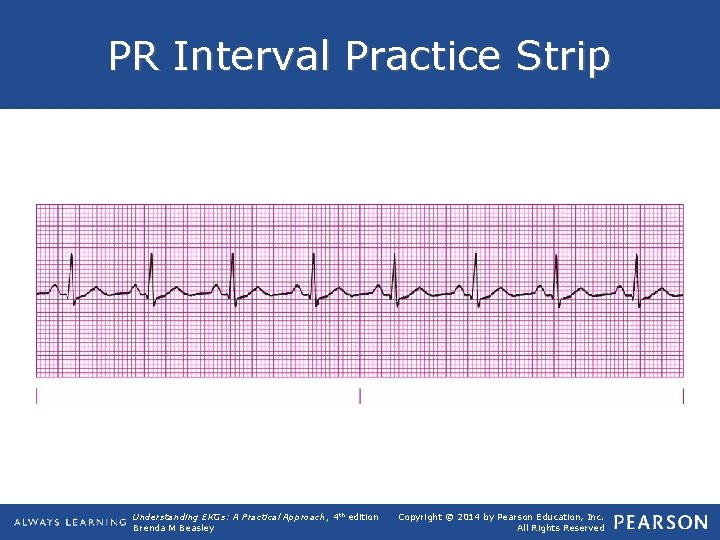
STEP 4: The PR Interval • Measures the time interval from the onset of atrial contraction to onset of ventricular contraction • Measured from onset of P wave to the onset of the QRS complex • Normal interval is 0. 12– 0. 20 seconds (3 – 5 small squares) Understanding EKGs: A Practical Approach, 4 th edition Brenda M Beasley Copyright © 2014 by Pearson Education, Inc. All Rights Reserved
STEP 4: The PR Interval Understanding EKGs: A Practical Approach, 4 th edition Brenda M Beasley Copyright © 2014 by Pearson Education, Inc. All Rights Reserved
PR Interval: 3 Questions to Ask 1. Are PR intervals greater than 0. 20 seconds? 2. Are PR intervals less than 0. 12 seconds? 3. Are the PR intervals constant across the EKG strip? Understanding EKGs: A Practical Approach, 4 th edition Brenda M Beasley Copyright © 2014 by Pearson Education, Inc. All Rights Reserved
PR Interval Practice Strip Understanding EKGs: A Practical Approach, 4 th edition Brenda M Beasley Copyright © 2014 by Pearson Education, Inc. All Rights Reserved
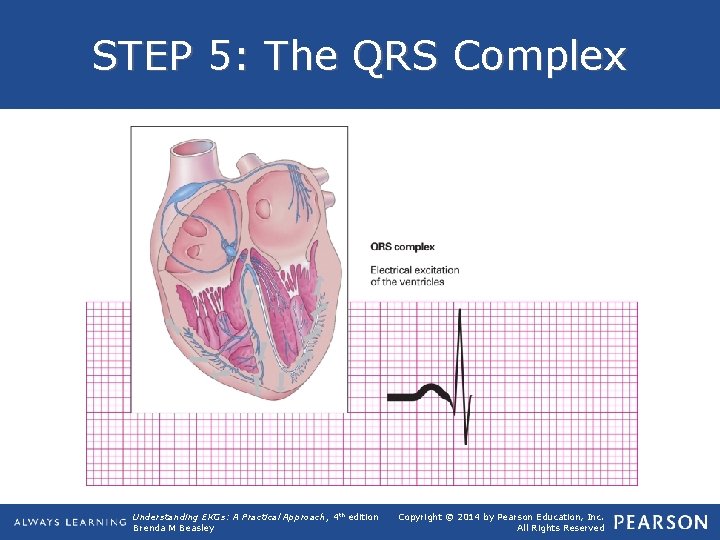
STEP 5: The QRS Complex Understanding EKGs: A Practical Approach, 4 th edition Brenda M Beasley Copyright © 2014 by Pearson Education, Inc. All Rights Reserved
STEP 5: The QRS Complex • Represents depolarization or contraction of the ventricles § Q wave • First negative or downward deflection of this large complex § R wave • First upward or positive deflection following the P wave (tallest waveform) Understanding EKGs: A Practical Approach, 4 th edition Brenda M Beasley Copyright © 2014 by Pearson Education, Inc. All Rights Reserved
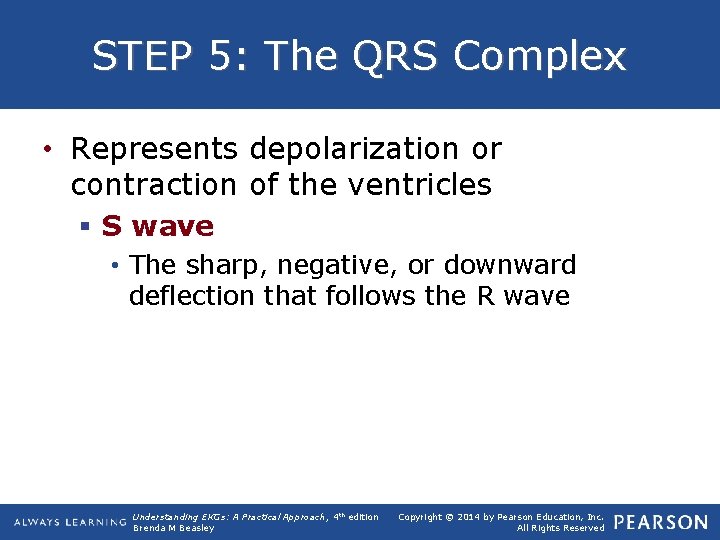
STEP 5: The QRS Complex • Represents depolarization or contraction of the ventricles § S wave • The sharp, negative, or downward deflection that follows the R wave Understanding EKGs: A Practical Approach, 4 th edition Brenda M Beasley Copyright © 2014 by Pearson Education, Inc. All Rights Reserved
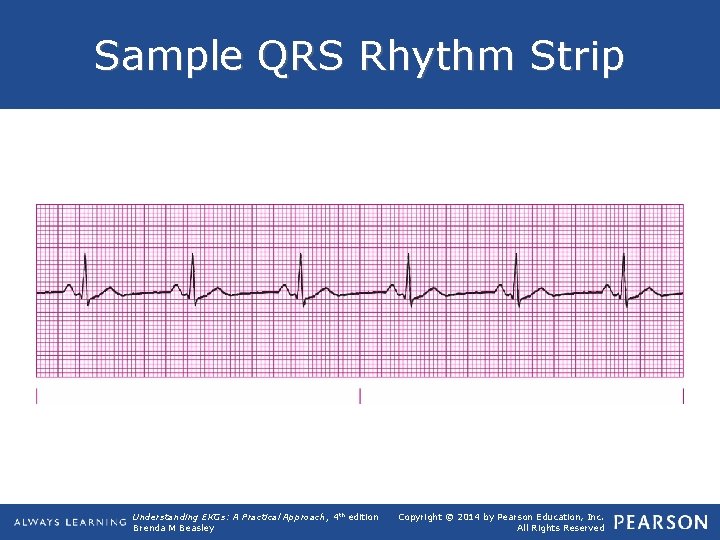
QRS Complex: 3 Questions to Ask 1. Are QRS intervals greater than 0. 12 seconds (wide)? 2. Are QRS intervals less than 0. 12 seconds (narrow)? 3. Are the QRS complexes similar in appearance across the EKG strip? Understanding EKGs: A Practical Approach, 4 th edition Brenda M Beasley Copyright © 2014 by Pearson Education, Inc. All Rights Reserved
Sample QRS Rhythm Strip Understanding EKGs: A Practical Approach, 4 th edition Brenda M Beasley Copyright © 2014 by Pearson Education, Inc. All Rights Reserved
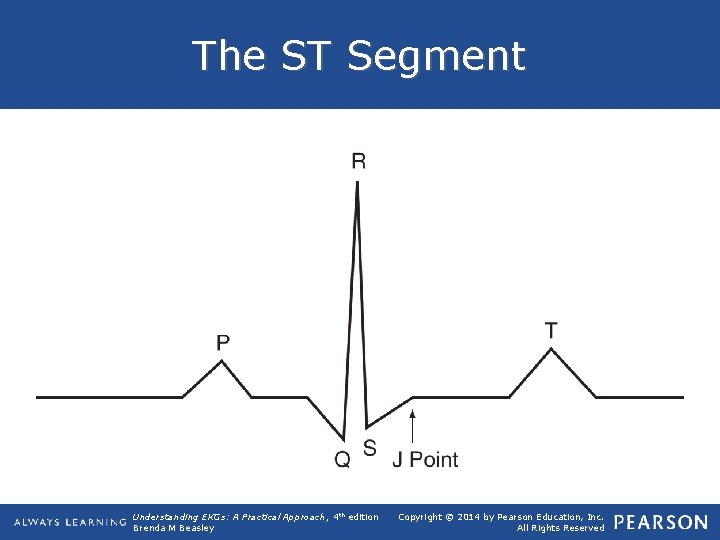
The ST Segment Understanding EKGs: A Practical Approach, 4 th edition Brenda M Beasley Copyright © 2014 by Pearson Education, Inc. All Rights Reserved
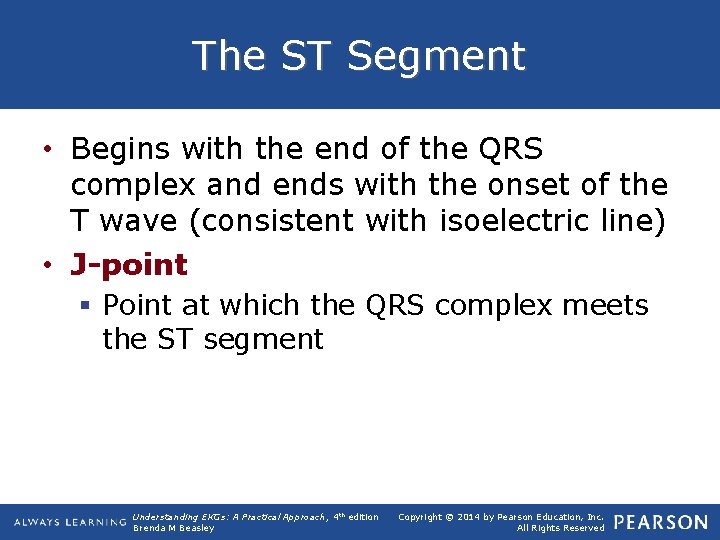
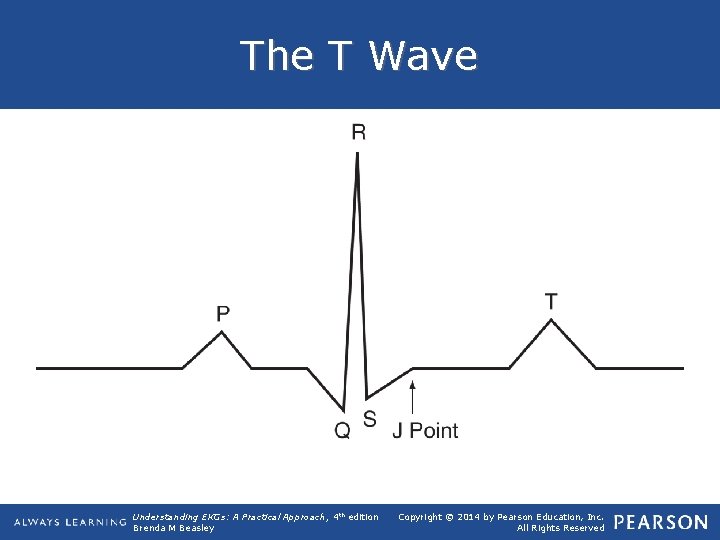
The ST Segment • Begins with the end of the QRS complex and ends with the onset of the T wave (consistent with isoelectric line) • J-point § Point at which the QRS complex meets the ST segment Understanding EKGs: A Practical Approach, 4 th edition Brenda M Beasley Copyright © 2014 by Pearson Education, Inc. All Rights Reserved
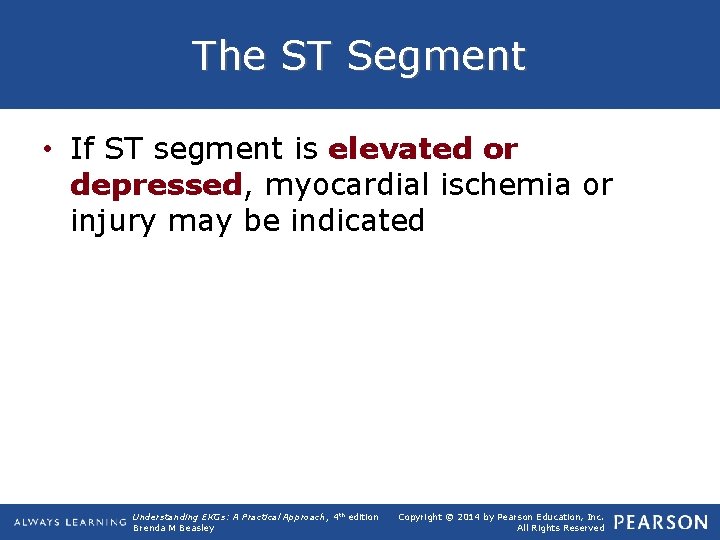
The ST Segment • If ST segment is elevated or depressed, myocardial ischemia or injury may be indicated Understanding EKGs: A Practical Approach, 4 th edition Brenda M Beasley Copyright © 2014 by Pearson Education, Inc. All Rights Reserved
The T Wave Understanding EKGs: A Practical Approach, 4 th edition Brenda M Beasley Copyright © 2014 by Pearson Education, Inc. All Rights Reserved
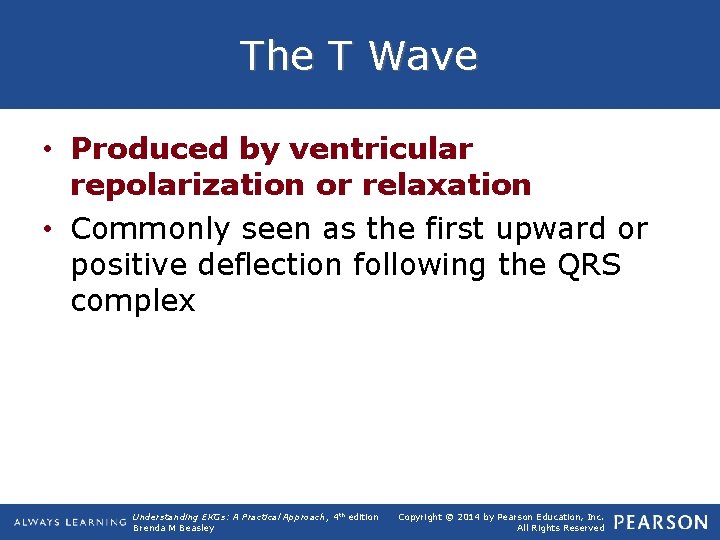
The T Wave • Produced by ventricular repolarization or relaxation • Commonly seen as the first upward or positive deflection following the QRS complex Understanding EKGs: A Practical Approach, 4 th edition Brenda M Beasley Copyright © 2014 by Pearson Education, Inc. All Rights Reserved
The U Wave • Usually not visible on EKG strips • Cause or origin not completely understood • Typically follows the T wave • Appears much smaller than T wave, rounded, upright, or positive deflection if they are present Understanding EKGs: A Practical Approach, 4 th edition Brenda M Beasley Copyright © 2014 by Pearson Education, Inc. All Rights Reserved
Artifact • EKG waveforms from sources outside the heart Understanding EKGs: A Practical Approach, 4 th edition Brenda M Beasley Copyright © 2014 by Pearson Education, Inc. All Rights Reserved
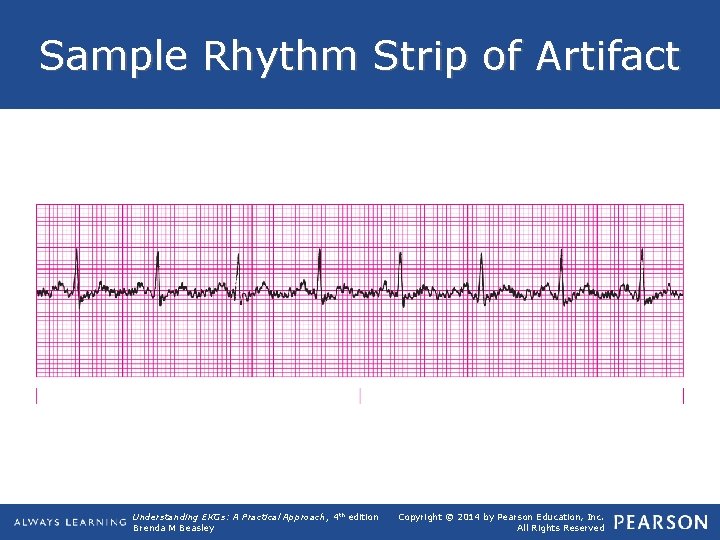
Artifact • Interference seen on a monitor or EKG strip § 4 causes • Patient movement • Loose or defective electrodes (fuzzy baseline) • Improper grounding (60 cycle interference) • Faulty EKG apparatus Understanding EKGs: A Practical Approach, 4 th edition Brenda M Beasley Copyright © 2014 by Pearson Education, Inc. All Rights Reserved
Sample Rhythm Strip of Artifact Understanding EKGs: A Practical Approach, 4 th edition Brenda M Beasley Copyright © 2014 by Pearson Education, Inc. All Rights Reserved