
UNDERSTANDING EFFECTIVE PROCUREMENT PROCESS IN KANO STATE BY

UNDERSTANDING EFFECTIVE PROCUREMENT PROCESS IN KANO STATE BY: ENGR. IBRAHIM IDRIS, MNSE, MNICE, COREN REG. KANO STATE DUE PROCESS BUREAU DATE: 30 th SEPTEMBER, 2020
LEARNING OBJECTIVES: Understanding the meaning and mission of Public Procurement Identifying Scope and Category of Public Procurement Knowing the Basic Principles of Public Procurement Knowing Procurement Process and Stages Understanding Procurement Circle Drivers of Public Procurement Approving and Awarding Authorities for Public Procurement Knowing Spending Limits on Public Procurement in Kano State Establishment of Procurement Committees Documents require for effective procurement on Contract Procurement through Direct-Labour Approach (Force Account) Documents require for effective procurement on Direct-Labour
DEFINITION OF PUBLIC PROCUREMENT Procurement is define as the acquisition of goods, works, and/or services at the Best Possible Total Cost of ownership in the Right Quantity and Quality at the Right Time, in the Right Place for direct BENEFIT or use of Government, Corporation or Individuals, generally via a Contract and/or Direct force.
What is the mission of Public Procurement? The mission of public procurement is to ensure and enable Procuring Entities (PE) meet their policy and business objectives in the delivery of better public services. The public procurement process spans the whole project life cycle from initial conception and definition of the needs of the public service through to the end of the useful life of an asset or the end of a contract.
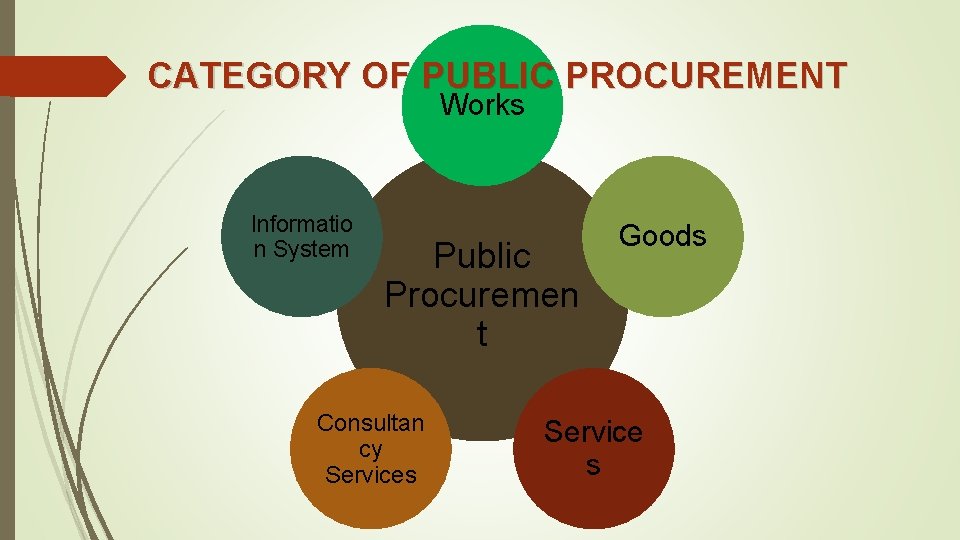
CATEGORY OF PUBLIC PROCUREMENT Works Informatio n System Public Procuremen t Consultan cy Services Goods Service s
PRINCIPLES FOR PUBLIC PROCUREMENT Competition Accountability Transparency Fairness Economy Efficiency. v The above identified principles of public procurement are aim to achieve value for money and fitness for purpose.
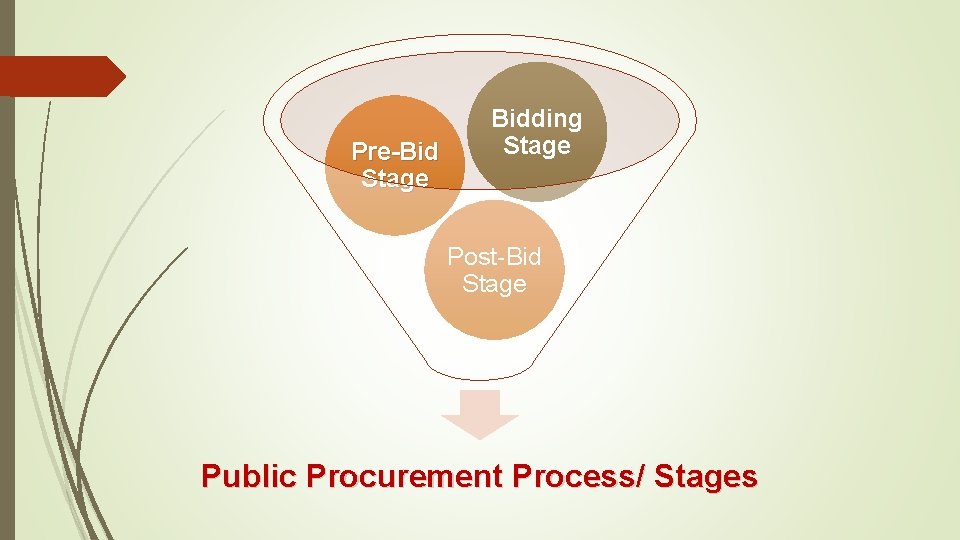
Pre-Bid Stage Bidding Stage Post-Bid Stage Public Procurement Process/ Stages
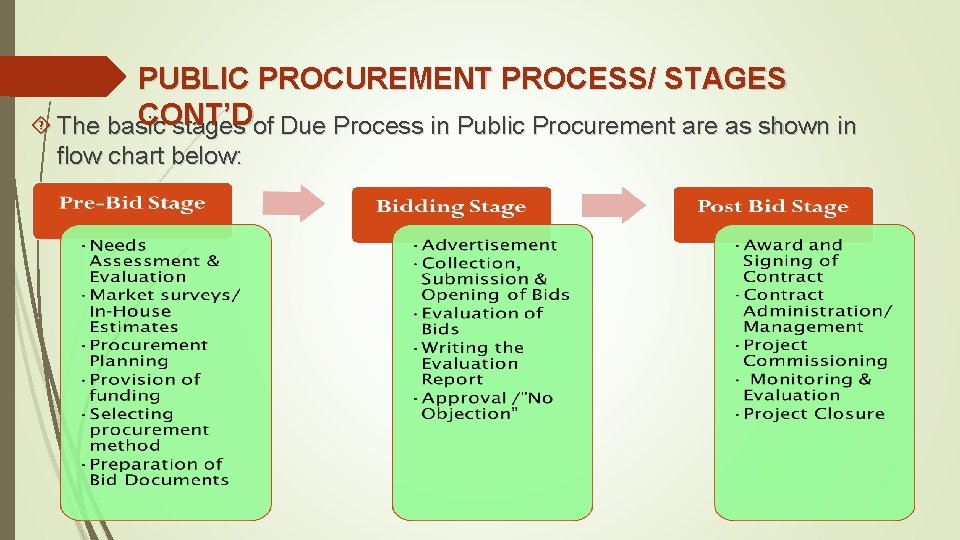
PUBLIC PROCUREMENT PROCESS/ STAGES CONT’D The basic stages of Due Process in Public Procurement are as shown in flow chart below:
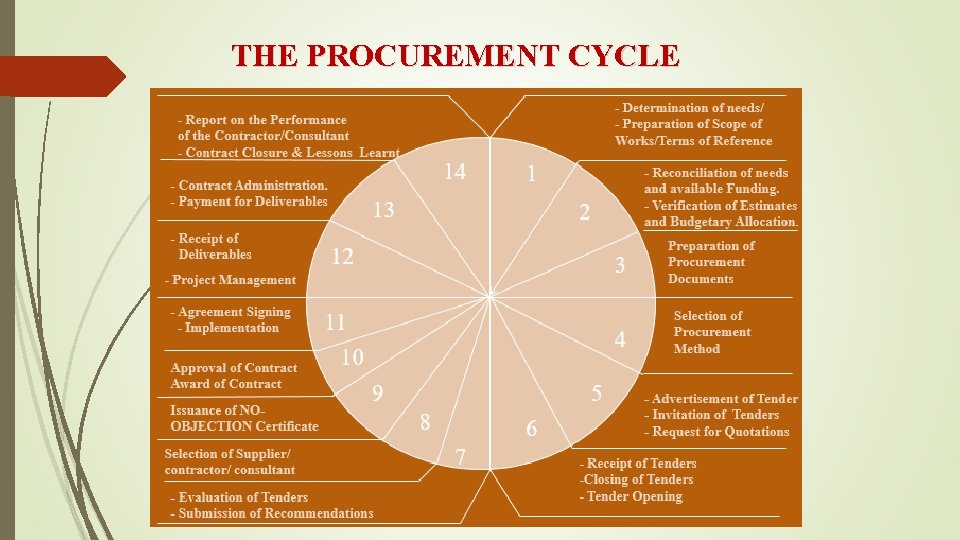
THE PROCUREMENT CYCLE
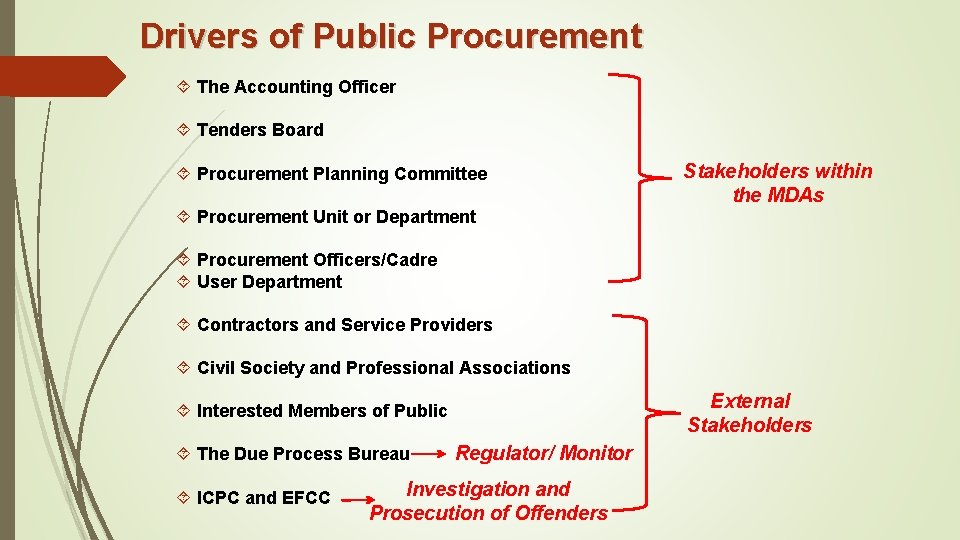
Drivers of Public Procurement The Accounting Officer Tenders Board Procurement Planning Committee Stakeholders within the MDAs Procurement Unit or Department Procurement Officers/Cadre User Department Contractors and Service Providers Civil Society and Professional Associations External Stakeholders Interested Members of Public The Due Process Bureau ICPC and EFCC Regulator/ Monitor Investigation and Prosecution of Offenders
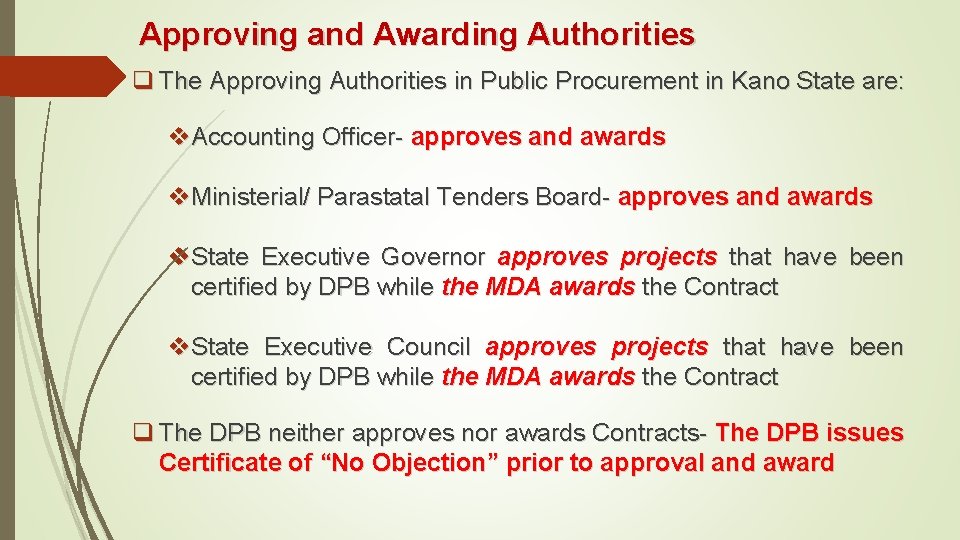
Approving and Awarding Authorities q The Approving Authorities in Public Procurement in Kano State are: v. Accounting Officer- approves and awards v. Ministerial/ Parastatal Tenders Board- approves and awards v. State Executive Governor approves projects that have been certified by DPB while the MDA awards the Contract v. State Executive Council approves projects that have been certified by DPB while the MDA awards the Contract q The DPB neither approves nor awards Contracts- The DPB issues Certificate of “No Objection” prior to approval and award
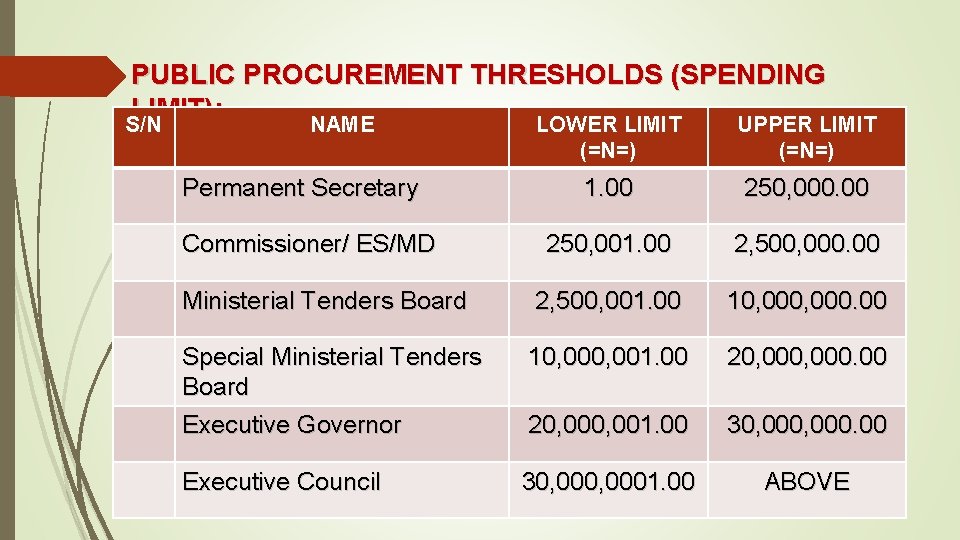
PUBLIC PROCUREMENT THRESHOLDS (SPENDING LIMIT): S/N NAME LOWER LIMIT UPPER LIMIT (=N=) 1. 00 250, 000. 00 250, 001. 00 2, 500, 000. 00 Ministerial Tenders Board 2, 500, 001. 00 10, 000. 00 Special Ministerial Tenders Board 10, 001. 00 20, 000. 00 Executive Governor 20, 001. 00 30, 000. 00 Executive Council 30, 0001. 00 ABOVE Permanent Secretary Commissioner/ ES/MD
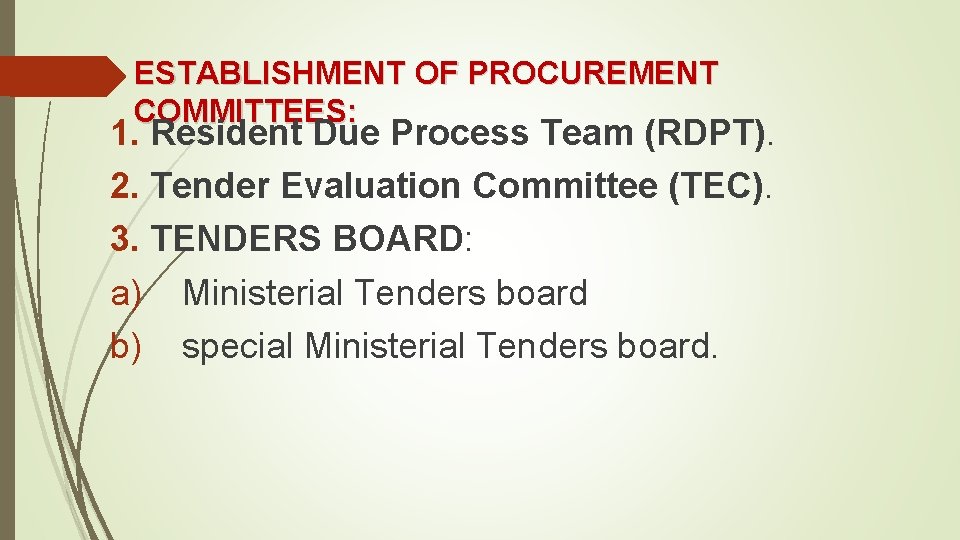
ESTABLISHMENT OF PROCUREMENT COMMITTEES: 1. Resident Due Process Team (RDPT). 2. Tender Evaluation Committee (TEC). 3. TENDERS BOARD: a) Ministerial Tenders board b) special Ministerial Tenders board.
Resident Due Process Team (RDPT): There shall be established in every Ministry, Department or Agency a “Resident Due Process Team” (RDPT) to review, evaluate and make recommendations to the Ministerial/and Special Tenders Board on works and services that fall within the limits stipulated as listed above.
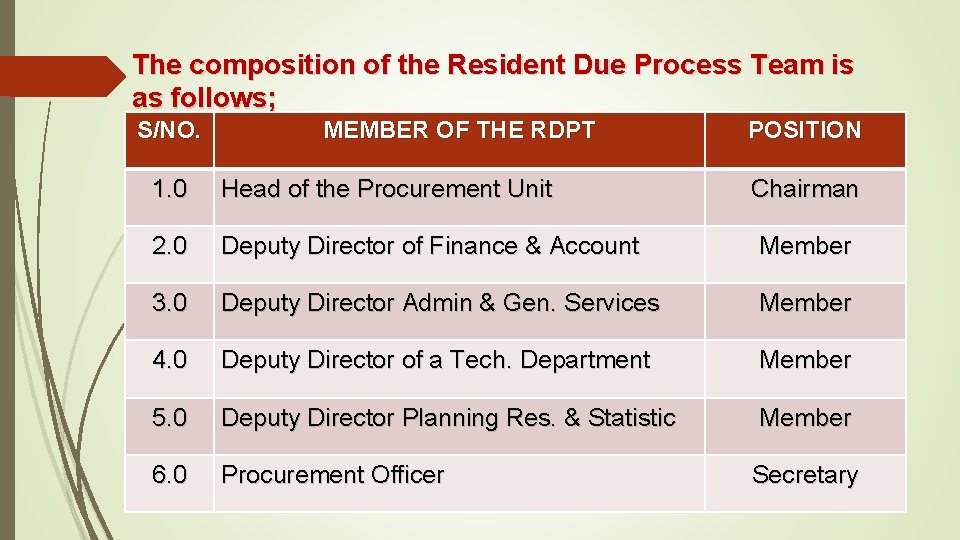
The composition of the Resident Due Process Team is as follows; S/NO. MEMBER OF THE RDPT POSITION 1. 0 Head of the Procurement Unit Chairman 2. 0 Deputy Director of Finance & Account Member 3. 0 Deputy Director Admin & Gen. Services Member 4. 0 Deputy Director of a Tech. Department Member 5. 0 Deputy Director Planning Res. & Statistic Member 6. 0 Procurement Officer Secretary
Tender Evaluation Committee (TEC): v For the purpose of evaluation, the MDAs shall establish Tender Evaluation Committee (TEC) which shall consist of five members, three of which shall be experienced in procurement. v The Committee is expected to carefully evaluate the submissions of the prospective bidders to determine their appropriateness/compliance with the Standard Technical and Financial Requirements. v The Committee is to be chaired by the Head of the Procurement Department or Unit.
TENDERS BOARD: i. Tenders Board shall be established in all MDA’s. ii. There shall be Ministerial/and or special Ministerial Tenders board as applicable in each MDA. iii. The establishment of Special Ministerial Tenders Board shall be at Ministerial level and not limited to specific Ministries, in accordance with the Spending Limits as outlined above.
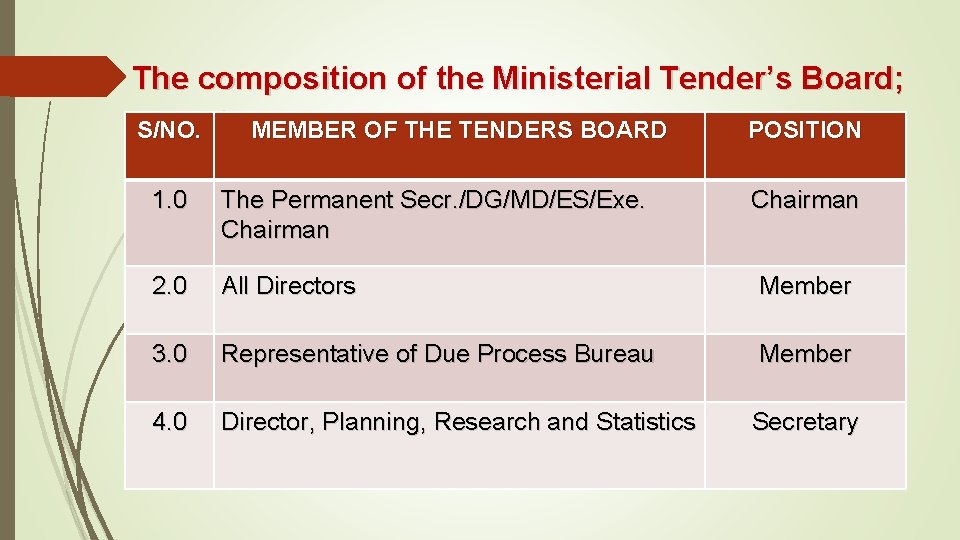
The composition of the Ministerial Tender’s Board; S/NO. MEMBER OF THE TENDERS BOARD POSITION 1. 0 The Permanent Secr. /DG/MD/ES/Exe. Chairman 2. 0 All Directors Member 3. 0 Representative of Due Process Bureau Member 4. 0 Director, Planning, Research and Statistics Secretary
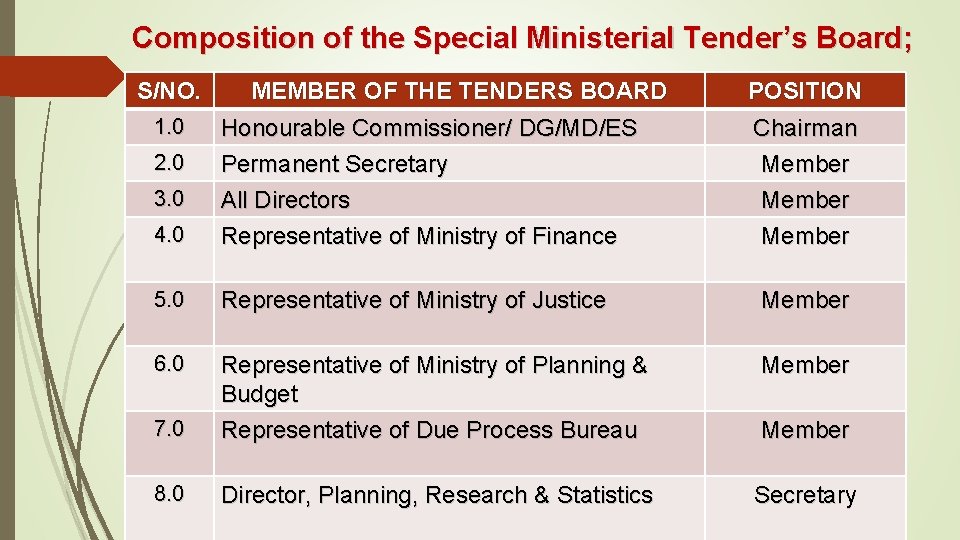
Composition of the Special Ministerial Tender’s Board; S/NO. 1. 0 2. 0 MEMBER OF THE TENDERS BOARD Honourable Commissioner/ DG/MD/ES POSITION Chairman 3. 0 Permanent Secretary All Directors Member 4. 0 Representative of Ministry of Finance Member 5. 0 Representative of Ministry of Justice Member 6. 0 Member 7. 0 Representative of Ministry of Planning & Budget Representative of Due Process Bureau 8. 0 Director, Planning, Research & Statistics Secretary Member
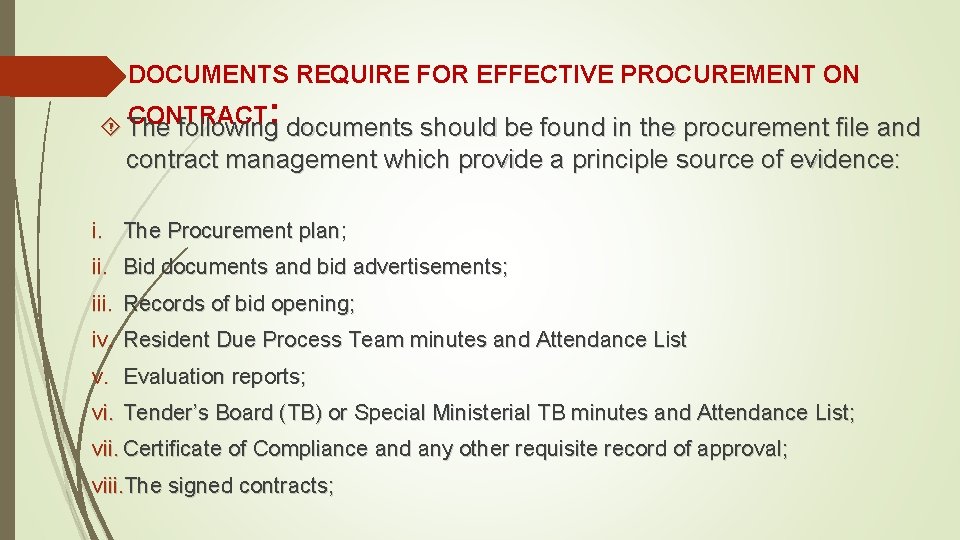
DOCUMENTS REQUIRE FOR EFFECTIVE PROCUREMENT ON CONTRACT: The following documents should be found in the procurement file and contract management which provide a principle source of evidence: i. The Procurement plan; ii. Bid documents and bid advertisements; iii. Records of bid opening; iv. Resident Due Process Team minutes and Attendance List v. Evaluation reports; vi. Tender’s Board (TB) or Special Ministerial TB minutes and Attendance List; vii. Certificate of Compliance and any other requisite record of approval; viii. The signed contracts;
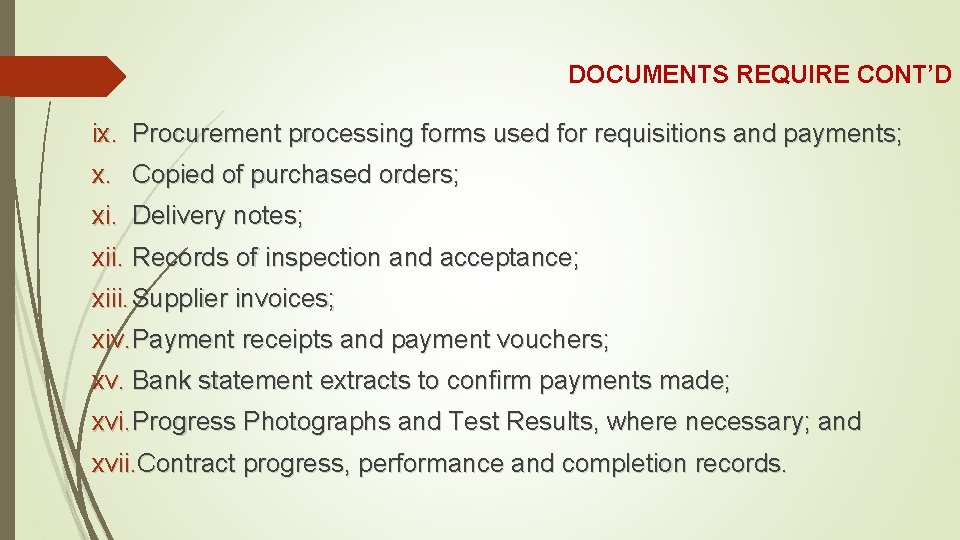
DOCUMENTS REQUIRE CONT’D ix. Procurement processing forms used for requisitions and payments; x. Copied of purchased orders; xi. Delivery notes; xii. Records of inspection and acceptance; xiii. Supplier invoices; xiv. Payment receipts and payment vouchers; xv. Bank statement extracts to confirm payments made; xvi. Progress Photographs and Test Results, where necessary; and xvii. Contract progress, performance and completion records.
FORCE-ACCOUNTS (DIRECT LABOUR) q Direct labour or force account is a process whereby, MDAs carryout activities including planning, design, construction of a project by a public agency using its own personnel and equipment and/or procurements of goods directly. q Force account may be justified where: § The works are small and scattered or in remote locations for which qualified construction firms are unlikely to tender at reasonable prices; § Work is required to be carried out without disrupting ongoing operations; § Risks of work interruption are better borne by a PE or public authority than by a contractor; or § There are emergencies needing prompt attention.
Force-Accounts (Direct Labour) Cont’d q Where MDAs have to operate Direct Labour procurement, they shall obtain current prices of goods and services from the Due Process Bureau. q The requirements of Direct Labour Procurement (DLP) once assembled should be passed to the RDPT for verification as should normally be done on contract procurements. q The RDPT is required to with outmost expedience issue its recommendations or no objection to the Chief Executive of the MDA for his approval and subsequent implementation by the proposing Department or disapproval. q Where the Chief Executive approves, the implementing department shall ensure cost and appropriate record keeping.
Force-Accounts (Direct Labour) Cont’d Conditions for Direct Labour: Direct labour shall be applied under the following situations/conditions: a. The job/procurement is of emergency nature, and cannot therefore stand the elaborate requirement of procurement procedure, b. The MDA has the requisite skill, knowhow and equipment to execute the work/procurement, and c. Using the in-house team is at least as economical (if not economically better) as using contractors.
Requirements for effective Procurement on Direct Labour Detailed written proposals where design may not be needed e. g. rehabilitation/renovation works; Bill of Engineering Measurement & Evaluation or Bill of Quantity for the proposal; Drawings or Engineering Design and Specification (if any); Minutes of Meeting of the Resident Due Process Team (RDPT); Approval of the Chief Executive of the MDA, Governor or Executive Council depending on the spending limits;
Requirements for Direct Labour Cont’d REQUIREMENTS AFTER EXECUTION: Payment Receipts, Supplier Invoice (s) and/ or Payment Vouchers; Records of inspection and acceptance (if any); Evidence of the Store Receipt Voucher (SRV); Evidence of the Store Issuance Voucher (SIV) Any other relevant Documents pertaining to the proposal/ procurement such as copies of purchase order, delivery notes, among others.

THANKS YOU FOR LISTENING
- Slides: 27