
Understanding Disabilities Centers for Disease Control and Prevention
Understanding Disabilities Centers for Disease Control and Prevention
Disability Overview: Impairments, Activity Limitations, and Participation Restrictions What is a disability? A disability is any condition of the body or mind (impairment) that makes it more difficult for the person with the condition to do certain activities (activity limitation) and interact with the world around them (participation restrictions) There are many types of disabilities, such as those that affect a person’s: Vision Movement Thinking Remembering Learning Communicating Hearing Mental health Social relationships
Disabilities Can Be: Related to conditions that are present at birth and may affect functions later in life, including cognition (memory, learning, and understanding), mobility (moving around in the environment), vision, hearing, behavior, and other areas. These conditions may be: Disorders in single genes (example Duchenne Muscular Dystrophy) Disorders of chromosomes (example Down Syndrome) The result of the mother’s exposure during pregnancy to infections (example Rubella) or substances, such as alcohol or cigarettes
Disabilities Can Be: Associated with developmental conditions that become apparent during childhood (example Autism Spectrum Disorder and Attention-Deficit Hyperactivity Disorder) Related to injury (example Traumatic Brain Injury or Spinal Cord Injury) Associated with a longstanding condition (example Diabetes) which can cause a disability such as vision loss, nerve damage, or limb loss Progressive Static (Limb loss) Intermittent (some forms of MS)
Disability Overview Although “people with disabilities” sometimes refers to a single population, this is actually a diverse group of people with a wide range of needs. Two people with the same type of disability can be affected in very different ways. Some disabilities may be hidden or not easy to see. According to World Health Organization, disability has 3 dimensions: Impairment Activity Limitation Participation Restrictions
Disability Overview: 3 Dimensions of Disabilities Impairment (absence of or significant difference) in a person’s body structure or function, or mental functioning; For example, problems in the structure of the brain can result in difficulty with mental functions such as memory, or problems with the structure of the eyes or ears can result in difficulty with the functions of vision or hearing Activity limitation, such as a difficulty seeing, hearing, walking, or problem solving Participation restrictions in normal daily activities, such as working, engaging in social and recreational activities, and obtaining health care and prevention services
Disability Overview: Impairment Structural Impairments Significant problems with an internal or external component of the body (examples: a type of nerve damage that can result in MS or a complete loss of a body component, as when a limb has been amputated) Functional Impairments Complete or partial loss of function of a body part (examples: pain that doesn’t go away or joints that no longer move easily
Disability Overview: Difference between Activity Limitation & Participation Restriction According to International Classifications of Functioning, Disability and Health (ICF): Activity is the execution of a task or action by an individual Participation is a person’s involvement in a life situation The ICF acknowledges that the distinction between these two categories is somewhat unclear and combines them, although basically, activities take place at a personal level and participation involves engagement in life roles, such as employment, education, or relationships Activity Limitations and Participation Restrictions have to do with difficulties in individual experiences in performing tasks and engaging in social roles
Disability Overview: Difference between Activity Limitations and Participation Restrictions Activities and Participation can be made easier or more difficult as a result of environmental factors, such as technology, support and relationships, services, policies, or the beliefs of others It is very important to improve the conditions in communities by providing accommodations that decrease or eliminate activity limitations and participation restrictions for people with disabilities, so they can participate in the roles and activities of every day life
Categories of Activities and Participation Learning and applying knowledge Managing tasks and demands Mobility (moving and maintaining body positions, handling and moving objects, moving around in the environment, moving around using transportation) Managing self care tasks Managing domestic life Establishing and managing interpersonal relationships and interactions Engaging in major life areas (education, employment, managing money or finances) Engaging in community, social, and civic life
Common Barriers to Participation Experienced by People with Disabilities Nearly everyone faces hardships and difficulties at one time or another, but for people with disabilities, barriers can be more frequent and have greater impact Barriers are more than just physical obstacles: They are factors in a person’s environment that, through their absence or presence, limit functioning and create disability A physical environment that is not accessible Lack of relevant assistive technology (assistive, adaptive, rehabilitative devices) Negative attitudes of people towards disability Services, systems and policies that are either nonexistent or that hinder the involvement of all people with a health condition in all areas of life
Most Common Barriers: Attitudinal Communication Physical Policy Programmatic Social Transportation

Attitudinal Barriers Most basic and contribute to other barriers Some people may not be aware that difficulties in getting to or into a place can limit a person with a disability from participating in everyday life and common daily activities Examples of attitudinal barriers include: Stereotyping: people sometimes stereotype those with disabilities, assuming their quality of life is poor or that they are unhealthy because of their impairments Stigma, prejudice, and discrimination: within society, these attitudes may come from people’s ideas related to disability. People may see disability as a personal tragedy, as something that needs to be cured or prevented, as a punishment for wrongdoing, or as an indication of the lack of ability to behave as expected in society
Attitudinal Barriers Today’s society’s understanding of disability is improving as we recognize “disability” as what occurs when a person’s functional needs are not addressed in his or her physical and social environment. By not considering disability a personal deficit or shortcoming, and instead thinking of it as a social responsibility in which all people can be supported to live independent and full lives, it becomes easier to recognize and address challenges that all people (including those with disabilities) experience
Communication Barriers Experienced by people who have disabilities that affect hearing, speaking, reading, writing, and/or understanding, and who use different ways to communicate than people who do not have these disabilities Examples of communication barriers: Written health promotion messages with barriers that prevent people with vision impairments from receiving the message Use of small print or no large print versions of material No Braille or versions for people who use screen readers
Examples of Communication Barriers cont: Auditory health messages may be inaccessible to people with hearing impairments Videos that do not include captioning Oral communications without accompanying manual interpretation (such as American Sign Language) The use of technical language, long sentences, and words with many syllables may be significant barriers to understanding for people with cognitive impairments
Physical Barriers Structural obstacles in natural or manmade environments that prevent or block mobility or access Examples of physical barriers Steps and curbs that block a person with mobility impairment from entering a building or using a sidewalk Mammography equipment that requires a woman with mobility impairment to stand Absence of a weight scale that accommodates wheelchairs or others who have difficulty stepping up
Policy Barriers Frequently related to lack of awareness or enforcement of existing laws and regulations that require programs and activities be accessible to people with disabilities Examples of policy barriers Denying qualified individuals with disabilities the opportunity to participate in or benefit from federally funded programs, services, or other benefits Denying individuals with disabilities access to programs, services, benefits, or opportunities to participate as a result of physical barriers Denying reasonable accommodations to qualified individuals with disabilities, so that they can perform the essential functions of the job for which they have applied or have been hired to perform
Programmatic Barriers Limit the effective delivery of public health or healthcare program for people with different types of impairments Examples of programmatic barriers Inconvenient scheduling Lack of accessible equipment (such as mammography screening equipment) Insufficient time set aside for medical examination and procedures Little or no communication with patients/participants Provider’s attitudes, knowledge, and understanding of people with disabilities
Social Barriers Related to the condition in which people are born, grow, live, learn, work, and age or social determinants of health that can contribute to decreased functioning among people with disabilities Examples of social barriers People with disabilities are far less likely to be employed. The unemployment rate in 2012 for people with disabilities was more than 1 in 10 (13. 9%) compared to less than 1 in 10 (6%) for those without disabilities Adults age 25 years and older with disabilities are less likely to have completed high school compared to their peers without disabilities People with disabilities are more likely to live in poverty compared to people without disabilities Children with disabilities are almost 4 times more likely to experience violence than children without disabilities
Transportation Barriers Are due to a lack of adequate transportation that interferes with a person’s ability to be independent and to function in society Examples of transportation barriers Lack of access to accessible or convenient transportation for people who are not able to drive because of vision or cognitive impairments or mobility impairments Public transportation may be unavailable or at inconvenient distances/locations or not accessible for those with disabilities
Inclusion Strategies Inclusion of people with disabilities into everyday activities involves practices and policies designed to identify and remove barriers that hamper individuals’ ability to have full participation in society, the same as people without disabilities Inclusion involves: Getting fair treatment from others (nondiscrimination) Making products, communications, and the physical environment more usable by as many people as possible (universal design) Modifying items, procedures, or systems to enable a person with a disability to use them to the maximum extent possible (reasonable accommodations) Eliminating the belief that people with disabilities are unhealthy or less capable of doing things (stigma, stereotypes)
Types of Inclusion Strategies National Policy and Legislation Universal Design Accessibility Reasonable Accommodations Independent Living Assisted Living People First Language
National Policy and Legislation Three federal laws protect the rights of people with disabilities and ensure their inclusion in many aspects of society Section 504 of the Rehabilitation Act of 1973 The Americans with Disabilities Act (ADA) of 1990, which was followed by the ADA Amendments Act of 2008 in an attempt to restore the original intent of the legislation The Patient Protection and Affordable Care Act in 2010
Section 504 of the Rehabilitation ACT Federal law that protects individuals from discrimination based on disability The nondiscrimination requirements of the law apply to employers and organizations that receive financial assistance from federal departments or agencies Section 504 forbids organizations and employers from denying individuals with disabilities an equal opportunity to receive program benefits and services. It defines the rights of individuals with disabilities to participate in, and have access to, program benefits and services
Americans with Disabilities Act As amended protects the civil rights of people with disabilities, and has helped remove or reduce many barriers for people with disabilities The legislation required the elimination of discrimination against people with disabilities The ADA has expanded opportunities for people with disabilities by reducing barriers, changing perceptions, and increasing participation in community life
ADA Act Cont: ADA guarantees equal opportunity for individuals with disabilities in several areas: Employment Public accommodations such as restaurants, hotels, theaters, doctors’ offices, pharmacies, retail stores, museums, libraries, parks, private schools, and day care centers Transportation State and local government services Telecommunications such as telephones, televisions, and computers
People with Disabilities and the Patient Protection and Affordable Care Act On March 23, 2010, President Obama signed into law the Patient Protection and Affordable Care Act, commonly referred to as ACA For people with disabilities, the ACA: Provides more health care choices and enhanced protection for Americans with disabilities Provides new health care options for long term support services Improves the Medicaid home and community based services option Provides access to high quality and affordable health care for many with disabilities Mandates accessible preventative screening equipment Designates disability status as a demographic category and mandates data collection to assess health disparities
Universal Design The intent of universal design is to simplify life for everyone by making products, communications, and the physical environment more usable by as many people as possible at little or no extra cost Universal design benefits people of all ages and abilities Center for Universal Design at North Carolina State University has developed 7 principles for universal design
Principles for Universal Design 1. Equitable use: the design is useful and marketable to people with diverse abilities (example: power doors with sensors at entrances that are convenient for all users) 2. Flexibility in use: the design accommodates a wide range of individual preferences and abilities (example: an automated teller machine (ATM) that has enhancements in the way it looks, feels, or sounds so that people with vision or hearing impairments can use it; a tapered card opening for ease in inserting or removing a bank card; a palm rest to aid those with arm mobility or strength limitations) 3. Simple and intuitive use: use of the design is easy to understand, regardless of the user’s experience, knowledge, language skills, or current concentration level (example: including an instruction manual with clear drawings and no text)
Principles for Universal Design cont: 4. Perceptible information: the design communicates necessary information effectively to the user, regardless of the current light, visual, or sound conditions or the person’s abilities to read, see, or hear (example: alarm systems that can be both seen and heard; routinely making captioning available in all television or video presentations) 5. Tolerance for error: the design minimizes hazards and the harmful consequences of accidental or unintended actions (example: ground-fault interrupter electrical outlet that reduces risk of shock in bathrooms and kitchens)
Principles for Universal Design cont: 6. Low physical effort: the design can be used efficiently and comfortably with minimum fatigue (example: easy-to-use handles that make opening doors easier for people of all ages and abilities) 7. Size and space for approach and use: appropriate size and space is provided for approach, reach, manipulation, and use regardless of person’s body size, posture, or mobility (example: counters and service windows are low enough for everyone to reach, including people who use wheelchairs; curb cuts or sidewalk ramps, essential for people in wheelchairs, but are used by all people, and also convenient for people pushing baby strollers)
Accessibility is when the needs of people with disabilities are specifically considered, and products, services, and facilities are built or modified so that they can be used by people of all abilities Examples of Accessibility: Parking spaces are close to entrances Floor spaces and hallways are free of equipment and other barriers Staff and healthcare professionals can use sign language or have access to someone who can use sign language
Reasonable Accommodations Alterations that have been made to items, procedures, or systems that enable a person with a disability to use them to the maximum extent possible Can also be a modification to an existing environment or process to increase the participation by an individual with an impairment or activity limitation Braille, large print, or audio books are examples of accommodations for people who are blind or have visual limitations For people who are deaf or who have difficulty hearing, accommodations may take form of having an American Sign Language interpreter available during meetings or presentations, or exchanging written messages Communication accommodations do not have to be elaborated, but they must be able to convey information effectively
Assistive Technology Assistive technologies (ATs) are devices or equipment that can be used to help a person with a disability fully engage in life activities ATs can help enhance functional independence and make daily living tasks easier through the use of aids that help a person travel, communicate with others, learn, work, and participate in social and recreational activities Example of AT can be anything from a low-tech device, such as a magnifying glass, to a high tech device, such as a computer that talks and helps someone communicate Other examples are wheelchairs, walkers, and scooters, which are mobility aids that can be used by persons with physical disabilities Smartphones have greatly expanded the availability of assistive technology for people with vision or hearing difficulties, or who have problems with effectively communicating their thoughts because of mental or physical limitations
Independent Living Independent living is about people with disabilities having voice, choice, and control over their everyday lives The person may not need any assistance or might need help with only complex issues, such as managing money, rather than day-today living skills Whether an adult with disabilities continues to live at home or moves into the community depends in large part on his/her ability to manage everyday tasks with little or no help (example: is the person able to clean the house, cook, shop, and pay bills, or able to use public transportation)
Assisted Living Assisted living is for adults who need help with everyday tasks They may need help with dressing, bathing, eating, or using the bathroom, but they don’t need full-time nursing care Some assisted living facilities are part of retirement communities Others are near nursing homes, so a person can move easily if needs change
People First Language People first language is used to speak appropriately and respectfully with and about people with disabilities It emphasizes the person first not the disability by starting the phrase with the words “person who” or “person with”
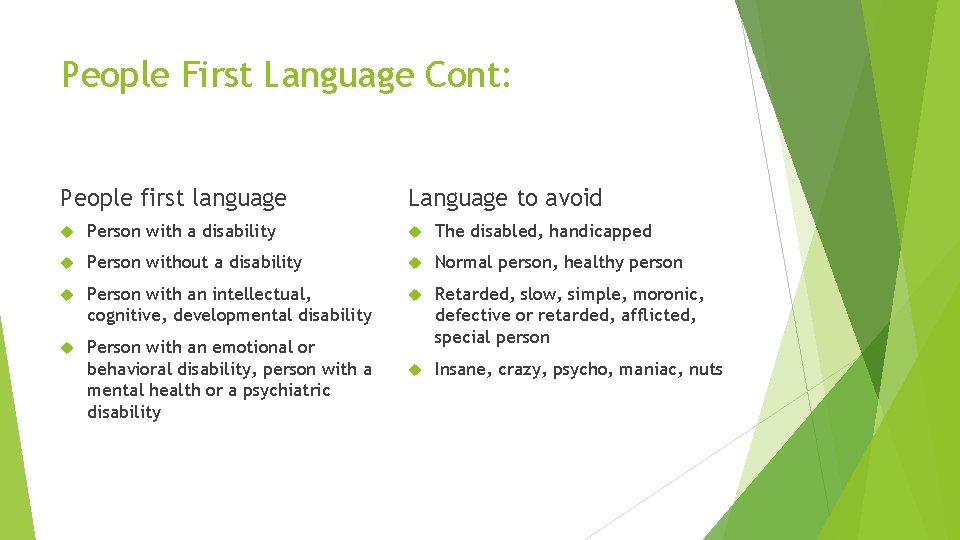
People First Language Cont: People first language Language to avoid Person with a disability The disabled, handicapped Person without a disability Normal person, healthy person Person with an intellectual, cognitive, developmental disability Person with an emotional or behavioral disability, person with a mental health or a psychiatric disability Retarded, slow, simple, moronic, defective or retarded, afflicted, special person Insane, crazy, psycho, maniac, nuts
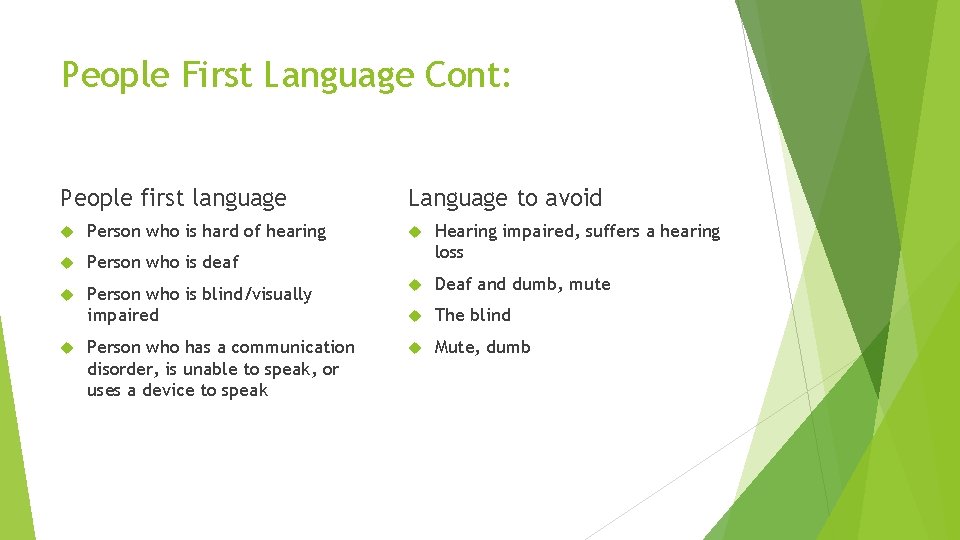
People First Language Cont: People first language Person who is hard of hearing Person who is deaf Language to avoid Hearing impaired, suffers a hearing loss Person who is blind/visually impaired Deaf and dumb, mute The blind Person who has a communication disorder, is unable to speak, or uses a device to speak Mute, dumb
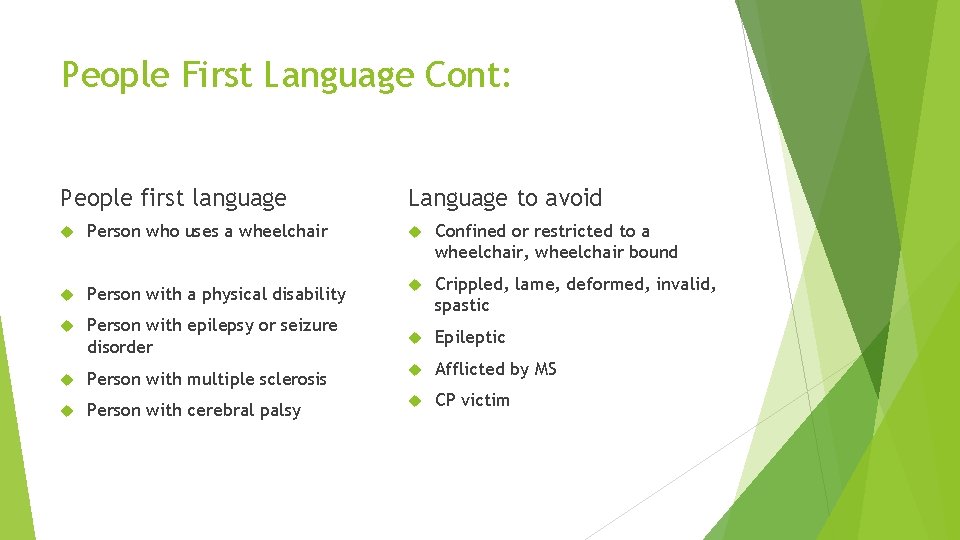
People First Language Cont: People first language Language to avoid Person who uses a wheelchair Confined or restricted to a wheelchair, wheelchair bound Person with a physical disability Person with epilepsy or seizure disorder Crippled, lame, deformed, invalid, spastic Epileptic Person with multiple sclerosis Afflicted by MS Person with cerebral palsy CP victim
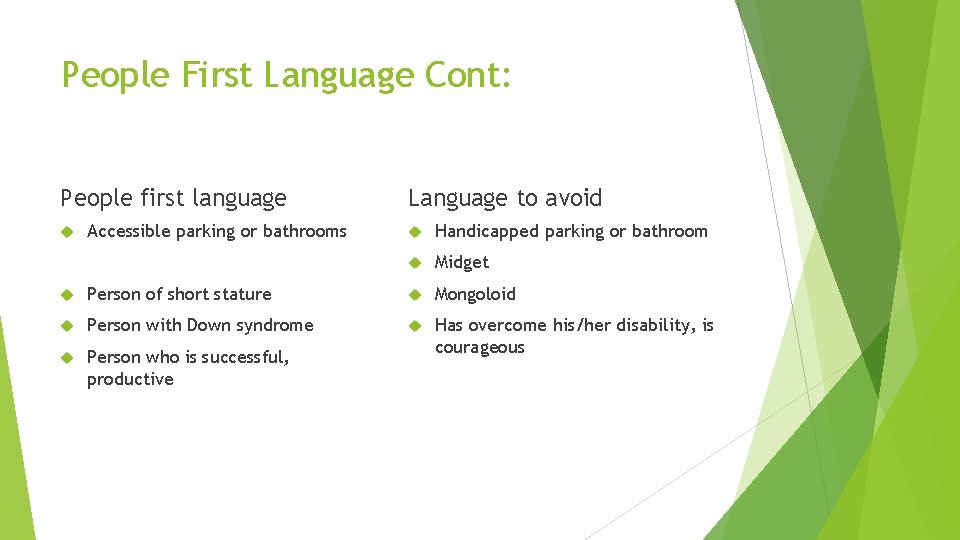
People First Language Cont: People first language Accessible parking or bathrooms Language to avoid Handicapped parking or bathroom Midget Person of short stature Mongoloid Person with Down syndrome Person who is successful, productive Has overcome his/her disability, is courageous
Including People with Disabilities in Public Health Programs and Activities Centers for Disease Control and Prevention (CDC) operates on the principle that people with disabilities are best served by public health when they are included in all public health programs and activities such as: Education and counselling programs that promote physical activity, improve nutrition or reduce the use of tobacco, alcohol or drugs Blood pressure and cholesterol assessment during annual health exams, and screening for illnesses such as cancer, diabetes, and heart disease People with disabilities need public health programs and healthcare services for the same reasons anyone does – to be healthy, active, and engaged as part of the community
CDC’s approach: Work across public health systems to encourage including accessibility features for all people with disabilities Focus on specific functional populations as a whole, with accommodations as necessary Example: those with vision or hearing loss, or mobility limitation Develop and implement public health programs for people with specific conditions A public health strategy is to use prevention efforts to help make the broadest health impact possible on the health of populations, in this case, people with disabilities Public health is directed at improving the health of communities or populations, and is distinguishable from clinical health, which is directed at the health of the individual
Disabilities and Health Programs CDC supports state-based disability and health programs dedicated to improve the health of people with disabilities, which broadens expertise and information-sharing among states 19 of these state-based programs promote equity in health, prevent chronic disease (such as diabetes, asthma, and high blood pressure), and increase the quality of life for people with disabilities. Each program customizes its activities to meet its state’s needs These state programs represent a network of standardized programs committed to helping people with disabilities benefit from public health services to the greatest extent possible These states serve as communities of practice and play a much needed role in identifying effective practices, policies, and services for people with disabilities

Disabilities and Health Programs Cont: State based disability and health programs also inform policy and practice Such programs ensure that individuals with disabilities are included in disease prevention and health promotion activities within the state CDS also supports and provides funding to National Centers on Health Promotion for People with Disabilities also known as National Centers on Disability to prevent disease and promote health and wellness for people with disabilities The purpose of the National Centers on Disability is to improve the quality of life of individuals living with disabilities by providing health information, education and consultation to healthcare professionals, people with disabilities, caregivers, media, researchers, policymakers and the public
Disabilities and Health Programs Cont: The National Centers on Disability accomplish their goals by implementing the following activities Serve as a resource for increasing knowledge and changing attitudes and practices as it relates to people with disabilities Educate policymakers about differences in health among people with disabilities Build collaborations with consumers, local health organizations, CDC and other relevant partners Share information about programs, methods, and materials and lessons learned Measure and document the National Centers on Disability impact using common methods of evaluation and reporting activities, such as the population reached by activities, and outcomes/impact indicators Identify the health needs of people with disabilities
- Slides: 47