
Understanding DGCA CAR A Generic Interpretation Flight Duty
- Slides: 22
Understanding DGCA CAR A Generic Interpretation Flight Duty Time Limitations. (Flight Crew Members) Version 1. 0 Copyright © 2014 Understanding DGCA CAR – A Generic Interpretation All rights reserved.
Disclaimer The documentation is provided “AS IS” and is solely intended to provide a general understanding of the author’s interpretation of DGCA FDTL 2011 / 2014, Flight Crew Regulations. (CAR-7 -J-III) The author makes no representations and disclaims any and all responsibility for the completeness or accuracy of the documentation. The author reserves the right, at his discretion, to change or modify the documentation as deemed appropriate. None of these interpretations are endorsed, or approved by the DGCA. Always check the approved OPSPEC and Operations Manual. Copyright © 2012 -2014, Understanding DGCA FDTL 2011 / 2014 – A Generic Interpretation. All rights reserved. Copyright © 2014 Understanding DGCA CAR – A Generic Interpretation All rights reserved.
Module 2: Concept Model Copyright © 2014 Understanding DGCA CAR – A Generic Interpretation All rights reserved.
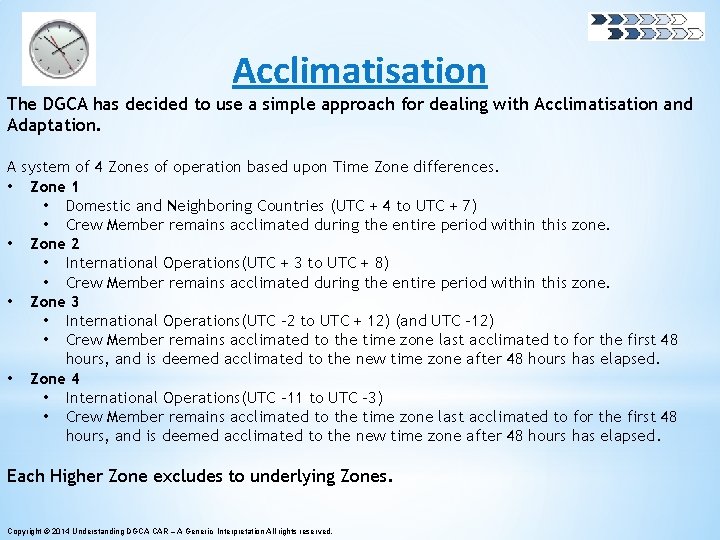
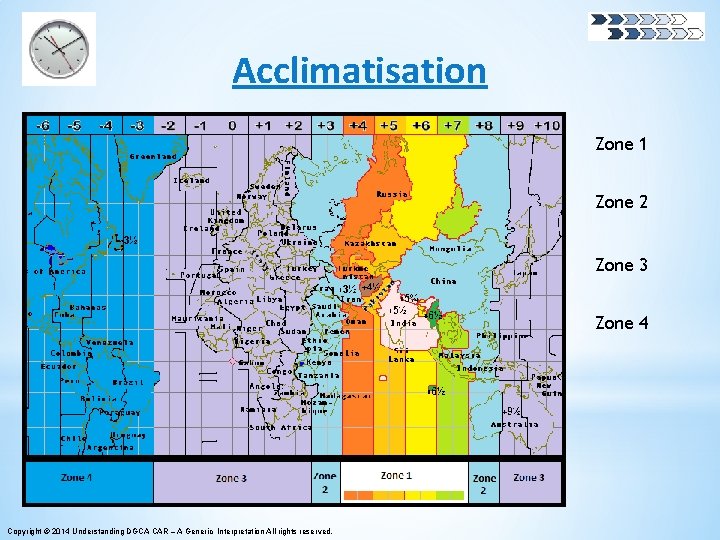
Acclimatisation The DGCA has decided to use a simple approach for dealing with Acclimatisation and Adaptation. A system of 4 Zones of operation based upon Time Zone differences. • Zone 1 • Domestic and Neighboring Countries (UTC + 4 to UTC + 7) • Crew Member remains acclimated during the entire period within this zone. • Zone 2 • International Operations(UTC + 3 to UTC + 8) • Crew Member remains acclimated during the entire period within this zone. • Zone 3 • International Operations(UTC -2 to UTC + 12) (and UTC – 12) • Crew Member remains acclimated to the time zone last acclimated to for the first 48 hours, and is deemed acclimated to the new time zone after 48 hours has elapsed. • Zone 4 • International Operations(UTC -11 to UTC -3) • Crew Member remains acclimated to the time zone last acclimated to for the first 48 hours, and is deemed acclimated to the new time zone after 48 hours has elapsed. Each Higher Zone excludes to underlying Zones. Copyright © 2014 Understanding DGCA CAR – A Generic Interpretation All rights reserved.
Acclimatisation Zone 1 Zone 2 Zone 3 Zone 4 Copyright © 2014 Understanding DGCA CAR – A Generic Interpretation All rights reserved.
Adaptation • The CM will remain acclimatised to the Time Zone where last acclimated to for the first 48 hours. • References to WOCL and Local Nights Rest remain fixed to the time zone where last acclimated to. • After 48 hours away from the Time Zone where previously acclimated to, the CM will be deemed at the first FDP start after 48 hours, to be acclimated to the new time zone. • Upon Return to Base, the CM must undergo another Adaptation Period. This is based upon the maximum Time Zone Difference during the Trip and Home Base. The Adaptation period is 36: 00 rest including 2 Local Nights Rest for travel to Zone 3, and 72: 00 rest including 3 Local Nights Rest for travel to Zone 4. Copyright © 2014 Understanding DGCA CAR – A Generic Interpretation All rights reserved.
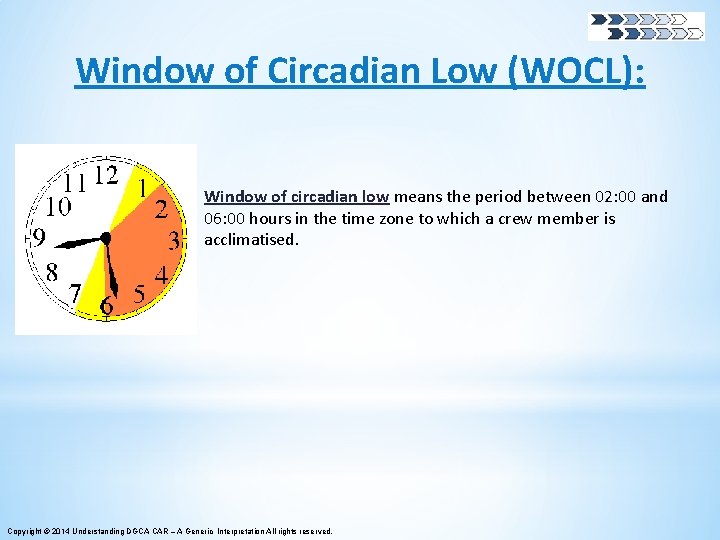
Window of Circadian Low (WOCL): Window of circadian low means the period between 02: 00 and 06: 00 hours in the time zone to which a crew member is acclimatised. Copyright © 2014 Understanding DGCA CAR – A Generic Interpretation All rights reserved.
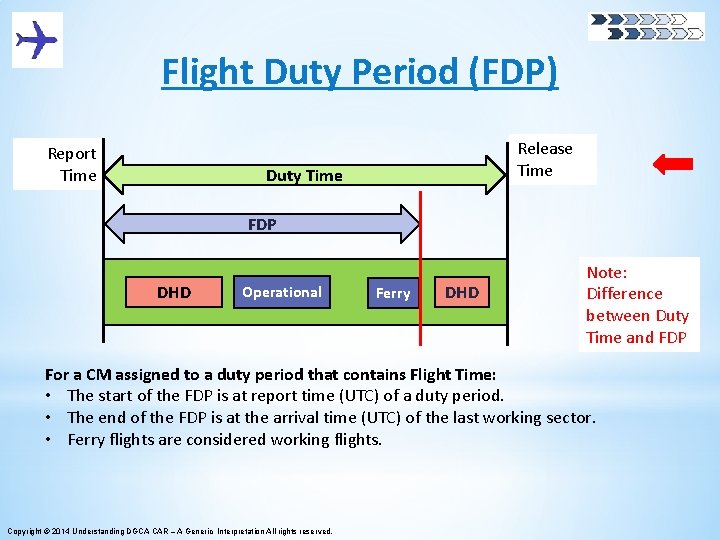
Flight Duty Period (FDP) Report Time Release Time Duty Time FDP DHD Operational Ferry DHD Note: Difference between Duty Time and FDP For a CM assigned to a duty period that contains Flight Time: • The start of the FDP is at report time (UTC) of a duty period. • The end of the FDP is at the arrival time (UTC) of the last working sector. • Ferry flights are considered working flights. Copyright © 2014 Understanding DGCA CAR – A Generic Interpretation All rights reserved.
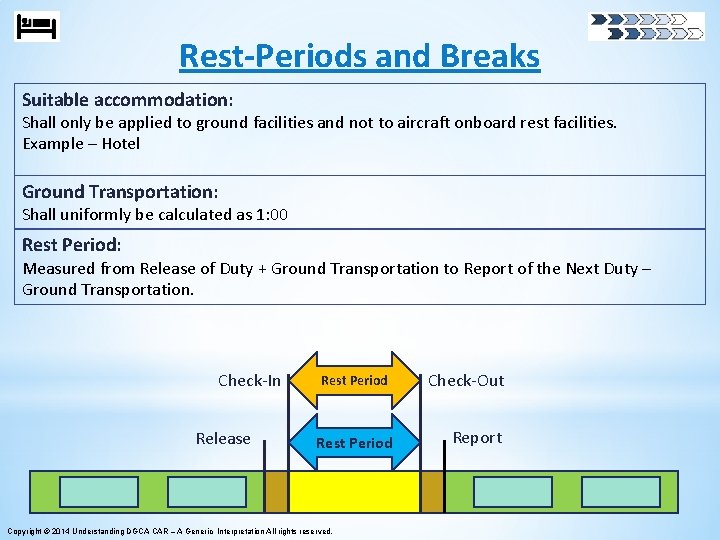
Rest-Periods and Breaks Suitable accommodation: Shall only be applied to ground facilities and not to aircraft onboard rest facilities. Example – Hotel Ground Transportation: Shall uniformly be calculated as 1: 00 Rest Period: Measured from Release of Duty + Ground Transportation to Report of the Next Duty – Ground Transportation. Check-In Release Rest Period Copyright © 2014 Understanding DGCA CAR – A Generic Interpretation All rights reserved. Check-Out Report
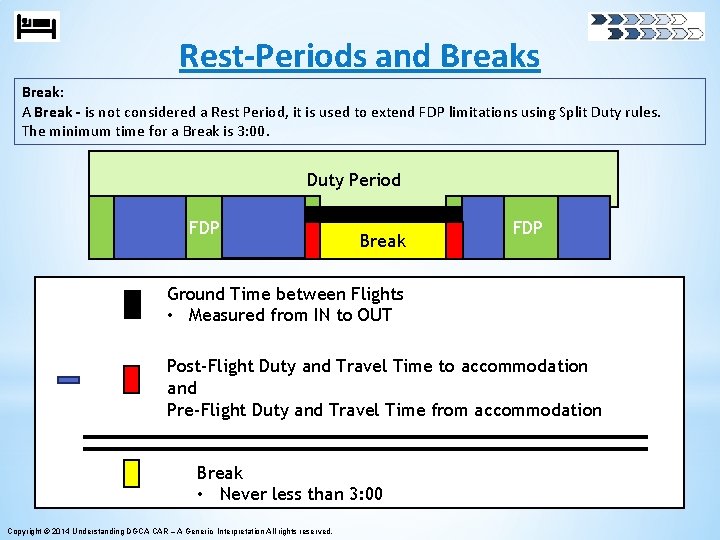
Rest-Periods and Breaks Break: A Break - is not considered a Rest Period, it is used to extend FDP limitations using Split Duty rules. The minimum time for a Break is 3: 00. Duty Period FDP Break FDP Ground Time between Flights • Measured from IN to OUT Post-Flight Duty and Travel Time to accommodation and Pre-Flight Duty and Travel Time from accommodation Break • Never less than 3: 00 Copyright © 2014 Understanding DGCA CAR – A Generic Interpretation All rights reserved.
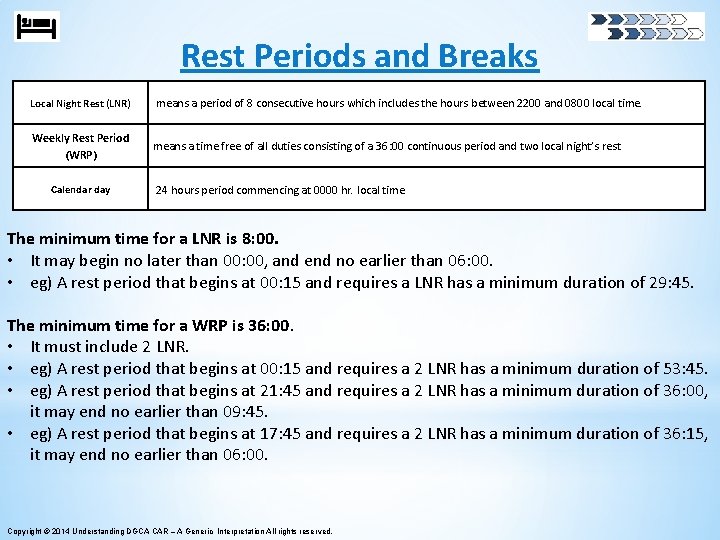
Rest Periods and Breaks Local Night Rest (LNR) means a period of 8 consecutive hours which includes the hours between 2200 and 0800 local time. Weekly Rest Period (WRP) means a time free of all duties consisting of a 36: 00 continuous period and two local night’s rest Calendar day 24 hours period commencing at 0000 hr. local time. The minimum time for a LNR is 8: 00. • It may begin no later than 00: 00, and end no earlier than 06: 00. • eg) A rest period that begins at 00: 15 and requires a LNR has a minimum duration of 29: 45. The minimum time for a WRP is 36: 00. • It must include 2 LNR. • eg) A rest period that begins at 00: 15 and requires a 2 LNR has a minimum duration of 53: 45. • eg) A rest period that begins at 21: 45 and requires a 2 LNR has a minimum duration of 36: 00, it may end no earlier than 09: 45. • eg) A rest period that begins at 17: 45 and requires a 2 LNR has a minimum duration of 36: 15, it may end no earlier than 06: 00. Copyright © 2014 Understanding DGCA CAR – A Generic Interpretation All rights reserved.
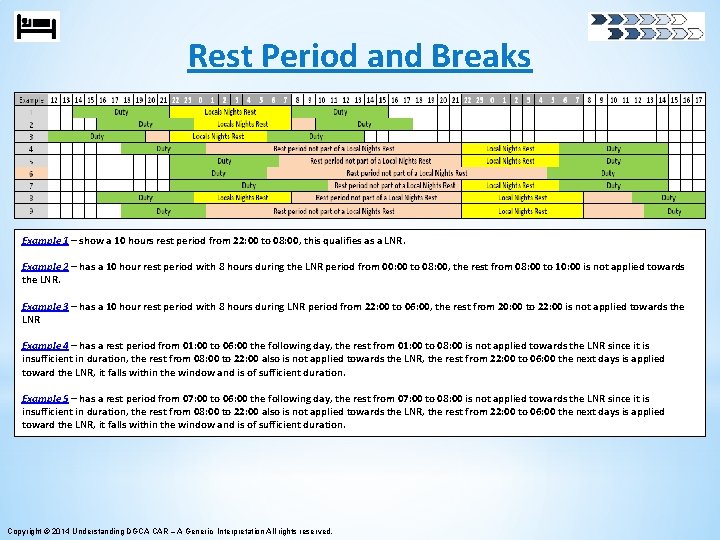
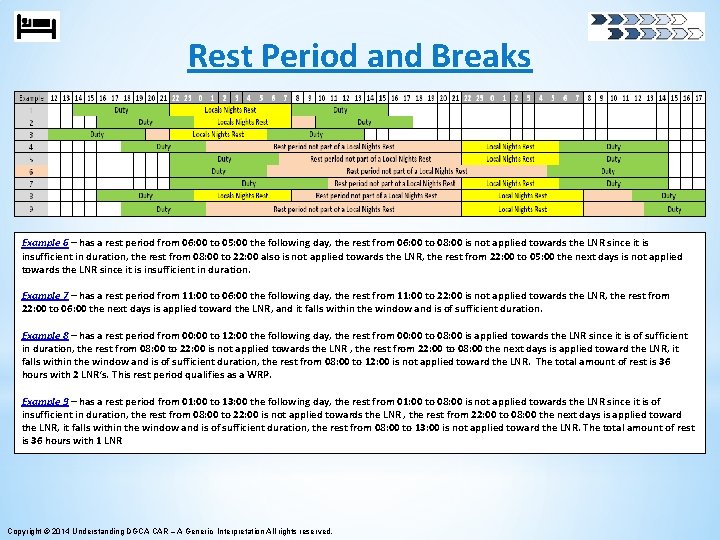
Rest Period and Breaks Example 1 – show a 10 hours rest period from 22: 00 to 08: 00, this qualifies as a LNR. Example 2 – has a 10 hour rest period with 8 hours during the LNR period from 00: 00 to 08: 00, the rest from 08: 00 to 10: 00 is not applied towards the LNR. Example 3 – has a 10 hour rest period with 8 hours during LNR period from 22: 00 to 06: 00, the rest from 20: 00 to 22: 00 is not applied towards the LNR Example 4 – has a rest period from 01: 00 to 06: 00 the following day, the rest from 01: 00 to 08: 00 is not applied towards the LNR since it is insufficient in duration, the rest from 08: 00 to 22: 00 also is not applied towards the LNR, the rest from 22: 00 to 06: 00 the next days is applied toward the LNR, it falls within the window and is of sufficient duration. Example 5 – has a rest period from 07: 00 to 06: 00 the following day, the rest from 07: 00 to 08: 00 is not applied towards the LNR since it is insufficient in duration, the rest from 08: 00 to 22: 00 also is not applied towards the LNR, the rest from 22: 00 to 06: 00 the next days is applied toward the LNR, it falls within the window and is of sufficient duration. Copyright © 2014 Understanding DGCA CAR – A Generic Interpretation All rights reserved.
Rest Period and Breaks Example 6 – has a rest period from 06: 00 to 05: 00 the following day, the rest from 06: 00 to 08: 00 is not applied towards the LNR since it is insufficient in duration, the rest from 08: 00 to 22: 00 also is not applied towards the LNR, the rest from 22: 00 to 05: 00 the next days is not applied towards the LNR since it is insufficient in duration. Example 7 – has a rest period from 11: 00 to 06: 00 the following day, the rest from 11: 00 to 22: 00 is not applied towards the LNR, the rest from 22: 00 to 06: 00 the next days is applied toward the LNR, and it falls within the window and is of sufficient duration. Example 8 – has a rest period from 00: 00 to 12: 00 the following day, the rest from 00: 00 to 08: 00 is applied towards the LNR since it is of sufficient in duration, the rest from 08: 00 to 22: 00 is not applied towards the LNR , the rest from 22: 00 to 08: 00 the next days is applied toward the LNR, it falls within the window and is of sufficient duration, the rest from 08: 00 to 12: 00 is not applied toward the LNR. The total amount of rest is 36 hours with 2 LNR‘s. This rest period qualifies as a WRP. Example 9 – has a rest period from 01: 00 to 13: 00 the following day, the rest from 01: 00 to 08: 00 is not applied towards the LNR since it is of insufficient in duration, the rest from 08: 00 to 22: 00 is not applied towards the LNR , the rest from 22: 00 to 08: 00 the next days is applied toward the LNR, it falls within the window and is of sufficient duration, the rest from 08: 00 to 13: 00 is not applied toward the LNR. The total amount of rest is 36 hours with 1 LNR Copyright © 2014 Understanding DGCA CAR – A Generic Interpretation All rights reserved.
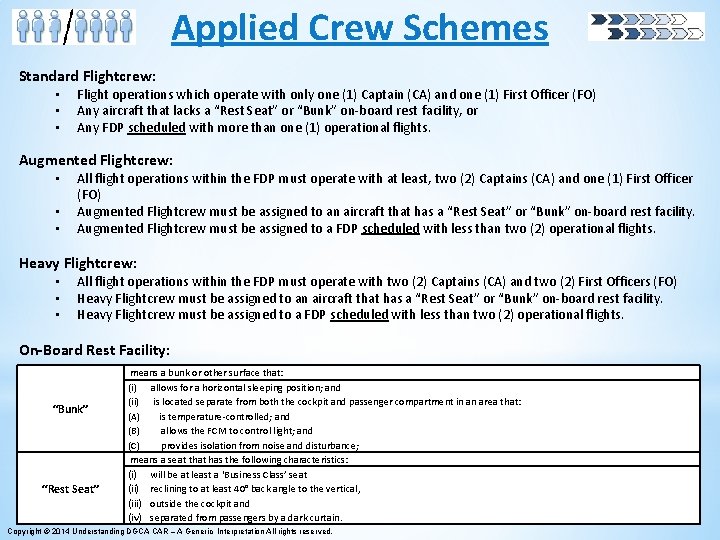
Applied Crew Schemes Standard Flightcrew: • • • Flight operations which operate with only one (1) Captain (CA) and one (1) First Officer (FO) Any aircraft that lacks a “Rest Seat” or “Bunk” on-board rest facility, or Any FDP scheduled with more than one (1) operational flights. Augmented Flightcrew: • • • All flight operations within the FDP must operate with at least, two (2) Captains (CA) and one (1) First Officer (FO) Augmented Flightcrew must be assigned to an aircraft that has a “Rest Seat” or “Bunk” on-board rest facility. Augmented Flightcrew must be assigned to a FDP scheduled with less than two (2) operational flights. Heavy Flightcrew: • • • All flight operations within the FDP must operate with two (2) Captains (CA) and two (2) First Officers (FO) Heavy Flightcrew must be assigned to an aircraft that has a “Rest Seat” or “Bunk” on-board rest facility. Heavy Flightcrew must be assigned to a FDP scheduled with less than two (2) operational flights. On-Board Rest Facility: “Bunk” “Rest Seat” means a bunk or other surface that: (i) allows for a horizontal sleeping position; and (ii) is located separate from both the cockpit and passenger compartment in an area that: (A) is temperature-controlled; and (B) allows the FCM to control light; and (C) provides isolation from noise and disturbance; means a seat that has the following characteristics: (i) will be at least a ‘Business Class’ seat (ii) reclining to at least 40° back angle to the vertical, (iii) outside the cockpit and (iv) separated from passengers by a dark curtain. Copyright © 2014 Understanding DGCA CAR – A Generic Interpretation All rights reserved.
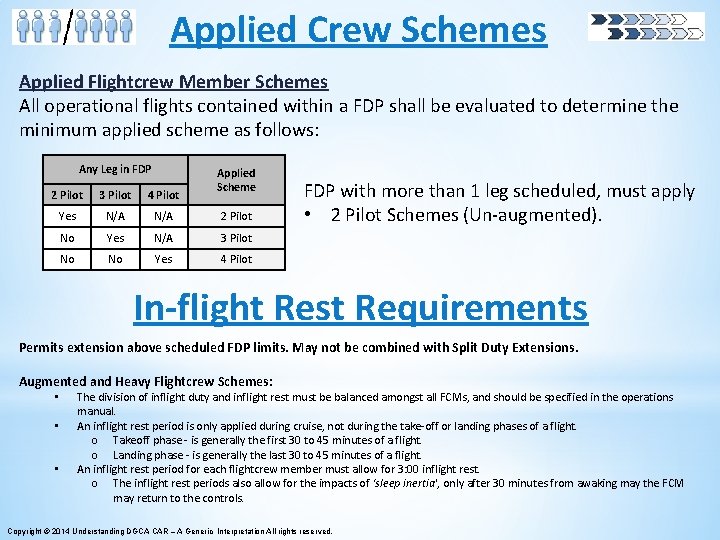
Applied Crew Schemes Applied Flightcrew Member Schemes All operational flights contained within a FDP shall be evaluated to determine the minimum applied scheme as follows: Any Leg in FDP Applied Scheme 2 Pilot 3 Pilot 4 Pilot Yes N/A 2 Pilot No Yes N/A 3 Pilot No No Yes 4 Pilot FDP with more than 1 leg scheduled, must apply • 2 Pilot Schemes (Un-augmented). In-flight Rest Requirements Permits extension above scheduled FDP limits. May not be combined with Split Duty Extensions. Augmented and Heavy Flightcrew Schemes: • • • The division of inflight duty and inflight rest must be balanced amongst all FCMs, and should be specified in the operations manual. An inflight rest period is only applied during cruise, not during the take-off or landing phases of a flight. o Takeoff phase - is generally the first 30 to 45 minutes of a flight. o Landing phase - is generally the last 30 to 45 minutes of a flight. An inflight rest period for each flightcrew member must allow for 3: 00 inflight rest. o The inflight rest periods also allow for the impacts of 'sleep inertia', only after 30 minutes from awaking may the FCM may return to the controls. Copyright © 2014 Understanding DGCA CAR – A Generic Interpretation All rights reserved.
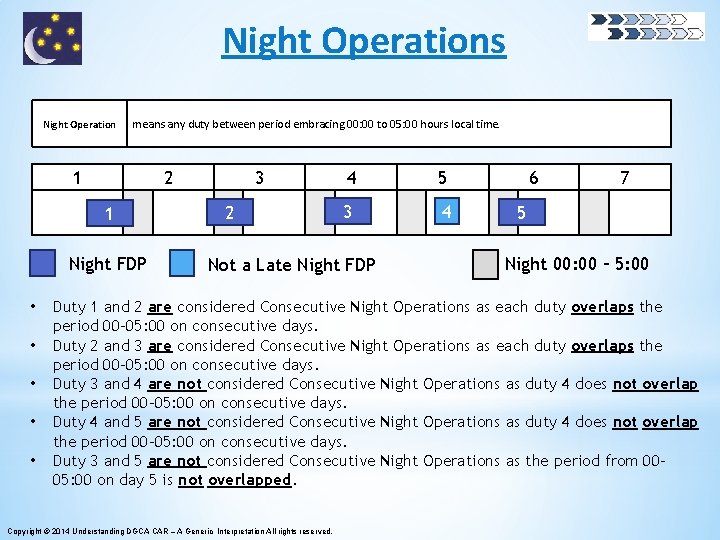
Night Operations Night Operation means any duty between period embracing 00: 00 to 05: 00 hours local time. 1 1 Night FDP • • • 3 2 2 4 5 3 4 Not a Late Night FDP 6 7 5 Night 00: 00 – 5: 00 Duty 1 and 2 are considered Consecutive Night Operations as each duty overlaps the period 00 -05: 00 on consecutive days. Duty 2 and 3 are considered Consecutive Night Operations as each duty overlaps the period 00 -05: 00 on consecutive days. Duty 3 and 4 are not considered Consecutive Night Operations as duty 4 does not overlap the period 00 -05: 00 on consecutive days. Duty 4 and 5 are not considered Consecutive Night Operations as duty 4 does not overlap the period 00 -05: 00 on consecutive days. Duty 3 and 5 are not considered Consecutive Night Operations as the period from 0005: 00 on day 5 is not overlapped. Copyright © 2014 Understanding DGCA CAR – A Generic Interpretation All rights reserved.
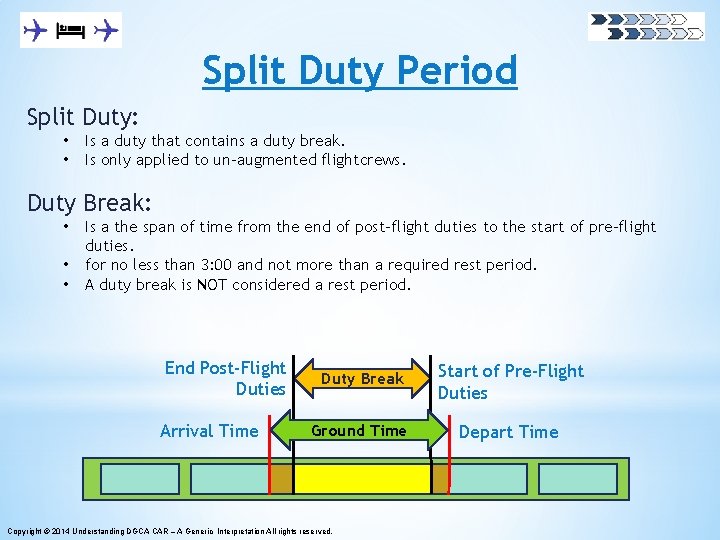
Split Duty Period Split Duty: • • Is a duty that contains a duty break. Is only applied to un-augmented flightcrews. Duty Break: • • • Is a the span of time from the end of post-flight duties to the start of pre-flight duties. for no less than 3: 00 and not more than a required rest period. A duty break is NOT considered a rest period. End Post-Flight Duties Arrival Time Duty Break Start of Pre-Flight Duties Ground Time Depart Time Copyright © 2014 Understanding DGCA CAR – A Generic Interpretation All rights reserved.
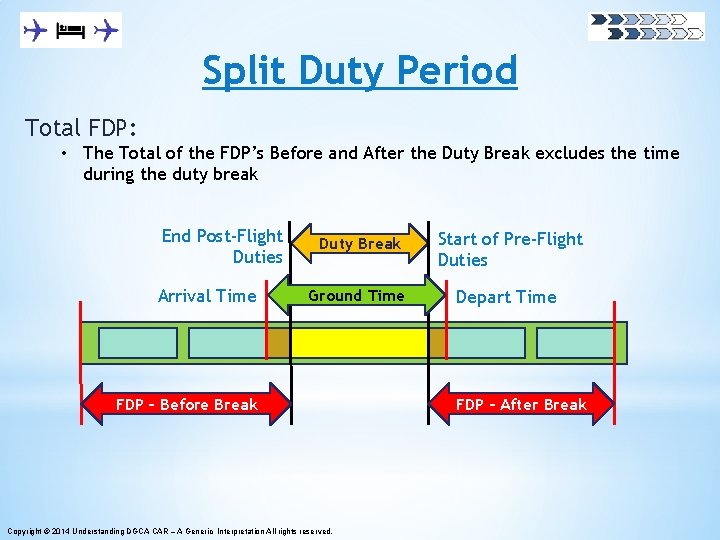
Split Duty Period Total FDP: • The Total of the FDP’s Before and After the Duty Break excludes the time during the duty break End Post-Flight Duties Arrival Time Duty Break Start of Pre-Flight Duties Ground Time Depart Time FDP – Before Break Copyright © 2014 Understanding DGCA CAR – A Generic Interpretation All rights reserved. FDP – After Break
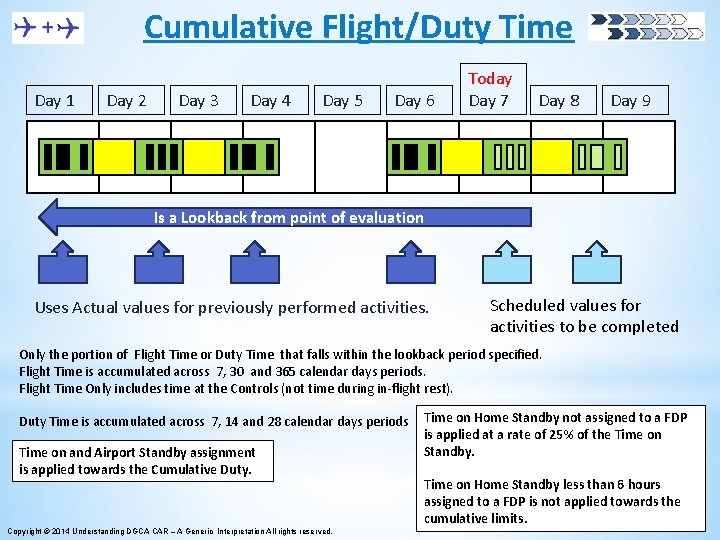
Cumulative Flight/Duty Time Day 1 Day 2 Day 3 Day 4 Day 5 Day 6 Today Day 7 Day 8 Day 9 Is a Lookback from point of evaluation Uses Actual values for previously performed activities. Scheduled values for activities to be completed Only the portion of Flight Time or Duty Time that falls within the lookback period specified. Flight Time is accumulated across 7, 30 and 365 calendar days periods. Flight Time Only includes time at the Controls (not time during in-flight rest). Duty Time is accumulated across 7, 14 and 28 calendar days periods Time on and Airport Standby assignment is applied towards the Cumulative Duty. Copyright © 2014 Understanding DGCA CAR – A Generic Interpretation All rights reserved. Time on Home Standby not assigned to a FDP is applied at a rate of 25% of the Time on Standby. Time on Home Standby less than 6 hours assigned to a FDP is not applied towards the cumulative limits.
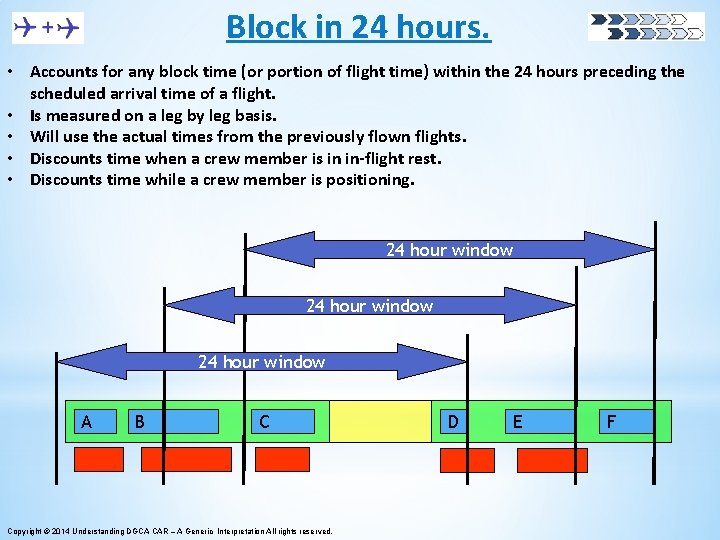
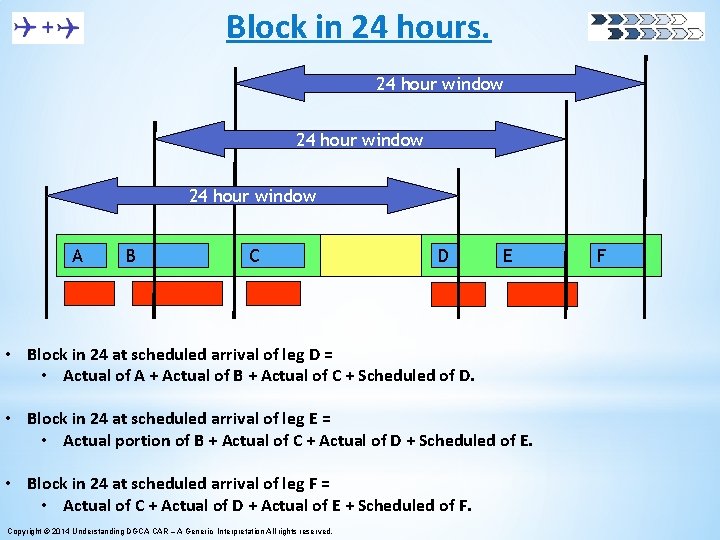
Block in 24 hours. • Accounts for any block time (or portion of flight time) within the 24 hours preceding the scheduled arrival time of a flight. • Is measured on a leg by leg basis. • Will use the actual times from the previously flown flights. • Discounts time when a crew member is in in-flight rest. • Discounts time while a crew member is positioning. 24 hour window A B C Copyright © 2014 Understanding DGCA CAR – A Generic Interpretation All rights reserved. D E F
Block in 24 hours. 24 hour window A B C D E • Block in 24 at scheduled arrival of leg D = • Actual of A + Actual of B + Actual of C + Scheduled of D. • Block in 24 at scheduled arrival of leg E = • Actual portion of B + Actual of C + Actual of D + Scheduled of E. • Block in 24 at scheduled arrival of leg F = • Actual of C + Actual of D + Actual of E + Scheduled of F. Copyright © 2014 Understanding DGCA CAR – A Generic Interpretation All rights reserved. F
Understanding DGCA CAR A Generic Interpretation Flight Duty Time Limitations. (Flight Crew Members) Version 1. 0 Copyright © 2014 Understanding DGCA CAR – A Generic Interpretation All rights reserved.