
Understanding Depression What causes Depression n Family History
- Slides: 31
Understanding Depression
What causes Depression? n Family History n Having a family members who has depression may increase a person’s risk n Imbalances of certain chemicals in the brain may lead to depression
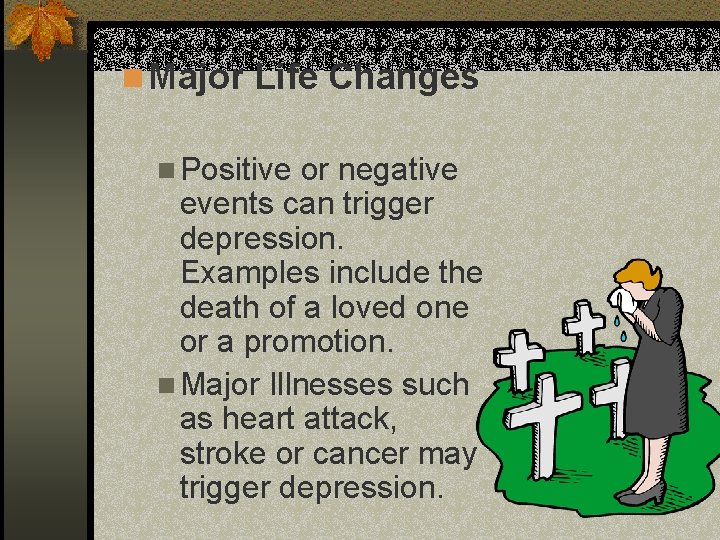
n Major Life Changes n Positive or negative events can trigger depression. Examples include the death of a loved one or a promotion. n Major Illnesses such as heart attack, stroke or cancer may trigger depression.
Postpartum Depression n 15% of women report depression within three months of delivery n Women with a prior history of depression are at greater risk n Postpartum “blues” or “baby blues” is normal n mild feeling of being down, tearful n lasts for only a day or so
n Certain medications used alone or in combination cause side effects much like the symptoms of depression. n Use of Alcohol or other Drugs can lead to or worsen depression. n Depression can also occur for no apparent reason!
Causes of Depression n Depression can be caused by one or more of the following: n Imbalance of certain chemicals in the brain n Triggered by stress, medication or other medical problems n Certain personality factors or genetic traits
Who suffers from Depression n Depression can effect anyone but there is a significantly higher rate of depression among women than men. n 17 million Americans develop depression each year. n 8. 6% of adults over 18 have a mental health problem for at least 2 weeks a year.
What is Depression? n Depression is an illness that involves the body, mood and thoughts n It impacts the way a person functions socially, at work, and in relationships. n It is more than feeling blue, down in the dumps or sad about a particular issue or situation. n It is a medical condition that requires diagnosis and treatment
What Depression IS n TREATABLE n No matter what the cause of a persons depression, there is treatment and it is widely available!!
What Depression is NOT: n It is not something to be ashamed of. n It is NOT a character flaw or sign of weakness. n No one with depression can just “Snap Out of It”. n You can’t “Pull yourself up by your bootstraps”.
Symptoms of Depression n Vary from person to person n 2 key signs are loss of interest in things you like to do and sadness or irritability
Additional Signs include: n Changes in feelings which may include: n Feeling empty n Inability to enjoy anything n Hopelessness n Loss of sexual desire n Loss of warm feelings for family or friends n Feelings of self blame or guilt n Loss of self esteem n Inexplicable crying spells, sadness or irritability
Changes in behavior and attitude n These may include: n General slowing down n Neglect of responsibilities and appearance n Poor memory n Inability to concentrate n Suicidal thoughts, feelings or behaviors n Difficulty making decisions
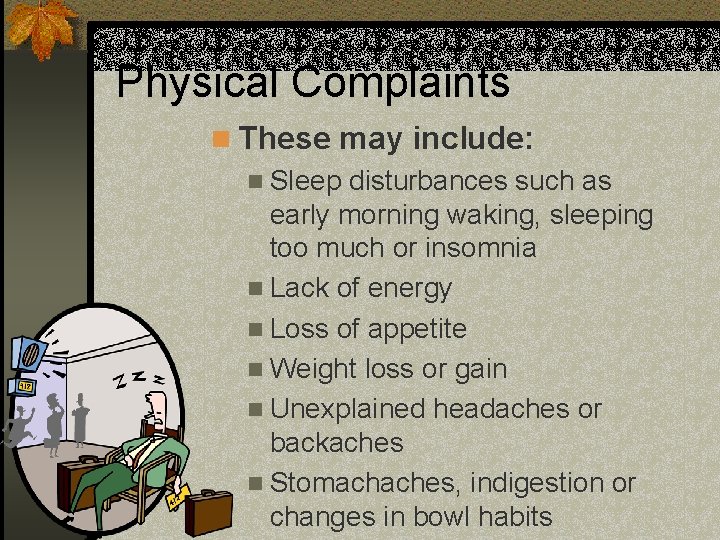
Physical Complaints n These may include: n Sleep disturbances such as early morning waking, sleeping too much or insomnia n Lack of energy n Loss of appetite n Weight loss or gain n Unexplained headaches or backaches n Stomachaches, indigestion or changes in bowl habits
Common Types of Depression n Major Depression n Dysthymia n Bipolar Disorder n Seasonal Affective Disorder (SAD)
Major Depression n This type causes symptoms that may: n Begin suddenly, possibly triggered by a loss, crisis or change n Interfere with normal functioning n Continue for months or years n It is possible for a person to have only one episode of major depression. It is more common for episodes to be long lasting or to occur several times during a person’s life
Dysthymia n People with this illness are mildly depressed for years. They function fairly well on a daily basis but their relationships suffer over time.
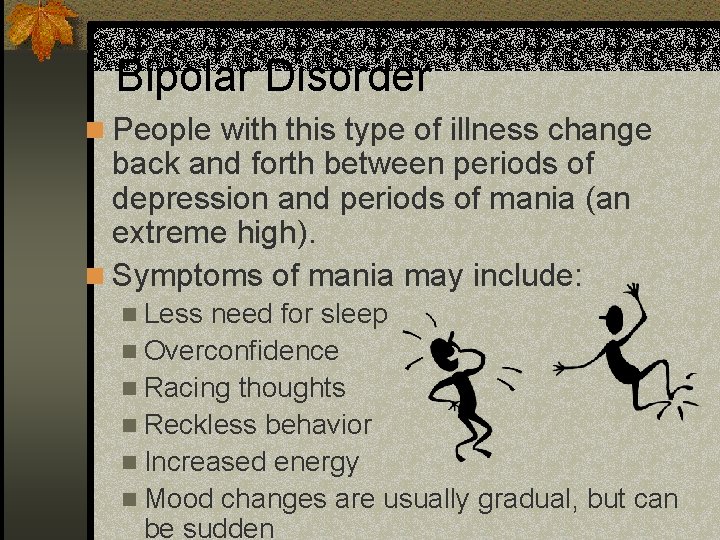
Bipolar Disorder n People with this type of illness change back and forth between periods of depression and periods of mania (an extreme high). n Symptoms of mania may include: n Less need for sleep n Overconfidence n Racing thoughts n Reckless behavior n Increased energy n Mood changes are usually gradual, but can be sudden
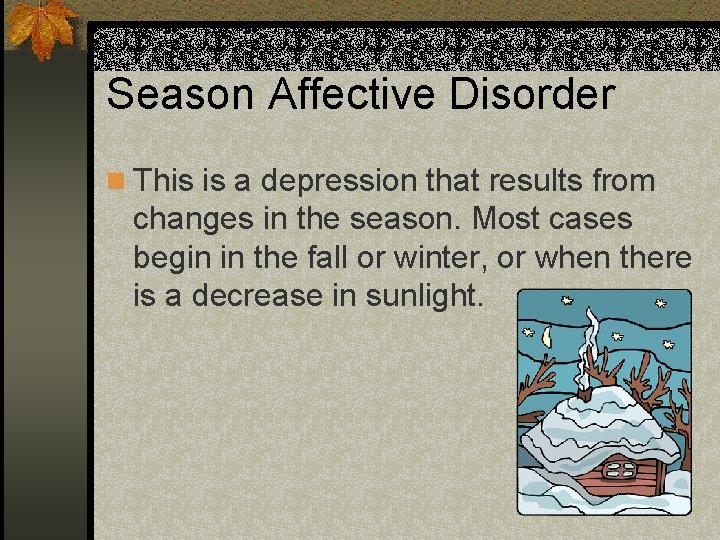
Season Affective Disorder n This is a depression that results from changes in the season. Most cases begin in the fall or winter, or when there is a decrease in sunlight.
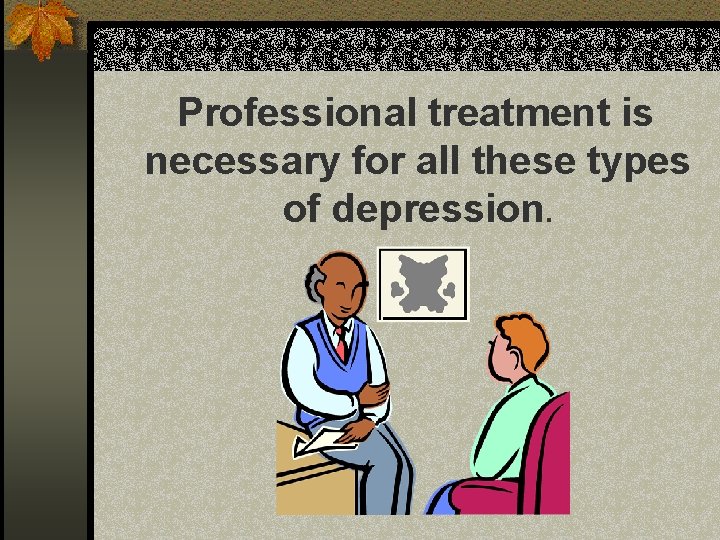
Professional treatment is necessary for all these types of depression.
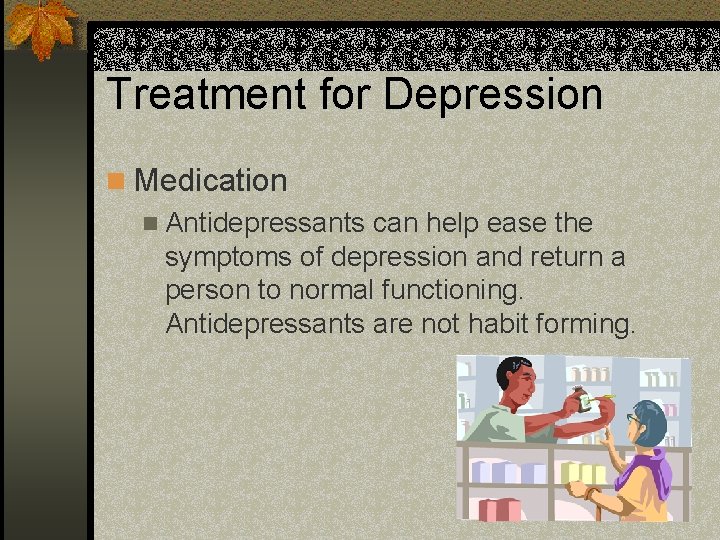
Treatment for Depression n Medication n Antidepressants can help ease the symptoms of depression and return a person to normal functioning. Antidepressants are not habit forming.
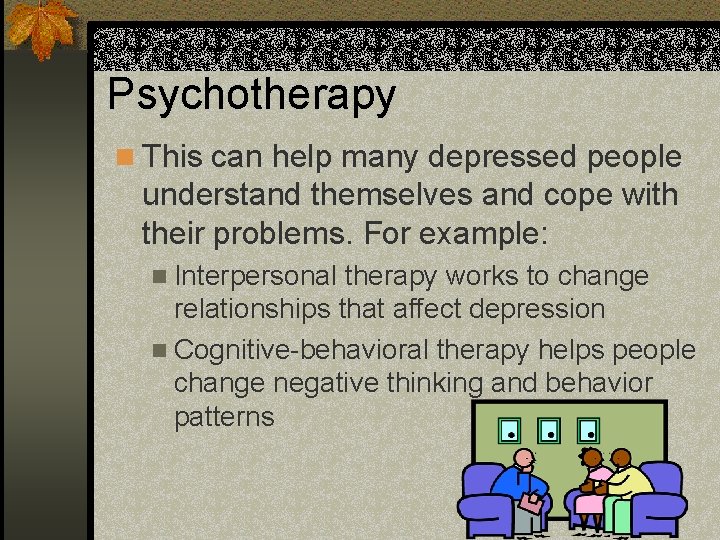
Psychotherapy n This can help many depressed people understand themselves and cope with their problems. For example: n Interpersonal therapy works to change relationships that affect depression n Cognitive-behavioral therapy helps people change negative thinking and behavior patterns
If you or someone you know has symptoms of depression… Take Action!
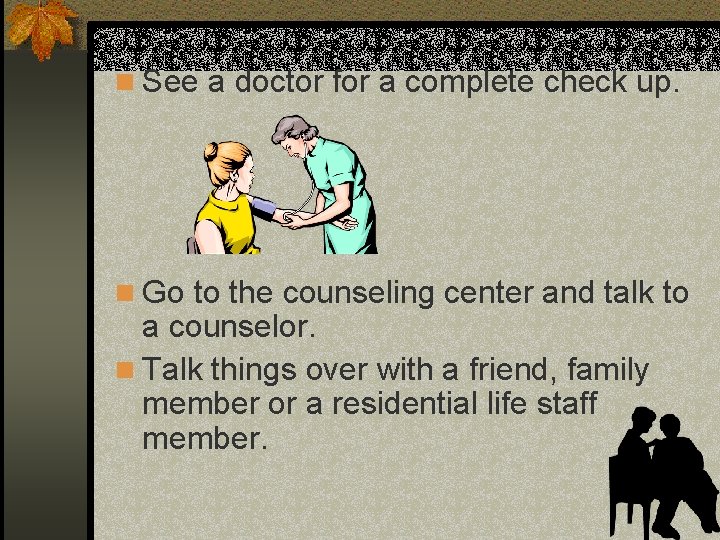
n See a doctor for a complete check up. n Go to the counseling center and talk to a counselor. n Talk things over with a friend, family member or a residential life staff member.
n Don’t expect too much of yourself n Take a break n Get some exercise n Avoid extra stress and big changes
Things to do n Reduce or eliminate the use of alcohol or drugs n Exercise or engage in some form of physical activity n Eat a proper, well-balanced diet
n Obtain an adequate amount of sleep n Seek emotional support from family and friends n Focus on positive aspects of your life n Pace yourself, modify your schedule, and set realistic goals
Things to Avoid n Don’t make long-term commitments or n n important decisions unless necessary Don’t assume things are hopeless Don’t engage in “emotional reasoning” (i. e. : because I feel awful, my life is terrible) Don’t assume responsibility for events which are outside of your control Don’t avoid treatment as a way of coping
Intervening with a depressed friend n Be empathetic and understanding n Don’t try to “cheer up” a depressed person n Avoid critical or shaming statements n Challenge expressions of hopelessness n Empathize with feelings of sadness, grief, anger and frustration
Helping a depressed friend… n Don’t argue about how bad things are n Don’t insist that depression or sadness are the wrong feelings to be experiencing n Don’t become angry even though your efforts may be resisted or rejected
Helping a depressed friend… n Advocate for their recovery from depression n Emphasize that depression is treatable n Seek consultation n Encourage them to seek help, go with them to the counseling center n Be supportive of counselor or doctor suggestions