
Understanding Databases Lesson 6 Objective Domain Matrix SkillsConcepts
Understanding Databases Lesson 6
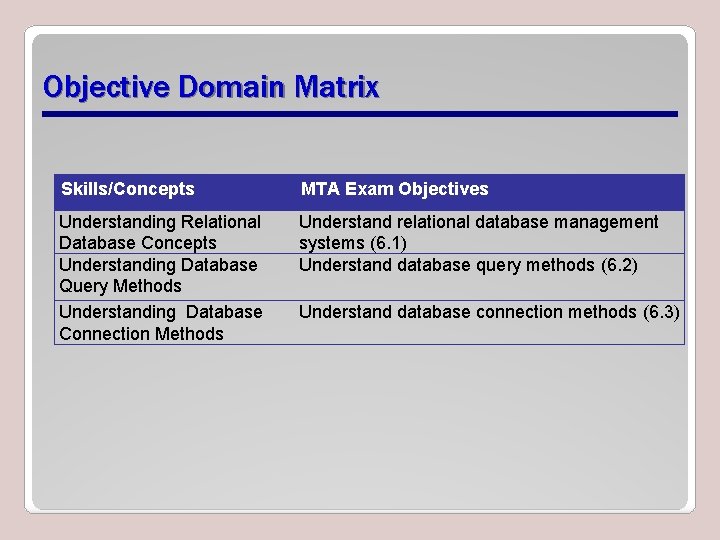
Objective Domain Matrix Skills/Concepts MTA Exam Objectives Understanding Relational Database Concepts Understanding Database Query Methods Understanding Database Connection Methods Understand relational database management systems (6. 1) Understand database query methods (6. 2) Understand database connection methods (6. 3)
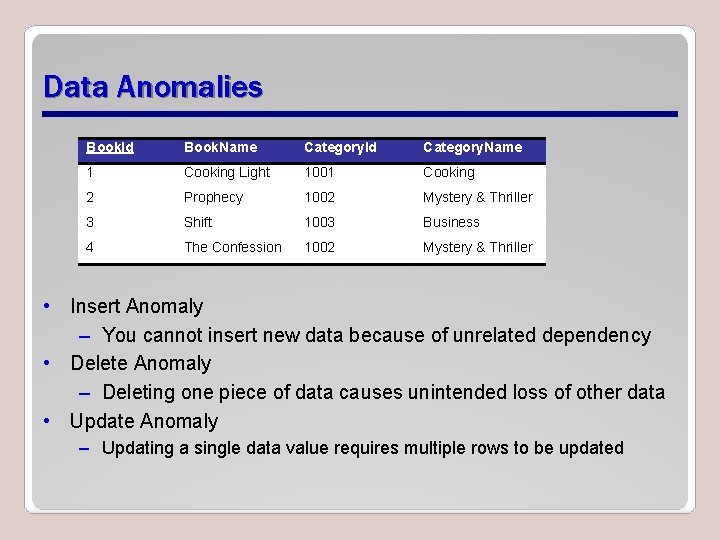
Data Anomalies Book. Id Book. Name Category. Id Category. Name 1 Cooking Light 1001 Cooking 2 Prophecy 1002 Mystery & Thriller 3 Shift 1003 Business 4 The Confession 1002 Mystery & Thriller • Insert Anomaly – You cannot insert new data because of unrelated dependency • Delete Anomaly – Deleting one piece of data causes unintended loss of other data • Update Anomaly – Updating a single data value requires multiple rows to be updated
Data Normalization • The process of data normalization ensures that a database design is free of any problems that could lead to loss of data integrity. • This lesson discusses three normal forms – First Normal Form – Second Normal Form – Third Normal Form
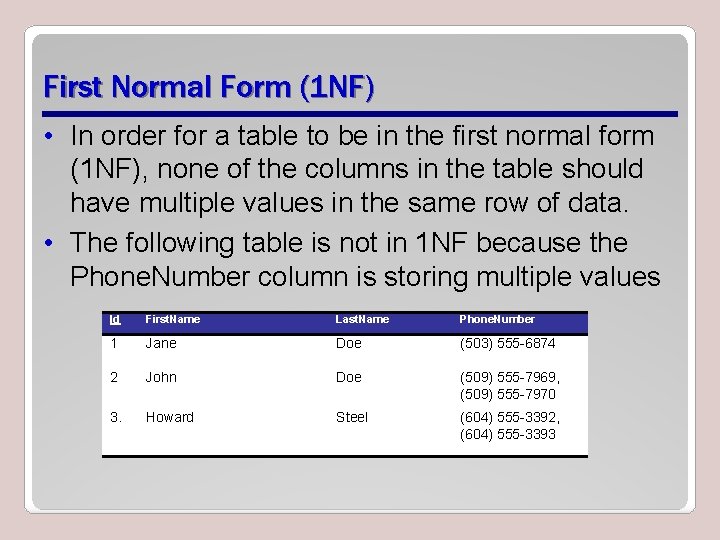
First Normal Form (1 NF) • In order for a table to be in the first normal form (1 NF), none of the columns in the table should have multiple values in the same row of data. • The following table is not in 1 NF because the Phone. Number column is storing multiple values Id First. Name Last. Name Phone. Number 1 Jane Doe (503) 555 -6874 2 John Doe (509) 555 -7969, (509) 555 -7970 3. Howard Steel (604) 555 -3392, (604) 555 -3393
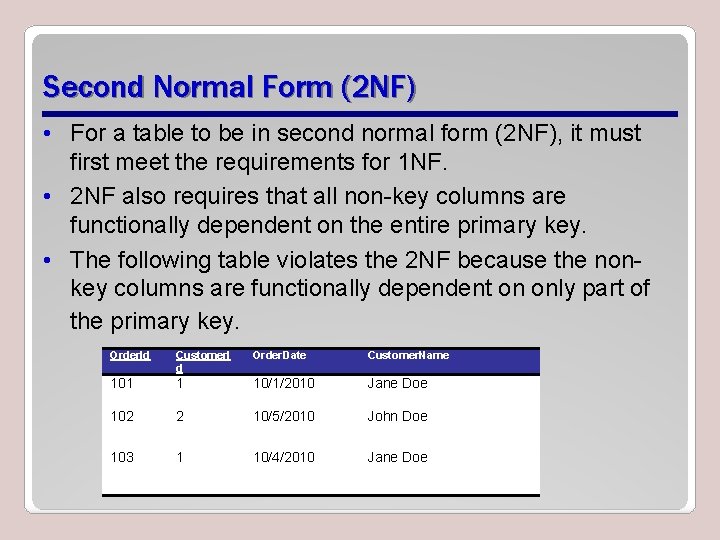
Second Normal Form (2 NF) • For a table to be in second normal form (2 NF), it must first meet the requirements for 1 NF. • 2 NF also requires that all non-key columns are functionally dependent on the entire primary key. • The following table violates the 2 NF because the nonkey columns are functionally dependent on only part of the primary key. Order. Id Customer. I d Order. Date Customer. Name 101 1 10/1/2010 Jane Doe 102 2 10/5/2010 John Doe 103 1 10/4/2010 Jane Doe
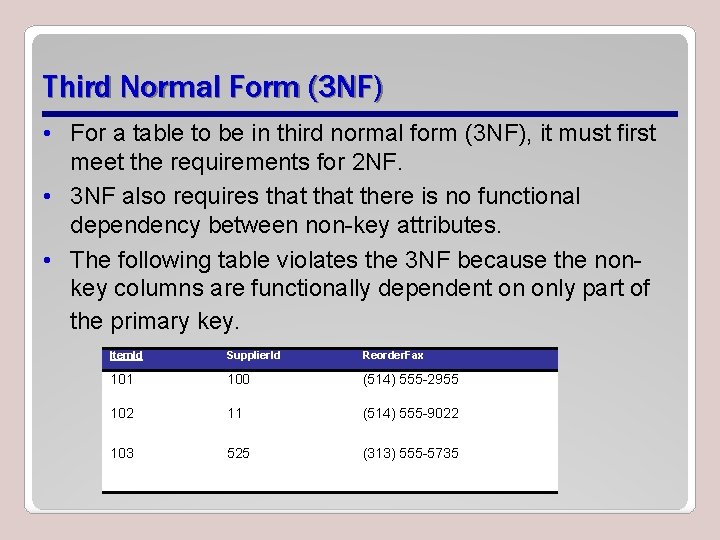
Third Normal Form (3 NF) • For a table to be in third normal form (3 NF), it must first meet the requirements for 2 NF. • 3 NF also requires that there is no functional dependency between non-key attributes. • The following table violates the 3 NF because the nonkey columns are functionally dependent on only part of the primary key. Item. Id Supplier. Id Reorder. Fax 101 100 (514) 555 -2955 102 11 (514) 555 -9022 103 525 (313) 555 -5735
Structured Query Language (SQL) • SQL is the language used by most database systems to manage the information in their databases. • SQL is declarative in nature -- you tell the database what needs to done, and it’s the database’s job to figure out how to do it. • There are two main ways to submit T-SQL to SQL Server: – Ad-hoc SQL statements – Stored procedures
SQL Queries • SELECT, INSERT, UPDATE, and DELETE statements are the four main types of SQL statements used to manipulate SQL Server data: – SELECT statement: retrieves data – INSERT statement: adds new data – UPDATE statement: modifies data – DELETE statement: deletes data
Running SQL Queries • There are many way to communicate with SQL Server in order to run database queries: – Visual Studio Integrated Development Environment – C# application – SQL Query Analyzer – osql command prompt utility
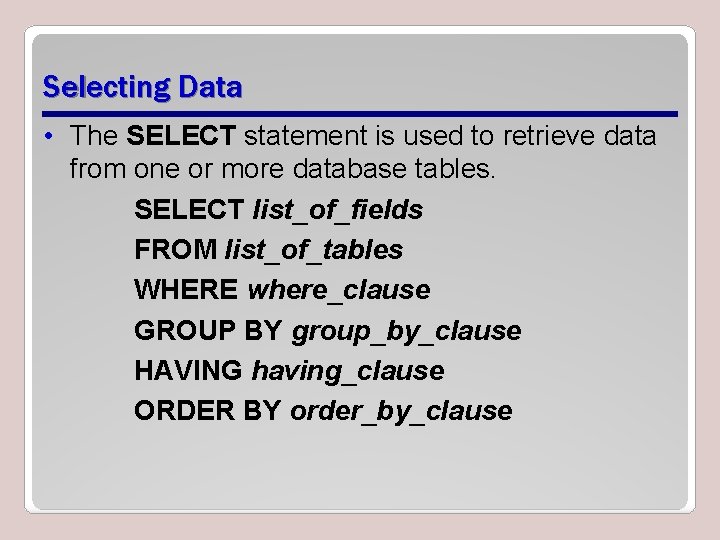
Selecting Data • The SELECT statement is used to retrieve data from one or more database tables. SELECT list_of_fields FROM list_of_tables WHERE where_clause GROUP BY group_by_clause HAVING having_clause ORDER BY order_by_clause
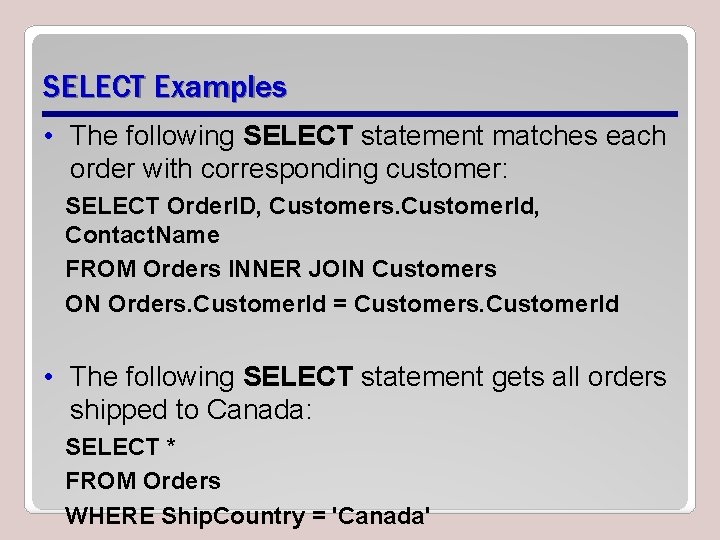
SELECT Examples • The following SELECT statement matches each order with corresponding customer: SELECT Order. ID, Customers. Customer. Id, Contact. Name FROM Orders INNER JOIN Customers ON Orders. Customer. Id = Customers. Customer. Id • The following SELECT statement gets all orders shipped to Canada: SELECT * FROM Orders WHERE Ship. Country = 'Canada'
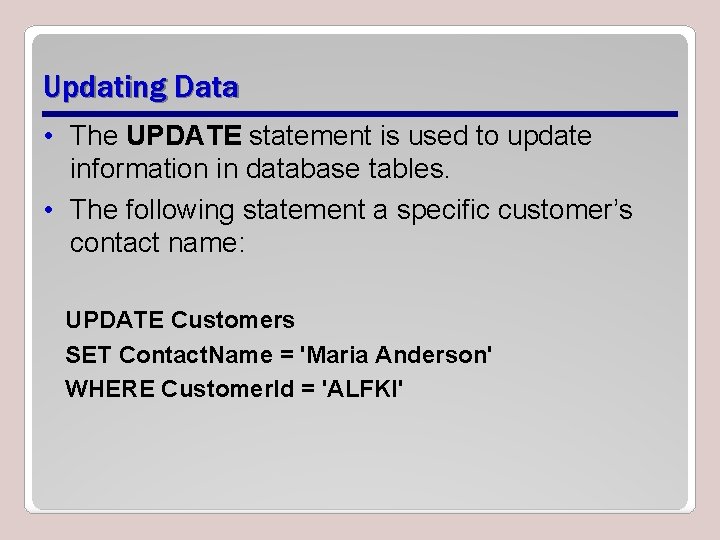
Updating Data • The UPDATE statement is used to update information in database tables. • The following statement a specific customer’s contact name: UPDATE Customers SET Contact. Name = 'Maria Anderson' WHERE Customer. Id = 'ALFKI'
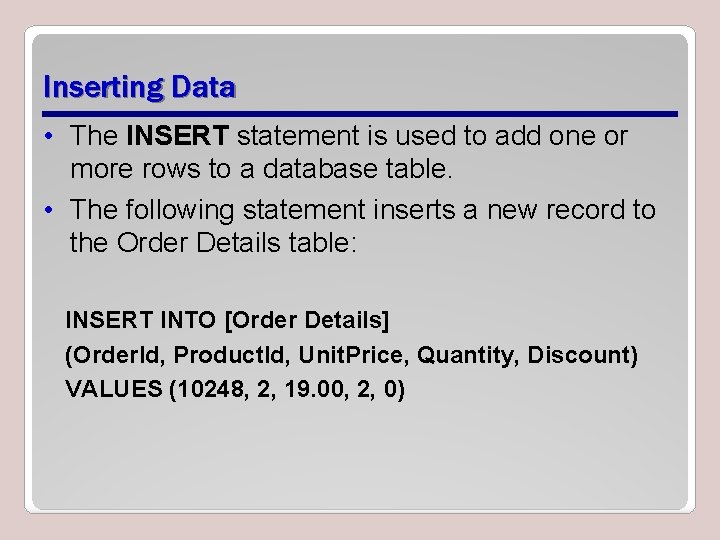
Inserting Data • The INSERT statement is used to add one or more rows to a database table. • The following statement inserts a new record to the Order Details table: INSERT INTO [Order Details] (Order. Id, Product. Id, Unit. Price, Quantity, Discount) VALUES (10248, 2, 19. 00, 2, 0)
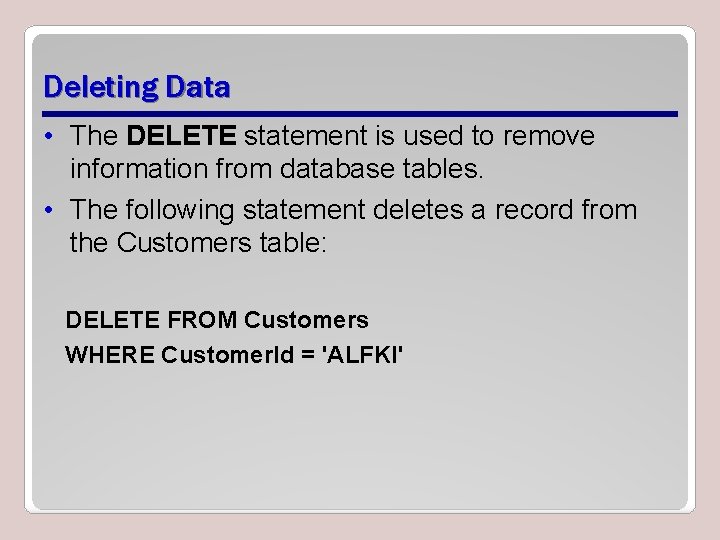
Deleting Data • The DELETE statement is used to remove information from database tables. • The following statement deletes a record from the Customers table: DELETE FROM Customers WHERE Customer. Id = 'ALFKI'
Stored Procedures • A stored procedure is a set of SQL statements that is stored in a database. • Stored procedures benefits: – You can use them to save complex SQL statements for future execution. – SQL Server compiles stored procedures so that they run faster than ad hoc queries.
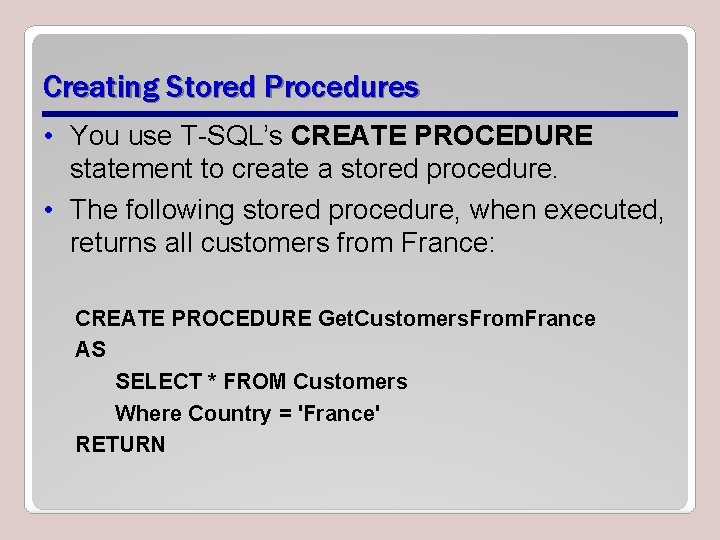
Creating Stored Procedures • You use T-SQL’s CREATE PROCEDURE statement to create a stored procedure. • The following stored procedure, when executed, returns all customers from France: CREATE PROCEDURE Get. Customers. From. France AS SELECT * FROM Customers Where Country = 'France' RETURN
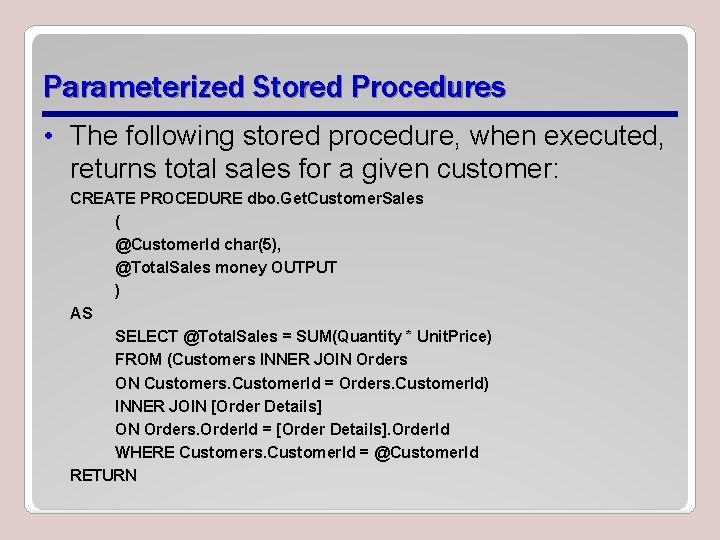
Parameterized Stored Procedures • The following stored procedure, when executed, returns total sales for a given customer: CREATE PROCEDURE dbo. Get. Customer. Sales ( @Customer. Id char(5), @Total. Sales money OUTPUT ) AS SELECT @Total. Sales = SUM(Quantity * Unit. Price) FROM (Customers INNER JOIN Orders ON Customers. Customer. Id = Orders. Customer. Id) INNER JOIN [Order Details] ON Orders. Order. Id = [Order Details]. Order. Id WHERE Customers. Customer. Id = @Customer. Id RETURN
Working with Flat Files • The data in a flat file can be plain text or binary. These files are called “flat files” to distinguish them from more structured forms of storage, such as relational databases and XML files. • The Stream. Reader and Stream. Writer classes allows you to manipulate text files. • The Binary. Reader and Binary. Writer classes allows you to manipulate binary files.
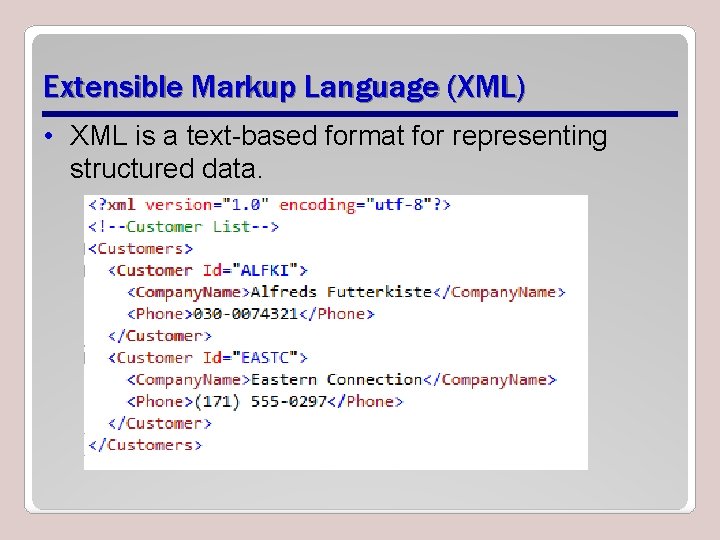
Extensible Markup Language (XML) • XML is a text-based format for representing structured data.
Working with XML • The classes that work with XML data are organized in the System. Xml namespace: – Xml. Reader and Xml. Writer: These classes provide a fast, non-cached, forward-only way to read or write XML data. – Xml. Document: This class is an in-memory representation of XML data and allows navigation and editing of the XML document.
Working with Data. Set • A Data. Set is an in-memory representation of relational data. • A Data. Set can have tables, relations, and data-integrity constraints such as unique constraints or foreign-key constraints. • The Data. Adapter acts as a bridge between the data source and the Data. Set. • The Data. Adapter stores the data connection and data commands needed to connect to the data source. The Data. Adapter also provides commands for retrieving data from the data source and commands for updating the data source with any changes.
Recap • Relational Database Design – Entity Relationship Diagram – Data Normalization • Database Query Methods – Working with SQL Queries – Working with Stored Procedures • Database Connection Methods – Working with Flat Files, XML, Data. Set
- Slides: 23