
UNDERSTANDING DATA CENTER TRAFFIC CHARACTERISTICS 1 Theophilus Benson
UNDERSTANDING DATA CENTER TRAFFIC CHARACTERISTICS 1 Theophilus Benson 1, Ashok Anand 1, Aditya Akella 1, Ming Zhang 2 University Of Wisconsin – Madison 1, Microsoft Research 2
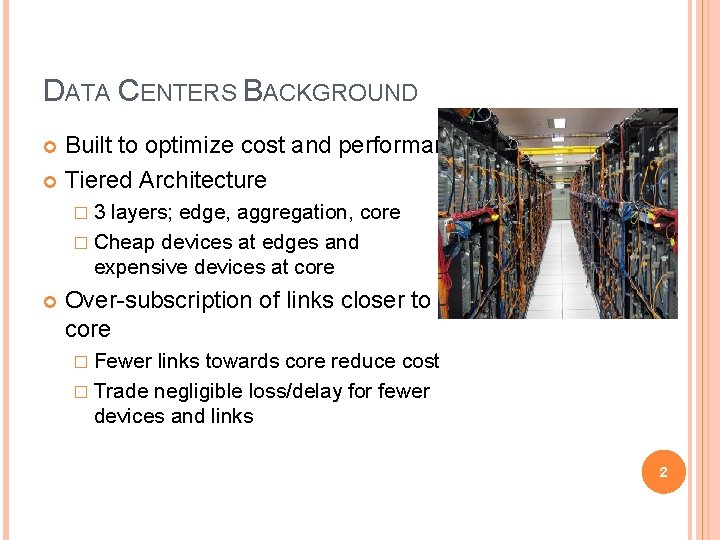
DATA CENTERS BACKGROUND Built to optimize cost and performance Tiered Architecture � 3 layers; edge, aggregation, core � Cheap devices at edges and expensive devices at core Over-subscription of links closer to the core � Fewer links towards core reduce cost � Trade negligible loss/delay for fewer devices and links 2
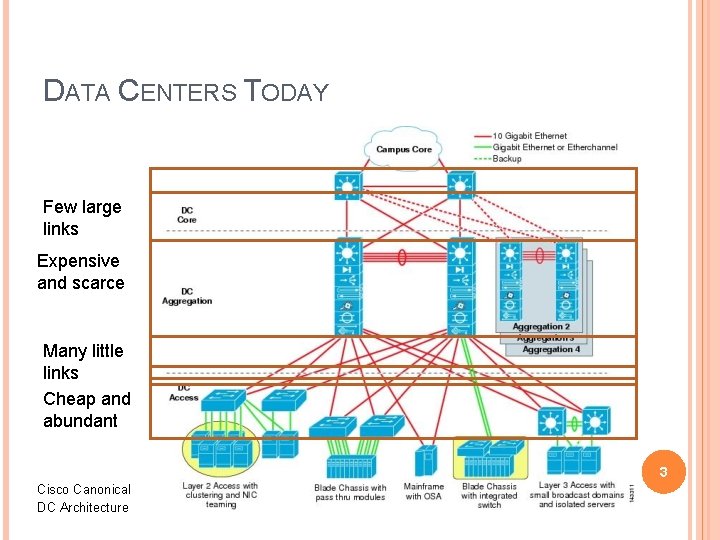
DATA CENTERS TODAY Few large links Expensive and scarce Many little links Cheap and abundant 3 Cisco Canonical DC Architecture
CHALLENGES IN DESIGNING FOR DATA CENTERS Very little is known about data centers � No models for evaluation Lack of knowledge effects evaluation � Use properties of wide area network traffic. � Make up traffic matrixes/random traffic patterns. Insufficient for the following reasons � Can’t accurately compare techniques � Oblivious to actual characteristics of data centers 4
DATA CENTER TRAFFIC CHARACTERIZATION Goals of our project � Understand low level characteristics of traffic in data centers What is the arrival process? Is it similar or distinct from wide area networks? � How does low level traffic impact the data center? 5
DATA CENTER TRAFFIC CHARACTERIZATION In studying data center traffic we found that: � Few links experience loss � Many links are unutilized � Traffic adheres to ON-OFF � Arrival process is log normal 6
OUTLINE Background Goals Data set Observations and insights Overview of traffic generator (see paper for details) Conclusion 7
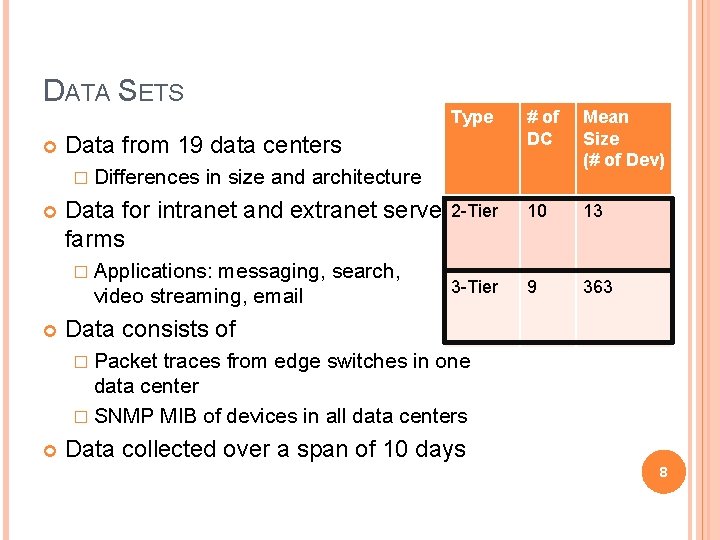
DATA SETS Data from 19 data centers � Differences Type Mean Size (# of Dev) 10 13 9 363 in size and architecture Data for intranet and extranet server 2 -Tier farms � Applications: messaging, search, video streaming, email # of DC 3 -Tier Data consists of � Packet traces from edge switches in one data center � SNMP MIB of devices in all data centers Data collected over a span of 10 days 8
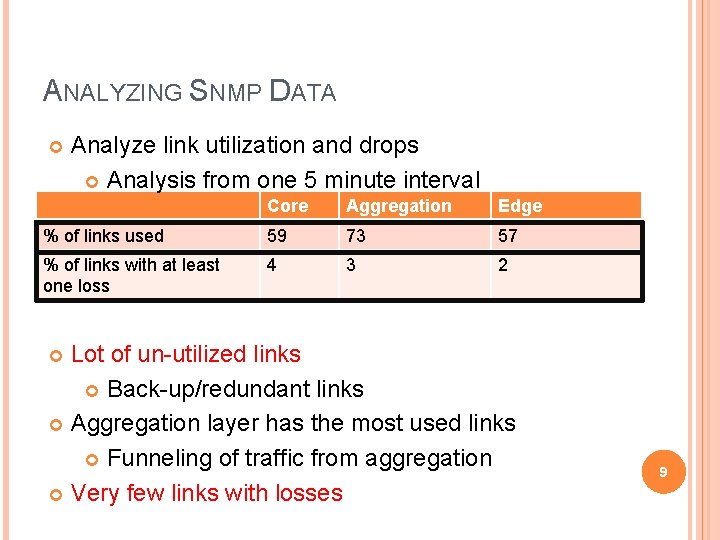
ANALYZING SNMP DATA Analyze link utilization and drops Analysis from one 5 minute interval Core Aggregation Edge % of links used 59 73 57 % of links with at least one loss 4 3 2 Lot of un-utilized links Back-up/redundant links Aggregation layer has the most used links Funneling of traffic from aggregation Very few links with losses 9
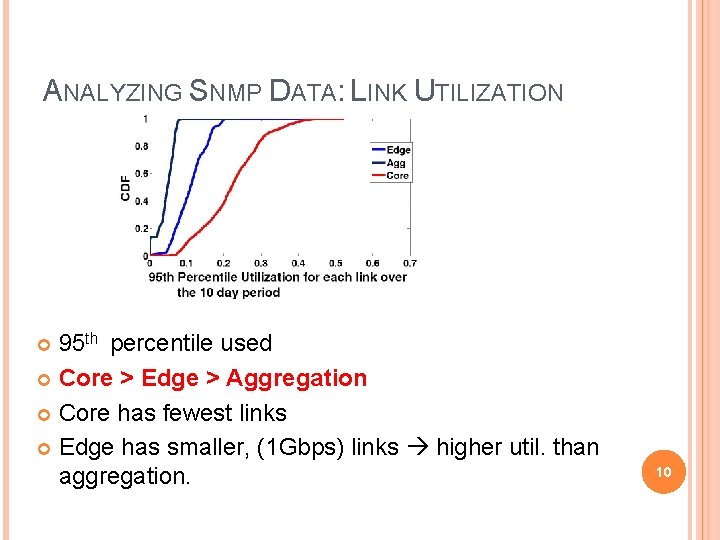
ANALYZING SNMP DATA: LINK UTILIZATION 95 th percentile used Core > Edge > Aggregation Core has fewest links Edge has smaller, (1 Gbps) links higher util. than aggregation. 10
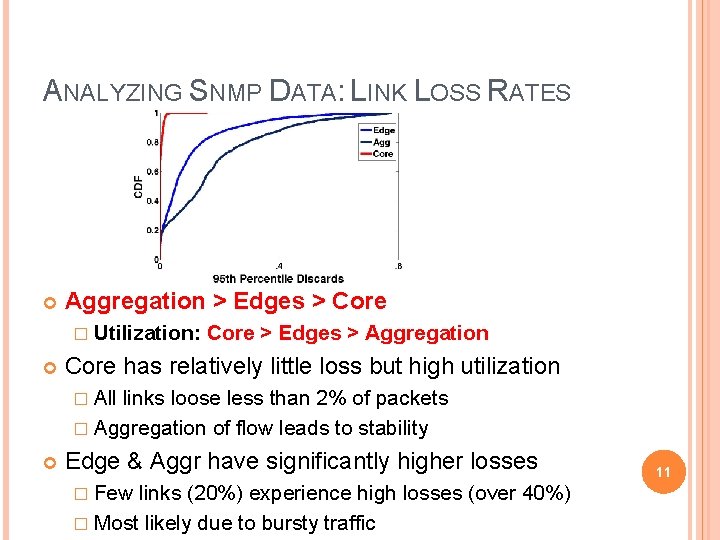
ANALYZING SNMP DATA: LINK LOSS RATES Aggregation > Edges > Core � Utilization: Core > Edges > Aggregation Core has relatively little loss but high utilization � All links loose less than 2% of packets � Aggregation of flow leads to stability Edge & Aggr have significantly higher losses � Few links (20%) experience high losses (over 40%) � Most likely due to bursty traffic 11
INSIGHTS FROM SNMP Loss is localized to a few links (4%) Loss may be avoided by utilizing all links � 40% of links are unused in some areas � Reroute traffic � Move applications/migrate virtual machine Inverse correlation between loss and utilization � Should examine low level packet traces � Traces from same 10 days as SNMP 12
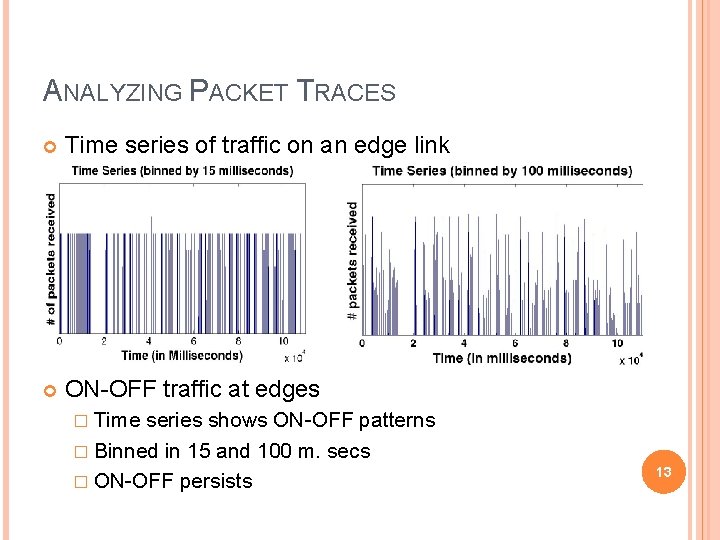
ANALYZING PACKET TRACES Time series of traffic on an edge link ON-OFF traffic at edges � Time series shows ON-OFF patterns � Binned in 15 and 100 m. secs � ON-OFF persists 13
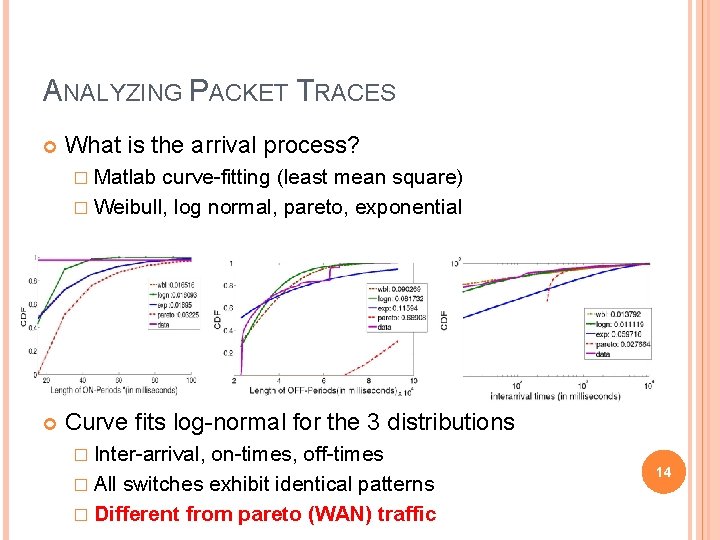
ANALYZING PACKET TRACES What is the arrival process? � Matlab curve-fitting (least mean square) � Weibull, log normal, pareto, exponential Curve fits log-normal for the 3 distributions � Inter-arrival, on-times, off-times � All switches exhibit identical patterns � Different from pareto (WAN) traffic 14
DATA CENTER TRAFFIC GENERATOR Based on our insights we created a traffic generator Goal: produce a stream of packets that exhibits an ON-OFF arrival pattern Input: distribution of traffic volumes and loss rates from SNMP pulls for a link Output: the parameters for a fine grained arrival process that will produce the input distribution 15
DATA CENTER TRAFFIC GENERATOR Approach � Search the space of available parameters Simulate each set of parameters Accept parameters that pass a similarity test with high confidence Wilcoxon used for the similarity test 16
SHARING INSIGHTS Implications for research and operations � Evaluate designs with traffic generator Implications for Fat-tree � Fat-tree: congestion eliminated through no overprovision and traffic balancing � Parameterization: traffic engineering, flow classification, assumes stableness on the order of ‘T’ seconds � Our work can inform the setting of ‘T’ 17
CONCLUSION Analyzed traffic from 19 data centers � Bottle neck aggregation layer � Characterized arrival process at edge links Described a traffic generator for data centers � Utilized for evaluation of data center designs Future work � Analyze packet trace stableness of traffic matrix ratio of inter/intra-dc communication 18
QUESTIONS? 19
- Slides: 19