
Understanding Culture Preview n n Introduction to theoretical



- Slides: 35
Understanding Culture
Preview n n Introduction to theoretical concepts of Culture Introduction to IC
Objective/Rationale n n n Understand the principles and characteristics of culture Gain a greater understanding of how culture impacts on what we do Introduce the concept of IC
Case study: Daimler-Chrysler merger
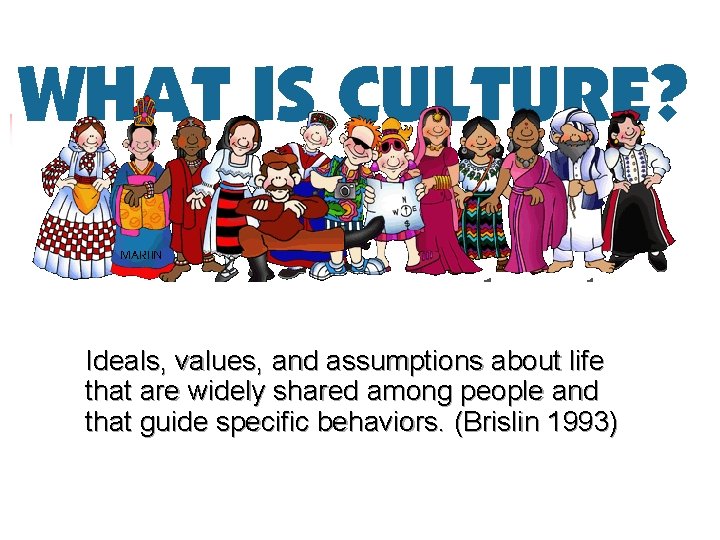
Ideals, values, and assumptions about life that are widely shared among people and that guide specific behaviors. (Brislin 1993)
Definitions of Culture 1. 2. 3. 4. The sum total of all the beliefs, values and norms shared by a group of people The way you have been conditioned in a society to think, feel, interpret and react The collective programming of the human mind All you need to know and believe in order to be accepted in society
Culture? n "Collective Programming" n n Some visible characteristics: n n Customs, behavior Some less visible ones: n 8 Starts from birth, is reinforced in school & by education Relates to values & core beliefs Displayed in attitudes & behavior Values, beliefs
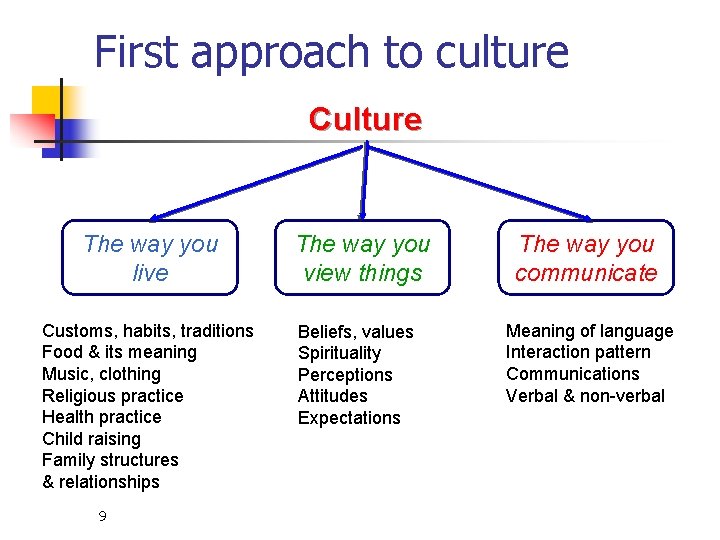
First approach to culture Culture The way you live Customs, habits, traditions Food & its meaning Music, clothing Religious practice Health practice Child raising Family structures & relationships 9 The way you view things Beliefs, values Spirituality Perceptions Attitudes Expectations The way you communicate Meaning of language Interaction pattern Communications Verbal & non-verbal
Nature of culture Learned Culture is acquired by learning and experience Shared People as a member of a group, organization, or society share culture Transgenerational Culture is cumulative, passed down from generation to generation 10
Culture is basically… the way of life of a people passed down from one generation to the next through learning
Culture is a key issue Culture a set of values and assumptions shared by any group of people Hall’s analogy Culture is to people what water is to fish
Humu’humu’nuku’a’pu’a’a Water to the fish
2 concepts to remember… n Enculturation: learning a primary culture n Acculturation: learning a secondary culture
Emic & Etic Approaches Emic: cultural specific - only in one culture Etic: cultural general – in many cultures (from psycholinguistics)
Emic vs Etic n The emic approach investigates how local people think" (Kottak, 2006): How they perceive and categorize the world, their rules for behavior, what has meaning for them, and how they imagine and explain things.
n "The etic (scientist-oriented) approach shifts the focus from local observations, categories, explanations, and interpretations to those of the anthropologist. The etic approach realizes that members of a culture often are too involved in what they are doing to interpret their cultures impartially. When using the etic approach, the ethnographer emphasizes what he or she considers important
Culture = Communication n Culture is communication and communication is culture (Hall, 1959, in Hall, 1990: 186)
a) ‘culture is communication’ n Amongst other things, Hall is suggesting that there are no aspects of a person’s behaviors, values, and ways of thinking which do not communicate sth about his/her cultural background(s), cultural identity(ies), and cultural-informed and influenced preferences and
‘culture is communication’ (cont’) n expectations –to other people with whom s/he comes into contact in some way. Whenever sb enacts an aspect of their cultural background and identity, and others respond to this enactment, regardless of what their behavior involved, the individual is communicating sth about their cultural “baggage” to others.
b) ‘communication is culture’ n Similarly, because all of us have been socialized within a particular part or set of parts in a particular society at a particular time in its history, we have developed culturally-informed and influenced preferences and expectations. These include preferences and expectations about how to communicate.
‘communication is culture’ (cont) n Thus, Hall is noting that there is no aspect of an individual’s communicational performance which does not act as vehicle for their culturally-informed and influenced preferences and expectations about communication. (Fay, 2008)
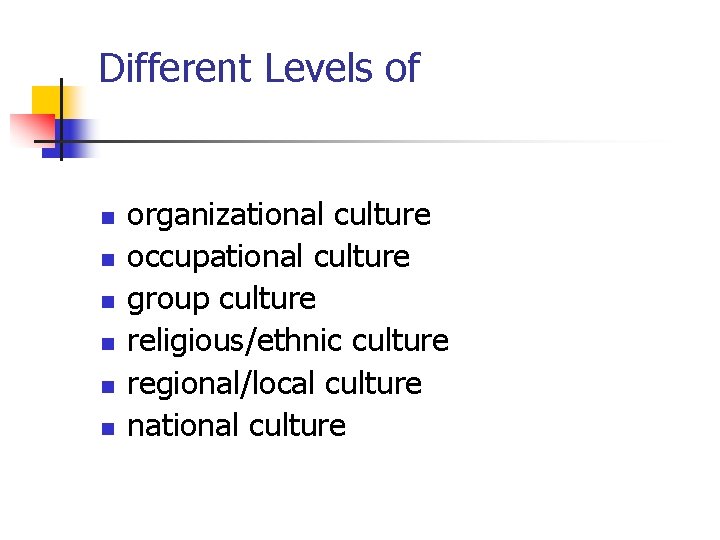
Different Levels of n n n organizational culture occupational culture group culture religious/ethnic culture regional/local culture national culture
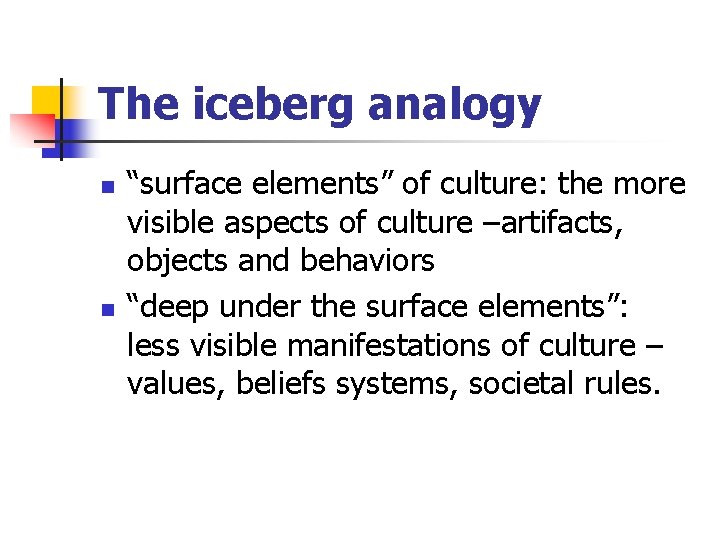
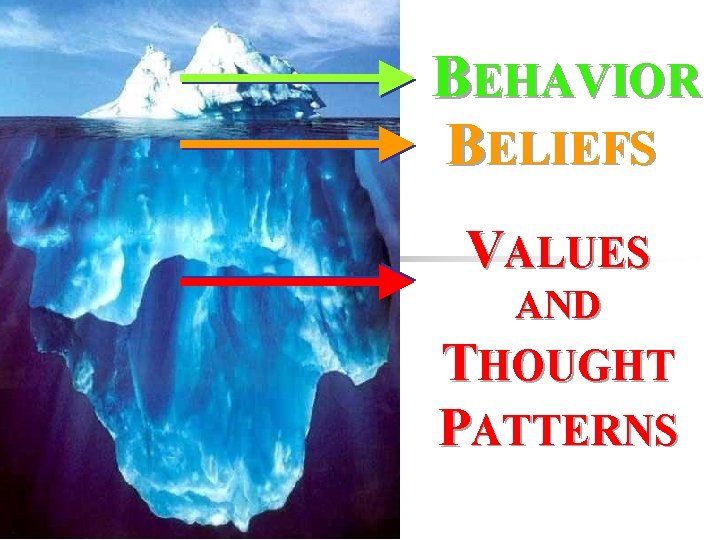
The iceberg analogy n n “surface elements” of culture: the more visible aspects of culture –artifacts, objects and behaviors “deep under the surface elements”: less visible manifestations of culture – values, beliefs systems, societal rules.
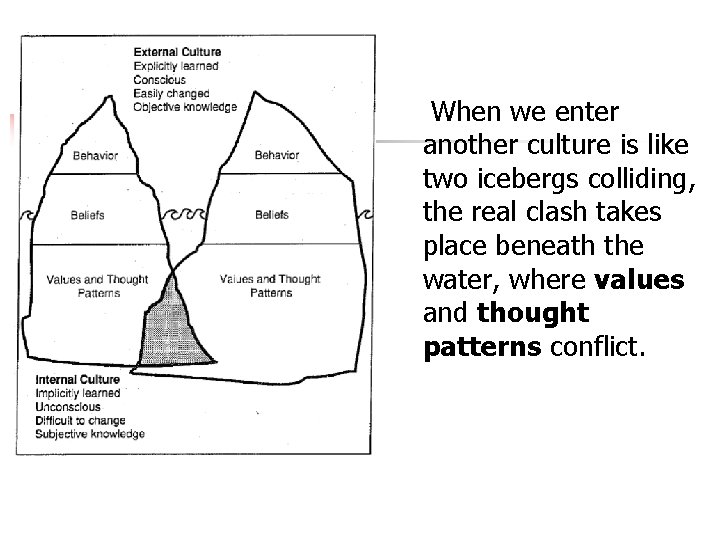
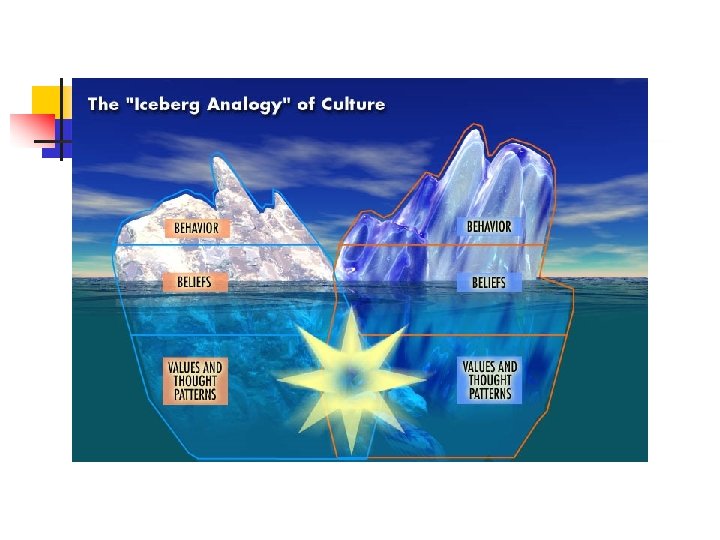
When we enter another culture is like two icebergs colliding, the real clash takes place beneath the water, where values and thought patterns conflict.
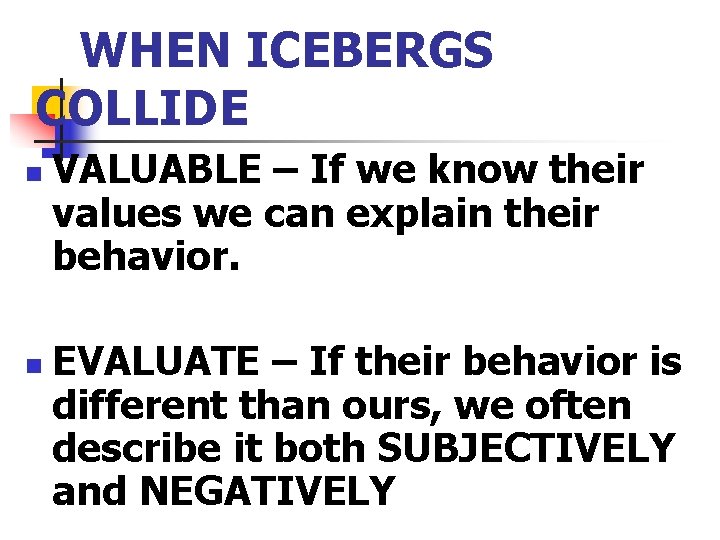
WHEN ICEBERGS COLLIDE n n VALUABLE – If we know their values we can explain their behavior. EVALUATE – If their behavior is different than ours, we often describe it both SUBJECTIVELY and NEGATIVELY
BEHAVIOR BELIEFS VALUES AND THOUGHT PATTERNS
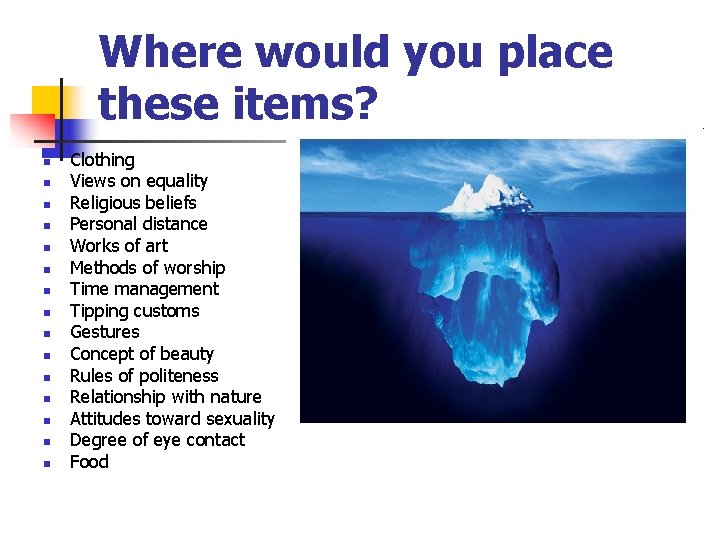
Where would you place these items? n n n n Clothing Views on equality Religious beliefs Personal distance Works of art Methods of worship Time management Tipping customs Gestures Concept of beauty Rules of politeness Relationship with nature Attitudes toward sexuality Degree of eye contact Food
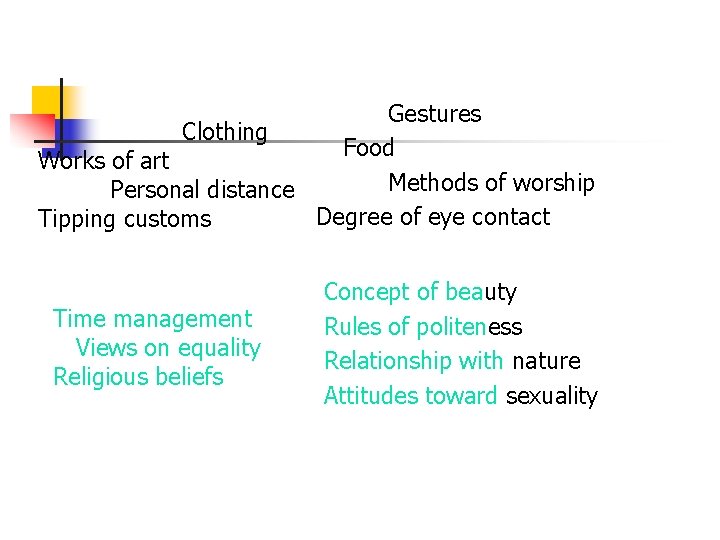
Gestures Clothing Food Works of art Methods of worship Personal distance Degree of eye contact Tipping customs Time management Views on equality Religious beliefs Concept of beauty Rules of politeness Relationship with nature Attitudes toward sexuality
What is intercultural communication? An academic field of study and research. It seeks to understand how people from different countries and cultures behave, communicate and perceive the world around them. The findings of such academic research are then applied to 'real life' situations such as how to create cultural synergy between people from different cultures within a business (cited from kwintessential. co. uk)
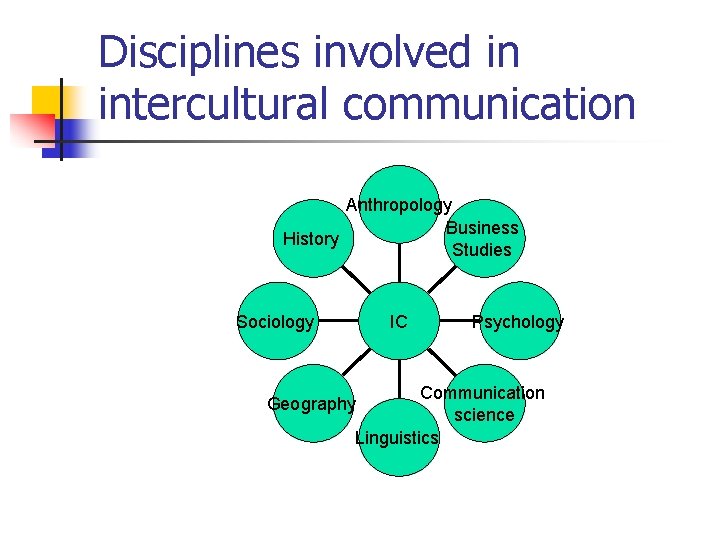
Disciplines involved in intercultural communication Anthropology Business History Studies Sociology IC Psychology Communication science Linguistics Geography
What is cultural briefing? The process of finding out about another culture, especially in preparation for a period of residence, a business trip or a holiday (Utley, 2004)
Flight to Rubovia You are on your first flight to Rubovia. You board the flight and cabin crew and passengers are all speaking Rubovian. You don’t understand a word. A Rubovian business person sits next to you and wishes you ‘good afternoon’ in excellent English. Over the next few hours you have a wonderful opportunity to find out about Rubovian culture. What questions will you ask the passenger.
Conclusion “Culture is more often a source of conflict than of synergy. Cultural differences are a nuisance at best and often a disaster. But if we really want to globalize, there is no way around them so we better take them for what they are. ” Geert Hofstede 35