
Understanding Copyright Law Fall 2011 International Business Law
Understanding Copyright Law Fall 2011 International Business Law - Jeffrey Pittman 1
Copyright Law – Magic To begin our look at an expansive area of law, consider copyright issues in “Abracadabra! Dutch court fines magician over act” International Business Law - Jeffrey Pittman 2
Copyright Law Videos Although cartoon in nature, the following copyright videos provide an interesting introduction to copyright law You. Tube Copyright School Copyright Basics International Business Law - Jeffrey Pittman 3
The Berne Convention for the Protection of Literary and Artistic Works A major source of international copyright law is The Berne Convention for the Protection of Literary and Artistic Works (the Berne Convention) The convention was first accepted in Berne, Switzerland in 1886 Nearly every country today is a signatory of the Berne Convention (see Contracting Parties) International Business Law - Jeffrey Pittman 4
Berne Convention History The Berne Convention was developed in part through the efforts of Victor Hugo, through the Association Littéraire et Artistique Internationale The Convention was influenced by the French "right of the author" (droit d'auteur), contrasting with a concept of "copyright" focusing only on economic concerns International Business Law - Jeffrey Pittman 5
Berne Convention There are three basic principles under the Berne Convention: 1. Works originating in one of the contracting States must be given the same protection in each of the other contracting States as the latter grants to the works of its own nationals (principle of “national treatment”) International Business Law - Jeffrey Pittman 6
Berne Convention There are three basic principles under the Berne Convention: 2. Such protection must not be conditional upon compliance with any formality (principle of “automatic” protection) International Business Law - Jeffrey Pittman 7
Berne Convention There are three basic principles under the Berne Convention: 3. Such protection is independent of the existence of protection in the country of origin of the work (principle of the “independence” of protection) International Business Law - Jeffrey Pittman 8
Copyright Law Basics 1 - What May Be Protected Copyright protects “literary and artistic works” that are original works of authorship Expressions are protected, not the underlying ideas or concepts Original means the works are not copied from another The ideas in the work do not need to be original, but the form of expression must be an original creation of the author There must be some nominal creativity by the author International Business Law - Jeffrey Pittman 9
Berne Convention Article 2 – Protected Works ‘The expression “literary and artistic works” shall include every production in the literary, scientific and artistic domain, whatever may be the mode or form of its expression. . . ’ International Business Law - Jeffrey Pittman 10
Berne Convention Article 2 – Protected Works “Literary and artistic works” is a broad category and includes the following works, and others beyond this list Books, pamphlets and other writings Lectures, addresses, sermons Dramatic or dramatico-musical works Cinematographic and choreographic works Musical compositions Drawing, painting, architecture, sculpture, engraving and lithography International Business Law - Jeffrey Pittman 11
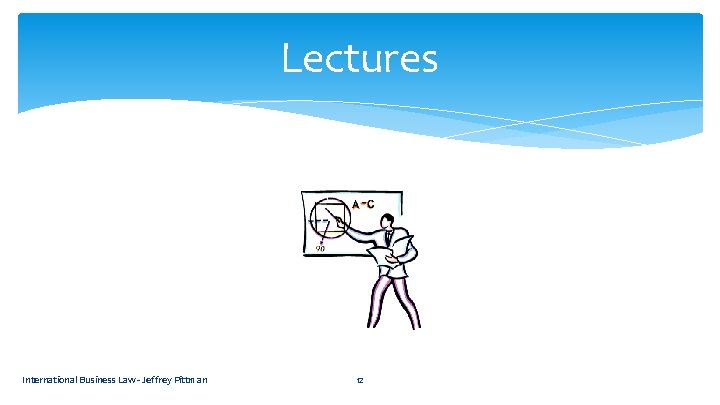
Lectures International Business Law - Jeffrey Pittman 12
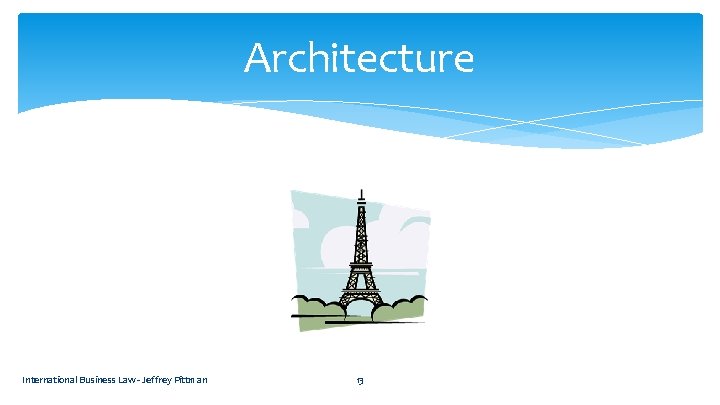
Architecture International Business Law - Jeffrey Pittman 13
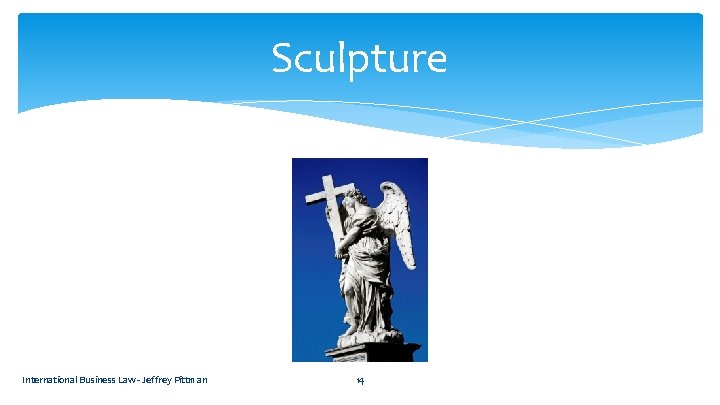
Sculpture International Business Law - Jeffrey Pittman 14
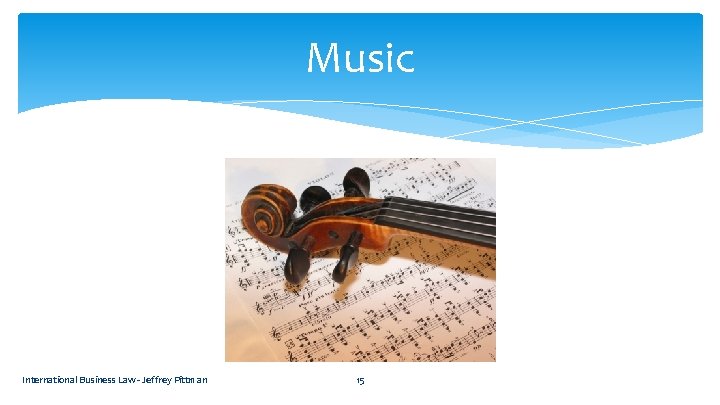
Music International Business Law - Jeffrey Pittman 15

Books International Business Law - Jeffrey Pittman 16
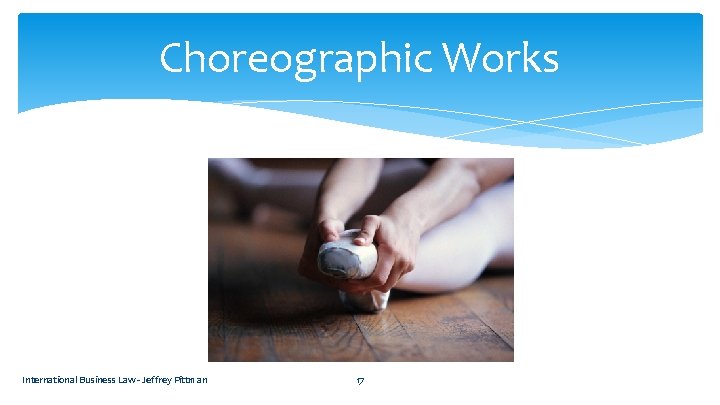
Choreographic Works International Business Law - Jeffrey Pittman 17
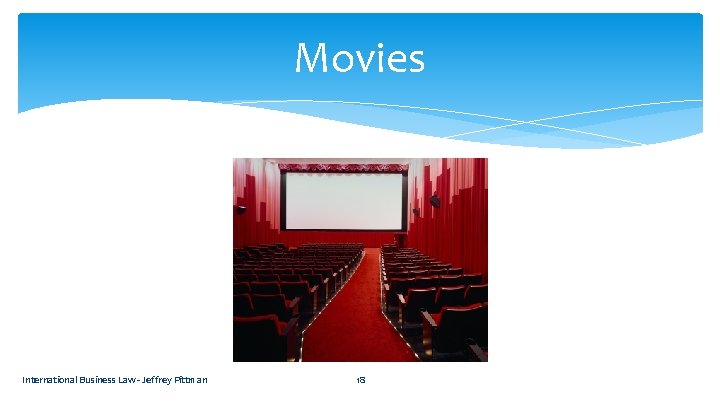
Movies International Business Law - Jeffrey Pittman 18
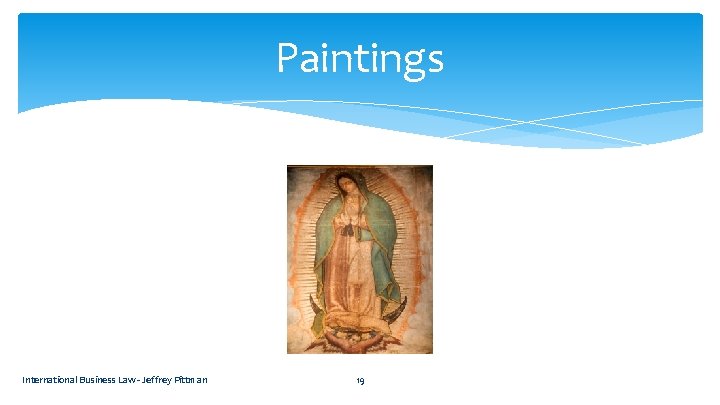
Paintings International Business Law - Jeffrey Pittman 19
Computer Programs International Business Law - Jeffrey Pittman 20
Special Copyright Protection Issues Databases – see WIPO Copyright Treaty (WCT), Article 5 “Compilations of data or other material, in any form, which by reason of the selection or arrangement of their contents constitute intellectual creations, are protected as such. This protection does not extend to the data or the material itself and is without prejudice to any copyright subsisting in the data or material contained in the compilation” Copyright protection of product designs Architecture issues International Business Law - Jeffrey Pittman 21
Copyright Law Basics 2. Rights Protected Under Copyright There are two types of rights protected under copyright law Economic rights, which allow the rights owner to derive financial reward from the use of his works by others Moral rights, which allow the author to take certain actions to preserve the personal link between himself and the work International Business Law - Jeffrey Pittman 22
Economics Rights under Copyright Economics rights - the copyright owner of a work can prohibit or authorize: Reproduction in various forms, such as printed publications or sound recordings Distribution of copies Public performance Broadcasting or other communication to the public Translation into other languages, and Adaptation, such as a novel into a screenplay International Business Law - Jeffrey Pittman 23
Moral Rights under Copyright Moral rights include the right to claim authorship of the work (sometimes called the right of paternity); and the right to object to any distortion or modification of the work, or other derogatory action in relation to the work, which would be prejudicial to the author’s honor or reputation (sometimes called the right of integrity) The Berne Convention requires moral rights to be independent of the author’s economic rights, and to remain with the author even after he has transferred his economic rights. International Business Law - Jeffrey Pittman 24
Limitations on Rights The first limitation is the exclusion from copyright protection of certain categories of works In some countries (for example, the US), works are excluded from protection if they are not fixed in tangible form Thus, a work of choreography would only be protected once the movements were written down in dance notation or recorded on videotape In certain countries (for example, the US), the texts of laws, court and administrative decisions are excluded from copyright protection International Business Law - Jeffrey Pittman 25
Limitations on Rights (Cont. ) The second category of limitations concerns particular acts of exploitation, normally requiring the authorization of the rights owner, which may, under circumstances specified in the law, be carried out without authorization There are two basic types of limitations in this category: (a) free use, which carries no obligation to compensate the rights owner for the use of his work without authorization; and (b) non-voluntary licenses, which do require that compensation be paid to the rights owner for nonauthorized exploitation International Business Law - Jeffrey Pittman 26
Examples of Free Use Quoting from a protected work, provided that the source of the quotation and the name of the author is mentioned, and that the extent of the quotation is compatible with fair practice; Use of works by way of illustration for teaching purposes; and Use of works for the purpose of news reporting International Business Law - Jeffrey Pittman 27
Fair Use In addition to the specific categories of free use set out in national laws, the laws of some countries (for example, the US) recognize the concept known as fair use or fair dealing This allows use of works without the authorization of the rights owner, taking into account factors such as: the nature and purpose of the use, including whether it is for commercial purposes; the nature of the work used; the amount of the work used in relation to the work as a whole; and the likely effect of the use on the potential commercial value of the work International Business Law - Jeffrey Pittman 28
Fair Use For information on fair use in the United States, see Benedict. com Use the fair use visualizer on the homepage Analyze the 2 Live Crew/Pretty Woman dispute International Business Law - Jeffrey Pittman 29
Copyright Law Basics 3. Copyright Ownership Author Works made for hire Licensing and assignment International Business Law - Jeffrey Pittman 30
Copyright Law Basics 4. Duration of Copyright Ownership The period or duration of copyright begins from the moment when the work has been created, or, under some national laws, when it has been expressed in a tangible form Copyright continues, in general, until some time after the death of the author . International Business Law - Jeffrey Pittman 31
Copyright Duration In countries party to the Berne Convention, and in many other countries, the duration of copyright provided for by national law is as a general rule the life of the author plus not less than 50 years after his death The European Union, the United States of America and several others have extended the term of copyright to 70 years after the death of the author International Business Law - Jeffrey Pittman 32
Copyright Law Basics 5. Copyright Damages In the United States, damages for copyright violations are listed in Remedies for infringement: Damages and profits The basic level of copyright damages is between $750 and $30, 000 per work, at the discretion of the court Plaintiffs who prove willful infringement may be entitled to damages up to $150, 000 per work infringed International Business Law - Jeffrey Pittman 33
The Role of WIPO The World Intellectual Property Organization (WIPO) is an international organization dedicated to ensuring that the rights of creators and owners of intellectual property are protected worldwide, and that inventors and authors are thus recognized and rewarded for their ingenuity International Business Law - Jeffrey Pittman 34
The Role of WIPO administers the following international treaties on copyright and related rights: Berne Convention for the Protection of Literary and Artistic Works Brussels Convention Relating to the Distribution of Program. Carrying Signals Transmitted by Satellite Geneva Convention for the Protection of Producers of Phonograms Against Unauthorized Duplication of Their Phonograms Rome Convention for the Protection of Performers, Producers of Phonograms and Broadcasting Organizations WIPO Copyright Treaty (WCT) WIPO Performances and Phonograms Treaty (WPPT) International Business Law - Jeffrey Pittman 35
- Slides: 35