
Understanding Consumers Using Consumer Research to Build Powerful
Understanding Consumers Using Consumer Research to Build Powerful Brands Slides M. G. Parameswaran Source: Understanding Consumers by M. G. Parameswaran
“The purpose of a business is to create and keep a customer. ” -Theodore Levitt Source: Understanding Consumers by M. G. Parameswaran
Structure of the Seminar • Section I : Understanding consumers to build brands • Section II : Consumer Research steps • Section III : Secondary Data Analysis • Section IV : Qualitative Research Methods • Section V : Using Quantitative Research Understanding • Source: Section VIConsumers by M. G. Parameswaran : Quantitative
Using Consumer Research to Build Powerful Brands Section I Understanding Consumers to Build Brands Source: Understanding Consumers by M. G. Parameswaran
What is a Brand? “ A brand is a storehouse of trust. That matters more and more as choices multiply. People want to simplify their lives. ” -Niall Fitzgerald, Chairman, Unilever Source: Understanding Consumers by M. G. Parameswaran
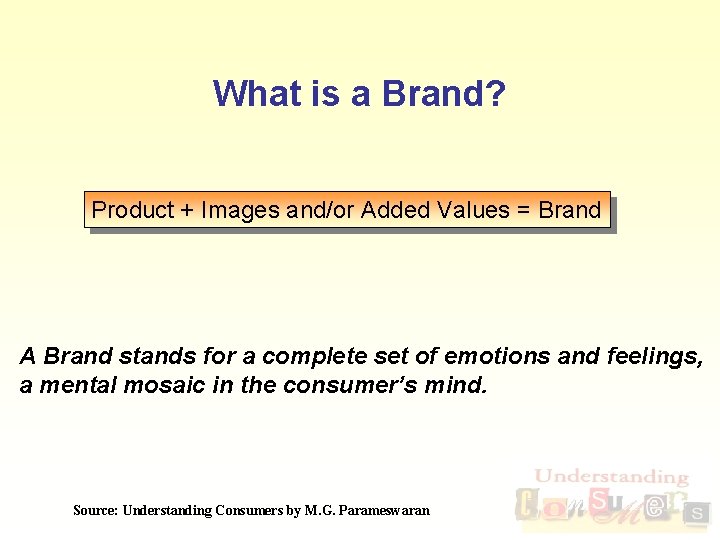
What is a Brand? Product + Images and/or Added Values = Brand A Brand stands for a complete set of emotions and feelings, a mental mosaic in the consumer’s mind. Source: Understanding Consumers by M. G. Parameswaran
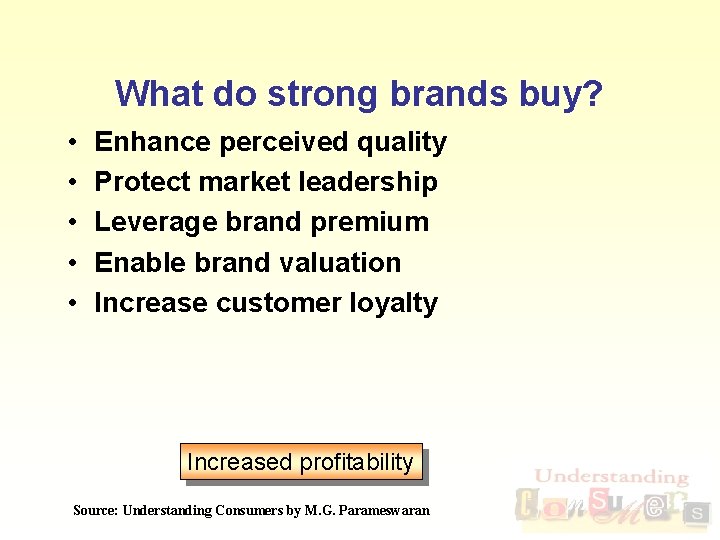
What do strong brands buy? • • • Enhance perceived quality Protect market leadership Leverage brand premium Enable brand valuation Increase customer loyalty Increased profitability Source: Understanding Consumers by M. G. Parameswaran
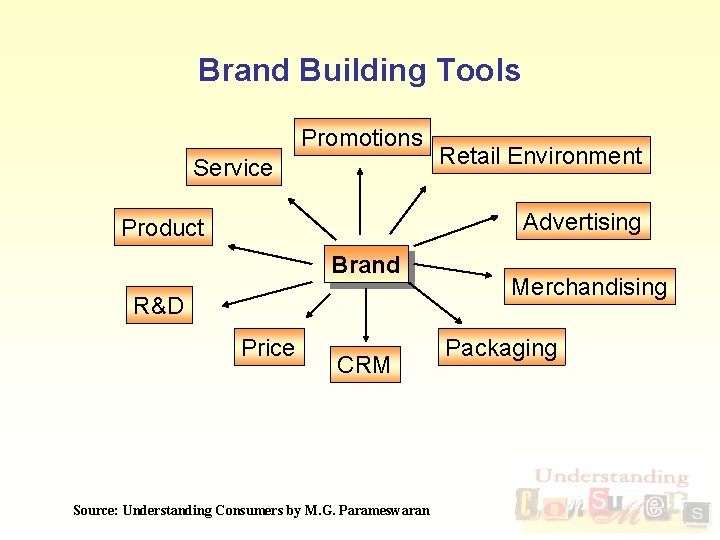
Brand Building Tools Promotions Service Retail Environment Advertising Product Brand R&D Price CRM Source: Understanding Consumers by M. G. Parameswaran Merchandising Packaging
“Who’s running the organisation? Customers!!!” - Tom Peters The Circle of Innovation Source: Understanding Consumers by M. G. Parameswaran
Brand building activities start and end with the consumer Brand building: Dangers • Complacency • Inconsistency • Unexpected competition Brand building: Essentials • Focus on the brand • Innovation as the driver • Need to track and understand consumers Source: Understanding Consumers by M. G. Parameswaran
Understanding consumers: How do consumers behave Different means to the same end: A look at some Behaviour models Source: Understanding Consumers by M. G. Parameswaran
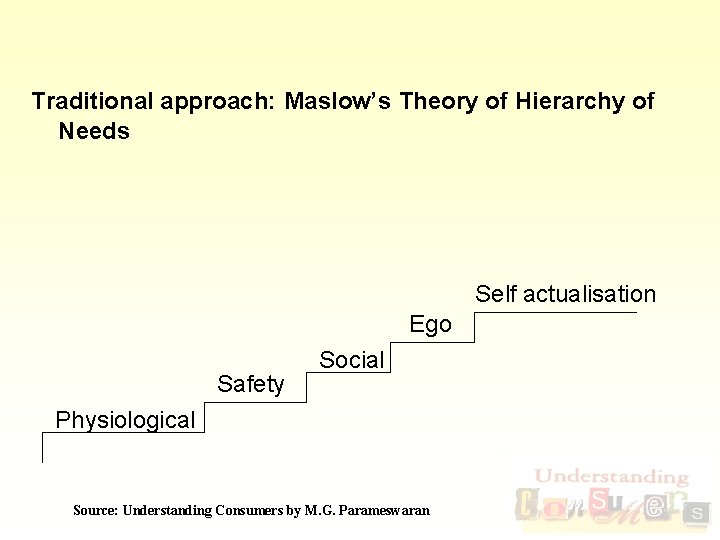
Traditional approach: Maslow’s Theory of Hierarchy of Needs Self actualisation Ego Safety Social Physiological Source: Understanding Consumers by M. G. Parameswaran
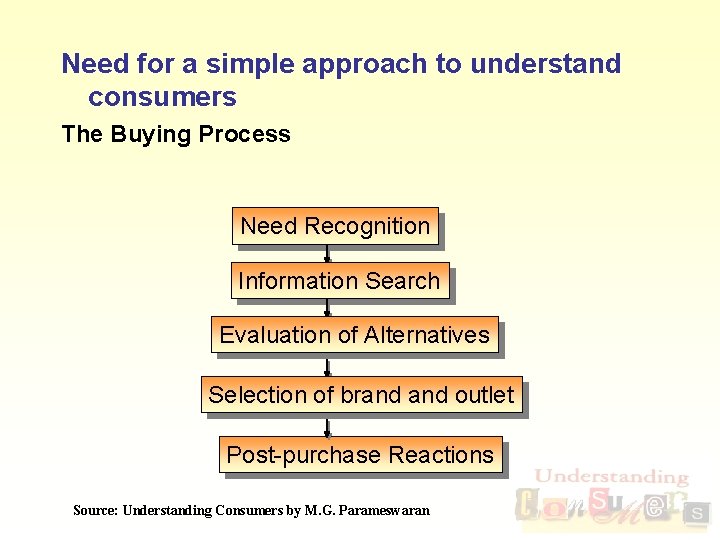
Need for a simple approach to understand consumers The Buying Process Need Recognition Information Search Evaluation of Alternatives Selection of brand outlet Post-purchase Reactions Source: Understanding Consumers by M. G. Parameswaran
Factors affecting Consumer Behaviour – External • • Culture Religion Family Region – Internal • Lifestyle (AIO framework) – eg. TGI’s HMT and EMT classification – Mediagraphics classification Lifestyle trends have direct implications for marketers Source: Understanding Consumers by M. G. Parameswaran
Using Consumer Research to Build Powerful Section II Consumer Research Steps Source: Understanding Consumers by M. G. Parameswaran
“Marketing Research unconnected with marketing judgement is dangerous. But judgement unsupported by research is generally worse. ” - John Philip Jones Behind Powerful Brands Source: Understanding Consumers by M. G. Parameswaran
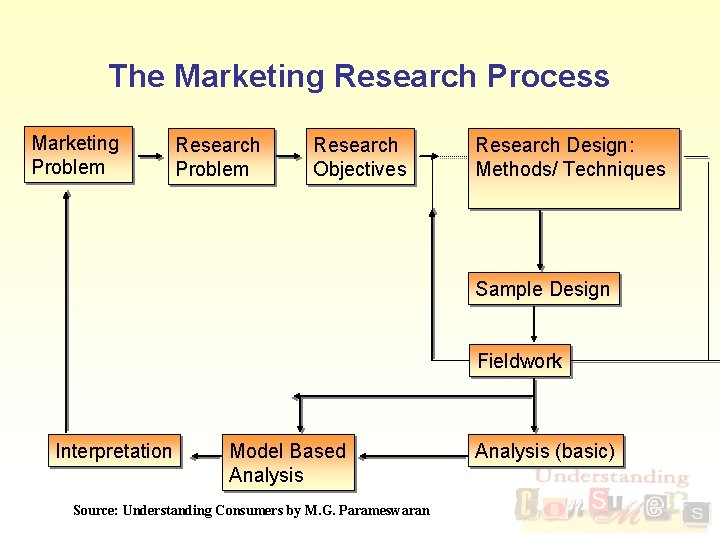
The Marketing Research Process Marketing Problem Research Objectives Research Design: Methods/ Techniques Sample Design Fieldwork Interpretation Model Based Analysis Source: Understanding Consumers by M. G. Parameswaran Analysis (basic)
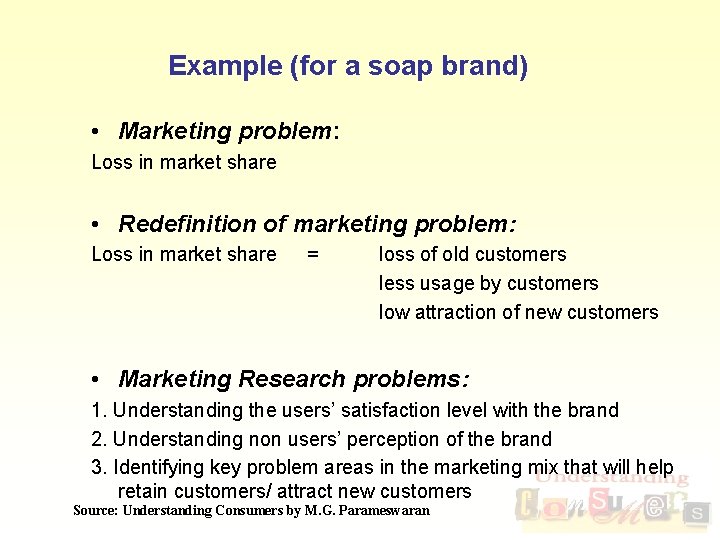
Example (for a soap brand) • Marketing problem: Loss in market share • Redefinition of marketing problem: Loss in market share = loss of old customers less usage by customers low attraction of new customers • Marketing Research problems: 1. Understanding the users’ satisfaction level with the brand 2. Understanding non users’ perception of the brand 3. Identifying key problem areas in the marketing mix that will help retain customers/ attract new customers Source: Understanding Consumers by M. G. Parameswaran
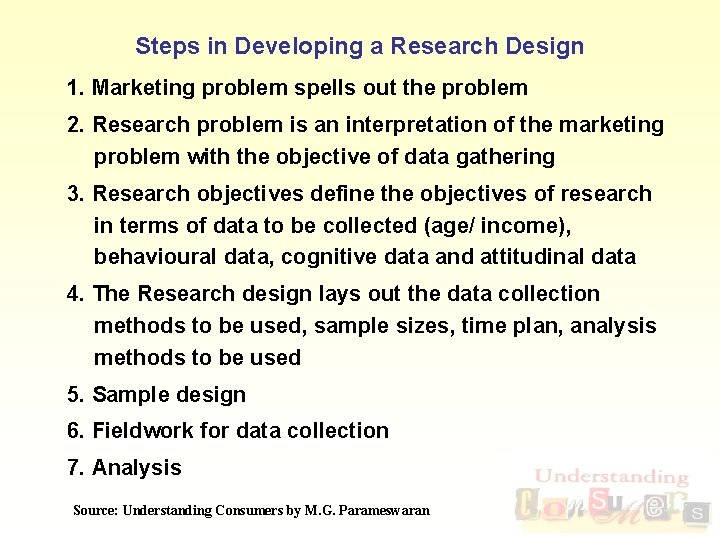
Steps in Developing a Research Design 1. Marketing problem spells out the problem 2. Research problem is an interpretation of the marketing problem with the objective of data gathering 3. Research objectives define the objectives of research in terms of data to be collected (age/ income), behavioural data, cognitive data and attitudinal data 4. The Research design lays out the data collection methods to be used, sample sizes, time plan, analysis methods to be used 5. Sample design 6. Fieldwork for data collection 7. Analysis Source: Understanding Consumers by M. G. Parameswaran
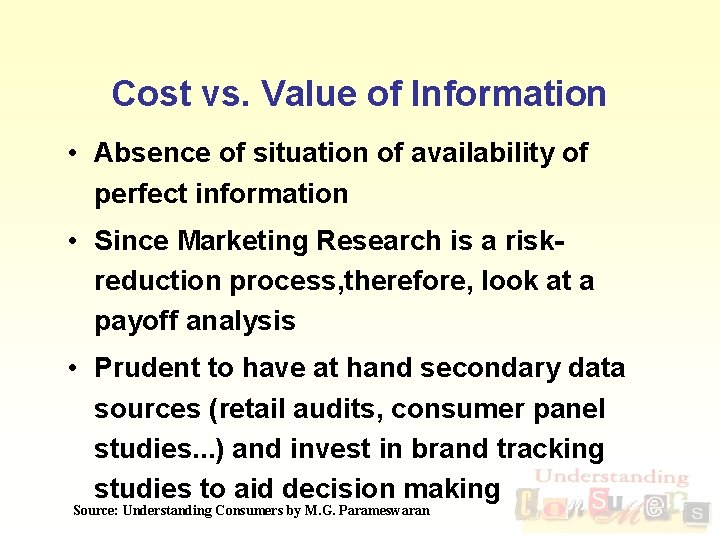
Cost vs. Value of Information • Absence of situation of availability of perfect information • Since Marketing Research is a riskreduction process, therefore, look at a payoff analysis • Prudent to have at hand secondary data sources (retail audits, consumer panel studies. . . ) and invest in brand tracking studies to aid decision making Source: Understanding Consumers by M. G. Parameswaran
Using Consumer Research to Build Powerful Section III Secondary Data Analysis Source: Understanding Consumers by M. G. Parameswaran
Defining Secondary Data • Secondary data sources are information sources that provide information where data collection was not done to address the specific research problem under study • Examples of Secondary data sources include syndicated studies, government data banks, retail audits, past studies • Essential to filter secondary data by asking relevant questions Source: Understanding Consumers by M. G. Parameswaran
Types of Secondary Data Sources • The Census: – Largest data source in the country – Furnishes population, age/sex, education of the CWE (Chief Wage Earner) and household sizes for entire country • NCAER study – Across urban and rural India to study income patterns, usage of products (consumer products and durables) • CMIE reports Source: Understanding Consumers by M. G. Parameswaran – Collate and analyse various government. Reports,
Types of Secondary Data Sources • Industry body reports – NASSCOM, OPPI, SIAM, AMA • Media research (NRS) – media data, household size distribution, SEC, income and age distribution – product usage data – consumer trend tracking in future • Retail audits (ORG Retail Sales Audits) – consumer offtake data, market share estimates, distribution data and stock levels at retail points • Consumer panels – monthly purchase track Source: Understanding Consumers by M. G. Parameswaran switches, gain-loss. . . – brand usage, ever used, brand
Types of Secondary Data Sources • Consumer Trend studies published by magazines and television channels • Old research reports • The Internet and Web based information services Source: Understanding Consumers by M. G. Parameswaran
Limitations and Benefits of Secondary Data Sources • Limitations: – Can answer questions like size of the market Growth rate of the market, Regional differences and Seasonality differences but not Consumer motivations, consumer acceptance of brand extensions, consumer motives for trying out new products – Historical, rarely predictive data • Benefits: – Snapshot of the market – Exhaustive information Source: Understanding Consumers by M. G. Parameswaran
Using Consumer Research to Build Powerful Session IV Qualitative Research Methods Source: Understanding Consumers by M. G. Parameswaran
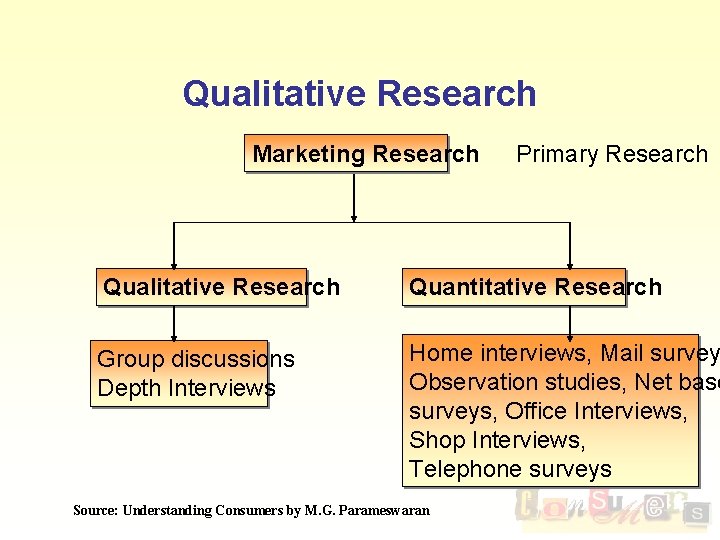
Qualitative Research Marketing Research Primary Research Qualitative Research Quantitative Research Group discussions Depth Interviews Home interviews, Mail survey Observation studies, Net base surveys, Office Interviews, Shop Interviews, Telephone surveys Source: Understanding Consumers by M. G. Parameswaran
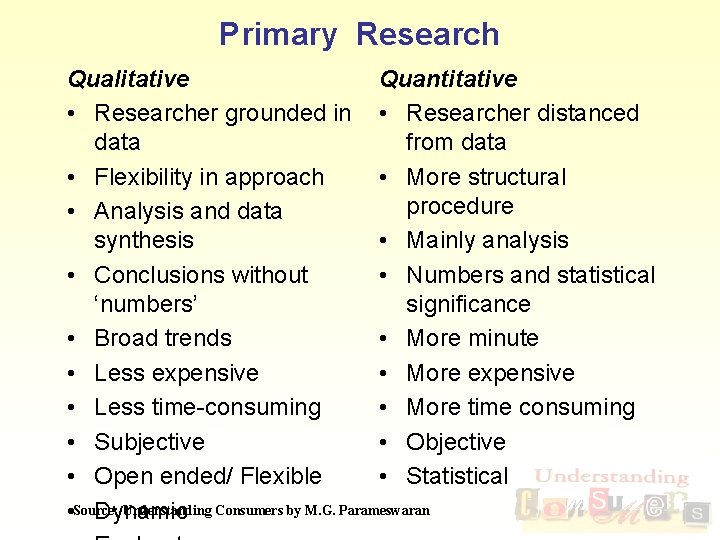
Primary Research Qualitative Quantitative • Researcher grounded in • Researcher distanced data from data • Flexibility in approach • More structural procedure • Analysis and data synthesis • Mainly analysis • Conclusions without • Numbers and statistical ‘numbers’ significance • Broad trends • More minute • Less expensive • More expensive • Less time-consuming • More time consuming • Subjective • Open ended/ Flexible • Statistical Understanding Consumers by M. G. Parameswaran • Source: Dynamic
Why Qualitative Research • Proliferation of brands, products, intangible benefits in recent times leads to heightened importance of consumer emotions • Qualitative research helps understand hidden emotions • Borrows heavily from psychology theories: understanding of the concepts of perception, cognition, learning and motivation critical to help formulate Source: Understanding Consumers by M. G. Parameswaran research methodologies
Types of Qualitative Research • Exploratory – Help in building an overall construct – Used when little information about the consumer is at hand – Eg. , launch of a new product (cooling eye drops) • Diagnostic – Prelude to or a part of an overall research project – Study a phenomenon in greater detail – Eg. , Testing a new creative concept for an advertising campaign Source: Understanding Consumers by M. G. Parameswaran
Types of Qualitative Research • Focus Group – Held among a homogeneous group of 7 -10 consumers – Usually runs for 60 -90 minutes, moderated by an experienced researcher – Proceedings are audio and video taped, and observed through CCTV – Information areas would have to be identified and defined in the form of a Discussion Guide, in the Direct Funnel or the Inverted Funnel Approach Source: Understanding Consumers by M. G. Parameswaran
Focus Groups – Usage of Projective Techniques • Brand Sorting • Picture Identification • Brand Obituary • Star/Sports Star Linkage • Brand Personification Source: Understanding Consumers by M. G. Parameswaran
Depth Interviews • Focus Groups not feasible for all types of research (collecting people together, taboo topics) • Therefore, individual interviews conducted (more expensive on a per respondent basis) • Need for a minimum number of interviews to start gaining relevant insights • Duration of an interview could be 45 minutes • Source: Expert depth interviews essential to Understanding Consumers by M. G. Parameswaran
Analysing and Interpreting Qualitative Research • Method of Analysis: – Basic analysis to be carried out by the key researcher himself – Obtain verbatim transcription of the group discussion – Sorting of observations/comments into ‘bins’ (for eg. , in ‘eye drops’ research, the bins could be level of concern for health, concern about eyes. . . ) – Greater indepth analysis – Interpreting dialogue Source: Understanding Consumers by M. G. Parameswaran
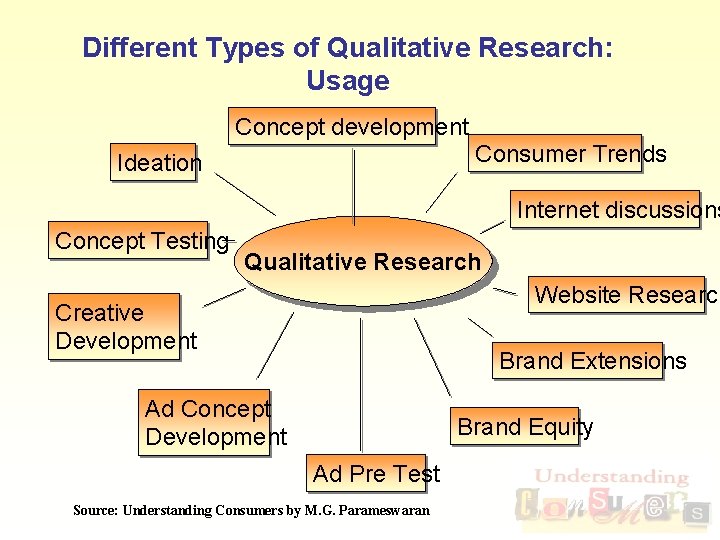
Different Types of Qualitative Research: Usage Concept development Consumer Trends Ideation Internet discussions Concept Testing Qualitative Research Website Research Creative Development Brand Extensions Ad Concept Development Brand Equity Ad Pre Test Source: Understanding Consumers by M. G. Parameswaran
Using Consumer Research to Build Powerful Brands Section V Using Quantitative Research Source: Understanding Consumers by M. G. Parameswaran
Quantitative Research Methods • Interviewer administered (face-to-face) Questionnaire – Conducted by trained investigators on the basis of a sampling plan at home, office, shopping areas or even airports (eg. , Mall Intercept interviewing internationally) • Self administered Questionnaire – Respondent answers in his own free time • Mail Survey – Form of self administered Questionnaire, with a pre-paid envelope • Telephone Survey Source: Understanding Consumers by M. G. Parameswaran
Quantitative Research Methods • Internet Survey – Promising future, given its cost and speed advantages, but care needs to be taken to control respondents to the online survey • Panel Studies – Studies behaviour of the same set of consumers, over a period of time. – Types: Consumer panels(tracks consumer product purchases), Retail panels (tracks retail offtake) and TV panels (tracks TV viewing habits) Source: Understanding Consumers by M. G. Parameswaran
Quantitative Research Methods • Tracking Studies – Studies undertaken by consumer product marketers and consumer durable marketers (to study awareness levels, trials, repeat purchase, image scores…) • Observation Study – No questions are asked of the consumer Source: Understanding Consumers by M. G. Parameswaran
Reliability and Validity • Reliability – Accuracy of response measured by the research instrument (questions/ questionnaire) – Same answer obtained on repeating the same question • Validity – Is the instrument measuring what it is supposed to be measuring? All research designs are put through a reliabilityvalidity test Source: Understanding Consumers by M. G. Parameswaran
Measurement Types “Measuring behaviour usually involves four related concepts: what the respondent did or did not do; where the action takes place; the timing, including past, present and future; and the frequency or persistence of behaviour” - Aaker, Kumar and Day Marketing Research, 1998 Source: Understanding Consumers by M. G. Parameswaran
Measurement Types Measuring Behaviour: • Best way is through observation • Verbal technique involves ‘flashback’ (problem of ‘telescoping’) • Usage of Panel data in a dynamic situation • Two ways of obtaining Behavioural data: – Event specific – Habitual (be aware of the consumer projecting a behaviour they think is expected of them) Source: Understanding Consumers by M. G. Parameswaran
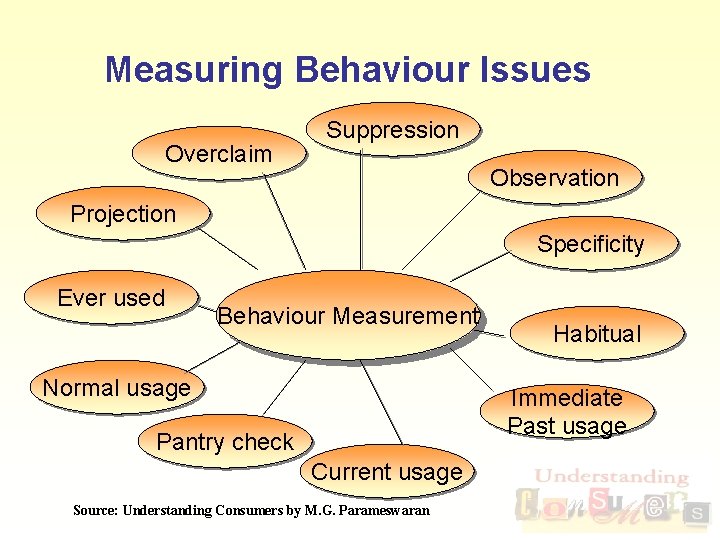
Measuring Behaviour Issues Overclaim Suppression Observation Projection Specificity Ever used Behaviour Measurement Normal usage Habitual Immediate Past usage Pantry check Current usage Source: Understanding Consumers by M. G. Parameswaran
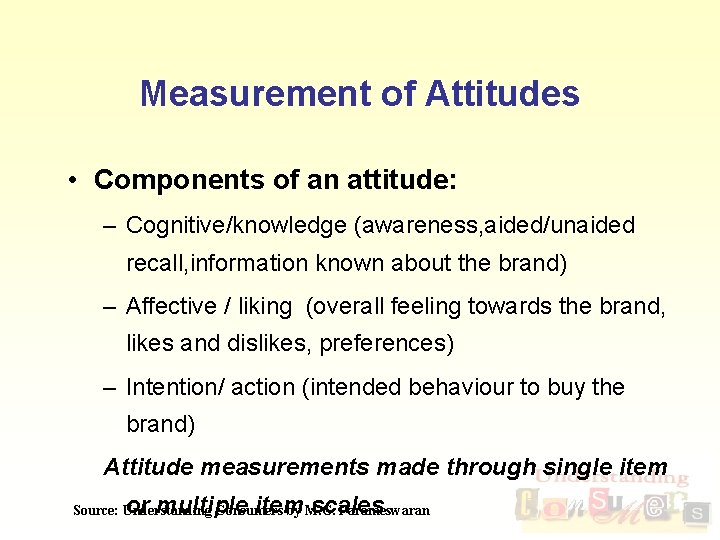
Measurement of Attitudes • Components of an attitude: – Cognitive/knowledge (awareness, aided/unaided recall, information known about the brand) – Affective / liking (overall feeling towards the brand, likes and dislikes, preferences) – Intention/ action (intended behaviour to buy the brand) Attitude measurements made through single item or multiple item scales Source: Understanding Consumers by M. G. Parameswaran
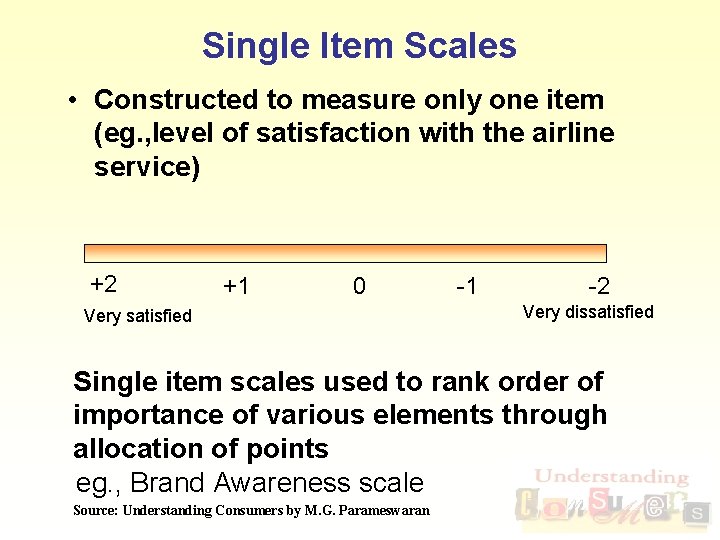
Single Item Scales • Constructed to measure only one item (eg. , level of satisfaction with the airline service) +2 +1 0 Very satisfied -1 -2 Very dissatisfied Single item scales used to rank order of importance of various elements through allocation of points eg. , Brand Awareness scale Source: Understanding Consumers by M. G. Parameswaran
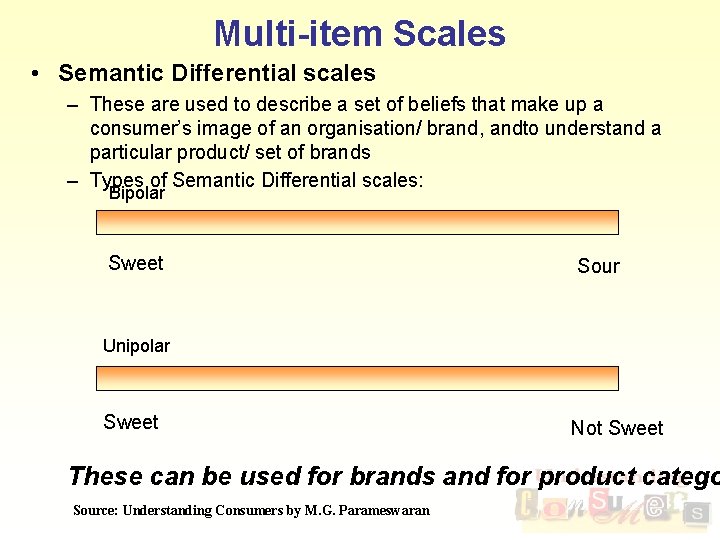
Multi-item Scales • Semantic Differential scales – These are used to describe a set of beliefs that make up a consumer’s image of an organisation/ brand, andto understand a particular product/ set of brands – Types of Semantic Differential scales: Bipolar Sweet Sour Unipolar Sweet Not Sweet These can be used for brands and for product catego Source: Understanding Consumers by M. G. Parameswaran
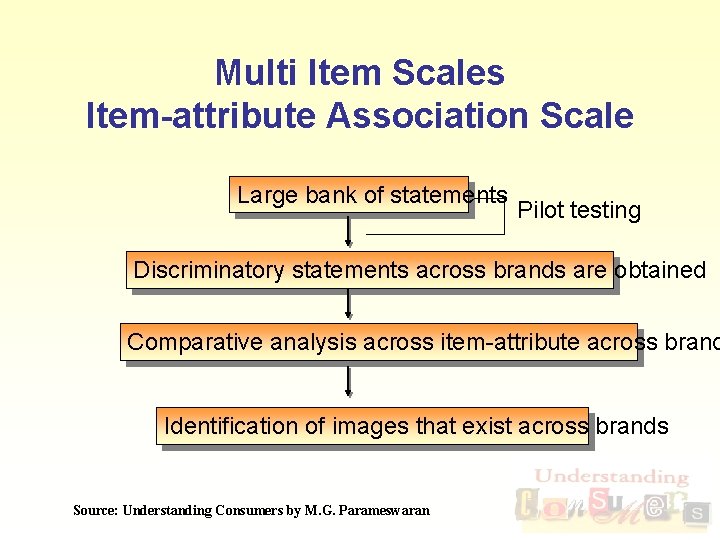
Multi Item Scales Item-attribute Association Scale Large bank of statements Pilot testing Discriminatory statements across brands are obtained Comparative analysis across item-attribute across brand Identification of images that exist across brands Source: Understanding Consumers by M. G. Parameswaran
Purchase Intention Measurement • Simulated test market research tools (STM) used to evaluate new products/ campaigns • Methodology: – Consumers are exposed to the marketing stimuli and their purchase intentions are measured – Results are then projected to the entire population after factoring in variables like media reach, distribution reach etc Source: Understanding Consumers by M. G. Parameswaran
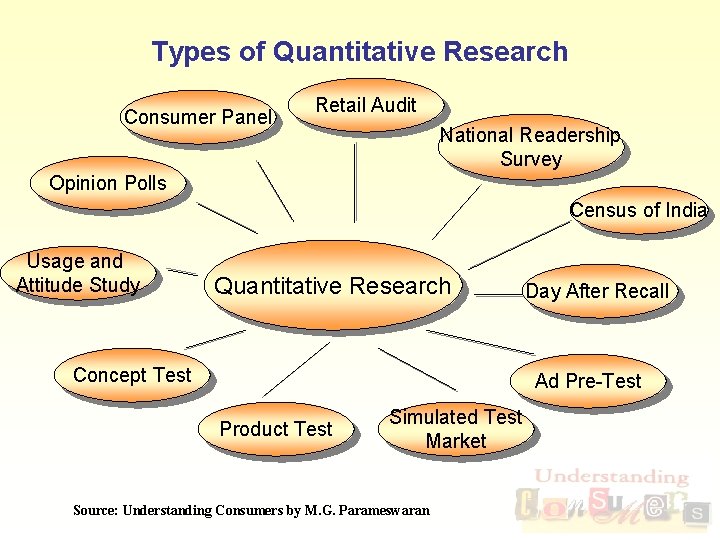
Types of Quantitative Research Consumer Panel Retail Audit National Readership Survey Opinion Polls Census of India Usage and Attitude Study Quantitative Research Concept Test Day After Recall Ad Pre-Test Product Test Simulated Test Market Source: Understanding Consumers by M. G. Parameswaran
Using Consumer Research to Build Powerful B Section VI Quantitative Research Sampling- Questionnaire- Analysis 3 cornerstones of Quantitative Research Source: Understanding Consumers by M. G. Parameswaran
Key ingredients of Quantitative Research • Sampling • Questionnaire • Analysis Source: Understanding Consumers by M. G. Parameswaran
Sampling Process • First step: definition of universe/ sampling frame (eg. The electoral list or the telephone directory) • Drawing out the sample through random number generation process • Particular number of interviews are conducted using the right hand thumb rule or the random walk method Source: Understanding Consumers by M. G. Parameswaran
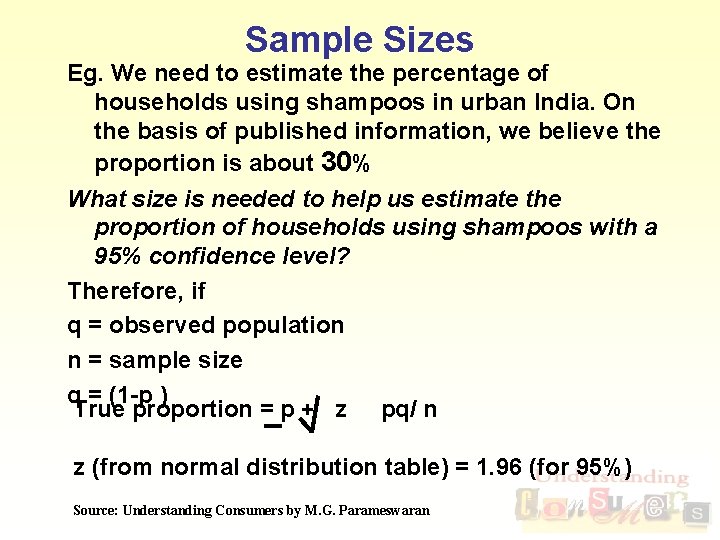
Sample Sizes Eg. We need to estimate the percentage of households using shampoos in urban India. On the basis of published information, we believe the proportion is about 30% What size is needed to help us estimate the proportion of households using shampoos with a 95% confidence level? Therefore, if q = observed population n = sample size q = (1 -p ) True proportion = p + z pq/ n z (from normal distribution table) = 1. 96 (for 95%) Source: Understanding Consumers by M. G. Parameswaran
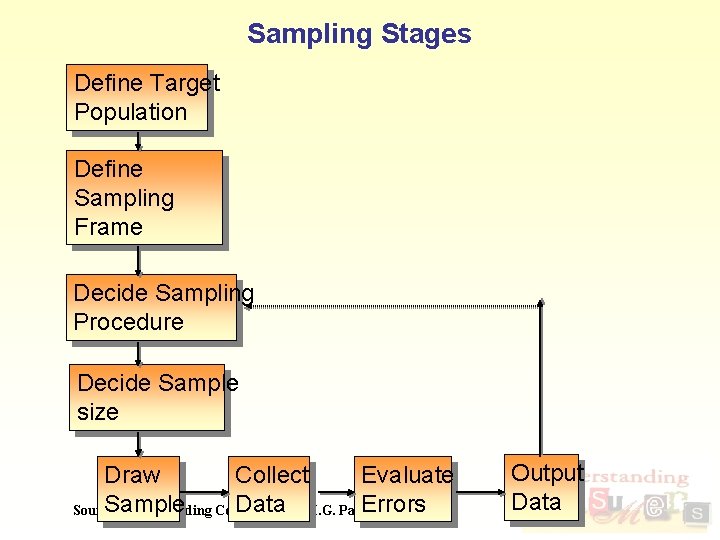
Sampling Stages Define Target Population Define Sampling Frame Decide Sampling Procedure Decide Sample size Draw Collect Evaluate Sample Data by M. G. Parameswaran Errors Source: Understanding Consumers Output Data
![Questionnaire Development “I keep six honest men [They taught me all I knew] Their](http://slidetodoc.com/presentation_image_h/2d72b0bc5f05bf3be449c2cadbe77d88/image-56.jpg "Questionnaire Development “I keep six honest men [They taught me all I knew] Their")
Questionnaire Development “I keep six honest men [They taught me all I knew] Their names were What and Why and When And How and Where and Who!” - Kipling The Elephant’s Child. Stanza I Source: Understanding Consumers by M. G. Parameswaran
Type of Questions The questions should be worded unambiguously and should be simple, specific and clear. • Open ended questions – Respondent not given any alternatives and response is noted down verbatim – These questions provide a lot of information, are spontaneous and in the ‘consumer speak’ – Coding and analysing them maybe difficult • Closed ended questions – Easy to administer, faster to elicit response, easier to analyse and interpret Source: Understanding Consumers by M. G. Parameswaran
• Types of closed ended questions – Bipolar questions (where the answer is ‘yes’ or ‘no’ – Multiple choice questions (where there is a choice of 5 -7 alternatives) Closed ended questions are used – in conjunction with attitude scales, – in ranking benefits/ attributes, and – where respondents are made to split a sum of 100 over 5 variables Source: Understanding Consumers by M. G. Parameswaran
Questionnaire Flow • The respondent has to be taken through a set of questions in an unbiased manner • An attitude question cannot be asked before going through the awareness and usage questions • Personal details are best asked at the end of the interview • In order to break the monotony of the interview, it is good to have verbal and visual stimuli in the form of cards • Interviewer training, briefing and pre-testing the Questionnaire is by important Source: Understanding Consumers M. G. Parameswaran
Questionnaire Development Process • Defining information areas to be covered • Target respondents profile • Geographical spread of research • Finalisation of – Behaviour data to be collected – Attitude data to be collected • Attitude scales to be tested and finalised • Flow of questionnaire finalisation • Coding systems finalisation • Pre testing of questionnaire • Source: Field work Understanding Consumers by M. G. Parameswaran
Data Analysis Although data analysis can be a powerful aid to gaining useful knowledge, it cannot rescue a badly conceived marketing research study. . . data analysis rarely can compensate for a bad question, , an inadequate sampling procedure or sloppy fieldwork” - Aaker, Kumar and Day Marketing Research Source: Understanding Consumers by M. G. Parameswaran
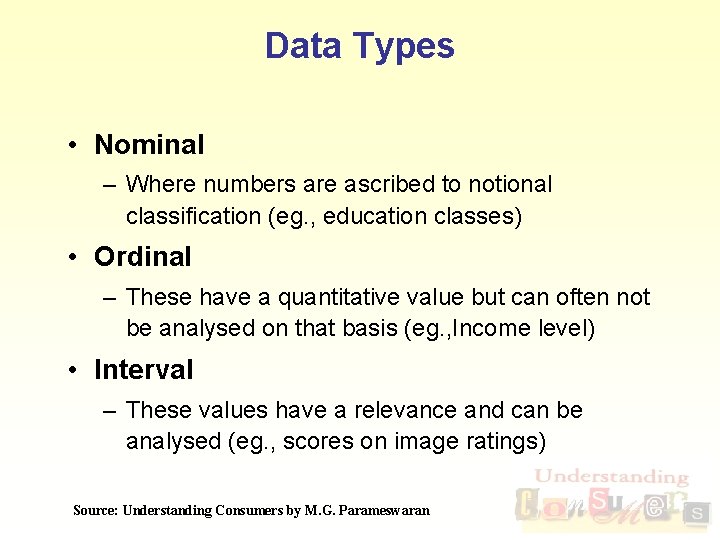
Data Types • Nominal – Where numbers are ascribed to notional classification (eg. , education classes) • Ordinal – These have a quantitative value but can often not be analysed on that basis (eg. , Income level) • Interval – These values have a relevance and can be analysed (eg. , scores on image ratings) Source: Understanding Consumers by M. G. Parameswaran
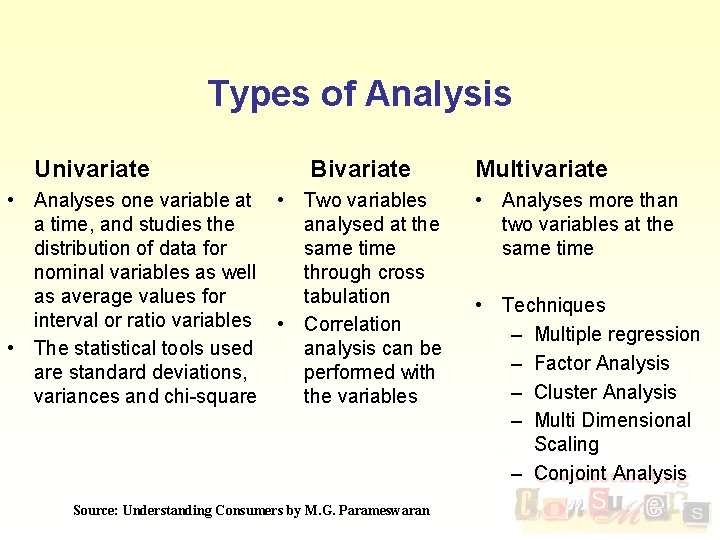
Types of Analysis Univariate Bivariate • Analyses one variable at • Two variables a time, and studies the analysed at the distribution of data for same time nominal variables as well through cross as average values for tabulation interval or ratio variables • Correlation • The statistical tools used analysis can be are standard deviations, performed with variances and chi-square the variables Source: Understanding Consumers by M. G. Parameswaran Multivariate • Analyses more than two variables at the same time • Techniques – Multiple regression – Factor Analysis – Cluster Analysis – Multi Dimensional Scaling – Conjoint Analysis
Using Consumer Research to Build Powerful B Section VII Beyond Research- Instinct Source: Understanding Consumers by M. G. Parameswaran
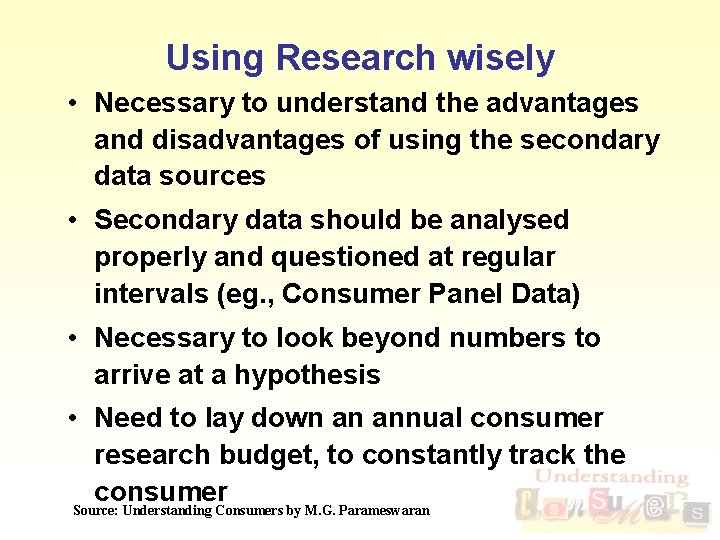
Using Research wisely • Necessary to understand the advantages and disadvantages of using the secondary data sources • Secondary data should be analysed properly and questioned at regular intervals (eg. , Consumer Panel Data) • Necessary to look beyond numbers to arrive at a hypothesis • Need to lay down an annual consumer research budget, to constantly track the consumer Source: Understanding Consumers by M. G. Parameswaran
Faith and the Process • Different timelines to implement entire research process • Most multinationals have well laid down research procedures Consumer research, above all, is dependent on the faith of the senior management. They can use it to show the way or as a crutch for decision making. Source: Understanding Consumers by M. G. Parameswaran
Organisational Consumer Focus • An organisational orientation towards consumer research is a but a litmus test for the focus of the organisation • A consumer centric organisation is reflected in the structure and culture of the organisation • Every manager is expected to meet few consumers every year through ‘house visits’, retailers through market visits and interacting with customers in the shops Source: Understanding Consumers by M. G. Parameswaran
Data to Information to Insight. . . to Instinct “The trick is to see the future before it arrives” - Gary Hamel and C K Prahlad Competing for the Future Source: Understanding Consumers by M. G. Parameswaran
“Marketing is becoming more of a battle based on information rather than sales power. ” - Philip Kotler Marketing Management Source: Understanding Consumers by M. G. Parameswaran
- Slides: 69