
Understanding Computers Today and Tomorrow 12 th Edition
- Slides: 48
Understanding Computers Today and Tomorrow 12 th Edition Chapter 13: Program Development and Programming Languages
Learning Objectives • Understand the differences between structured programming, object-oriented programming (OOP), aspect-oriented programming (AOP), and adaptive software development. • Identify and describe the activities involved in the program development life cycle (PDLC). • Understand what constitutes good program design and list several tools that can be used by computer professionals when designing a program. Chapter 13 Understanding Computers, 12 th Edition 2
Learning Objectives • Explain the three basic control structures and how they can be used to control program flow during execution. • Discuss some of the activities involved with coding, debugging, maintaining, documenting, and ensuring the quality of programs. • List some tools that can be used to speed up or otherwise facilitate the program development process. • Describe several programming languages in use today. Chapter 13 Understanding Computers, 12 th Edition 3
Overview • This chapter covers: – The most common approaches to program design and development – The steps in the program development life cycle (PDLC) – Tools that can facilitate program development – Popular programming languages Chapter 13 Understanding Computers, 12 th Edition 4
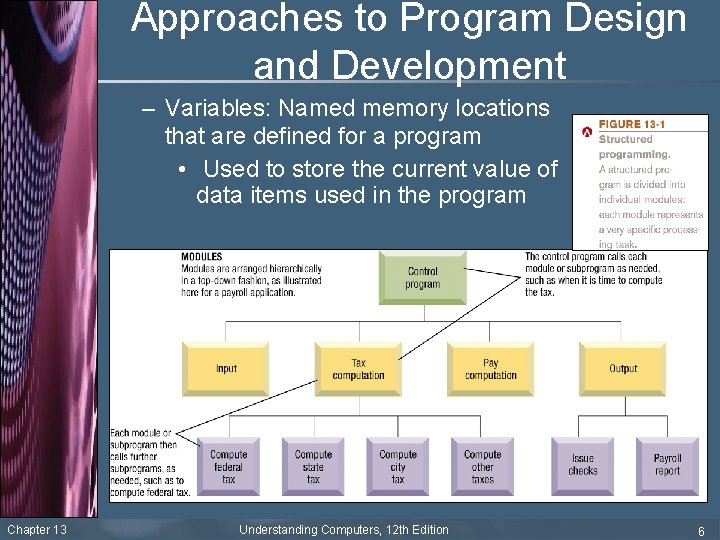
Approaches to Program Design and Development • Procedural programming: Focuses on the step-by-step instructions that tell the computer what to do – Uses procedures (modules, subprograms): Smaller sections of code that perform particular tasks – Allows each procedure to be performed as many times as needed without requiring multiple copies of code – Prior to procedural programming, programs were one large set of instructions containing statements that sent control to different parts of the program as needed (i. e. GOTO statements) – Structured programming: Breaks the program into small chunks • Top-down design Chapter 13 Understanding Computers, 12 th Edition 5
Approaches to Program Design and Development – Variables: Named memory locations that are defined for a program • Used to store the current value of data items used in the program Chapter 13 Understanding Computers, 12 th Edition 6
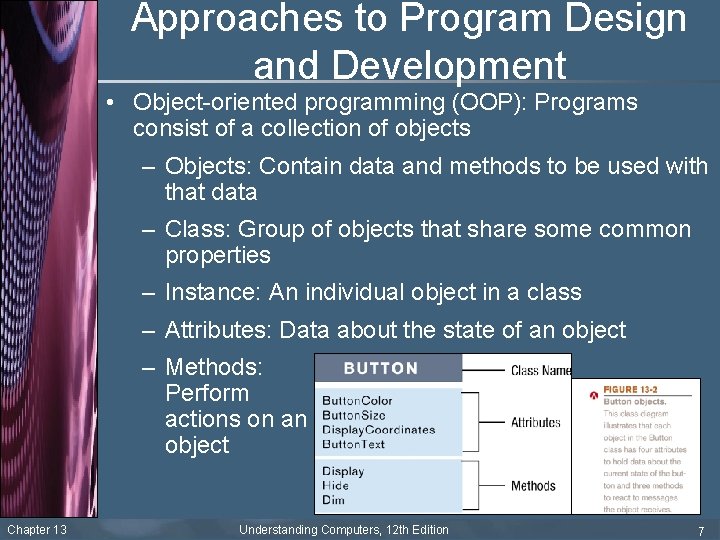
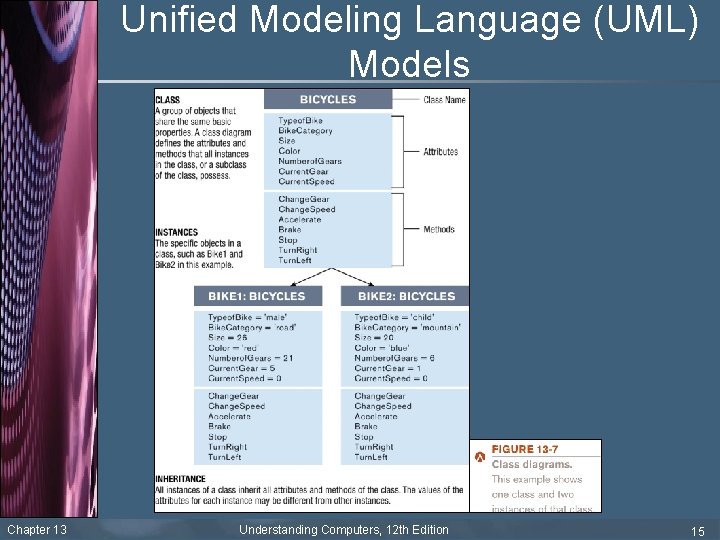
Approaches to Program Design and Development • Object-oriented programming (OOP): Programs consist of a collection of objects – Objects: Contain data and methods to be used with that data – Class: Group of objects that share some common properties – Instance: An individual object in a class – Attributes: Data about the state of an object – Methods: Perform actions on an object Chapter 13 Understanding Computers, 12 th Edition 7
Approaches to Program Design and Development • Aspect-oriented programming (AOP): Breaks program into small pieces that overlap in functionality as little as possible – Program components can be developed and modified individually, and easily reused • Adaptive software development: Designed to make program development faster and more efficient and focus on adapting the program as it is being written – Iterative: Cyclical approach that allows the repetition of steps and tasks as needed – Incremental: Developing one piece at a time – Includes RAD (rapid application development) and extreme programming (XP) – More recent adaptive software development approaches are called agile software development Chapter 13 Understanding Computers, 12 th Edition 8
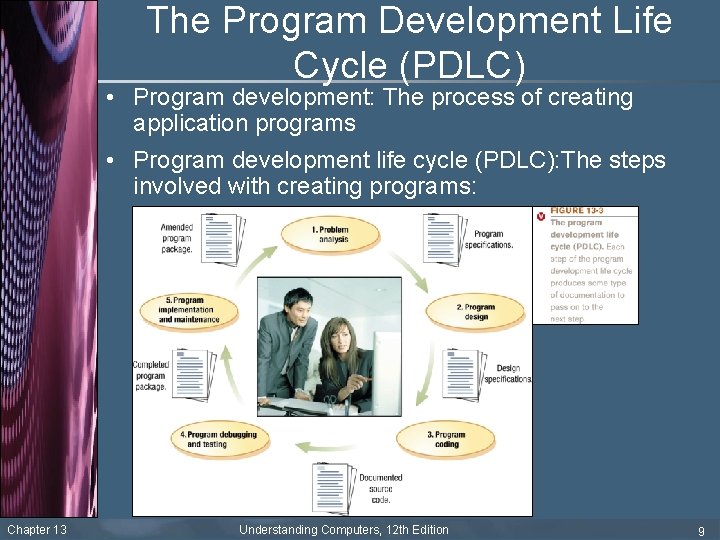
The Program Development Life Cycle (PDLC) • Program development: The process of creating application programs • Program development life cycle (PDLC): The steps involved with creating programs: Chapter 13 Understanding Computers, 12 th Edition 9
The Program Development Life Cycle (PDLC) • Problem analysis: The problem is considered and the program specifications are developed – Specifications developed during the SDLC are reviewed by the systems analyst and the programmer (the person who will code the program) – Goal: To understand the functions the software must perform – Documentation: Includes program specifications (what it does, timetable, programming language to be used, etc) Chapter 13 Understanding Computers, 12 th Edition 10
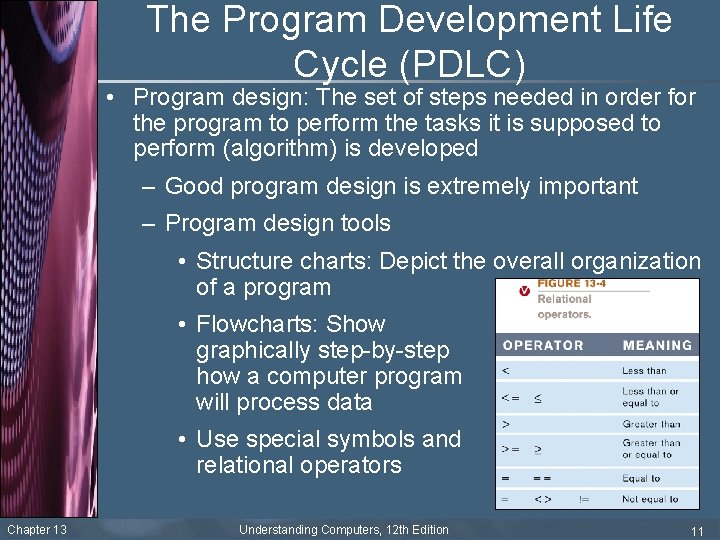
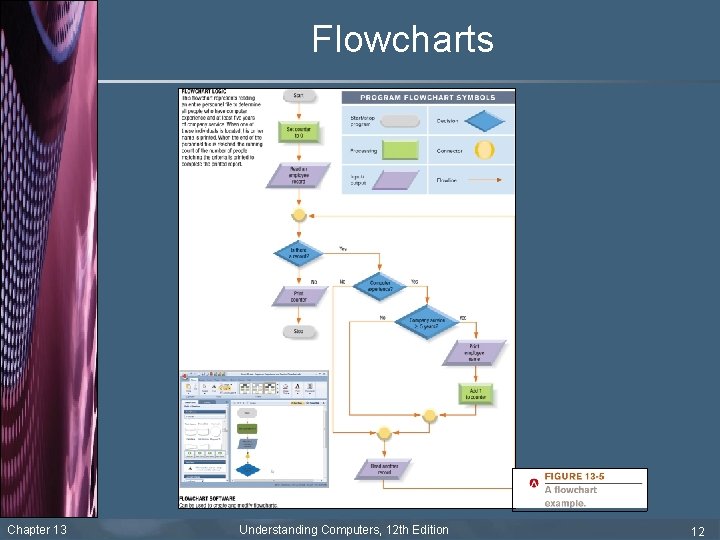
The Program Development Life Cycle (PDLC) • Program design: The set of steps needed in order for the program to perform the tasks it is supposed to perform (algorithm) is developed – Good program design is extremely important – Program design tools • Structure charts: Depict the overall organization of a program • Flowcharts: Show graphically step-by-step how a computer program will process data • Use special symbols and relational operators Chapter 13 Understanding Computers, 12 th Edition 11
Flowcharts Chapter 13 Understanding Computers, 12 th Edition 12
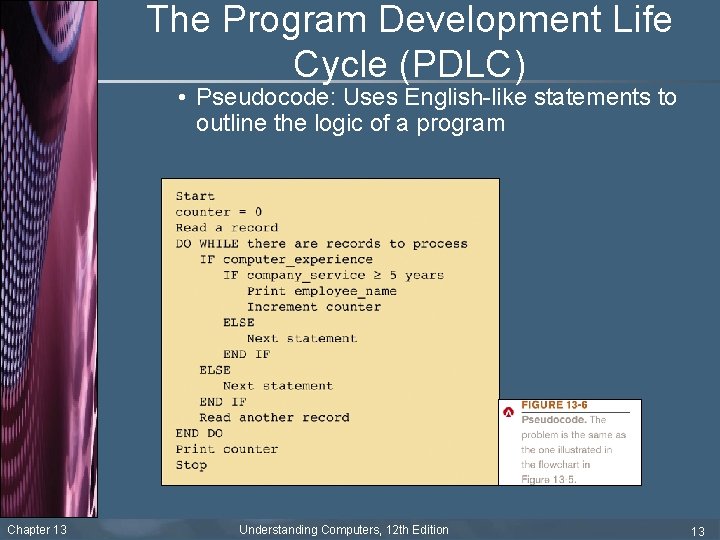
The Program Development Life Cycle (PDLC) • Pseudocode: Uses English-like statements to outline the logic of a program Chapter 13 Understanding Computers, 12 th Edition 13
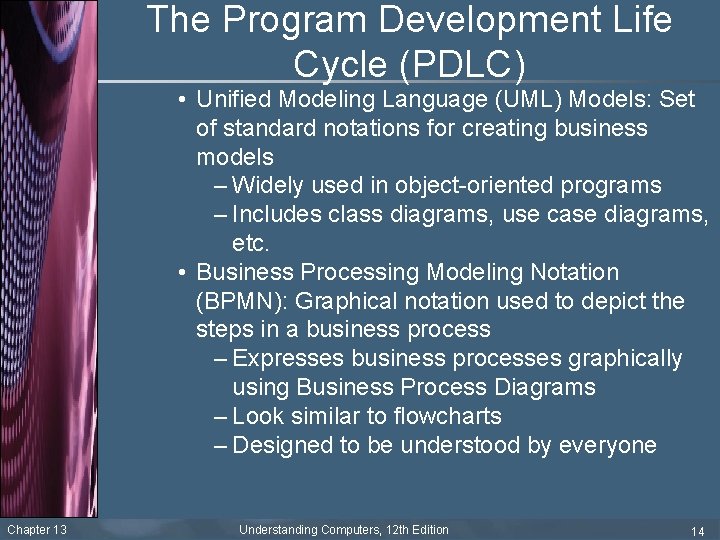
The Program Development Life Cycle (PDLC) • Unified Modeling Language (UML) Models: Set of standard notations for creating business models – Widely used in object-oriented programs – Includes class diagrams, use case diagrams, etc. • Business Processing Modeling Notation (BPMN): Graphical notation used to depict the steps in a business process – Expresses business processes graphically using Business Process Diagrams – Look similar to flowcharts – Designed to be understood by everyone Chapter 13 Understanding Computers, 12 th Edition 14
Unified Modeling Language (UML) Models Chapter 13 Understanding Computers, 12 th Edition 15
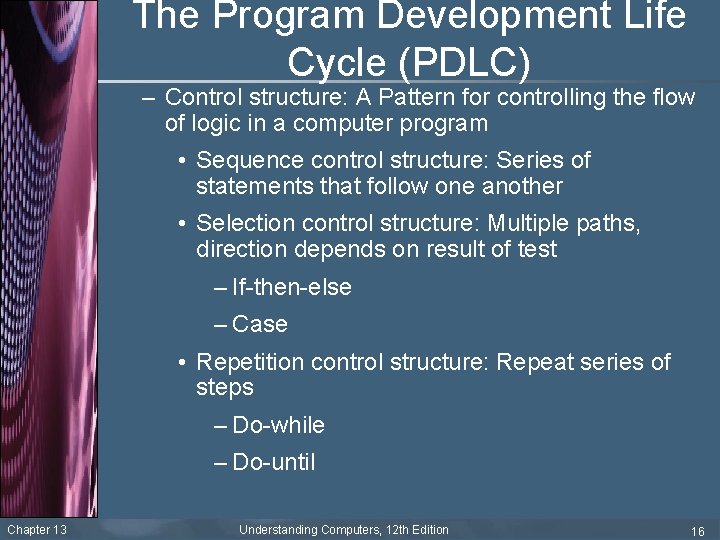
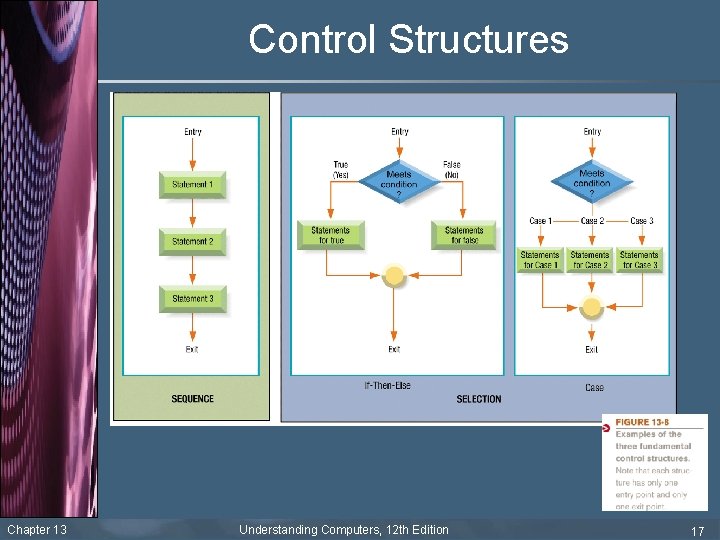
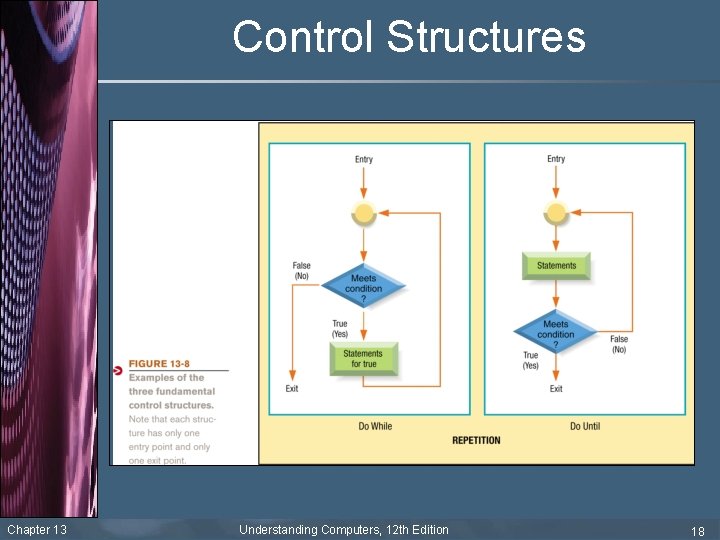
The Program Development Life Cycle (PDLC) – Control structure: A Pattern for controlling the flow of logic in a computer program • Sequence control structure: Series of statements that follow one another • Selection control structure: Multiple paths, direction depends on result of test – If-then-else – Case • Repetition control structure: Repeat series of steps – Do-while – Do-until Chapter 13 Understanding Computers, 12 th Edition 16
Control Structures Chapter 13 Understanding Computers, 12 th Edition 17
Control Structures Chapter 13 Understanding Computers, 12 th Edition 18
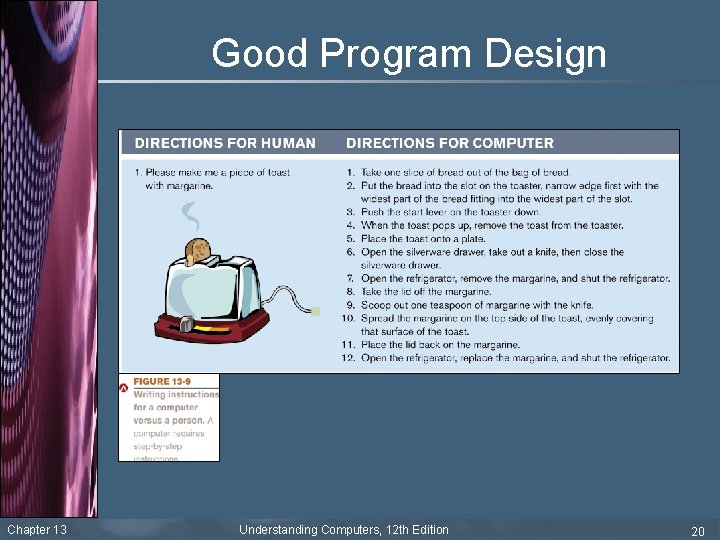
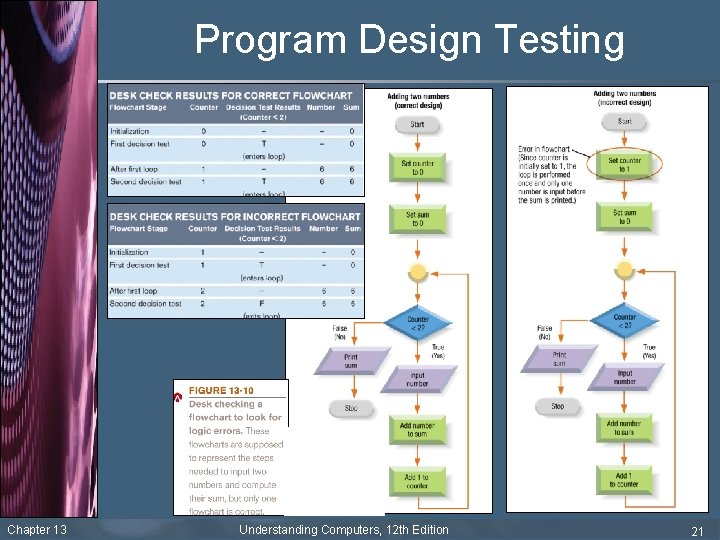
The Program Development Life Cycle (PDLC) – Good program design: • Saves time • Creates better programs – Good program design principles: • Be specific – All things the program must do need to be specified • One-entry-point/one-exit-point rule • No infinite loops or other logic errors – Infinite loop: Series of steps that repeat forever – Design should be tested to ensure logic is correct • Desk check; tracing tables – Documentation: Includes design specifications Chapter 13 Understanding Computers, 12 th Edition 19
Good Program Design Chapter 13 Understanding Computers, 12 th Edition 20
Program Design Testing Chapter 13 Understanding Computers, 12 th Edition 21
The Program Development Life Cycle (PDLC) • Program coding: The process of writing the programming language statements to create a computer program – When choosing a programming language, consider: • Suitability to the application • Integration with other programs • Standards for the company • Programmer availability • Portability if being run on multiple platforms • Development speed – Coding creates source code Chapter 13 Understanding Computers, 12 th Edition 22
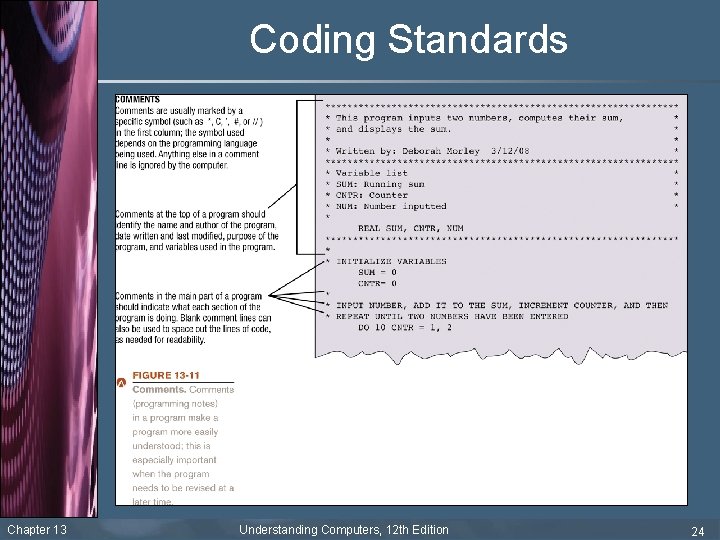
Coding Standards – Coding standards: A list of rules designed to standardize programming styles • Make programs more universally readable and easier to maintain • Includes the proper use of comments to: – Identify the programmer and last modification date – Explain variables used in the program – Identify the main parts of the program – Reusable code: Generic code segments that can be used over and over again with minor modifications • Can greatly reduce development time – Documentation: Includes documented source code Chapter 13 Understanding Computers, 12 th Edition 23
Coding Standards Chapter 13 Understanding Computers, 12 th Edition 24
The Program Development Life Cycle (PDLC) • Program debugging and testing: The process of ensuring a program is free of errors (bugs) and works as it is supposed to – Before they can be debugged, coded programs need to be translated into executable code • Source code: Coded program before it is compiled • Object code: Machine language version of a program • Language translator: Program that converts source code to machine language Chapter 13 Understanding Computers, 12 th Edition 25
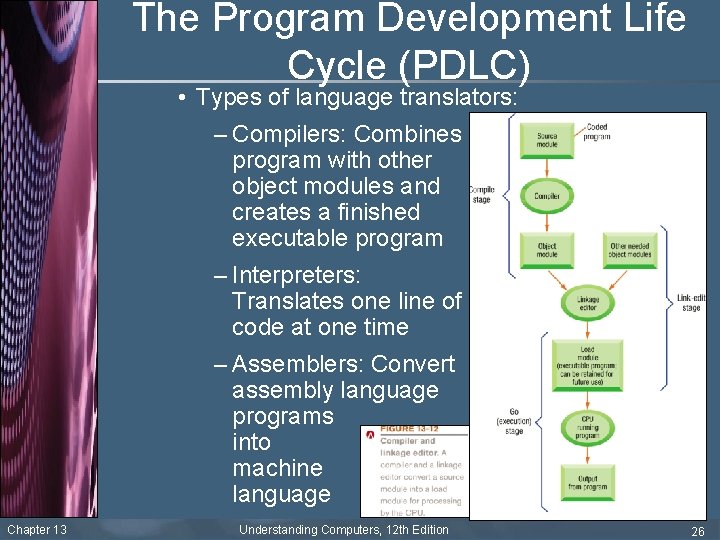
The Program Development Life Cycle (PDLC) • Types of language translators: – Compilers: Combines program with other object modules and creates a finished executable program – Interpreters: Translates one line of code at one time – Assemblers: Convert assembly language programs into machine language Chapter 13 Understanding Computers, 12 th Edition 26
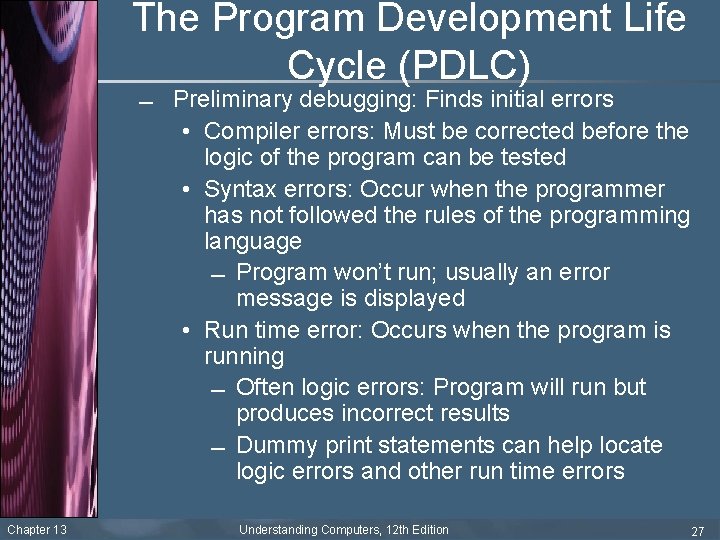
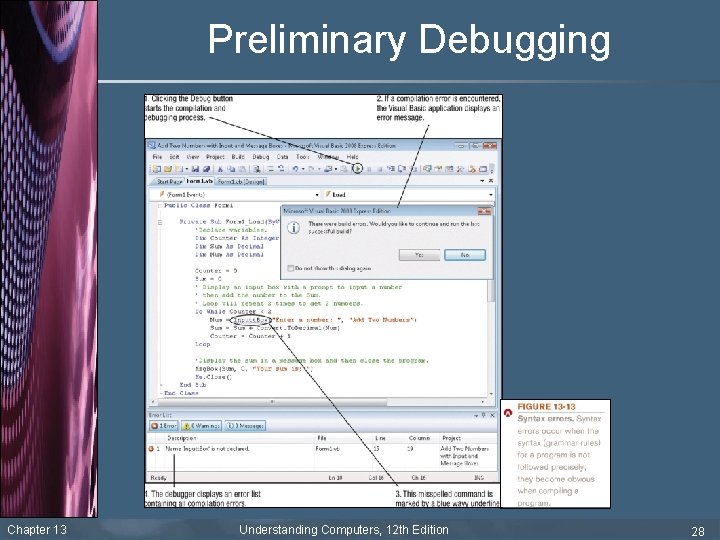
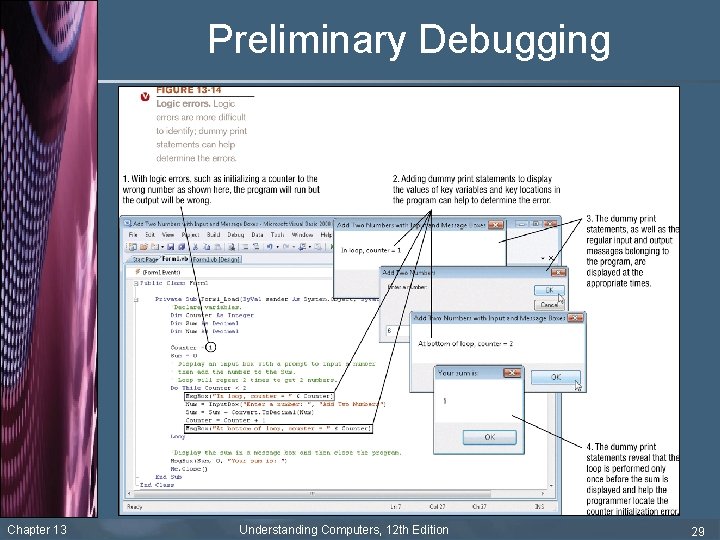
The Program Development Life Cycle (PDLC) Chapter 13 Preliminary debugging: Finds initial errors • Compiler errors: Must be corrected before the logic of the program can be tested • Syntax errors: Occur when the programmer has not followed the rules of the programming language Program won’t run; usually an error message is displayed • Run time error: Occurs when the program is running Often logic errors: Program will run but produces incorrect results Dummy print statements can help locate logic errors and other run time errors Understanding Computers, 12 th Edition 27
Preliminary Debugging Chapter 13 Understanding Computers, 12 th Edition 28
Preliminary Debugging Chapter 13 Understanding Computers, 12 th Edition 29
The Program Development Life Cycle (PDLC) – Testing occurs after the program appears to be correct to find any additional errors • Should use good test data • Tests conditions that will occur when the program is implemented • Should check for coding omissions (product quantity allowed to be < 0, etc. ) • Alpha test (inside organization) • Beta test (outside testers) – Documentation: Completed program package (user’s manual, description of software commands, troubleshooting guide to help with difficulties, etc. ) Chapter 13 Understanding Computers, 12 th Edition 30
The Program Development Life Cycle (PDLC) • Program implementation and maintenance: Installing and maintaining the program – Once the system containing the program is up and running, the implementation process is complete – Program maintenance: Process of updating software so it continues to be useful • Very costly – Documentation: Amended program package Chapter 13 Understanding Computers, 12 th Edition 31
Tools for Facilitating Program Development • Application Lifecycle Management (ALM): Creating and managing an application during its entire lifecycle, from design through testing – Tools include: • Requirements management: Keeping track of and managing the information needs of users – Requirements definition software – Requirements management software • Configuration management: Keeping track of the progress of a program development project • Program design tools to generate diagrams, code, etc. Chapter 13 Understanding Computers, 12 th Edition 32
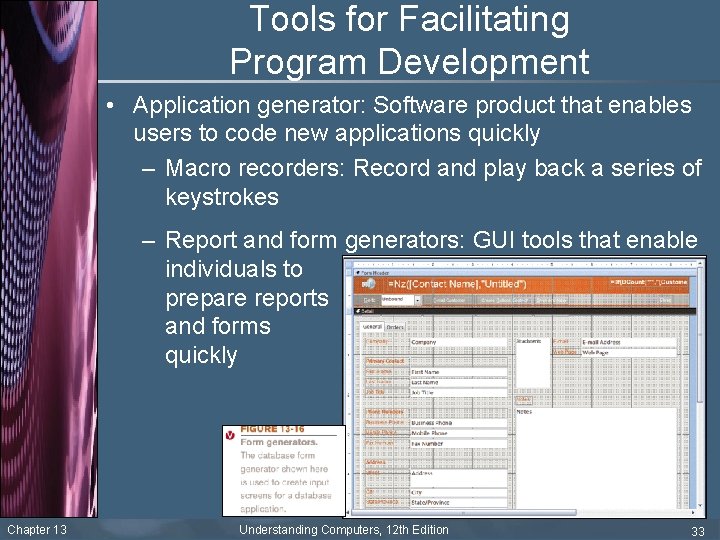
Tools for Facilitating Program Development • Application generator: Software product that enables users to code new applications quickly – Macro recorders: Record and play back a series of keystrokes – Report and form generators: GUI tools that enable individuals to prepare reports and forms quickly Chapter 13 Understanding Computers, 12 th Edition 33
Tools for Facilitating Program Development • Device software development tools: Assist with developing software to be used on devices, such as cars, ATM machines, consumer devices, etc • Software development kits (SDK): Programming package designed for a particular platform that enables programmers to develop applications more quickly and easily – Released by hardware or software companies (Microsoft, Apple, etc. ) • Application Program Interfaces (API): An interface designed to help applications interface with a particular operating system – Often used in conjunction with Web sites Chapter 13 Understanding Computers, 12 th Edition 34
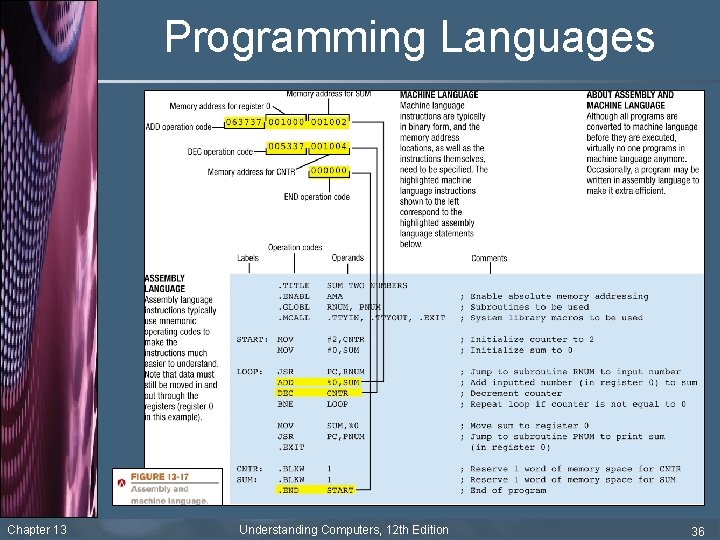
Programming Languages • Programming language: A set of rules used to write computer programs – To write a program, you need appropriate software for the programming language you will be using • Categories of programming languages – Low-level languages: Difficult to code in; machine dependent • Machine language: 1 s and 0 s • Assembly language: Includes some words and symbols Chapter 13 Understanding Computers, 12 th Edition 35
Programming Languages Chapter 13 Understanding Computers, 12 th Edition 36
Programming Languages – High-level languages: Closer to natural languages and so are easier to write in • Machine independent • Includes third-level procedural languages such as FORTRAN, BASIC, COBOL, Pascal, and C, as well as newer object-oriented languages such as Visual Basic, C++, C#, Python, Ruby, and Java – Fourth-generation languages (4 GLs): Even closer to natural languages and easier to work with than 3 GLs • Declarative rather than procedural • Includes structured query language (SQL) used with databases Chapter 13 Understanding Computers, 12 th Edition 37
Programming Languages – Natural programming languages: Users can communicate in their native language • Doesn’t have to follow program syntax • In the infancy stage – Visual programming languages: Uses a visual programming environment • User can use mouse and graphical interface and the code is automatically generated • Visual versions of many programming languages • Visual programming environment (VPE): Use visual elements to assist in program development but still require some coding Chapter 13 Understanding Computers, 12 th Edition 38
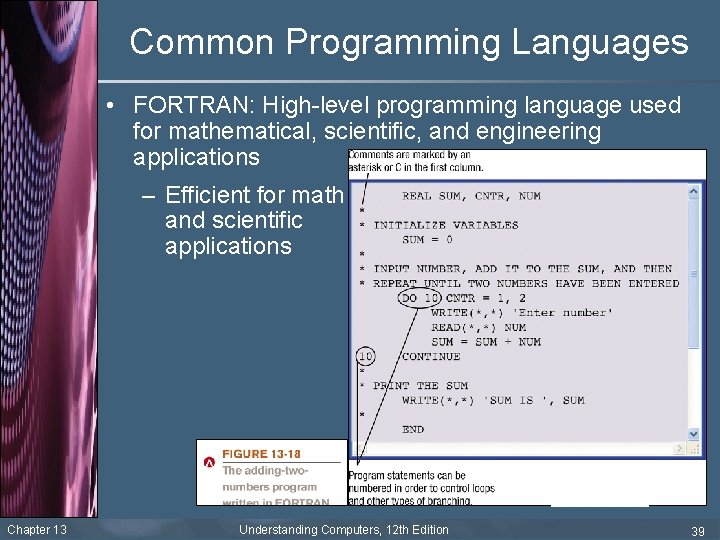
Common Programming Languages • FORTRAN: High-level programming language used for mathematical, scientific, and engineering applications – Efficient for math and scientific applications Chapter 13 Understanding Computers, 12 th Edition 39
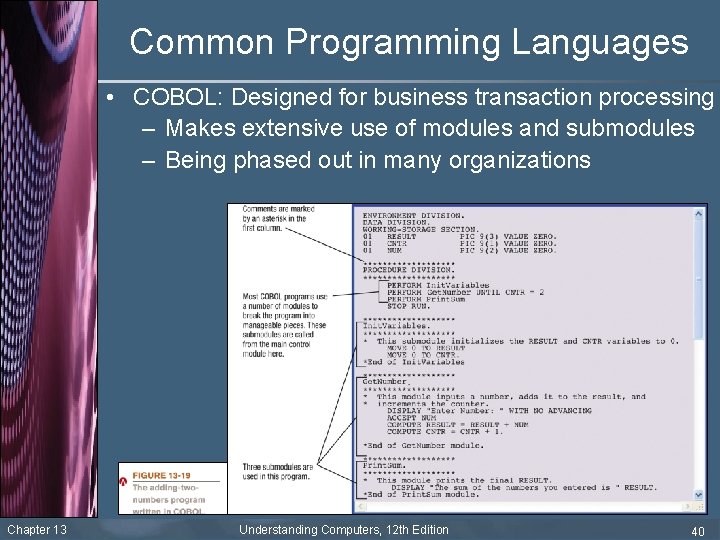
Common Programming Languages • COBOL: Designed for business transaction processing – Makes extensive use of modules and submodules – Being phased out in many organizations Chapter 13 Understanding Computers, 12 th Edition 40
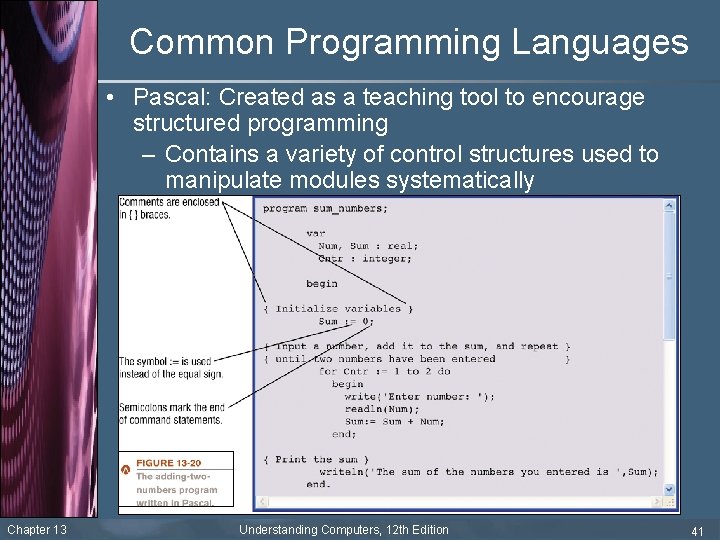
Common Programming Languages • Pascal: Created as a teaching tool to encourage structured programming – Contains a variety of control structures used to manipulate modules systematically Chapter 13 Understanding Computers, 12 th Edition 41
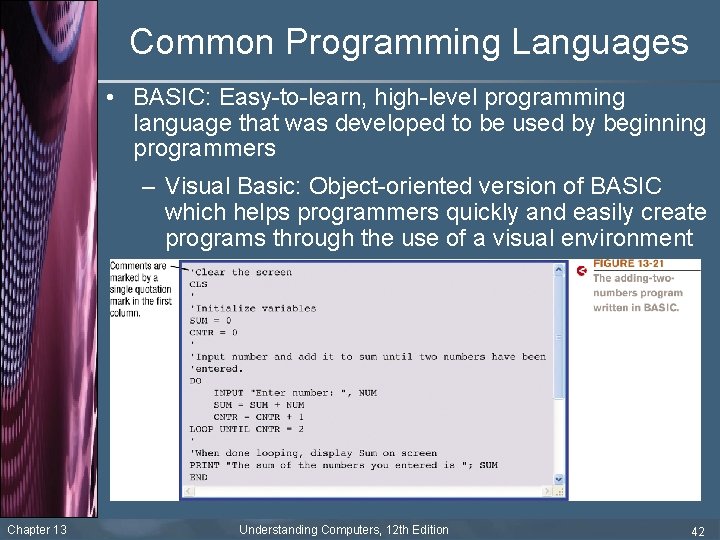
Common Programming Languages • BASIC: Easy-to-learn, high-level programming language that was developed to be used by beginning programmers – Visual Basic: Object-oriented version of BASIC which helps programmers quickly and easily create programs through the use of a visual environment Chapter 13 Understanding Computers, 12 th Edition 42
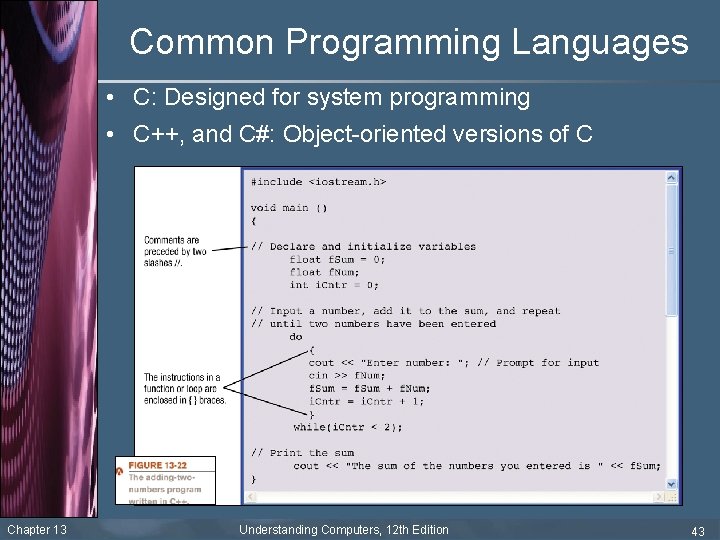
Common Programming Languages • C: Designed for system programming • C++, and C#: Object-oriented versions of C Chapter 13 Understanding Computers, 12 th Edition 43
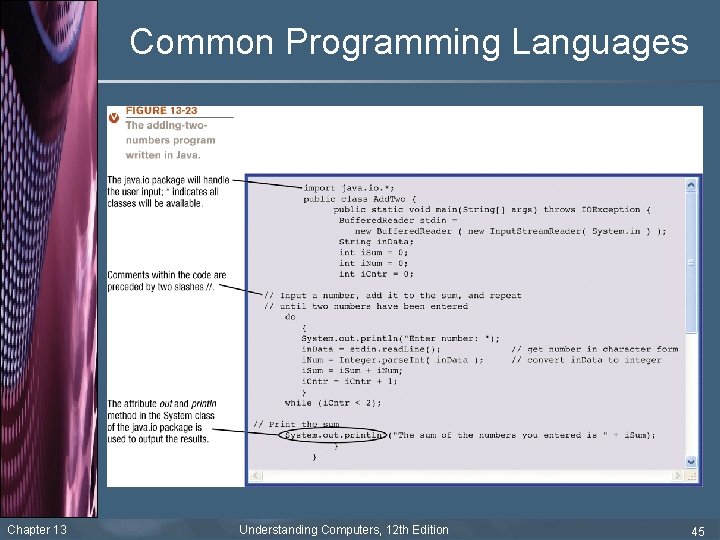
Common Programming Languages • Java: High-level, object-oriented programming language frequently used for Web-based applications – Platform independence is one of Java’s biggest advantages – Any operating system or browser that understands Java (compiled Java programs) can run Java bytecode applications – Is one of the most popular programming languages today – Can be used to write Java applets Chapter 13 Understanding Computers, 12 th Edition 44
Common Programming Languages Chapter 13 Understanding Computers, 12 th Edition 45
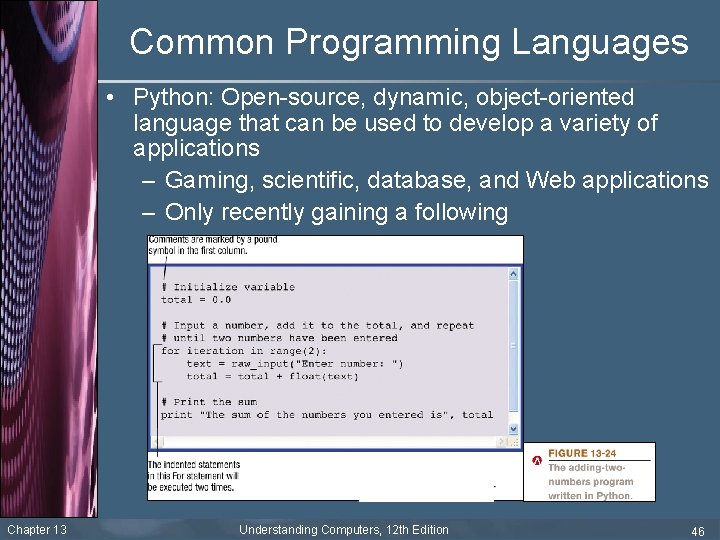
Common Programming Languages • Python: Open-source, dynamic, object-oriented language that can be used to develop a variety of applications – Gaming, scientific, database, and Web applications – Only recently gaining a following Chapter 13 Understanding Computers, 12 th Edition 46
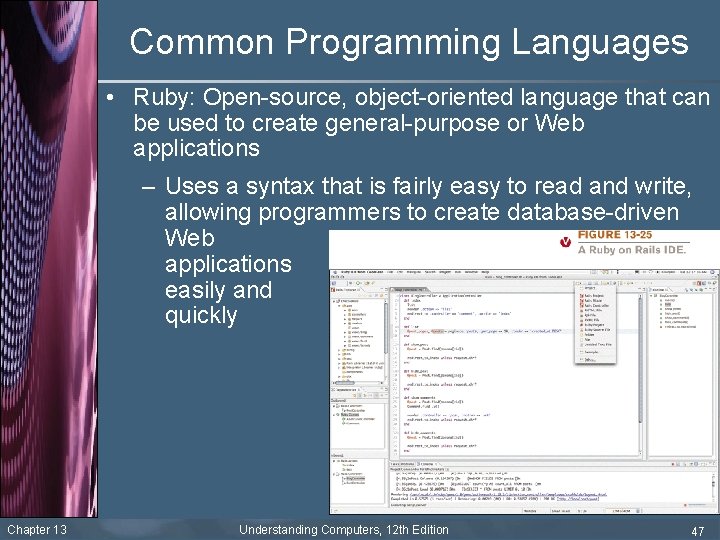
Common Programming Languages • Ruby: Open-source, object-oriented language that can be used to create general-purpose or Web applications – Uses a syntax that is fairly easy to read and write, allowing programmers to create database-driven Web applications easily and quickly Chapter 13 Understanding Computers, 12 th Edition 47
Summary • Approaches to Program Design and Development • The Program Development Life Cycle (PDLC) • Tools for Facilitating Program Development • Programming Languages Chapter 13 Understanding Computers, 12 th Edition 48