
UNDERSTANDING COMPETENCY AND THE RESTORATION PROCESS PETER TOLISANO
- Slides: 12
UNDERSTANDING COMPETENCY AND THE RESTORATION PROCESS PETER TOLISANO, PSY. D. , ABPP BOARD CERTIFIED IN CLINICAL PSYCHOLOGY DIRECTOR OF PSYCHOLOGY CONNECTICUT DEPARTMENT OF DEVELOPMENTAL SERVICES
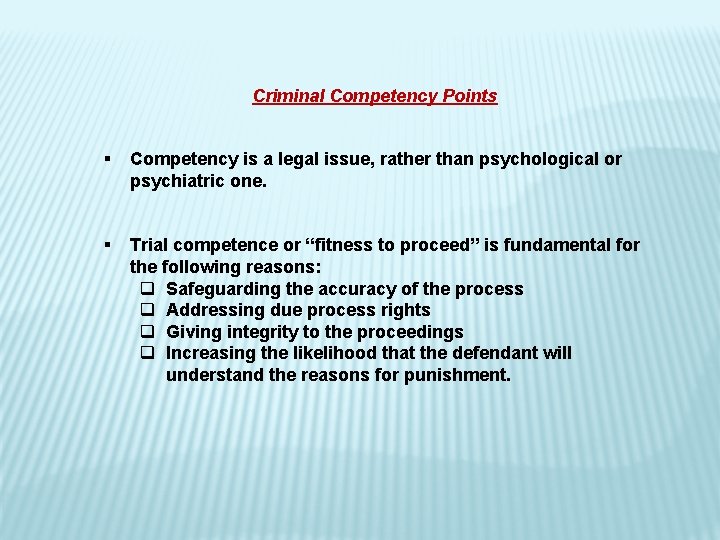
Criminal Competency Points Competency is a legal issue, rather than psychological or psychiatric one. Trial competence or “fitness to proceed” is fundamental for the following reasons: q Safeguarding the accuracy of the process q Addressing due process rights q Giving integrity to the proceedings q Increasing the likelihood that the defendant will understand the reasons for punishment.
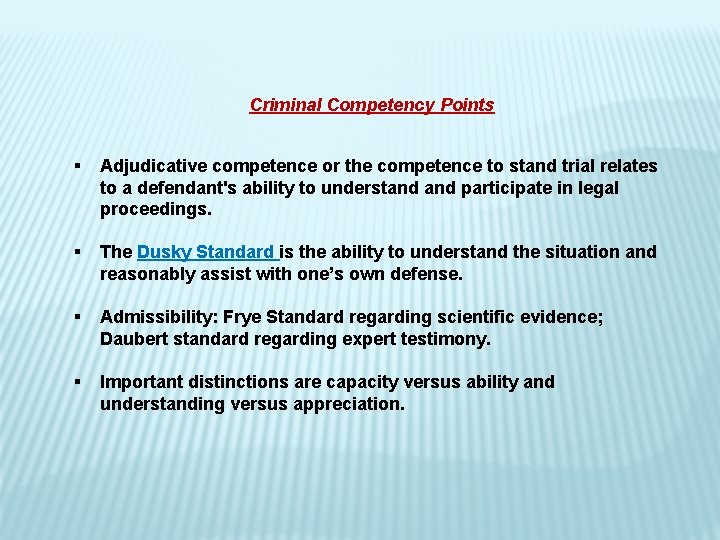
Criminal Competency Points Adjudicative competence or the competence to stand trial relates to a defendant's ability to understand participate in legal proceedings. The Dusky Standard is the ability to understand the situation and reasonably assist with one’s own defense. Admissibility: Frye Standard regarding scientific evidence; Daubert standard regarding expert testimony. Important distinctions are capacity versus ability and understanding versus appreciation.
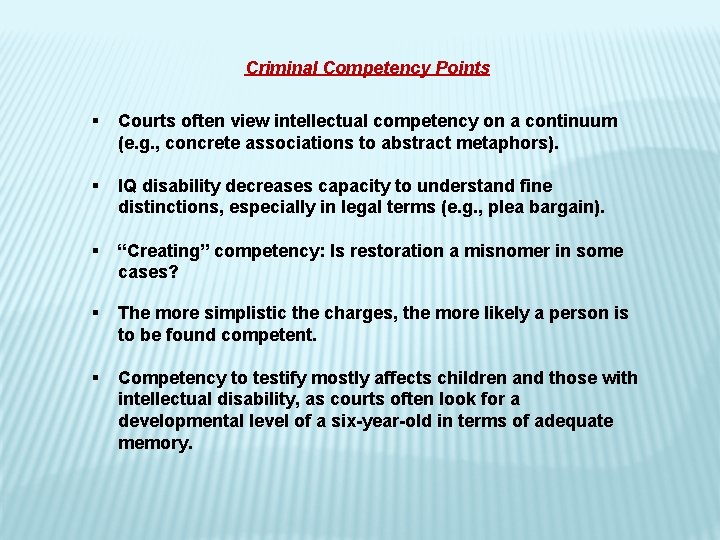
Criminal Competency Points Courts often view intellectual competency on a continuum (e. g. , concrete associations to abstract metaphors). IQ disability decreases capacity to understand fine distinctions, especially in legal terms (e. g. , plea bargain). “Creating” competency: Is restoration a misnomer in some cases? The more simplistic the charges, the more likely a person is to be found competent. Competency to testify mostly affects children and those with intellectual disability, as courts often look for a developmental level of a six-year-old in terms of adequate memory.
Criminal Competency Points Most common mistake is the misbelief that a clinical disorder, especially psychosis, equals incompetence. A diagnosis is generally irrelevant in the legal context and it is better to look at an individual’s functioning. Another key factor is decompensation under distress, especially due to personality-related issues.
Criminal Competency Points Most incompetent defendants have a thought disorder, intellectual disability, or organic brain damage. Disagreeing with or refusing treatment does not mean incompetence. As psychologists, our task is to inform the process. Opinions should not be based solely on testing results.
Five Keys to Competency for Individuals with Intellectual and Developmental Disabilities Video Available Module-Based Pre-and Post-Testable 1: Overview Objectives: Ø Understand what led to the arrest (i. e. , What the police allege that you did? ), as well as the person’s reactions and memories of the event. Ø Determine what the individual needs to know in order to proceed with a court hearing Ø Assist the individual to view restoration as an opportunity to learn to help themselves in court Ø Respect the individual’s privacy. 2. The People Objectives: Ø Help the individual to distinguish terminology (e. g. , defendant, defense attorney, prosecutor, witness, testify, jury, and judge) and define the associated roles. Ø Visual techniques (e. g. , diagrams, television, and movies) 3. The Truth Objectives: Ø Explaining the events in their own words Ø Why is the truth important?
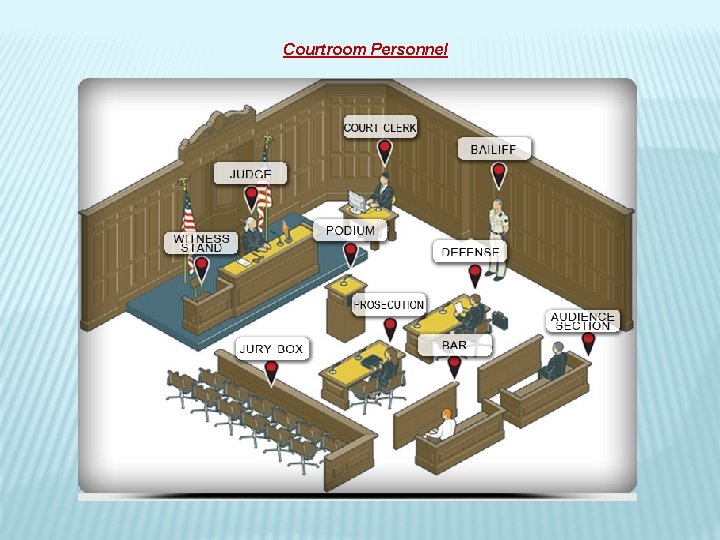
Courtroom Personnel
Five Keys to Competency for Individuals with Intellectual and Developmental Disabilities 4: Definitions Objectives: Ø Learning key words and phrases, such as oath, perjury, charges, evidence, and proof. 5: Definitions Continued Objectives: Ø Comprehend and discuss key terms including contempt, courtroom demeanor, plea bargain, sentence, jail vs. prison, and probation. Ø Demonstrate the difference between guilt and innocence 6: You and Your Defense Attorney Objectives: Ø Learn the five rules to assist with one’s defense (e. g. , cooperate, truthfulness, remember, pay attention, and behave).
Restoration Process • Most cases will include collateral information about the arrest, as well as a report from the Office of Forensic/Court Evaluations describing the person’s competence and the recommendation for restoration. � Assessment prior to restoration may include brief intelligence measures, a mental status exam, a clinical interview. � Tests of malingering (cognitive and/or psychiatric) may be administered after the process is underway if poor or inconsistent effort is observed. � The competency trainer has the discretion to choose the materials used for training. The competency trainer should keep track of training dates, the time spent in each session, the general attitude of the individual, and note any special techniques that were necessary for training. � A brief report describing the training process should be provided to the person generating the competency assessment. The report should contain information about the total number of sessions, the dates of each session, the training time spent per session, pre- and post-test scores, as well as the concepts learned adequately versus incorrectly.
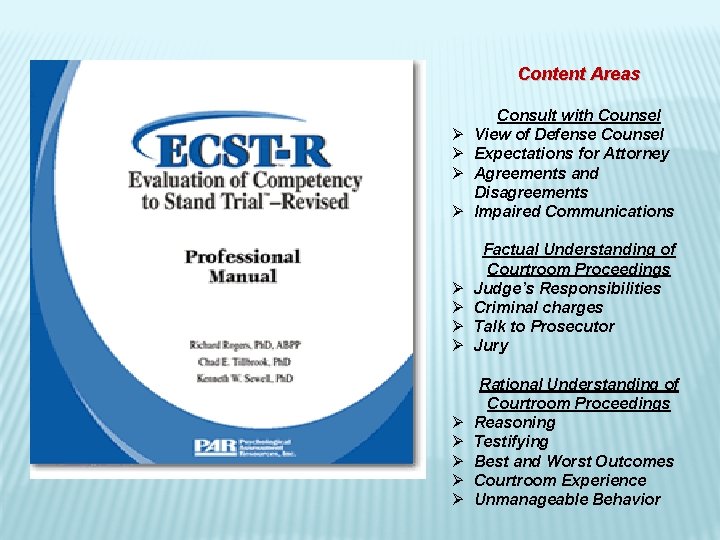
Content Areas Ø Consult with Counsel View of Defense Counsel Expectations for Attorney Agreements and Disagreements Impaired Communications Ø Ø Factual Understanding of Courtroom Proceedings Judge’s Responsibilities Criminal charges Talk to Prosecutor Jury Ø Ø Ø Rational Understanding of Courtroom Proceedings Reasoning Testifying Best and Worst Outcomes Courtroom Experience Unmanageable Behavior Ø Ø Ø