
UNDERSTANDING CLINICAL TERMINOLOGY the language of science Word

- Slides: 29
UNDERSTANDING CLINICAL TERMINOLOGY: the language of science
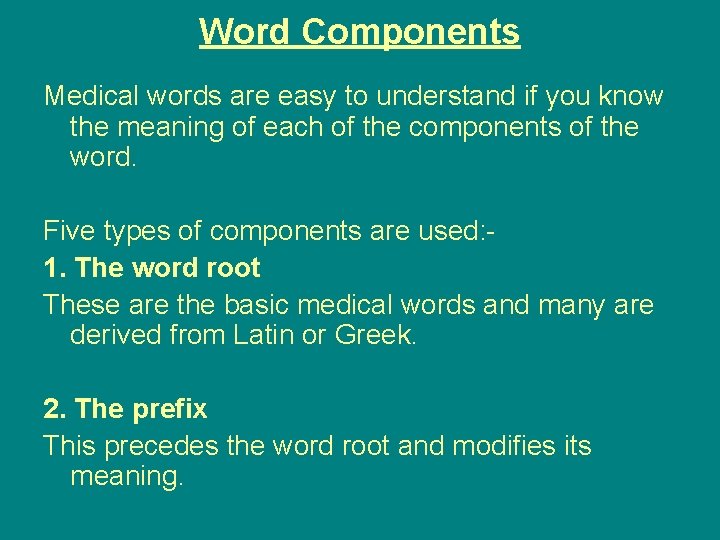
Word Components Medical words are easy to understand if you know the meaning of each of the components of the word. Five types of components are used: 1. The word root These are the basic medical words and many are derived from Latin or Greek. 2. The prefix This precedes the word root and modifies its meaning.
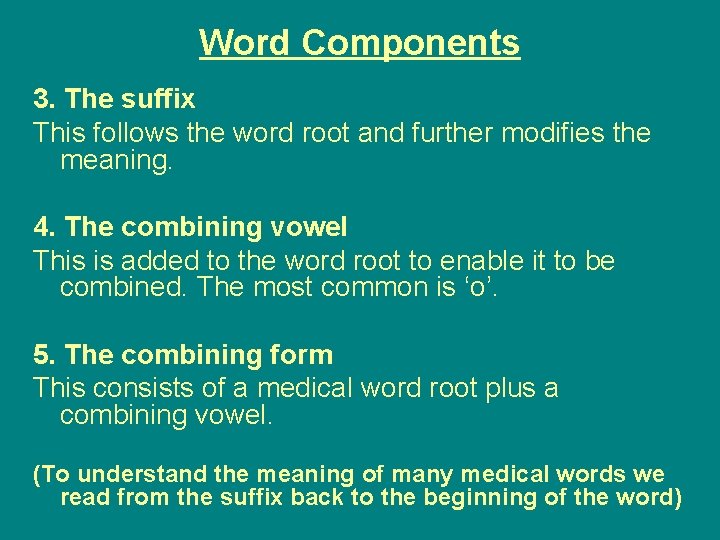
Word Components 3. The suffix This follows the word root and further modifies the meaning. 4. The combining vowel This is added to the word root to enable it to be combined. The most common is ‘o’. 5. The combining form This consists of a medical word root plus a combining vowel. (To understand the meaning of many medical words we read from the suffix back to the beginning of the word)
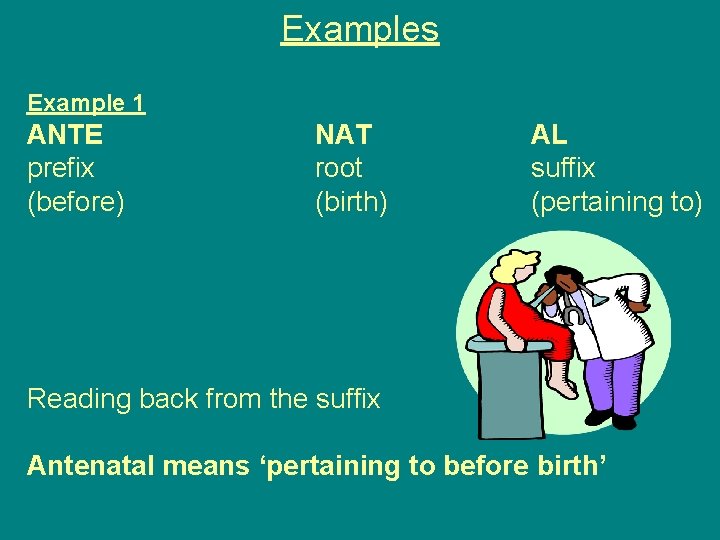
Examples Example 1 ANTE prefix (before) NAT root (birth) AL suffix (pertaining to) Reading back from the suffix Antenatal means ‘pertaining to before birth’
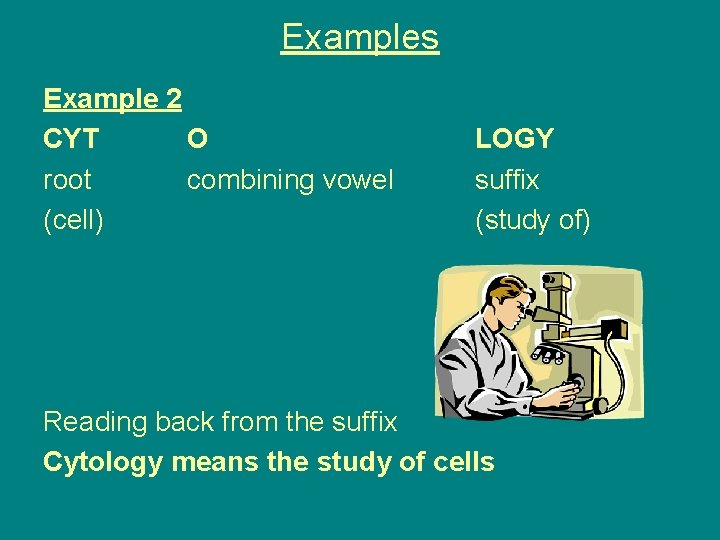
Examples Example 2 CYT O root combining vowel (cell) LOGY suffix (study of) Reading back from the suffix Cytology means the study of cells
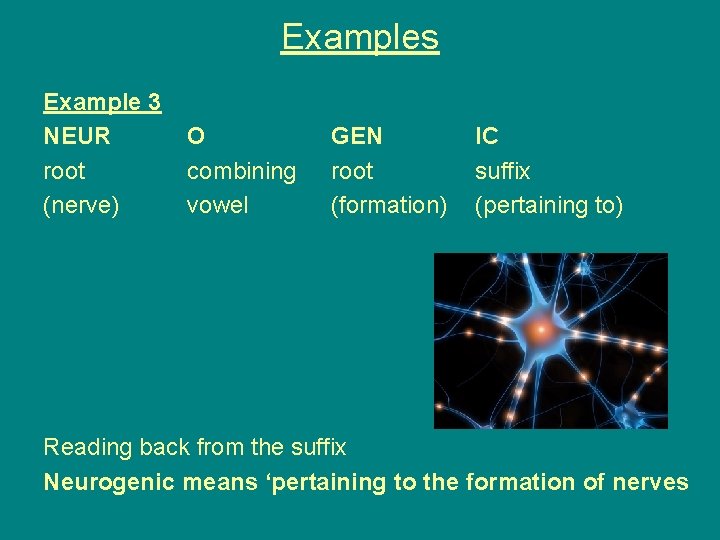
Examples Example 3 NEUR root (nerve) O combining vowel GEN root (formation) IC suffix (pertaining to) Reading back from the suffix Neurogenic means ‘pertaining to the formation of nerves
Exercises State the meaning of the following words: CYTOPATHY = Disease of cell/s LEUCOCYTE = White cell ERYTHROCYTE = Red cell MELANOCYTE = Melanin cell OOCYTE = Egg cell
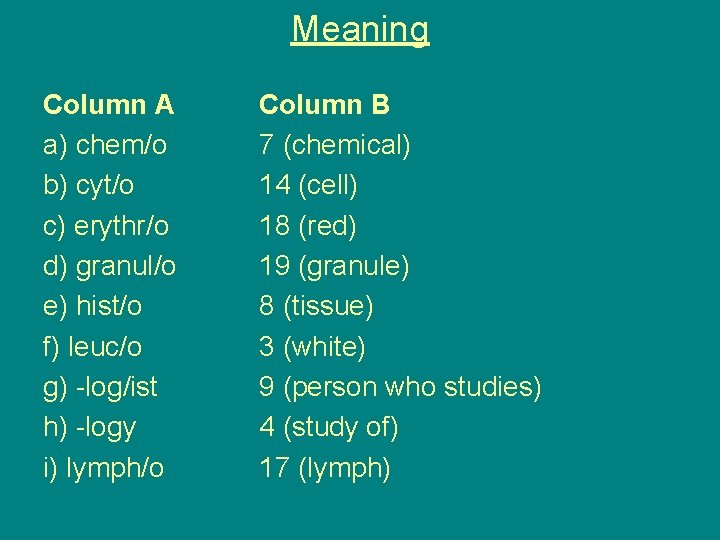
Meaning Column A a) chem/o b) cyt/o c) erythr/o d) granul/o e) hist/o f) leuc/o g) -log/ist h) -logy i) lymph/o Column B 7 (chemical) 14 (cell) 18 (red) 19 (granule) 8 (tissue) 3 (white) 9 (person who studies) 4 (study of) 17 (lymph)
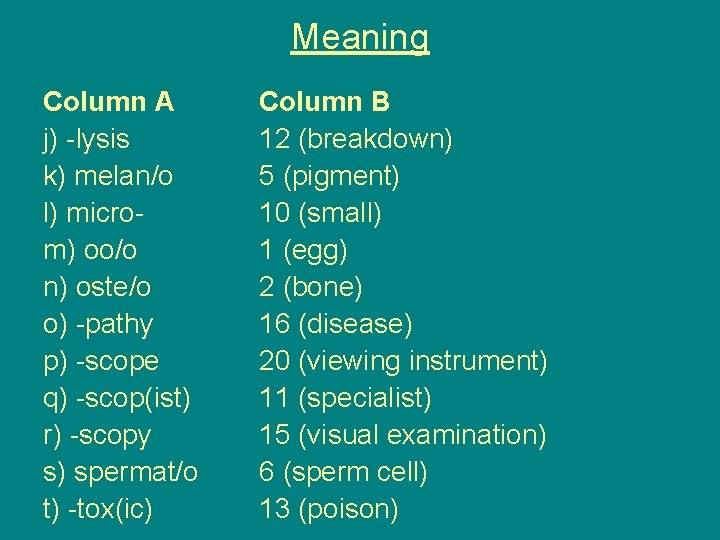
Meaning Column A j) -lysis k) melan/o l) microm) oo/o n) oste/o o) -pathy p) -scope q) -scop(ist) r) -scopy s) spermat/o t) -tox(ic) Column B 12 (breakdown) 5 (pigment) 10 (small) 1 (egg) 2 (bone) 16 (disease) 20 (viewing instrument) 11 (specialist) 15 (visual examination) 6 (sperm cell) 13 (poison)
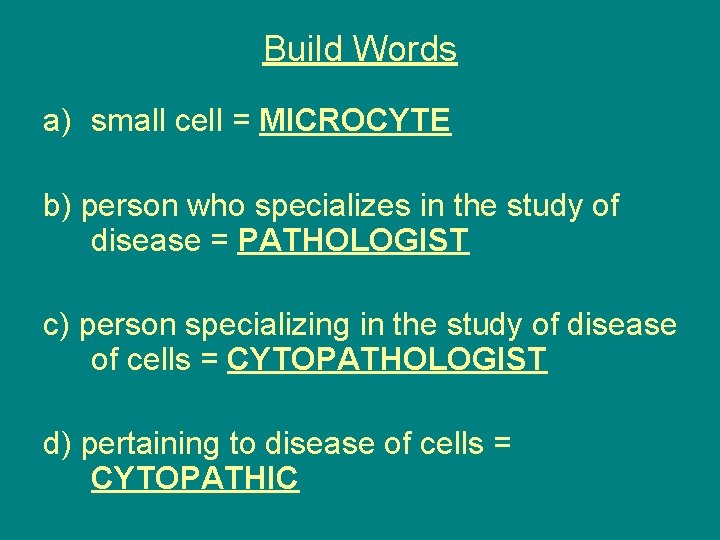
Build Words a) small cell = MICROCYTE b) person who specializes in the study of disease = PATHOLOGIST c) person specializing in the study of disease of cells = CYTOPATHOLOGIST d) pertaining to disease of cells = CYTOPATHIC
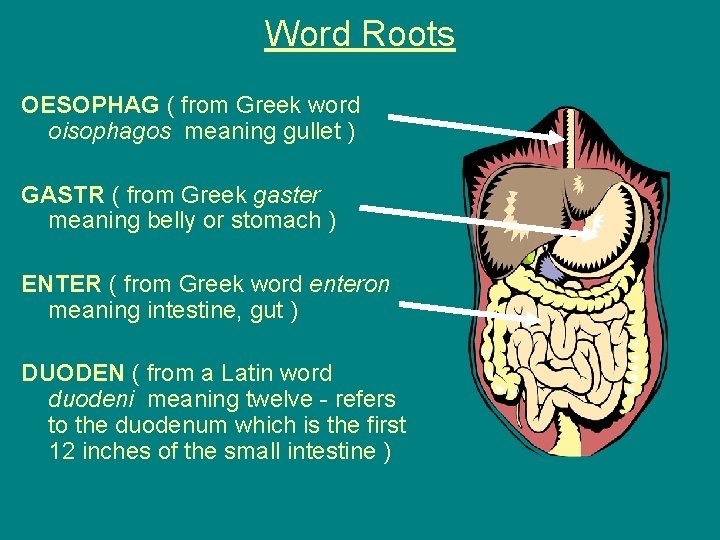
Word Roots OESOPHAG ( from Greek word oisophagos meaning gullet ) GASTR ( from Greek gaster meaning belly or stomach ) ENTER ( from Greek word enteron meaning intestine, gut ) DUODEN ( from a Latin word duodeni meaning twelve - refers to the duodenum which is the first 12 inches of the small intestine )
Suffixes Find the meaning of the suffixes -scope, ectomy, -tomy and -itis and write the meaning of: Oesophagitis ? Gastroscope ? Enterotomy ? Duodenectomy ?
What is the meaning of … • ACROPHOBIA • ADRENOCORTICAL • AGORAPHOBIA • ANAESTHESIA • ANALGESIA • ATAXIA • BALANITIS
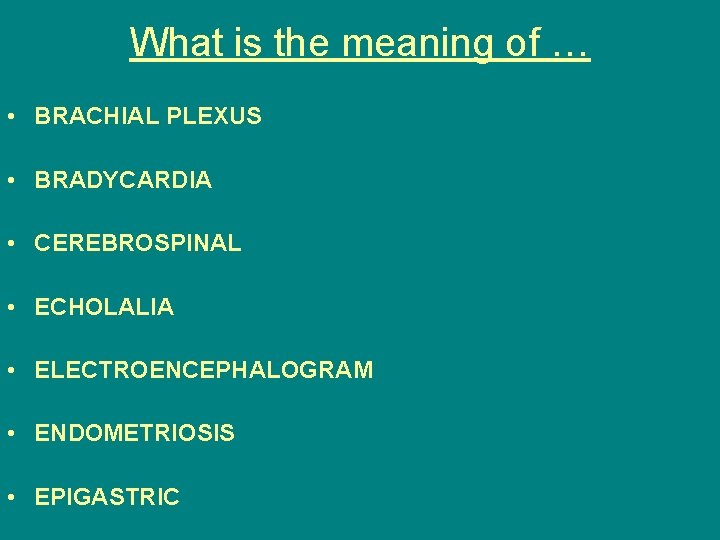
What is the meaning of … • BRACHIAL PLEXUS • BRADYCARDIA • CEREBROSPINAL • ECHOLALIA • ELECTROENCEPHALOGRAM • ENDOMETRIOSIS • EPIGASTRIC
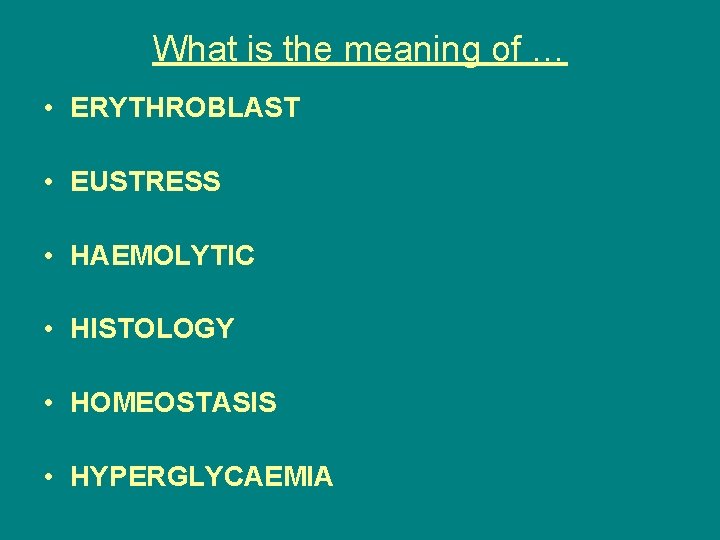
What is the meaning of … • ERYTHROBLAST • EUSTRESS • HAEMOLYTIC • HISTOLOGY • HOMEOSTASIS • HYPERGLYCAEMIA
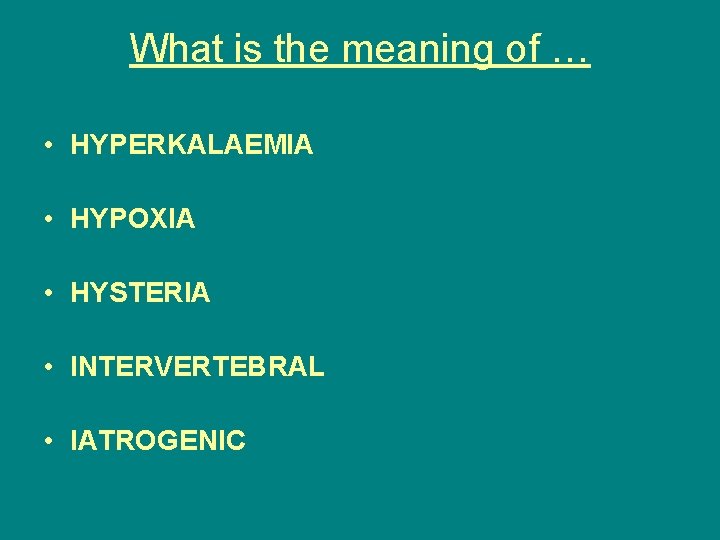
What is the meaning of … • HYPERKALAEMIA • HYPOXIA • HYSTERIA • INTERVERTEBRAL • IATROGENIC
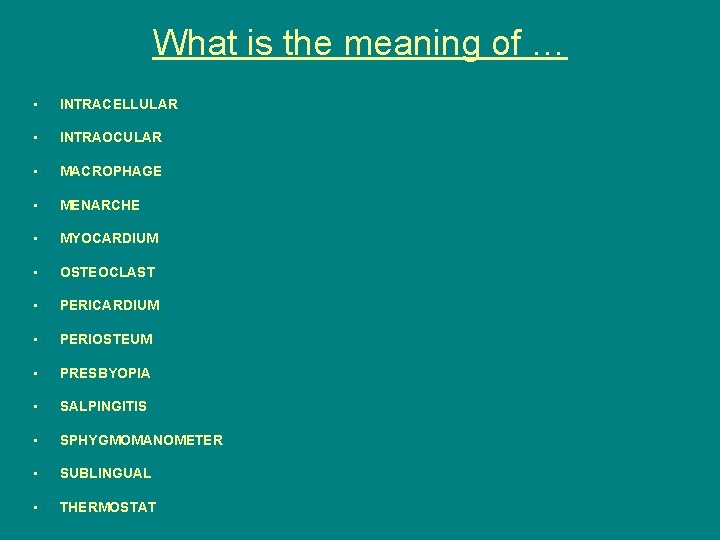
What is the meaning of … • INTRACELLULAR • INTRAOCULAR • MACROPHAGE • MENARCHE • MYOCARDIUM • OSTEOCLAST • PERICARDIUM • PERIOSTEUM • PRESBYOPIA • SALPINGITIS • SPHYGMOMANOMETER • SUBLINGUAL • THERMOSTAT
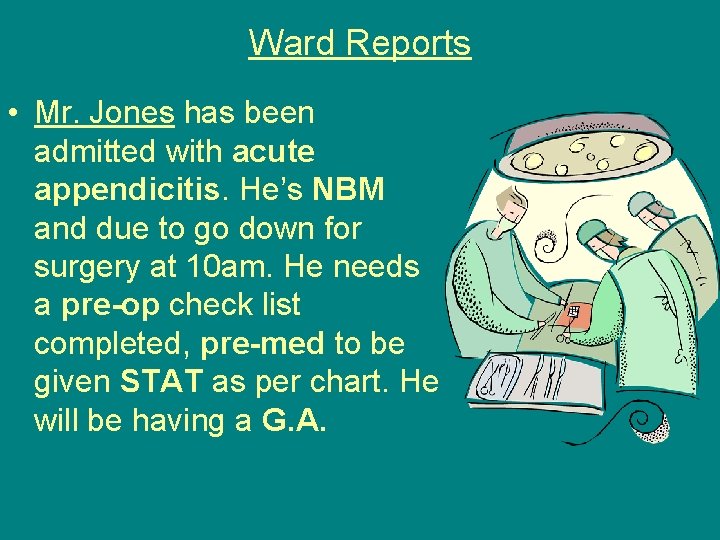
Ward Reports • Mr. Jones has been admitted with acute appendicitis. He’s NBM and due to go down for surgery at 10 am. He needs a pre-op check list completed, pre-med to be given STAT as per chart. He will be having a G. A.
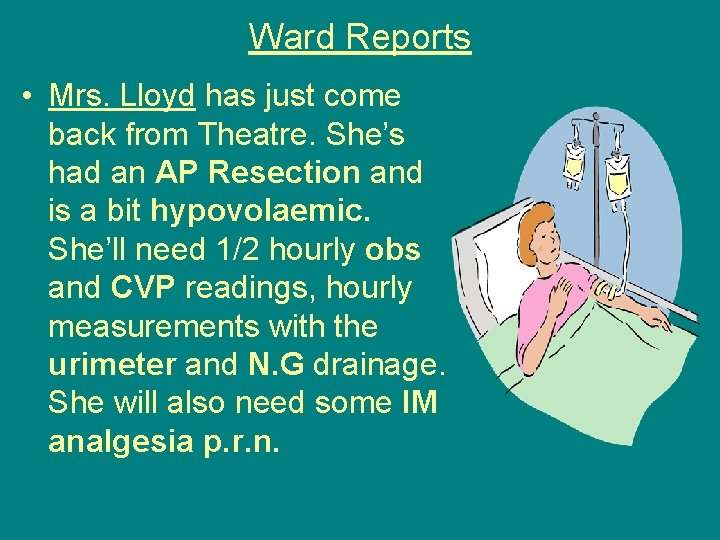
Ward Reports • Mrs. Lloyd has just come back from Theatre. She’s had an AP Resection and is a bit hypovolaemic. She’ll need 1/2 hourly obs and CVP readings, hourly measurements with the urimeter and N. G drainage. She will also need some IM analgesia p. r. n.
Ward Report • Mr. Smith has been complaining of balanitis and has been taking antibiotics. He has now developed some general erythema.
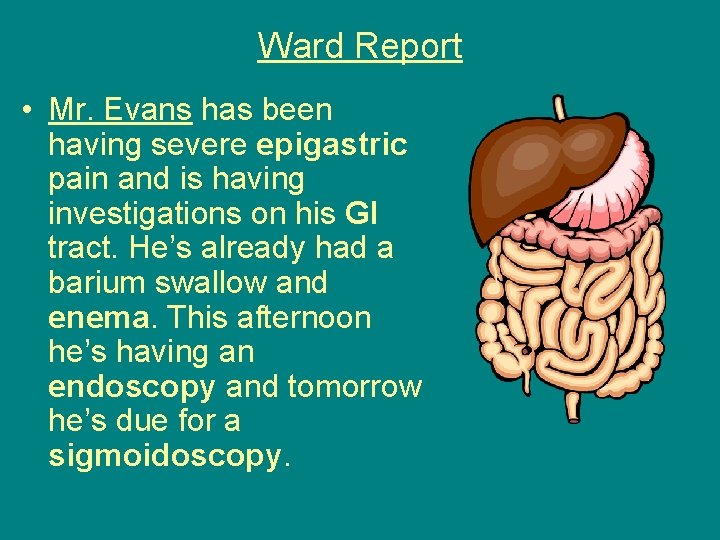
Ward Report • Mr. Evans has been having severe epigastric pain and is having investigations on his GI tract. He’s already had a barium swallow and enema. This afternoon he’s having an endoscopy and tomorrow he’s due for a sigmoidoscopy.
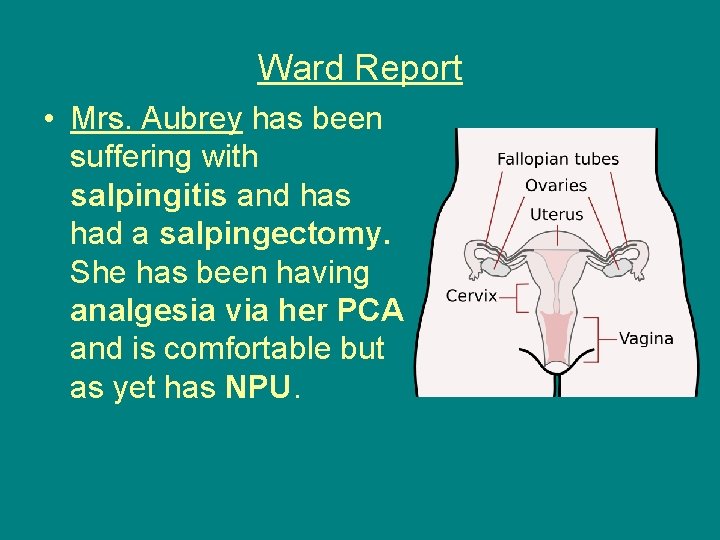
Ward Report • Mrs. Aubrey has been suffering with salpingitis and has had a salpingectomy. She has been having analgesia via her PCA and is comfortable but as yet has NPU.
Ward Report • Mrs. Jenner has been complaining of pruritis in the vulval area following her hysterectomy. The doctor is due to see her mane.
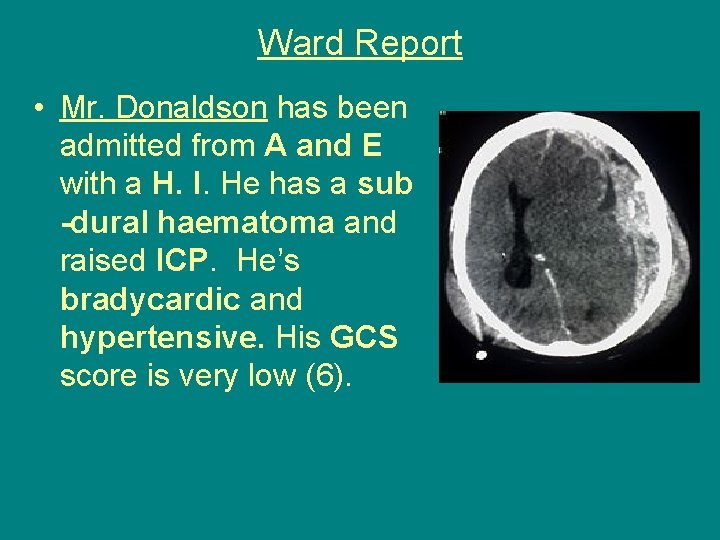
Ward Report • Mr. Donaldson has been admitted from A and E with a H. I. He has a sub -dural haematoma and raised ICP. He’s bradycardic and hypertensive. His GCS score is very low (6).
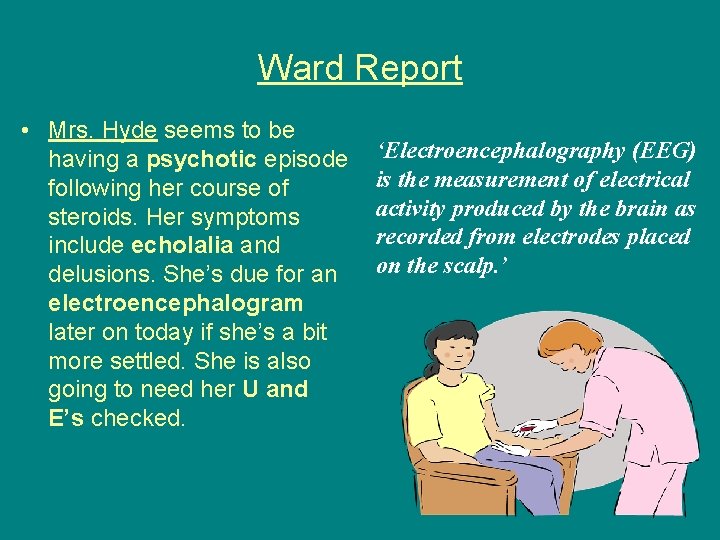
Ward Report • Mrs. Hyde seems to be having a psychotic episode following her course of steroids. Her symptoms include echolalia and delusions. She’s due for an electroencephalogram later on today if she’s a bit more settled. She is also going to need her U and E’s checked. ‘Electroencephalography (EEG) is the measurement of electrical activity produced by the brain as recorded from electrodes placed on the scalp. ’
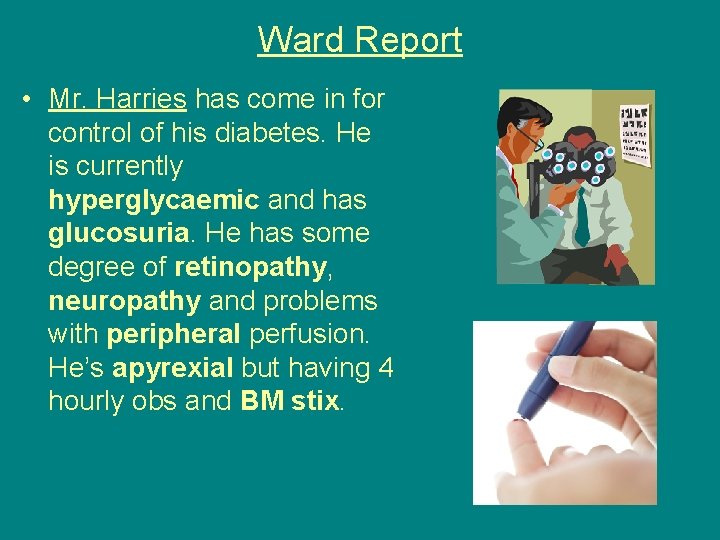
Ward Report • Mr. Harries has come in for control of his diabetes. He is currently hyperglycaemic and has glucosuria. He has some degree of retinopathy, neuropathy and problems with peripheral perfusion. He’s apyrexial but having 4 hourly obs and BM stix.
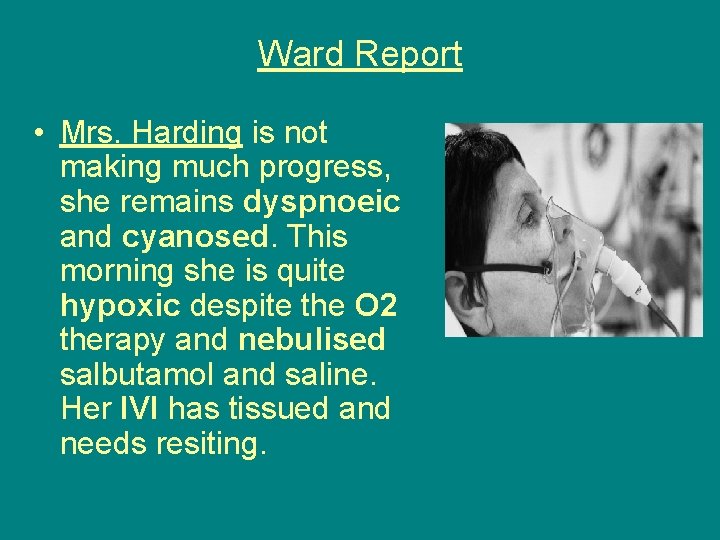
Ward Report • Mrs. Harding is not making much progress, she remains dyspnoeic and cyanosed. This morning she is quite hypoxic despite the O 2 therapy and nebulised salbutamol and saline. Her IVI has tissued and needs resiting.
Ward Report • Mr. Noakes had an M. I. 2 days ago. He’s just come to us from CCU. He’ll be having a repeat 12 lead ECG following further chest pain unrelieved by his sublingual GTN.
Ward Report • Mrs. Head has had a CVA with a R hemiplegia. She is dysphasic as well as dysphagic. She is NBM, having aspirated and appears to also have quite a bad UTI with dysuria and frequency. We’ll need to send an MSU and sputum specimens for C and S.