
Understanding class definitions Part II Main concepts to




- Slides: 13
Understanding class definitions – Part II –
Main concepts to be covered • • mutator and accessor methods conditional statements local variables string concatenation Objects First with Java - A Practical Introduction using Blue. J, © David J. Barnes, Michael Kölling
Reflecting on the ticket machines • Their behaviour is inadequate in several ways: • No checks on the amounts entered. • No refunds. • No checks for a sensible initialisation. • How can we do better? • We need more sophisticated behaviour. Objects First with Java - A Practical Introduction using Blue. J, © David J. Barnes, Michael Kölling
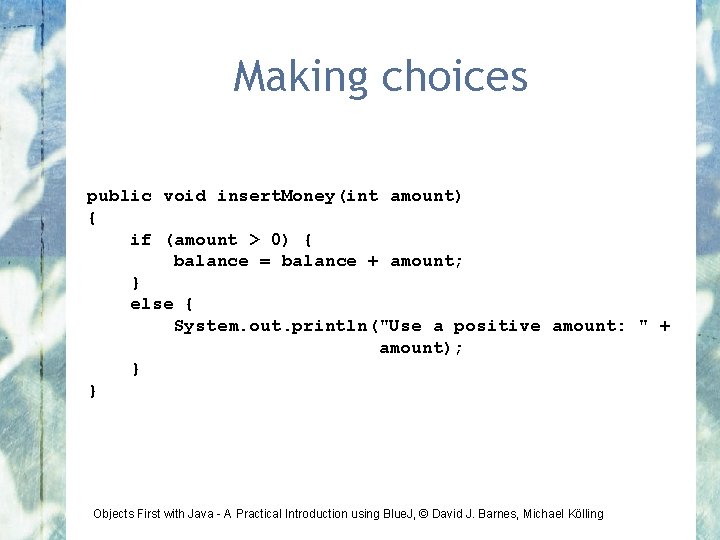
Making choices public void insert. Money(int amount) { if (amount > 0) { balance = balance + amount; } else { System. out. println("Use a positive amount: " + amount); } } Objects First with Java - A Practical Introduction using Blue. J, © David J. Barnes, Michael Kölling
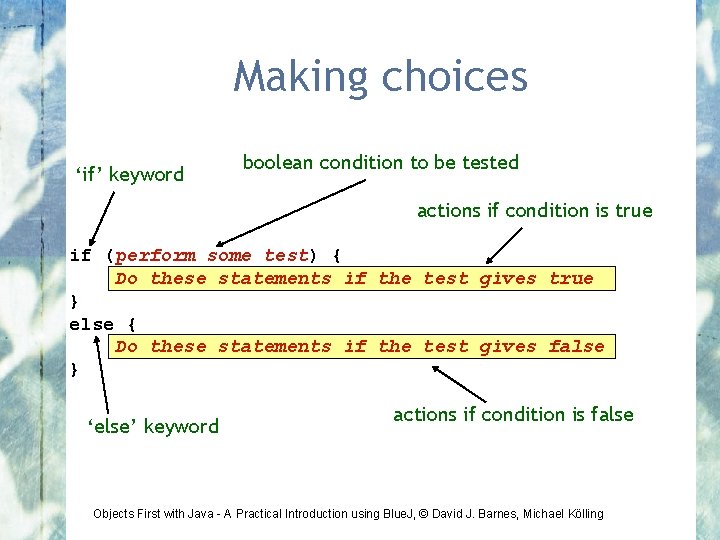
Making choices ‘if’ keyword boolean condition to be tested actions if condition is true if (perform some test) { Do these statements if the test gives true } else { Do these statements if the test gives false } ‘else’ keyword actions if condition is false Objects First with Java - A Practical Introduction using Blue. J, © David J. Barnes, Michael Kölling
How do we write 'refund. Balance'? Objects First with Java - A Practical Introduction using Blue. J, © David J. Barnes, Michael Kölling
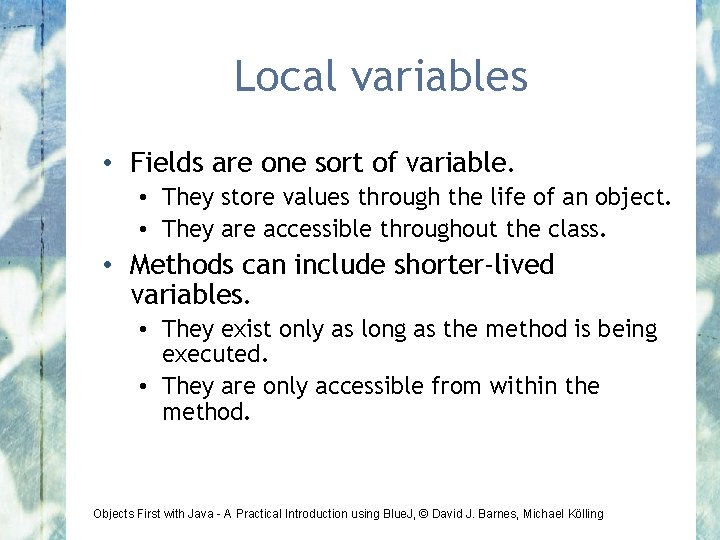
Local variables • Fields are one sort of variable. • They store values through the life of an object. • They are accessible throughout the class. • Methods can include shorter-lived variables. • They exist only as long as the method is being executed. • They are only accessible from within the method. Objects First with Java - A Practical Introduction using Blue. J, © David J. Barnes, Michael Kölling
Scope and life time • The scope of a local variable is the block it is declared in. • The lifetime of a local variable is the time of execution of the block it is declared in. Objects First with Java - A Practical Introduction using Blue. J, © David J. Barnes, Michael Kölling
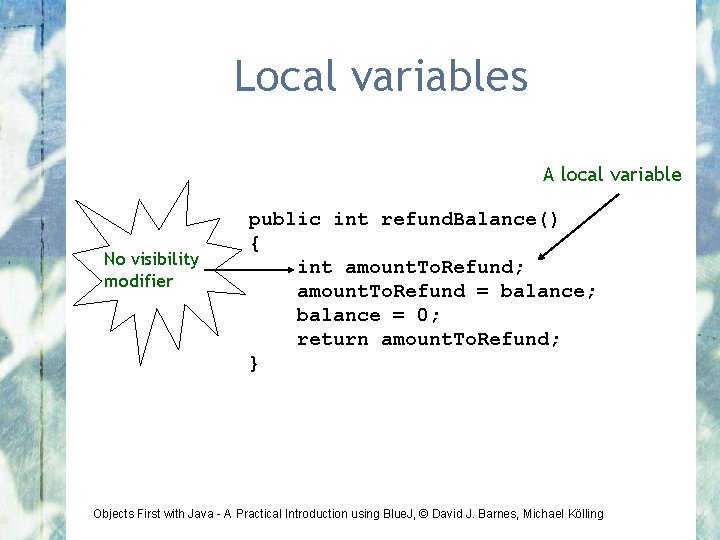
Local variables A local variable No visibility modifier public int refund. Balance() { int amount. To. Refund; amount. To. Refund = balance; balance = 0; return amount. To. Refund; } Objects First with Java - A Practical Introduction using Blue. J, © David J. Barnes, Michael Kölling
Review • Class bodies contain fields, constructors and methods. • Fields store values that determine an object’s state. • Constructors initialise objects. • Methods implement the behaviour of objects. Objects First with Java - A Practical Introduction using Blue. J, © David J. Barnes, Michael Kölling
Review • Fields, parameters and local variables are all variables. • Fields persist for the lifetime of an object. • Parameters are used to receive values into a constructor or method. • Local variables are used for short-lived temporary storage. Objects First with Java - A Practical Introduction using Blue. J, © David J. Barnes, Michael Kölling
Review • Objects can make decisions via conditional (if) statements. • A true or false test allows one of two alternative courses of actions to be taken. Objects First with Java - A Practical Introduction using Blue. J, © David J. Barnes, Michael Kölling