
Understanding Child Development Rosalind Charlesworth Ph D 10




- Slides: 29
Understanding Child Development Rosalind Charlesworth Ph. D. 10 th Edition © 2017 Cengage Learning. All Rights Reserved.
Chapter 1 Chapter 6 Infant Cognitive and Affective Development © 2017 Cengage Learning. All Rights Reserved.
Infant Cognitive Learning and Development • Developmental biodynamics – Research designed to consider in detail the processes that relate to sensory and motor development • Cognitive Development – Changes in cognitive structure and functioning that may take place over time © 2017 Cengage Learning. All Rights Reserved.
Piaget’s Six Substages of Sensorimotor Development (slide 1 of 2) • Basic reflexes (birth to two months): Inborn reflexes make first connections to the world. • Primary circular reactions (two to five months): Infant discovers connections within own body by chance and repeats them. • Secondary circular reactions (six to nine months): Actions connecting infant with the environment are repeated. © 2017 Cengage Learning. All Rights Reserved.
Piaget’s Six Substages of Sensorimotor Development (slide 2 of 2) • Coordination of secondary circular reactions (10 -12 months): goal-directed behavior • Tertiary circular reactions (12 -18 months): uses secondary circular reactions as the means to solve new problems. • Invention of new means through mental combinations (18 -24 months): Infant solves problems and thinks through a solution before acting. © 2017 Cengage Learning. All Rights Reserved.
Sensorimotor Abilities • Object permanence: knowledge that objects continue to exist even when one is not seeing, hearing, or feeling them – Begins to develop at about eight months and is completely developed by about middle of second year • Object recognition: sensorimotor ability to identify objects by their features – Acquired at about 16 weeks © 2017 Cengage Learning. All Rights Reserved.
Categorization • Enables the ability to sort and group items according to similar attributes. • Infants can recognize categories such human faces, birds and dogs. (Bjorklund & Blasi, 2012). • The face category is one of the most complex that is learned during the first year. © 2017 Cengage Learning. All Rights Reserved.
Planning and Object Manipulation • Infants are capable of some primitive planning behaviors by the age of 9 months. • Presented with a problem, they can develop a solution. • Object manipulation – Fingering the surface of, looking at, and transferring an object from hand to explore it. It is dependent on the infants ability to reach, grasp, explore, and problem-solve. (Lobo & Galloway, 2008) © 2017 Cengage Learning. All Rights Reserved.
Communication, Language, and Literacy Development • • • Birth: infant enjoys sounds One month: develops differentiated cries Three months: cooing Seven to eight months: babbling 10 months: imitates speech One year: meaningful speech begins © 2017 Cengage Learning. All Rights Reserved.
Media • Media can support language development if watched with an active, involved adult. • On average, infants begin watching videos at about six months. • About half of parents report engaging in language activities while watching videos with babies. © 2017 Cengage Learning. All Rights Reserved.
Literacy Beginners: Birth to 3 • Appropriate literacy activities for infants include: – – Listening to books; labeling illustrations Turning pages Holding books and examining pictures Mouthing and exploring books © 2017 Cengage Learning. All Rights Reserved.
Brain Development During Infancy • Brain research: Studies that have looked at how the brain functions. • Brain lateralization: development of both left- and right-brain functions and communication between the two. – Past beliefs were that right side recognizes negative emotions faster and left side recognizes positive emotions faster. – Current research indicates optimal development involves communication between both. © 2017 Cengage Learning. All Rights Reserved.
Gender Differences • Male brains tend to be more lateralized and operate more independently. • Girls tend to use two hemispheres more equally during speaking and navigating the environment. • Female infants tend to be more advanced in the sensory areas, to be more socially advanced and ahead in language and motor skills. • Boys tend to catch up by age three and to be ahead of girls in visual-spatial integration and hand-eye coordination. © 2017 Cengage Learning. All Rights Reserved.
Conclusions from Brain Research • Experience has profound implications on development and learning. • Warmth, continuity, love, and respect enhance development. • Development continues throughout the life span. © 2017 Cengage Learning. All Rights Reserved.
Brain Development: A Cautionary Note in Infancy • The focus on brain development research by the media has made parents rush to obtain materials that they believe will make their children smarter. • In the 1990 s, word spread that classical music would enhance infant intelligence. • This was labeled The Mozart Effect and proved to be a myth. • Special toys and classes are not essential—warmth, continuity of care, love and respect are the essential developmental support for cognitive, social and physical development. © 2017 Cengage Learning. All Rights Reserved.
Social Referencing and Play • Social referencing: process used by infants to gain information from others to understand evaluate a situation and behave appropriately. – Positive affect of others promotes positive behaviors towards novel objects. – Negative affect promotes avoidance. – Gaining information from others to apply it to a new situation is essential in order to gain from life experiences. © 2017 Cengage Learning. All Rights Reserved.
Play • Major vehicle for cognitive and motor development – Sensorimotor intelligence develops as infants actively learn. – Advancing memory, motor coordination, and language allow older infants to begin to engage in symbolic play. – Adults can support infant play by taking on a role and providing toys and materials. © 2017 Cengage Learning. All Rights Reserved.
Adult-Infant Interactions • Stages of Early Interaction (Brazelton & Cramer, 1990) • Emerging competencies: gain control of ability to maintain attention (0 -10 days) • Prolonging attention: maintaining communication and interaction (one to eight weeks) • Limit-testing period: infant/adult test abilities to communicate and affect one another (three to four months) • Emergence of autonomy: infant takes the lead in the interactions with adults (four to five months) © 2017 Cengage Learning. All Rights Reserved.
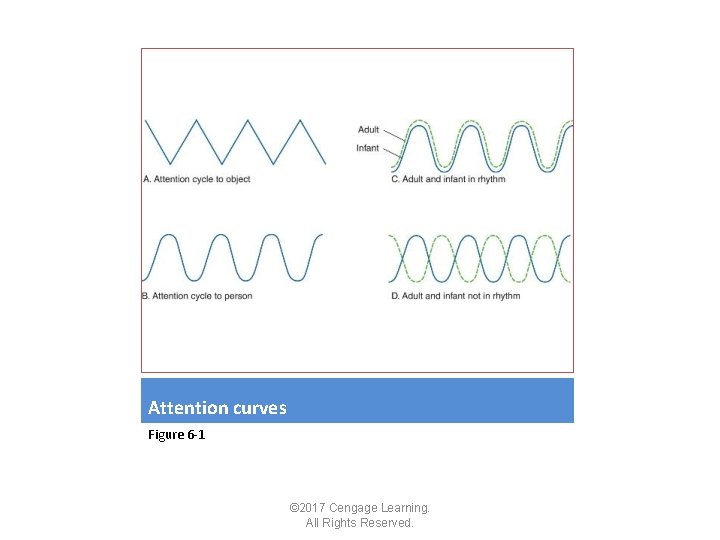
Rhythm and Reciprocity – Rhythm: being in a mutual exchange mode that promotes communication between adult and child. Important in one-to-one relationships and physiological functioning. – Reciprocity: communication exchange in an equal give-and-take manner. Necessary for affective, cognitive, and motor growth. © 2017 Cengage Learning. All Rights Reserved.
Attention curves Figure 6 -1 © 2017 Cengage Learning. All Rights Reserved.
Brain Development: Convergence of Cognitive and Affective • Genes and experience interact in the infant adult game of give and take. • Infants reach out for responses by making noises, facial expressions, movements and cries. • Adults respond with sounds and gestures. • This interaction is the foundation of human development. © 2017 Cengage Learning. All Rights Reserved.
Attachment (slide 1 of 2) • Attachment grows over time. • First three months are critical time for development of attachment. • Takes about 9 months to develop secure attachment • Strength of attachment at 12 months is predictive of later attachment. • Outcome is detachment & independence © 2017 Cengage Learning. All Rights Reserved.
Attachment (slide 2 of 2) • Strange-situation: a setting in which the infant is placed in an unfamiliar room and is allowed to explore some toys either with the mother or a stranger present. • Stranger anxiety: fear of strangers begins to occur about seven to nine months when attachment to mother is complete. © 2017 Cengage Learning. All Rights Reserved.
Four Patterns of Reunion Behavior • Secure: parent is home base for exploration; child looks for comfort at reunion then returns to toys. • Insecure-resistant: child wavers from mother to toys, hesitant to explore; upset when mother leaves, ambivalent at reunion; may push away. • Insecure-avoidant: not upset when left, does not approach mother at return and resists her attempt to comfort; may hit or push mother. • Disorganized-disoriented: inconsistent behavior, smiles and moves toward mother, then sits still and stares at the wall. © 2017 Cengage Learning. All Rights Reserved.
Interactions with Adults and Peers • The amount of time spent interacting with the infant, especially verbalizing seems to be the most critical factor related to the child’s later competence. • Parent-infant conversations are very important developmental activities. • Infants relate socially with other infants. • Mixing infants and toddlers in groups provides social advantages for children of both ages. (Paul, 2014) © 2017 Cengage Learning. All Rights Reserved.
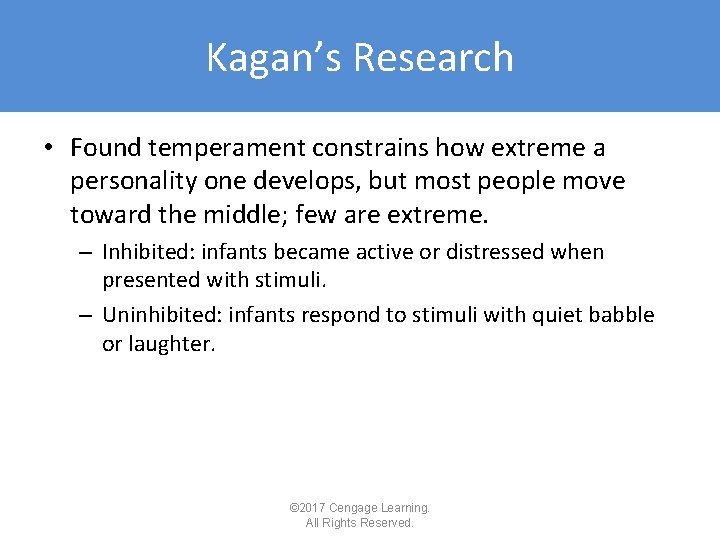
Temperament and Emotional Development • A persistent pattern of emotion and emotional regulation in relation to people and things in the environment or stable individual differences in quality and intensity of emotional reaction influenced by both genetics and environmental interactions (shy, assertive, friendly, outgoing, etc. ). • Culture is an important element in evaluating the adaptability of temperament. (Carlson, Feng, & Harwood, 2004) © 2017 Cengage Learning. All Rights Reserved.
Kagan’s Research • Found temperament constrains how extreme a personality one develops, but most people move toward the middle; few are extreme. – Inhibited: infants became active or distressed when presented with stimuli. – Uninhibited: infants respond to stimuli with quiet babble or laughter. © 2017 Cengage Learning. All Rights Reserved.
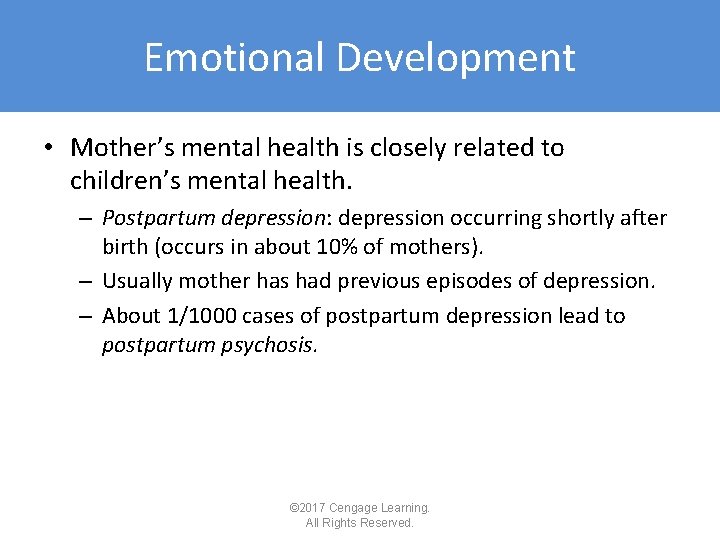
Emotional Development • Mother’s mental health is closely related to children’s mental health. – Postpartum depression: depression occurring shortly after birth (occurs in about 10% of mothers). – Usually mother has had previous episodes of depression. – About 1/1000 cases of postpartum depression lead to postpartum psychosis. © 2017 Cengage Learning. All Rights Reserved.
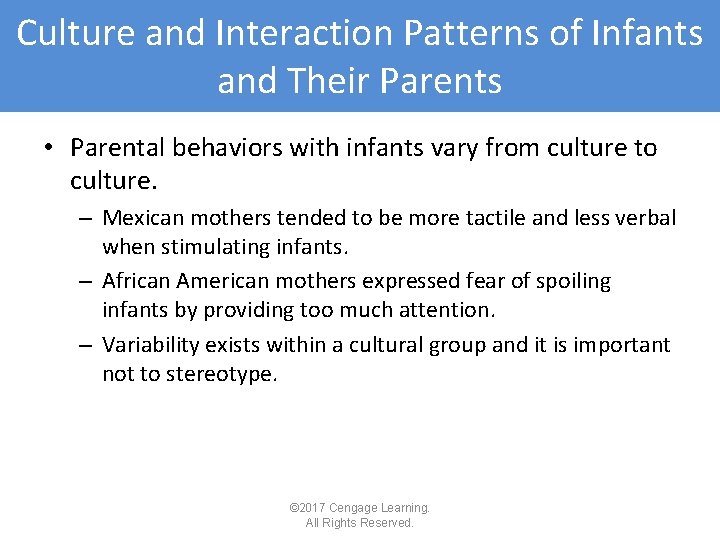
Culture and Interaction Patterns of Infants and Their Parents • Parental behaviors with infants vary from culture to culture. – Mexican mothers tended to be more tactile and less verbal when stimulating infants. – African American mothers expressed fear of spoiling infants by providing too much attention. – Variability exists within a cultural group and it is important not to stereotype. © 2017 Cengage Learning. All Rights Reserved.