
Understanding CAO 48 1 A Generic Interpretation Flight
- Slides: 23
Understanding CAO 48. 1 A Generic Interpretation Flight Crew Fatigue Regulations. (Complex operations) Version 2. 0 Copyright © 2012 -2016 Understanding CAO 48. 1 – A Generic Interpretation All rights reserved.
Disclaimer The documentation is provided “AS IS” and is solely intended to provide a general understanding of the author’s interpretation of CASA CAO 48. 1. The author makes no representations and disclaims any and all responsibility for the completeness or accuracy of the documentation. The author reserves the right, at his discretion, to change or modify the documentation as deemed appropriate. Copyright © 2012 -2016, Understanding CAO 48. 1 – A Generic Interpretation. All rights reserved. Copyright © 2012 -2016 Understanding CAO 48. 1 – A Generic Interpretation All rights reserved.
Module 2: Concept Model Copyright © 2012 -2016 Understanding CAO 48. 1 – A Generic Interpretation All rights reserved.
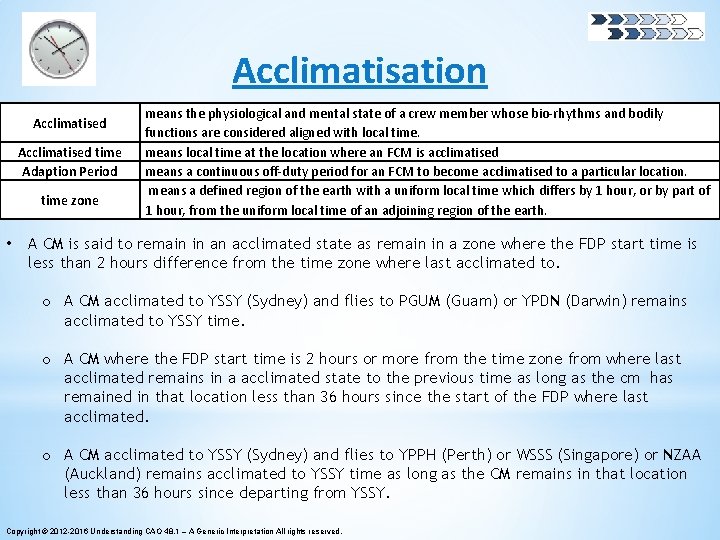
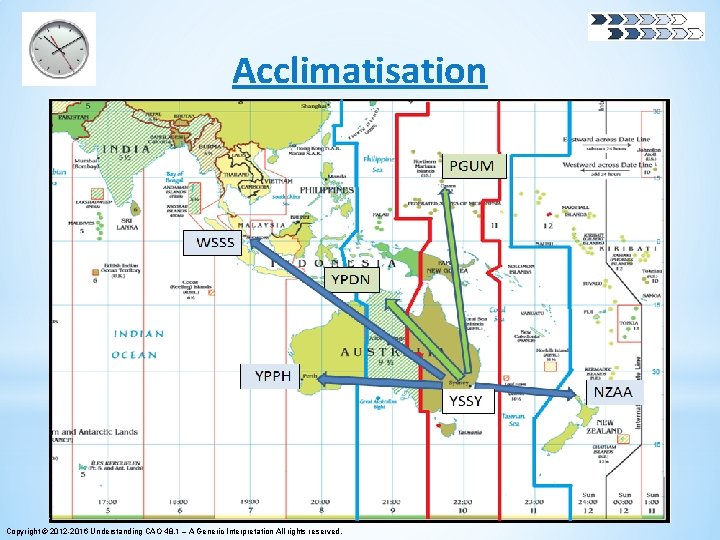
Acclimatisation Acclimatised time Adaption Period time zone • means the physiological and mental state of a crew member whose bio-rhythms and bodily functions are considered aligned with local time. means local time at the location where an FCM is acclimatised means a continuous off-duty period for an FCM to become acclimatised to a particular location. means a defined region of the earth with a uniform local time which differs by 1 hour, or by part of 1 hour, from the uniform local time of an adjoining region of the earth. A CM is said to remain in an acclimated state as remain in a zone where the FDP start time is less than 2 hours difference from the time zone where last acclimated to. o A CM acclimated to YSSY (Sydney) and flies to PGUM (Guam) or YPDN (Darwin) remains acclimated to YSSY time. o A CM where the FDP start time is 2 hours or more from the time zone from where last acclimated remains in a acclimated state to the previous time as long as the cm has remained in that location less than 36 hours since the start of the FDP where last acclimated. o A CM acclimated to YSSY (Sydney) and flies to YPPH (Perth) or WSSS (Singapore) or NZAA (Auckland) remains acclimated to YSSY time as long as the CM remains in that location less than 36 hours since departing from YSSY. Copyright © 2012 -2016 Understanding CAO 48. 1 – A Generic Interpretation All rights reserved.
Acclimatisation Copyright © 2012 -2016 Understanding CAO 48. 1 – A Generic Interpretation All rights reserved.
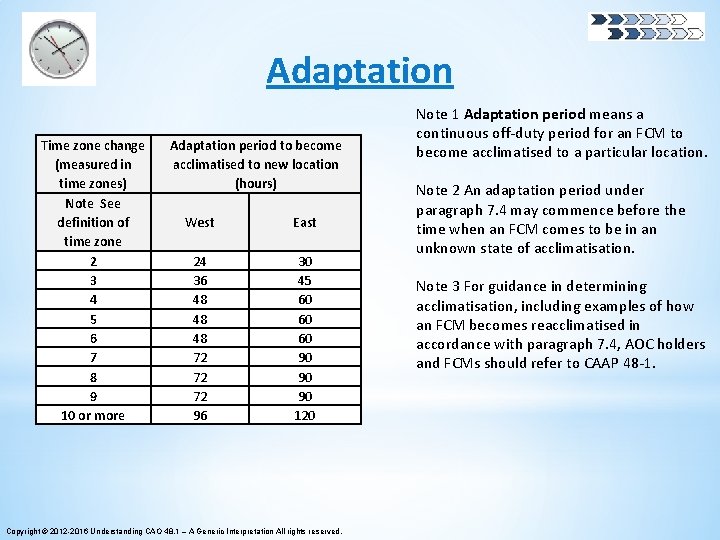
Adaptation • A CM who has flown to a time zone 2 hours or more from where last acclimated to and has remained away from the point where last acclimated to for more than 36 hours, is deemed to be in an Unknown State of Acclimatization. The CM will remain in an unknown state of acclimatization until an Adaptation Period is given. To determine if an off-duty-period qualifies as an adaptation period the provisions in Part 1 General – sections 7. 4 and 7. 5 are applied. • Direction of travel is very important to determine time zone displacement as well as understanding that only 24 time zones exist and how to compensate for the crossing of the International Date Line. • The basic formula is: o Displacement Time = TZ offset at Destination – TZ offset at point of last acclimatisation. o A positive value will be an East displacement o while a negative value will be a West displacement. • A flight from YSSY (Sydney) +10 UTC to PHNL (Honolulu) -10 UTC has a displacement of 4 hours East. If we apply the formula above it will yield: o -20 = -10 –(10), since this value is less than -12, we will need to add 24 to the result 4 = (-20)+ 24. • Had the first FDP been in PHNL and ended in YSSY, we would see: o 20 = 10 –(-10), since this value is greater than 12 we would need to subtract 24, -4 = (20) – 24. Copyright © 2012 -2016 Understanding CAO 48. 1 – A Generic Interpretation All rights reserved.
Adaptation 7. 4 An FCM is considered to remain in his or her state of acclimatisation (whether acclimatised to a particular location, or in an unknown state of acclimatisation) until he or she has had: (a) an adaptation period in a location (the adaptation location) in accordance with Table 7. 1 in this subsection; or (b) an adaptation period that is: (i) in a location other than home base; and (ii) in accordance with subparagraph (a); and (iii) reduced by 12 hours for each previous off-duty period that: (A) immediately preceded the adaptation period; and (B) was taken at an off-duty location which differs in local time by less than 2 hours from the adaptation location; and (C) included an off-duty location local night. Copyright © 2012 -2016 Understanding CAO 48. 1 – A Generic Interpretation All rights reserved.
Adaptation 7. 5 In applying Table 7. 1 to arrive at an adaptation period for paragraph 7. 4: (a) determine the time zone displacement between: (i) the location where the FCM was last acclimatised (the original location); and (ii) each location where an FDP or off-duty period was commenced since last acclimatised (later locations); and (b) then choose the time zone displacement between the original location and whichever of the later locations gives the greatest time zone displacement; and (c) then choose the time zone change in the Table that corresponds to the greatest time zone displacement; and (d) then choose the direction (west or east) in which the FCM travelled and in which, therefore, the greatest time zone displacement occurred under subparagraph (b); and (e) then choose the number of hours west or east (as the case requires) that corresponds to the time zone change chosen under subparagraph (c). Copyright © 2012 -2016 Understanding CAO 48. 1 – A Generic Interpretation All rights reserved.
Adaptation Time zone change (measured in time zones) Note See definition of time zone 2 3 4 5 6 7 8 9 10 or more Adaptation period to become acclimatised to new location (hours) West East 24 36 48 48 48 72 72 72 96 30 45 60 60 60 90 90 90 120 Copyright © 2012 -2016 Understanding CAO 48. 1 – A Generic Interpretation All rights reserved. Note 1 Adaptation period means a continuous off-duty period for an FCM to become acclimatised to a particular location. Note 2 An adaptation period under paragraph 7. 4 may commence before the time when an FCM comes to be in an unknown state of acclimatisation. Note 3 For guidance in determining acclimatisation, including examples of how an FCM becomes reacclimatised in accordance with paragraph 7. 4, AOC holders and FCMs should refer to CAAP 48 -1.
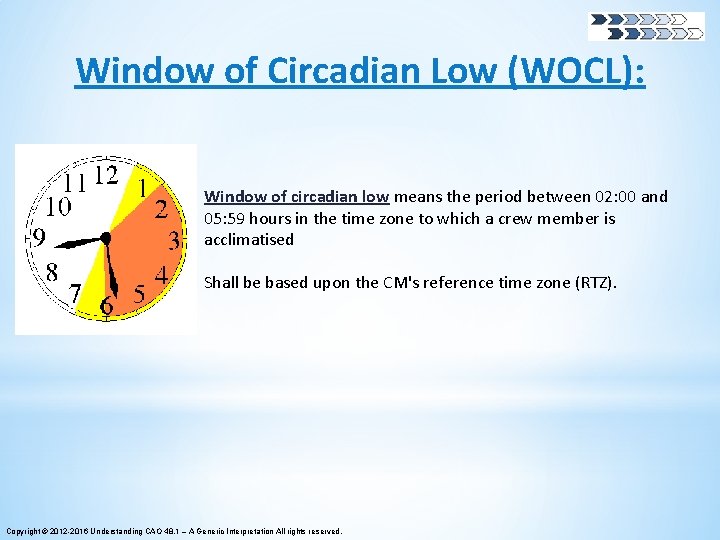
Window of Circadian Low (WOCL): Window of circadian low means the period between 02: 00 and 05: 59 hours in the time zone to which a crew member is acclimatised Shall be based upon the CM's reference time zone (RTZ). Copyright © 2012 -2016 Understanding CAO 48. 1 – A Generic Interpretation All rights reserved.
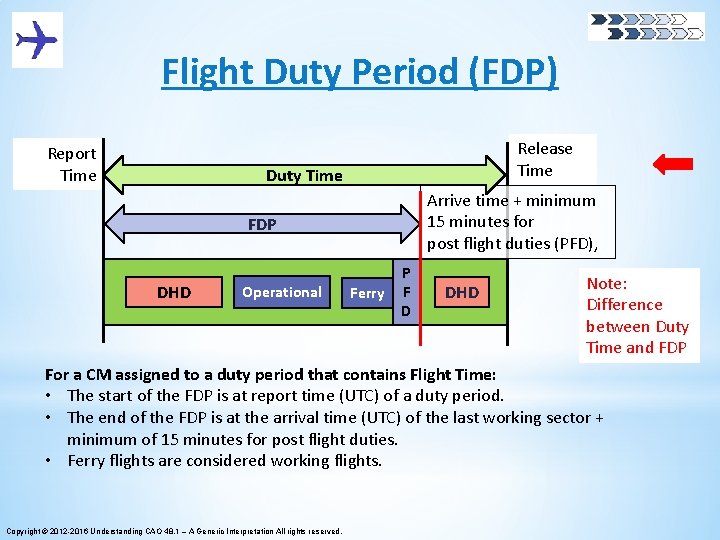
Flight Duty Period (FDP) Report Time Release Time Duty Time Arrive time + minimum 15 minutes for post flight duties (PFD), FDP DHD Operational Ferry P F D DHD Note: Difference between Duty Time and FDP For a CM assigned to a duty period that contains Flight Time: • The start of the FDP is at report time (UTC) of a duty period. • The end of the FDP is at the arrival time (UTC) of the last working sector + minimum of 15 minutes for post flight duties. • Ferry flights are considered working flights. Copyright © 2012 -2016 Understanding CAO 48. 1 – A Generic Interpretation All rights reserved.
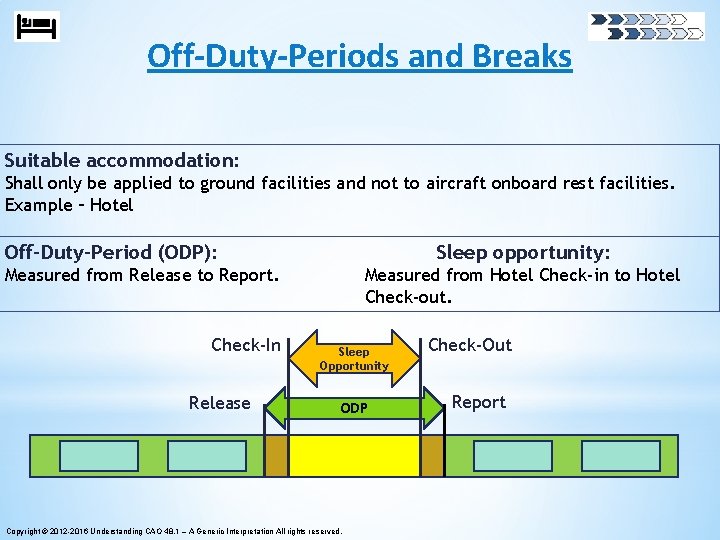
Off-Duty-Periods and Breaks Suitable accommodation: Shall only be applied to ground facilities and not to aircraft onboard rest facilities. Example – Hotel Off-Duty-Period (ODP): Sleep opportunity: Measured from Release to Report. Check-In Release Measured from Hotel Check-in to Hotel Check-out. Sleep Opportunity ODP Copyright © 2012 -2016 Understanding CAO 48. 1 – A Generic Interpretation All rights reserved. Check-Out Report
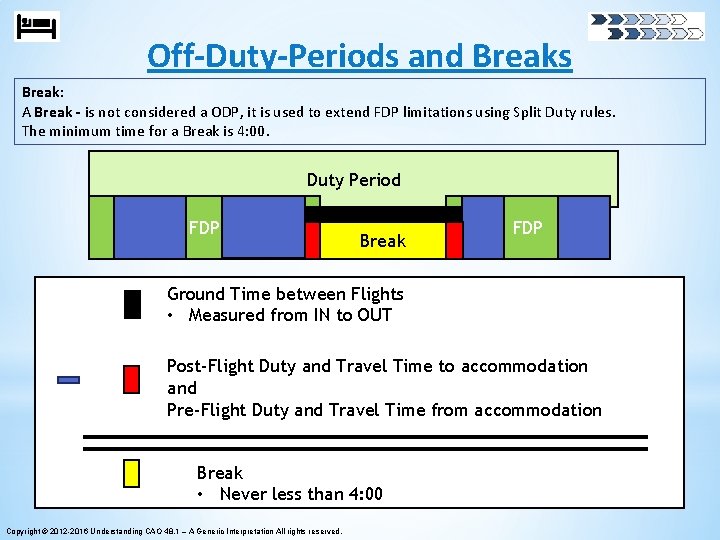
Off-Duty-Periods and Breaks Break: A Break - is not considered a ODP, it is used to extend FDP limitations using Split Duty rules. The minimum time for a Break is 4: 00. Duty Period FDP Break FDP Ground Time between Flights • Measured from IN to OUT Post-Flight Duty and Travel Time to accommodation and Pre-Flight Duty and Travel Time from accommodation Break • Never less than 4: 00 Copyright © 2012 -2016 Understanding CAO 48. 1 – A Generic Interpretation All rights reserved.
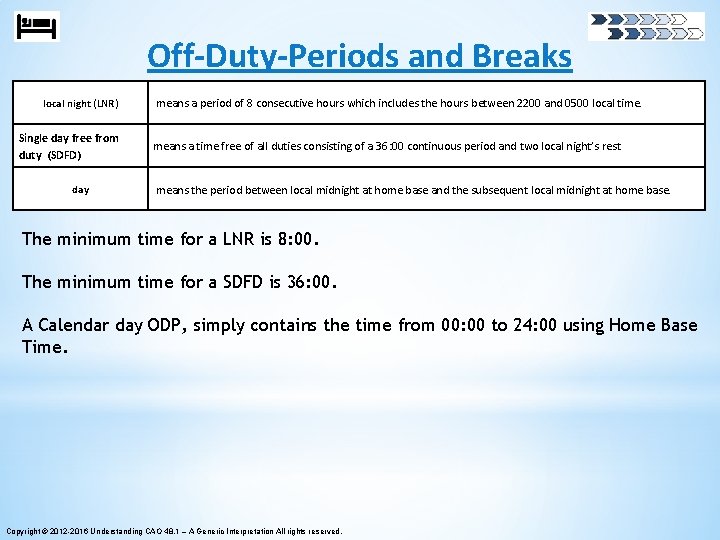
Off-Duty-Periods and Breaks local night (LNR) Single day free from duty (SDFD) day means a period of 8 consecutive hours which includes the hours between 2200 and 0500 local time. means a time free of all duties consisting of a 36: 00 continuous period and two local night’s rest means the period between local midnight at home base and the subsequent local midnight at home base. The minimum time for a LNR is 8: 00. The minimum time for a SDFD is 36: 00. A Calendar day ODP, simply contains the time from 00: 00 to 24: 00 using Home Base Time. Copyright © 2012 -2016 Understanding CAO 48. 1 – A Generic Interpretation All rights reserved.
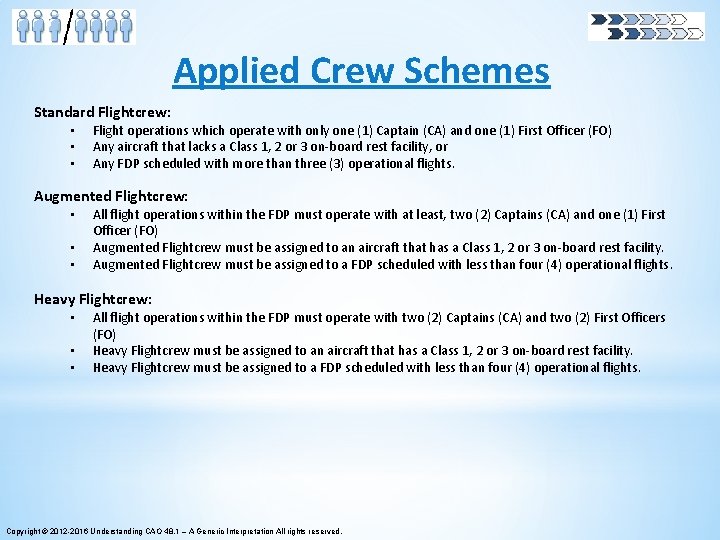
Applied Crew Schemes Standard Flightcrew: • • • Flight operations which operate with only one (1) Captain (CA) and one (1) First Officer (FO) Any aircraft that lacks a Class 1, 2 or 3 on-board rest facility, or Any FDP scheduled with more than three (3) operational flights. Augmented Flightcrew: • • • All flight operations within the FDP must operate with at least, two (2) Captains (CA) and one (1) First Officer (FO) Augmented Flightcrew must be assigned to an aircraft that has a Class 1, 2 or 3 on-board rest facility. Augmented Flightcrew must be assigned to a FDP scheduled with less than four (4) operational flights. Heavy Flightcrew: • • • All flight operations within the FDP must operate with two (2) Captains (CA) and two (2) First Officers (FO) Heavy Flightcrew must be assigned to an aircraft that has a Class 1, 2 or 3 on-board rest facility. Heavy Flightcrew must be assigned to a FDP scheduled with less than four (4) operational flights. Copyright © 2012 -2016 Understanding CAO 48. 1 – A Generic Interpretation All rights reserved.
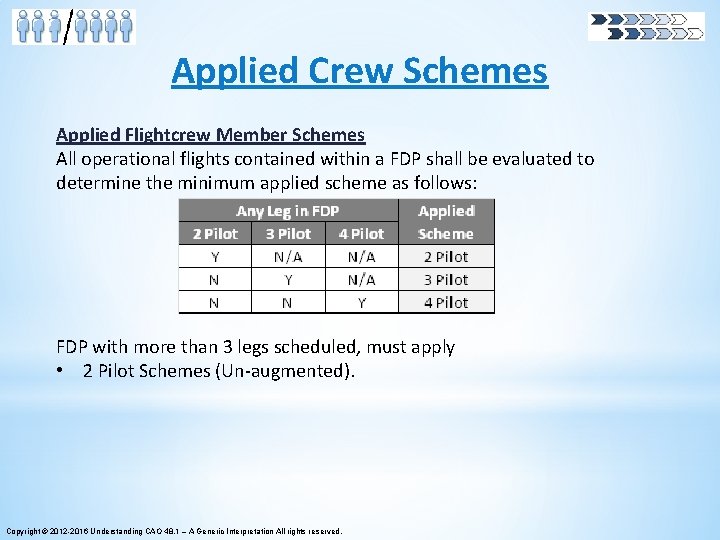
Applied Crew Schemes Applied Flightcrew Member Schemes All operational flights contained within a FDP shall be evaluated to determine the minimum applied scheme as follows: FDP with more than 3 legs scheduled, must apply • 2 Pilot Schemes (Un-augmented). Copyright © 2012 -2016 Understanding CAO 48. 1 – A Generic Interpretation All rights reserved.
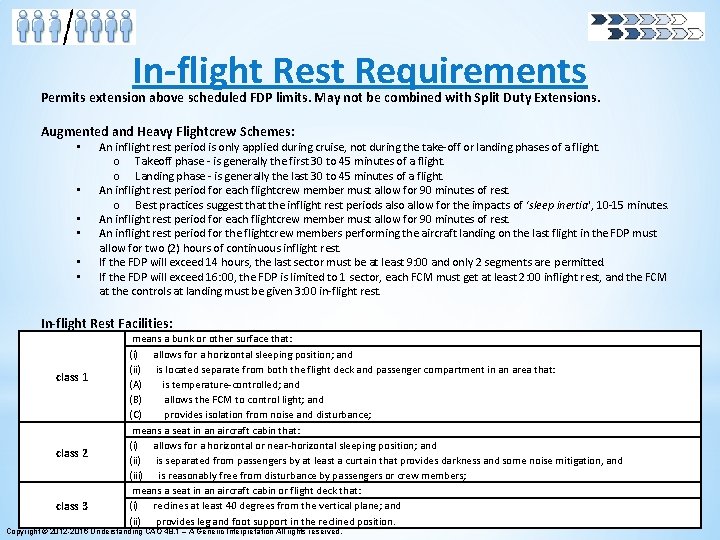
In-flight Rest Requirements Permits extension above scheduled FDP limits. May not be combined with Split Duty Extensions. Augmented and Heavy Flightcrew Schemes: • • • An inflight rest period is only applied during cruise, not during the take-off or landing phases of a flight. o Takeoff phase - is generally the first 30 to 45 minutes of a flight. o Landing phase - is generally the last 30 to 45 minutes of a flight. An inflight rest period for each flightcrew member must allow for 90 minutes of rest. o Best practices suggest that the inflight rest periods also allow for the impacts of 'sleep inertia', 10 -15 minutes. An inflight rest period for each flightcrew member must allow for 90 minutes of rest. An inflight rest period for the flightcrew members performing the aircraft landing on the last flight in the FDP must allow for two (2) hours of continuous inflight rest. If the FDP will exceed 14 hours, the last sector must be at least 9: 00 and only 2 segments are permitted. If the FDP will exceed 16: 00, the FDP is limited to 1 sector, each FCM must get at least 2: 00 inflight rest, and the FCM at the controls at landing must be given 3: 00 in-flight rest. In-flight Rest Facilities: class 1 class 2 class 3 means a bunk or other surface that: (i) allows for a horizontal sleeping position; and (ii) is located separate from both the flight deck and passenger compartment in an area that: (A) is temperature-controlled; and (B) allows the FCM to control light; and (C) provides isolation from noise and disturbance; means a seat in an aircraft cabin that: (i) allows for a horizontal or near-horizontal sleeping position; and (ii) is separated from passengers by at least a curtain that provides darkness and some noise mitigation, and (iii) is reasonably free from disturbance by passengers or crew members; means a seat in an aircraft cabin or flight deck that: (i) reclines at least 40 degrees from the vertical plane; and (ii) provides leg and foot support in the reclined position. Copyright © 2012 -2016 Understanding CAO 48. 1 – A Generic Interpretation All rights reserved.
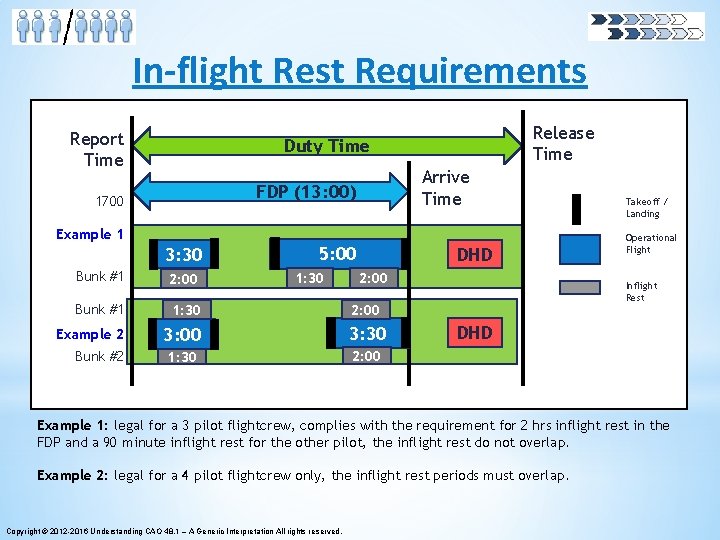
In-flight Rest Requirements Report Time Release Time Duty Time Arrive Time FDP (13: 00) 1700 Example 1 3: 30 5: 00 DHD Bunk #1 2: 00 Bunk #1 1: 30 Example 2 3: 00 3: 30 1: 30 2: 00 Bunk #2 1: 30 2: 00 Takeoff / Landing Operational Flight Inflight Rest 2: 00 DHD Example 1: legal for a 3 pilot flightcrew, complies with the requirement for 2 hrs inflight rest in the FDP and a 90 minute inflight rest for the other pilot, the inflight rest do not overlap. Example 2: legal for a 4 pilot flightcrew only, the inflight rest periods must overlap. Copyright © 2012 -2016 Understanding CAO 48. 1 – A Generic Interpretation All rights reserved.
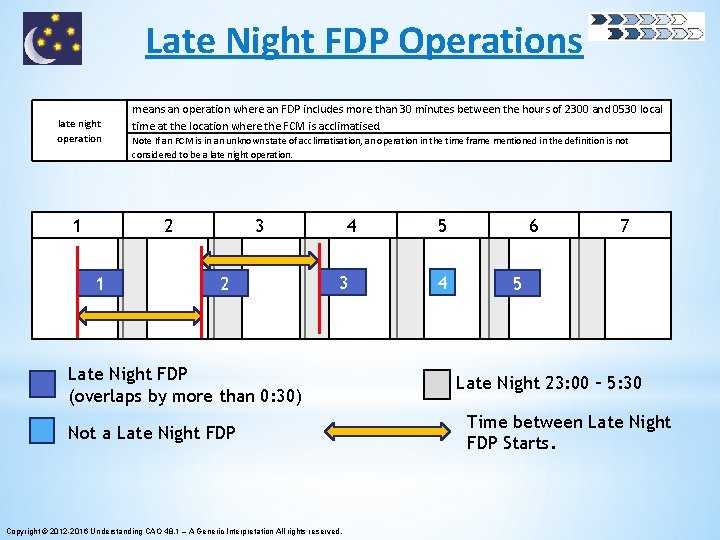
Late Night FDP Operations late night operation 1 means an operation where an FDP includes more than 30 minutes between the hours of 2300 and 0530 local time at the location where the FCM is acclimatised. Note If an FCM is in an unknown state of acclimatisation, an operation in the time frame mentioned in the definition is not considered to be a late night operation. 3 2 1 2 4 3 Late Night FDP (overlaps by more than 0: 30) Not a Late Night FDP Copyright © 2012 -2016 Understanding CAO 48. 1 – A Generic Interpretation All rights reserved. 5 4 6 7 5 Late Night 23: 00 – 5: 30 Time between Late Night FDP Starts.
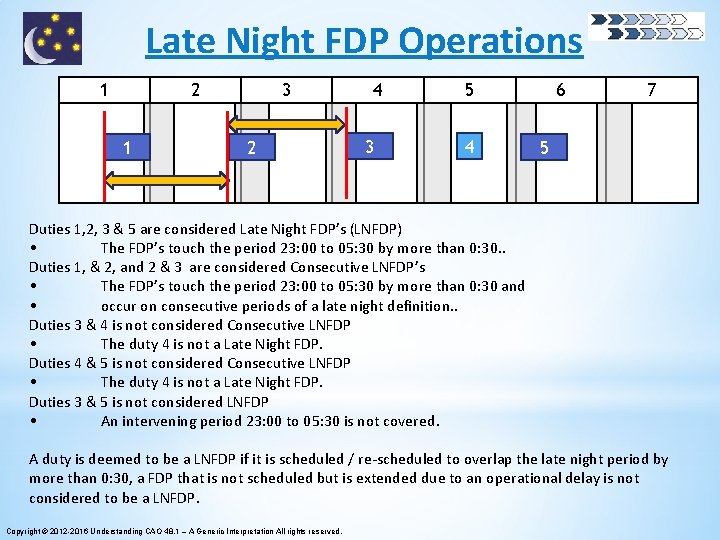
Late Night FDP Operations 1 3 2 1 2 4 3 5 4 6 7 5 Duties 1, 2, 3 & 5 are considered Late Night FDP’s (LNFDP) • The FDP’s touch the period 23: 00 to 05: 30 by more than 0: 30. . Duties 1, & 2, and 2 & 3 are considered Consecutive LNFDP’s • The FDP’s touch the period 23: 00 to 05: 30 by more than 0: 30 and • occur on consecutive periods of a late night definition. . Duties 3 & 4 is not considered Consecutive LNFDP • The duty 4 is not a Late Night FDP. Duties 4 & 5 is not considered Consecutive LNFDP • The duty 4 is not a Late Night FDP. Duties 3 & 5 is not considered LNFDP • An intervening period 23: 00 to 05: 30 is not covered. A duty is deemed to be a LNFDP if it is scheduled / re-scheduled to overlap the late night period by more than 0: 30, a FDP that is not scheduled but is extended due to an operational delay is not considered to be a LNFDP. Copyright © 2012 -2016 Understanding CAO 48. 1 – A Generic Interpretation All rights reserved.
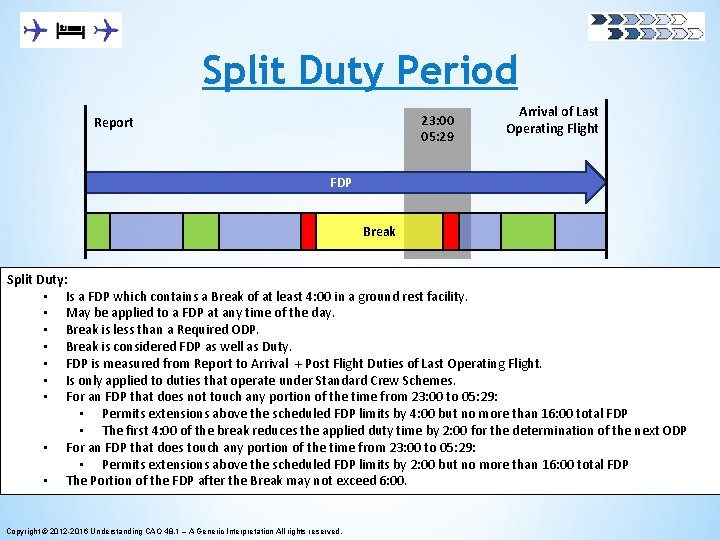
Split Duty Period 23: 00 05: 29 Report Arrival of Last Operating Flight FDP Break Split Duty: • Is a FDP which contains a Break of at least 4: 00 in a ground rest facility. • May be applied to a FDP at any time of the day. • Break is less than a Required ODP. • Break is considered FDP as well as Duty. • FDP is measured from Report to Arrival + Post Flight Duties of Last Operating Flight. • Is only applied to duties that operate under Standard Crew Schemes. • For an FDP that does not touch any portion of the time from 23: 00 to 05: 29: • Permits extensions above the scheduled FDP limits by 4: 00 but no more than 16: 00 total FDP • The first 4: 00 of the break reduces the applied duty time by 2: 00 for the determination of the next ODP • For an FDP that does touch any portion of the time from 23: 00 to 05: 29: • Permits extensions above the scheduled FDP limits by 2: 00 but no more than 16: 00 total FDP • The Portion of the FDP after the Break may not exceed 6: 00. Copyright © 2012 -2016 Understanding CAO 48. 1 – A Generic Interpretation All rights reserved.
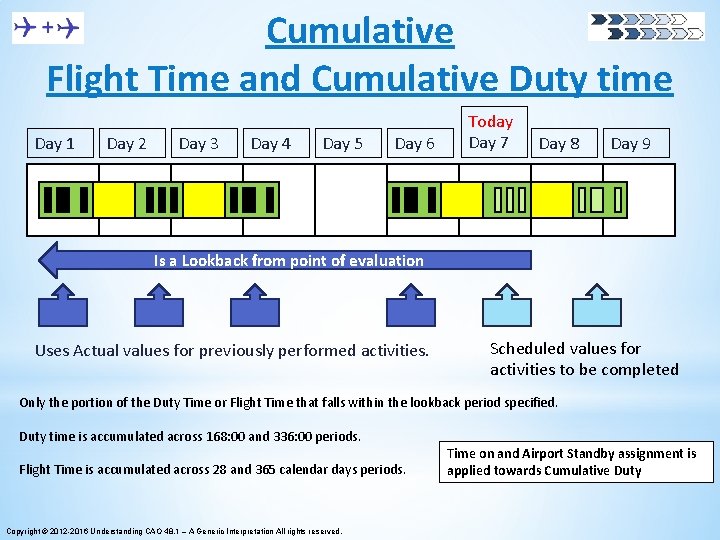
Cumulative Flight Time and Cumulative Duty time Day 1 Day 2 Day 3 Day 4 Day 5 Day 6 Today Day 7 Day 8 Day 9 Is a Lookback from point of evaluation Uses Actual values for previously performed activities. Scheduled values for activities to be completed Only the portion of the Duty Time or Flight Time that falls within the lookback period specified. Duty time is accumulated across 168: 00 and 336: 00 periods. Flight Time is accumulated across 28 and 365 calendar days periods. Copyright © 2012 -2016 Understanding CAO 48. 1 – A Generic Interpretation All rights reserved. Time on and Airport Standby assignment is applied towards Cumulative Duty
Understanding CAO 48. 1 A Generic Interpretation Flight Crew Fatigue Regulations. (Complex operations) Version 2. 0 Copyright © 2012 -2016 Understanding CAO 48. 1 – A Generic Interpretation All rights reserved.