
Understanding by Design Angela Cunningham Bullitt Central High
Understanding by Design Angela Cunningham Bullitt Central High School
Backward Design Process n Stage 1: Identify Desired Results n Stage 2: Determine Acceptable Evidence n Stage 3: Plan Learning Experiences and Instruction

Big Picture of Ub. D Approach Key Design Considerations Filters (Design Criteria) What the Final Design Accomplishes Stage 1 What is worthy and requiring of understanding? National standards State standards Teacher expertise and interest Enduring ideas. Opportunities for authentic, disciplinebased work; Uncoverage; Engaging Unit framed around enduring understandings and essential questions. Stage 2 What is evidence of understanding? Six facets of understanding Continuum of assessment types Valid; Reliable; Sufficient; Authentic work; Feasible; Student friendly Unit anchored in credible and educationally vital evidence of the desired understandings. Stage 3 To what extent is the learning plan effective and engaging? Research based repertoire of learning and teaching strategies WHERETO Where is it going? Hook the students Explore &equip Rethink & revise Exhibit & evaluate Tailored to student need Organized Coherent learning experiences and teaching that will evoke and develop the desired understandings, promote interest and make excellent performance more likely. Essential and enabling knowledge and skill
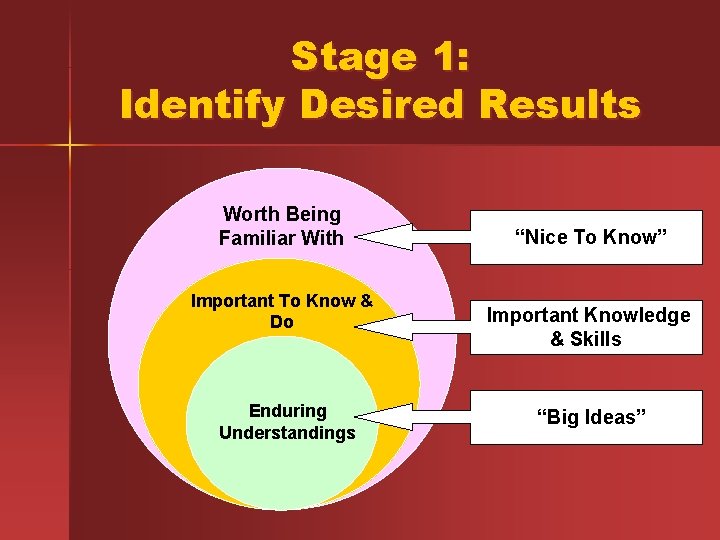
Stage 1: Identify Desired Results Worth Being Familiar With Important To Know & Do Enduring Understandings “Nice To Know” Important Knowledge & Skills “Big Ideas”

Enduring Understandings n Are derived from or are aligned with content standards. n Are framed as full-sentence generalizations in response to the stem: “The students will understand that…” n Are not obvious or true by definition (i. e. , factual knowledge). They need to be uncovered (rather than merely stated) in order for student to come to understand them.
Sample Enduring Understandings Students will understand that… n Numbers are abstract concepts that enable us to represent concrete quantities, sequences, and rates. n Democratic governments struggle to balance the rights of individuals with the common good. n The form in which authors write shapes how they address both their audience and their purpose(s). n Scientists use observation and statistical analysis to uncover and analyze patterns in nature. n As technologies change, our views of nature and our world shift and redefine themselves.
Essential Questions n Serve as “doorways” through which students explore the key concepts, themes, theories, and issues within the content. n Elicit interesting and alternative views. n Raise other important questions. n Spark connections and promote the transfer of ideas from one setting to others.
Sample Essential Questions n When is error unavoidable in measurement? What margins of error are acceptable? n In what ways might a government guard against abuses of power? n To what extent can a fictional story be “true”? n How do recent developments in genetics affect the nature v. nurture argument? n In what ways does art reflect, as well as shape, culture?
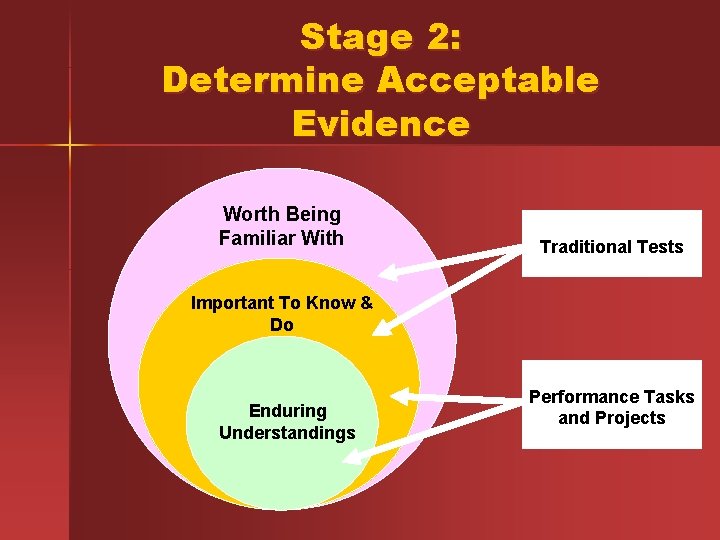
Stage 2: Determine Acceptable Evidence Worth Being Familiar With Traditional Tests Important To Know & Do Enduring Understandings Performance Tasks and Projects
Stage 2: Determine Acceptable Evidence Assessments should be designed before lessons and activities and should answer the following: n What are the key complex performance tasks indicative of student understanding? n What other evidence will be collected to build the case for understanding, knowledge, and skills? n What rubrics will be used to assess student understanding, knowledge, and skills?
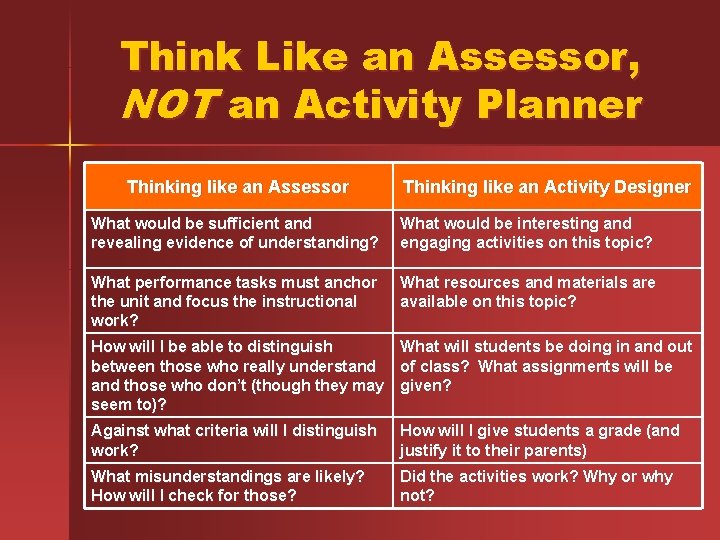
Think Like an Assessor, NOT an Activity Planner Thinking like an Assessor Thinking like an Activity Designer What would be sufficient and revealing evidence of understanding? What would be interesting and engaging activities on this topic? What performance tasks must anchor the unit and focus the instructional work? What resources and materials are available on this topic? How will I be able to distinguish What will students be doing in and out between those who really understand of class? What assignments will be and those who don’t (though they may given? seem to)? Against what criteria will I distinguish work? How will I give students a grade (and justify it to their parents) What misunderstandings are likely? How will I check for those? Did the activities work? Why or why not?
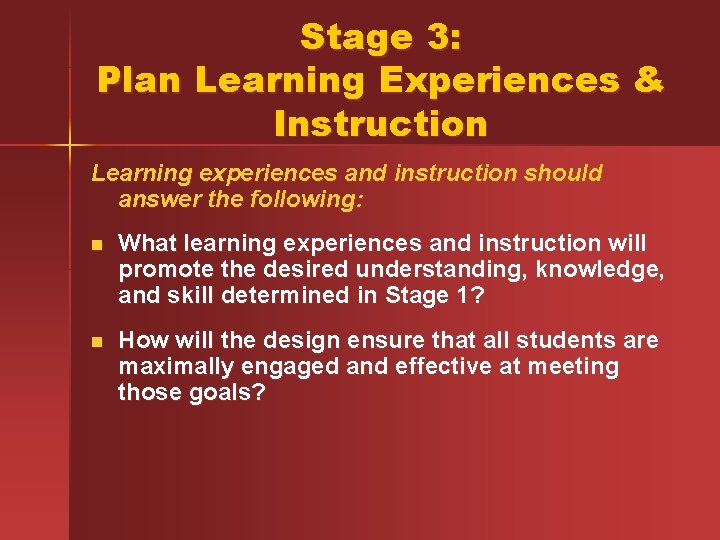
Stage 3: Plan Learning Experiences & Instruction Learning experiences and instruction should answer the following: n What learning experiences and instruction will promote the desired understanding, knowledge, and skill determined in Stage 1? n How will the design ensure that all students are maximally engaged and effective at meeting those goals?
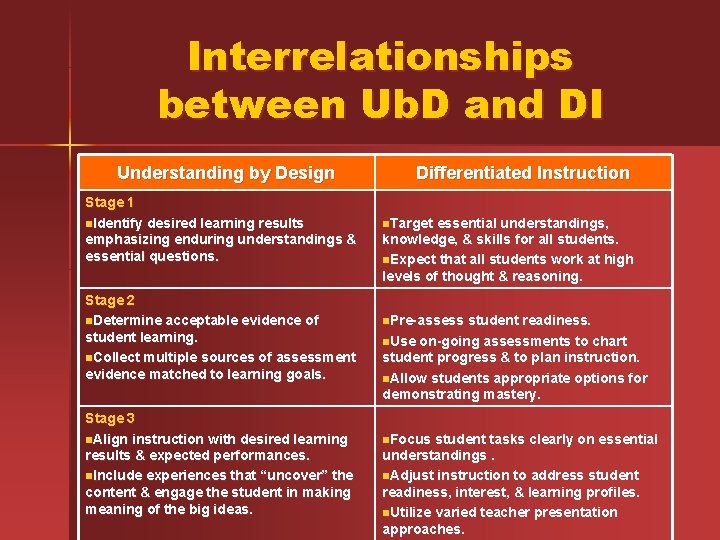
Interrelationships between Ub. D and DI Understanding by Design Stage 1 n. Identify desired learning results emphasizing enduring understandings & essential questions. Stage 2 n. Determine acceptable evidence of student learning. n. Collect multiple sources of assessment evidence matched to learning goals. Stage 3 n. Align instruction with desired learning results & expected performances. n. Include experiences that “uncover” the content & engage the student in making meaning of the big ideas. Differentiated Instruction n. Target essential understandings, knowledge, & skills for all students. n. Expect that all students work at high levels of thought & reasoning. n. Pre-assess student readiness. n. Use on-going assessments to chart student progress & to plan instruction. n. Allow students appropriate options for demonstrating mastery. n. Focus student tasks clearly on essential understandings. n. Adjust instruction to address student readiness, interest, & learning profiles. n. Utilize varied teacher presentation approaches.
- Slides: 13