
Understanding Business Ethics and Social Responsibility 2 Copyright
Understanding Business Ethics and Social Responsibility # 2 Copyright © 2012 Pearson Education, Copyright © 2015 Pearson Education, Inc. Publishing as Prentice Hall 2 -1
Introduction • In this chapter, we’ll look at ethics and social responsibility— – what they mean – how they apply to environmental issues and to a firm’s relationships with its customers, employees, and investors. – approaches to social responsibility – steps businesses must take to implement social responsibility programs Copyright © 2012 Pearson Education, Copyright © 2015 Pearson Education, Inc. Publishing as Prentice Hall 2 -2
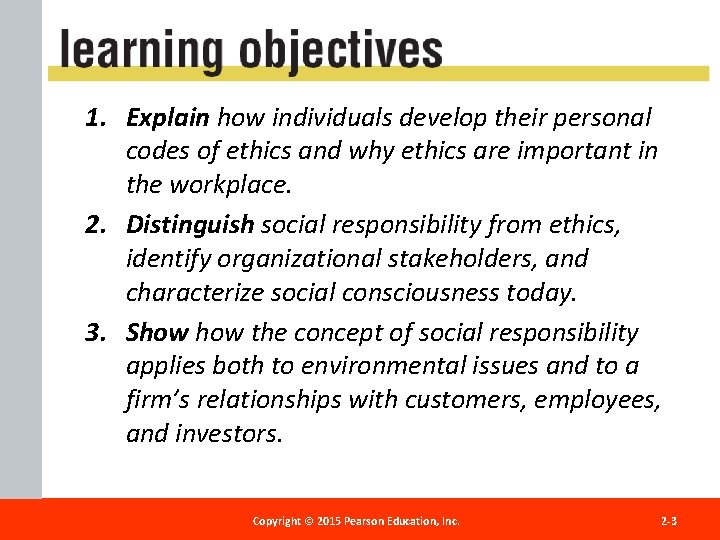
1. Explain how individuals develop their personal codes of ethics and why ethics are important in the workplace. 2. Distinguish social responsibility from ethics, identify organizational stakeholders, and characterize social consciousness today. 3. Show the concept of social responsibility applies both to environmental issues and to a firm’s relationships with customers, employees, and investors. Copyright©© 2015 2012 Pearson. Education, Inc. Copyright Publishing as Prentice Hall 2 -3
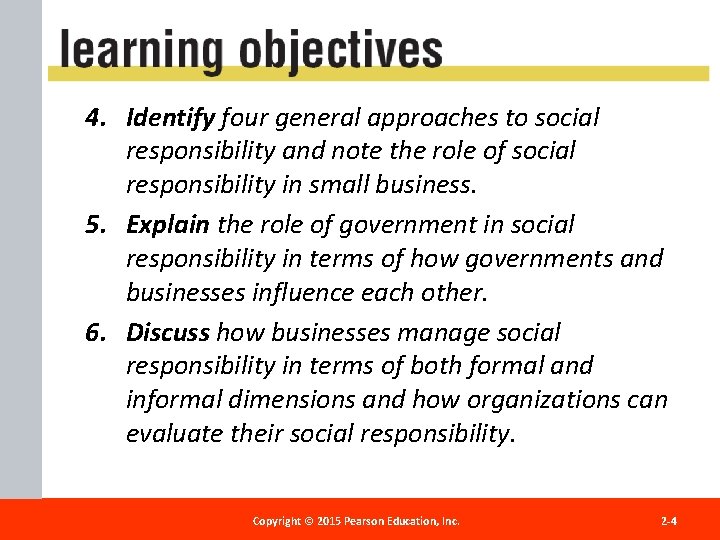
4. Identify four general approaches to social responsibility and note the role of social responsibility in small business. 5. Explain the role of government in social responsibility in terms of how governments and businesses influence each other. 6. Discuss how businesses manage social responsibility in terms of both formal and informal dimensions and how organizations can evaluate their social responsibility. Copyright©© 2015 2012 Pearson. Education, Inc. Copyright Publishing as Prentice Hall 2 -4
Ethics in the Workplace • Ethics – beliefs about what is right and wrong or good and bad in actions that affect others • Business ethics – refers to ethical or unethical behaviors by employees in the context of their jobs Copyright © 2012 Pearson Education, Copyright © 2015 Pearson Education, Inc. Publishing as Prentice Hall 2 -5
Ethics in the Workplace (cont. ) • Ethical behavior – behavior that conforms to individual beliefs and social norms about what’s right and good • Unethical behavior – behavior that conforms to individual beliefs and social norms about what is defined as wrong and bad Copyright © 2012 Pearson Education, Copyright © 2015 Pearson Education, Inc. Publishing as Prentice Hall 2 -6
Business and Managerial Ethics • Managerial Ethics • standards of behavior that guide individual managers in their work Behavior toward Employees Behavior toward the Organization Behavior toward Other Economic Agents Copyright © 2012 Pearson Education, Copyright © 2015 Pearson Education, Inc. Publishing as Prentice Hall 2 -7
Assessing Ethical Behavior 1. Gather the relevant factual information 2. Analyze the facts to determine the most appropriate moral values 3. Make an ethical judgment based on how right or wrong the proposed activity or policy is. Copyright © 2012 Pearson Education, Copyright © 2015 Pearson Education, Inc. Publishing as Prentice Hall 2 -8
Ethical Norms 1. Utility – Does a particular act optimize the benefits to those who are affected by it? (That is, do all relevant parties receive “fair” benefits? ) 2. Rights – Does it respect the rights of all individuals involved? Copyright © 2012 Pearson Education, Copyright © 2015 Pearson Education, Inc. Publishing as Prentice Hall 2 -9
Ethical Norms (cont. ) 4. Justice – Is it consistent with what’s fair? 5. Caring – Is it consistent with people’s responsibilities to each other? Copyright © 2012 Pearson Education, Copyright © 2015 Pearson Education, Inc. Publishing as Prentice Hall 2 -10
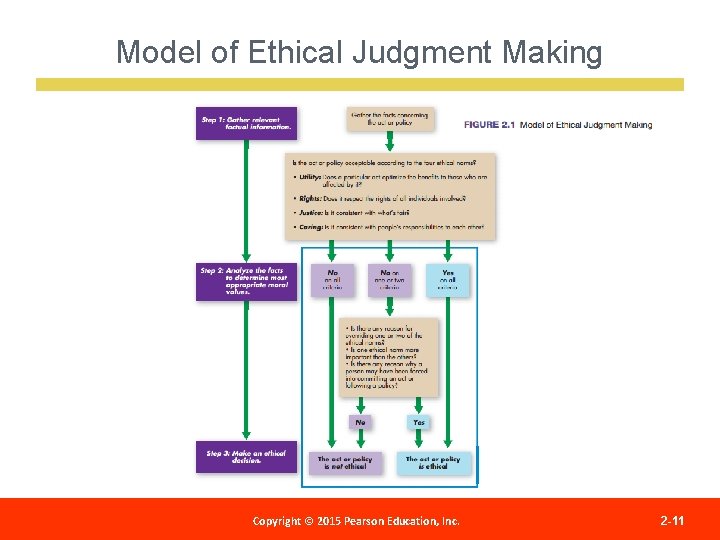
Model of Ethical Judgment Making Copyright © 2012 Pearson Education, Copyright © 2015 Pearson Education, Inc. Publishing as Prentice Hall 2 -11
Company Practices and Business Ethics Two of the most common approaches to formalizing top management commitment to ethical business practices: • Adopting written codes • Instituting ethics programs Copyright © 2012 Pearson Education, Copyright © 2015 Pearson Education, Inc. Publishing as Prentice Hall 2 -12
Adopting Written Codes – The HP Way -We have trust and respect for individuals. -We focus on a high level of achievement and contribution. -We conduct our business with uncompromising integrity. -We achieve our common objectives through teamwork. -We encourage flexibility and innovation. Copyright © 2012 Pearson Education, Copyright © 2015 Pearson Education, Inc. Publishing as Prentice Hall 2 -13
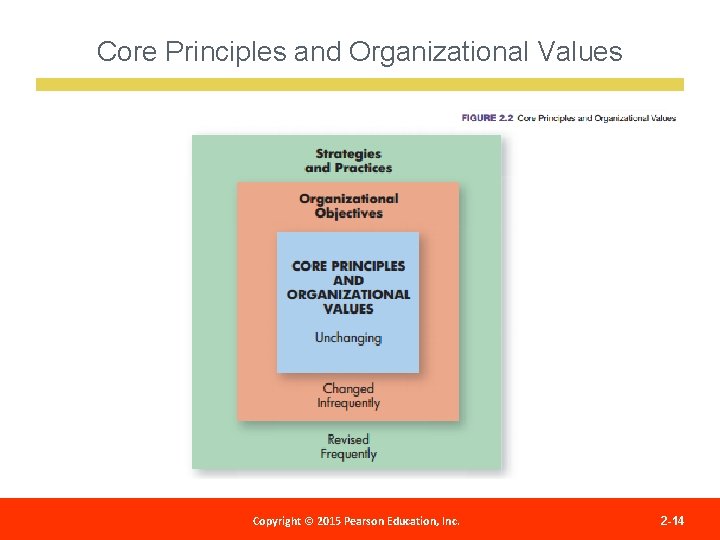
Core Principles and Organizational Values Copyright © 2012 Pearson Education, Copyright © 2015 Pearson Education, Inc. Publishing as Prentice Hall 2 -14

Social Responsibility • Social responsibility – refers to the overall way in which a business attempts to balance its commitments to relevant groups and individuals in its social environment Copyright © 2012 Pearson Education, Copyright © 2015 Pearson Education, Inc. Publishing as Prentice Hall 2 -15
Social Responsibility (cont. ) • Organizational Stakeholders – those groups, individuals, and organizations that are directly affected by the practices of an organization and who therefore have a stake in its performance Copyright © 2012 Pearson Education, Copyright © 2015 Pearson Education, Inc. Publishing as Prentice Hall 2 -16
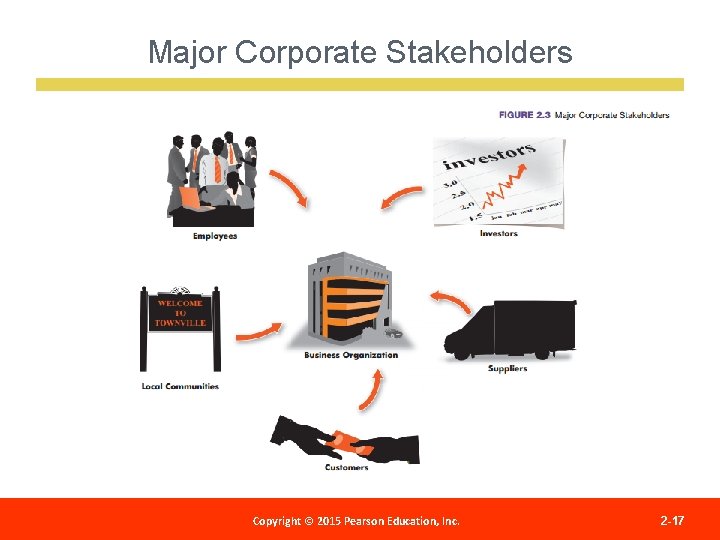
Major Corporate Stakeholders Copyright © 2012 Pearson Education, Copyright © 2015 Pearson Education, Inc. Publishing as Prentice Hall 2 -17
The Stakeholder Model of Responsibility Most companies that strive to be responsible to their stakeholders concentrate first and foremost on five main groups: • Customers • Employees • Investors • Suppliers • Local communities where they do business Copyright © 2012 Pearson Education, Copyright © 2015 Pearson Education, Inc. Publishing as Prentice Hall 2 -18
The Stakeholder Model of Responsibility (cont. ) • Customers – Treat customers fairly and honestly • Employees – Treat employees fairly and respect their dignity and basic human needs • Investors – Follow proper accounting procedures; provide information to shareholders about financial performance Copyright © 2012 Pearson Education, Copyright © 2015 Pearson Education, Inc. Publishing as Prentice Hall 2 -19
The Stakeholder Model of Responsibility • Suppliers – Create mutually beneficial partnership arrangements with suppliers • Local and International Communities – Involvement in programs and charities Copyright © 2012 Pearson Education, Copyright © 2015 Pearson Education, Inc. Publishing as Prentice Hall 2 -20
Contemporary Social Consciousness • The Concept of Accountability – The expectation of an expanded role for business in protecting and enhancing the general welfare of society Copyright © 2012 Pearson Education, Copyright © 2015 Pearson Education, Inc. Publishing as Prentice Hall 2 -21
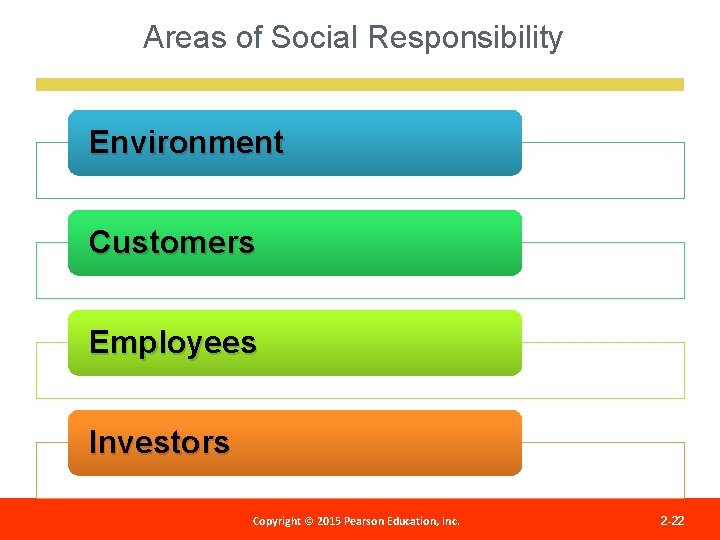
Areas of Social Responsibility Environment Customers Employees Investors Copyright © 2012 Pearson Education, Copyright © 2015 Pearson Education, Inc. Publishing as Prentice Hall 2 -22
Responsibility toward Customers • Consumer rights – Consumerism – social activism dedicated to protecting the rights of consumers in their dealings with businesses • Unfair pricing – Collusion – two or more firms collaborate on such wrongful acts as price fixing – Price gouging Copyright © 2012 Pearson Education, Copyright © 2015 Pearson Education, Inc. Publishing as Prentice Hall 2 -23
Consumerism • Consumerism – a form of social activism dedicated to protecting the rights of consumers in their dealings with businesses • Collusion – illegal agreement between two or more companies to commit a wrongful act Copyright © 2012 Pearson Education, Copyright © 2015 Pearson Education, Inc. Publishing as Prentice Hall 2 -24
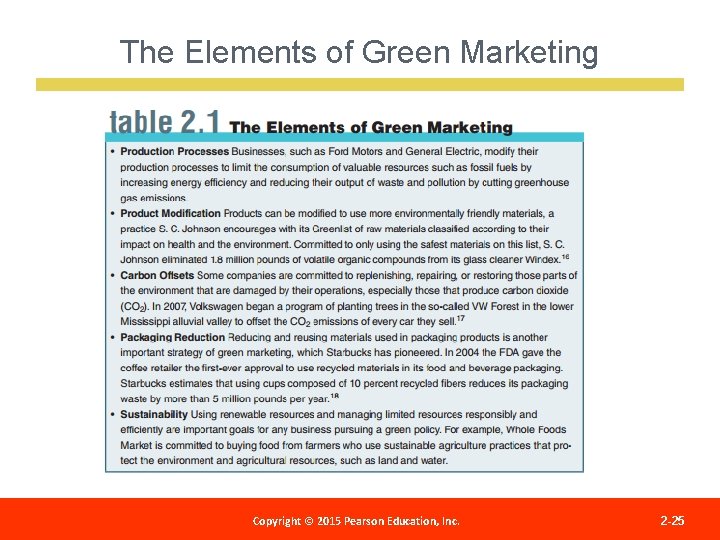
The Elements of Green Marketing Copyright © 2012 Pearson Education, Copyright © 2015 Pearson Education, Inc. Publishing as Prentice Hall 2 -25
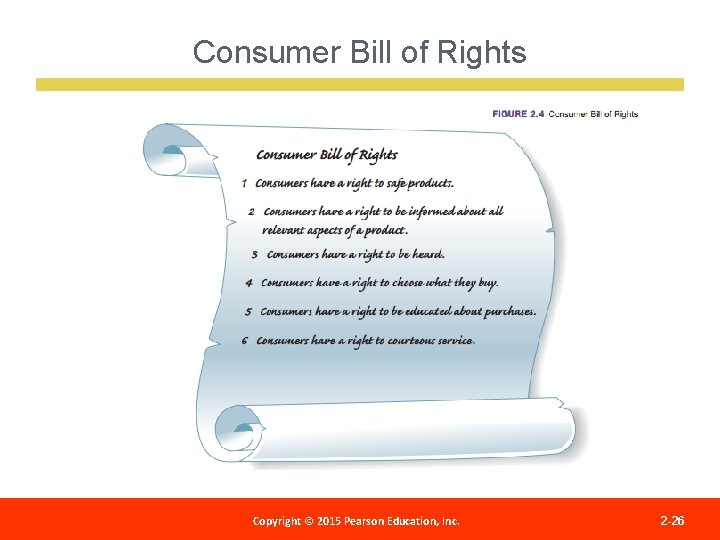
Consumer Bill of Rights Copyright © 2012 Pearson Education, Copyright © 2015 Pearson Education, Inc. Publishing as Prentice Hall 2 -26
Responsibility toward Employees • Provide opportunities to balance work and life pressures and preferences • Help employees maintain job skills • Treat terminated or laid-off employees with respect and compassion Copyright © 2012 Pearson Education, Copyright © 2015 Pearson Education, Inc. Publishing as Prentice Hall 2 -27
Responsibility toward Employees (cont. ) • A company that provides its employees with equal opportunities without regard to race, sex, or other irrelevant factors is meeting both its legal and its social responsibilities Copyright © 2012 Pearson Education, Copyright © 2015 Pearson Education, Inc. Publishing as Prentice Hall 2 -28
Responsibility toward the Environment • Air pollution • Water pollution • Land pollution – Toxic waste disposal – Recycling Copyright © 2012 Pearson Education, Copyright © 2015 Pearson Education, Inc. Publishing as Prentice Hall 2 -29
Responsibility toward Investors • Insider trading – using confidential information to gain from the purchase or sale of stocks. • Misrepresentation of finances Copyright © 2012 Pearson Education, Copyright © 2015 Pearson Education, Inc. Publishing as Prentice Hall 2 -30
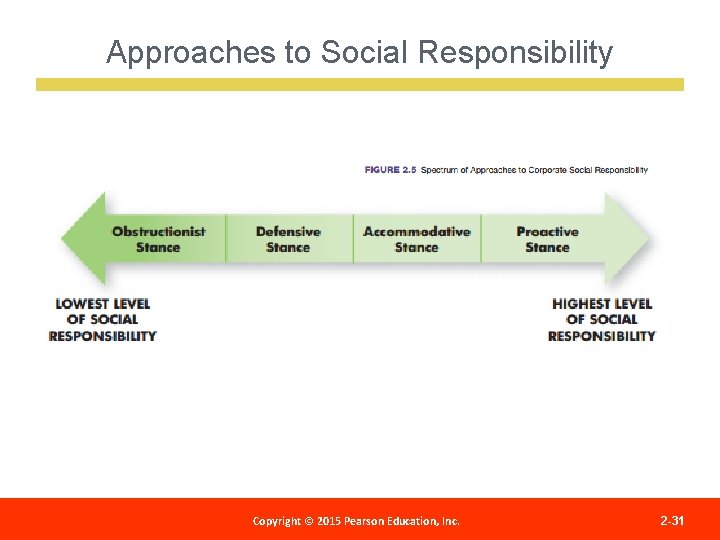
Approaches to Social Responsibility Copyright © 2012 Pearson Education, Copyright © 2015 Pearson Education, Inc. Publishing as Prentice Hall 2 -31

Approaches to Social Responsibility (cont. ) • Obstructionist Stance – involves doing as little as possible and may involve attempts to deny or cover up violations • Defensive Stance – company meets only minimum legal requirements in its commitments to groups and individuals its social environment Copyright © 2012 Pearson Education, Copyright © 2015 Pearson Education, Inc. Publishing as Prentice Hall 2 -32
Approaches to Social Responsibility (cont. ) • Accommodative Stance – a company, if specifically asked to do so, exceeds legal minimums in its commitments to groups • Proactive Stance – a company actively seeks opportunities to contribute to the well-being of groups and individuals in its social environment Copyright © 2012 Pearson Education, Copyright © 2015 Pearson Education, Inc. Publishing as Prentice Hall 2 -33
Social Responsibility and the Small Business • For small businesses, ethical issues are questions of individual ethics • But in questions of social responsibility, they must ask themselves if they can afford a social agenda Copyright © 2012 Pearson Education, Copyright © 2015 Pearson Education, Inc. Publishing as Prentice Hall 2 -34
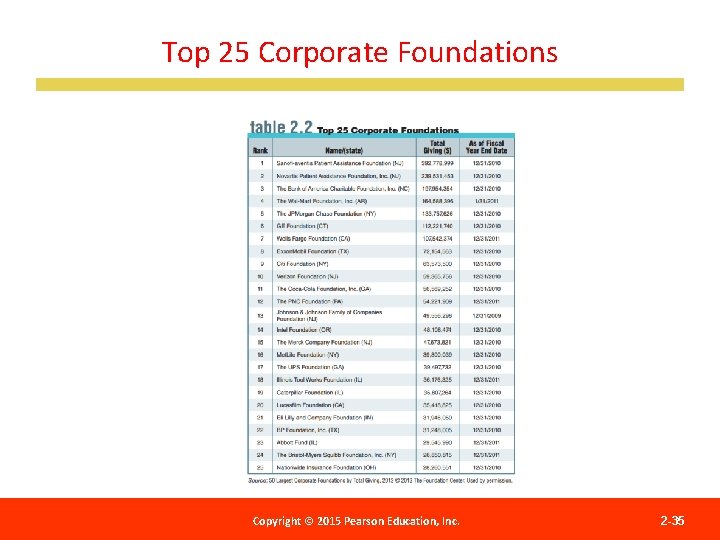
Top 25 Corporate Foundations Copyright © 2012 Pearson Education, Copyright © 2015 Pearson Education, Inc. Publishing as Prentice Hall 2 -35
The Government and Social Responsibility • Regulation – the establishment of laws and rules that dictate what organizations can and cannot do – Direct – Indirect Copyright © 2012 Pearson Education, Copyright © 2015 Pearson Education, Inc. Publishing as Prentice Hall 2 -36
How Organizations Influence Government • Political Action Committees (PACs) – special organizations created to solicit money and then distribute it to political candidates • Lobbying – the use of persons or groups to formally represent an organization or group of organizations before political bodies Copyright © 2012 Pearson Education, Copyright © 2015 Pearson Education, Inc. Publishing as Prentice Hall 2 -37
Formal Organizational Dimensions • Legal Compliance – the extent to which the organization conforms to local, state, federal, and international laws • Ethical Compliance – the extent to which the members of the organization follow basic ethical (and legal) standards of behavior Copyright © 2012 Pearson Education, Copyright © 2015 Pearson Education, Inc. Publishing as Prentice Hall 2 -38
Formal Organizational Dimensions (cont. ) • Philanthropic giving – the awarding of funds or gifts to charities or other worthy causes Copyright © 2012 Pearson Education, Copyright © 2015 Pearson Education, Inc. Publishing as Prentice Hall 2 -39
Evaluating Social Responsibility • Corporate Social Audit – systematic analysis of a firm’s success in using funds earmarked for meeting its social responsibility goals Copyright © 2012 Pearson Education, Copyright © 2015 Pearson Education, Inc. Publishing as Prentice Hall 2 -40
Applying What You’ve Learned 1. Explain how individuals develop their personal codes of ethics and why ethics are important in the workplace. 2. Distinguish social responsibility from ethics, identify organizational stakeholders, and characterize social consciousness today. 3. Show the concept of social responsibility applies both to environmental issues and to a firm’s relationships with customers, employees, and investors. Copyright © 2012 Pearson Education, Copyright © 2015 Pearson Education, Inc. Publishing as Prentice Hall 2 -41
Applying What You’ve Learned (cont. ) 4. Identify four general approaches to social responsibility and note the role of social responsibility in small business. 5. Explain the role of government in social responsibility in terms of how governments and businesses influence each other. Copyright © 2012 Pearson Education, Copyright © 2015 Pearson Education, Inc. Publishing as Prentice Hall 2 -42
Copyright©© 2015 2012 Pearson. Education, Inc. Copyright Publishing as Prentice Hall 2 -43
- Slides: 43