
UNDERSTANDING BEHAVIOR Why do people join cults What
UNDERSTANDING BEHAVIOR Why do people join cults?
What is a cult? Cults can be defined as a group having all of the following five characteristics: 1. Psychological coercion (manipulation) to recruit, indoctrinate and retain its members 2. It forms an elitist society (totalitarian). 3. Its founder/leader is self-appointed, dogmatic, messianic, and very charismatic 4. The cult believes that 'the end justifies the means' when working to get money and recruit people. 5. Its wealth does not benefit its members or society.
Key Vocabulary • Conformity • Compliance • Obedience
Possible effects of cults • "When you meet the friendliest people you have ever known, who introduce you to the most loving group of people you've ever encountered, and you find the leader to be the most inspired, caring, compassionate and understanding person you've ever met, and then you learn the cause of the group is something you never dared hope could be accomplished, and all of this sounds too good to be true-it probably is too good to be true! Don't give up your education, your hopes and ambitions to follow a rainbow. " • Jeannie Mills Ex - member of The People's Temple, later found murdered.

FORMS OF “MIND CONTROL” How do people recruit and retain cult members?
Forms of “Mind Control” • Hypnosis • Inducing a state of high suggestibility by hypnosis, often thinly disguised as relaxation or meditation. • Peer Group Pressure • Suppressing doubt and resistance to new ideas by exploiting the need to belong. • Love Bombing • Creating a sense of family and belonging through hugging, kissing, touching and flattery.
Forms of “Mind Control” • Rejection of Old Values • Accelerating acceptance of new life style by constantly denouncing former values and beliefs. • Confusing Doctrine • Encouraging blind acceptance and rejection of logic through complex lectures on an incomprehensible doctrine. • Metacommunication • Implanting subliminal messages by stressing certain key words or phrases in long, confusing lectures.
Forms of “Mind Control” • Removal of Privacy • Achieving loss of ability to evaluate logically by preventing private contemplation. • Time Sense Deprivation • Destroying ability to evaluate information, personal reactions, and body functions in relation to passage of time by removing all clocks and watches. • Disinhibition • Encouraging child-like obedience by orchestrating child-like behavior.
Forms of “Mind Control” • Uncompromising Rules • Inducing regression and disorientation by soliciting agreement to seemingly simple rules which regulate mealtimes, bathroom breaks and use of medications. • Verbal Abuse • Desensitizing through bombardment with foul and abusive language. • Sleep Deprivation and Fatigue • Creating disorientation and vulnerability by prolonging mental and physical activity and withholding adequate rest and sleep.
Forms of “Mind Control” • Dress Codes • Removing individuality by demanding conformity to the group dress code. • Chanting and Singing • Eliminating non-cult ideas through group repetition of mind-narrowing chants or phrases. • Confession • Encouraging the destruction of individual ego through confession of personal weaknesses and innermost feelings of doubt.
Forms of “Mind Control” • Financial Commitment • Achieving increased dependence on the group by 'burning bridges' to the past, through the donation of assets. • Finger Pointing • Creating a false sense of righteousness by pointing to the shortcomings of the outside world and other cults. • Flaunting Hierarchy • Promoting acceptance of cult authority by promising advancement, power and salvation. • Isolation • Inducing loss of reality by physical separation from family, friends, society and rational references.
Forms of “Mind Control” • Controlled Approval • Maintaining vulnerability and confusion by alternately rewarding and punishing similar actions. • Change of Diet • Creating disorientation and increased susceptibility to emotional arousal by depriving the nervous system of necessary nutrients through the use of special diets and/or fasting. • Games • Inducing dependence on the group by introducing games with obscure rules.
Forms of “Mind Control” • No Questions • Accomplishing automatic acceptance of beliefs by discouraging questions. • Guilt • Reinforcing the need for 'salvation' by exaggerating the sins of the former lifestyles. • Fear • Maintaining loyalty and obedience to the group by threatening soul, life or limb for the slightest 'negative' thought, word or deed. • Replacement of Relationships • Destroying pre-cult families by arranging cult marriages and 'families'.
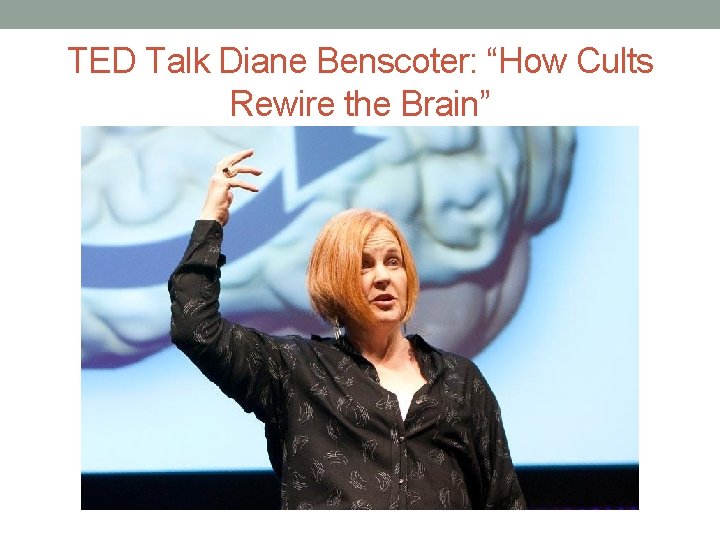
TED Talk Diane Benscoter: “How Cults Rewire the Brain”
Reflection – Paragraph Response • What are the similarities and differences between the behavior of individuals in cults and participants of the Milgram shock experiment?
- Slides: 16