
UNDERSTANDING BEHAVIOR HUMAN RELATIONS AND PERFORMANCE Personality Intelligence
UNDERSTANDING BEHAVIOR, HUMAN RELATIONS, AND PERFORMANCE Personality, Intelligence, and Perception 2
HERE’S THE SITUATION…
STORY: THE CO-WORKER On Friday, you said goodbye to everyone at work. It had been a great week and you were looking forward to the weekend. On Monday, you returned to work. Your coworker, David, has just walked in and appears to be upset about something. You decide to ask him what is wrong, and he proceeds to snap at you. You decide to apologize to him if you have hurt his feelings. He just yells at you…. You return to your workstation, upset and worried… Questions: As a Coworker 1. What could be wrong? 2. Is this your problem? 3. Did you handle the situation correctly? 4. If not, what should you have done? 5. Why? 6. What are some other things to consider?
OTHER THINGS TO CONSIDER Sleep deprivation Hunger Coffee withdrawal Pain Stress coming from other sources Emotional/Personal issues
QUICK QUIZ: 1. Define what the “Total person approach” is: 2. What is “Systems effect”: 3. Fredrick W. Taylor is the father of _________ 4. Called “father of personnel administration” _____________ 5. According to W. EDWARDS DEMING, MANAGEMENT MUST TAKE ____ Steps.
ANSWERS: 1. Total person approach: the organization employs the whole person, not just his or her job skills. 2. Systems effect: all people in the organization are effected by at least one other person, and each person affects the whole group/organization. 3. Fredrick W. Taylor is the father of Scientific Management 4. Called “father of personnel administration” – Robert Owen 5. W. EDWARDS DEMING - 14 STEPS MANAGEMENT MUST TAKE
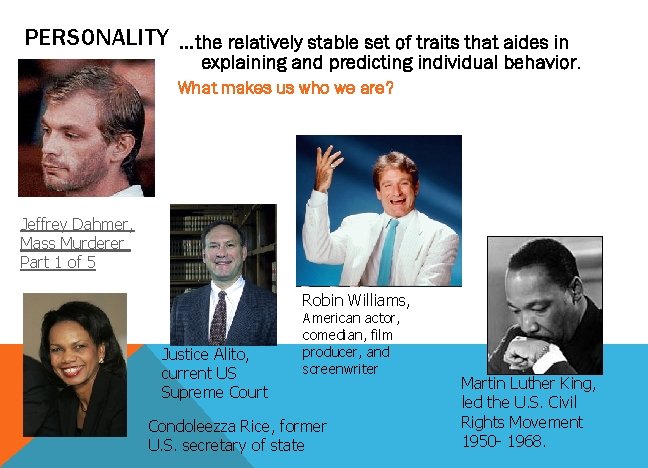
PERSONALITY …the relatively stable set of traits that aides in explaining and predicting individual behavior. What makes us who we are? Jeffrey Dahmer, Mass Murderer Part 1 of 5 Robin Williams, Justice Alito, current US Supreme Court American actor, comedian, film producer, and screenwriter Condoleezza Rice, former U. S. secretary of state Martin Luther King, led the U. S. Civil Rights Movement 1950 - 1968.
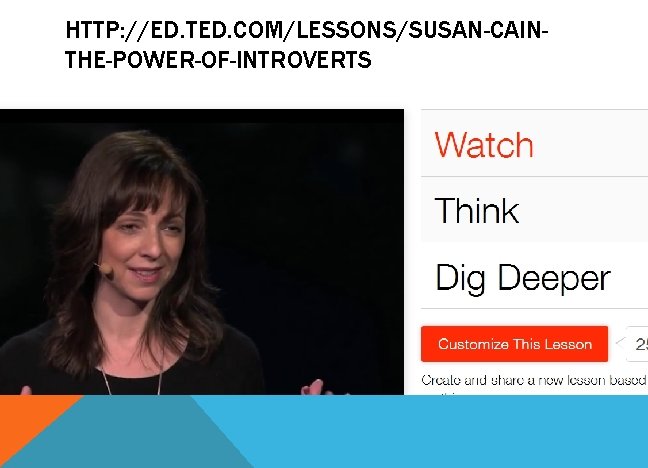
HTTP: //ED. TED. COM/LESSONS/SUSAN-CAINTHE-POWER-OF-INTROVERTS
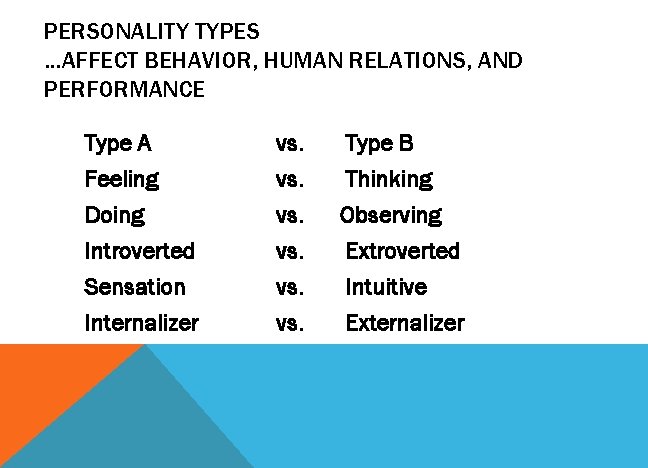
PERSONALITY TYPES …AFFECT BEHAVIOR, HUMAN RELATIONS, AND PERFORMANCE Type A Feeling Doing Introverted Sensation Internalizer vs. vs. vs. Type B Thinking Observing Extroverted Intuitive Externalizer
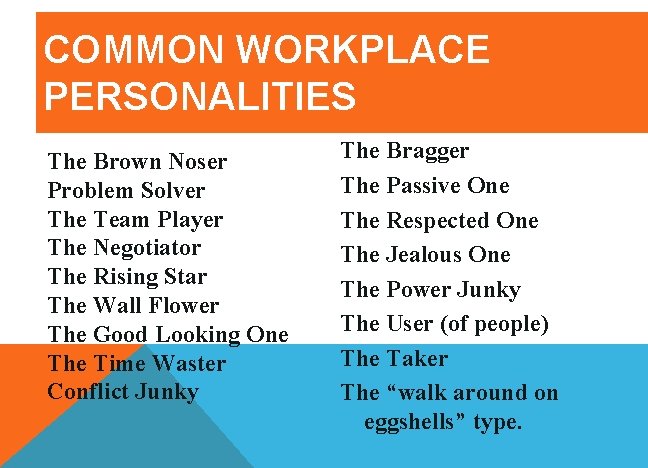
COMMON WORKPLACE PERSONALITIES The Brown Noser Problem Solver The Team Player The Negotiator The Rising Star The Wall Flower The Good Looking One The Time Waster Conflict Junky The Bragger The Passive One The Respected One The Jealous One The Power Junky The User (of people) The Taker The “walk around on eggshells” type.
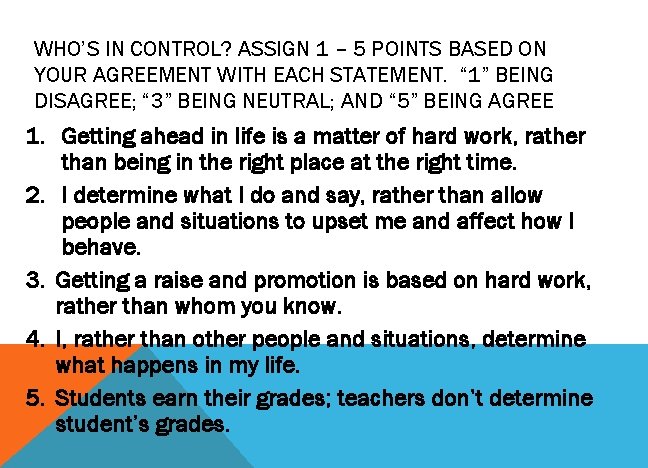
WHO’S IN CONTROL? ASSIGN 1 – 5 POINTS BASED ON YOUR AGREEMENT WITH EACH STATEMENT. “ 1” BEING DISAGREE; “ 3” BEING NEUTRAL; AND “ 5” BEING AGREE 1. Getting ahead in life is a matter of hard work, rather than being in the right place at the right time. 2. I determine what I do and say, rather than allow people and situations to upset me and affect how I behave. 3. Getting a raise and promotion is based on hard work, rather than whom you know. 4. I, rather than other people and situations, determine what happens in my life. 5. Students earn their grades; teachers don’t determine student’s grades.
LOCUS OF CONTROL …A CONTINUUM BETWEEN AN EXTERNAL AND INTERNAL BELIEF OVER WHO HAS CONTROL OVER ONE’S DESTINY. Internals Greater job satisfaction Non-conforming Secure Motivated by skill-based compensation Self-structuring Initiative and independent Prefer to participate in decisions Prefers democratic leadership Externals Less job satisfaction Conforming Anxious Responds less well to incentive-based pay Prefer a set, simple structure Compliant Prefer to be directed Prefers autocratic leadership
INTELLIGENCE …THE LEVEL OF ONE’S CAPACITY FOR NEW LEARNING, PROBLEM-SOLVING, AND DECISION MAKING. Multiple intelligences which include: § Interpersonal § Intrapersonal The capacity to learn affects our intelligence.
EQ OR EMOTIONAL IQ http: //www. ihhp. com/ Emotional intelligence or Quotient (EQ) is the capacity for effectively recognizing and managing our own emotions and those of others. Emotions have the potential to get in the way of our most important business relationships. A lack of EQ is the main reason promising careers derail. A critical mass of EQ is the number one reason successful leaders, managers and sales people outperform the average! Interested in finding out your level of EQ? http: //www. ihhp. com/avclips. htm
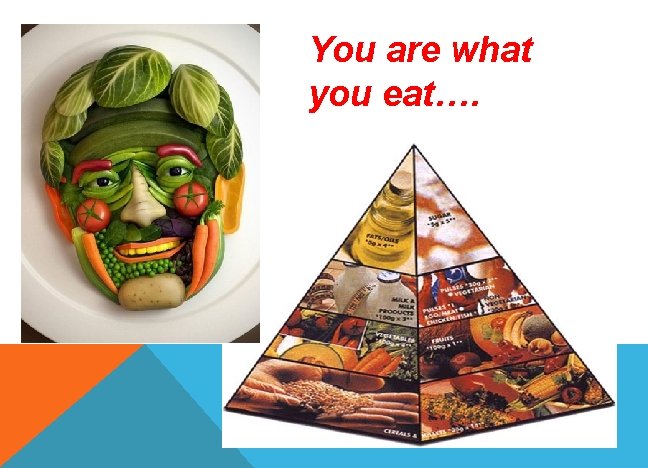
You are what you eat….
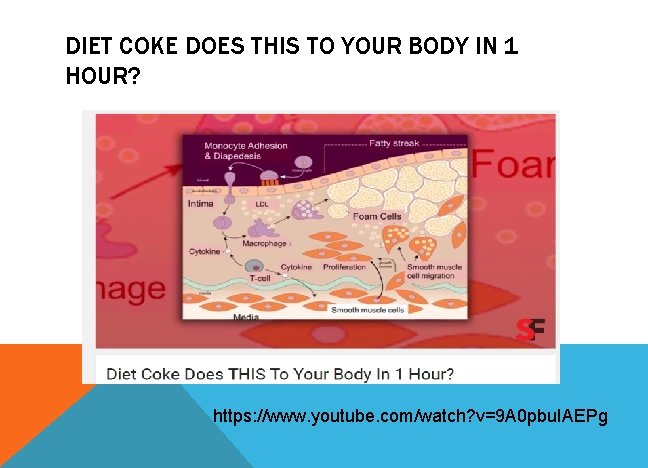
DIET COKE DOES THIS TO YOUR BODY IN 1 HOUR? https: //www. youtube. com/watch? v=9 A 0 pbu. IAEPg
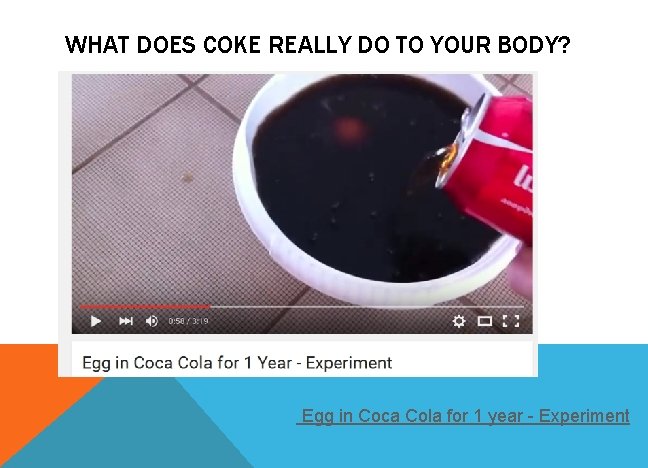
WHAT DOES COKE REALLY DO TO YOUR BODY? Egg in Coca Cola for 1 year - Experiment
Biorhythm charts illustrate the principle that our lives are affected by physical, emotional, and intellectual cycles. Many people report that they can improve the quality of their lives by monitoring the highs and lows of these cycles and acting accordingly. You can even compute your compatibility with someone else to predict the highs and lows in your physical, emotional, and intellectual relationships with them.
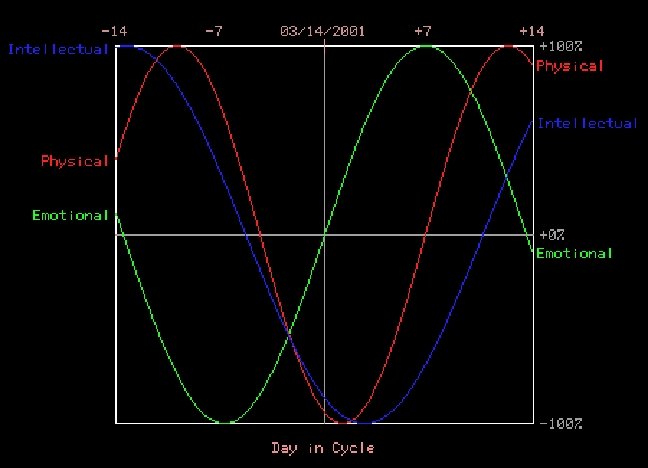
Primary Cycles The primary cycles you see are three cardinal biorhythm cycles: Physical, Emotional, and, Intellectual. Generally speaking, the more positive a cycle is at any given point in time, the better one is able to interact in that arena. For example, high emotional level tends to mean that a person is more stable, is better able to make relationship decisions, and so on. This is not to say that when the cycle is in the negative range that the person is not doing well in that arena, rather, it means that it is harder to do well. -- Plan exams when your Intellectual cycle is high.
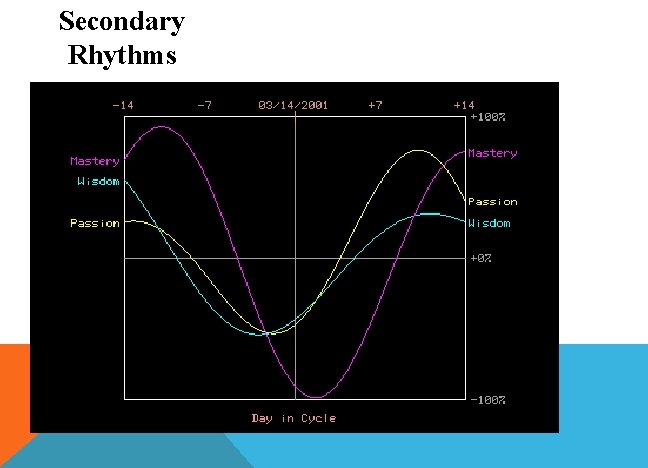
Secondary Rhythms
SECONDARY BIORYTHMS The secondary rhythms are derived from various interactions among the primary rhythms. As such, the aspects they influence are a little less well defined, but, the power they exert is still very strong. Below is a description of the cycles. Passion (Physical joined with Emotional) The common force linking the physical and the emotional is power. Drive, incentive, and sexuality all draw from the passion cycle. From passion comes the ability to act. Wisdom (Emotional joined with Intellectual) From the emotional and the intellectual comes the ability to gauge what is worth pursuing. Wisdom guides passion.
SECONDARY BIORYTHMS Mastery (Intellectual joined with Physical) While passion gives the initial energy to take something on, it is mastery that allows you to complete it (yet without passion, completion takes much longer). Mastery is the stoic ability to act on what you desire.
S E L G N I N L R A E Y T S
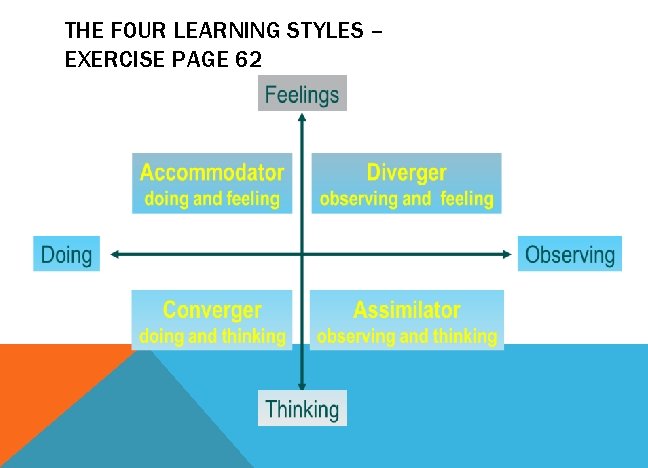
THE FOUR LEARNING STYLES – EXERCISE PAGE 62
S T N W I O P S N O I T P PE E C R D N A E VI
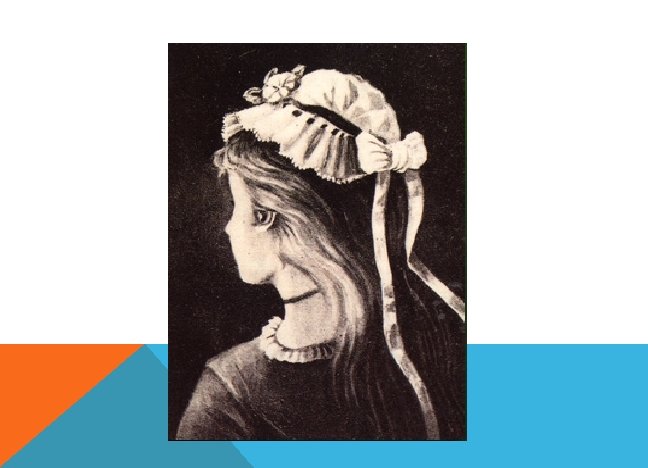
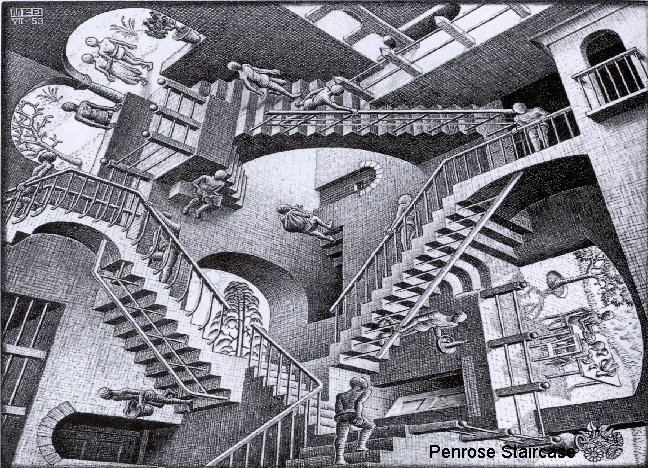
Penrose Staircase
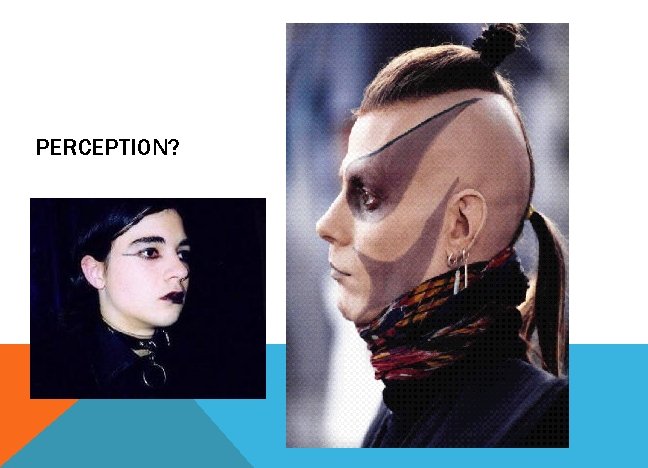
PERCEPTION?
BLINK – SNAP JUDGEMENTS AND PERCEPTIONS Snap Judgements https: //www. youtube. com/watch? v=AG BVgvisb. I 8
IMPRESSIONS AND IMAGE Primacy effect: the way people perceive one another during first impressions; Four-minute barrier: the time we have to make a good impression. Image: other people’s attitudes towards us. § Appearance § Nonverbal communication § Behavior
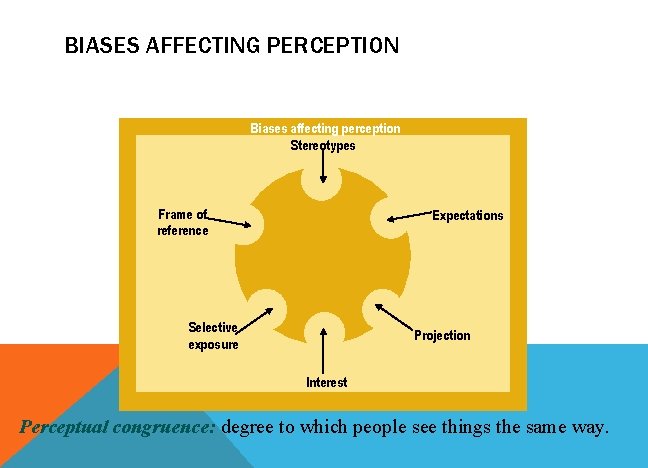
BIASES AFFECTING PERCEPTION Biases affecting perception Stereotypes Frame of reference Expectations Selective exposure Projection Interest Perceptual congruence: degree to which people see things the same way.
PERCEPTION … A PERSON’S INTERPRETATION OF REALITY. Biases in Perception: Stereotyping: the process of generalizing behavior of all members of a group. Frame of reference: tendency to see things from a narrow focus that directly affects us. Expectations: perceiving, selecting, organizing, and interpreting information as we expect it to be. Selective exposure: tendency to see and hear what we want to. Interest: Level of interest influences behavior and perception. Projection: attributing our attitudes or shortcomings to others.
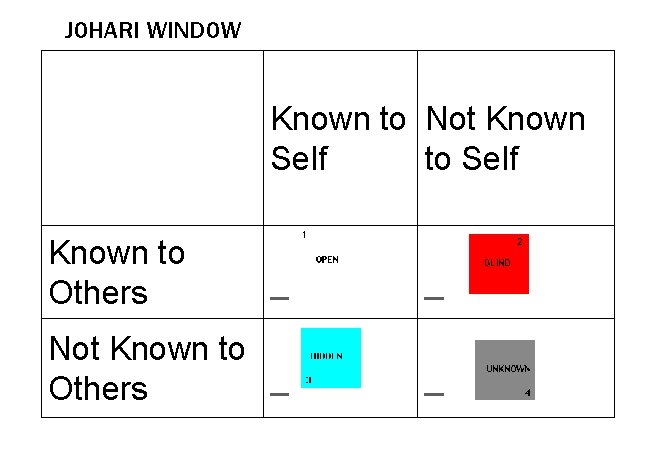
JOHARI WINDOW Known to Not Known Self to Self Known to Others Not Known to Others
STRESS MANAGEMENT
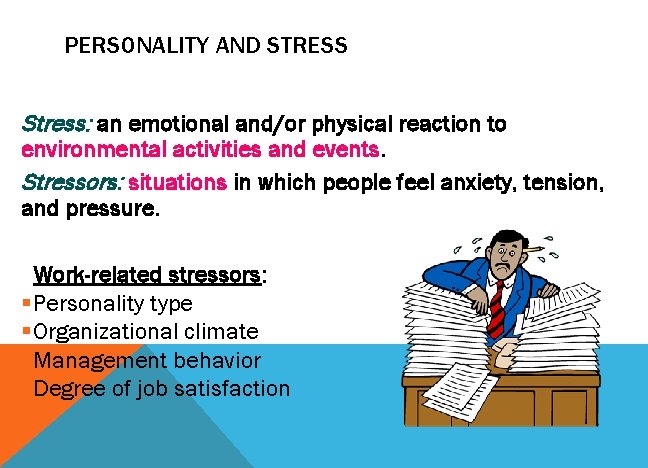
PERSONALITY AND STRESS Stress: an emotional and/or physical reaction to environmental activities and events. Stressors: situations in which people feel anxiety, tension, and pressure. Work-related stressors: § Personality type § Organizational climate § Management behavior § Degree of job satisfaction
STRESS Symptoms Burnout: the constant lack of interest and motivation to perform one’s job due to stress. § Disillusionment § Irritability § Headaches § Body tension § Exhaustion § Stomach problems § Burnout
… R E SE #1 U A C O C F C N A
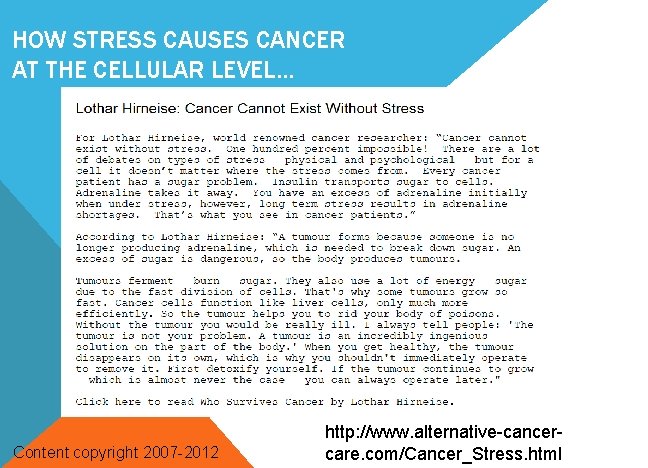
HOW STRESS CAUSES CANCER AT THE CELLULAR LEVEL… Content copyright 2007 -2012 http: //www. alternative-cancercare. com/Cancer_Stress. html
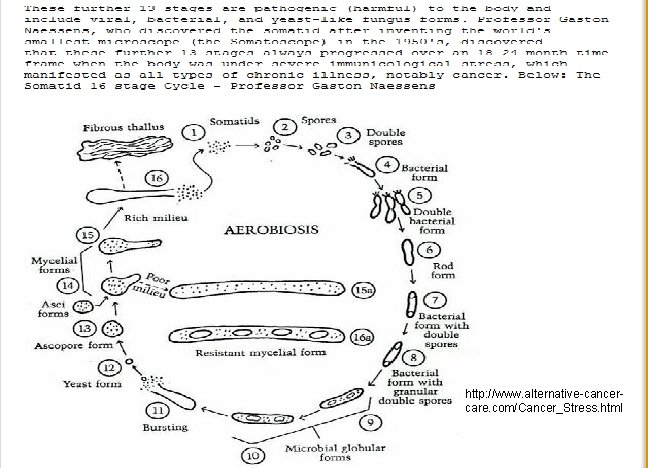
http: //www. alternative-cancercare. com/Cancer_Stress. html
STRESS: REMEDIES Controlling Stress Plan: § Identify stressors § Determine their causes and consequences § Plan to eliminate or decrease the stress. Remedies: § Physical exercise § Nutrition § Relaxation § Positive thinking § Support system
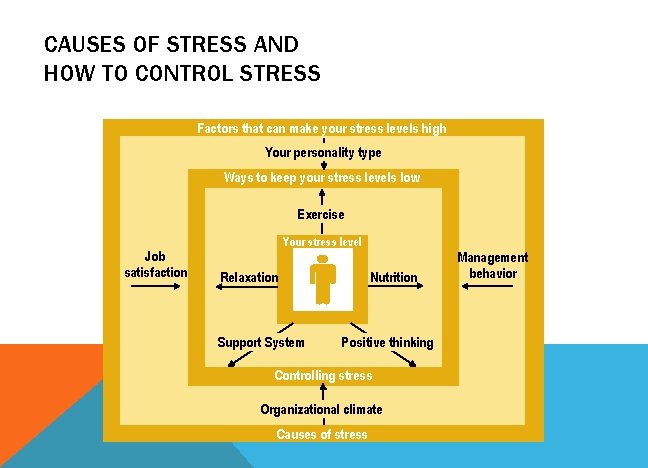
CAUSES OF STRESS AND HOW TO CONTROL STRESS Factors that can make your stress levels high Your personality type Ways to keep your stress levels low Exercise Job satisfaction Your stress level Relaxation Support System Nutrition Positive thinking Controlling stress Organizational climate Causes of stress Management behavior
OKAY, PUT EVERYTHING AWAY AND RELAX!
EASY WORKOFFICE EXERCISES… B HTTP: //WWW. MAYOCLINIC. COM/INDEX. CFM Y MAYO CLINIC STAFF 11/18/2004 WL 00030 © 1998 -2005 MAYO FOUNDATION FOR MEDICAL EDUCATION AND RESEARCH (MFMER). ALL RIGHTS RESERVED. A SINGLE COPY OF THESE MATERIALS MAY BE REPRINTED FOR NONCOMMERCIAL PERSONAL USE ONLY. "MAYO, " "MAYO CLINIC, " "MAYOCLINIC. COM, " "MAYO CLINIC HEALTH INFORMATION, " "RELIABLE INFORMATION FOR A HEALTHIER LIFE" AND THE TRIPLE-SHIELD MAYO LOGO ARE TRADEMARKS OF MAYO FOUNDATION FOR MEDICAL EDUCATION AND RESEARCH.
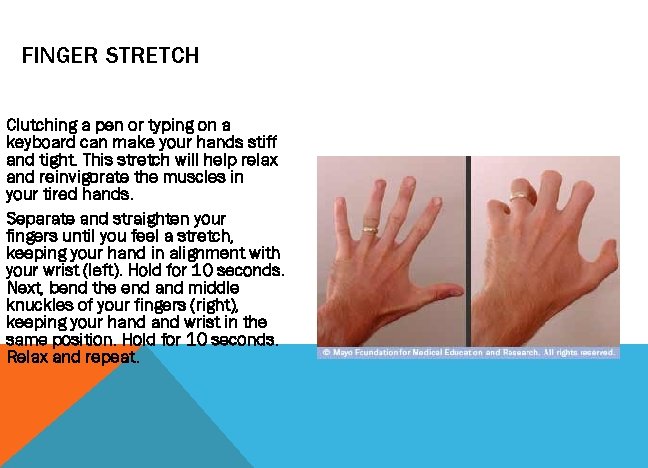
FINGER STRETCH Clutching a pen or typing on a keyboard can make your hands stiff and tight. This stretch will help relax and reinvigorate the muscles in your tired hands. Separate and straighten your fingers until you feel a stretch, keeping your hand in alignment with your wrist (left). Hold for 10 seconds. Next, bend the end and middle knuckles of your fingers (right), keeping your hand wrist in the same position. Hold for 10 seconds. Relax and repeat.
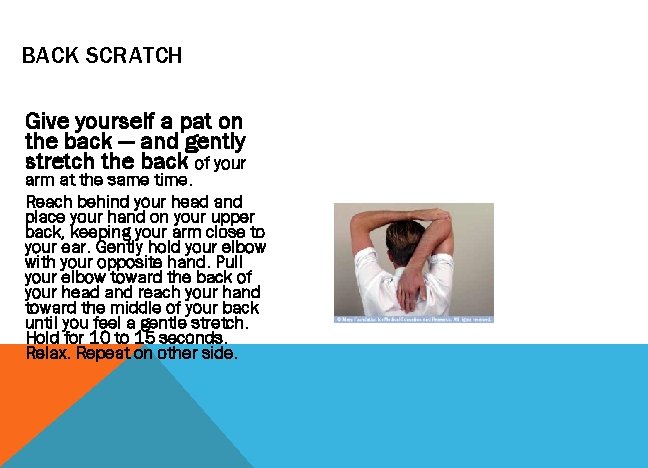
BACK SCRATCH Give yourself a pat on the back — and gently stretch the back of your arm at the same time. Reach behind your head and place your hand on your upper back, keeping your arm close to your ear. Gently hold your elbow with your opposite hand. Pull your elbow toward the back of your head and reach your hand toward the middle of your back until you feel a gentle stretch. Hold for 10 to 15 seconds. Relax. Repeat on other side.
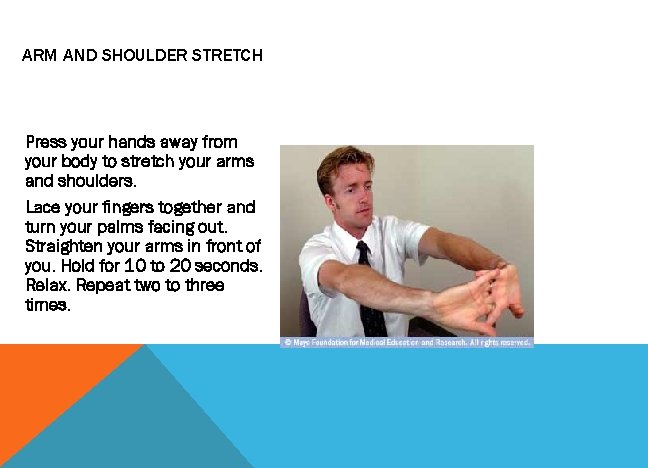
ARM AND SHOULDER STRETCH Press your hands away from your body to stretch your arms and shoulders. Lace your fingers together and turn your palms facing out. Straighten your arms in front of you. Hold for 10 to 20 seconds. Relax. Repeat two to three times.
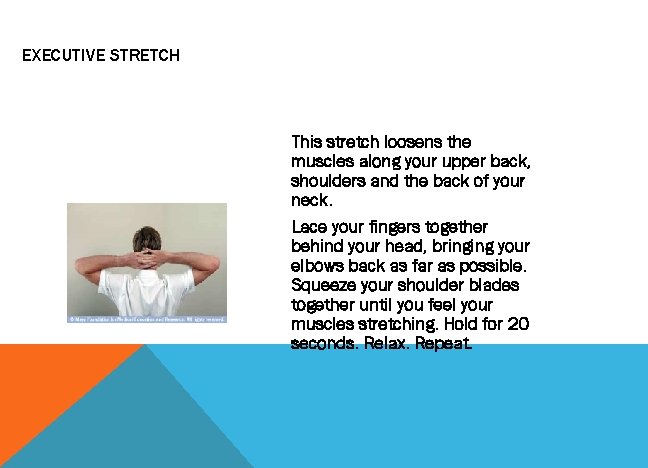
EXECUTIVE STRETCH This stretch loosens the muscles along your upper back, shoulders and the back of your neck. Lace your fingers together behind your head, bringing your elbows back as far as possible. Squeeze your shoulder blades together until you feel your muscles stretching. Hold for 20 seconds. Relax. Repeat.
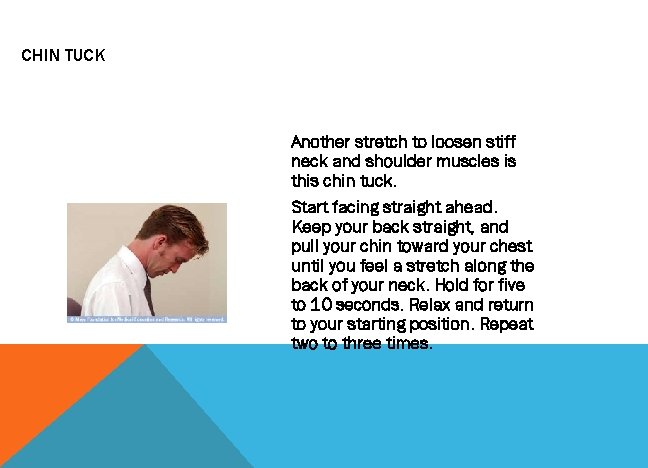
CHIN TUCK Another stretch to loosen stiff neck and shoulder muscles is this chin tuck. Start facing straight ahead. Keep your back straight, and pull your chin toward your chest until you feel a stretch along the back of your neck. Hold for five to 10 seconds. Relax and return to your starting position. Repeat two to three times.
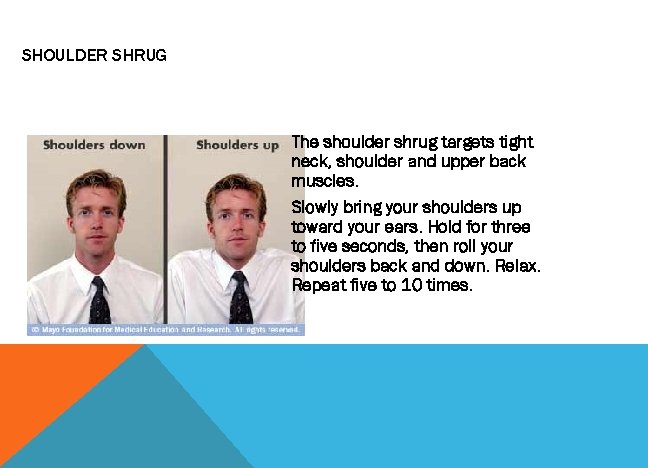
SHOULDER SHRUG The shoulder shrug targets tight neck, shoulder and upper back muscles. Slowly bring your shoulders up toward your ears. Hold for three to five seconds, then roll your shoulders back and down. Relax. Repeat five to 10 times.
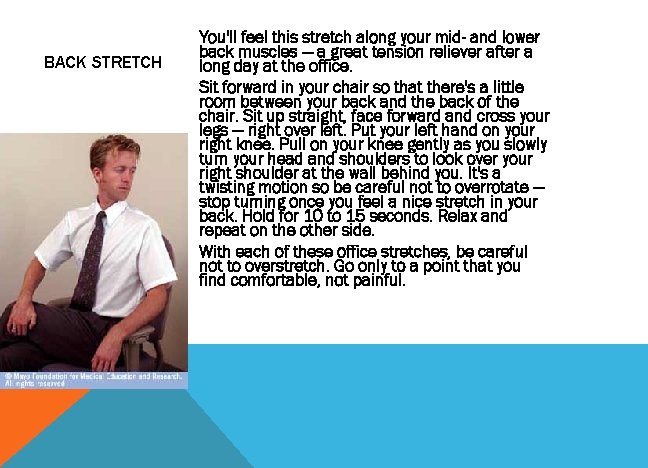
BACK STRETCH You'll feel this stretch along your mid- and lower back muscles — a great tension reliever after a long day at the office. Sit forward in your chair so that there's a little room between your back and the back of the chair. Sit up straight, face forward and cross your legs — right over left. Put your left hand on your right knee. Pull on your knee gently as you slowly turn your head and shoulders to look over your right shoulder at the wall behind you. It's a twisting motion so be careful not to overrotate — stop turning once you feel a nice stretch in your back. Hold for 10 to 15 seconds. Relax and repeat on the other side. With each of these office stretches, be careful not to overstretch. Go only to a point that you find comfortable, not painful.
OTHER THINGS YOU CAN DO: Close your eyes and take some deep breathes Go for a walk – even if it is a short one! Go see a movie or go out to eat with friends Get a massage or go to a day spa Get together with a friend to just talk things out. Have a glass of wine and listen to classical music Take some downtime from work Do Yoga , ride a bike, go play tennis, go for a swim Sleep!
- Slides: 54