
Understanding ASP and FFT Data Benchmarking your schools
Understanding ASP and FFT Data Benchmarking your school’s performance through use of Fischer Family Trust and ASP. • Welcome
Aims of this session • To look at how governing boards use Fischer Family Trust (FFT Aspire) and Analysing School Performance (ASP) data to benchmark their school's performance. • To undertake a 'walk-through' the ASP summary pages and FFT Aspire governor dashboard.
Why do we benchmark? ?

Why do we benchmark?

Benchmarking questions • How does our pupil attainment compare to national? • How does our pupil progress compare to national? • Which are our higher, and lower, performing groups? • How are we performing in different subjects? • How are our disadvantaged pupils doing – what impact is the pupil premium grant having? • How does our pupil attendance and exclusions data compare to national?
Benchmarking questions • How well do our Key Priorities – as set out in the School Development Plan- seek to address the lower performing subject areas and groups? • Where are our biggest ‘gaps’ – and what are we doing to address them? What other questions could we ask, in our support and challenge role?
The benchmarking ‘tools’ • Analysing School Performance (ASP) – includes the Ofsted Inspection Data Summary Report (IDSR). • Fischer Family Trust (FFT Aspire) • others are available. PLUS • Compare Schools Performance (Df. E’s website) https: //www. compare-school-performance. service. gov. uk
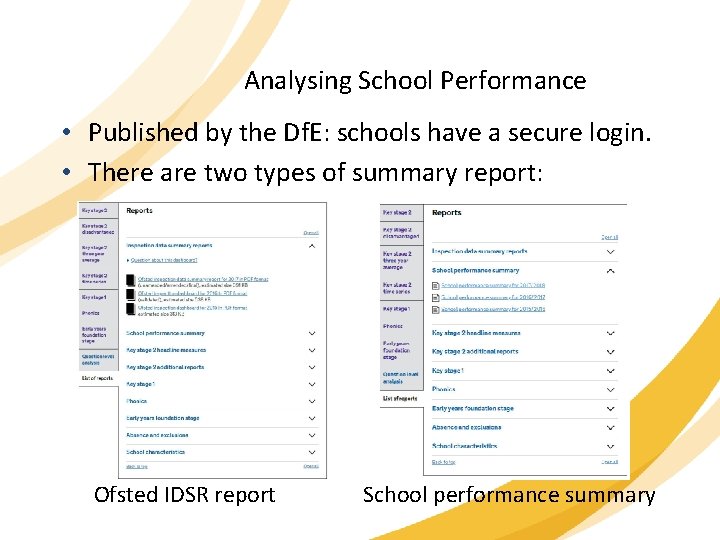
Analysing School Performance • Published by the Df. E: schools have a secure login. • There are two types of summary report: Ofsted IDSR report School performance summary
Analysing School Performance Ofsted inspection data summary report: The IDSR is a tool showing historical data for inspectors to use when preparing for inspections. During inspection, inspectors will give most weight to the outcomes, attendance and behaviour of pupils currently in the school, taking account also of historical data. Primaries - new format coming soon (see handout).
Analysing School Performance School performance summary report: • Replaced Raise. Online reports in 2017 • Can be downloaded as a pdf – about 40 pages long for primary & secondary schools. • Compares your school’s KPIs with both National and Local Authority values. Gives 3 year average and timeseries charts for monitoring trends (KS 2 - new 2018). • Bar graphs at top level. Tables (broken down by groups) and scatter charts for digging deeper.
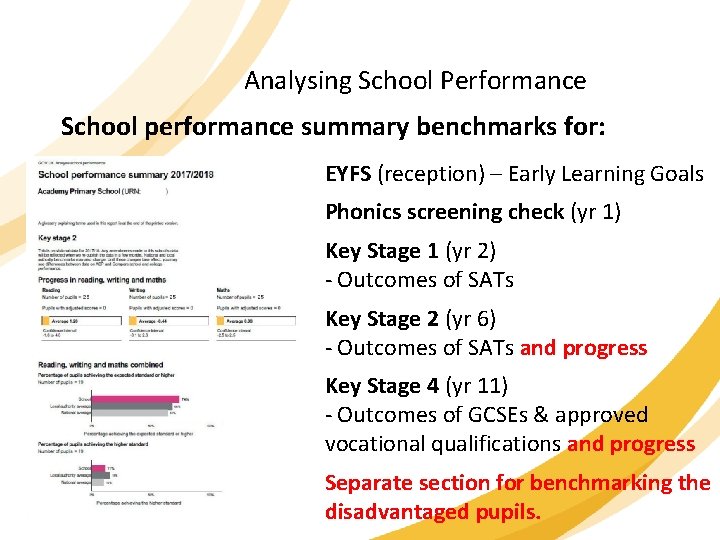
Analysing School Performance School performance summary benchmarks for: EYFS (reception) – Early Learning Goals Phonics screening check (yr 1) Key Stage 1 (yr 2) - Outcomes of SATs Key Stage 2 (yr 6) - Outcomes of SATs and progress Key Stage 4 (yr 11) - Outcomes of GCSEs & approved vocational qualifications and progress Separate section for benchmarking the disadvantaged pupils.
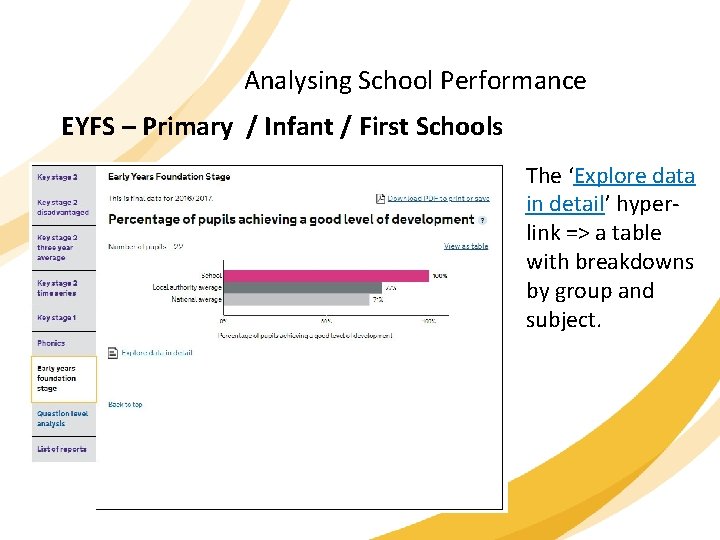
Analysing School Performance EYFS – Primary / Infant / First Schools The ‘Explore data in detail’ hyperlink => a table with breakdowns by group and subject.
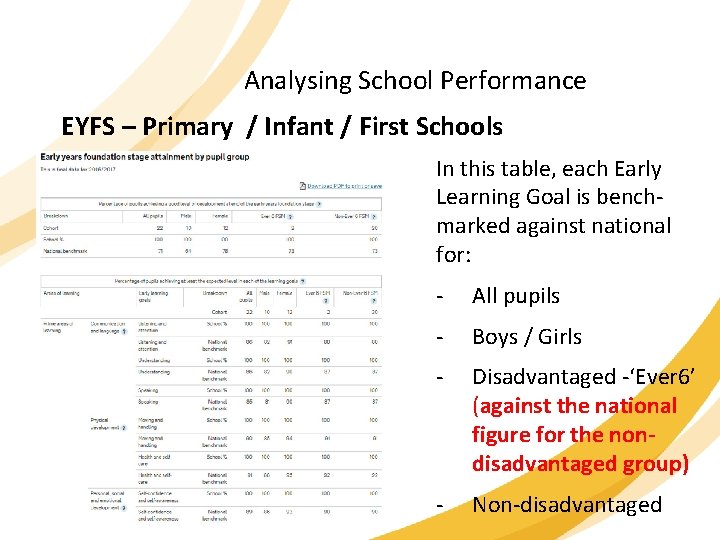
Analysing School Performance EYFS – Primary / Infant / First Schools In this table, each Early Learning Goal is benchmarked against national for: - All pupils - Boys / Girls - Disadvantaged -‘Ever 6’ (against the national figure for the nondisadvantaged group) - Non-disadvantaged
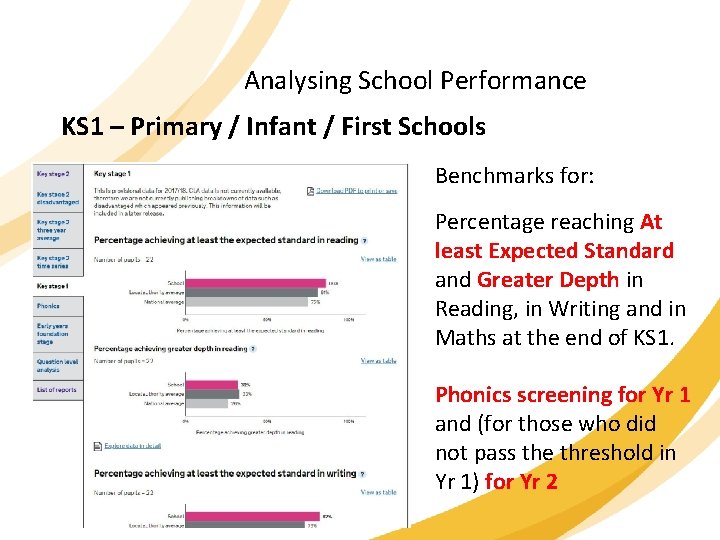
Analysing School Performance KS 1 – Primary / Infant / First Schools Benchmarks for: Percentage reaching At least Expected Standard and Greater Depth in Reading, in Writing and in Maths at the end of KS 1. Phonics screening for Yr 1 and (for those who did not pass the threshold in Yr 1) for Yr 2
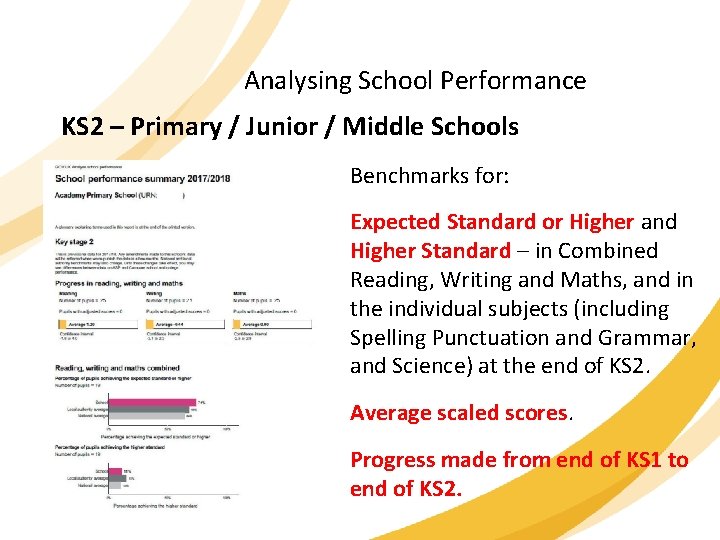
Analysing School Performance KS 2 – Primary / Junior / Middle Schools Benchmarks for: Expected Standard or Higher and Higher Standard – in Combined Reading, Writing and Maths, and in the individual subjects (including Spelling Punctuation and Grammar, and Science) at the end of KS 2. Average scaled scores. Progress made from end of KS 1 to end of KS 2.
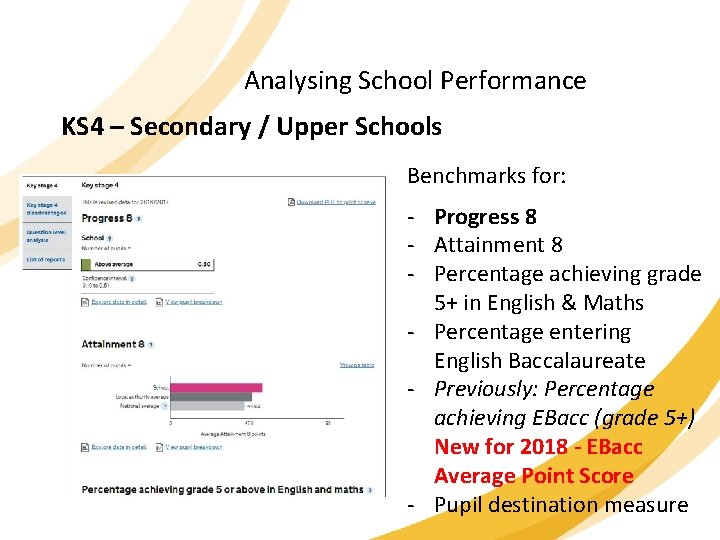
Analysing School Performance KS 4 – Secondary / Upper Schools Benchmarks for: - Progress 8 - Attainment 8 - Percentage achieving grade 5+ in English & Maths - Percentage entering English Baccalaureate - Previously: Percentage achieving EBacc (grade 5+) New for 2018 - EBacc Average Point Score - Pupil destination measure
Analysing School Performance KS 4 – Progress 8 was introduced in 2016 as the headline indicator of school performance at Key Stage 4. A Progress 8 score is calculated for each pupil by comparing their Attainment 8 score with the average Attainment 8 of all pupils nationally who had a similar starting point. The school’s Progress 8 score is calculated as the average of its pupils’ Progress 8 scores. It gives an indication of whether, as a group, the pupils in the school made above or below average progress, compared to similar pupils in other schools.
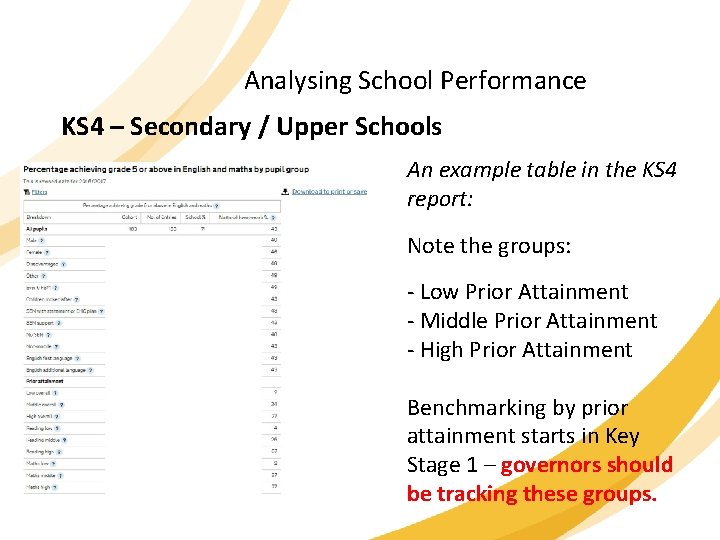
Analysing School Performance KS 4 – Secondary / Upper Schools An example table in the KS 4 report: Note the groups: - Low Prior Attainment - Middle Prior Attainment - High Prior Attainment Benchmarking by prior attainment starts in Key Stage 1 – governors should be tracking these groups.
Analysing School Performance • The ASP reports are updated by the Df. E several times over the year (provisional data -> revised data / final data). Mid-November 2018: • EYFS – still final 2017 data (provisional 2018 data is due early 2019) • Phonics & Key Stage 1 – provisional 2018 data, but the disadvantaged pupil benchmarks are not yet available • Key Stage 2 - provisional 2018 data (including disadvantaged) • Key Stage 4 – still final 2017 data (provisional 2018 is data
Fisher Family Trust Aspire • FFT Aspire dashboard for school leaders and governors – 8 page summary reports for Key Stages 1, 2 & 4 • Plus interactive online reports (governor login required) • Uses the same source data as ASP. Creates additional ‘FFT rankings’. • Does not include EYFS, phonic screening, exclusion data or LA figures to benchmark against. • Graphs showing 3 year trends – progress over time • November ‘ 18 – The KS 2 and KS 4 provisional data dashboards are available. KS 1 due soon.
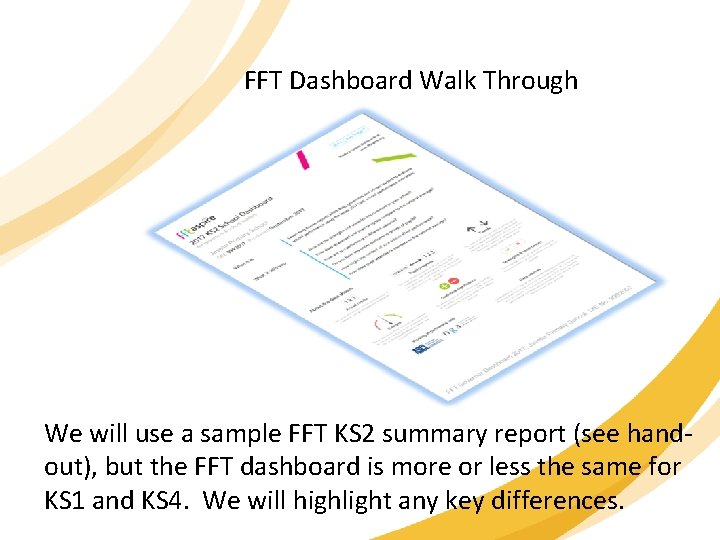
FFT Dashboard Walk Through We will use a sample FFT KS 2 summary report (see handout), but the FFT dashboard is more or less the same for KS 1 and KS 4. We will highlight any key differences.

FFT Report 1: Overview Page Attainment is on the LHS and Progress on the RHS Key Stage 1: Expected Standard & Higher Standard (RWM) Key Stage 2: Average Scaled Score (RM) & Expected Standard. Key Stage 4: Attainment 8, English & Maths @ 4+ & Progress 8
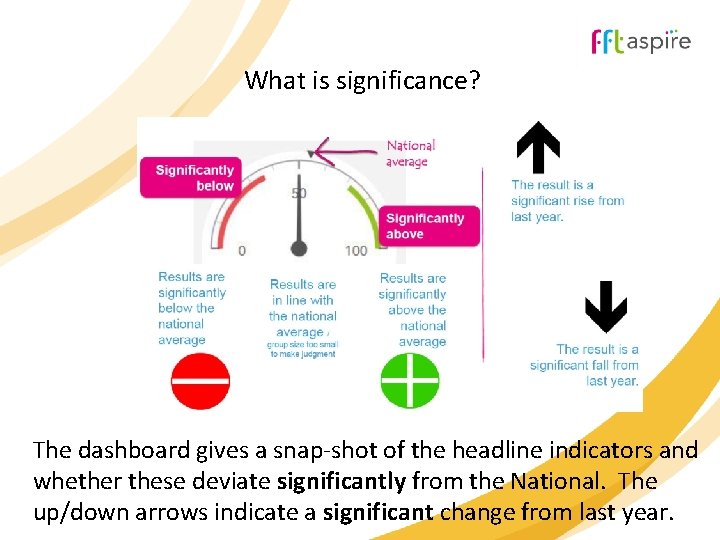
What is significance? The dashboard gives a snap-shot of the headline indicators and whether these deviate significantly from the National. The up/down arrows indicate a significant change from last year.
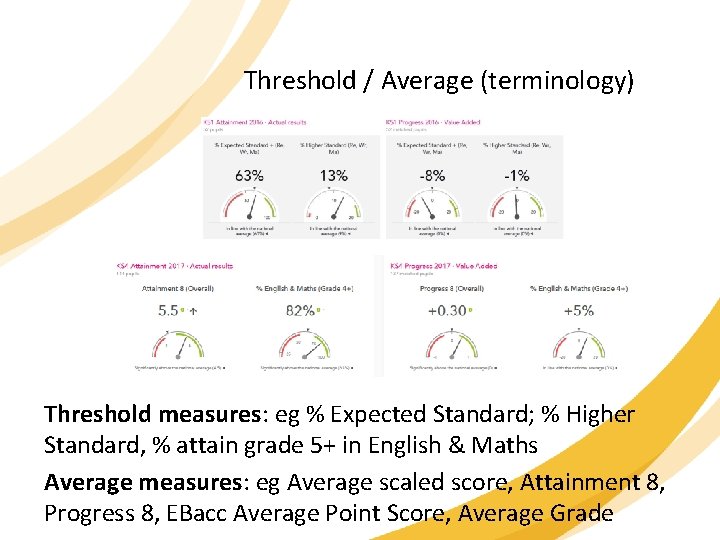
Threshold / Average (terminology) Threshold measures: eg % Expected Standard; % Higher Standard, % attain grade 5+ in English & Maths Average measures: eg Average scaled score, Attainment 8, Progress 8, EBacc Average Point Score, Average Grade
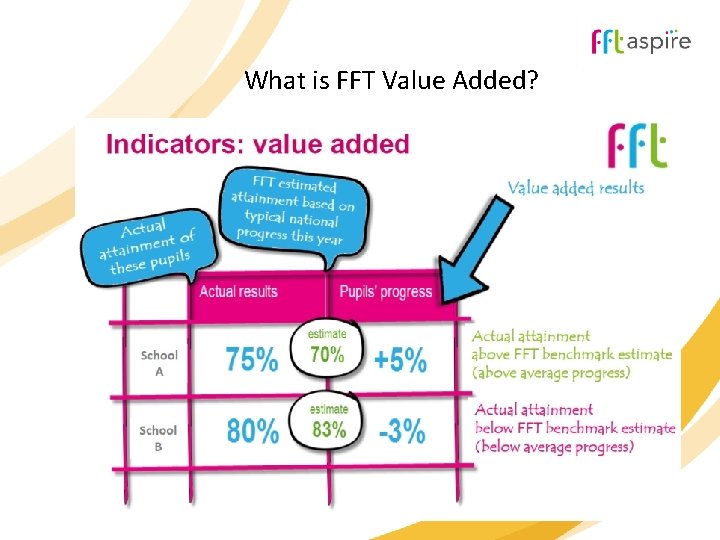
What is FFT Value Added?

FFT Report 1: Overview Page Table of higher & lower performing groups based on progress. KS 1: Overall plus Reading, Writing and Maths. KS 4: Overall plus English & Maths. Subjects (progress).
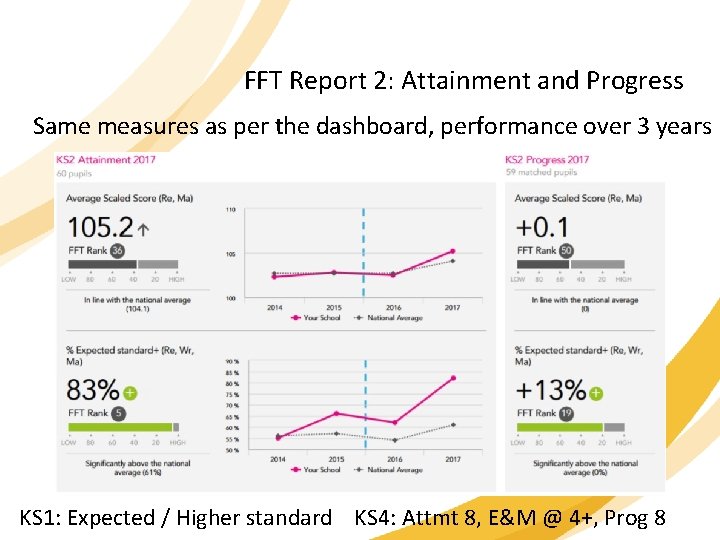
FFT Report 2: Attainment and Progress Same measures as per the dashboard, performance over 3 years KS 1: Expected / Higher standard KS 4: Attmt 8, E&M @ 4+, Prog 8
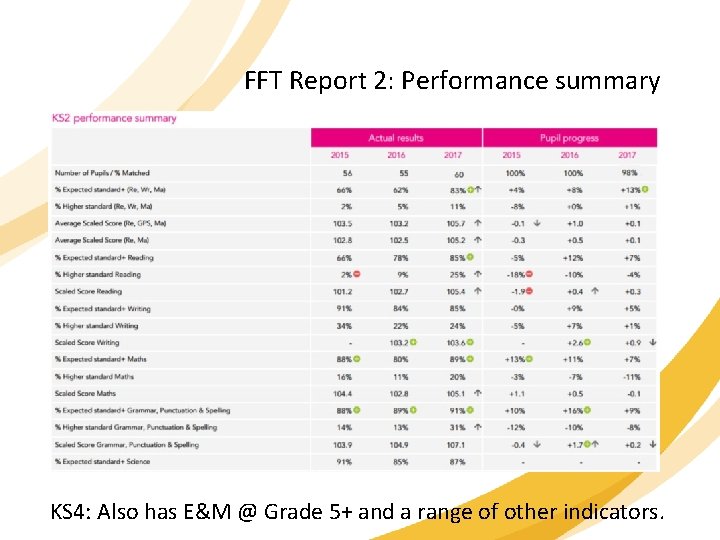
FFT Report 2: Performance summary KS 4: Also has E&M @ Grade 5+ and a range of other indicators.
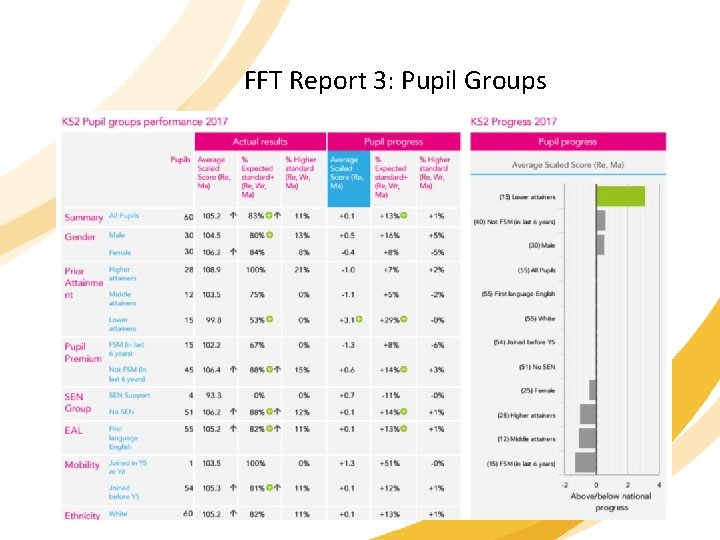
FFT Report 3: Pupil Groups
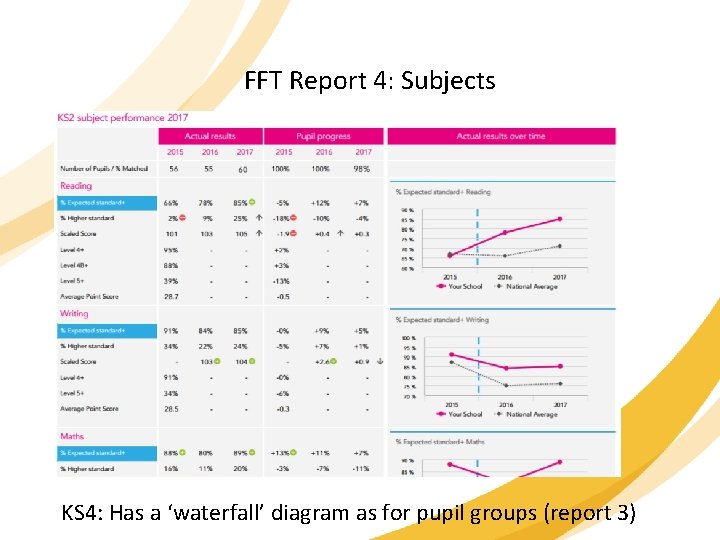
FFT Report 4: Subjects KS 4: Has a ‘waterfall’ diagram as for pupil groups (report 3)
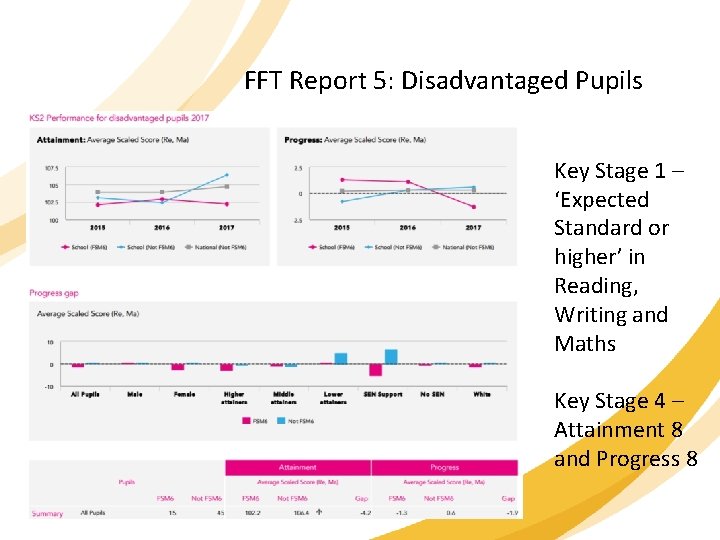
FFT Report 5: Disadvantaged Pupils Key Stage 1 – ‘Expected Standard or higher’ in Reading, Writing and Maths Key Stage 4 – Attainment 8 and Progress 8
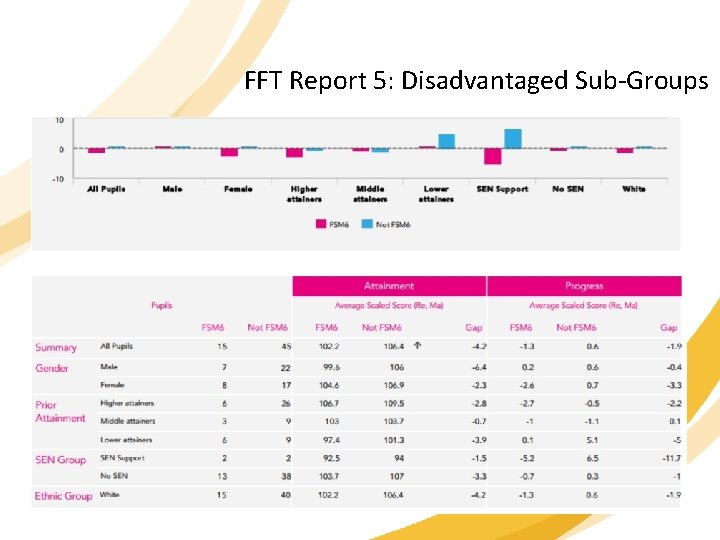
FFT Report 5: Disadvantaged Sub-Groups

FFT Report 6: Scatter Plot
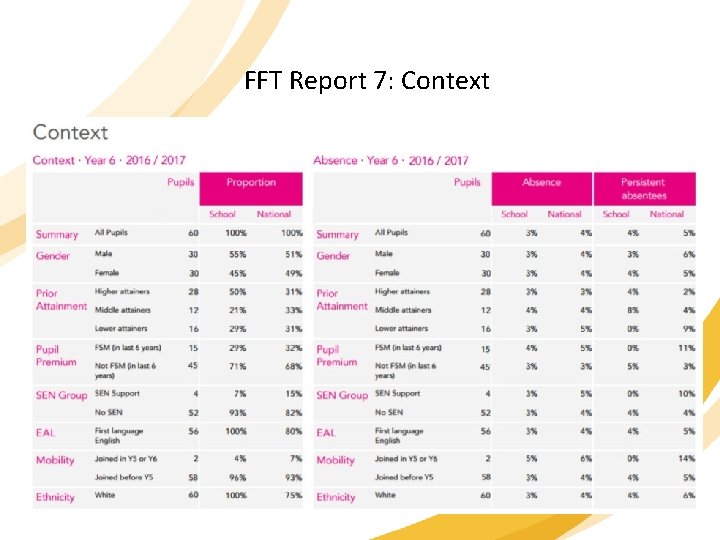
FFT Report 7: Context

Any questions? ?
Recap support & challenge questions: • How well do our Key Priorities – as set out in the School Development Plan- match up with the lower performing subject areas and groups? • Where are our biggest attainment and progress ‘gaps’ – and what are we doing to address them?
- Slides: 36