
Understanding Applying The Engineering Design Process Mark D

- Slides: 32
Understanding & Applying The Engineering Design Process Mark D. Conner The Engineering Academy at Hoover High School www. eahoover. com
A good product is the result of a good process. + What is design? + What is the Engineering Design Process? Examples help What tools are available?
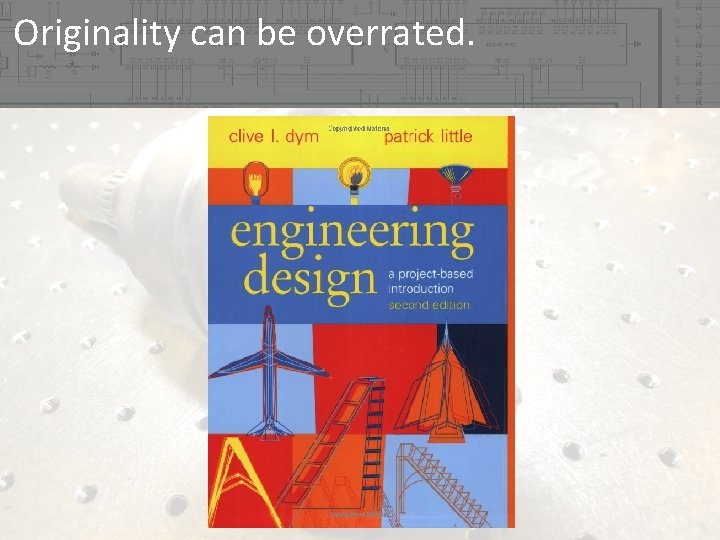
Originality can be overrated.
What is Design?
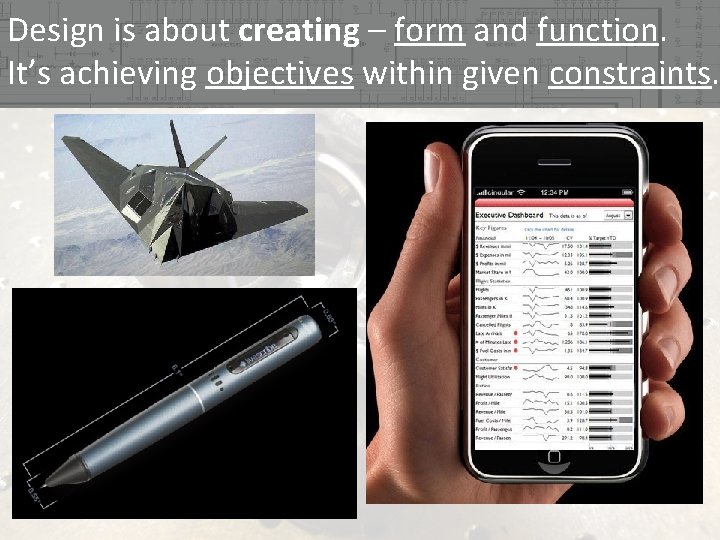
Design is about creating – form and function. It’s achieving objectives within given constraints.
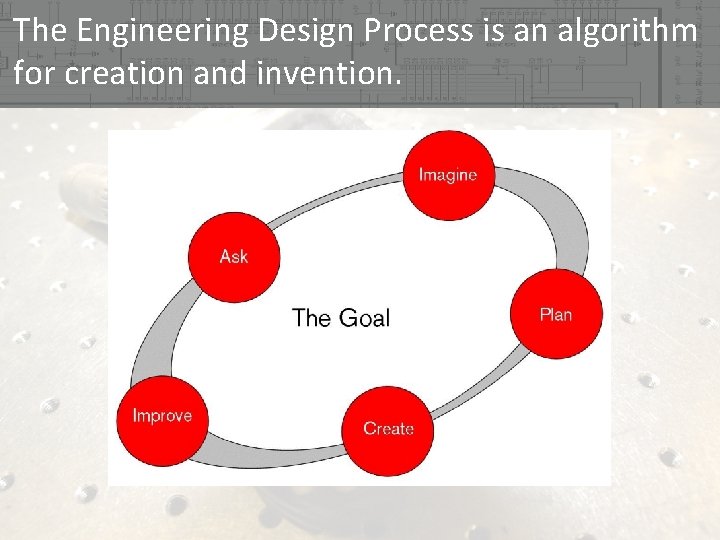
The Engineering Design Process is an algorithm for creation and invention.
What is the Engineering Design Process?
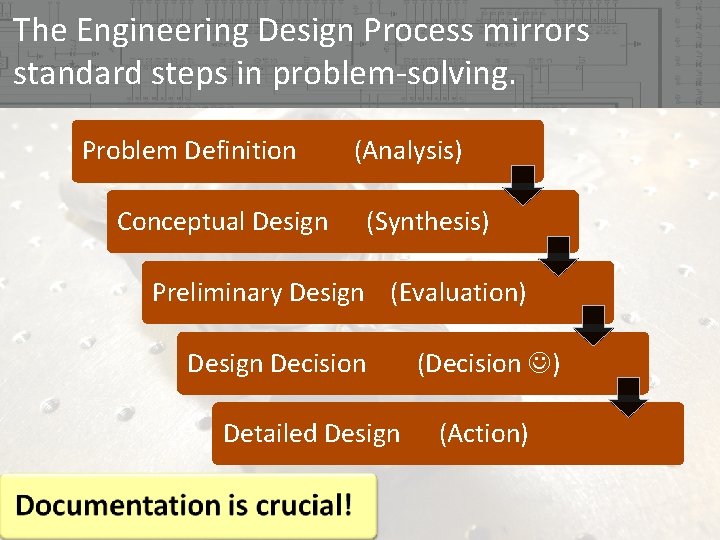
The Engineering Design Process mirrors standard steps in problem-solving. Problem Definition (Analysis) Conceptual Design (Synthesis) Preliminary Design (Evaluation) Design Decision Detailed Design (Decision ) (Action)
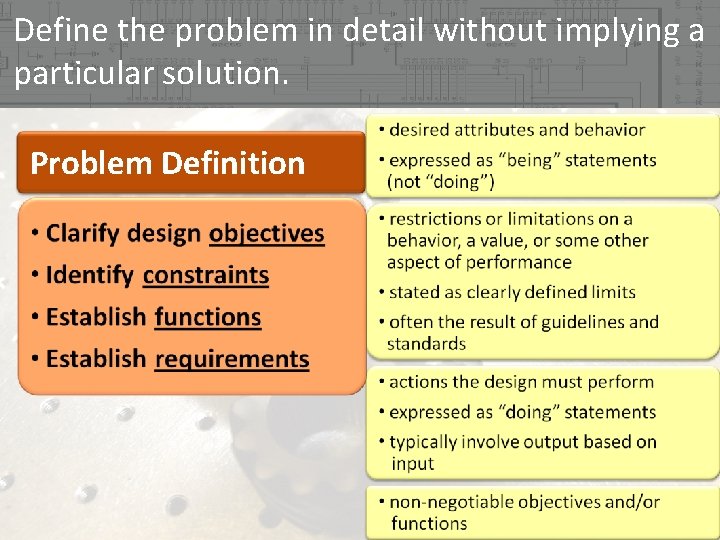
Define the problem in detail without implying a particular solution. Problem Definition
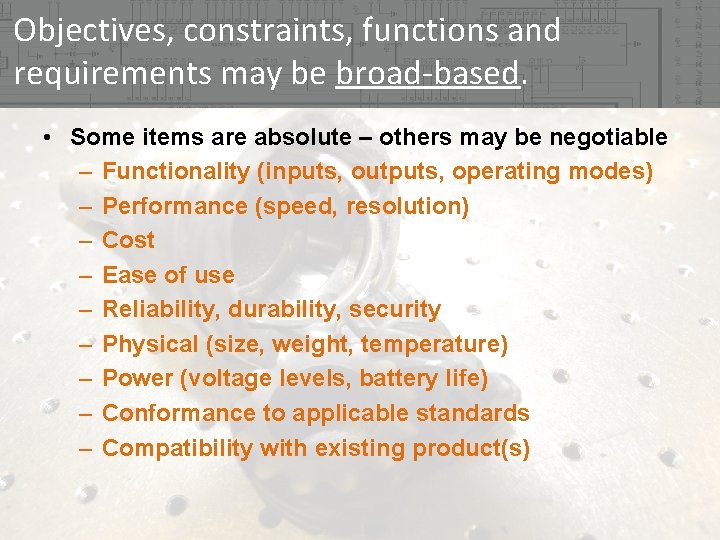
Objectives, constraints, functions and requirements may be broad-based. • Some items are absolute – others may be negotiable – Functionality (inputs, outputs, operating modes) – Performance (speed, resolution) – Cost – Ease of use – Reliability, durability, security – Physical (size, weight, temperature) – Power (voltage levels, battery life) – Conformance to applicable standards – Compatibility with existing product(s)
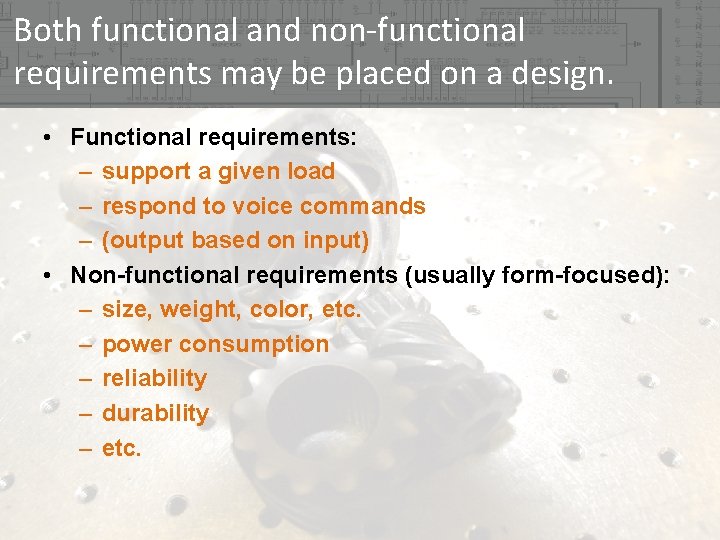
Both functional and non-functional requirements may be placed on a design. • Functional requirements: – support a given load – respond to voice commands – (output based on input) • Non-functional requirements (usually form-focused): – size, weight, color, etc. – power consumption – reliability – durability – etc.
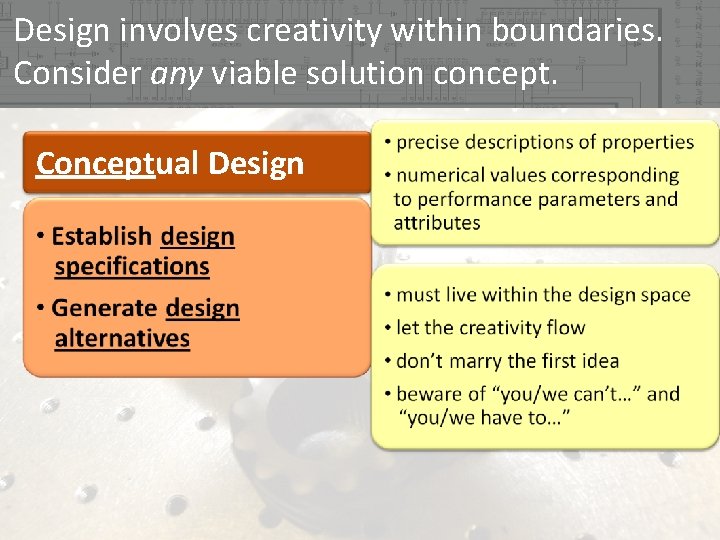
Design involves creativity within boundaries. Consider any viable solution concept. Conceptual Design
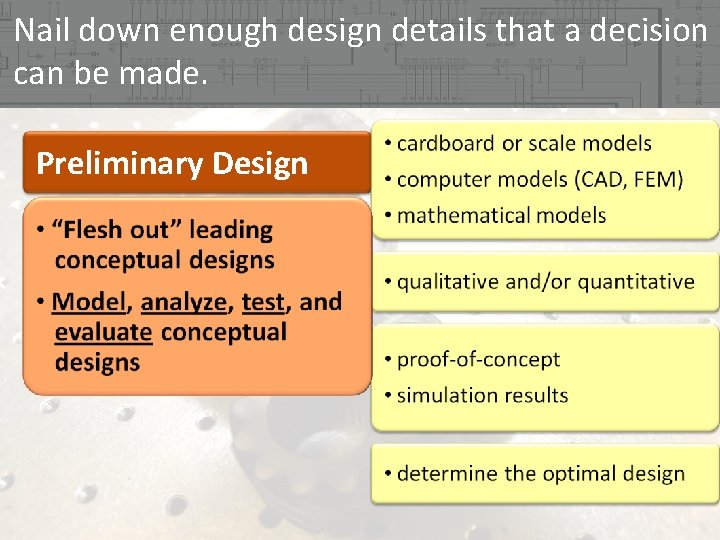
Nail down enough design details that a decision can be made. Preliminary Design
The “optimal” design solution may or may not be obvious. Design Decision
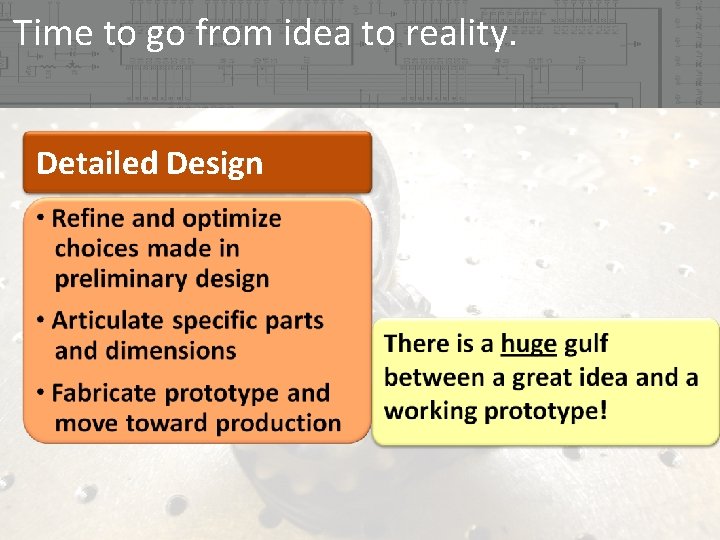
Time to go from idea to reality. Detailed Design
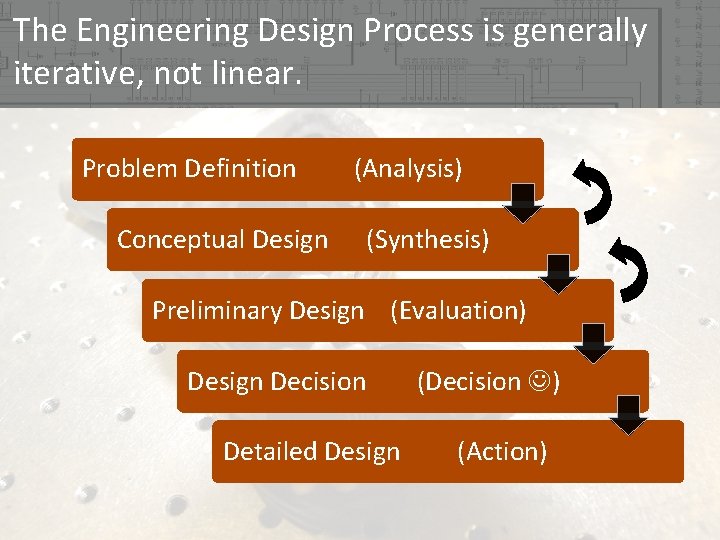
The Engineering Design Process is generally iterative, not linear. Problem Definition (Analysis) Conceptual Design (Synthesis) Preliminary Design (Evaluation) Design Decision Detailed Design (Decision ) (Action)
How is the Engineering Design Process applied? (Part 1 – Asking Questions) Context: BEST Robotics
The design process begins with some initial problem statement. • Initial Problem Statement – Design a robot to play this year’s game. • Design problems are often ill-structured and openended. • Asking questions is a great way to begin defining the problem to be addressed.
Think in terms of questions that would help define the problem and guide the design. • • • What scoring strategy will we use? What type of steering is desired? How many degrees-of-freedom does the robot need? What maximum reach must the robot have? How fast does the robot need to be? How much weight must the robot lift? What physical obstacles must the robot overcome? Will the robot be interacting with other robots? What sight (or other) limitations will be placed on the driver? • What functions must the robot perform?
Begin to categorize questions in terms of what information the answers communicate. Problem Definition • Clarifying objectives – What scoring strategy will be adopted? – How much practice time will drivers have? • Identifying constraints – Can the robot touch other robots? – Can game pieces touch the field? – What are the dimensions of key parts of the field? • Establishing functions – What scoring strategy will be adopted? – How much ground must the robot cover in a round? • Establishing requirements – What minimum size must the robot be to carry a given game piece? – How much weight must be lifted to carry a given game piece?
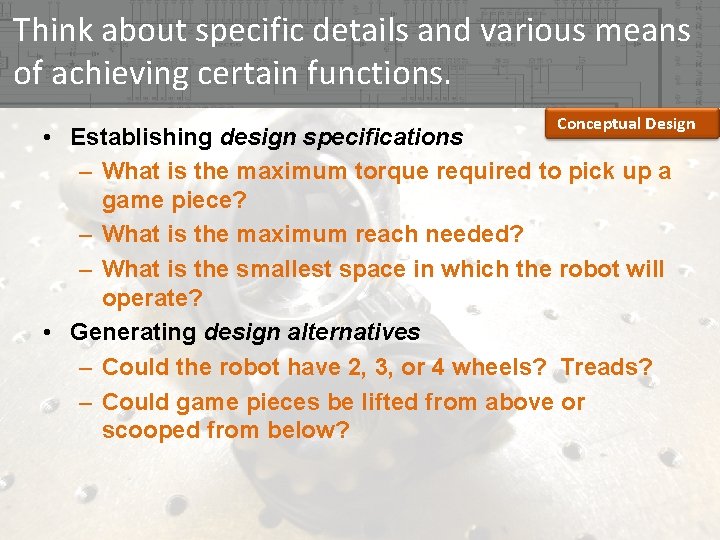
Think about specific details and various means of achieving certain functions. Conceptual Design • Establishing design specifications – What is the maximum torque required to pick up a game piece? – What is the maximum reach needed? – What is the smallest space in which the robot will operate? • Generating design alternatives – Could the robot have 2, 3, or 4 wheels? Treads? – Could game pieces be lifted from above or scooped from below?
What tools are available to aid in the Engineering Design Process? How is the Engineering Design Process applied? (Part 2 – Some Tools to Guide the Process)
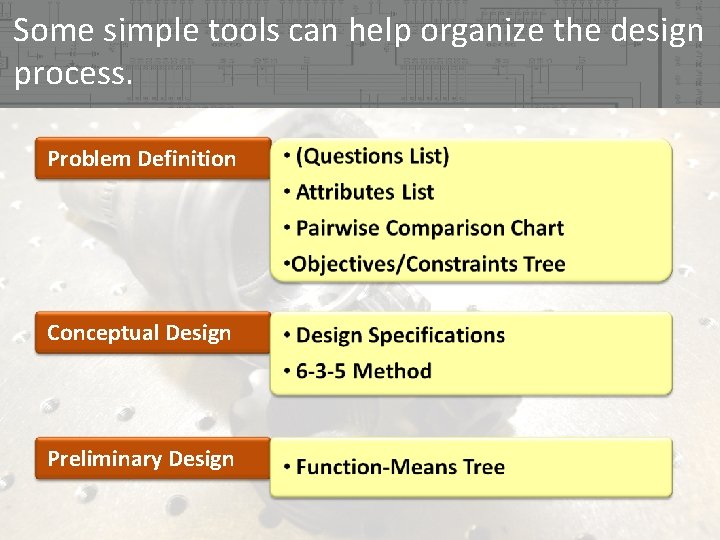
Some simple tools can help organize the design process. Problem Definition Conceptual Design Preliminary Design
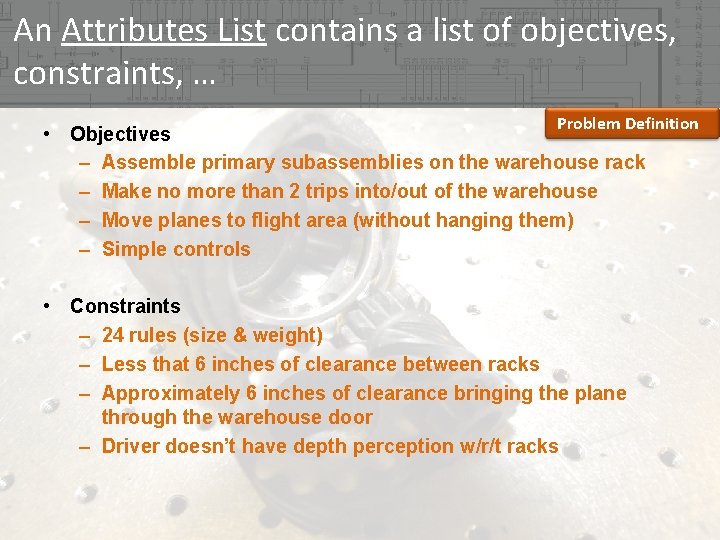
An Attributes List contains a list of objectives, constraints, … Problem Definition • Objectives – Assemble primary subassemblies on the warehouse rack – Make no more than 2 trips into/out of the warehouse – Move planes to flight area (without hanging them) – Simple controls • Constraints – 24 rules (size & weight) – Less that 6 inches of clearance between racks – Approximately 6 inches of clearance bringing the plane through the warehouse door – Driver doesn’t have depth perception w/r/t racks
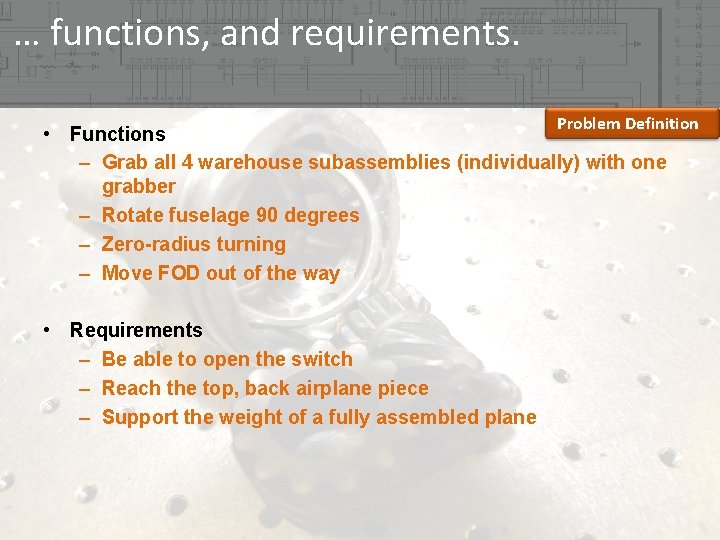
… functions, and requirements. Problem Definition • Functions – Grab all 4 warehouse subassemblies (individually) with one grabber – Rotate fuselage 90 degrees – Zero-radius turning – Move FOD out of the way • Requirements – Be able to open the switch – Reach the top, back airplane piece – Support the weight of a fully assembled plane
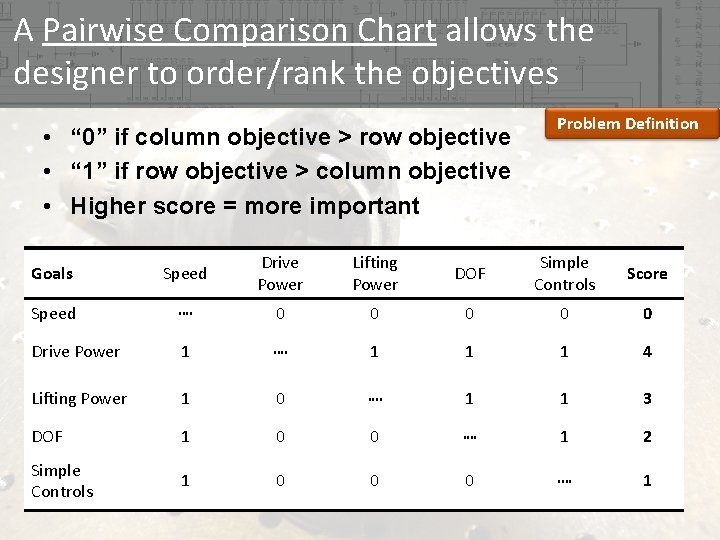
A Pairwise Comparison Chart allows the designer to order/rank the objectives • “ 0” if column objective > row objective • “ 1” if row objective > column objective • Higher score = more important Problem Definition Goals Speed Drive Power Lifting Power DOF Simple Controls Score Speed • • 0 0 0 Drive Power 1 • • 1 1 1 4 Lifting Power 1 0 • • 1 1 3 DOF 1 0 0 • • 1 2 Simple Controls 1 0 0 0 • • 1
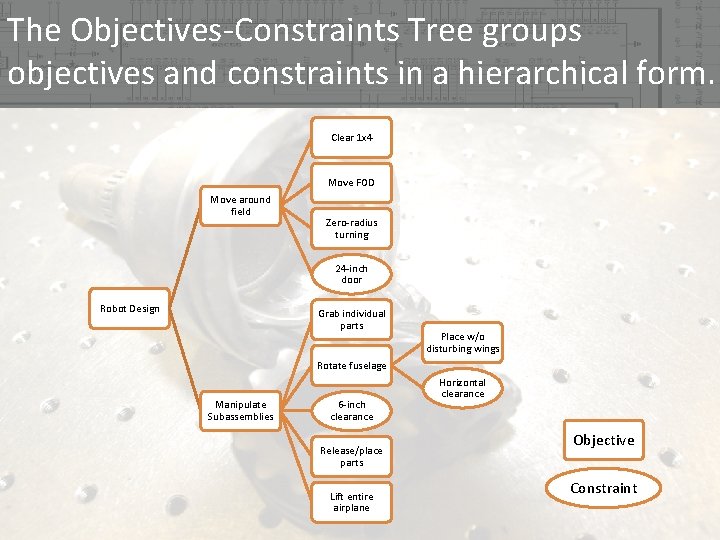
The Objectives-Constraints Tree groups objectives and constraints in a hierarchical form. Clear 1 x 4 Move FOD Move around field Zero-radius turning 24 -inch door Robot Design Grab individual parts Place w/o disturbing wings Rotate fuselage Manipulate Subassemblies 6 -inch clearance Release/place parts Lift entire airplane Horizontal clearance Objective Constraint
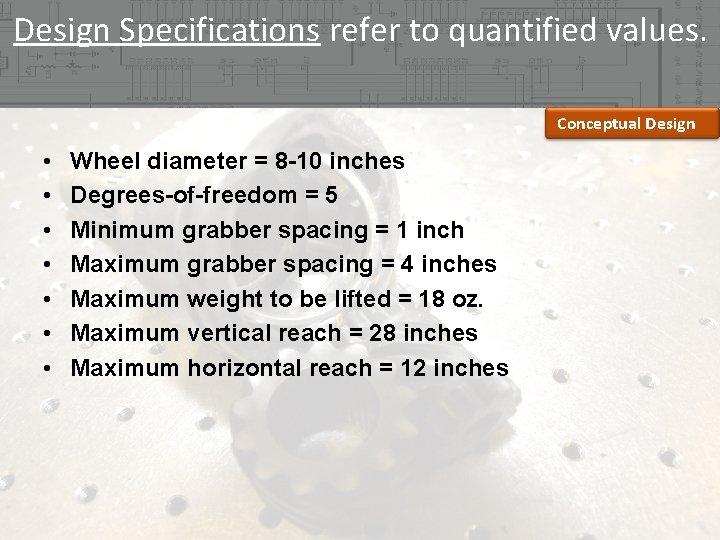
Design Specifications refer to quantified values. Conceptual Design • • Wheel diameter = 8 -10 inches Degrees-of-freedom = 5 Minimum grabber spacing = 1 inch Maximum grabber spacing = 4 inches Maximum weight to be lifted = 18 oz. Maximum vertical reach = 28 inches Maximum horizontal reach = 12 inches
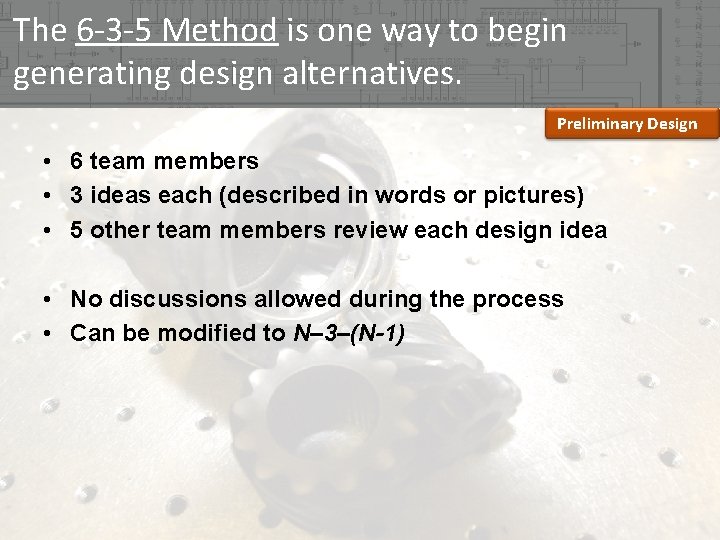
The 6 -3 -5 Method is one way to begin generating design alternatives. Preliminary Design • 6 team members • 3 ideas each (described in words or pictures) • 5 other team members review each design idea • No discussions allowed during the process • Can be modified to N– 3–(N-1)
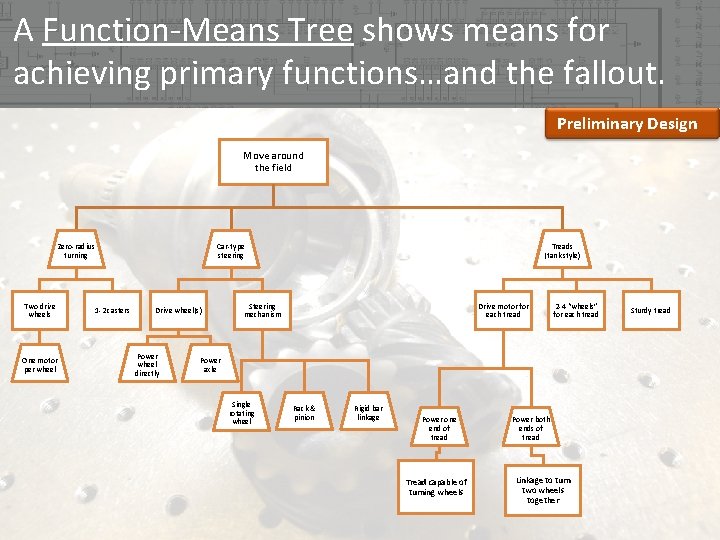
A Function-Means Tree shows means for achieving primary functions…and the fallout. Preliminary Design Move around the field Zero-radius turning Two drive wheels One motor per wheel Car-type steering 1 -2 casters Drive wheel(s) Power wheel directly Treads (tank style) Steering mechanism Drive motor for each tread 2 -4 “wheels” for each tread Power axle Single rotating wheel Rack & pinion Rigid bar linkage Power one end of tread Tread capable of turning wheels Power both ends of tread Linkage to turn two wheels together Sturdy tread
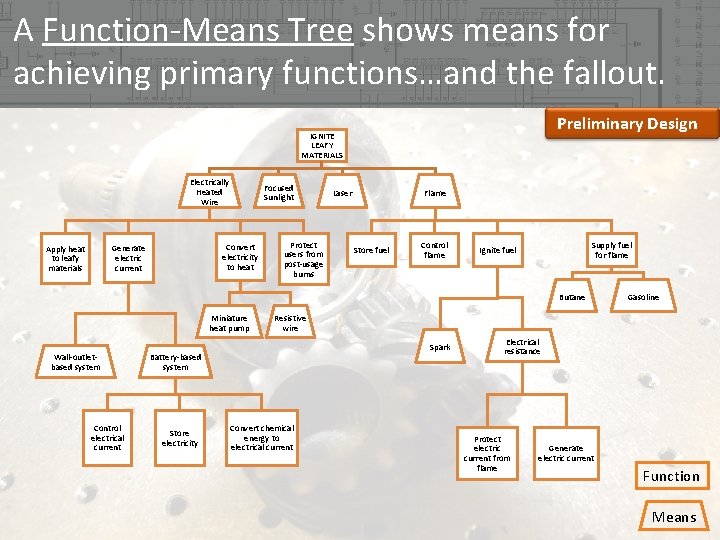
A Function-Means Tree shows means for achieving primary functions…and the fallout. Preliminary Design IGNITE LEAFY MATERIALS Electrically Heated Wire Convert electricity to heat Generate electric current Apply heat to leafy materials Focused Sunlight Protect users from post-usage burns Laser Flame Store fuel Control flame Supply fuel for flame Ignite fuel Butane Miniature heat pump Wall-outletbased system Control electrical current Resistive wire Spark Battery-based system Store electricity Gasoline Convert chemical energy to electrical current Electrical resistance Protect electric current from flame Generate electric current Function Means
Are there any questions?