
Understanding and Working with Families Julie Clifton MSW
- Slides: 41
Understanding and Working with Families Julie Clifton, MSW, LCSW Practice I SOW 3300 Chapters 9 & 10 Kirst-Ashman & Hull 1
What is a Family? An Inclusive Definition of Family According to Kirst-Ashman & Hull a family structure may be: “the nuclear family as well as alternatives to nuclear family which are adopted by persons in committed relationships and the people they consider to be family”. A family can “include two or more people who assume responsibility for each other’s well-being over time (e. g. caring for children, providing economic support, or giving help & support during illness)”. What does the client system look like to you? ? 2
Family Assessment Family Communication • Verbal & Nonverbal Communication • Avenues of Communication- consonance, condemnation, submission, intellectualization, indifference. (p. 354) 3
The Family as a System • Family are systems and need to be assessed in relation to • systems theory Inside the family, “Boundaries distinguish between subsystems, helping to define the separate subunits of the overall system. ” (Goldenberg & Goldenberg, 2013, p 102. p. 357) 4
Family Structure- refers to the organization of relationships and patterns of interaction occurring within the family. • Boundaries & Subsystems • Family Norms • Family Roles • Balance of Power within the Family Systems • Assessing Intergenerational Aspects of Family Systems • Assessing a Family’s Access to Resources 5
Assessing Family Structure • Boundaries and subsystems Boundaries—Invisible lines of demarcation that separate the family from outside non-family environment (p. 337) Subsystem—Subordinate system (system within a system) (p 337) 6
Boundaries and Subsystems • Family norms—Rules that specify what is considered • • proper behavior within the family group. Family roles—Individually prescribed patterns of behavior reinforced by the expectations and norms of the family. Balance of power within the family system – power is the ability of prevailing family members to have authority & control over the perspectives or actions of other family members (Kirst-Ashman & Hull, 2018, p. 359) 7
• Assessing Intergenerational Aspects of Family Systems (p. 360) • Assessing Life-Cycle Adjustments • Impacts of the Impinging Social Environment • Assessing a Family’s Access to Basic Resources (FRA), (p. 363) 8
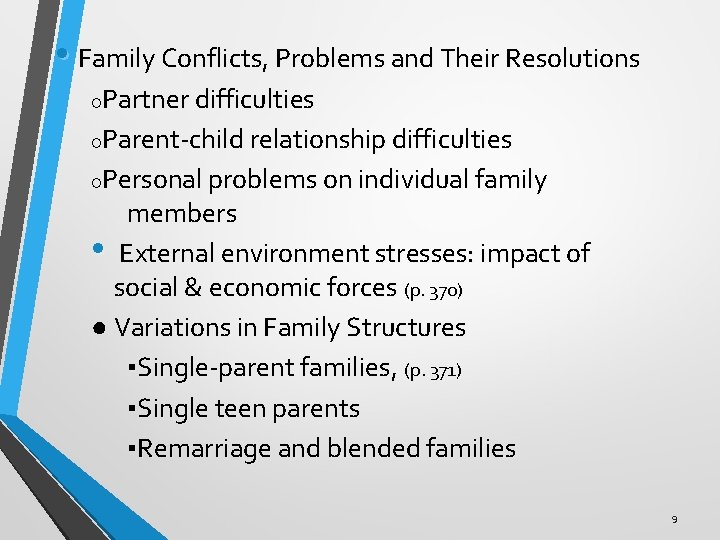
• Family Conflicts, Problems and Their Resolutions ○Partner difficulties ○Parent-child relationship difficulties ○Personal problems on individual family members • External environment stresses: impact of social & economic forces (p. 370) ● Variations in Family Structures ▪Single-parent families, (p. 371) ▪Single teen parents ▪Remarriage and blended families 9
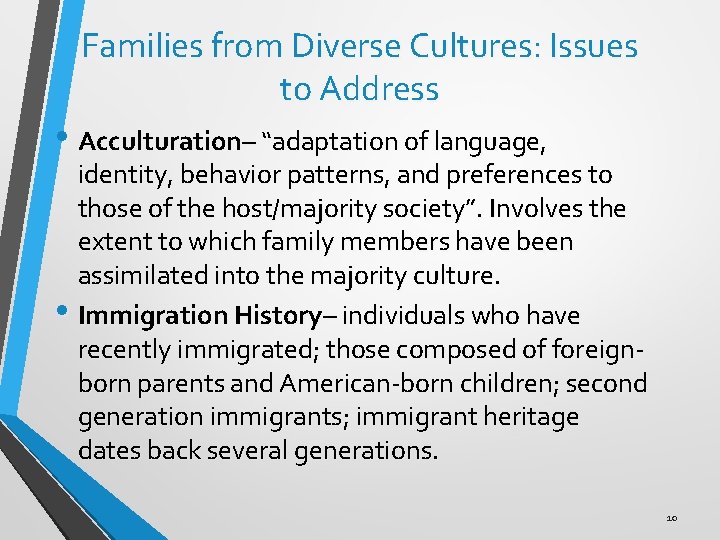
Families from Diverse Cultures: Issues to Address • Acculturation– “adaptation of language, identity, behavior patterns, and preferences to those of the host/majority society”. Involves the extent to which family members have been assimilated into the majority culture. • Immigration History– individuals who have recently immigrated; those composed of foreignborn parents and American-born children; second generation immigrants; immigrant heritage dates back several generations. 10
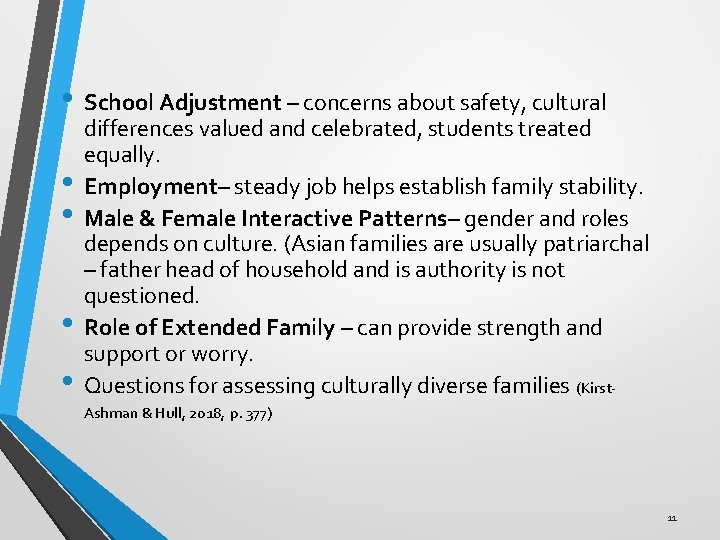
• School Adjustment – concerns about safety, cultural • • differences valued and celebrated, students treated equally. Employment– steady job helps establish family stability. Male & Female Interactive Patterns– gender and roles depends on culture. (Asian families are usually patriarchal – father head of household and is authority is not questioned. Role of Extended Family – can provide strength and support or worry. Questions for assessing culturally diverse families (Kirst. Ashman & Hull, 2018, p. 377) 11
Chapter 10 Working with Families
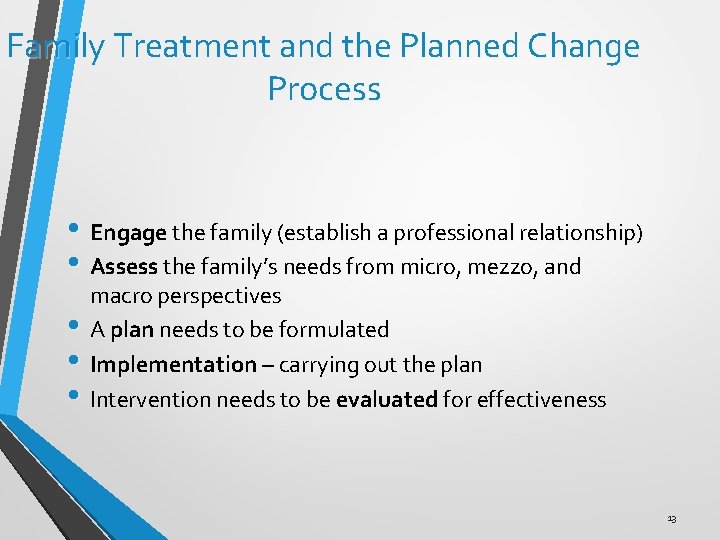
Family Treatment and the Planned Change Process • Engage the family (establish a professional relationship) • Assess the family’s needs from micro, mezzo, and • • • macro perspectives A plan needs to be formulated Implementation – carrying out the plan Intervention needs to be evaluated for effectiveness 13
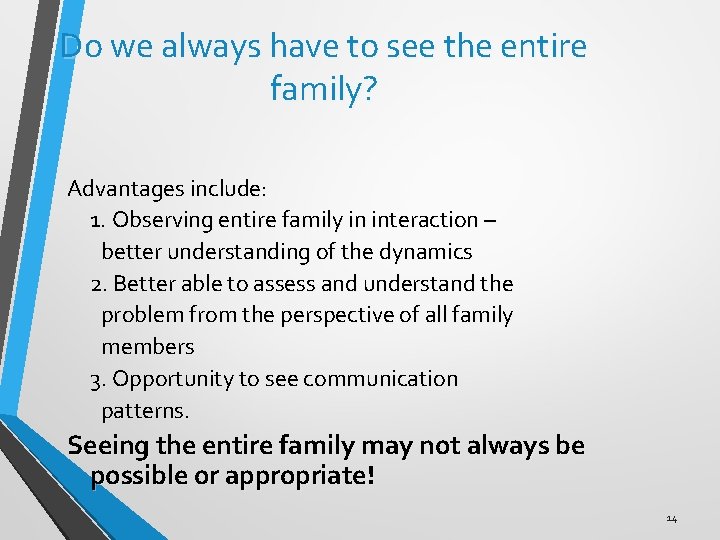
Do we always have to see the entire family? Advantages include: 1. Observing entire family in interaction – better understanding of the dynamics 2. Better able to assess and understand the problem from the perspective of all family members 3. Opportunity to see communication patterns. Seeing the entire family may not always be possible or appropriate! 14
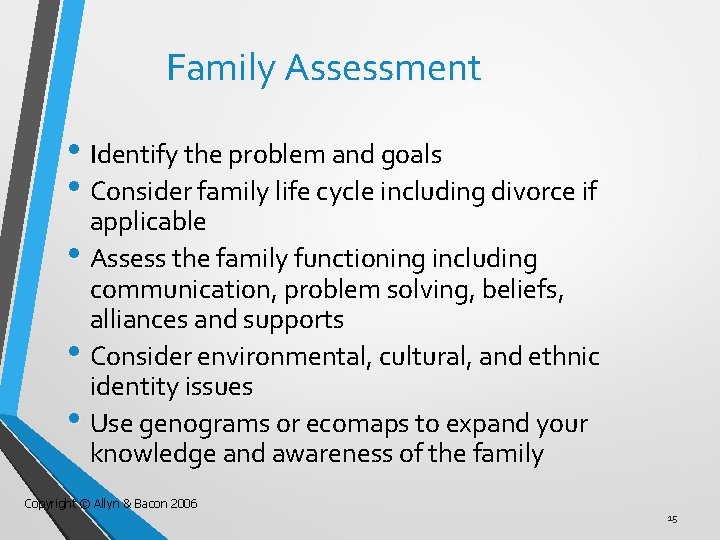
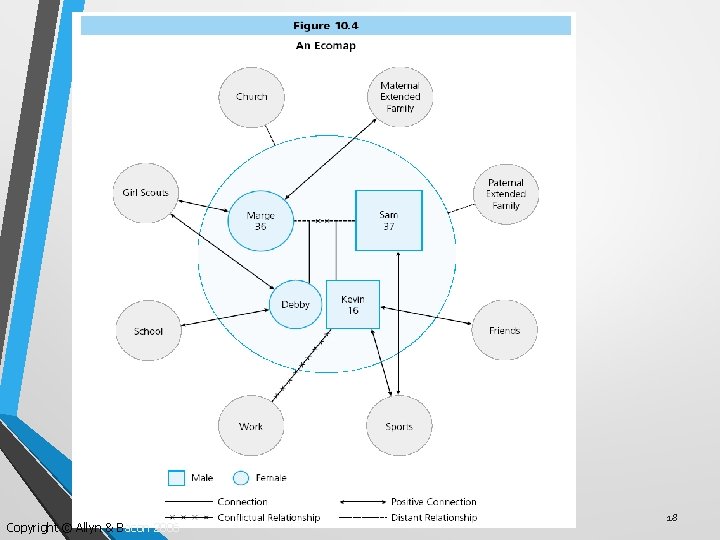
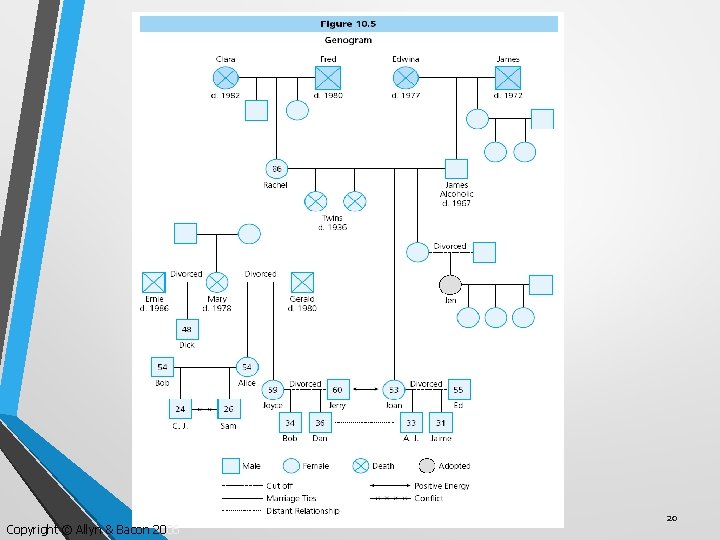
Family Assessment • Identify the problem and goals • Consider family life cycle including divorce if applicable • Assess the family functioning including communication, problem solving, beliefs, alliances and supports • Consider environmental, cultural, and ethnic identity issues • Use genograms or ecomaps to expand your knowledge and awareness of the family Copyright © Allyn & Bacon 2006 15
16
Eco-Map • Provides a graphic representation of the family’s ecological system. • It depicts family membership and relationships and can help individuals and families recognize their own strengths and areas of weaknesses • Certain symbols and lines assist in demonstrating the eco-map. • Good assessment tool • Enhances the ability of obtaining information from families. • The eco-map is something they can do together. 17
Copyright © Allyn & Bacon 2006 18
Genogram • Useful tool for assessing families • Provides a means of depicting a family from one generation to the next. • It presents a chronological picture of the family noting such things as important events, additions or losses to the family, communication and relationship patterns, and occupational or work connections. • A genogram usually denotes three or more generations. Useful tools for gathering information and helping families understand data. 19
Copyright © Allyn & Bacon 2006 20
Primary Goals When Beginning the Intervention Process with Families • The worker needs to get a clear picture of the family’s • • interaction, the problem itself, and how the family’s interaction serves to maintain the problem The worker must gain the family’s consent to begin treatment and their commitment to participate Set procedures for change in motion (something positive can happen) 21
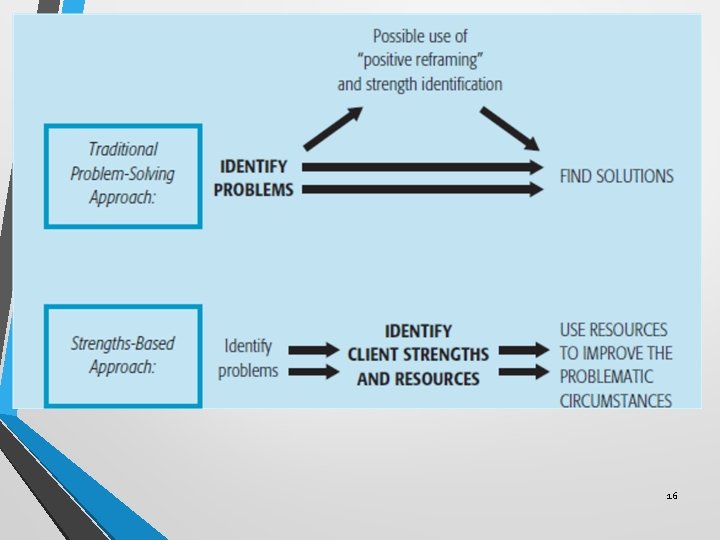
• Generalist Practice with Families • Family Treatment and the Planned Change Process • Adopting a Strengths Perspective with Families • Traditional Problem-Solving versus Strengths. Based Approaches • Strengths-Based Strategies for Working with Families (p. 364 - 366) 22
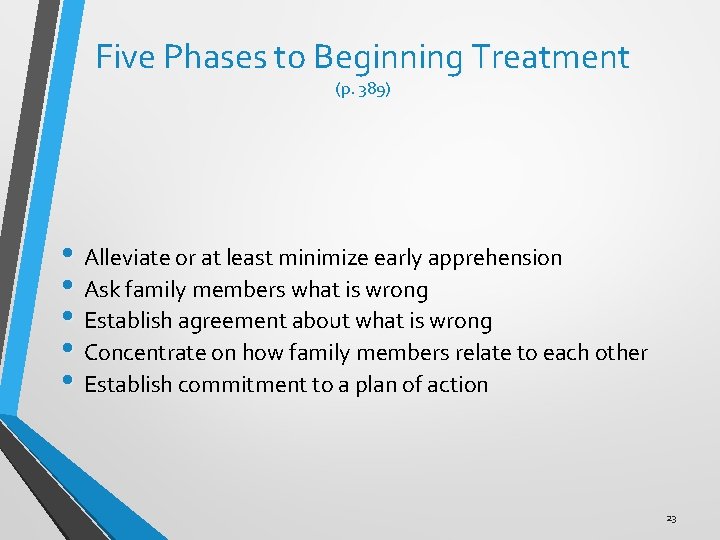
Five Phases to Beginning Treatment (p. 389) • Alleviate or at least minimize early apprehension • Ask family members what is wrong • Establish agreement about what is wrong • Concentrate on how family members relate to each other • Establish commitment to a plan of action 23
Basic Interviewing Skills Needed by Family Social Workers • Listening carefully to expressed family meanings • Being sensitive to verbal and nonverbal communication about desires and goals from each family member • Recognizing family difficulties related to effective problem solving • Promoting skills, knowledge, attitudes, and environmental conditions that contribute to effective family coping. Collins, D. , Jordan, C, & Coleman, H. (1999). An introduction to family social work. Itasca, IL: F. E. Peacock Publishers. 24
• Engagement, Assessment, and Planning with Families (cont. ) • Empowerment by Emphasizing Family Strengths (p. 394) • Reframing • Teaching Families Problem-Solving Techniques 25
Empowerment by Emphasizing Family Strengths (p. 394) • Emphasize positive statements reported by family members • Encourage family members to share stories about themselves (how has family coped with other problems) • Note family interactions that reflect strength & competency • Investigate times that family members enjoy together • Emphasize what families do well (patience, coping behaviors) (Hanna 2007 in Kirst-Ashman & Hull, 2015, p. 394)
Implementing Family Intervention • Reframing– Helping family members view a problem • or an issue with a different outlook or understand it in a new way Teaching families new problem solving techniques – how the family experienced differences as well on its methods for solving difficulties 27
Implementing Family Interventions • Teaching Child Management Methods • Positive Reinforcement • Negative Reinforcement • Punishment • Modeling 28
Implementing Family Interventions (cont. ) • Offering Families Support • Role Playing • Audiovisual Recording • Homework Assignments 29
Family Evaluation, Termination and Follow -Up • Need to determine when longer term goals have been met in preparation for termination • Ongoing measurement of progress • Termination - preparing the family for the end of contact with the worker and the agency is vital • As evaluation occurs, we need to reference the future, what is to follow? • Follow-up can include identification of resources, including interventions learned in seeing you; and by contacting the family to review its status and maintenance of achieved goals (p. 399) 30
Issues Confronting Families Multi-Problem Families • Do not get overwhelmed • Follow the planned change process • Partialize and prioritize • Determine which problems you can work on yourself • Identify and use relevant community resources 31
Family Preservation– emphasizes service provision to the family unit in a more coordinated fashion. The child would likely remain in the home during the entire process. 32
Family Preservation Goals 1. To protect children 2. To maintain and strengthen family bonds 3. To stabilize the crisis situation 4. To increase the family’s skills and competencies 5. To facilitate the family’s use of a variety of formal and informal helping resources 6. To prevent unnecessary out-of-home placement of children (Kirst-Ashman & Hull, 2018) 33
Family Preservation Themes (P. 379 -380) ØCrisis intervention ØFocus on the family ØHome-based services ØTime limits ØLimited, focused objectives ØIntensive, comprehensive services ØEmphasis on education and skill building ØCoordination ØFlexibility ØAccessibility ØAccountability Family Preservation and Planned Change (p. 402) 34
The Importance of Cultural Competency Lesbian and Gay Families • Homophobia—Confronting It • Coming Out to Oneself and Others • Lesbians and Gay Men as Parents • Parents Coming Out to Children • Social and Economic Oppression of Lesbian and Gay People 35
Working With Families • Social and economic oppression of lesbian and gay people • Suggestions for empowering lesbian and gay people at the micro level • • • Don’t assume that all people are heterosexual Be sensitive to the language and terminology you use Have a work environment that’s friendly to gay and lesbian people Become more knowledgeable about lesbian and gay life issues and culture Be aware of the wide range of diversity within the lesbian and gay communities Develop a list of local resources for gay and lesbian clients 36
Social Work Practice with African American Families Impact of History and Oppression ▫ Strong Kinship Bonds ▫ Flexibility of family roles ▫ Dedication to Religious Values, Commitment to Church 37
Working with African-American Families • The Many Strengths of African-American Families • Engage the Client/Family • Assess the Family in Past and Present • Set Mutual Goals • Identify the Target System for Change
Social Work Practice with African. American Families • Major Roles for social workers to assume • Develop empathy for the cultural context saturated with oppression • Maximize the use of practice skills & available resources to improve the social & economic conditions of African-American families • Must advocate on behalf of African-American families to change the policies, regulations, & expectations that act to discriminate against African-Americans (Evans, 2013 in Kirst-Ashman & Hull, 2018)
The Current Status of Family Services • Families, Macro Practice, and Integration of Policy & Practice • Employment • Direct provision of Income or Substitutes for Income • Health care • Homeless people • Day Care • Child support maintenance 40
Macro Practice with Families • Promotion of social and economic justice • Integration of policy and practice • Examples: • Employment • Health care • Homeless people 41