
Understanding and Using Work Keys Scores High School
- Slides: 39
Understanding and Using Work. Keys Scores High School Students
Webinar Objectives Introduction • Provide an overview of Work. Keys assessments • Explain how Work. Keys scores are calculated and what they mean • Explain the difference between Level Scores and Scale Scores • Demonstrate how students can use their Work. Keys scores • Provide you and your students with additional resources 2
Work. Keys Assessments 3
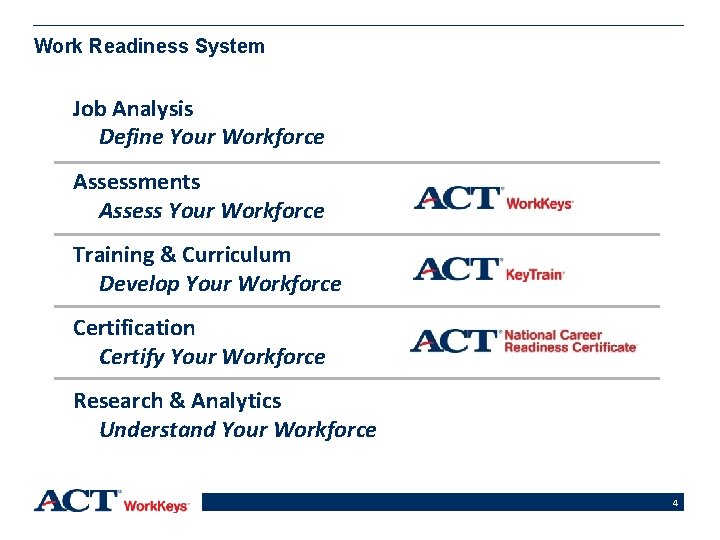
Work Readiness System Job Analysis Define Your Workforce Assessments Assess Your Workforce Training & Curriculum Develop Your Workforce Certification Certify Your Workforce Research & Analytics Understand Your Workforce 4
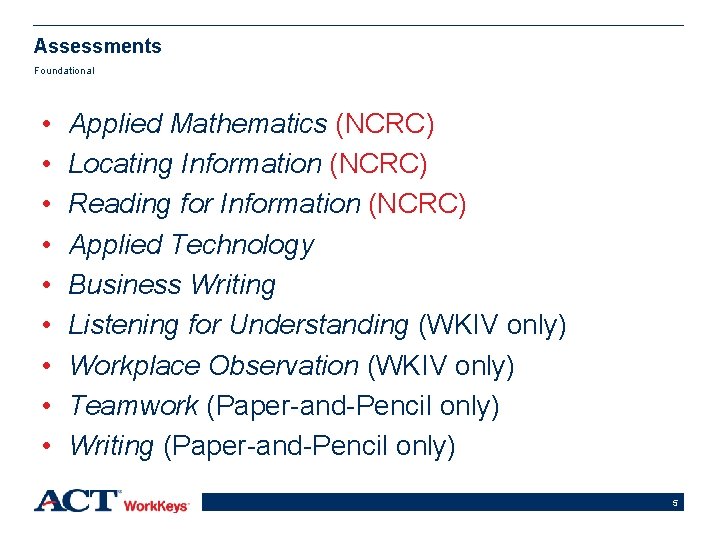
Assessments Foundational • • • Applied Mathematics (NCRC) Locating Information (NCRC) Reading for Information (NCRC) Applied Technology Business Writing Listening for Understanding (WKIV only) Workplace Observation (WKIV only) Teamwork (Paper-and-Pencil only) Writing (Paper-and-Pencil only) 5
Assessments Soft Skills • Fit • Performance • Talent (NCRC Plus) 6
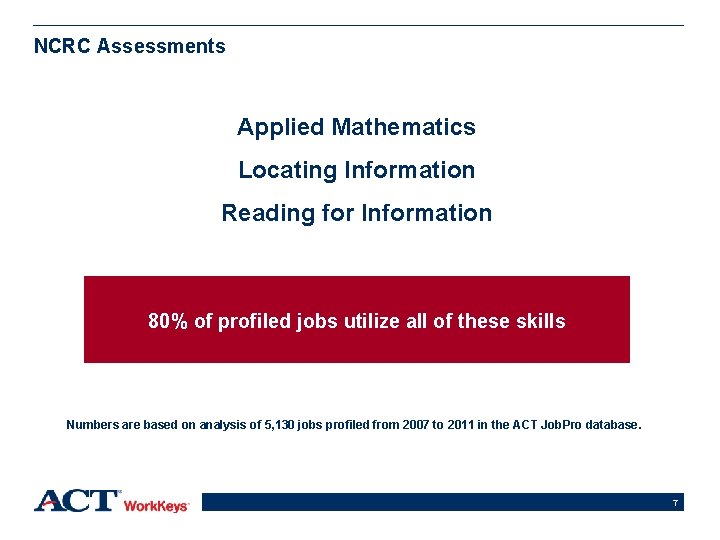
NCRC Assessments Applied Mathematics Locating Information Reading for Information 80% of profiled jobs utilize all of these skills Numbers are based on analysis of 5, 130 jobs profiled from 2007 to 2011 in the ACT Job. Pro database. 7
Understanding Work. Keys Scores 8
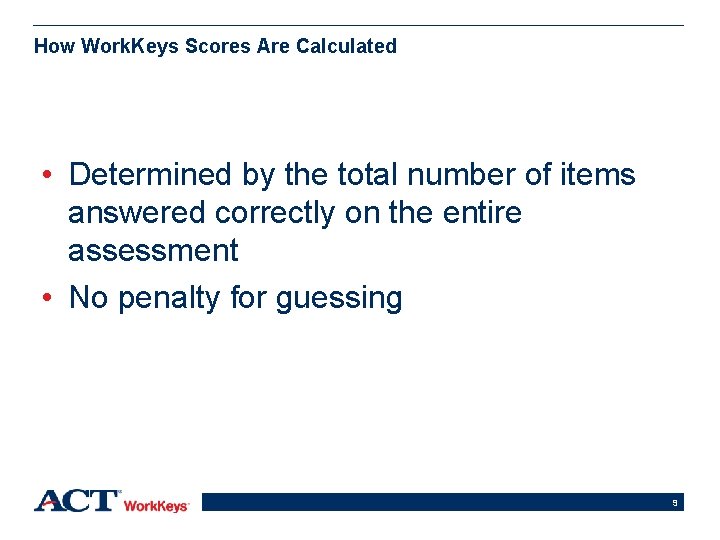
How Work. Keys Scores Are Calculated • Determined by the total number of items answered correctly on the entire assessment • No penalty for guessing 9
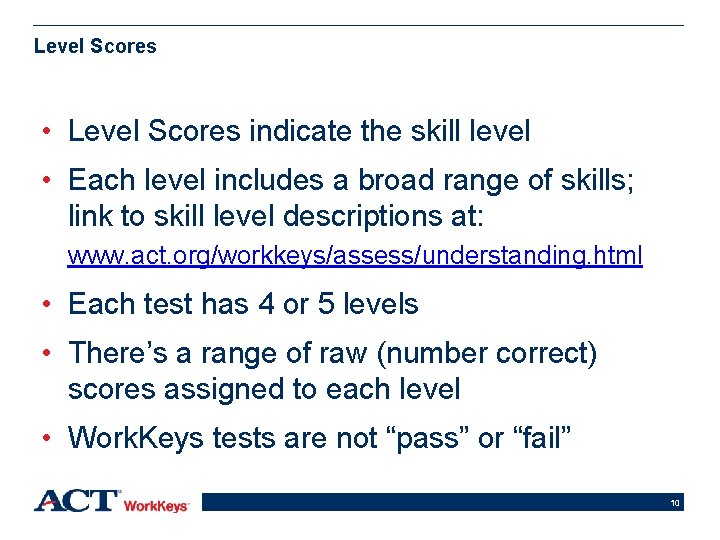
Level Scores • Level Scores indicate the skill level • Each level includes a broad range of skills; link to skill level descriptions at: www. act. org/workkeys/assess/understanding. html • Each test has 4 or 5 levels • There’s a range of raw (number correct) scores assigned to each level • Work. Keys tests are not “pass” or “fail” 10
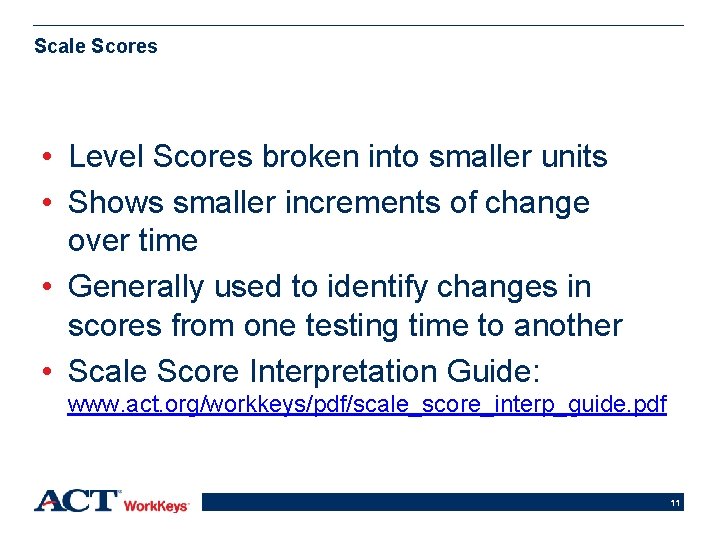
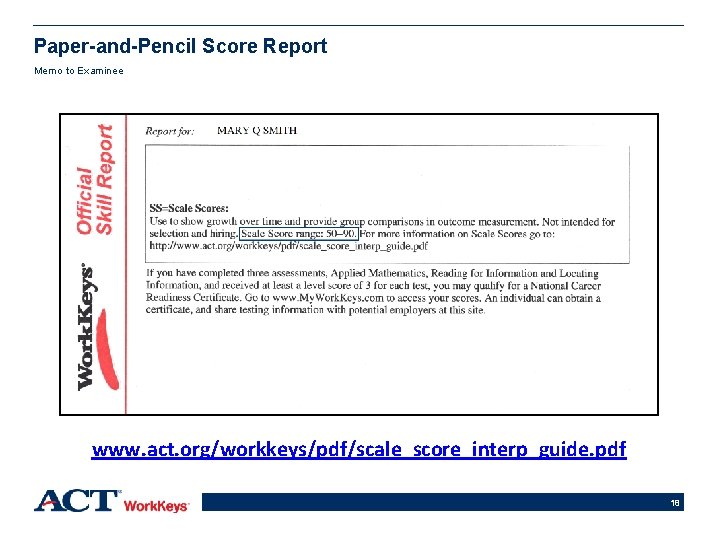
Scale Scores • Level Scores broken into smaller units • Shows smaller increments of change over time • Generally used to identify changes in scores from one testing time to another • Scale Score Interpretation Guide: www. act. org/workkeys/pdf/scale_score_interp_guide. pdf 11
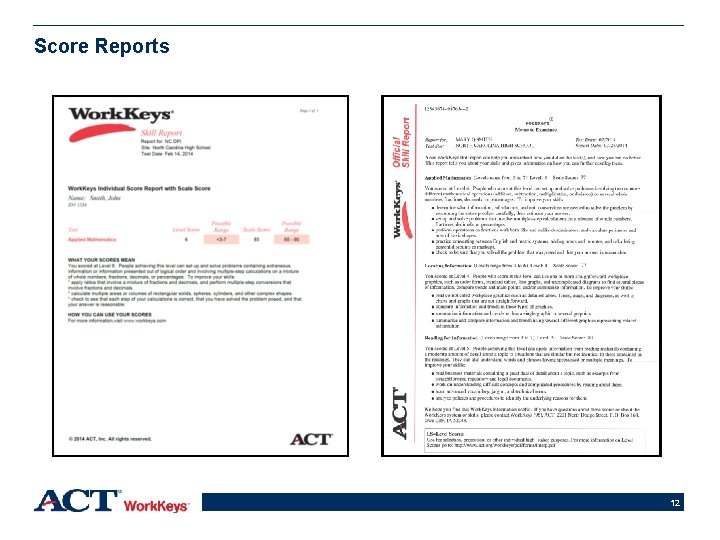
Score Reports 12
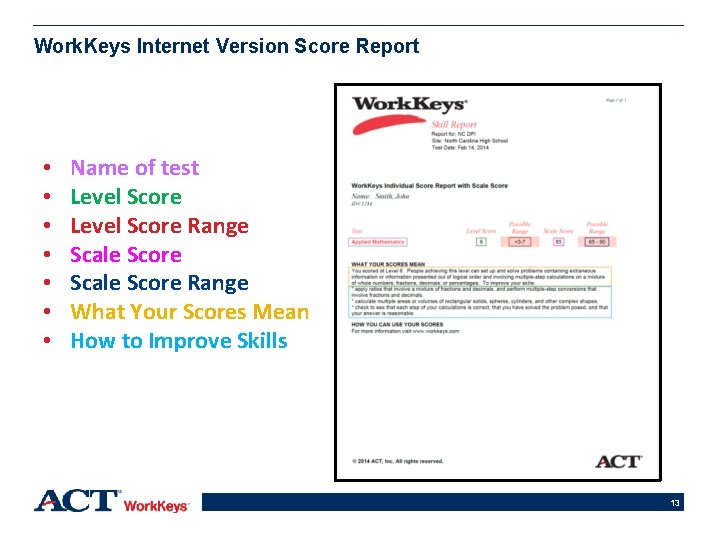
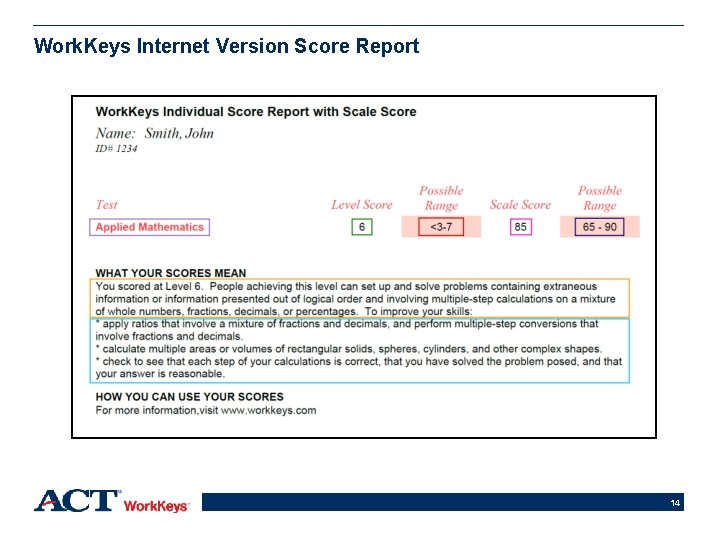
Work. Keys Internet Version Score Report • • Name of test Level Score Range Scale Score Range What Your Scores Mean How to Improve Skills 13
Work. Keys Internet Version Score Report 14
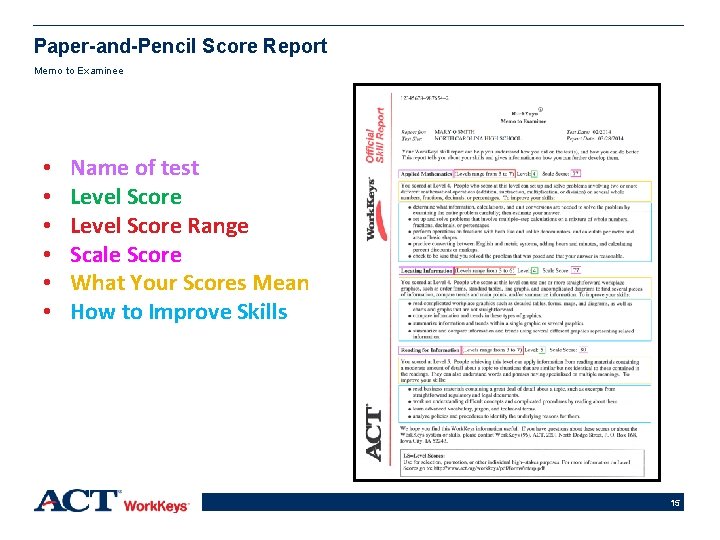
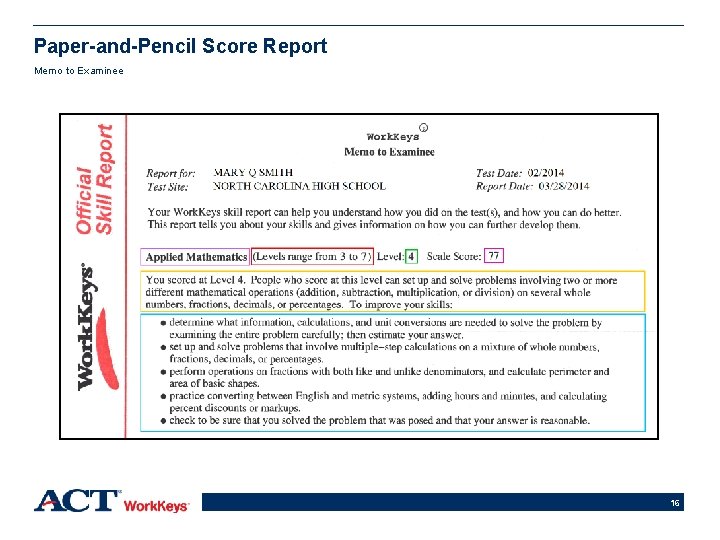
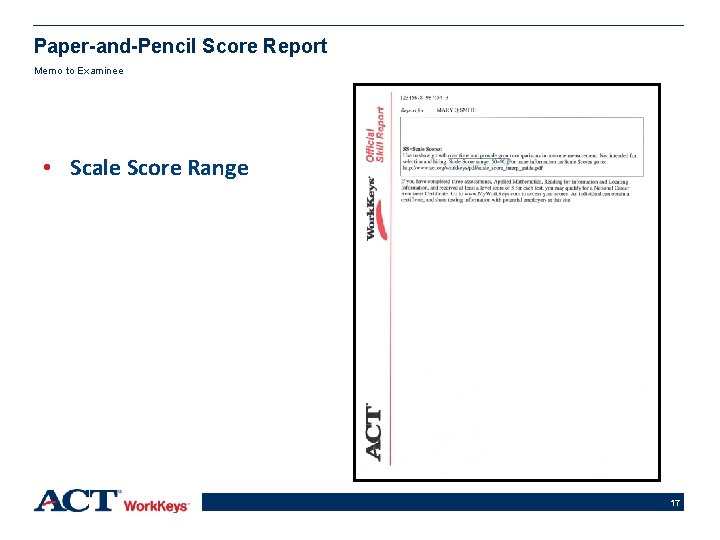
Paper-and-Pencil Score Report Memo to Examinee • • • Name of test Level Score Range Scale Score What Your Scores Mean How to Improve Skills 15
Paper-and-Pencil Score Report Memo to Examinee 16
Paper-and-Pencil Score Report Memo to Examinee • Scale Score Range 17
Paper-and-Pencil Score Report Memo to Examinee www. act. org/workkeys/pdf/scale_score_interp_guide. pdf 18
Using Work. Keys Scores 19
How Students Can Use Their Work. Keys Scores • • Qualify for an NCRC Career exploration Employment Entrance to/exit from community college programs • College credit 20
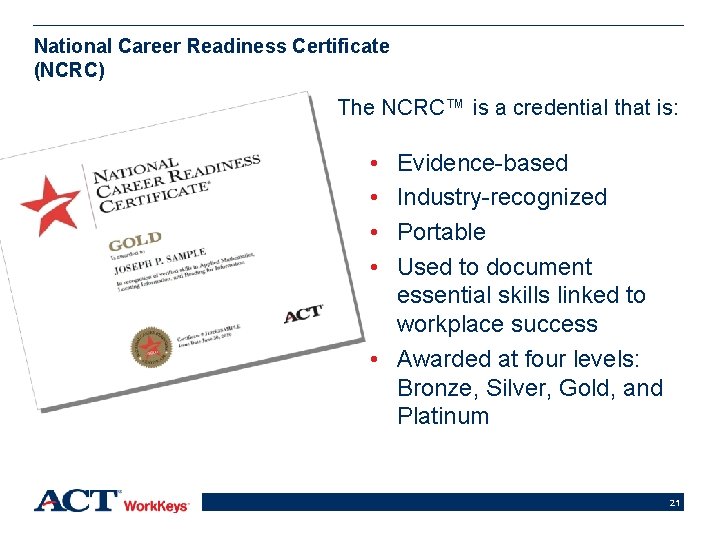
National Career Readiness Certificate (NCRC) The NCRC™ is a credential that is: • • Evidence-based Industry-recognized Portable Used to document essential skills linked to workplace success • Awarded at four levels: Bronze, Silver, Gold, and Platinum 21
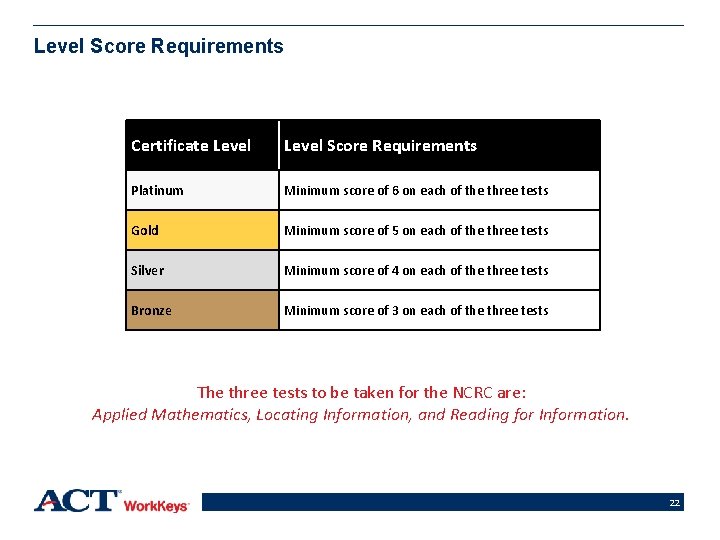
Level Score Requirements Certificate Level Score Requirements Platinum Minimum score of 6 on each of the three tests Gold Minimum score of 5 on each of the three tests Silver Minimum score of 4 on each of the three tests Bronze Minimum score of 3 on each of the three tests The three tests to be taken for the NCRC are: Applied Mathematics, Locating Information, and Reading for Information. 22
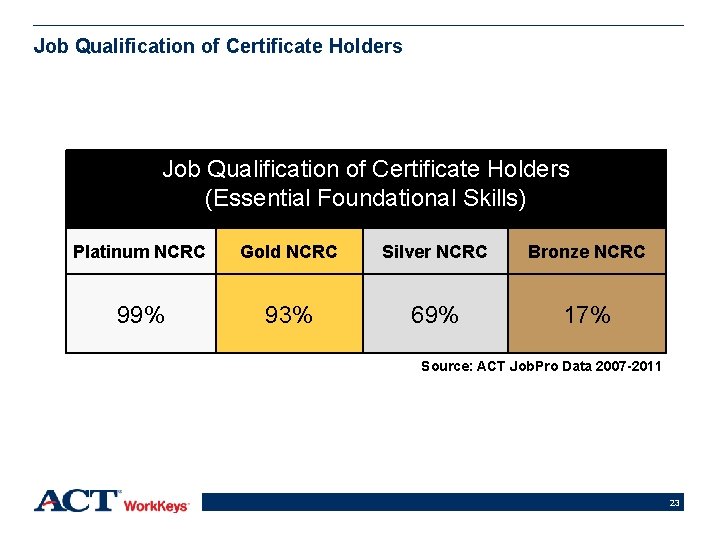
Job Qualification of Certificate Holders (Essential Foundational Skills) Platinum NCRC Gold NCRC Silver NCRC Bronze NCRC 99% 93% 69% 17% Source: ACT Job. Pro Data 2007 -2011 23
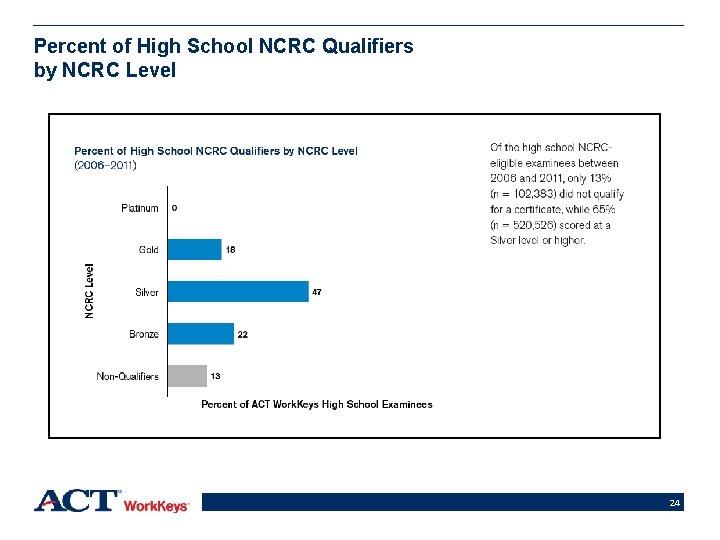
Percent of High School NCRC Qualifiers by NCRC Level 24
Career Exploration • Review the Work. Keys skills needed for different careers • Search for jobs by skill levels • profiles. keytrain. com/profile_search/ • For detailed information, attend the “Using the Occupational Profile Database” webinar: student. gototraining. com/1 yx 78/catalog/4912135621342396416 25
Employment – New Jobs • The student should: – Include NCRC information and Work. Keys scores on résumés and job applications – Take this same information to job interviews • Employers can see if a student possesses the skills needed for the job 26
Employment – Current Job • Skills may align better with another job • May have the skills needed for an advanced job • A happier worker? 27
Entrance to/Exit from Community College Programs • Community colleges may require an NCRC prior to accepting students into a program • Some require the NCRC prior to awarding a certificate/diploma 28
College Credit – ACE and the NCRC Recommendation for College Credit • Include Work. Keys scores with college application • The American Council of Education (ACE) has recommended the National Career Readiness Certificate for college credit: – Silver: 3 semester hours in applied critical thinking for vocational certificate programs – Gold or Platinum: 3 semester hours in applied critical thinking for lower-division baccalaureate or associate degree programs 29
College Credit – ACE and the NCRC What This Means to Students • According to studies conducted by the University of Michigan, 3 credit hours equates to between a 135 - and 180 -hour commitment by the individual • The average community college credit hour costs in the vicinity of $150. The average cost of a credit hour at an in-state university is $350. • This places the value of the NCRC and ACE’s endorsement between $450 and $1, 050. 30
College Credit – ACE and the NCRC Informational Websites • The ACE College Credit Recommendation Service (CREDIT): www. acenet. edu/news-room/Pages/College-Credit. Recommendation-Service-CREDIT. aspx • The ACE National Guide to College Credit for Workforce Training: www 2. acenet. edu/credit/? fuseaction=browse. main • ACE CREDIT – NCRC: www 2. acenet. edu/credit/? fuseaction=browse. get. Organization Detail&FICE=800047 31
Additional Resources 32
My. Work. Keys. com • Make scores and NCRC available to employers • Keep track of their Work. Keys scores • My. Work. Keys. com • For more information, go to: www. act. org/certificate/order. html 33
How Can You Help? • Key. Train • Look at Scale Scores • Focus on areas of improvement 34
Key. Train • Key. Train website: www. keytrain. com • Webinars: student. gototraining. com/1 yx 78/catalog/4912135621342396416 • Contact information: – 800. WORKKEY (967. 5539) – info@keytrain. com 35
Additional Websites For Students and Educators • ACT Work. Keys Information: www. act. org/workkeys • Understanding Work. Keys Scores: www. act. org/workkeys/assess/understanding. html • Using Your Work. Keys Scores: www. act. org/workkeys/careerseekers/scores. html • Occupational Profile Database (Search Jobs by Skills): profiles. keytrain. com/profile_search/ 36
Additional Websites For Educators • ACT Research Reports on Work Readiness: www. act. org/workreadiness/ • ACT Work. Keys Key Facts Information Briefs: www. act. org/workkeys/briefs/ • Ready for College and Ready for Work: Same or Different? : www. act. org/research/policymakers/pdf/Readiness. Brief. pdf 37
Webinar Objectives Review • Provide an overview of Work. Keys assessments • Explain how Work. Keys scores are calculated and what they mean • Explain the difference between Level Scores and Scale Scores • Demonstrate how students can use their Work. Keys scores • Provide you and your students with additional resources 38
For Information or Help… • Work. Keys Contact Center – 800. WORKKEY (800. 967. 5539) – workkeys@act. org – Hours: • Monday-Friday (except holidays): 8: 00 a. m. – 8: 00 p. m. (Eastern time) • Saturday (except holiday weekends): 9: 00 a. m. – 3: 00 p. m. (Eastern time) 39