
Understanding and Using Mixed Methods Research Approaches Steven

- Slides: 20
Understanding and Using Mixed. Methods Research Approaches Steven R. Terrell, Ph. D. Fischler College of Education College of Engineering and Computing Nova Southeastern University Ft. Lauderdale, Florida 33314 terrell@nova. edu
Mixed-Methods Studies that are products of the pragmatist paradigm and that combine the qualitative and quantitative approaches within different phases of the research process. (Tashakkori & Teddlie, 2008, p. 22). The problem statement for a mixed method study must call for the collection, analysis, and synthesis of both qualitative and quantitative data to answer your research questions and test your hypotheses (Terrell, 2015).
The Origins of Mixed-Methods Lie in the Two Major Research Paradigms n Quantitative research (i. e. , a positivist paradigm) has historically been the cornerstone of social-science research. Purists call for researchers to “eliminate their biases, remain emotionally detached and uninvolved with the objects of study and test or empirically justify their stated hypotheses” (Johnson & Onwuegbuzie, 2004, p. 14). n Qualitative purists support a constructivist or interpretivist paradigm and “contend that multiple-constructed realities abound, that time- and contextfree generalizations are neither desirable nor possible, that research is value -bound, that it is impossible to differentiate fully causes and effects, that logic flows from specific to general and that knower and known cannot be separated because the subjective knower is the only source of reality” (Johnson & Onwuegbuzie, 2004, p. 14).
The End of the “Paradigm Wars” and the Emergence of Mixed Methods n Calls in the 80’s and 90’s for “a truce” between the two major paradigms. n Many major authors and researchers felt that quantitative and qualitative research methodologies are compatible. n Paradigm relativism – “the use of whatever philosophical and/or methodological approach (that) works for the particular research problem under study” (Tashakkori & Teddlie, 2008, p. 9). n Many social-scientists now believe there is no major problem area that should be studied exclusively with one research method. n Quantitative tells us “If”; qualitative tells us “How or why”.
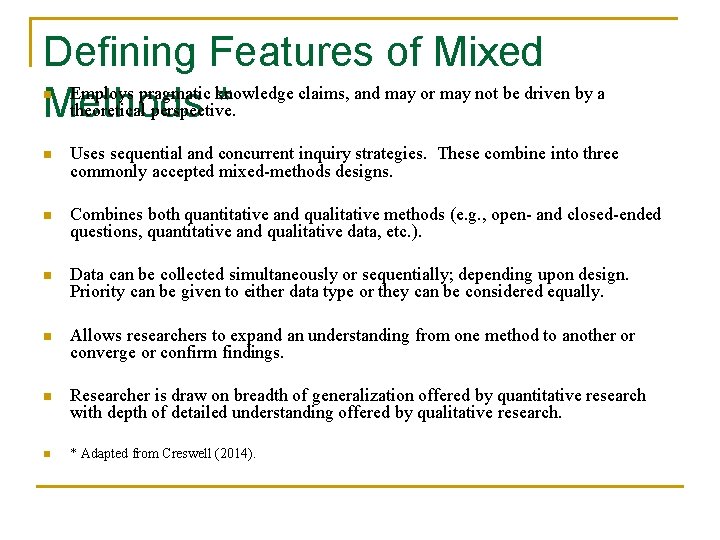
Defining Features of Mixed Employs pragmatic knowledge claims, and may or may not be driven by a theoretical perspective. Methods * n n Uses sequential and concurrent inquiry strategies. These combine into three commonly accepted mixed-methods designs. n Combines both quantitative and qualitative methods (e. g. , open- and closed-ended questions, quantitative and qualitative data, etc. ). n Data can be collected simultaneously or sequentially; depending upon design. Priority can be given to either data type or they can be considered equally. n Allows researchers to expand an understanding from one method to another or converge or confirm findings. n Researcher is draw on breadth of generalization offered by quantitative research with depth of detailed understanding offered by qualitative research. n * Adapted from Creswell (2014).
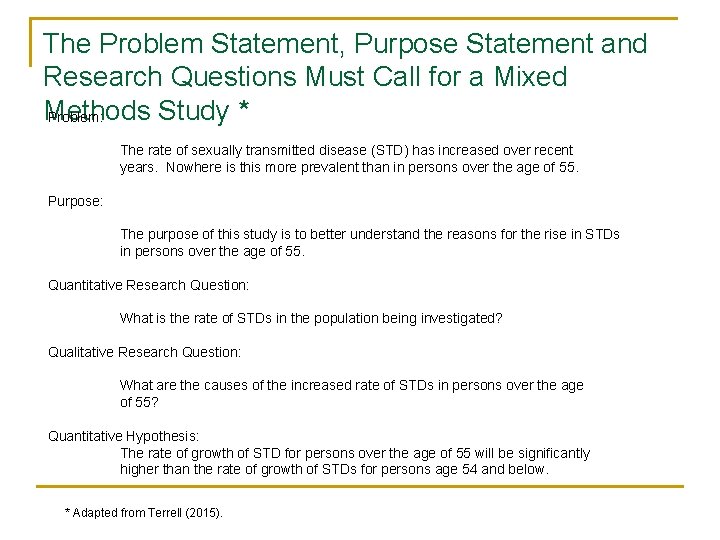
The Problem Statement, Purpose Statement and Research Questions Must Call for a Mixed Methods Study * Problem: The rate of sexually transmitted disease (STD) has increased over recent years. Nowhere is this more prevalent than in persons over the age of 55. Purpose: The purpose of this study is to better understand the reasons for the rise in STDs in persons over the age of 55. Quantitative Research Question: What is the rate of STDs in the population being investigated? Qualitative Research Question: What are the causes of the increased rate of STDs in persons over the age of 55? Quantitative Hypothesis: The rate of growth of STD for persons over the age of 55 will be significantly higher than the rate of growth of STDs for persons age 54 and below. * Adapted from Terrell (2015).
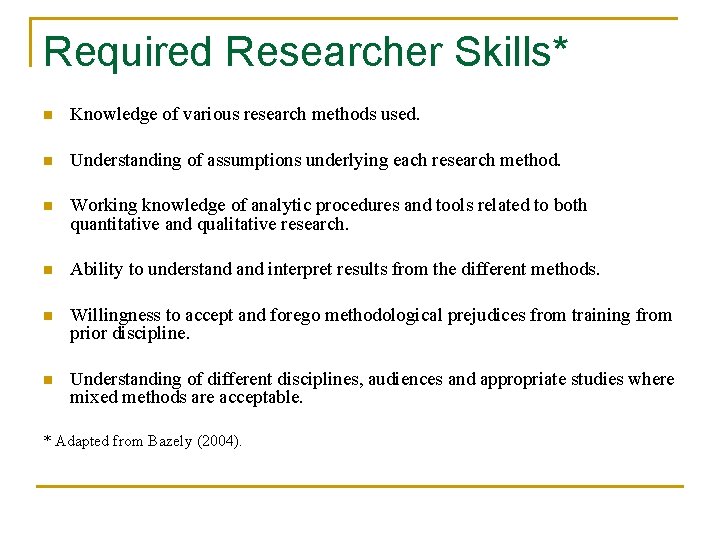
Required Researcher Skills* n Knowledge of various research methods used. n Understanding of assumptions underlying each research method. n Working knowledge of analytic procedures and tools related to both quantitative and qualitative research. n Ability to understand interpret results from the different methods. n Willingness to accept and forego methodological prejudices from training from prior discipline. n Understanding of different disciplines, audiences and appropriate studies where mixed methods are acceptable. * Adapted from Bazely (2004).
The Applications of Mixed-Methods Research are Far Ranging n n n n Nursing Psychology Education Sociology Library and Information Science Information Systems Political Science
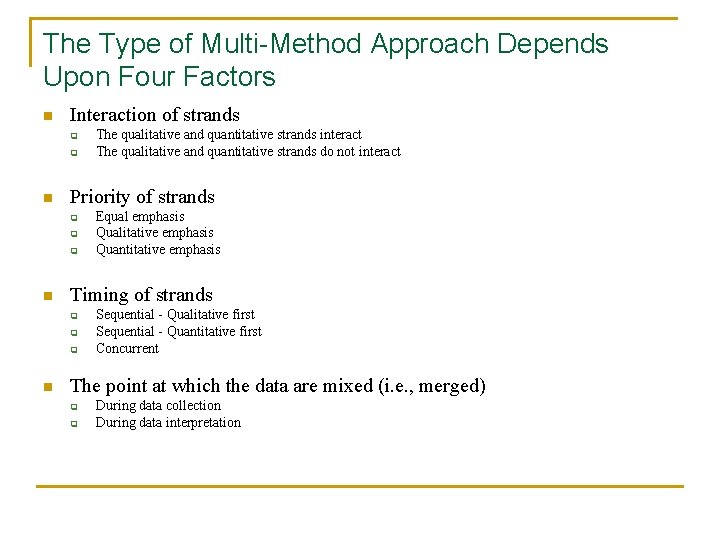
The Type of Multi-Method Approach Depends Upon Four Factors n Interaction of strands q q n Priority of strands q q q n Equal emphasis Qualitative emphasis Quantitative emphasis Timing of strands q q q n The qualitative and quantitative strands interact The qualitative and quantitative strands do not interact Sequential - Qualitative first Sequential - Quantitative first Concurrent The point at which the data are mixed (i. e. , merged) q q During data collection During data interpretation
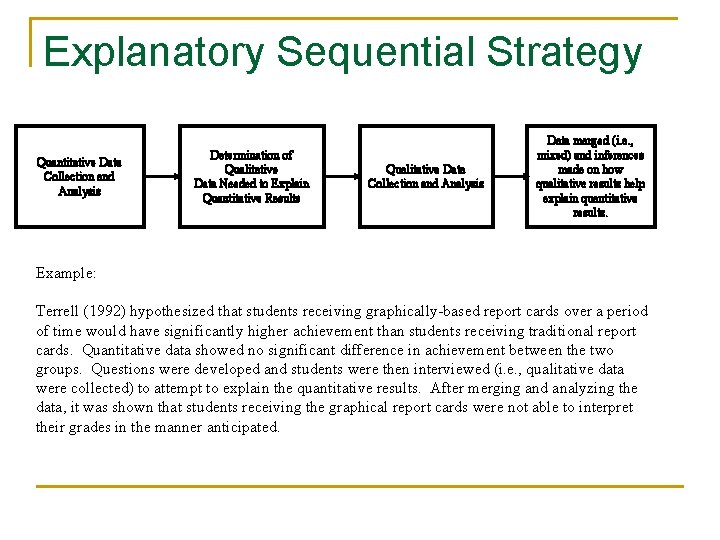
Explanatory Sequential Strategy Quantitative Data Collection and Analysis Determination of Qualitative Data Needed to Explain Quantitative Results Qualitative Data Collection and Analysis Data merged (i. e. , mixed) and inferences made on how qualitative results help explain quantitative results. Example: Terrell (1992) hypothesized that students receiving graphically-based report cards over a period of time would have significantly higher achievement than students receiving traditional report cards. Quantitative data showed no significant difference in achievement between the two groups. Questions were developed and students were then interviewed (i. e. , qualitative data were collected) to attempt to explain the quantitative results. After merging and analyzing the data, it was shown that students receiving the graphical report cards were not able to interpret their grades in the manner anticipated.
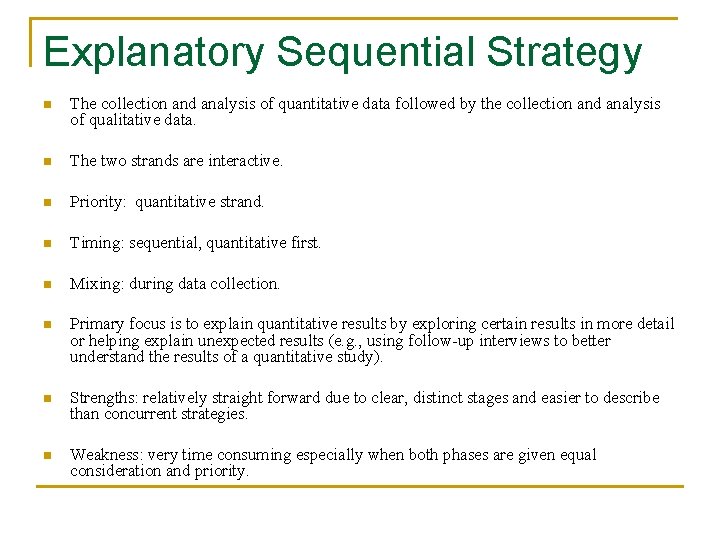
Explanatory Sequential Strategy n The collection and analysis of quantitative data followed by the collection and analysis of qualitative data. n The two strands are interactive. n Priority: quantitative strand. n Timing: sequential, quantitative first. n Mixing: during data collection. n Primary focus is to explain quantitative results by exploring certain results in more detail or helping explain unexpected results (e. g. , using follow-up interviews to better understand the results of a quantitative study). n Strengths: relatively straight forward due to clear, distinct stages and easier to describe than concurrent strategies. n Weakness: very time consuming especially when both phases are given equal consideration and priority.
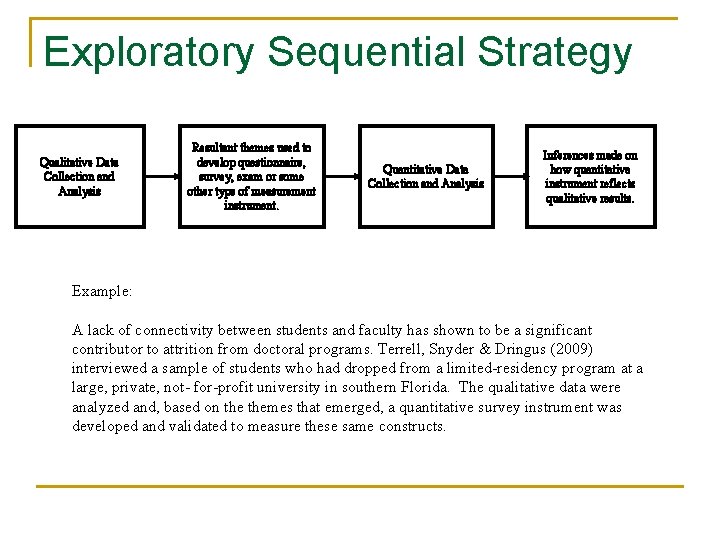
Exploratory Sequential Strategy Qualitative Data Collection and Analysis Resultant themes used to develop questionnaire, survey, exam or some other type of measurement instrument. Quantitative Data Collection and Analysis Inferences made on how quantitative instrument reflects qualitative results. Example: A lack of connectivity between students and faculty has shown to be a significant contributor to attrition from doctoral programs. Terrell, Snyder & Dringus (2009) interviewed a sample of students who had dropped from a limited-residency program at a large, private, not- for-profit university in southern Florida. The qualitative data were analyzed and, based on themes that emerged, a quantitative survey instrument was developed and validated to measure these same constructs.
Exploratory Sequential Strategy n The collection and analysis of qualitative data followed by the collection and analysis of quantitative data. n The two strands are interactive. n Priority: qualitative strand. n Timing: sequential, qualitative first. n Mixing: during data collection. n Used primarily to explore a phenomenon by: q Testing elements of a theory q Generalizing qualitative findings to different samples q Development of instrumentation (e. g. , using a small group to create instrumentation and then collecting quantitative data based on the instrumentation). n Strength: relatively straight forward due to clear, distinct stages and easier to describe than concurrent strategies. n Weakness: very time consuming especially when both phases are given equal consideration & priority.
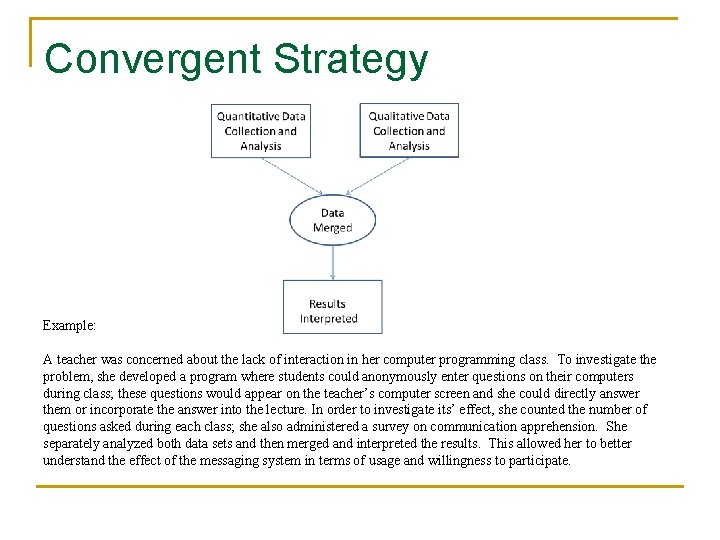
Convergent Strategy Example: A teacher was concerned about the lack of interaction in her computer programming class. To investigate the problem, she developed a program where students could anonymously enter questions on their computers during class; these questions would appear on the teacher’s computer screen and she could directly answer them or incorporate the answer into the lecture. In order to investigate its’ effect, she counted the number of questions asked during each class; she also administered a survey on communication apprehension. She separately analyzed both data sets and then merged and interpreted the results. This allowed her to better understand the effect of the messaging system in terms of usage and willingness to participate.
Convergent Strategy n The simultaneous collection of qualitative and quantitative data followed by the separate analysis of each. n The two strands are independent. n Priority: equal emphasis is given to both strands. n Timing: concurrent. n Mixing: during interpretation. n Used primarily to explore a phenomenon by: q Developing a more holistic understanding of the phenomenon by using the results of the qualitative data analysis to better understand inform the results of the quantitative data analysis. q For validation and corroboration of results by comparing the results of both data analyses. n Strength: efficient due to equal timing of data collection. Data can be collected analyzed separately using traditional tools for a given data type. n Weakness: very time consuming; consideration has to be given to concurrent data analyses, adequate sample sizes, merging of different types of data, and possibility of conflicting results.
Commonly Used Means of Quality Control “Mixed methods are inherently neither more nor less valid than specific approaches to research. As with any research, validity stems more from the appropriateness, thoroughness and effectiveness with which those methods are applied and the care given to thoughtful weighing of the evidence than from the application of a particular set of rules or adherence to an established tradition. ” (Bazely, 2004) In short, there are established rules for controlling validity in standard quantitative and qualitative research. These same rules must be followed when the methods are combined.
Ethical Concerns n n n n n Participants must participate voluntarily. Participants must understand purpose and procedures of the study. Participants must understand that they have the right to a copy of the results. Participants must understand the potential benefits of the study and that their privacy will be respected. Researchers must understand the impact of their presence at research sites and ensure that these sites are left undisturbed at the end of the study. Care must be taken to identify and nullify any actual or perceived issues where power between the researcher and participant could be abused. Anonymity must be maintained during data analysis and data kept for a reasonable period of time. Ensure that writing is free of bias towards any group (e. g. , age, ethnicity, sexual orientation, race, gender, etc. ) The details of the study must be careful explained within the actual report so as to allow readers the opportunity to judge the ethical quality of the study for themselves.
References Bazely, P. (2004). Issues in mixing qualitative and quantitative approaches to research. In. R. Buber, J. Gadner, & L. Richards (Eds. ) Applying qualitative methods to marketing management research. UK: Palgrave Macmillan, (pp. 141 -156). Clark, V. & Creswell, J. (2008). The mixed methods reader. Los Angeles: SAGE. Creswell, J. (2003). Research design: qualitative, quantitative, and mixed methods approaches (2 nd ed. ). Thousand Oaks, CA: Sage. Creswell, J. (2015). A concise introduction to mixed methods research. Thousand Oaks, CA: Sage. Johnson, R. B. & Onwuegbuzie, A. J. (2004). Mixed-methods research: a research paradigm whose time has come. Educational Researcher, 33(7), 14 -26. Petrosyan, Y. Assessing research protocols: mixed methods research. Methods Workshop for the Ministry of Health and Long. Term Care. Retrieved from https: //bit. ly/2 J 8 b. I 7 m. Tashakkori, A. , & Teddlie, C. (2008). Introduction to mixed method and mixed model studies in the social and behavioral science. In V. L. Plano-Clark & J. W. Creswell (Eds. ), The mixed methods reader, (pp. 7 -26). Terrell, S. (1992). An investigation of Cognitive Evaluation Theory: the effect of graphic feedback on student motivation and achievement Unpublished doctoral dissertation). Florida International University, Miami. Terrell, S. , Snyder, M. & Dringus, P. (2009). The development, validation, and application of the Doctoral Student Connectedness Scale. Internet and Higher Education, 12(2), 112 -116
Exemplary Resources and Studies Donovan, J. , Mills, N. , Smith, M. , Brindle, L: . , Jacoby, A. , Peters, T. , Frankel, S. , Neal, D. , & Hamdy, F. (2002). Improving design and conduct of randomized trials by embedding them in qualitative research: Protec. T (prostate testing for cancer and treatment) study. British Medical Journal, 325, 766 -769. Idler, E. L. , Hudson, S. V. , & Leventhal, H. (1999). The meanings of self-ratings of health: A qualitative and quantitative approach. Research on Aging, 21(3), 458 -476. Luzzo, D. A. (1995). Gender differences in college students’ career maturity and perceived barriers in career development. Journal of Counseling and Development, 73, 319 -322. Messer, L. , Steckler, A. , & Dignan, M. (1999). Early detection of cervical cancer among Native American women: A qualitative supplement to a quantitative study. Health Education & Behavior, 8(26), 547 -562. Milton, J. , Watkins, K. E. , Studdard, S. S. , & Burch, M. (2003). The ever widening gyre: Factors affecting change in adult education graduate programs in the United States. Adult Education Quarterly, 54(1), 23 -41. O’Cathain, A. , Murphy, E. & Nicholl, J. (2008). The quality of mixed methods studies in health services research. Journal of Health Services Research, 13(2), 92 -98. Richter, K. (1997). Child care choice in urban Thailand: Qualitative and quantitative evidence of the decisionmaking process. Journal of Family Issues, 18(2), 174 -204. Thøersen-Ntoumani, C. , & Fox, K. R. (2005). Physical activity and mental well-being typologies in corporate employees: A mixed methods approach. Work & Stress, 19(1), 50 -67. Victor, C. R. , Ross, F. , & Axford, J. (2004). Capturing lay perspectives in a randomized control trial of a health promotion intervention for people with osteoarthritis of the knee. Journal of Evaluation in Clinical Practice, 10(1), 63 -70.
Author Note and Contact Information Dr. Steve Terrell is a Professor in the Fischler College of Education and the College of Engineering and Computing at Nova Southeastern University. He is the Chair of the Online Teaching and Learning SIG of the American Educational Research Association. He can be contacted at: Fischler College of Education Nova Southeastern University Ft. Lauderdale, Fl 33314 954 -262 -2084 800 -986 -2247 x 2084 terrell@nova. edu Copyright 2018: Steve Terrell and Nova Southeastern University