
Understanding and Using ASAM Criteria Paul Kiernan LADC
- Slides: 26
Understanding and Using ASAM Criteria Paul Kiernan, LADC Clinical Services Specialist Division for Behavioral Health Bureau of Drug and Alcohol Services Clinical Services Unit 603. 271. 6115 paul. kiernan@dhhs. nh. gov
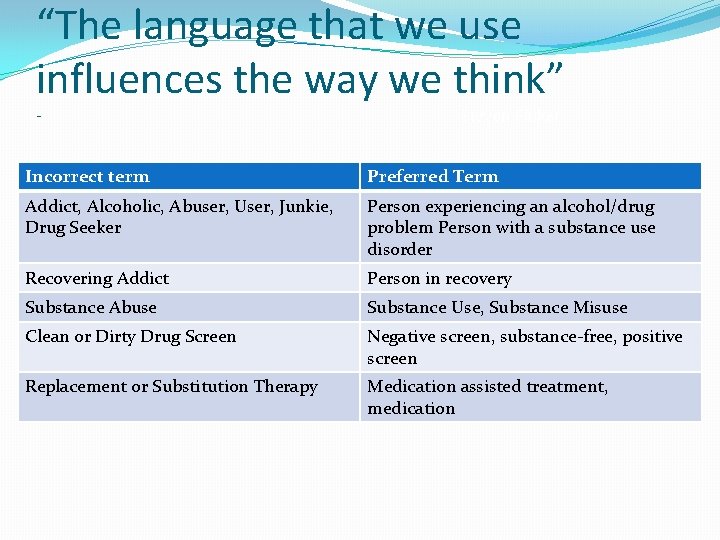
“The language that we use influences the way we think” - Steven Pinker Incorrect term Preferred Term Addict, Alcoholic, Abuser, User, Junkie, Drug Seeker Person experiencing an alcohol/drug problem Person with a substance use disorder Recovering Addict Person in recovery Substance Abuse Substance Use, Substance Misuse Clean or Dirty Drug Screen Negative screen, substance-free, positive screen Replacement or Substitution Therapy Medication assisted treatment, medication
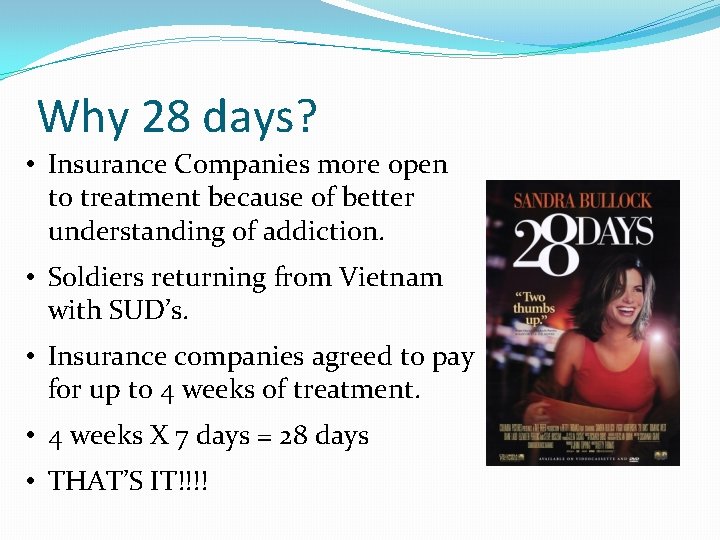
Why 28 days? • Insurance Companies more open to treatment because of better understanding of addiction. • Soldiers returning from Vietnam with SUD’s. • Insurance companies agreed to pay for up to 4 weeks of treatment. • 4 weeks X 7 days = 28 days • THAT’S IT!!!!
A change In approaches to Addiction treatment Late 1980’s Early 1990’s • More evidence in controlled outcome studies concluding no significant advantages to inpatient treatment • Less willingness for reimbursement by insurance • More focus on continuum of care model • Began looking at more paths to recovery • Moving away from “One size Fits all” model
American Society of Addiction Medicine �Patient driven lengths of stay �Non program/curriculum driven treatment �Discharge begins at intake �Continuum of care versus “graduating” treatment �Complete dimensional assessment �Continuing assessment
Adolescent levels of care �maintaining transparency with regard to confidentiality limitations. �The need for adolescent specific assessment methodologies. �Withdrawal Management services are “bundled” into levels of care �IOP services are 6 hours per week and suggested to be no longer than 2 hours per session �Efforts should be made for minimal disruption into school/family
ASAM Dimensions 1. Acute Intoxication and/or Withdrawal Potential 2. Biomedical Conditions and Complications 3. Emotional, Behavioral, or Cognitive Conditions and Complications 4. Readiness to Change 5. Relapse, Continued Use, or Continued Problem Potential 6. Recovery/Living Environment
Dimension 1: Acute Intoxication or Withdrawal Potential �Assessment considerations: • Risks associated with the patients current level of Intoxication or withdrawal. • Is the person intoxicated and planning to drive/bike? • Substance use History • How much, how often, how, and how long • Current withdrawal symptoms, withdrawal history • CIWA, COWS Score • Assessment of multidimensional interaction �Consider Patient for Withdrawal management services
Dimension 2: Biomedical Conditions and Complications �Assessment Considerations �Current Physical Illness �Chronic medical conditions �Pregnancy �Multidimensional interaction (special attention to dimension 1)
Dimension 3: Emotional, Behavioral, or Cognitive Conditions and Complication �Assessment Considerations �Current emotional, behavioral, or cognitive conditions that could interfere with Treatment �Chronic conditions �Relation of Symptoms to SUD �Mental health history �Treatment history �TBI History* �Monitor Symptoms �Multidimensional Interaction
Dimension 4: Readiness to Change �Assessment Considerations �Mental Health and SUD assessment. �Patient’s level of awareness of their relationship between negative consequences and substance use. �Patients readiness, willingness, ability to change addictive behavior. �Patient’s Goals for Treatment. �Multidimensional interaction.
Dimension 5: Relapse, Continued Use, Continued Problem Potential �Assessment Considerations �Both SUD and mental health disorder assessment �Strengths, coping skills, ability to manage craving, impulse control �Understanding relapse versus continued use �Relapse History � Thoughts, internal dialogue preceding relapse � Relapse does not mean a higher level of care. � Continued use could mean lower level of care � Patients awareness of cues/triggers �Multidimensional interaction
Dimension 6: Recovery Environment �Assessment Considerations �Both SUD and mental health disorder assessment �Threats to patients safety or engagement in treatment �Resources available to help with a successful recovery �Transportation, childcare, housing or employment issues �Mandates that influence treatment motivation �Spirituality �Multidimensional assessment
ASAM Levels of Care �Level 0. 5 – Early Intervention �Level 1 - Outpatient Services �Level 2 - Intensive Outpatient/Partial Hospitalization Services �Level 3 – Residential/Inpatient Services �Level 4 - Medically-Managed Intensive Inpatient Services
Early Intervention – Level 0. 5 �For individuals with known risk of developing a SUD �Not sufficient information for Diagnosis �Provides education, screening, identifies risk factors, helps individuals see consequences of continued use.
Outpatient Services – Level 1 �Organized services in a wide variety of settings �Professionally directed evaluation treatment and recovery service �Regularly scheduled meetings
Intensive Outpatient – Level 2. 1 �Organized services delivered day or evening hours to accommodate work, childcare schedules �Provides Patients the opportunity to apply skills learned as they learn them. �Regular consultation with psychiatric, medical and medication management � 9 or more hours a week for adult, 6 or more hours a week for adolescent
Partial Hospitalization Services Level 2. 5 �Direct access to psychiatric, medical, and lab services when warranted �Provides 20 or more hours/week of services
Clinically-Managed Low Intensity Residential – Level 3. 1 �Transitional living/Halfway House � 24 hour structure with available trained staff �Minimum of 5 Hours of clinical services per week
Clinically Managed Population Specific High Intensity Residential Services – Level 3. 3 �Adult Level of Care only � 24 Hour care with trained professionals to stabilize imminent risk �Less intense to accommodate the needs of patients unable to benefit from a more intense application of treatment �Typically for patients with developmental disabilities or TBI
Clinically-Managed High Intensity Residential - Level 3. 5 Clinically-Managed Medium Intensity Residential � 24 Hour care with trained professionals to stabilize imminent risk �Patients must be able to tolerate and benefit from intense milieu or therapeutic community
Medically-Monitored Intensive Inpatient Treatment – Level 3. 7 Adult Criteria � 24/7 nursing care and physicians available. �Similar to level 3. 5 but with in-house access to acute medical or psychiatric care. �For individuals with significant problems in Dimension 1, 2, or 3.
Medically Managed Intensive Inpatient Services – Level 4 � 24/7 nursing care and daily physician care for severe, unstable problems in dimension 1, 2, 3 �Counseling service are available. Although a SUD diagnosis is needed, patients acute needs are addressed.
Opioid Treatment Services (OTS) �Not a separate level of care. �Additional services that can be integrated or “bundled” into current levels of care
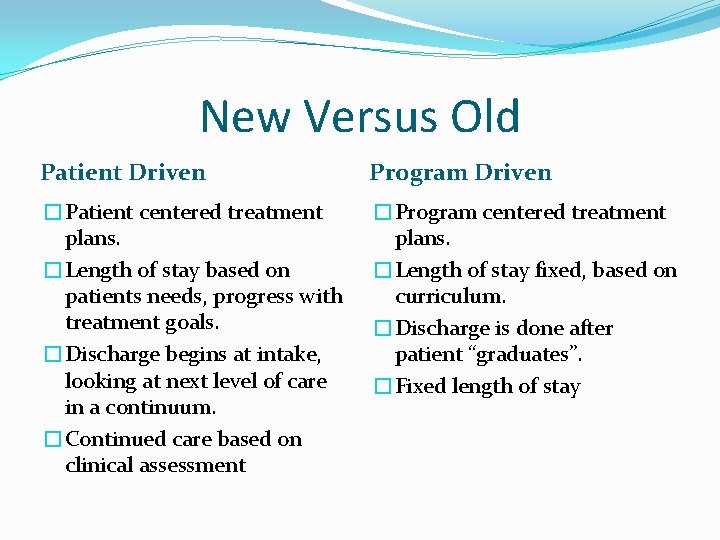
New Versus Old Patient Driven Program Driven �Patient centered treatment plans. �Length of stay based on patients needs, progress with treatment goals. �Discharge begins at intake, looking at next level of care in a continuum. �Continued care based on clinical assessment �Program centered treatment plans. �Length of stay fixed, based on curriculum. �Discharge is done after patient “graduates”. �Fixed length of stay
References �Mee-Lee, David (2013). The ASAM Criteria: Treatment Criteria for Addictive, Substance-Related and Co-Occurring Conditions. Chevy Chase, MD: American Society of Addiction Medicine, Inc.