
Understanding and Recognizing Dyslexia Definition of Dyslexia q
- Slides: 53
Understanding and Recognizing Dyslexia
Definition of Dyslexia: q. Dyslexia is a specific learning disability that is neurological in origin. q. It is characterized by difficulties with accurate and / or fluent word recognition and by poor spelling and decoding abilities. q. These difficulties typically result from a deficit in the phonological component of language that is often unexpected in relation to other cognitive abilities and the provision of effective classroom instruction. q. Secondary consequences may include problems in reading comprehension and reduced reading experience that can impede growth of vocabulary and background knowledge. Adopted by the IDA Board of Directors, Nov. 12, 2002. This Definition is also used by the National Institute of Child Health and Human Development (NICHD).
Specific Learning Disability IDEA 2004 q“The term ‘specific learning disability’ means a disorder in one or more of the basic processes involved in understanding or in using language, spoken or written, that may manifest itself in the imperfect ability to listen, think, speak, read, write spell or do mathematical calculations. q. Such terms includes conditions as perceptual disabilities, brain injury, minimal brain dysfunction, dyslexia, and developmental aphasia. q. Such term does not include a learning problem that is primarily the result of visual, hearing, or motor disabilities, of mental retardation, of emotional disturbance, or of environmental, cultural, or economic disadvantage. ”
Civil Rights and Dyslexia Section 504 q Section 504 prohibits discrimination on the basis of disability in programs or activities that receive federal financial assistance from the U. S. Department of Education. q To be protected under Section 504, a student must be determined to: 1) have a physical or mental impairment that substantially limits one or more major life activities; 2) have a record of such an impairment, or 3) be regarded as having such an impairment. q Section 504 requires that school districts provide a free and appropriate public education (FAPE) to qualified students in their jurisdictions who have a physical or mental impairment that substantially limits one or more major life activities. Colker, Shaywitz, Simon: Comments on Proposed DSM-5 Criteria for Specific Learning Disorder from a Legal and Medical/Scientific Perspective, Yale Center for Dyslexia and Creativity. 2012
Civil Rights and Dyslexia Americans with Disabilities Act (ADA) Exams administered by any private, state, or local government entity related to applications, licensing, certification, or credentialing for secondary or postsecondary education, professional, or trade purposes are covered by the ADA and testing accommodations must be provided. High school equivalency exams (such as the GED); High school entrance exams (such as the SSAT or ISEE); College entrance exams (such as the SAT or ACT); Exams for admission to professional schools (such as the LSAT or MCAT); Admissions exams for graduate schools (such as the GRE or GMAT); and Licensing exams for trade purposes (such as cosmetology) or professional purposes (such as bar exams or medical licensing exams, including clinical assessments). ADA. gov
DSM-5 and Dyslexia Specific Learning Disorders q DSM-5 considers SLD to be a type of Neurodevelopmental Disorder that impedes the ability to learn or use specific academic skills (e. g. , reading, writing, or arithmetic), which are the foundation for other academic learning. q The learning difficulties are ‘unexpected’ in that other aspects of development seem to be fine. q Dyslexia, dysgraphia, dyscalculia may be used to specify the nature of their SLD, according to individual preference. The aim of the requirement to use specifiers to characterize the range of academic skills affected by dyslexia is to increase awareness that ‘dyslexia’ typically encompasses far more difficulties than those related to decoding and spelling words Tannock R. Journal of Learning Disabilities. 2013 Jan-Feb; 46(1): 5 -25.
Dyslexia “Islands of weakness in a sea of strengths” q. Problems in accuracy and rate of oral reading of words and text and pseudo words and/or spelling q. Skills above discrepant from Verbal Comprehension Index (Verbal IQ) and below population mean. q. Language (except for phonology) is a relative strength that can mask severe problems in working memory that are invisible without assessment.
Myths About Dyslexia q Dyslexics see backwards or up-side down and therefore are likely to reverse letters and numbers. q Boys are more likely to be dyslexic than girls q Dyslexia stems from poor parenting or laziness. q Kids will grow out of it. q They will learn to read when they are ready. q There is no such thing as dyslexia.
Dyslexia Statistics q 15 -20% of the population have a language-based learning disability. q. Of the students with specific learning disabilities receiving special education services, 70 -80% have deficits in reading. q. Dyslexia is the most common cause of reading, writing and spelling difficulties. q. Dyslexia affects males and females nearly equally, and people from different ethnic and socio-economic backgrounds as well. q 74% of the children who are poor readers in 3 rd grade remain poor readers in the 9 th grade. Often they can't read well as adults either.
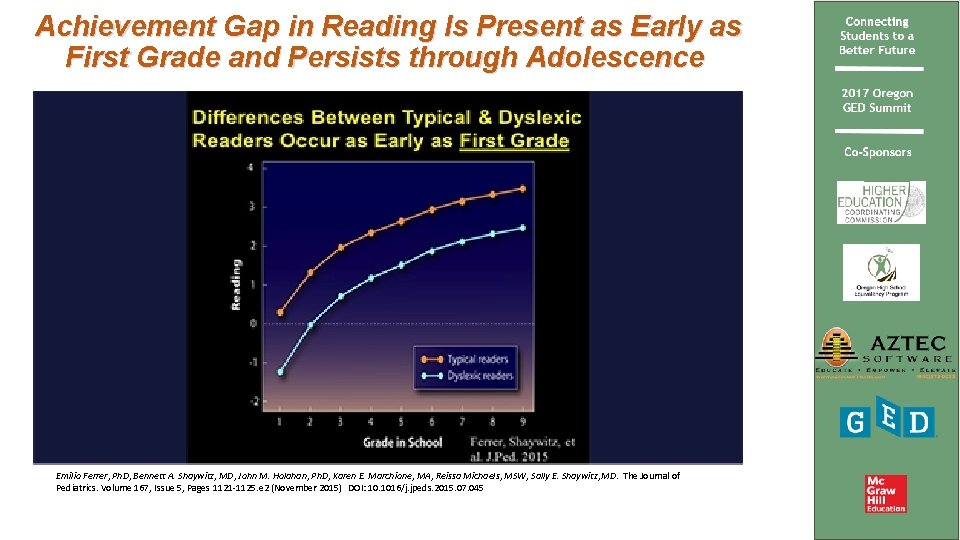
Achievement Gap in Reading Is Present as Early as First Grade and Persists through Adolescence Emilio Ferrer, Ph. D, Bennett A. Shaywitz, MD, John M. Holahan, Ph. D, Karen E. Marchione, MA, Reissa Michaels, MSW, Sally E. Shaywitz, MD. The Journal of Pediatrics. Volume 167, Issue 5, Pages 1121 -1125. e 2 (November 2015) DOI: 10. 1016/j. jpeds. 2015. 07. 045
Life with Dyslexia - Outcomes q Only 52% of students identified with LDs will actually graduate with a high school diploma. q Learning disabled students drop out of high school at more than twice the rate of their non-disabled peers. q Up to 60% of adolescents who receive treatment for substance abuse have learning disabilities. q 62% of learning disabled students were unemployed one year after high school graduation. q 31% of adolescents with LDs will be arrested within five years of leaving high school National Center for Education Statistics, Literacy Behind Prison Walls, 1994 JFA Associates, The Impact of Ignoring Dyslexia and Reading Disabilities in the Criminal Justice System: What We Know and Need to Know, 2004
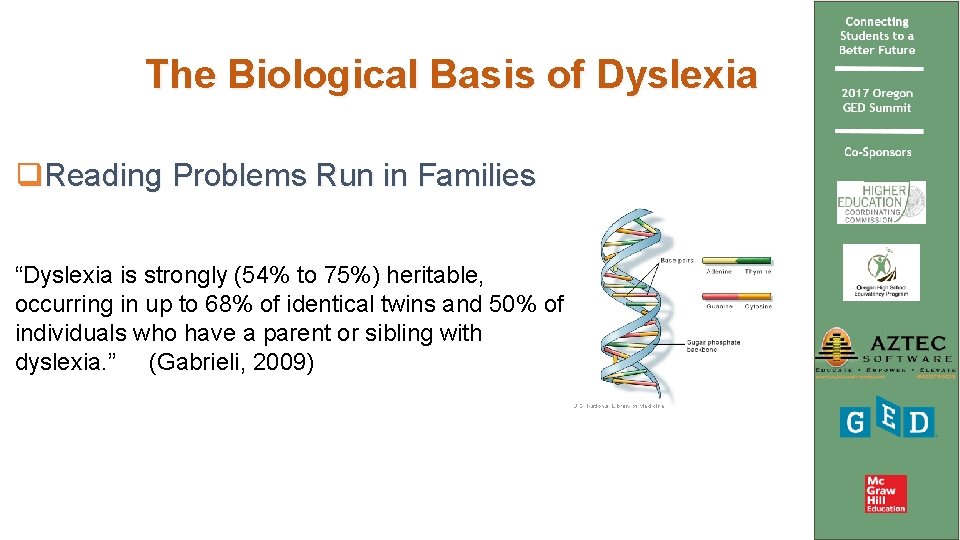
The Biological Basis of Dyslexia q. Reading Problems Run in Families “Dyslexia is strongly (54% to 75%) heritable, occurring in up to 68% of identical twins and 50% of individuals who have a parent or sibling with dyslexia. ” (Gabrieli, 2009)
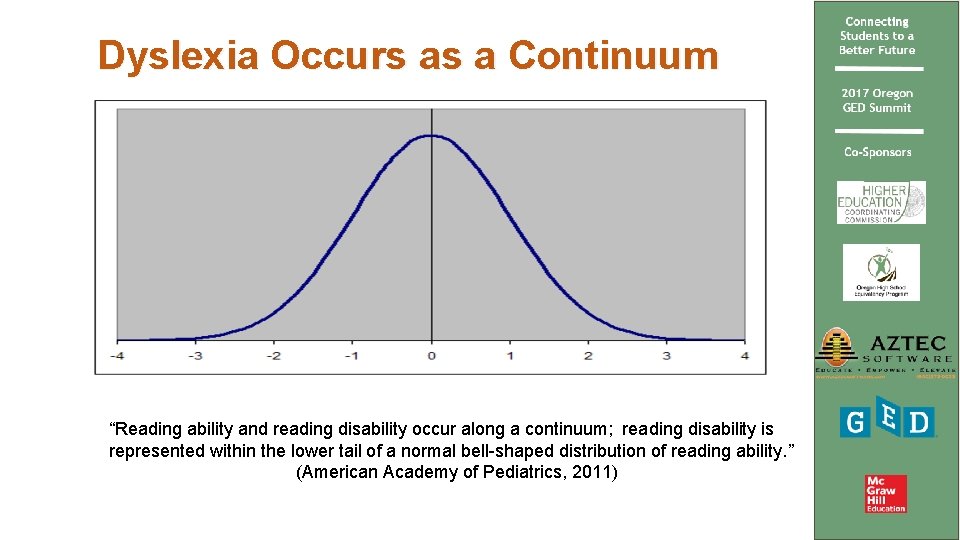
Dyslexia Occurs as a Continuum “Reading ability and reading disability occur along a continuum; reading disability is represented within the lower tail of a normal bell-shaped distribution of reading ability. ” (American Academy of Pediatrics, 2011)
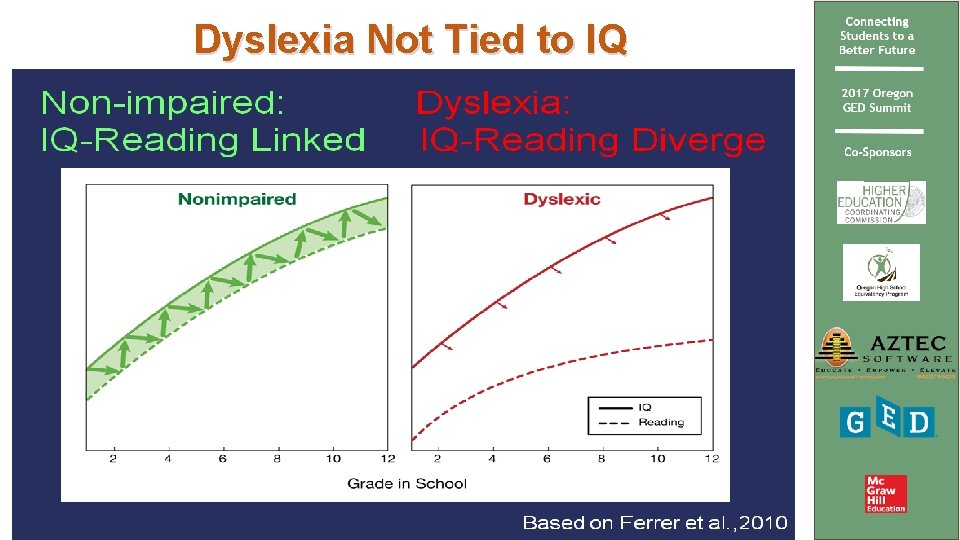
Dyslexia Not Tied to IQ
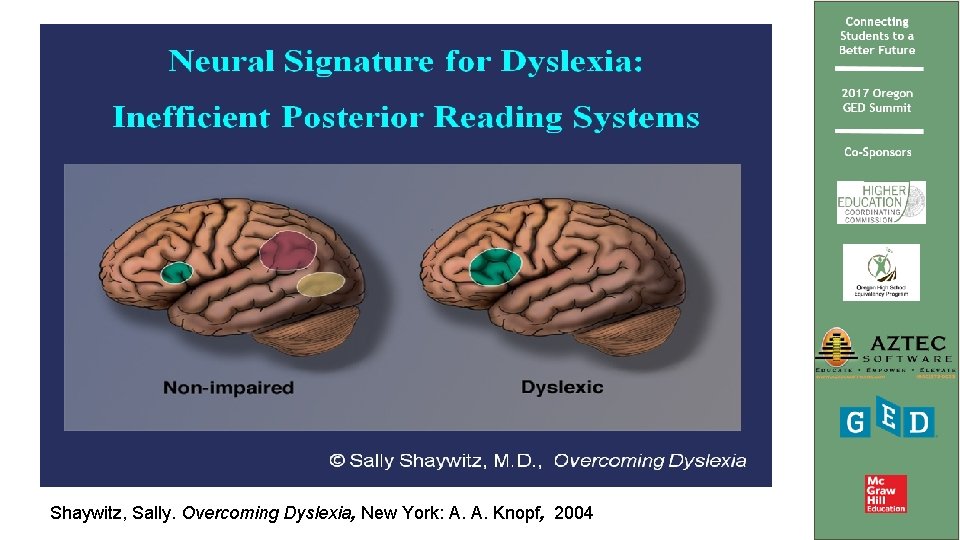
Shaywitz, Sally. Overcoming Dyslexia, New York: A. A. Knopf, 2004
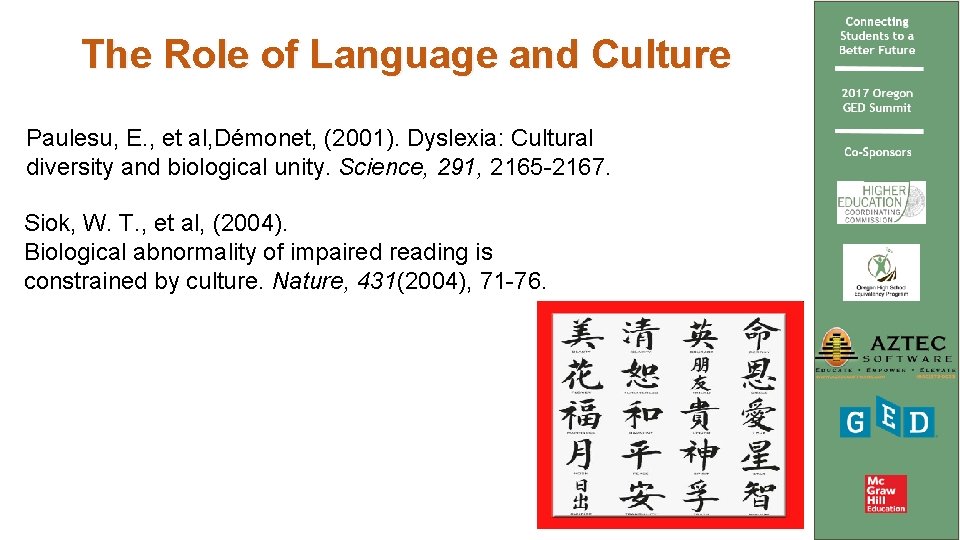
The Role of Language and Culture Paulesu, E. , et al, Démonet, (2001). Dyslexia: Cultural diversity and biological unity. Science, 291, 2165 -2167. Siok, W. T. , et al, (2004). Biological abnormality of impaired reading is constrained by culture. Nature, 431(2004), 71 -76.
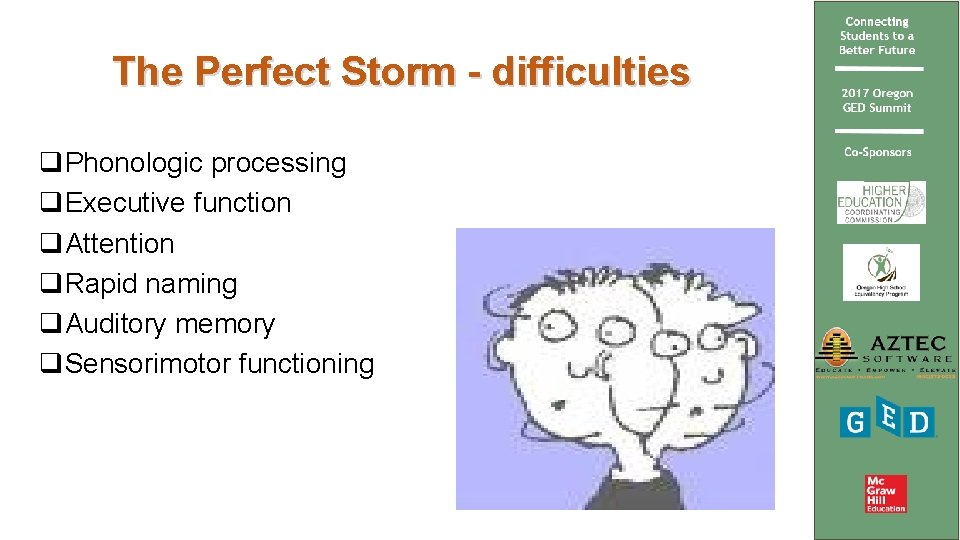
The Perfect Storm - difficulties q. Phonologic processing q. Executive function q. Attention q. Rapid naming q. Auditory memory q. Sensorimotor functioning
Reading May Not Be The Only Problem q. Writing, Speaking, SPELLING, Math q. Memory, Processing Speed, Sequencing q. Organization q. Social Skills
Watch For Co-morbidities q. ADD/ADHD q. Executive Function Disorders q. Anxiety Disorders q. Major Depression q. Bipolar Disorder q. Tourettes
Secondary Emotional Difficulties q. Anxiety q. Anger q. Self Image q. Frustration q. Depression q. Family Problems q. Substance Abuse
Watch for Talents and Gifts q. Art q. Music q. Athletics q. Dance q. Empathy q. Humor q. Out of the Box Thinking
Video Clip: It’s Never Too Late Meet Sandy and Mike
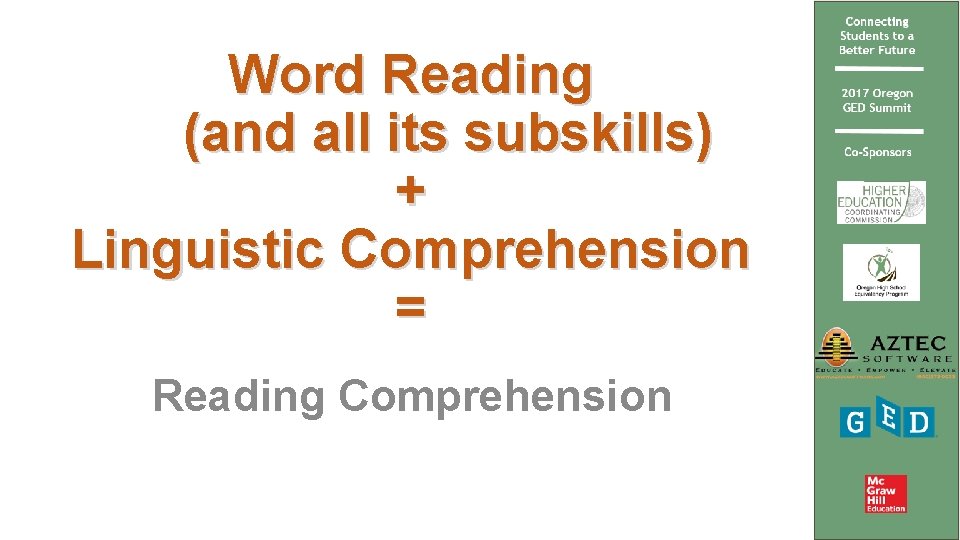
Word Reading (and all its subskills) + Linguistic Comprehension = Reading Comprehension
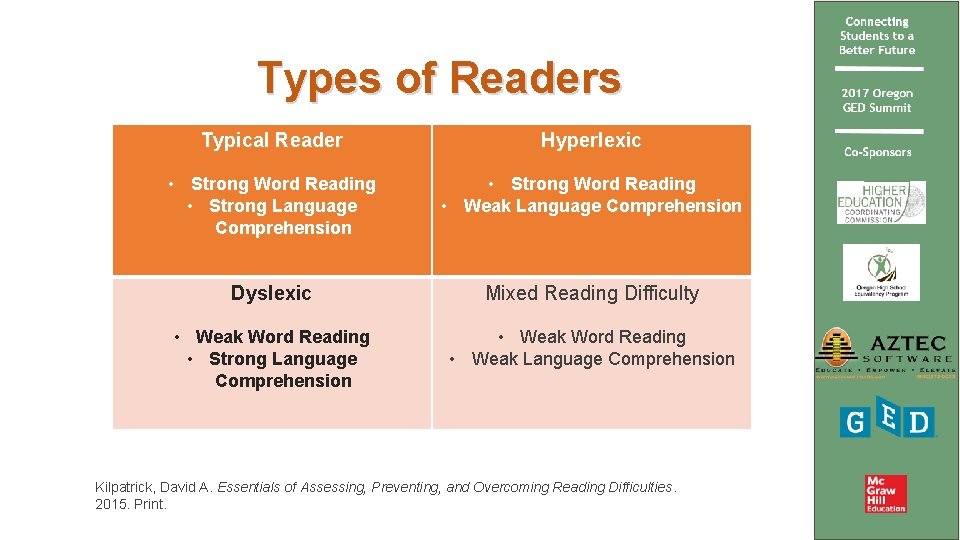
Types of Readers Typical Reader Hyperlexic • Strong Word Reading • Strong Language Comprehension • Strong Word Reading • Weak Language Comprehension Dyslexic Mixed Reading Difficulty • Weak Word Reading • Strong Language Comprehension • Weak Word Reading • Weak Language Comprehension Kilpatrick, David A. Essentials of Assessing, Preventing, and Overcoming Reading Difficulties. 2015. Print.
Successful Readers q. Rely primarily on the letters in the word rather than context or pictures to identify familiar and unfamiliar words. q. Process virtually every letter. q. Use letter-sound correspondences to identify words. q. Have a reliable strategy for decoding words. q. Read words for a sufficient number of times for words to become automatic. From: www. reading. uoregon. edu IDEA Institute for the Development of Educational Achievement 2002 -2004
Dyslexic Readers q. Lack knowledge of the ways in which sounds map to print q. May read single-syllable words, but have difficulty decoding longer, multisyllabic words q. May omit or substitute words such as a, the, and, of q. Have difficulty breaking words into syllable parts q. Often do not use word analysis strategies to break words into parts q. Difficulty retaining sight words Battacharya & Ehri, 2004, Nagy, Berninger, & Abbott, 2006; Boardman et al. , 2008
Preschool Warning Signs q. Delayed speech- Mixing sounds in multi-syllabic words q. Inability to rhyme by age 4 q. Can’t master tying shoes q. Confusion of left versus right q. Difficulty naming the names of the letters in the alphabet or their sounds; difficulty writing the alphabet in order q. Unusual pencil grip
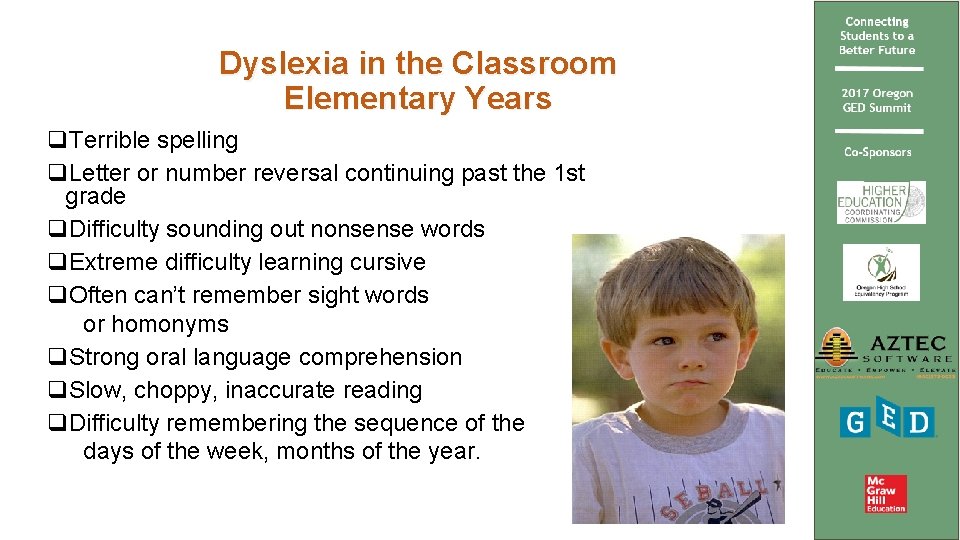
Dyslexia in the Classroom Elementary Years q. Terrible spelling q. Letter or number reversal continuing past the 1 st grade q. Difficulty sounding out nonsense words q. Extreme difficulty learning cursive q. Often can’t remember sight words or homonyms q. Strong oral language comprehension q. Slow, choppy, inaccurate reading q. Difficulty remembering the sequence of the days of the week, months of the year.
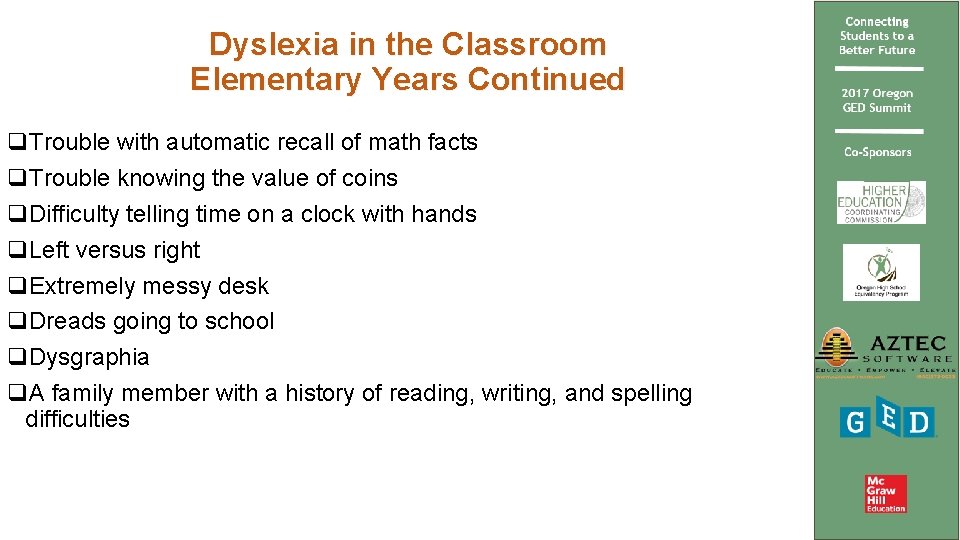
Dyslexia in the Classroom Elementary Years Continued q. Trouble with automatic recall of math facts q. Trouble knowing the value of coins q. Difficulty telling time on a clock with hands q. Left versus right q. Extremely messy desk q. Dreads going to school q. Dysgraphia q. A family member with a history of reading, writing, and spelling difficulties
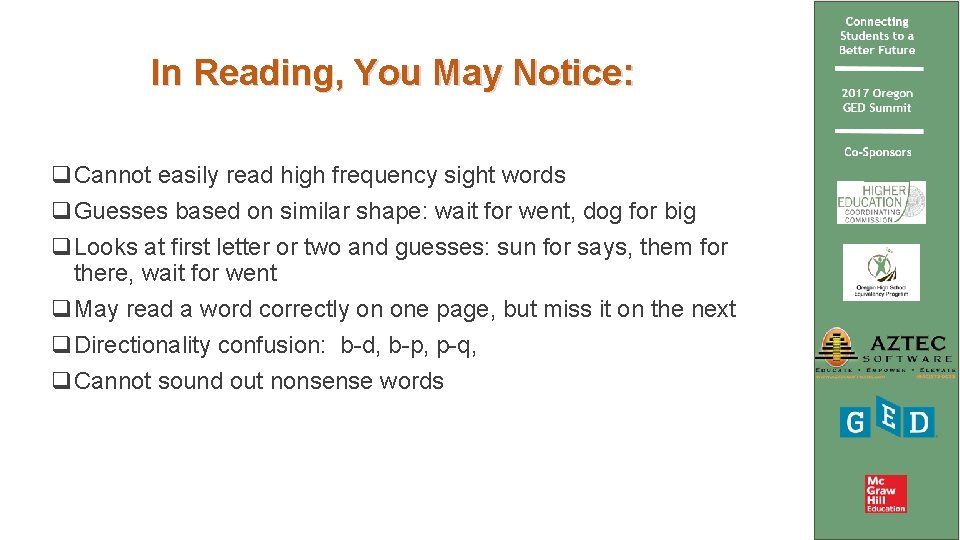
In Reading, You May Notice: q. Cannot easily read high frequency sight words q. Guesses based on similar shape: wait for went, dog for big q. Looks at first letter or two and guesses: sun for says, them for there, wait for went q. May read a word correctly on one page, but miss it on the next q. Directionality confusion: b-d, b-p, p-q, q. Cannot sound out nonsense words
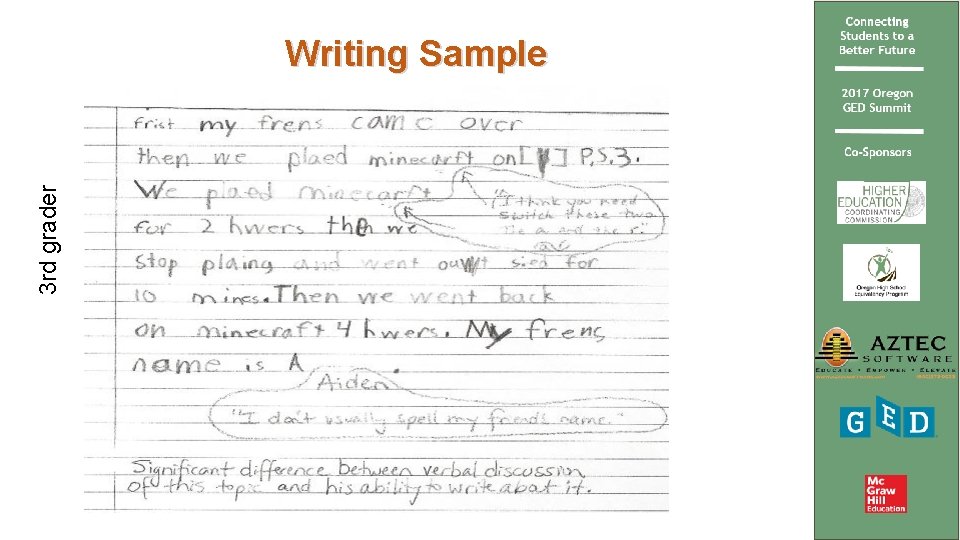
3 rd grader Writing Sample
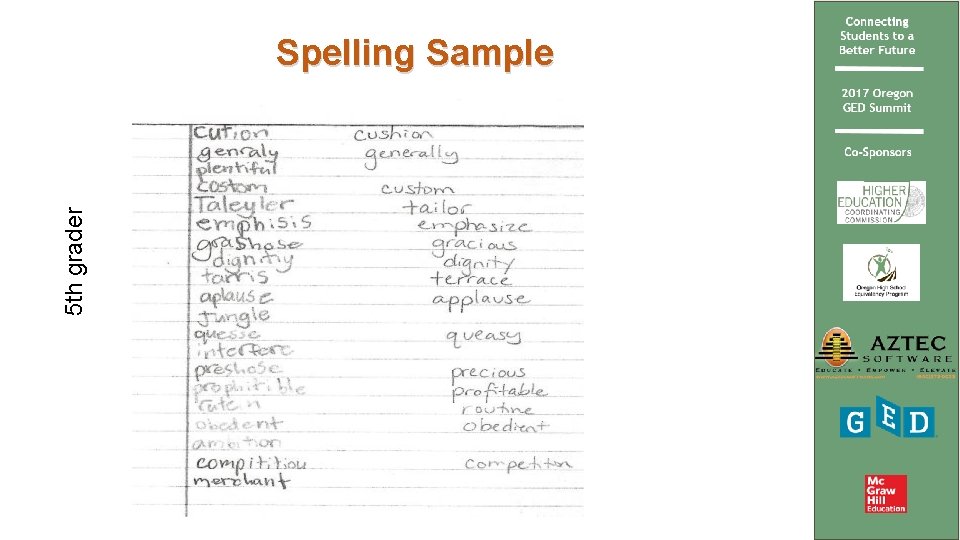
5 th grader Spelling Sample
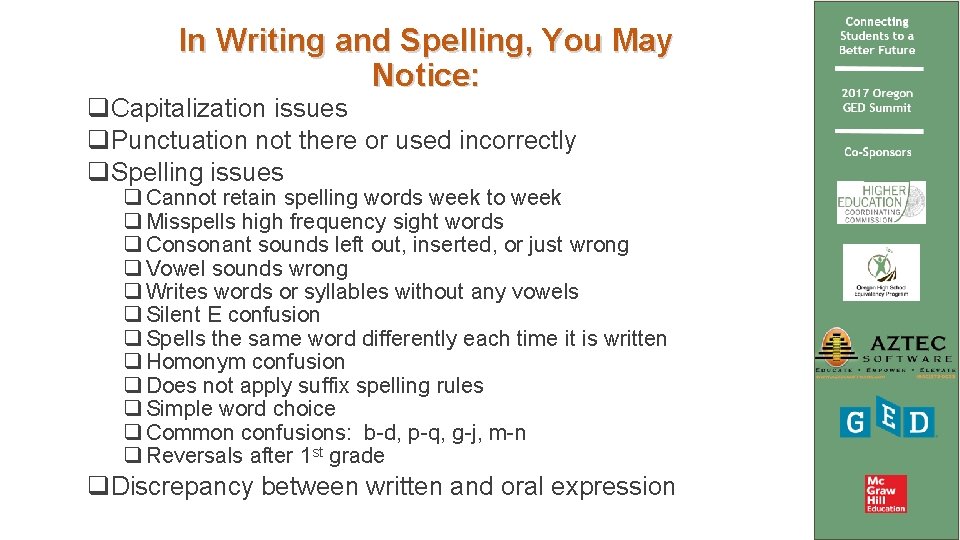
In Writing and Spelling, You May Notice: q. Capitalization issues q. Punctuation not there or used incorrectly q. Spelling issues q Cannot retain spelling words week to week q Misspells high frequency sight words q Consonant sounds left out, inserted, or just wrong q Vowel sounds wrong q Writes words or syllables without any vowels q Silent E confusion q Spells the same word differently each time it is written q Homonym confusion q Does not apply suffix spelling rules q Simple word choice q Common confusions: b-d, p-q, g-j, m-n q Reversals after 1 st grade q. Discrepancy between written and oral expression
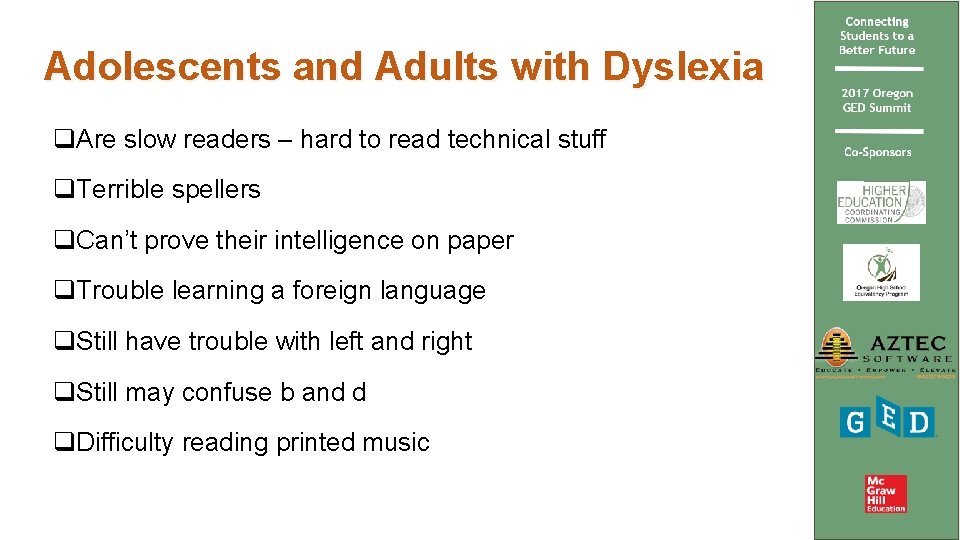
Adolescents and Adults with Dyslexia q. Are slow readers – hard to read technical stuff q. Terrible spellers q. Can’t prove their intelligence on paper q. Trouble learning a foreign language q. Still have trouble with left and right q. Still may confuse b and d q. Difficulty reading printed music
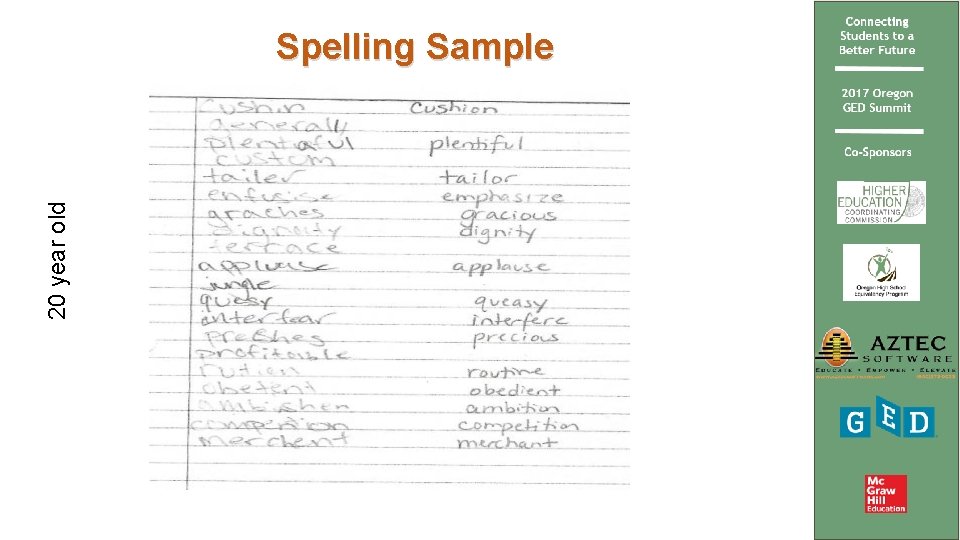
20 year old Spelling Sample
Video Clip: It’s Never Too Late Part 2
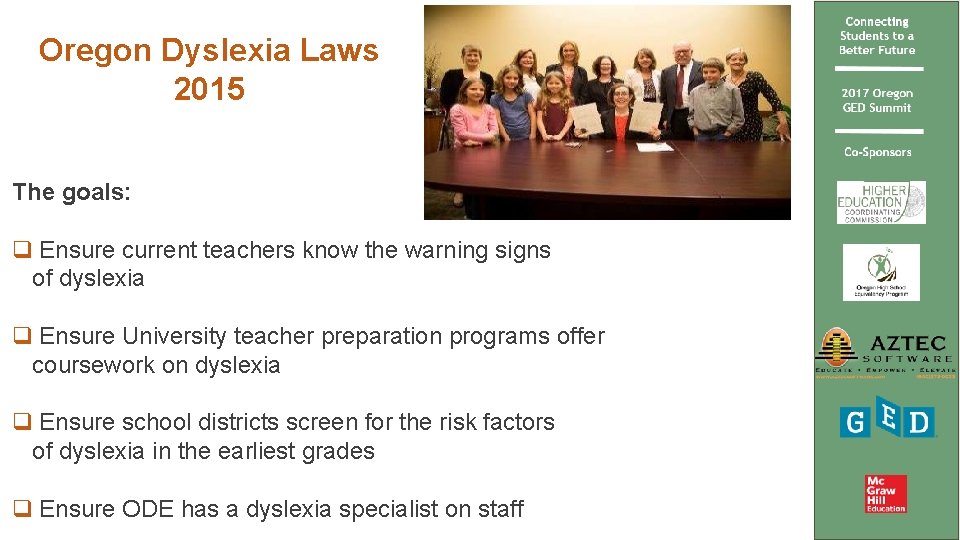
Oregon Dyslexia Laws 2015 The goals: q Ensure current teachers know the warning signs of dyslexia q Ensure University teacher preparation programs offer coursework on dyslexia q Ensure school districts screen for the risk factors of dyslexia in the earliest grades q Ensure ODE has a dyslexia specialist on staff
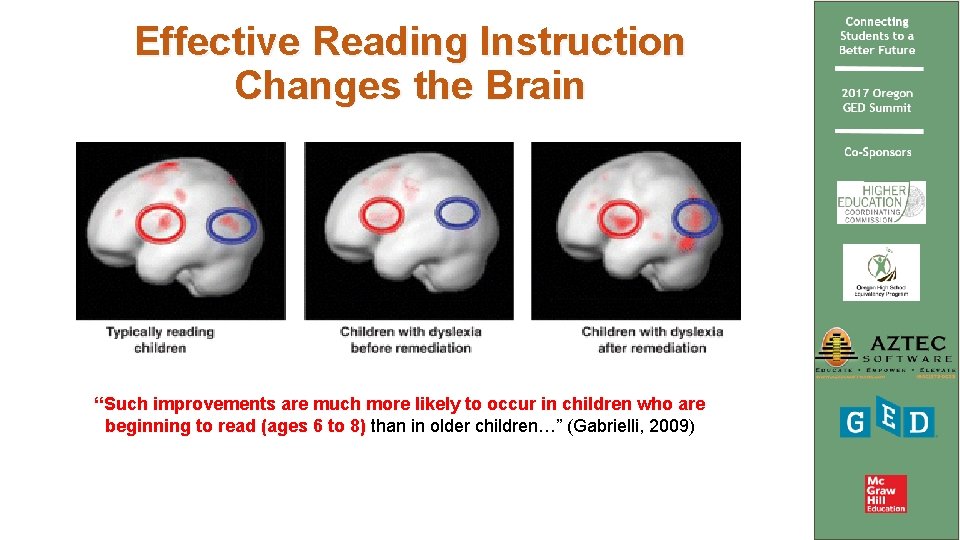
Effective Reading Instruction Changes the Brain “Such improvements are much more likely to occur in children who are beginning to read (ages 6 to 8) than in older children…” (Gabrielli, 2009)
Components of a Comprehensive Evaluation q. History (school, family and developmental) q. Cognitive Assessment (a comprehensive assessment of cognitive abilities, including phonemic awareness, verbal reasoning / vocabulary, short-term / working memory, long-term memory, fluid reasoning, speed of processing and rapid automatic naming) q. Academic Achievement (performance and achievement assessment including methods, integrity, and results)
Overcoming Dyslexia A student with dyslexia needs to be taught by a well prepared teacher with a program that: q Provides systematic, explicit, and intensive instruction in phonemic awareness, phonics, fluency, vocabulary and reading comprehension. q Is simultaneously Multi-Modal (Multisensory)
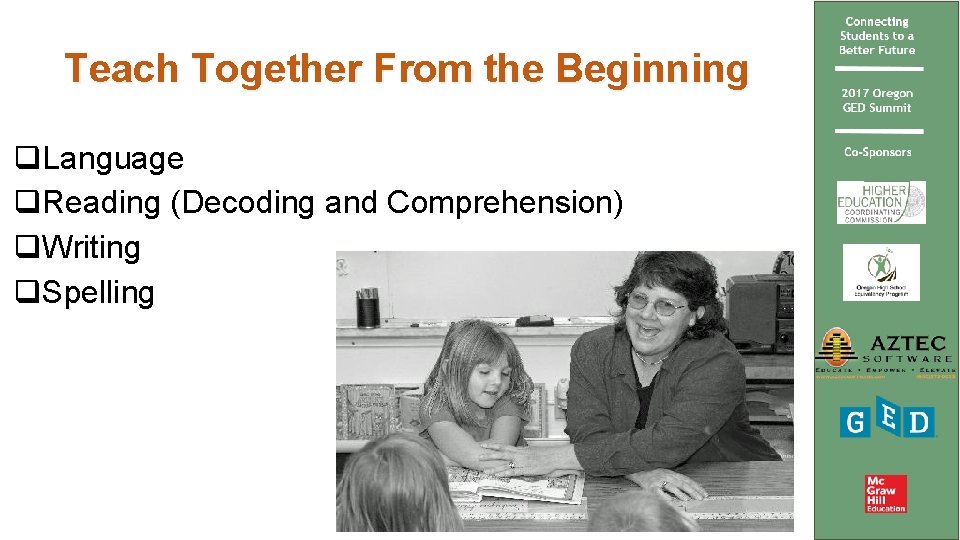
Teach Together From the Beginning q. Language q. Reading (Decoding and Comprehension) q. Writing q. Spelling
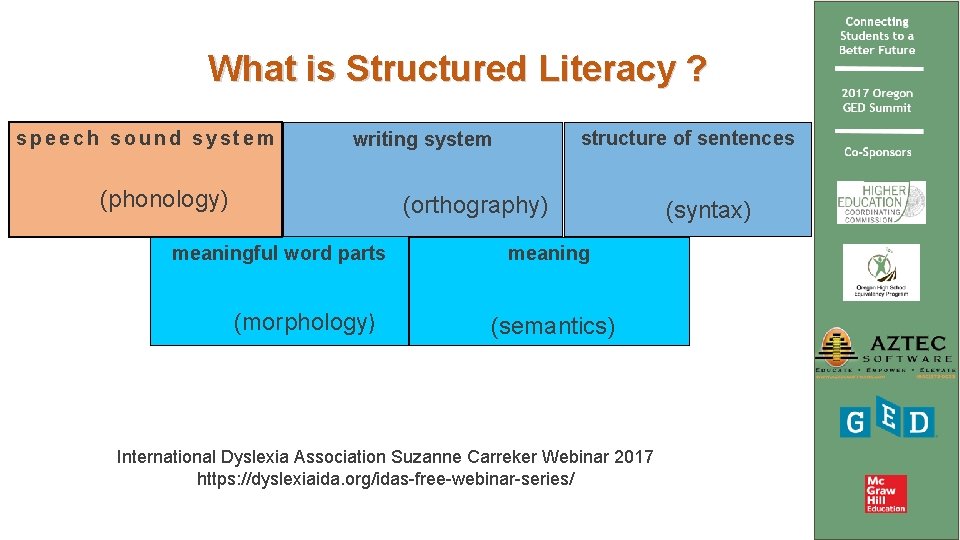
What is Structured Literacy ? speech sound system structure of sentences writing system (phonology) (orthography) meaningful word parts (morphology) meaning (semantics) International Dyslexia Association Suzanne Carreker Webinar 2017 https: //dyslexiaida. org/idas-free-webinar-series/ (syntax)
Effective Intervention Programs Orton Gillingham Lindamood - Bell LIPS Slingerland Alphabetic Phonics Project Read Wilson Language! Barton Reading & Spelling System There are others…. There are others or. dyslexiaida. org
Treatment for Dyslexia treatment has two components: q Educational treatment of core problems with reading and spelling. q Treatment of any concurrent psychological disorders.
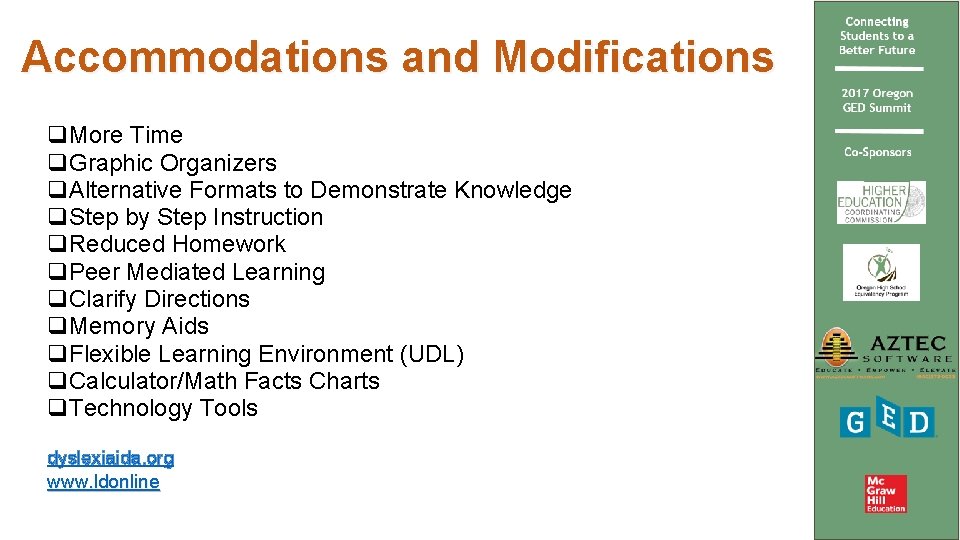
Accommodations and Modifications q. More Time q. Graphic Organizers q. Alternative Formats to Demonstrate Knowledge q. Step by Step Instruction q. Reduced Homework q. Peer Mediated Learning q. Clarify Directions q. Memory Aids q. Flexible Learning Environment (UDL) q. Calculator/Math Facts Charts q. Technology Tools dyslexiaida. org www. ldonline
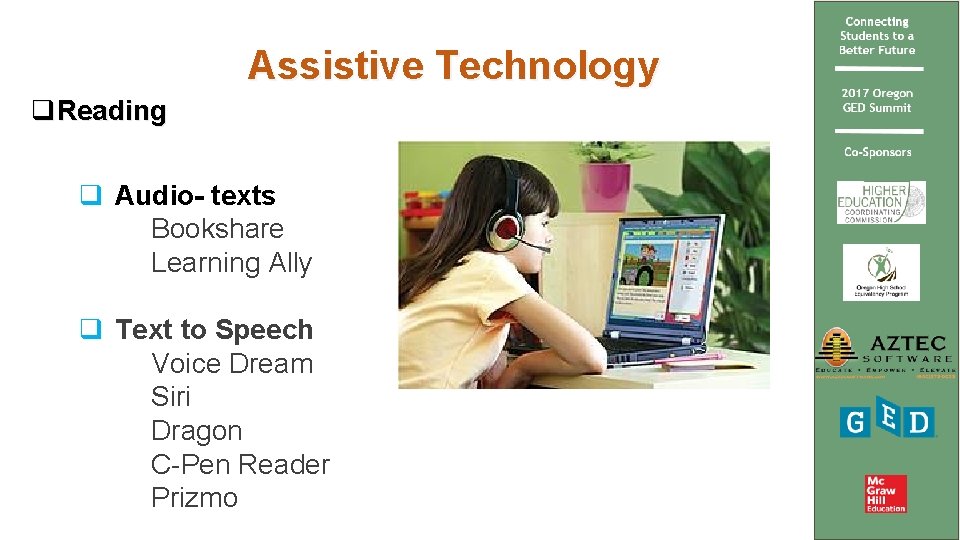
Assistive Technology q. Reading q Audio- texts Bookshare Learning Ally q Text to Speech Voice Dream Siri Dragon C-Pen Reader Prizmo
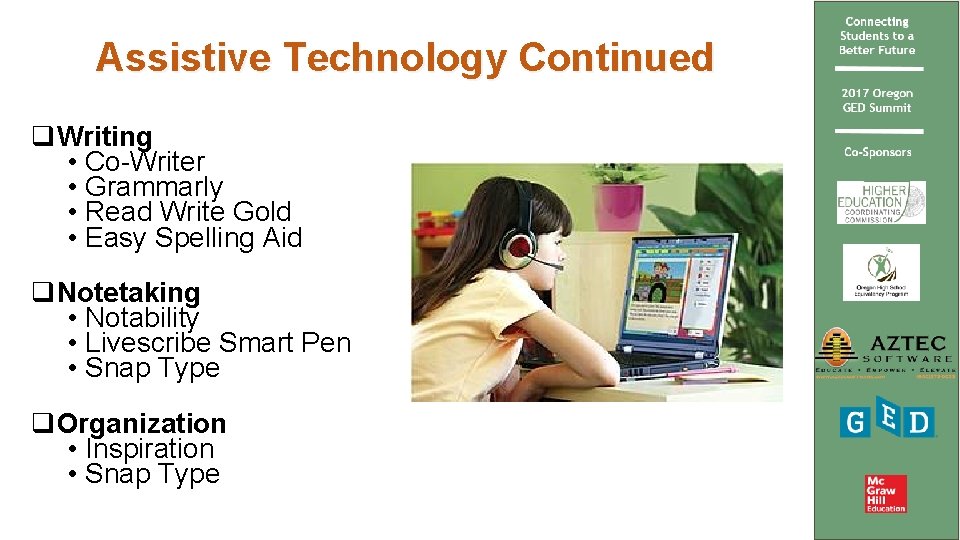
Assistive Technology Continued q. Writing • Co-Writer • Grammarly • Read Write Gold • Easy Spelling Aid q. Notetaking • Notability • Livescribe Smart Pen • Snap Type q. Organization • Inspiration • Snap Type
References q. Birsh, Judith. Multisensory Teaching of Basic Language Skills, 2011. q. Dehaene, Stanislas. Reading in the Brain: The New Science of How We Read 2009. q. Ferrer, Emilio et al. Achievement Gap in Reading Is Present as Early as First Grade and Persists through Adolescence. The Journal of Pediatrics, Volume 167, Issue 5, 1121 -1125 e 2 q Gabrieli, John. Dyslexia: A new synergy between education and cognitive neuroscience. Science, 325, 280 -283, 2009. q. Henry, Marcia K. Unlocking Literacy, Effective Decoding and Spelling Instruction, 2 nd Ed 2010 q. International Dyslexia Association. Dyslexia in the Classroom: What Every Teacher Needs to Know 2013.
References Continued q. Kilpatrick, David. Essentials of Assessing, Preventing, and Overcoming Reading Difficulties. Wiley, 2015. q Mc. Cardle, Peggy, Chhabra, Vininta, Kapinus, Barbara. Reading Research in Action: A Teacher’s Guide to Student Success, 2008 q Moats, Louisa C. Speech to Print, Language Essentials for Teachers, 2 nd Ed 2010 q NCLD, The State of Learning Disabilities; Facts Trends and Emerging Issues Third Edition, 2014. q Seidenberg, Mark. Language at the Speed of Sight, 2017. q Shaywitz, Sally. Overcoming Dyslexia, New York: A. A. Knopf, 2004. q Sherman, Lee and Ramsey, Betsy. The Reading Glitch 2006.
Web Resources q International Dyslexia Association (IDA) dyslexiaida. org q Oregon Branch (IDA Oregon) or. dyslexiaida. org q National Center for Learning Disabilities (NCLD) www. ncld. org q Learning Disabilities Association of America (LDA) www. ldaamerica. org q Learning Ally, www. learningally. org q Florida Center for Reading Research www. fcrr. org q Oregon Dept. of Education www. oregon. gov/ode/students-andfamily/Special. Education/Reg. Programs_Best. Practice/Pages/Dyslexia. aspx q Reading Rockets – Reading 101 http: //www. readingrockets. org/teaching/reading 101 course/welcome-reading-101 q The Center for Effective Reading Instruction (IDA Knowledge and Practice Standards) https: //effectivereading. org
Web Resources Continued Webinars https: //www. youtube. com/user/idachannel q. Louisa Moats, IDA's Knowledge and Practice Standards: How They Can Improve Reading Instruction for All Students q. Patricia Mathes, Overcoming Dyslexia: What Does It Take? Videos q“Journey into Dyslexia. ” HBO. Produced by Alan and Susan Raymond, 2011. q“It’s Never Too Late. ” Leslie, Jeremiah, Mears Pam Ed. D.
Disclaimer The Oregon Branch of the International Dyslexia Association is pleased to present a forum for information to benefit its constituents. It is IDA's policy to not recommend or endorse any specific program, product, institution, company, or instructional material, noting that there a number of such that present the critical components of instruction as defined by: IDA's Knowledge and Practice Standards for Teachers of Reading. Any program, product, institution, company, or instructional material carrying the IDA Accredited seal meets the IDA Standards.