
Understanding and Preventing Cognitive Errors in Healthcare Marjorie
- Slides: 12
Understanding and Preventing Cognitive Errors in Healthcare Marjorie Stiegler, M. D. Department of Anesthesiology University of North Carolina at Chapel Hill
Safety Experts Agree • Most errors are “thinking mistakes” • Decision-making is key in up to 80% of medical errors • Cognitive errors may be the #1 contributor to missed diagnoses and patient injury
“Cognitive Errors” are not: • • Insufficient knowledge Insufficient practice Technical slips Novel diagnoses
Cognitive Errors are: • Making mistakes even though you “know better” • Being influenced, often subconsciously, by non-rational or non-statistical decision factors
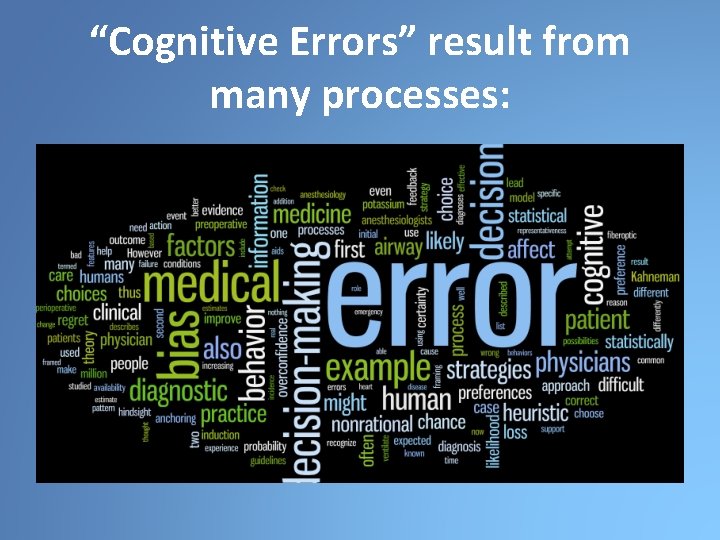
“Cognitive Errors” result from many processes:
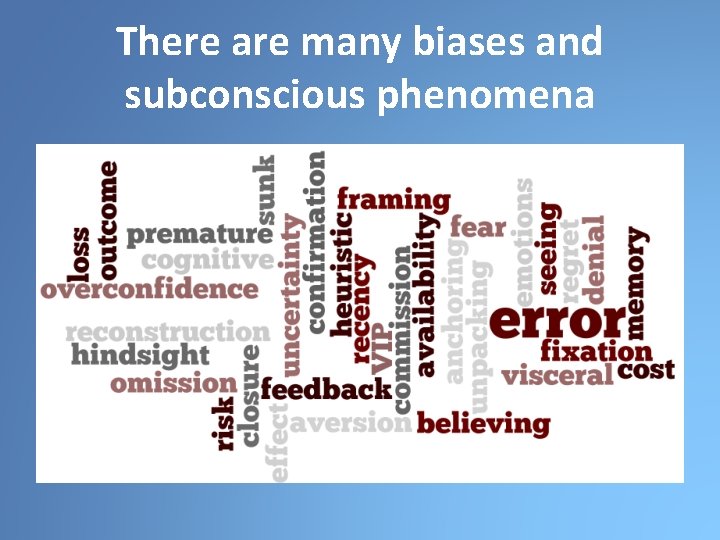
There are many biases and subconscious phenomena
Error Blindness “Whatever falsehoods each of us believes are necessarily invisible to us. We can be wrong, or we can know it, but we can’t do both at the same time. ” - Kathryn Schulz
Counterbalancing Strategy: “Rule of Three” • Diagnostic – For any diagnosis, consider at least three plausible alternatives • Therapeutic – Never repeat a maneuver for a third time without considering alternatives Stiegler MP, Ruskin KJ. Curr Opin Anaesth. 2012
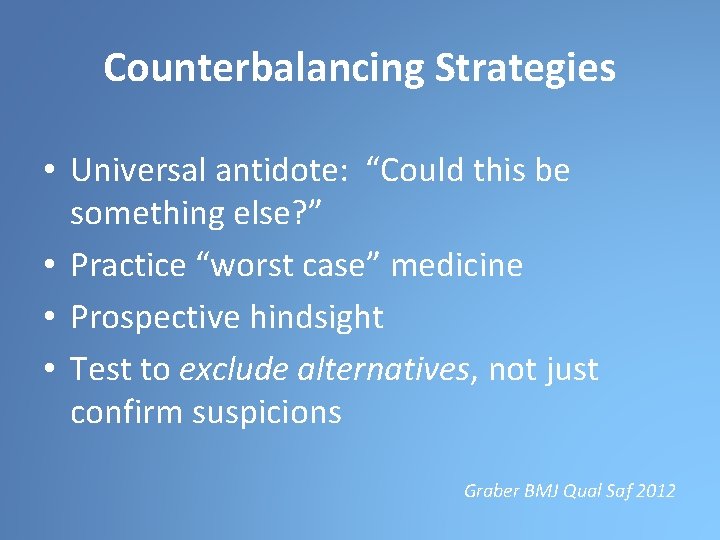
Counterbalancing Strategies • Universal antidote: “Could this be something else? ” • Practice “worst case” medicine • Prospective hindsight • Test to exclude alternatives, not just confirm suspicions Graber BMJ Qual Saf 2012
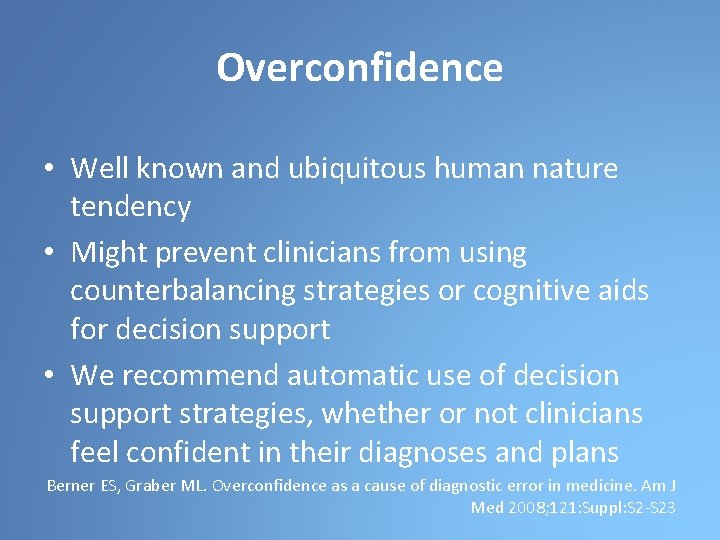
Overconfidence • Well known and ubiquitous human nature tendency • Might prevent clinicians from using counterbalancing strategies or cognitive aids for decision support • We recommend automatic use of decision support strategies, whether or not clinicians feel confident in their diagnoses and plans Berner ES, Graber ML. Overconfidence as a cause of diagnostic error in medicine. Am J Med 2008; 121: Suppl: S 2 -S 23
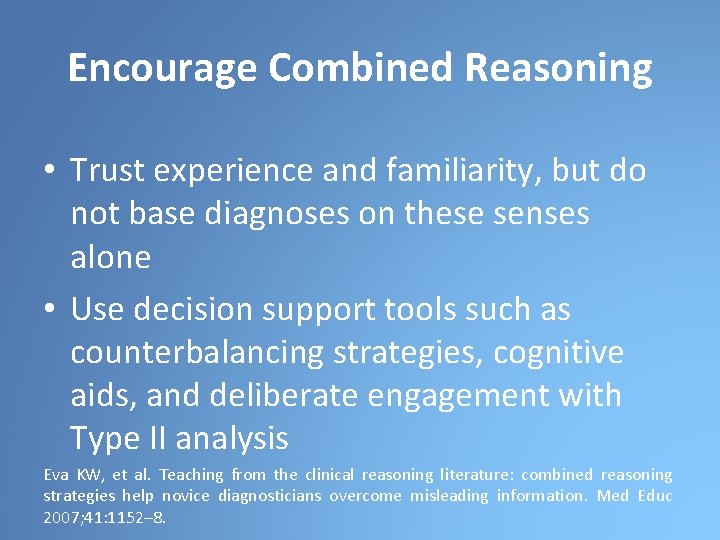
Encourage Combined Reasoning • Trust experience and familiarity, but do not base diagnoses on these senses alone • Use decision support tools such as counterbalancing strategies, cognitive aids, and deliberate engagement with Type II analysis Eva KW, et al. Teaching from the clinical reasoning literature: combined reasoning strategies help novice diagnosticians overcome misleading information. Med Educ 2007; 41: 1152– 8.
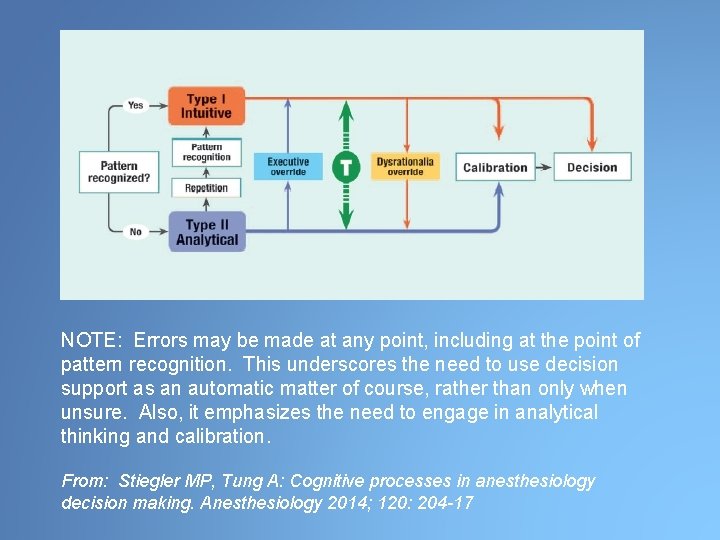
NOTE: Errors may be made at any point, including at the point of pattern recognition. This underscores the need to use decision support as an automatic matter of course, rather than only when unsure. Also, it emphasizes the need to engage in analytical thinking and calibration. From: Stiegler MP, Tung A: Cognitive processes in anesthesiology decision making. Anesthesiology 2014; 120: 204 -17