
Understanding and Modeling OnDie Error Correction in Modern

- Slides: 59
Understanding and Modeling On-Die Error Correction in Modern DRAM: An Experimental Study Using Real Devices Minesh Patel Hasan Hassan Jeremie S. Kim Onur Mutlu
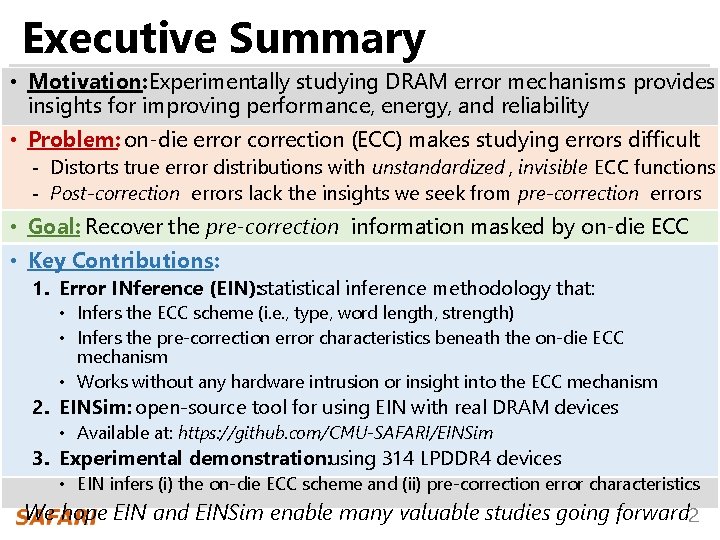
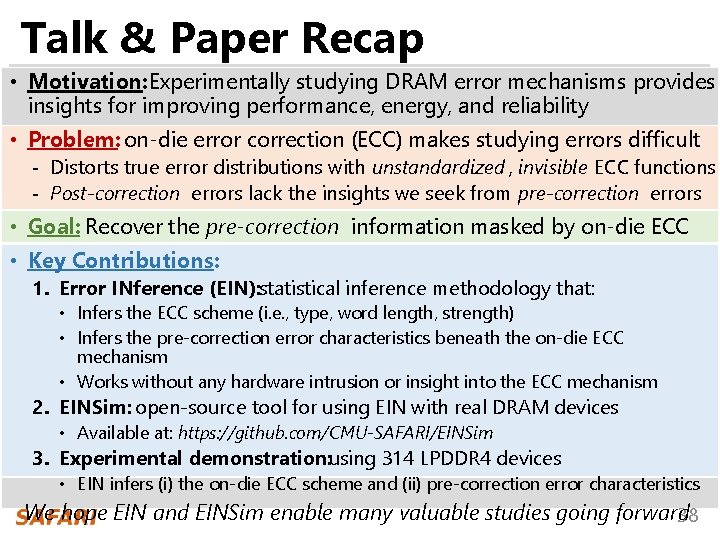
Executive Summary • Motivation: Experimentally studying DRAM error mechanisms provides insights for improving performance, energy, and reliability • Problem: on-die error correction (ECC) makes studying errors difficult - Distorts true error distributions with unstandardized , invisible ECC functions - Post-correction errors lack the insights we seek from pre-correction errors • Goal: Recover the pre-correction information masked by on-die ECC • Key Contributions: 1. Error INference (EIN): statistical inference methodology that: • Infers the ECC scheme (i. e. , type, word length, strength) • Infers the pre-correction error characteristics beneath the on-die ECC mechanism • Works without any hardware intrusion or insight into the ECC mechanism 2. EINSim: open-source tool for using EIN with real DRAM devices • Available at: https: //github. com/CMU-SAFARI/EINSim 3. Experimental demonstration: using 314 LPDDR 4 devices • EIN infers (i) the on-die ECC scheme and (ii) pre-correction error characteristics We hope EIN and EINSim enable many valuable studies going forward 2
Presentation Outline 1. Error Characterization and On-Die ECC 2. EIN: Error INference I. The Inference Problem II. Formalization III. EIN in Practice: EINSim 3. Demonstration Using LPDDR 4 Devices 3
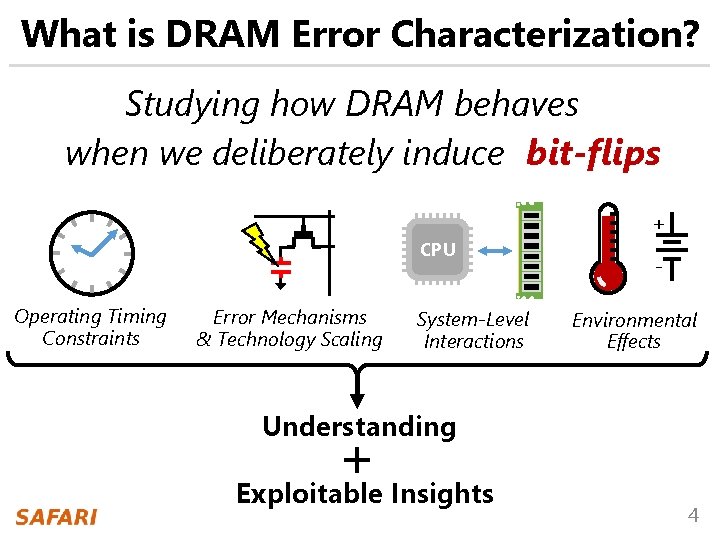
What is DRAM Error Characterization? Studying how DRAM behaves when we deliberately induce bit-flips + CPU Operating Timing Constraints Error Mechanisms & Technology Scaling System-Level Interactions Environmental Effects Understanding + Exploitable Insights 4
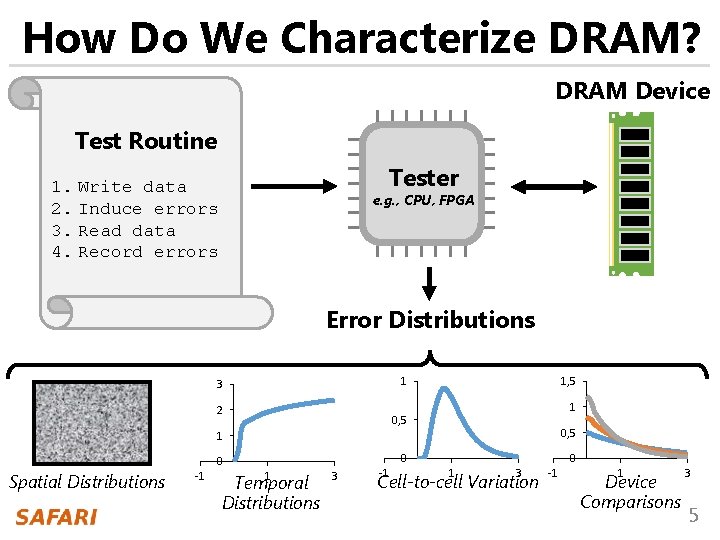
How Do We Characterize DRAM? DRAM Device Test Routine Tester 1. Write data 2. Induce errors 3. Read data 4. Record errors e. g. , CPU, FPGA Error Distributions 1 3 2 1, 5 1 0, 5 1 0 0 Spatial Distributions -1 1 Temporal Distributions 3 -1 0 1 3 Cell-to-cell Variation -1 1 Device Comparisons 3 5
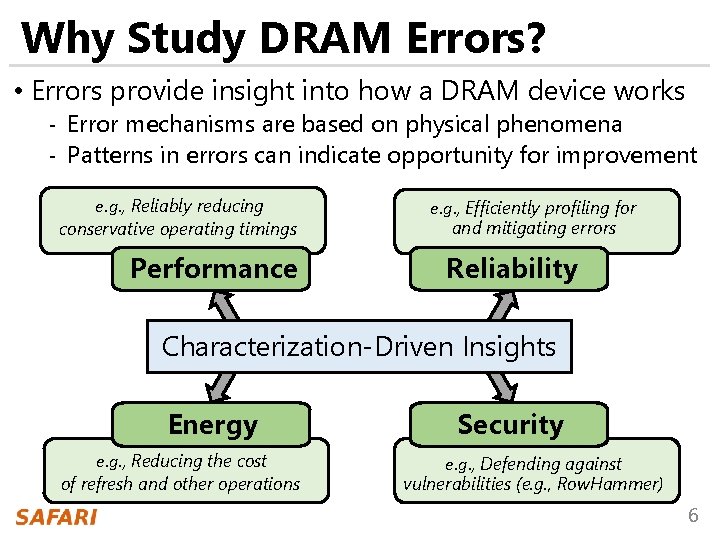
Why Study DRAM Errors? • Errors provide insight into how a DRAM device works - Error mechanisms are based on physical phenomena - Patterns in errors can indicate opportunity for improvement e. g. , Reliably reducing conservative operating timings Performance e. g. , Efficiently profiling for and mitigating errors Reliability Characterization-Driven Insights Energy e. g. , Reducing the cost of refresh and other operations Security e. g. , Defending against vulnerabilities (e. g. , Row. Hammer) 6
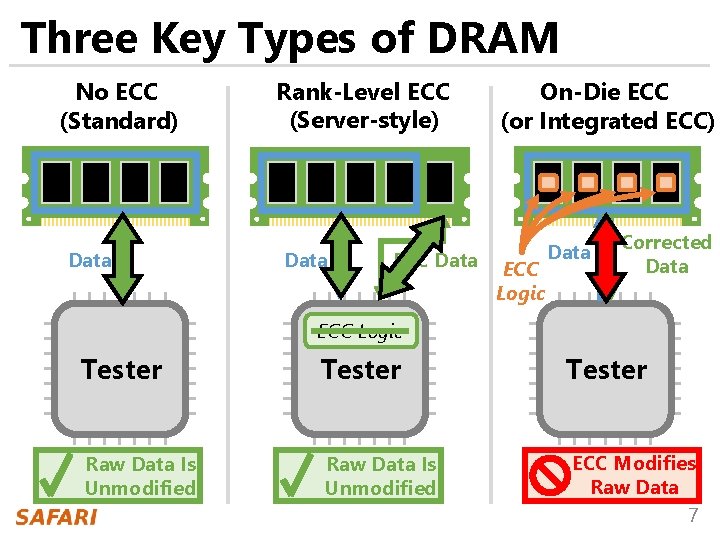
Three Key Types of DRAM No ECC (Standard) Data Rank-Level ECC (Server-style) Data ECC Data On-Die ECC (or Integrated ECC) ECC Logic Data Corrected Data ECC Logic Tester Raw Data Is Unmodified Tester ECC Modifies Raw Data 7
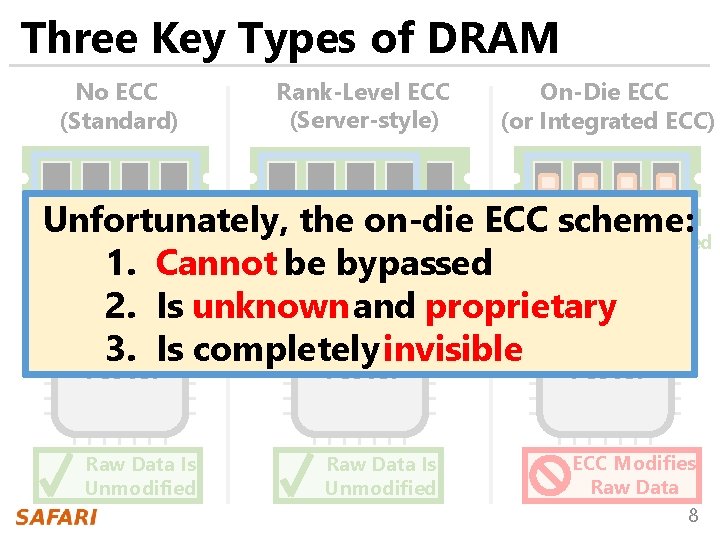
Three Key Types of DRAM No ECC (Standard) Rank-Level ECC (Server-style) On-Die ECC (or Integrated ECC) Unfortunately, the on-die ECC scheme: Corrected Data 1. Cannot Data ECC Data be bypassed Logic 2. Is unknown and proprietary ECC Logic 3. Is completely invisible Tester Raw Data Is Unmodified ECC Modifies Raw Data 8
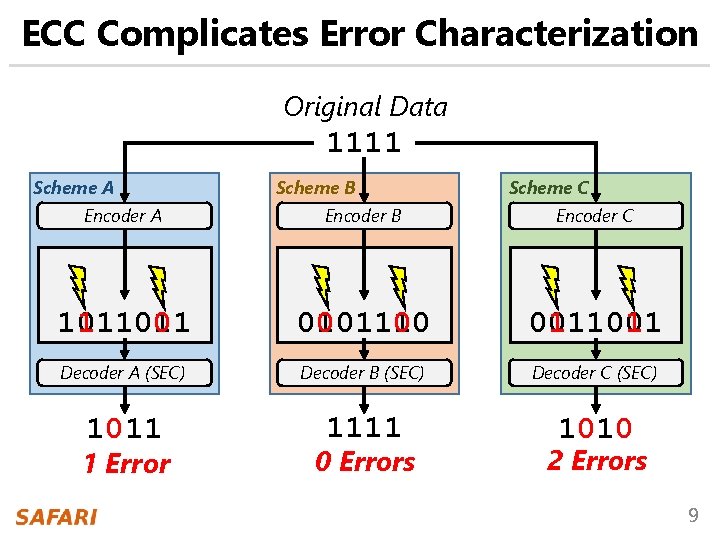
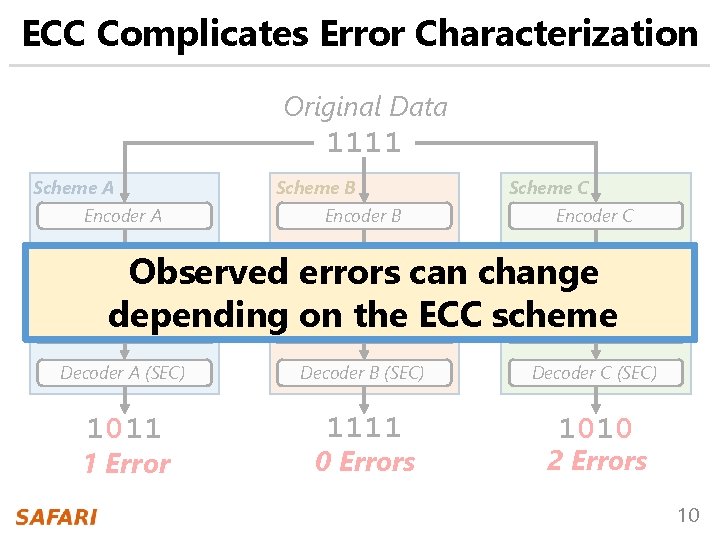
ECC Complicates Error Characterization Original Data 1111 Scheme A Scheme B Scheme C Encoder A Encoder B Encoder C 1111001 1011011 0001100 010111011 0011001 Decoder A (SEC) Decoder B (SEC) Decoder C (SEC) 1011 1111 1010 1 Error 0 Errors 2 Errors 9
ECC Complicates Error Characterization Original Data 1111 Scheme A Encoder A Scheme B Encoder B Scheme C Encoder C Observed errors can change depending 0001100 on the ECC scheme 1111001 0111011011 0101110 0011001 Decoder A (SEC) Decoder B (SEC) Decoder C (SEC) 1011 1111 1010 1 Error 0 Errors 2 Errors 10
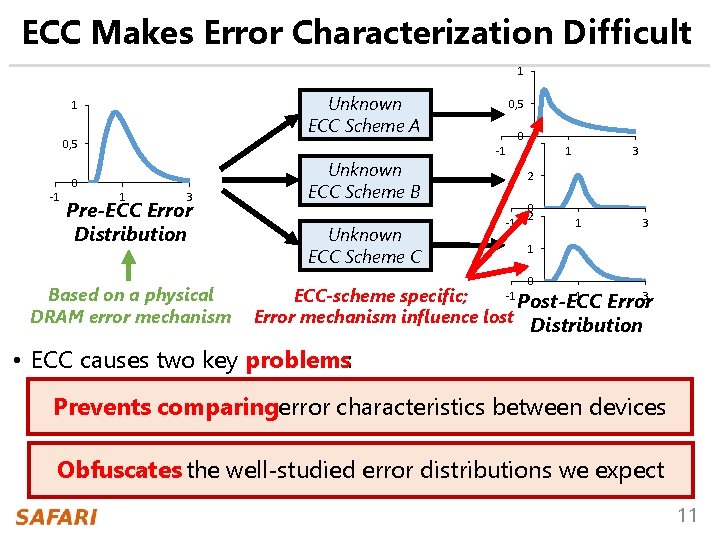
ECC Makes Error Characterization Difficult 1 Unknown ECC Scheme A 1 0, 5 0 -1 1 3 Pre-ECC Error Distribution Based on a physical DRAM error mechanism Unknown ECC Scheme B Unknown ECC Scheme C 0, 5 0 -1 4 1 3 2 -1 0 2 1 3 1 0 1 3 ECC-scheme specific; Post-ECC Error mechanism influence lost -1 Distribution • ECC causes two key problems: Prevents comparingerror characteristics between devices Obfuscates the well-studied error distributions we expect 11
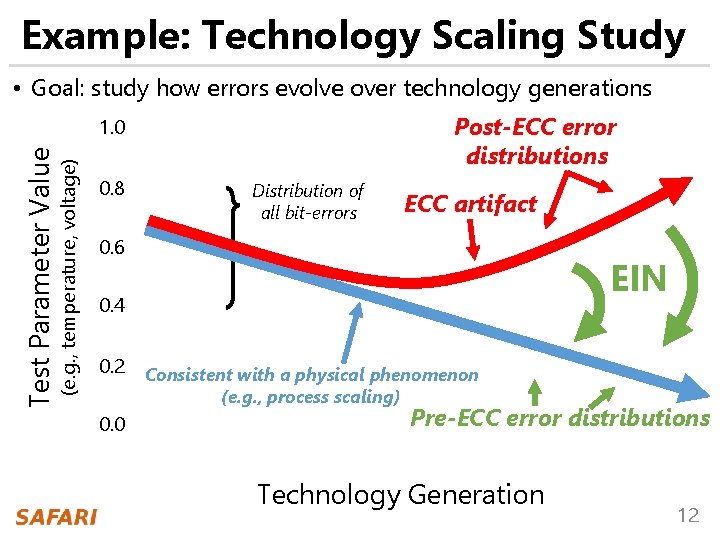
Example: Technology Scaling Study • Goal: study how errors evolve over technology generations Post-ECC error distributions (e. g. , temperature, voltage) Test Parameter Value 1. 0 0. 8 Distribution of all bit-errors ECC artifact 0. 6 EIN 0. 4 0. 2 0. 0 Consistent with a physical phenomenon (e. g. , process scaling) Pre-ECC error distributions Technology Generation 12
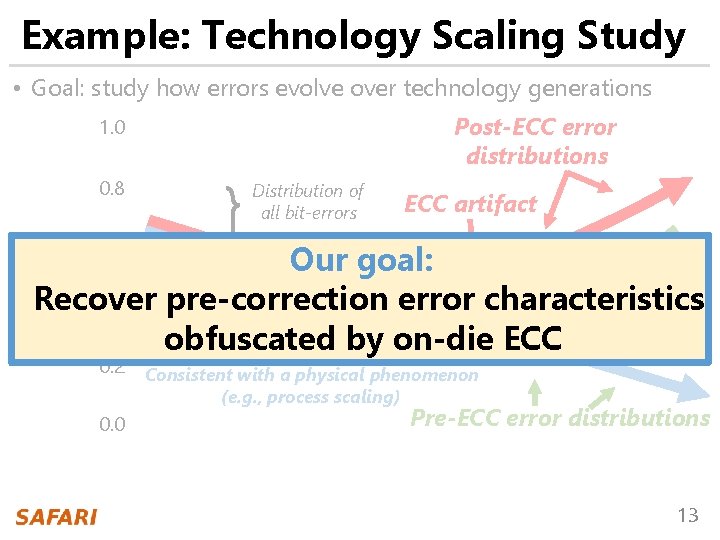
Example: Technology Scaling Study • Goal: study how errors evolve over technology generations Post-ECC error distributions 1. 0 0. 8 Distribution of all bit-errors ECC artifact 0. 6 Our goal: EIN Recover pre-correction error characteristics 0. 4 obfuscated by on-die ECC 0. 2 0. 0 Consistent with a physical phenomenon (e. g. , process scaling) Pre-ECC error distributions 13
Presentation Outline 1. Error Characterization and On-Die ECC 2. EIN: Error INference I. The Inference Problem II. Formalization III. EIN in Practice: EINSim 3. Demonstration Using LPDDR 4 Devices 14
Key Observation DRAM error mechanisms have predictable characteristics that are intrinsic to DRAM technology 15
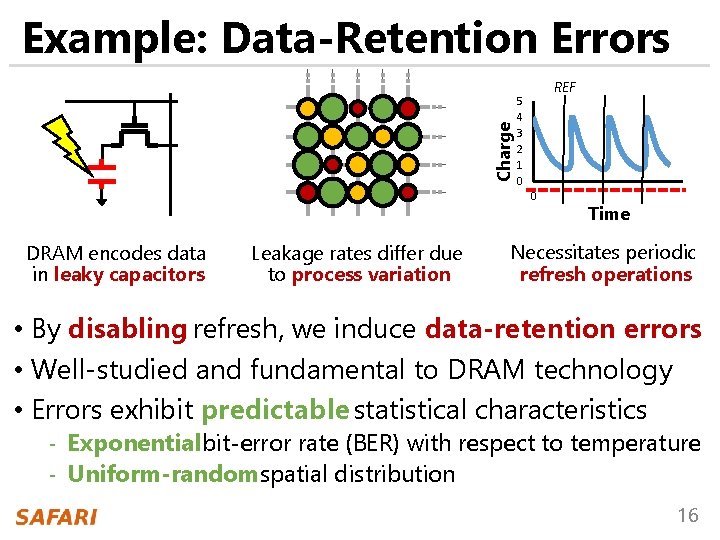
Charge Example: Data-Retention Errors REF 5 4 3 2 1 0 0 DRAM encodes data in leaky capacitors Leakage rates differ due to process variation Time Necessitates periodic refresh operations • By disabling refresh, we induce data-retention errors • Well-studied and fundamental to DRAM technology • Errors exhibit predictable statistical characteristics - Exponential bit-error rate (BER) with respect to temperature - Uniform-randomspatial distribution 16
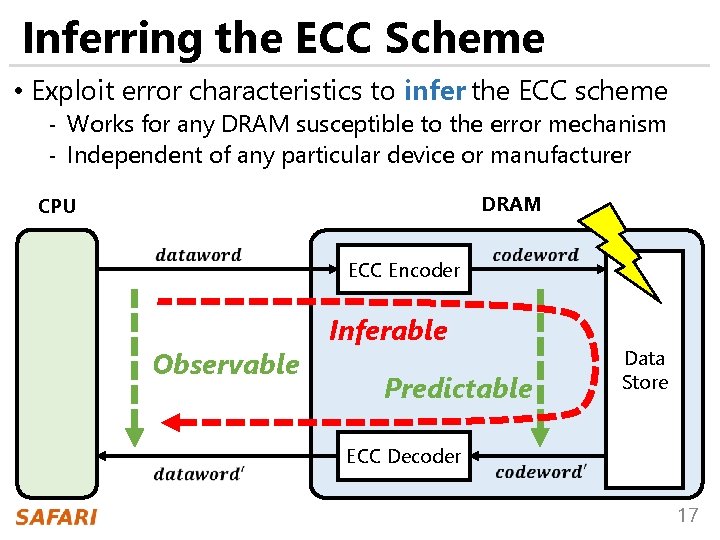
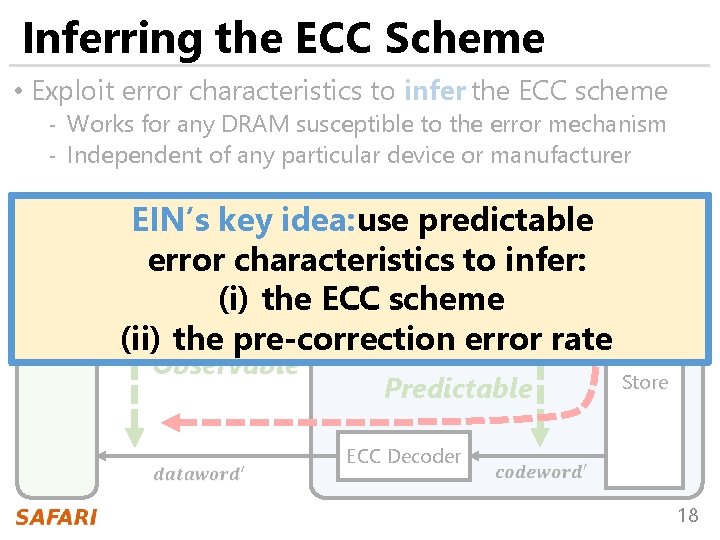
Inferring the ECC Scheme • Exploit error characteristics to infer the ECC scheme - Works for any DRAM susceptible to the error mechanism - Independent of any particular device or manufacturer DRAM CPU ECC Encoder Observable Inferable Predictable Data Store ECC Decoder 17
Inferring the ECC Scheme • Exploit error characteristics to infer the ECC scheme - Works for any DRAM susceptible to the error mechanism - Independent of any particular device or manufacturer CPU DRAM EIN’s key idea: use predictable error characteristics ECC Encoder to infer: (i) the ECC scheme Inferable error rate (ii) the pre-correction Observable Predictable Data Store ECC Decoder 18
Presentation Outline 1. Error Characterization and On-Die ECC 2. EIN: Error INference I. The Inference Problem II. Formalization III. EIN in Practice: EINSim 3. Demonstration Using LPDDR 4 Devices 19
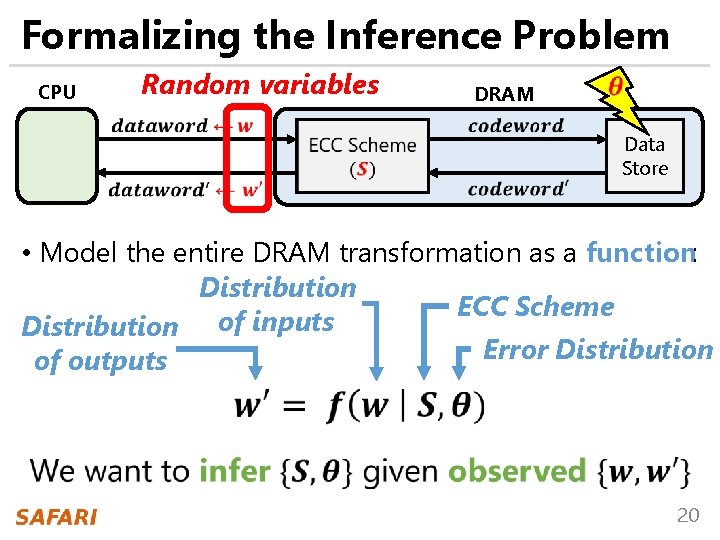
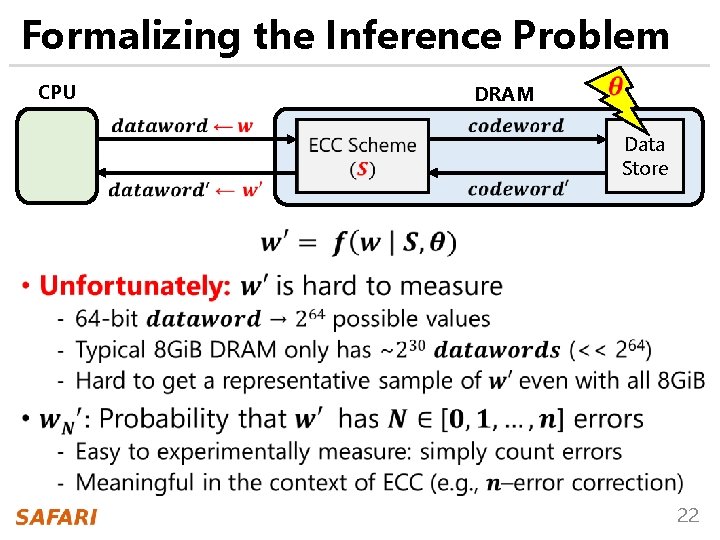
Formalizing the Inference Problem CPU Random variables DRAM Data Store • Model the entire DRAM transformation as a function: Distribution ECC Scheme of inputs Distribution Error Distribution of outputs 20
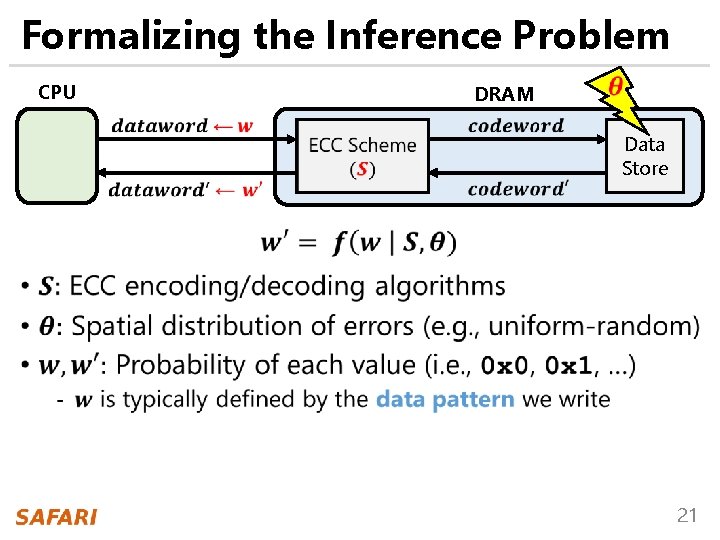
Formalizing the Inference Problem CPU DRAM Data Store • 21
Formalizing the Inference Problem CPU DRAM Data Store • 22
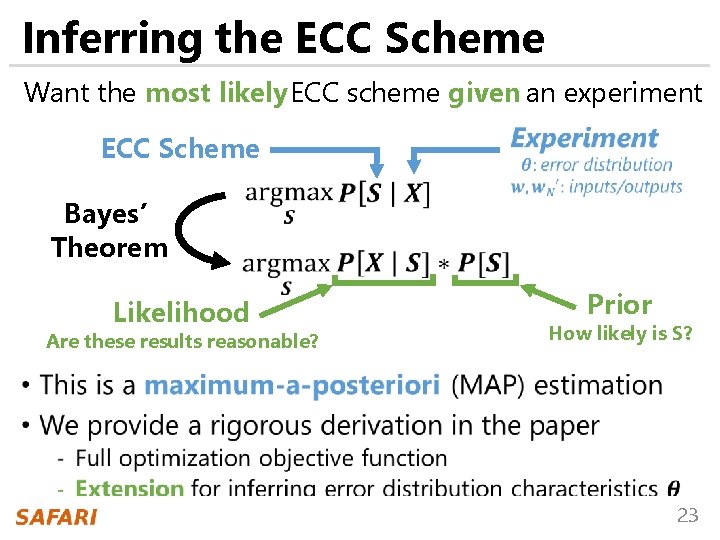
Inferring the ECC Scheme Want the most likely ECC scheme given an experiment ECC Scheme Bayes’ Theorem Likelihood Are these results reasonable? Prior How likely is S? 23
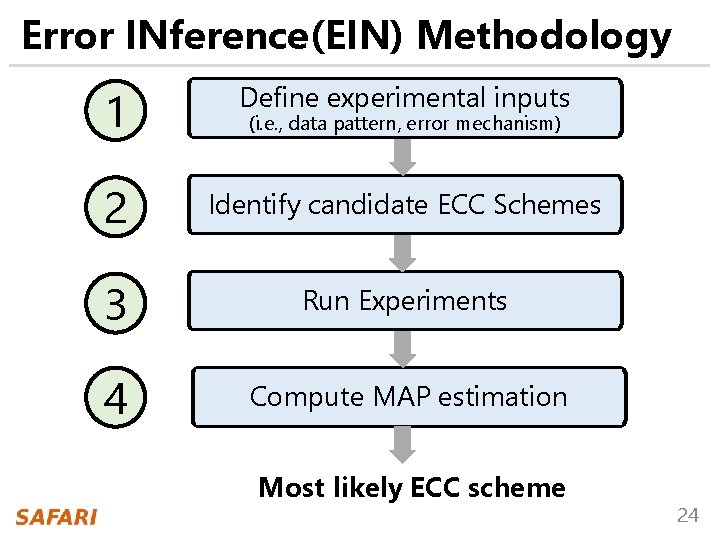
Error INference (EIN) Methodology 1 Define experimental inputs 2 Identify candidate ECC Schemes 3 Run Experiments 4 Compute MAP estimation (i. e. , data pattern, error mechanism) Most likely ECC scheme 24
Presentation Outline 1. Error Characterization and On-Die ECC 2. EIN: Error INference I. The Inference Problem II. Formalization III. EIN in Practice: EINSim 3. Demonstration Using LPDDR 4 Devices 25
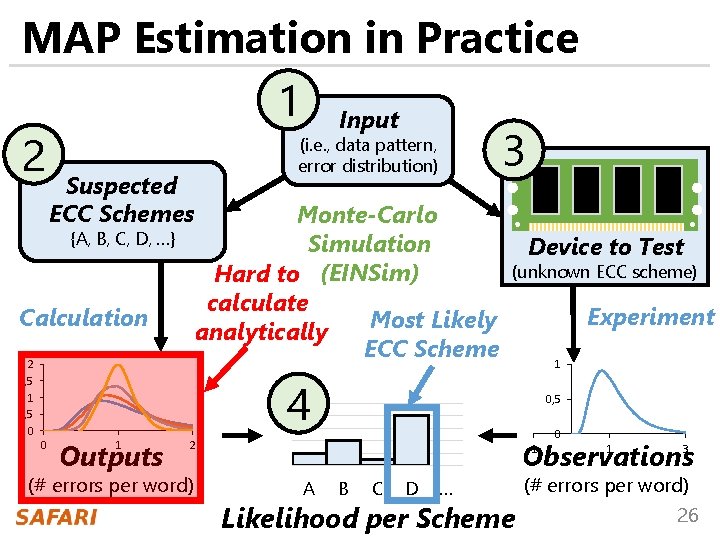
MAP Estimation in Practice 1 Input (i. e. , data pattern, 3 2 error distribution) Suspected ECC Schemes Monte-Carlo Simulation Hard to (EINSim) calculate Most Likely analytically ECC Scheme {A, B, C, D, …} Calculation 2 1, 5 1 0, 5 0 (unknown ECC scheme) 4 0 Outputs 1 Experiment 1 0, 5 0 -1 1 3 Observations 2 (# errors per word) Device to Test A B C D … Likelihood per Scheme (# errors per word) 26
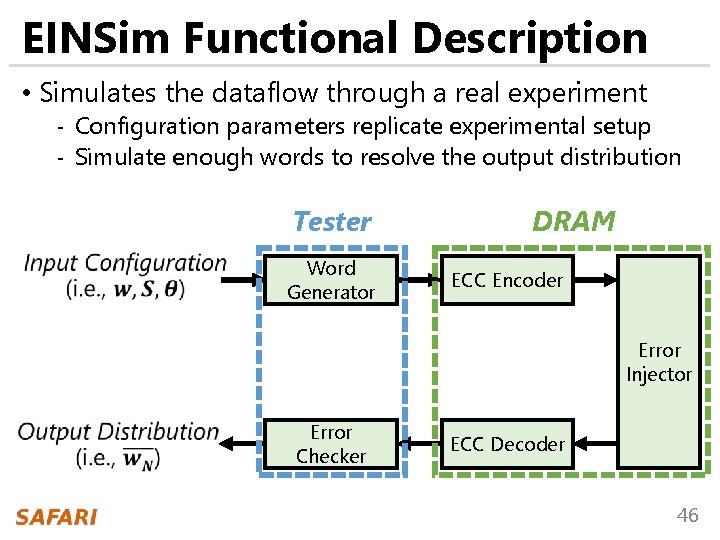
EINSim: A Tool for Using EIN • Evaluates MAP estimation via Monte-Carlo simulation - Simulates the life of a dataword through a real experiment - Configuration knobs to replicate the experimental setup • Flexible and extensible to apply to a wide variety of: - DRAM devices - Error mechanisms - ECC schemes Open-source C++/Python project https: //github. com/CMU-SAFARI/EINSim • Example datasets provided (same as used in paper) 27
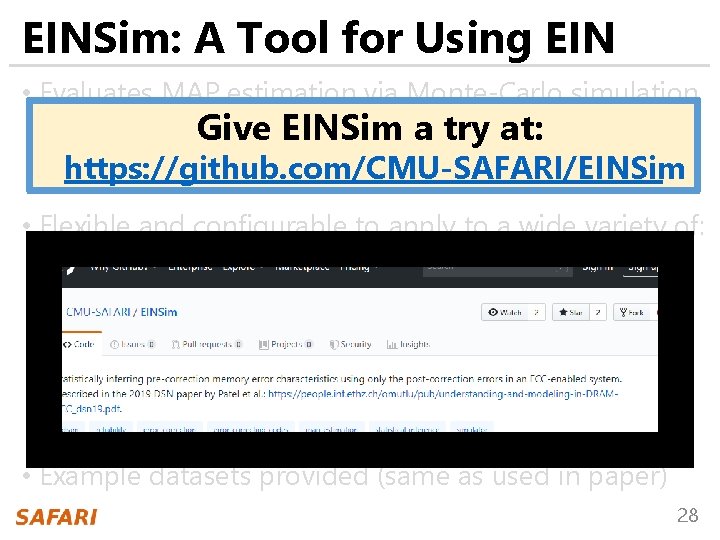
EINSim: A Tool for Using EIN • Evaluates MAP estimation via Monte-Carlo simulation - Simulates the life of. EINSim a dataword a through a real experiment Give try at: - Configuration knobs to replicate the experimental setup https: //github. com/CMU-SAFARI/EINSim • Flexible and configurable to apply to a wide variety of: - DRAM devices - Error mechanisms - ECC schemes Open-source C++/Python project https: //github. com/CMU-SAFARI/EINSim • Example datasets provided (same as used in paper) 28
Presentation Outline 1. Error Characterization and On-Die ECC 2. EIN: Error INference I. The Inference Problem II. Formalization III. EIN in Practice: EINSim 3. Demonstration Using LPDDR 4 Devices 29
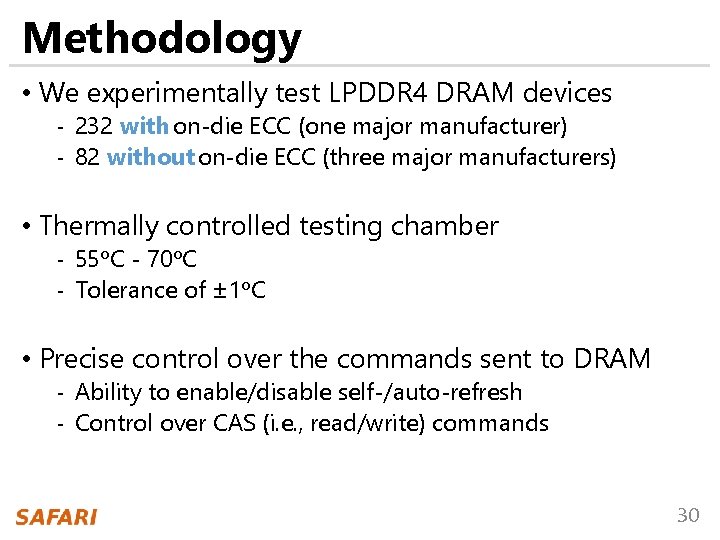
Methodology • We experimentally test LPDDR 4 DRAM devices - 232 with on-die ECC (one major manufacturer) - 82 without on-die ECC (three major manufacturers) • Thermally controlled testing chamber - 55 o. C - 70 o. C - Tolerance of ± 1 o. C • Precise control over the commands sent to DRAM - Ability to enable/disable self-/auto-refresh - Control over CAS (i. e. , read/write) commands 30
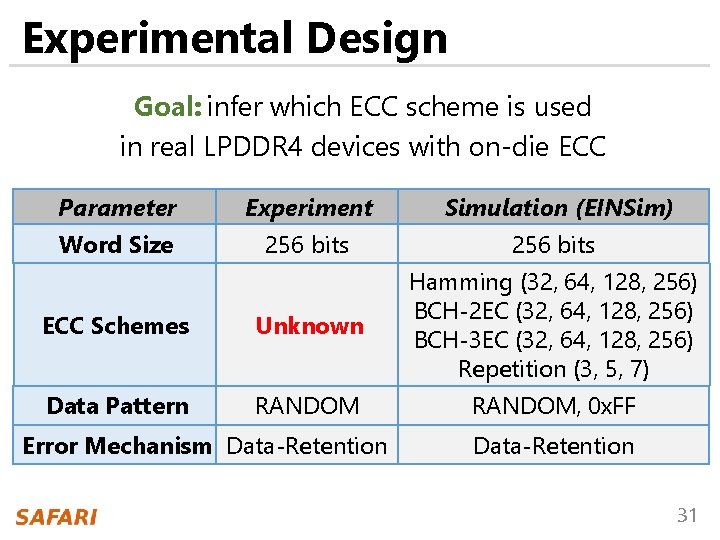
Experimental Design Goal: infer which ECC scheme is used in real LPDDR 4 devices with on-die ECC Parameter Experiment Simulation (EINSim) Word Size 256 bits ECC Schemes Unknown Hamming (32, 64, 128, 256) BCH-2 EC (32, 64, 128, 256) BCH-3 EC (32, 64, 128, 256) Repetition (3, 5, 7) Data Pattern RANDOM, 0 x. FF Error Mechanism Data-Retention 31
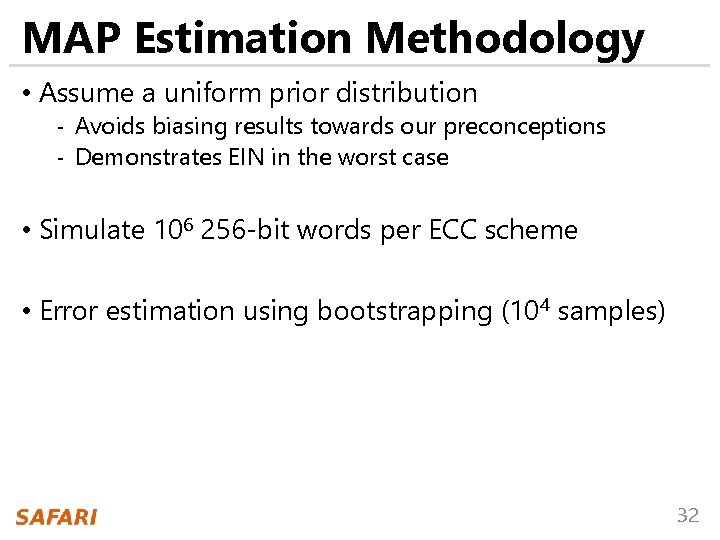
MAP Estimation Methodology • Assume a uniform prior distribution - Avoids biasing results towards our preconceptions - Demonstrates EIN in the worst case • Simulate 106 256 -bit words per ECC scheme • Error estimation using bootstrapping (104 samples) 32
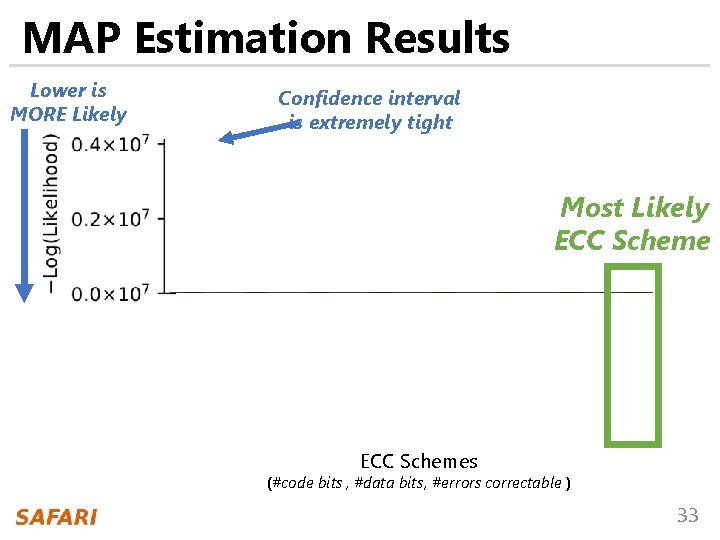
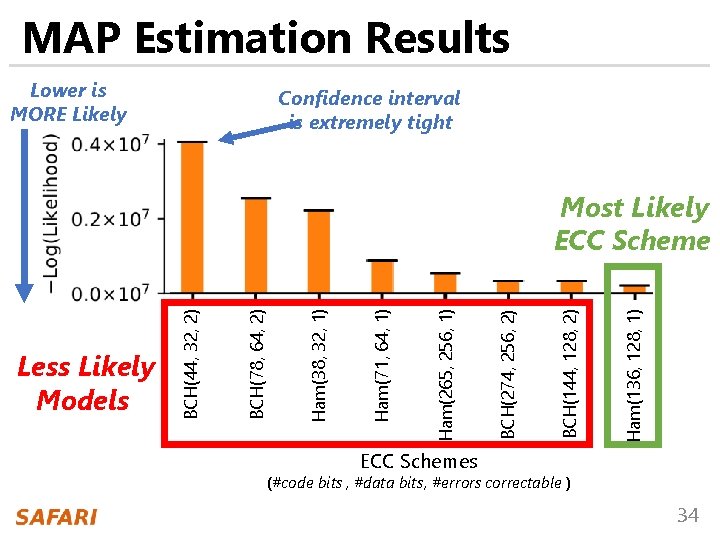
MAP Estimation Results Lower is MORE Likely Confidence interval is extremely tight Ham(136, 128, 1) BCH(144, 128, 2) BCH(274, 256, 2) Ham(265, 256, 1) Ham(71, 64, 1) Ham(38, 32, 1) BCH(78, 64, 2) BCH(44, 32, 2) Most Likely ECC Schemes (#code bits , #data bits, #errors correctable ) 33
MAP Estimation Results Lower is MORE Likely Confidence interval is extremely tight Ham(136, 128, 1) BCH(144, 128, 2) BCH(274, 256, 2) Ham(265, 256, 1) Ham(71, 64, 1) Ham(38, 32, 1) BCH(78, 64, 2) Less Likely Models BCH(44, 32, 2) Most Likely ECC Schemes (#code bits , #data bits, #errors correctable ) 34
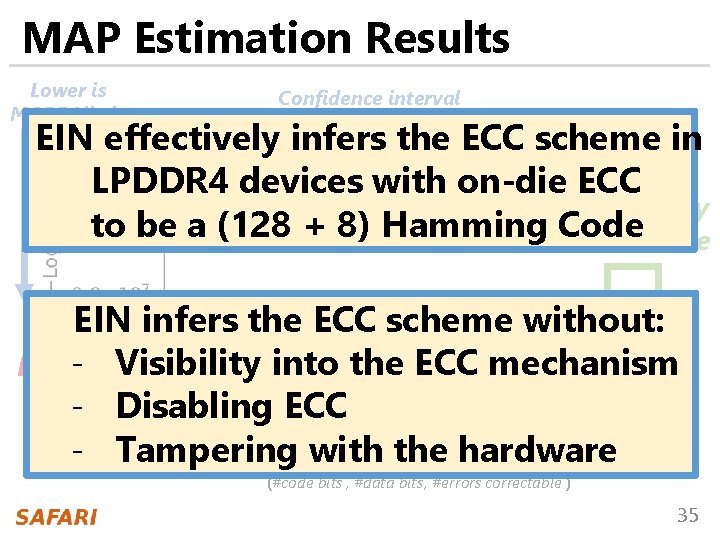
MAP Estimation Results Lower is MORE Likely Confidence interval is extremely tight EIN effectively infers the ECC scheme in LPDDR 4 devices with on-die ECC Most Likely to be a (128 + 8) Hamming ECC Code Scheme Ham(136, 128, 1) BCH(144, 128, 2) BCH(274, 256, 2) Ham(265, 256, 1) Ham(71, 64, 1) Ham(38, 32, 1) BCH(78, 64, 2) BCH(44, 32, 2) EIN infers the ECC scheme without: Visibility into the ECC mechanism Less-Likely Models - Disabling ECC - Tampering with hardware ECCthe Schemes (#code bits , #data bits, #errors correctable ) 35
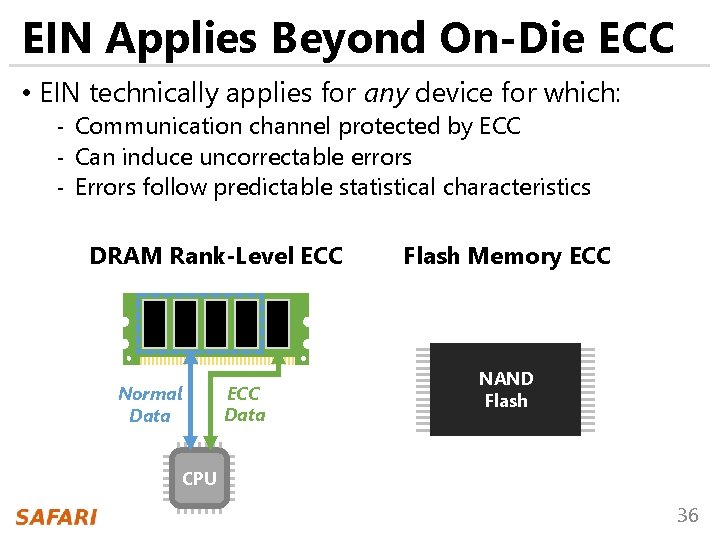
EIN Applies Beyond On-Die ECC • EIN technically applies for any device for which: - Communication channel protected by ECC - Can induce uncorrectable errors - Errors follow predictable statistical characteristics DRAM Rank-Level ECC Normal Data ECC Data Flash Memory ECC NAND Flash CPU 36
Other Contributions in our Paper • Two error-characterization studies showing EIN’s value 1. EIN enables comparing BERs of the DRAM technology itself 2. EIN recovers expected distributions that ECC obfuscates • Using EIN to infer additional information: - The data pattern written to DRAM - The pre-correction error characteristics (e. g. , pre-ECC BER) • Formal derivation of EIN + discussion of its limitations • Verify uniform-randomly spaced data-retention errors - Reverse-engineering DRAM design characteristics that affect uniformness (e. g. , true-/anti-cell layout) 37
Talk & Paper Recap • Motivation: Experimentally studying DRAM error mechanisms provides insights for improving performance, energy, and reliability • Problem: on-die error correction (ECC) makes studying errors difficult - Distorts true error distributions with unstandardized , invisible ECC functions - Post-correction errors lack the insights we seek from pre-correction errors • Goal: Recover the pre-correction information masked by on-die ECC • Key Contributions: 1. Error INference (EIN): statistical inference methodology that: • Infers the ECC scheme (i. e. , type, word length, strength) • Infers the pre-correction error characteristics beneath the on-die ECC mechanism • Works without any hardware intrusion or insight into the ECC mechanism 2. EINSim: open-source tool for using EIN with real DRAM devices • Available at: https: //github. com/CMU-SAFARI/EINSim 3. Experimental demonstration: using 314 LPDDR 4 devices • EIN infers (i) the on-die ECC scheme and (ii) pre-correction error characteristics We hope EIN and EINSim enable many valuable studies going forward 38
Understanding and Modeling On-Die Error Correction in Modern DRAM: An Experimental Study Using Real Devices Minesh Patel Jeremie S. Kim Hasan Hassan Onur Mutlu
Backup Slides
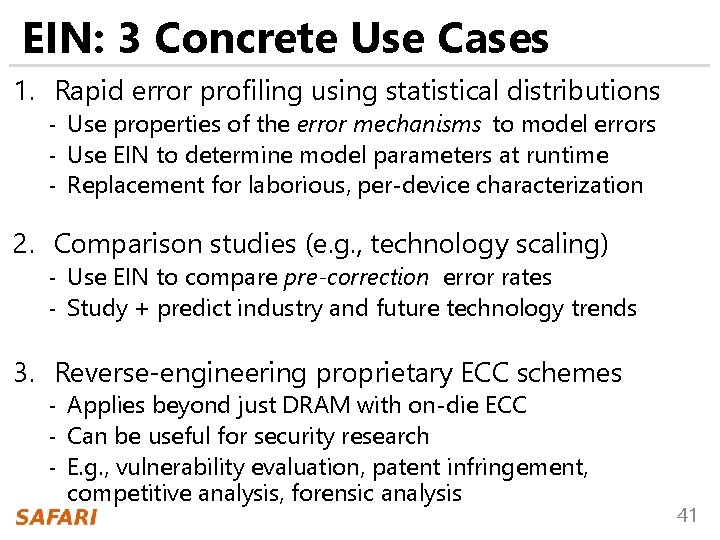
EIN: 3 Concrete Use Cases 1. Rapid error profiling using statistical distributions - Use properties of the error mechanisms to model errors - Use EIN to determine model parameters at runtime - Replacement for laborious, per-device characterization 2. Comparison studies (e. g. , technology scaling) - Use EIN to compare pre-correction error rates - Study + predict industry and future technology trends 3. Reverse-engineering proprietary ECC schemes - Applies beyond just DRAM with on-die ECC - Can be useful for security research - E. g. , vulnerability evaluation, patent infringement, competitive analysis, forensic analysis 41
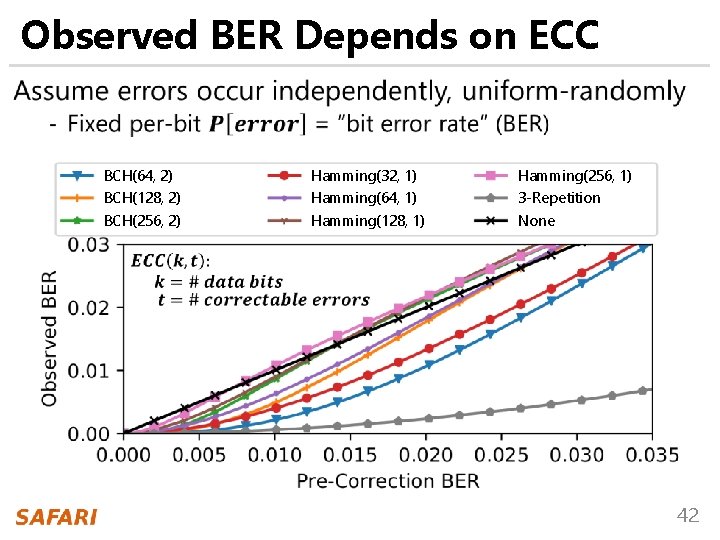
Observed BER Depends on ECC • BCH(64, 2) Hamming(32, 1) Hamming(256, 1) BCH(128, 2) Hamming(64, 1) 3 -Repetition BCH(256, 2) Hamming(128, 1) None 42
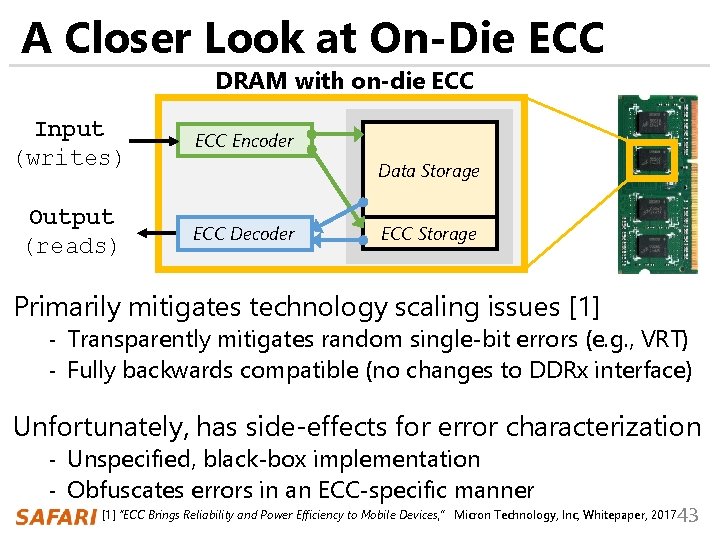
A Closer Look at On-Die ECC DRAM with on-die ECC Input (writes) ECC Encoder Output (reads) ECC Decoder Data Storage ECC Storage Primarily mitigates technology scaling issues [1] - Transparently mitigates random single-bit errors (e. g. , VRT) - Fully backwards compatible (no changes to DDRx interface) Unfortunately, has side-effects for error characterization - Unspecified, black-box implementation - Obfuscates errors in an ECC-specific manner [1] “ECC Brings Reliability and Power Efficiency to Mobile Devices, ” Micron Technology, Inc, Whitepaper, 2017 43
On-Die ECC in Literature • Two types of ECC mentioned - (128 + 8) Hamming code - (64 + 7) Hamming code • Paper contains references to both of these 44
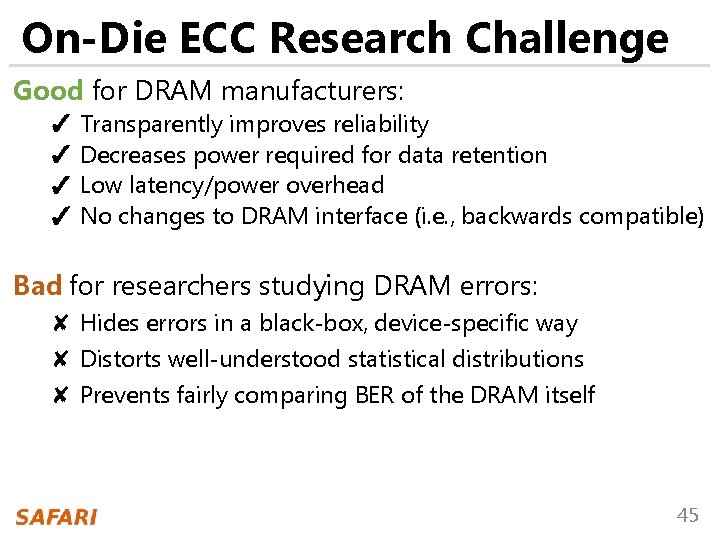
On-Die ECC Research Challenge Good for DRAM manufacturers: ✓ Transparently improves reliability ✓ Decreases power required for data retention ✓ Low latency/power overhead ✓ No changes to DRAM interface (i. e. , backwards compatible) Bad for researchers studying DRAM errors: ✘ Hides errors in a black-box, device-specific way ✘ Distorts well-understood statistical distributions ✘ Prevents fairly comparing BER of the DRAM itself 45
EINSim Functional Description • Simulates the dataflow through a real experiment - Configuration parameters replicate experimental setup - Simulate enough words to resolve the output distribution Tester Word Generator DRAM ECC Encoder Error Injector Error Checker ECC Decoder 46
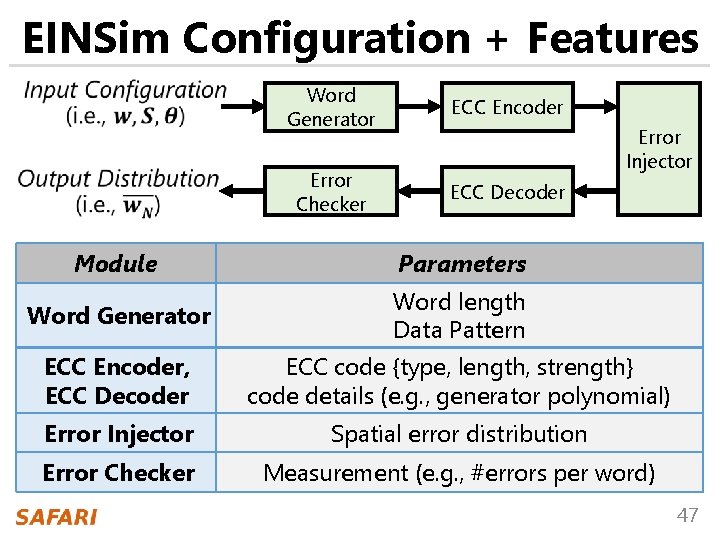
EINSim Configuration + Features Word Generator ECC Encoder Error Checker ECC Decoder Error Injector Module Parameters Word Generator Word length Data Pattern ECC Encoder, ECC Decoder ECC code {type, length, strength} code details (e. g. , generator polynomial) Error Injector Spatial error distribution Error Checker Measurement (e. g. , #errors per word) 47
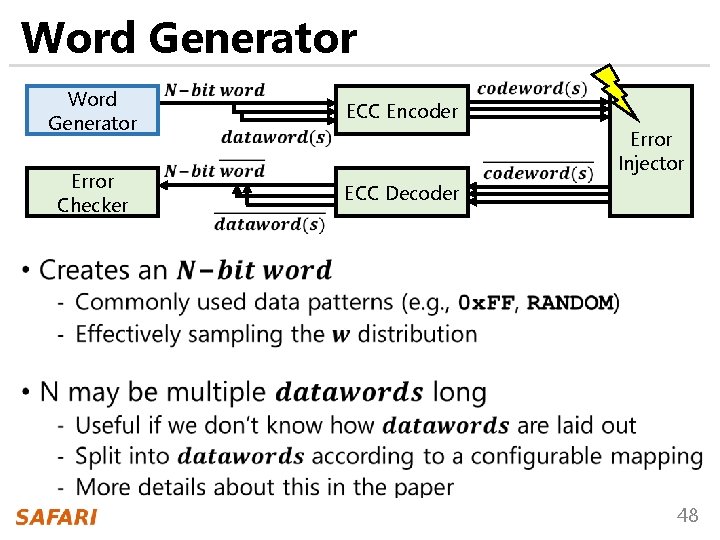
Word Generator ECC Encoder Error Checker ECC Decoder Error Injector • 48
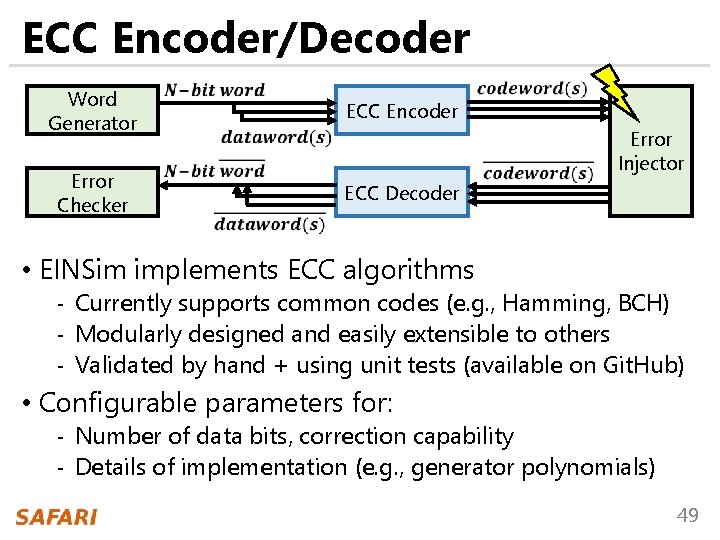
ECC Encoder/Decoder Word Generator ECC Encoder Error Checker ECC Decoder Error Injector • EINSim implements ECC algorithms - Currently supports common codes (e. g. , Hamming, BCH) - Modularly designed and easily extensible to others - Validated by hand + using unit tests (available on Git. Hub) • Configurable parameters for: - Number of data bits, correction capability - Details of implementation (e. g. , generator polynomials) 49
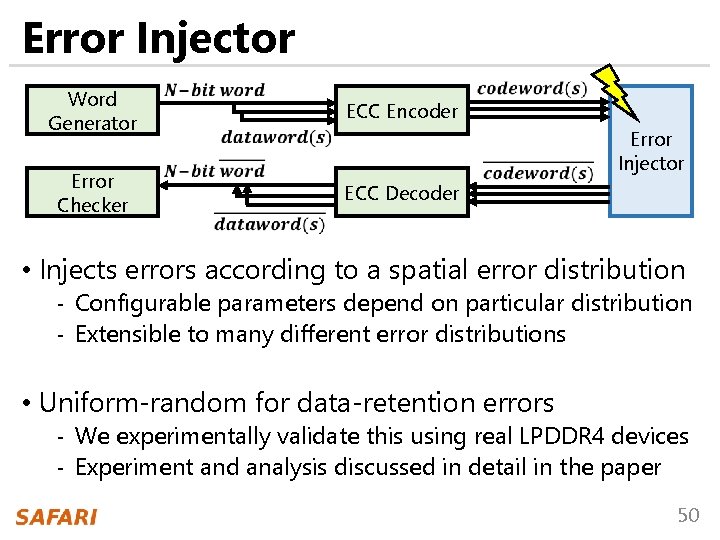
Error Injector Word Generator ECC Encoder Error Checker ECC Decoder Error Injector • Injects errors according to a spatial error distribution - Configurable parameters depend on particular distribution - Extensible to many different error distributions • Uniform-random for data-retention errors - We experimentally validate this using real LPDDR 4 devices - Experiment and analysis discussed in detail in the paper 50
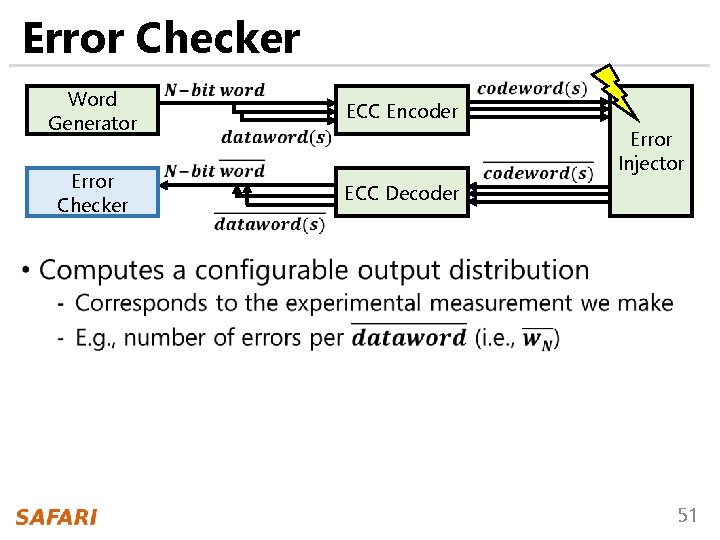
Error Checker Word Generator ECC Encoder Error Checker ECC Decoder Error Injector • 51
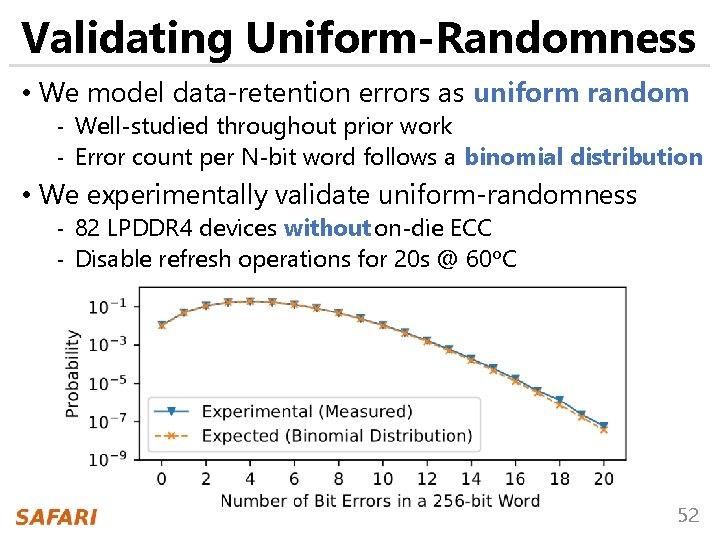
Validating Uniform-Randomness • We model data-retention errors as uniform random - Well-studied throughout prior work - Error count per N-bit word follows a binomial distribution • We experimentally validate uniform-randomness - 82 LPDDR 4 devices without on-die ECC - Disable refresh operations for 20 s @ 60 o. C 52
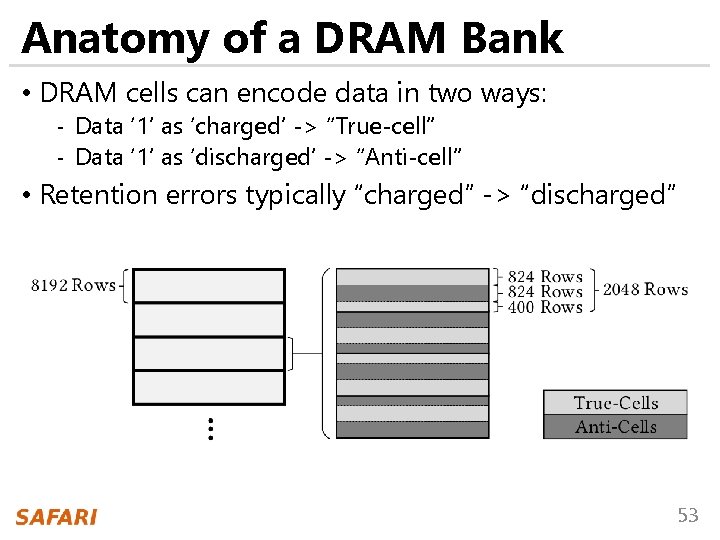
Anatomy of a DRAM Bank • DRAM cells can encode data in two ways: - Data ‘ 1’ as ‘charged’ -> “True-cell” - Data ‘ 1’ as ‘discharged’ -> “Anti-cell” • Retention errors typically “charged” -> “discharged” 53
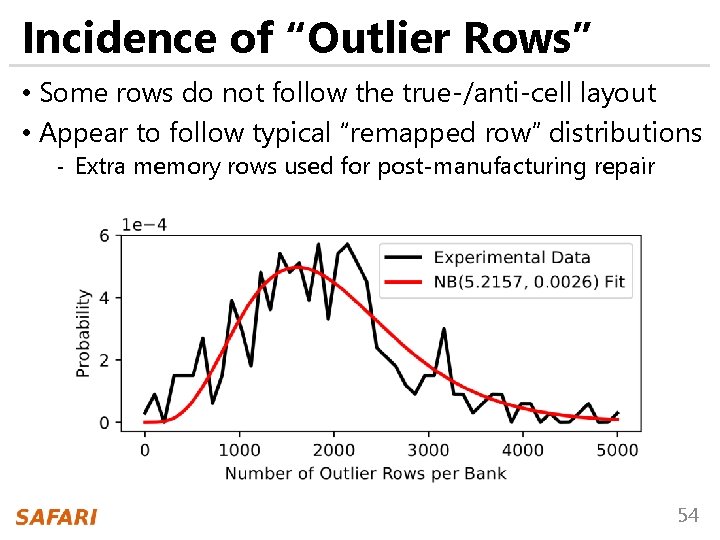
Incidence of “Outlier Rows” • Some rows do not follow the true-/anti-cell layout • Appear to follow typical “remapped row” distributions - Extra memory rows used for post-manufacturing repair 54
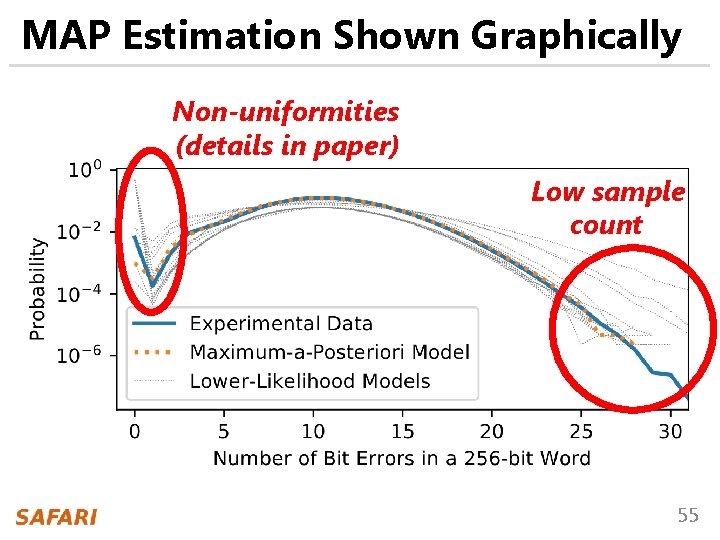
MAP Estimation Shown Graphically Non-uniformities (details in paper) Low sample count 55
Example Error-Characterization Studies • We provide two studies to demonstrate EIN’s value - Measure data-retention error rates - Have 314 LPDDR 4 devices (with + without on-die ECC) 1. BER vs. refresh rates - We compare devices with on-die ECC to those without it - EIN infers the pre-correction BER beneath on-die ECC - Enables comparing BER of the DRAM technology itself 2. BER vs. temperature - On-die ECC distorts the expected exponential relationship - EIN recovers the obfuscated statistical distribution 56
Finding the “Right” Answer • MAP estimation selects between suspected models - EIN cannot tell if the MAP estimate is “right” - “Likelihood” is a relative measure 1. Techniques for gaining confidence in the answer: - Using confidence intervals (e. g. , statistical bootstrap) - Testing across many different error conditions 2. Unlikely that the ECC scheme used is unknown - ECC is a well-studied area - Manufacturers are unlikely to a completely unknown code 3. Typically we may suspect some schemes already - Academic/industry papers, datasheets, etc. 57
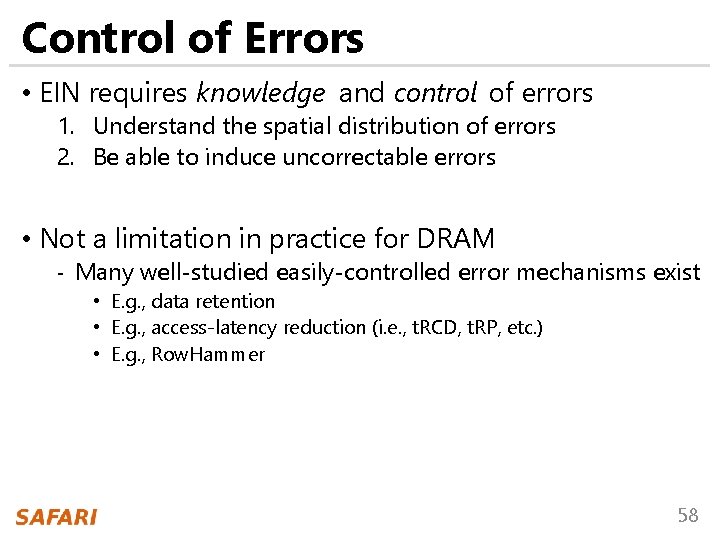
Control of Errors • EIN requires knowledge and control of errors 1. Understand the spatial distribution of errors 2. Be able to induce uncorrectable errors • Not a limitation in practice for DRAM - Many well-studied easily-controlled error mechanisms exist • E. g. , data retention • E. g. , access-latency reduction (i. e. , t. RCD, t. RP, etc. ) • E. g. , Row. Hammer 58
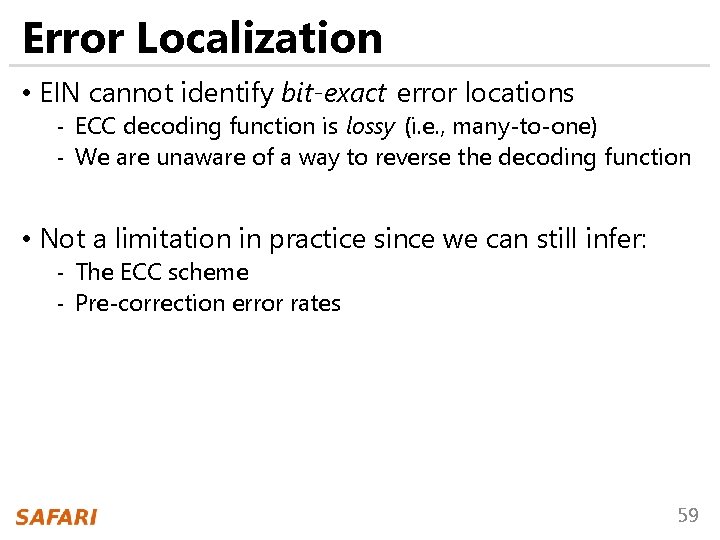
Error Localization • EIN cannot identify bit-exact error locations - ECC decoding function is lossy (i. e. , many-to-one) - We are unaware of a way to reverse the decoding function • Not a limitation in practice since we can still infer: - The ECC scheme - Pre-correction error rates 59