
Understanding and Managing Workplace Conflict SCWHE IR Workshop

- Slides: 12
Understanding and Managing Workplace Conflict SCWHE IR Workshop October 17, 2014 10 -1
Is Conflict Good or Bad? § Negative Outcomes • • • § Less information sharing Higher stress/dissatisfaction/turnover More organizational politics Wasted resources Lower team cohesion when conflict is internal Positive Outcomes • Better decision making • More responsive • Stronger team cohesion when conflict is external 10 -2
Is Conflict Good or Bad? : Emerging View § Two types of conflict • Constructive conflict -- Conflict is aimed at issue, not parties • Relationship conflict -- Conflict is aimed at undermining the other party § Goal: encourage constructive conflict with common goals and a cohesive team; minimize relationship conflict § Problem: difficult to separate the two conflicts 10 -3
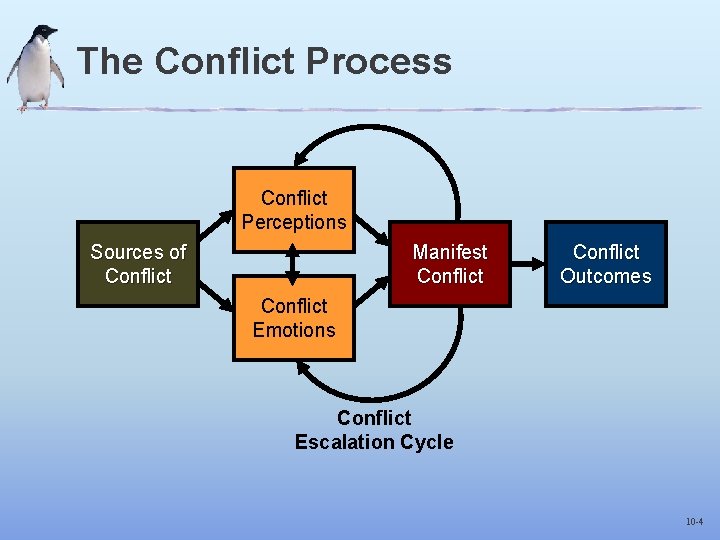
The Conflict Process Conflict Perceptions Sources of Conflict Manifest Conflict Outcomes Conflict Emotions Conflict Escalation Cycle 10 -4
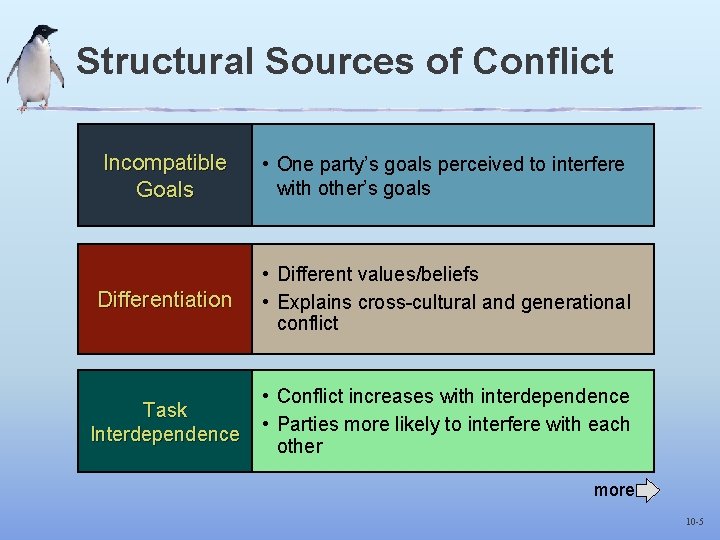
Structural Sources of Conflict Incompatible Goals • One party’s goals perceived to interfere with other’s goals Differentiation • Different values/beliefs • Explains cross-cultural and generational conflict Task Interdependence • Conflict increases with interdependence • Parties more likely to interfere with each other more 10 -5
Structural Sources of Conflict Scarce Resources • Motivates competition for the resource Ambiguous Rules • Creates uncertainty, threatens goals • Without rules, people rely on politics Communication Problems • Increases stereotyping • Reduces motivation to communicate • Escalates conflict when arrogant 10 -6
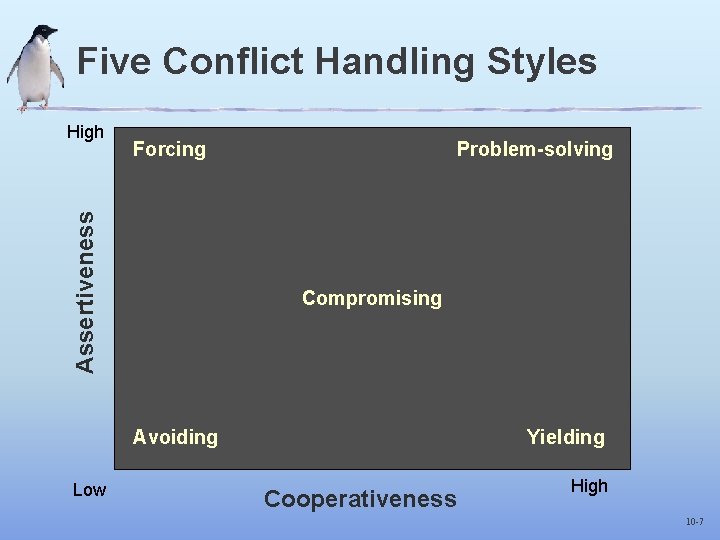
Five Conflict Handling Styles Forcing Assertiveness High Problem-solving Compromising Avoiding Low Yielding Cooperativeness High 10 -7
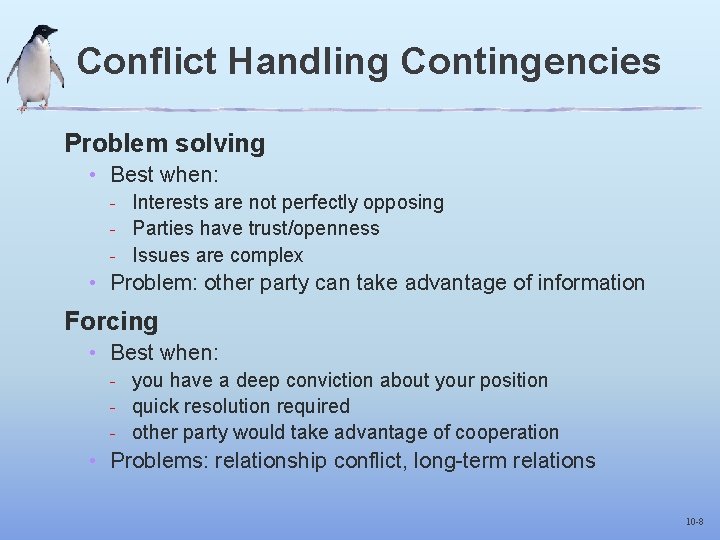
Conflict Handling Contingencies Problem solving • Best when: - Interests are not perfectly opposing - Parties have trust/openness - Issues are complex • Problem: other party can take advantage of information Forcing • Best when: - you have a deep conviction about your position - quick resolution required - other party would take advantage of cooperation • Problems: relationship conflict, long-term relations 10 -8
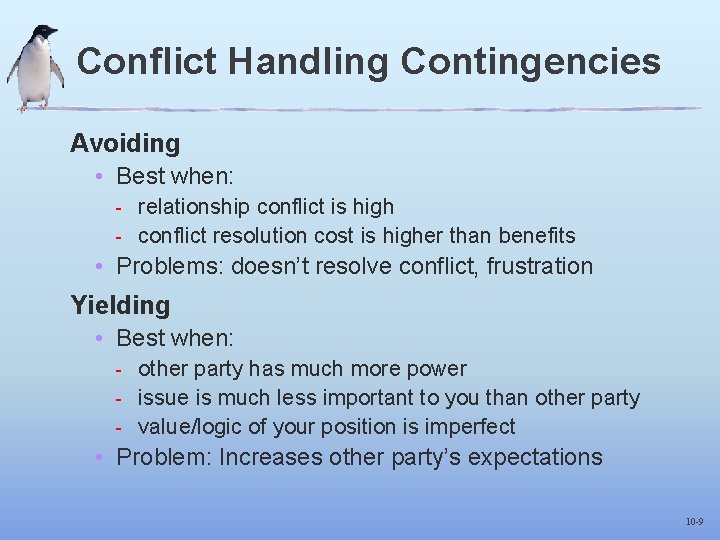
Conflict Handling Contingencies Avoiding • Best when: - relationship conflict is high - conflict resolution cost is higher than benefits • Problems: doesn’t resolve conflict, frustration Yielding • Best when: - other party has much more power - issue is much less important to you than other party - value/logic of your position is imperfect • Problem: Increases other party’s expectations 10 -9
Conflict Handling Contingencies Compromising • Best when… - Parties have equal power - Quick solution is required - Parties lack trust/openness • Problem: Sub-optimal solution if mutual gains had been possible 10 -10
Structural Approaches to Conflict Resolution 1. Emphasizing superordinate goals • Emphasize common objectives rather than conflicting sub-goals • Reduces goal incompatibility and differentiation 2. Reducing differentiation • Remove sources of different values and beliefs - e. g. Move employees around to different jobs 3. Improving communication/understanding • Employees understand appreciate each other’s views through communication 10 -11
Structural Approaches to Conflict Resolution (con’t) 4. Reduce Task Interdependence • Dividing shared resources • Combine tasks • Use buffers 5. Increase Resources • May be difficult to accomplish 6. Clarify Rules and Procedures • Clarify resource distribution • Change interdependence 10 -12