
Understanding and Managing Organizational Behavior Chapter 2 Individual
Understanding and Managing Organizational Behavior Chapter 2: Individual Differences: Personality and Ability 4 th Edition JENNIFER GEORGE & GARETH JONES 2 -1 © 2005 Prentice Hall
Chapter Objectives § Understand the nature of personality and how it is determined by both nature and nurture § Describe the Big Five personality traits and their implication for understanding behavior in organizations § Appreciate the ways in which other personality traits, in addition to the Big Five, influence employees’ behaviors in organizations 2 -2 © 2005 Prentice Hall
Chapter Objectives § Describe the different kinds of abilities that employees use to perform their jobs § Appreciate how organizations manage ability through selection, placement, and training 2 -3 © 2005 Prentice Hall
Individual Differences § Personality § Ability 2 -4 © 2005 Prentice Hall
The Nature of Personality § Personality: Personality The pattern of relatively enduring ways in which a person feels, thinks, and behaves – Develops over a person’s lifetime – Generally stable in the context of work – Can influence career choice, job satisfaction, stress, leadership, and even performance § Trait: Trait A specific component of personality that describes particular tendencies a person has to feel, think, and act in certain ways 2 -5 © 2005 Prentice Hall
Ben Schneider’s Attraction-Selection. Attrition (ASA) Framework § The personality of a whole organization is largely a product of the personalities of its workers § Individuals with similar personalities tend to be attracted to an organization (attraction) and hired by it (selection) and individuals with other types of personalities tend to leave the organization (attrition) 2 -6 © 2005 Prentice Hall
Extraversion (Positive Affectivity) § Personality trait that predisposes individuals to experience positive emotional states and feel good about themselves and the world around them – Extraverts: sociable, affectionate, friendly – Introverts: fewer social interactions, less likely to experience positive emotional states 2 -7 © 2005 Prentice Hall
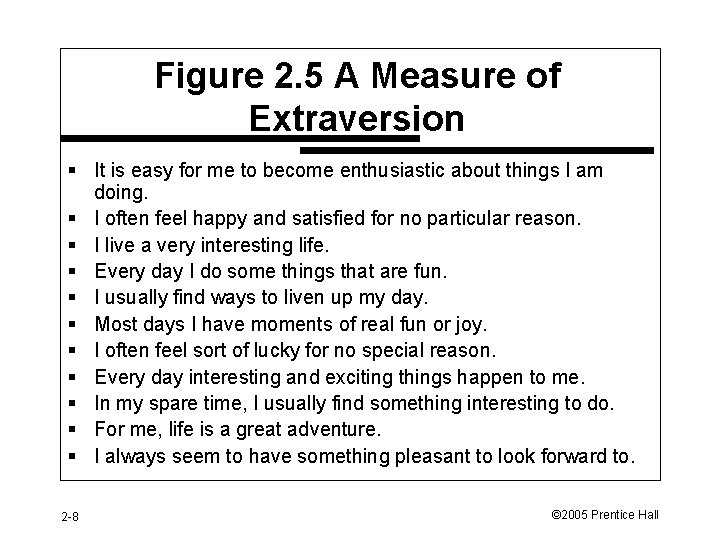
Figure 2. 5 A Measure of Extraversion § It is easy for me to become enthusiastic about things I am doing. § I often feel happy and satisfied for no particular reason. § I live a very interesting life. § Every day I do some things that are fun. § I usually find ways to liven up my day. § Most days I have moments of real fun or joy. § I often feel sort of lucky for no special reason. § Every day interesting and exciting things happen to me. § In my spare time, I usually find something interesting to do. § For me, life is a great adventure. § I always seem to have something pleasant to look forward to. 2 -8 © 2005 Prentice Hall
Neuroticism (Negative Affectivity) § Personality trait that reflects people’s tendency to experience negative emotional states, feel distressed, and generally view themselves and the world around them negatively – High: negative moods, stress, negative orientation towards work, critical – Low: less critical and less pessimistic 2 -9 © 2005 Prentice Hall
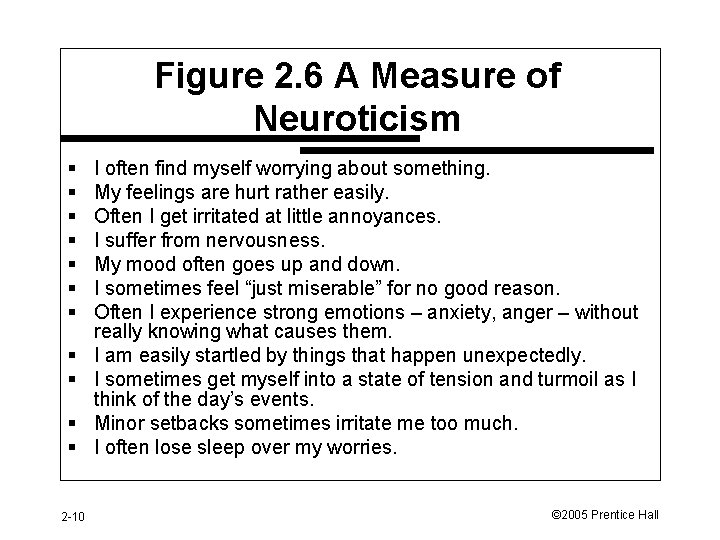
Figure 2. 6 A Measure of Neuroticism § § § 2 -10 I often find myself worrying about something. My feelings are hurt rather easily. Often I get irritated at little annoyances. I suffer from nervousness. My mood often goes up and down. I sometimes feel “just miserable” for no good reason. Often I experience strong emotions – anxiety, anger – without really knowing what causes them. I am easily startled by things that happen unexpectedly. I sometimes get myself into a state of tension and turmoil as I think of the day’s events. Minor setbacks sometimes irritate me too much. I often lose sleep over my worries. © 2005 Prentice Hall
Agreeableness § Personality trait that captures the distinction between individuals who get along well with other people and those who do not – High: likable, affectionate – Low: antagonistic, mistrustful, uncooperative 2 -11 © 2005 Prentice Hall
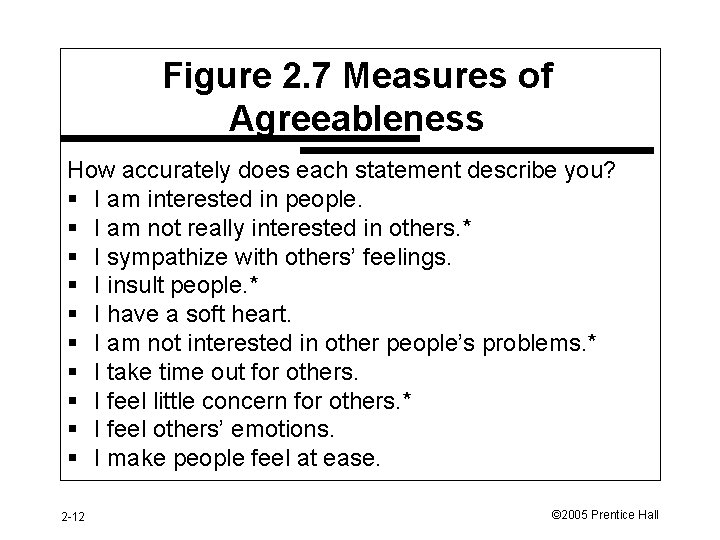
Figure 2. 7 Measures of Agreeableness How accurately does each statement describe you? § I am interested in people. § I am not really interested in others. * § I sympathize with others’ feelings. § I insult people. * § I have a soft heart. § I am not interested in other people’s problems. * § I take time out for others. § I feel little concern for others. * § I feel others’ emotions. § I make people feel at ease. 2 -12 © 2005 Prentice Hall
Conscientiousness § Personality trait that describes the extent to which an individual is careful, scrupulous, and persevering – High: organized, self-discipline – Low: lack of direction, lack of discipline 2 -13 © 2005 Prentice Hall
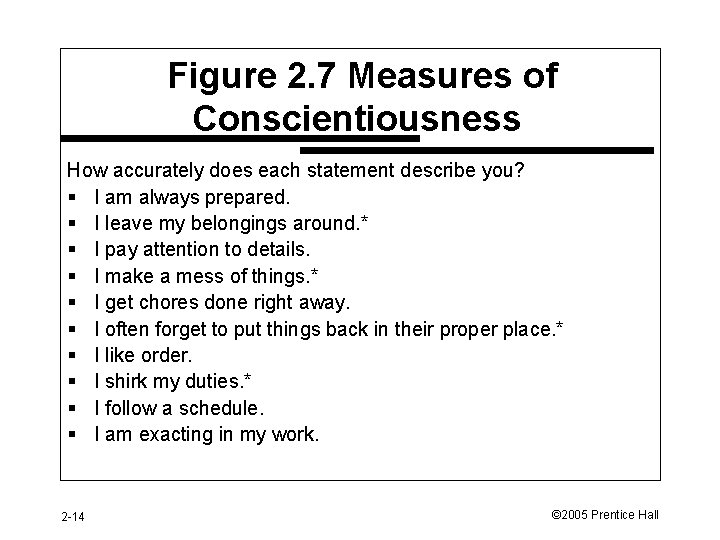
Figure 2. 7 Measures of Conscientiousness How accurately does each statement describe you? § I am always prepared. § I leave my belongings around. * § I pay attention to details. § I make a mess of things. * § I get chores done right away. § I often forget to put things back in their proper place. * § I like order. § I shirk my duties. * § I follow a schedule. § I am exacting in my work. 2 -14 © 2005 Prentice Hall
Openness to Experience § Personality trait that captures the extent to which an individual is – original, – open to a wide variety of stimuli, – has broad interests, and is – willing to take risks as opposed to being narrow-minded and cautious 2 -15 © 2005 Prentice Hall
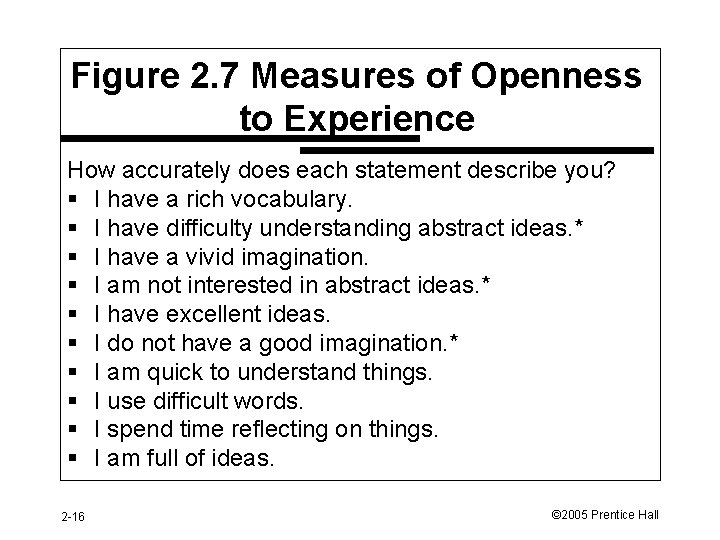
Figure 2. 7 Measures of Openness to Experience How accurately does each statement describe you? § I have a rich vocabulary. § I have difficulty understanding abstract ideas. * § I have a vivid imagination. § I am not interested in abstract ideas. * § I have excellent ideas. § I do not have a good imagination. * § I am quick to understand things. § I use difficult words. § I spend time reflecting on things. § I am full of ideas. 2 -16 © 2005 Prentice Hall
Locus of Control § External Locus of Control: Describes people who believe that fate, luck, or outside forces are responsible for what happens to them § Internal Locus of Control: Describes people who believe that ability, effort, or their own actions determine what happens to them 2 -17 © 2005 Prentice Hall
Self-Monitoring § The extent to which people try to control the way they present themselves to others – High self-monitors: strive for socially acceptable behavior; good at impression management – Low self-monitors: guided by own attitudes and beliefs; not concerned with what others think 2 -18 © 2005 Prentice Hall
Figure 2. 9 A Measure of Self. Monitoring § I find it hard to imitate the behavior of other people. * § At parties and social gatherings, I do not attempt to do or say things that others will like. * § I can only argue for ideas that I already believe. * § I can make impromptu speeches even on topics about which I have almost no information. § I guess I put on a show to impress or entertain others. § I would probably make a good actor. § In a group of people, I am rarely the center of attention. * § I’m not always the person I appear to be. * 2 -19 © 2005 Prentice Hall
Self-Esteem § Personality trait that describes the extent to which people have pride in themselves and their capabilities – High: capable, confident, and worthy – Low: questionable self-worth, doubt, apprehension about ability to succeed 2 -20 © 2005 Prentice Hall
Type A versus Type B Personality § Type A individuals have an intense desire to achieve, are extremely competitive, have a sense of urgency, are impatient, and can be hostile § Type B individuals are more relaxed and easy going 2 -21 © 2005 Prentice Hall
Mc. Clelland’s Learned Needs § Need for achievement § Need for affiliation § Need for power Managers should have a high need for achievement and power. 2 -22 © 2005 Prentice Hall
16 The Nature of Ability § What a person is capable of doing § Types of ability – Cognitive ability – Physical ability • Motor skill • Physical skill – Emotional intelligence 2 -23 © 2005 Prentice Hall
Emotional Intelligence § The ability to understand manage one’s own feelings and emotions and the feelings and emotions of others § A good understanding of how to use emotions to promote effective functioning and well-being 2 -24 © 2005 Prentice Hall
Figure 2. 12 A Measure of Emotional Intelligence § I have a good sense of why I have certain feelings most of the time. § I always know my friends’ emotions from their behavior. § I always set goals for myself and then try my best to achieve them. § I am able to control my temper so that I can handle difficulties rationally. § I have good understanding of my own emotions. § I always tell myself I am a competent person. § I am quite capable of controlling my own emotions. § I really understand how I feel. § I am sensitive to the feelings and emotions of others. 2 -25 © 2005 Prentice Hall
Management of Ability § Selection – Identify tasks to be accomplished – Identify abilities needed to accomplish tasks – Develop accurate measures of abilities § Placement – Match workers to jobs to capitalize on their abilities § Training 2 -26 © 2005 Prentice Hall
- Slides: 26