
Understanding and Managing Leave Presented by Human Resource
Understanding and Managing Leave Presented by: Human Resource Services (HRS) Revised Sept. 2015
Objectives By the end of this training you should have the tools to: • Navigate the medical leave processes, and avoid potential pitfalls. • Understand the interplay between medical leave, Workers’ Compensation (L&I) and Reasonable Accommodation (RA)

Medical Leave Benefits provided according to Federal Law State Law (RCW) WAC/Collective Bargaining Agreements University Policy AP Handbook / Faculty Manual
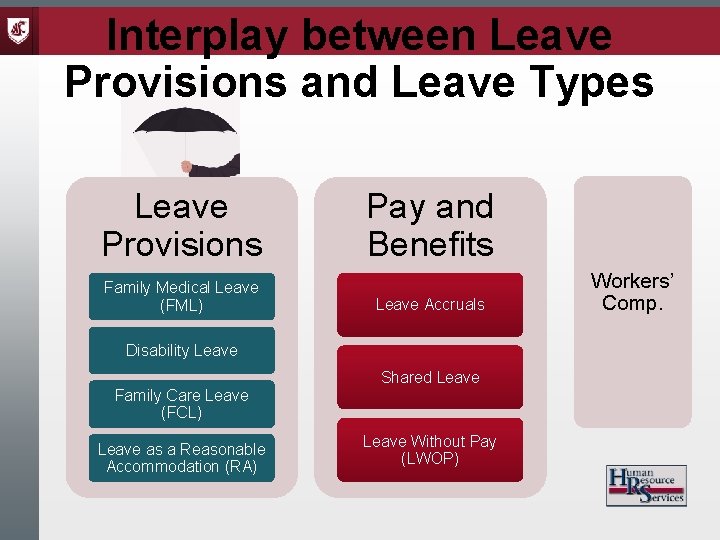
Interplay between Leave Provisions and Leave Types Leave Provisions Family Medical Leave (FML) Pay and Benefits Leave Accruals Disability Leave Shared Leave Family Care Leave (FCL) Leave as a Reasonable Accommodation (RA) Leave Without Pay (LWOP) Workers’ Comp.
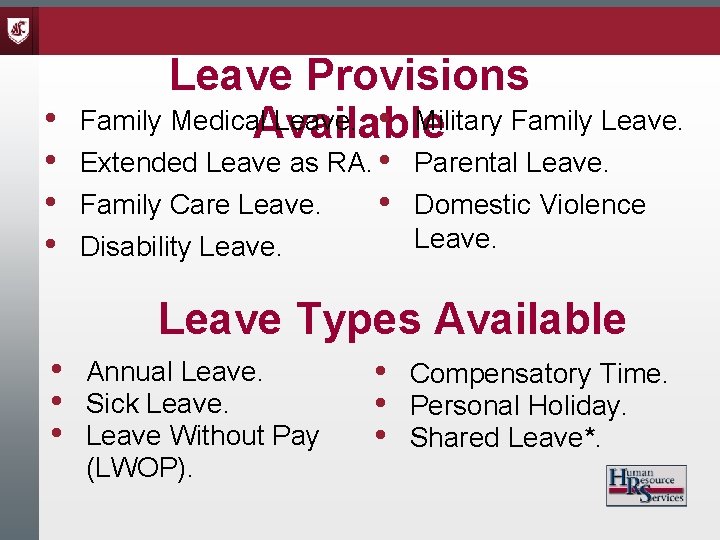
Leave Provisions • Family Medical. Available Leave. • Military Family Leave. • • • Extended Leave as RA. • Parental Leave. Family Care Leave. Disability Leave. • Domestic Violence Leave Types Available • • • Annual Leave. Sick Leave Without Pay (LWOP). • • • Compensatory Time. Personal Holiday. Shared Leave*.

Disability Services Coordination L&I RA Disability Leave FCL FML Interplay between these leaves is complicated. HRS is here to help you manage the process.
BPPM Medical Leaves BPPM 60. 56 & 60. 57 Triggers for medical leave provisions: • Employee is out for three or more days. • Employee was hospitalized. • Consistent use of sick leave. • Suspicious use of sick leave.
Family Medical Leave Federal Provision • Job protected leave. • FML does not protect against budget impacts, performance management, or layoff. • Benefits protected leave. • Employee maintains employer paid benefits, granted the employee continues to pay the premiums that are normally collected.
Family Medical Leave • 12 weeks/480 hours of leave, in a rolling 12 month period, for a fulltime employee for: • qualifying event. • employee must be eligible. • 26 weeks for care of military family member.
Family Medical Leave Eligible Employees: HRS determines eligibility based on if the employee has worked: • for the state of Washington for at least 12 months. • for at least 1, 250 hours during the 12 month period immediately preceding the request for FML.
Family Medical Leave Qualifying Events: • Employee’s serious health condition. • Birth, adoption, or placement of a child. • Care for a qualifying family member (child, parent, spouse) with a serious health condition.
Family Medical Leave Qualifying Events (cont. ): • Care for a qualifying family member recovering from a serious health condition sustained in the line of duty. • Exigency Leave for employee whose qualifying family member has been called to active duty.
Family Medical Leave • • Employee chooses how to use leave. Leave can be for a block of time, reduced work schedule, or used intermittently. 12 month period starts first day leave used and runs for next 12 months. All based on supporting medical documentation.
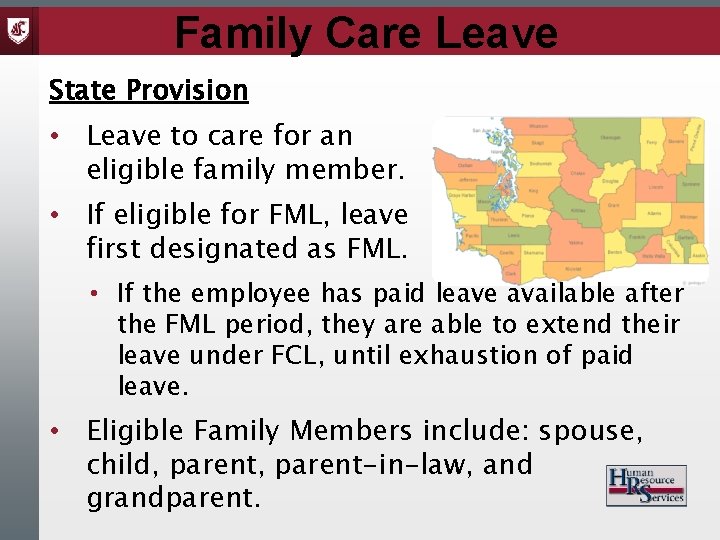
Family Care Leave State Provision • Leave to care for an eligible family member. • If eligible for FML, leave first designated as FML. • If the employee has paid leave available after the FML period, they are able to extend their leave under FCL, until exhaustion of paid leave. • Eligible Family Members include: spouse, child, parent-in-law, and grandparent.
Domestic Violence Leave State Provision Allows victims of domestic violence, sexual assault, or stalking to take reasonable leave from work: • To take care of legal or law enforcement needs and obtain health care. • Family members may take leave to help victim obtain help. • Paid or unpaid.
Disability Leave University Provision • Allows non-FML eligible employees, who need full-time leave for their own condition, up to total of 4 months. • Allows for an additional month of insurance benefits beyond FML period when an employee is out full time. • Must be in minimum 8 hours paid status during additional month.
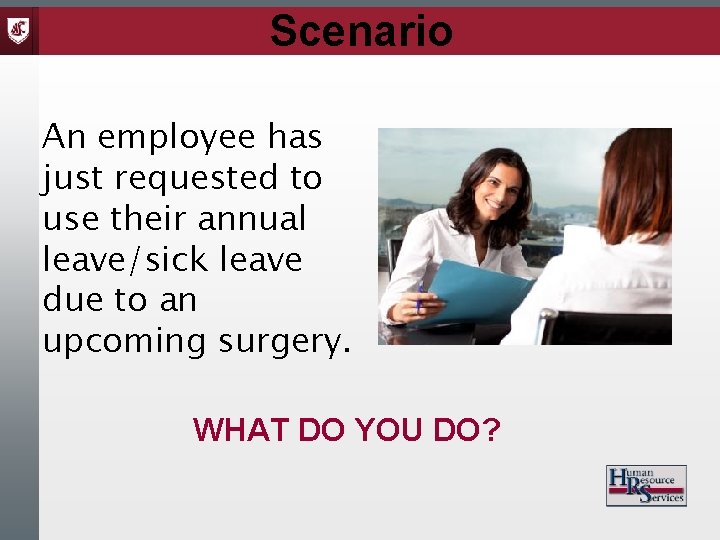
Scenario An employee has just requested to use their annual leave/sick leave due to an upcoming surgery. WHAT DO YOU DO?
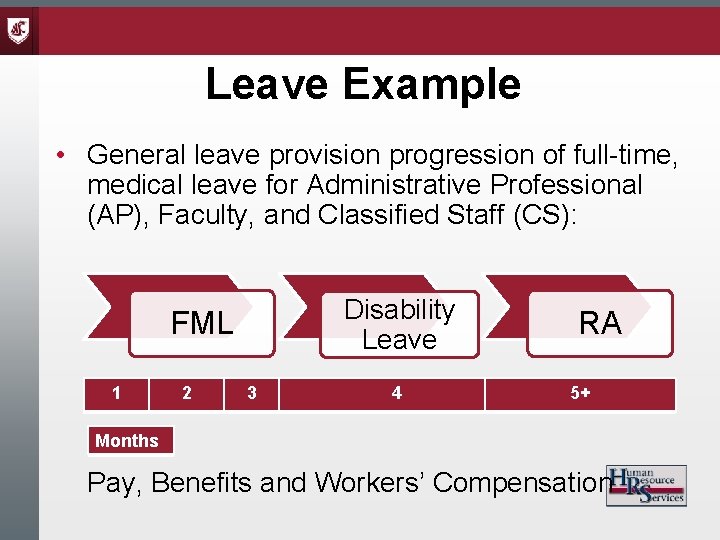
Leave Example • General leave provision progression of full-time, medical leave for Administrative Professional (AP), Faculty, and Classified Staff (CS): Disability Leave FML 1 2 3 4 RA 5+ Months Pay, Benefits and Workers’ Compensation
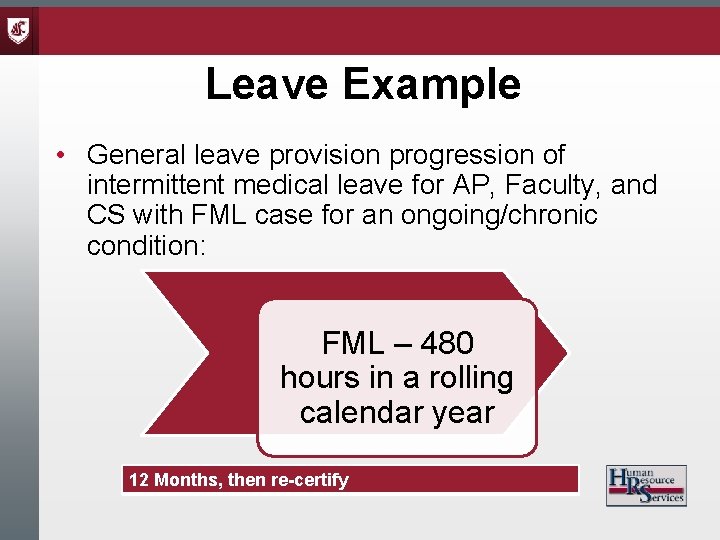
Leave Example • General leave provision progression of intermittent medical leave for AP, Faculty, and CS with FML case for an ongoing/chronic condition: FML – 480 hours in a rolling calendar year 12 Months, then re-certify
Requesting Leave Personal Leave Requests go through normal departmental procedures. These are the most familiar to employees. • Annual Leave. • Sick Leave. • Personal Holiday. • Comp Time Usage. • Leave Without Pay. • Exception: • Medical Leave requests are administered through Human Resource Services.
Medical Leave Requests Your responsibility as a supervisor is to: • Identify the request for medical leave. • Or potential need. • Refer employee to HRS. • If unsure of the request, contact HRS. • hrs. wsu. edu/Disability Services • 509 -335 -4521
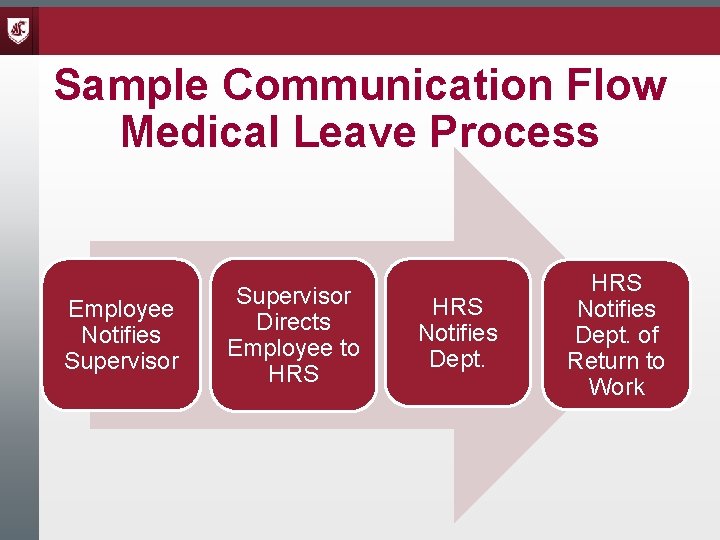
Sample Communication Flow Medical Leave Process Employee Notifies Supervisor Directs Employee to HRS Notifies Dept. of Return to Work
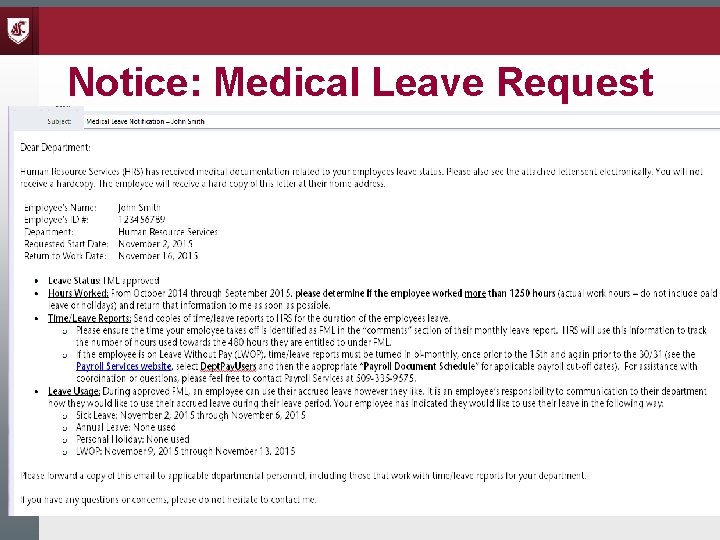
Notice: Medical Leave Request
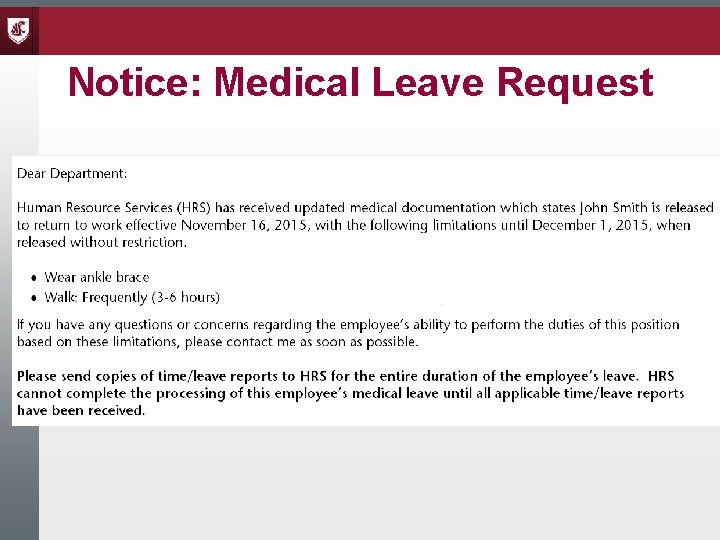
Notice: Medical Leave Request
Scenario An employee needs to take three weeks of full -time FML eligible leave during the beginning of the fall semester, when your office is at the bussiest time of the year. What things do you consider?
Scenario Your employee Sue calls out sick for two consecutive days. • Sue then comes back to work, but her spouse is now sick and she needs to take another two days off. • Now Sue’s spouse becomes seriously ill and she needs to work part-time, for the next three months, in order to care for him.
Leave Types Shared Leave RCW 41. 04. 660 BPPM 60. 58 Allows state employees to donate their annual leave, sick leave, or personal holidays to another state employee who meets Shared Leave criteria.
Shared Leave • As a supervisor, if your employee decides to donate leave to another Washington State employee, you will be asked to sign the Request to Donate Shared Leave Form • Form allows for the transfer of annual, sick and/or personal holiday.
Workers’ Compensation
Work Related Injury/Illness • Injury or Occupational Disease that has a. . . • Proximate Cause which occurred during. . . • Course of Employment
Workers’ Compensation • Washington State Department of Labor and Industries (L&I). * • No fault insurance. • L&I looks towards a quick and dependable remedy. • Priority is placed upon returning to work in any capacity.
Benefits of Workers’ Compensation • Approved Medical Care (100%). • Wage Replacement (60 -75%). • Return-to-Work Assistance. • Other long term benefits (partial permanent disability, pensions etc. ).
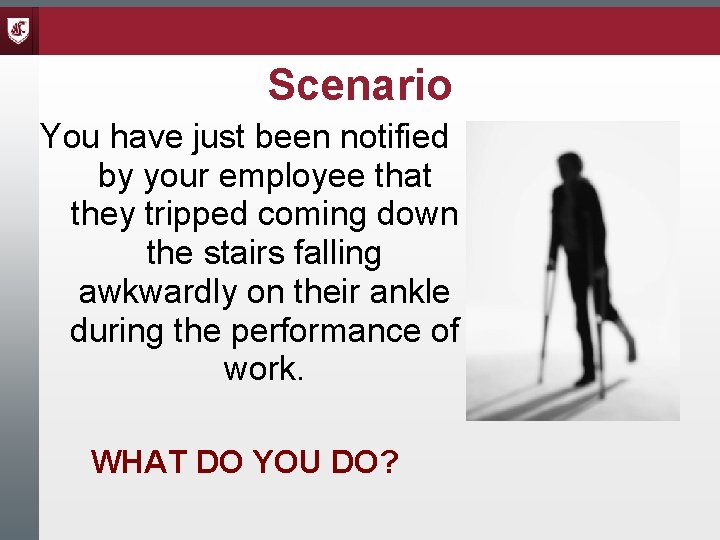
Scenario You have just been notified by your employee that they tripped coming down the stairs falling awkwardly on their ankle during the performance of work. WHAT DO YOU DO?
Supervisor / Department Responsibilities • Ensure first-aid and/or medical treatment is provided. • If required - Call 911. • Arrange for ride to hospital/doctor as necessary. • Interview the injured worker and any witnesses ASAP. • Have WSU Online Incident Report completed within 24 hrs.
Supervisor / Department Responsibilities • Complete the Supervisor’s Accident Investigation Report if: • Medical treatment is sought. • Employee is unable to work next full shift. • Provide initial safety training and periodic safety reviews. • Immediately report accidents which result in death, or serious injury according to policy (SPPM 2. 24)
Filing a L&I Claim If an employee chooses to file an L&I claim they do so 1. Through medical provider, 2. Online with L&I, or 3. Over the phone with L&I. WSU may question the claim validity if: • Condition is not covered by law. • Not work related. • Questionable based on situation or timing, etc.
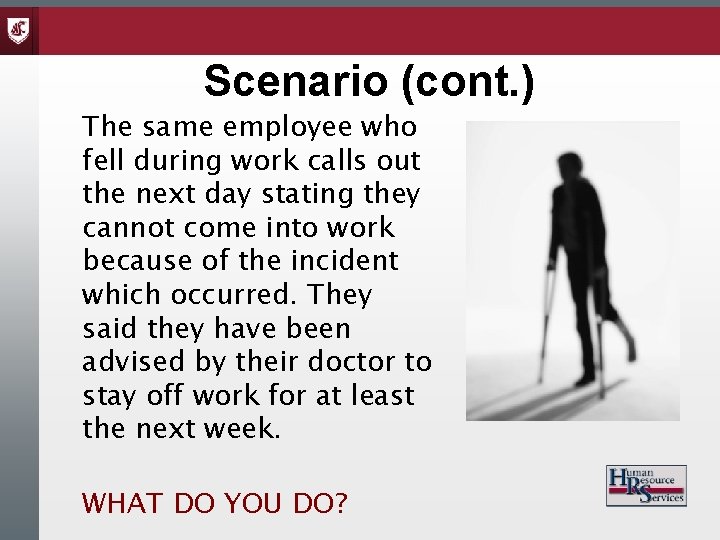
Scenario (cont. ) The same employee who fell during work calls out the next day stating they cannot come into work because of the incident which occurred. They said they have been advised by their doctor to stay off work for at least the next week. WHAT DO YOU DO?
Supervisor / Department Responsibilities • Alert HRS your employee has called out for more than 3 days due to a medical condition. • Complete Supervisor’s Investigative Report. • Limit employee questions to those on report. • Refer the employee to HRS. • Employees must follow normal leave processes even if due to a Work Related injury/illness.
Worker’s Compensation and Leave • WSU does not ‘keep on salary’ when someone is off due to a workplace illness/injury. • Employee utilizes their own accrued leaves (sick leave, annual leave, etc. ) to maintain their WSU pay. • Unless they are on FML, they must have at least 8 hours of pay in a month to maintain benefits.
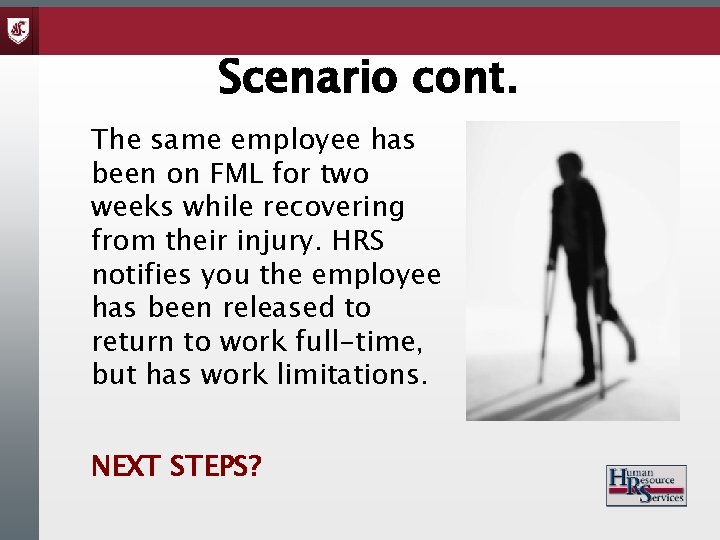
Scenario cont. The same employee has been on FML for two weeks while recovering from their injury. HRS notifies you the employee has been released to return to work full-time, but has work limitations. NEXT STEPS?
Return To Work Coordination • Employers held to higher standard to return injured workers to the workforce. • HRS Pullman coordinates WSU portion of all claims and works with employees and departments on applicable leave needs. • Do not change job duties due to illness or injury without HRS consultation.
Workers’ Compensation. Work Limitations Once notified of limitations from HRS: • Determine if work is available within the employee’s work duties, within the limitations. • Discuss available work with HRS. • If there is only part-time work available, HRS will notify the employee and may place them on leave for hours work NOT available.
Temporary Modified Duties • If normal job are impacted by limitations, can the job can be temporarily modified to accommodate the limitations. • Examples of Temporary Modified Duties: • Part-time/alternate schedule. • New duties - same knowledge. • Change building or location. • Different equipment or work methods. • Special projects. • Temp/hourly duties.
L&I Return to Work and Job Analysis • Job Analysis (JA) is a part of L&I vocational services, to review the details of an employee’s job. • It gathers, evaluates, and records objective data about the job’s characteristics. • Assists in evaluating return to work or other employment possibilities. • HRS co-ordinates with supervisor and Vocational Counselor. • JA may also assist in L&I claim validity determination.
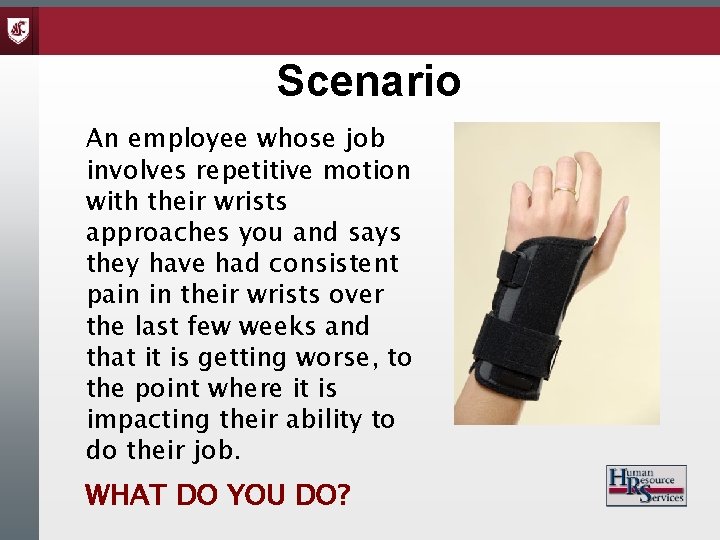
Scenario An employee whose job involves repetitive motion with their wrists approaches you and says they have had consistent pain in their wrists over the last few weeks and that it is getting worse, to the point where it is impacting their ability to do their job. WHAT DO YOU DO?
Supervisor / Department Responsibilities • Refer the employee to HRS for possible medical leave options. • Complete WSU Online Incident Report. • If exact time of illness/injury unknown, list the date employee reported it to you or the date your employee identifies they sought medical treatment. • Complete the Supervisor’s Accident Investigation Report.
Reasonable Accommodation (RA)
Reasonable Accommodations (RA) • WSU will provide RA for a known physical, mental, or sensory limitation of an otherwise qualified individual. • Condition substantially limits individual’s ability to perform the job. • Employee must be able to perform the essential functions of the position with or without an RA.
RA Overview Modification or adjustment to a job, work environment, policies, practices, or procedures that: • Enables an individual with a disability to enjoy equal employment opportunities. • That does not pose an Undue Hardship.
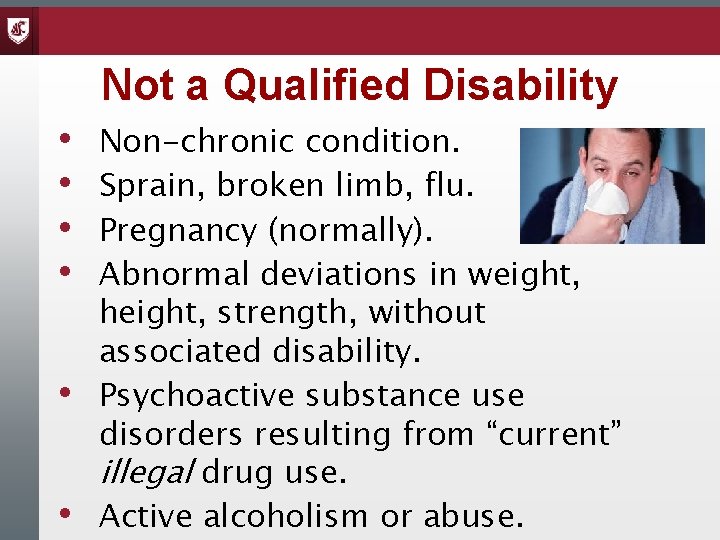
Not a Qualified Disability • • • Non-chronic condition. Sprain, broken limb, flu. Pregnancy (normally). Abnormal deviations in weight, height, strength, without associated disability. Psychoactive substance use disorders resulting from “current” illegal drug use. Active alcoholism or abuse.
RA Process Overview Identification - a need for RA may be identified, by the employee, the supervisor or a health care provider. Documentation - medical certification in support of the RA request is normally required. Accommodation - upon receipt of the necessary paperwork HRS will work with the department and the employee to review the request and possible options.
Process Overview WSU policies, procedures and practices follow the Equal Employment Opportunity Commission’s (EEOC) Best Practices for RA. • RA Procedures. • Timelines. • Documenting and Tracking Requests. • Ensuring the Confidentiality of Medical Information. • Denial of RA.
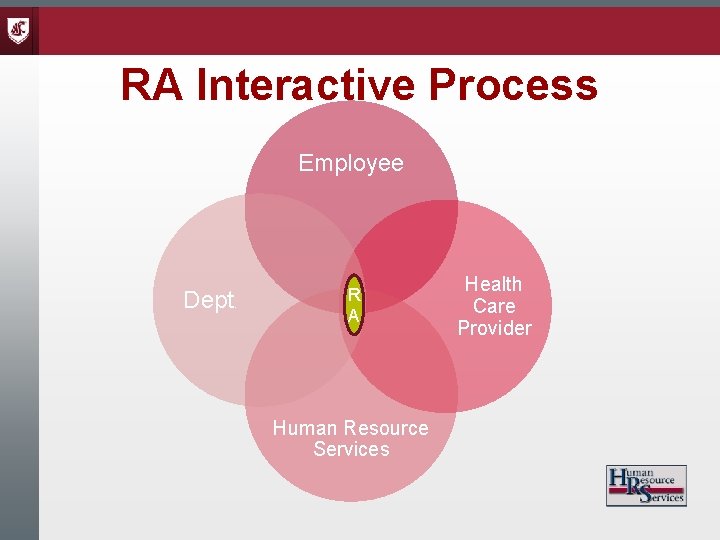
RA Interactive Process Employee Dept. R A Human Resource Services Health Care Provider
RA Stages - Receipt 1. HRS receives request. 2. HRS identifies any additional needs, i. e. missing paperwork, unclear request, unclear or lacking medical documentation, duration of need.
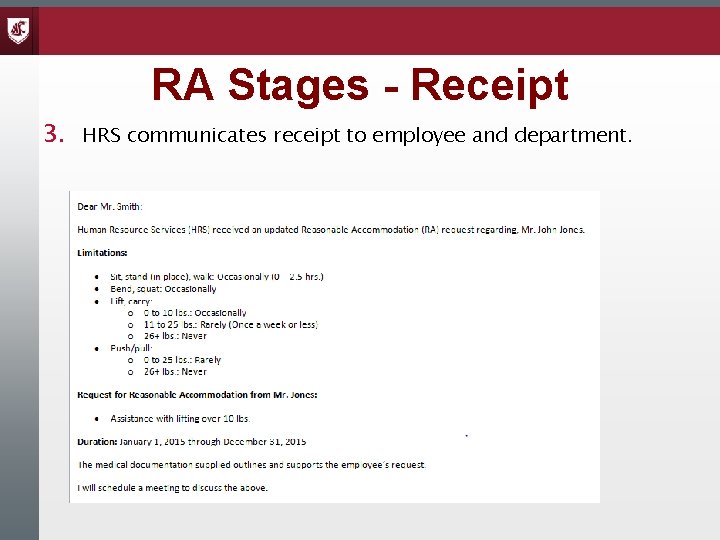
RA Stages - Receipt 3. HRS communicates receipt to employee and department.
RA Stages - Review 1. In collaboration with department, capabilities and limitations are compared with position description, job functions & departmental needs. 2. HRS contacts and works with other WSU or external partners to review options as needed. Examples include: EH&S, Capital Planning– space management and interior design, ITS, L&I, vocational rehabilitation counselors, job coaches, Job Accommodation Network (JAN).
RA Stages - Decision If an RA is identified: 1. Appointing Authority approves the RA. 2. HRS documents accommodation. 3. Review date established. If no RA is identified, including due to Undue Hardship, after full review and vetting process, HRS determines next steps in accordance with Federal and state laws and rules and University policies.
Undue Hardship • Not based solely on departmental funds, it is more global. • (i. e. department university state) • There are no central funds for accommodations. • Light duty and/or extended medical leave are RARELY undue hardships.
Types of Accommodations • Making existing facilities readily accessible. • Work space modification changes or location change. • Acquiring or modifying equipment or devices. • Restructuring the job in a manner consistent with the rules.
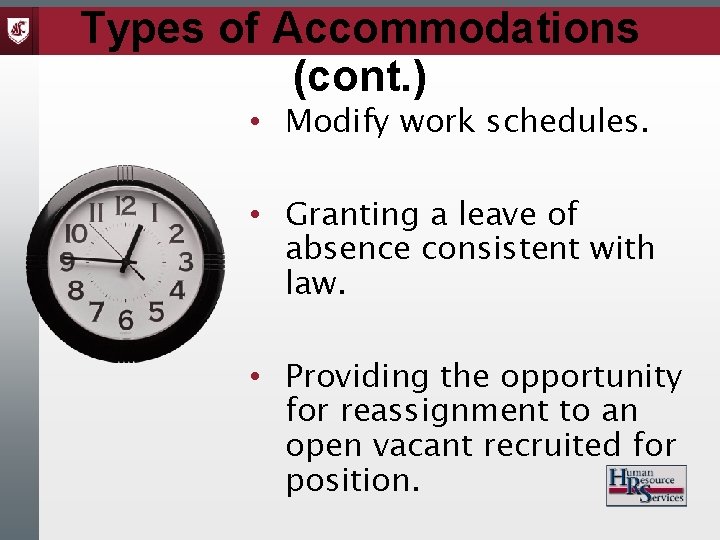
Types of Accommodations (cont. ) • Modify work schedules. • Granting a leave of absence consistent with law. • Providing the opportunity for reassignment to an open vacant recruited for position.
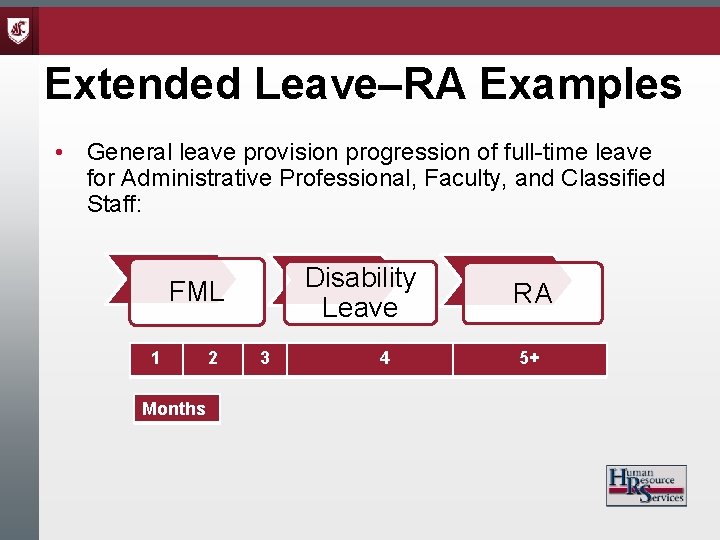
Extended Leave–RA Examples • General leave provision progression of full-time leave for Administrative Professional, Faculty, and Classified Staff: Disability Leave FML 1 Months 2 3 4 RA 5+
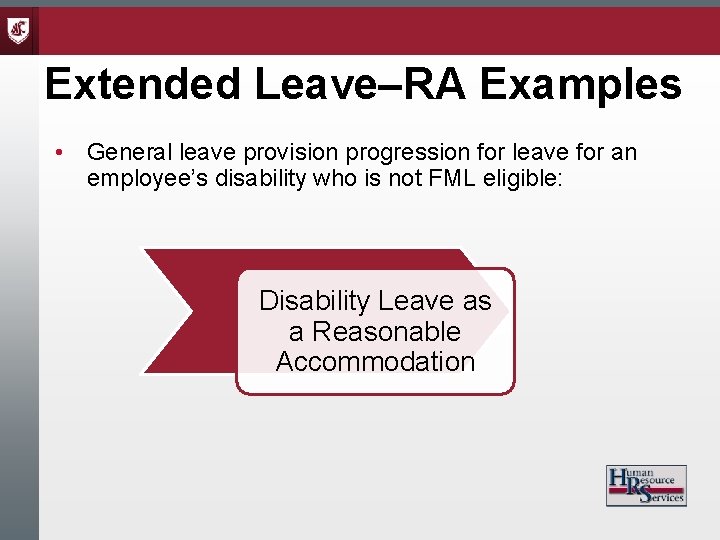
Extended Leave–RA Examples • General leave provision progression for leave for an employee’s disability who is not FML eligible: Disability Leave as a Reasonable Accommodation
Alternative Job Search (AJS) • Health Care Provider determines the employee will not be able to return to current position. OR • After going through thorough review process, the department is unable to accommodate the employee in their current position. • HRS may look university wide for: • open and recruited for positions; • at the employees same or lower salary range; • that match the employee’s accommodation requirements; • that the employee is qualified for.
Disability Separation • Medical documentation has identified the employee cannot work in any capacity. • RA options have been exhausted. • HRS Disability Services coordinates with HRS Benefits unit to determine other possible options: • Retirement. • Disability Retirement.
Department Responsibilities What to do • • Send employee to HRS. Notify HRS of the possible need for leave/RA. Send medical documentation to HRS. Keep conversations “private. ” Be an active, constructive participant in the leave and RA processes. Accommodate through the official RA process. Do not informally accommodate.
Scenario An employee in your office has been out on FML leave for two weeks and they can now return to work, but they have a permanent lifting limitation of 10 pounds. What do you take into account when looking at what, if any, accommodations are possible?
Scenario Your employee has requested several months of leave to attend to their own health condition. This leave will extend beyond their FML allotment. What do you take into account when looking at what, if any, accommodations are possible?
Scenario An employee in your department has requested a sit/stand work desk, due to their medical condition. What do you take into account when looking at what, if any, accommodations?
Resources • BPPM 60. 56 and 60. 57 (Leave). • BPPM 60. 58 (Shared Leave). • SPPM 2. 30 (Workers’ Compensation). • SPPM 2. 32 (RTW Policy). • BPPM 60. 21(RA). • Collective Bargaining Agreements. • Administrative Handbook. • Faculty Manual.
Other Resources • Office of Equal Opportunity (OEO). • EEO/AA compliance. • Disability discrimination. • ADA coordinator. • Access Center Student accommodation issues.
Questions Human Resource Services Disability Services www. hrs. wsu. edu/Disability Services 509 -335 -4521 or hrs@wsu. edu
This has been a WSU Training Videoconference If you wish to have your attendance documented in your training history, please notify Human Resource Services within 24 hours of today's date: hrstraining@wsu. edu
- Slides: 72