
Understanding and Managing Conflict ILDI MARTONFFY MD WISCONSIN
- Slides: 30
Understanding and Managing Conflict ILDI MARTONFFY, MD WISCONSIN FAMILY MEDICINE CHIEF RESIDENT RETREAT
Disclosures �No financial or other disclosures
Objectives �At the end of this presentation, chiefs will be able to: Understand sources of conflict, discussing conflict, and managing conflict Apply these themes to a practical but challenging case Discuss four survival lessons for managing conflict
Why is conflict bad? How can conflict be good? �Form groups of 3 with chiefs from different residency programs
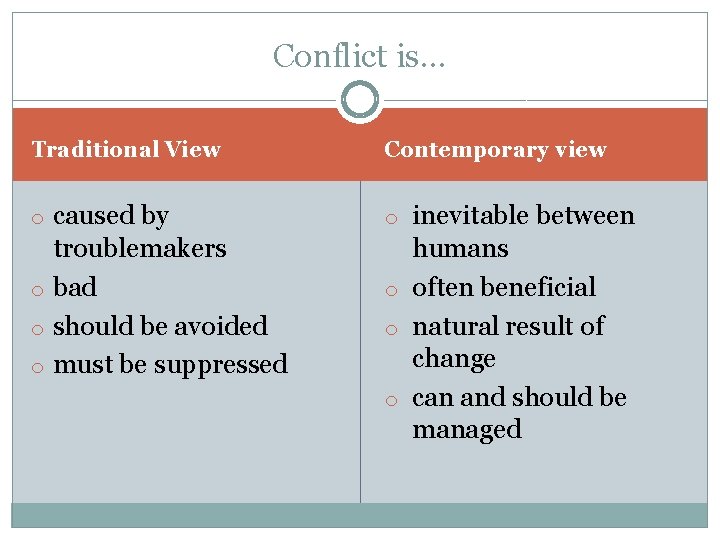
Conflict is… Traditional View Contemporary view o caused by o inevitable between troublemakers o bad o should be avoided o must be suppressed humans o often beneficial o natural result of change o can and should be managed
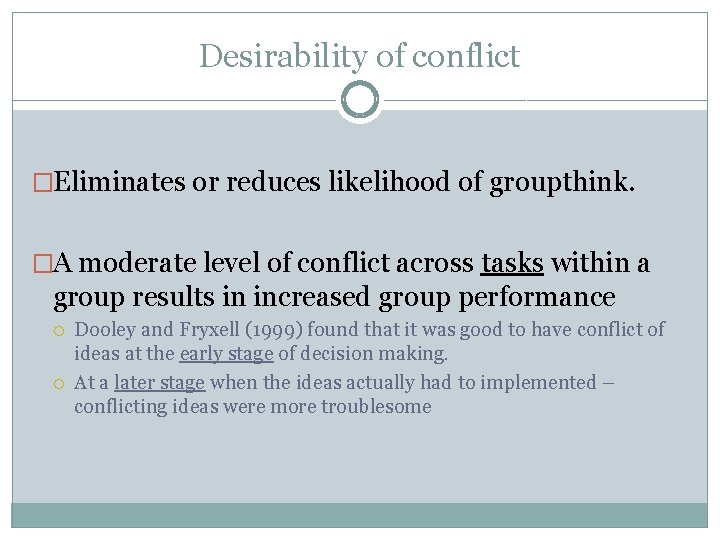
Desirability of conflict �Eliminates or reduces likelihood of groupthink. �A moderate level of conflict across tasks within a group results in increased group performance Dooley and Fryxell (1999) found that it was good to have conflict of ideas at the early stage of decision making. At a later stage when the ideas actually had to implemented – conflicting ideas were more troublesome
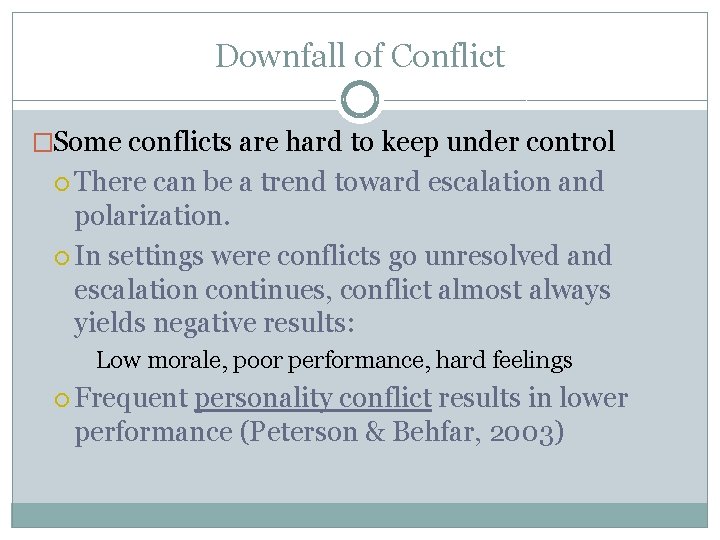
Downfall of Conflict �Some conflicts are hard to keep under control There can be a trend toward escalation and polarization. In settings were conflicts go unresolved and escalation continues, conflict almost always yields negative results: Low morale, poor performance, hard feelings Frequent personality conflict results in lower performance (Peterson & Behfar, 2003)
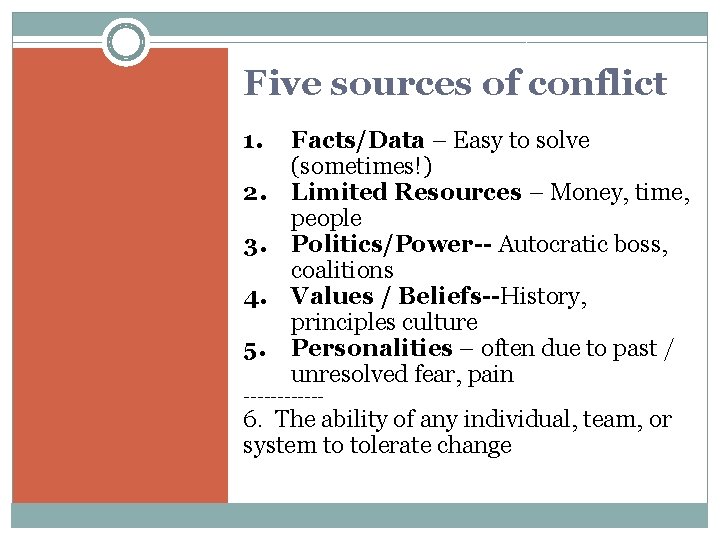
Five sources of conflict 1. 2. 3. 4. 5. Facts/Data – Easy to solve (sometimes!) Limited Resources – Money, time, people Politics/Power-- Autocratic boss, coalitions Values / Beliefs--History, principles culture Personalities – often due to past / unresolved fear, pain ------ 6. The ability of any individual, team, or system to tolerate change
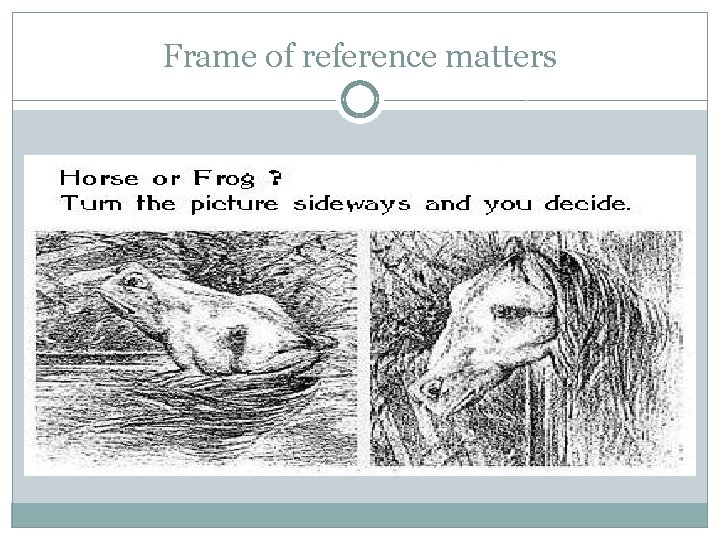
Frame of reference matters
Group work-team conflict 1. 2. 3. In your group, think of a case that one of you experienced that involved conflict within a teamwork setting (okay to change details of the case to protect those involved). Was it a conflict of… FACTS/DATA LIMITED RESOURCES POLITICS/POWER VALUES - BELIEFS PERSONALITIES What went well? What didn’t go well?
Discussing or raising conflict is often more difficult than resolving it.
Discussing/Raising conflict WHEN conflict comes to a chief’s attention, a crucial skill is knowing how to raise / follow up. Raising conflict could mean one or more: 1) discuss with others, including residents, staff or program director, 2) monitor and discuss again with key person/s, 3) keep notes about the conflict, what was known/ what was done. Six factors to consider…
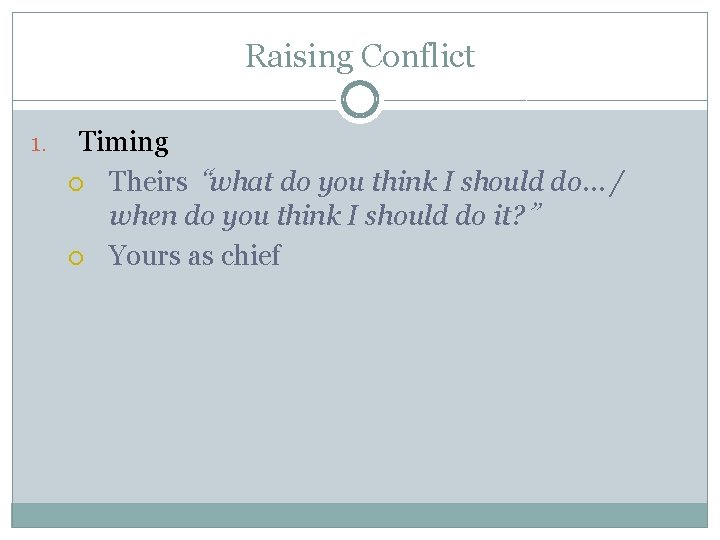
Raising Conflict 1. Timing Theirs “what do you think I should do… / when do you think I should do it? ” Yours as chief
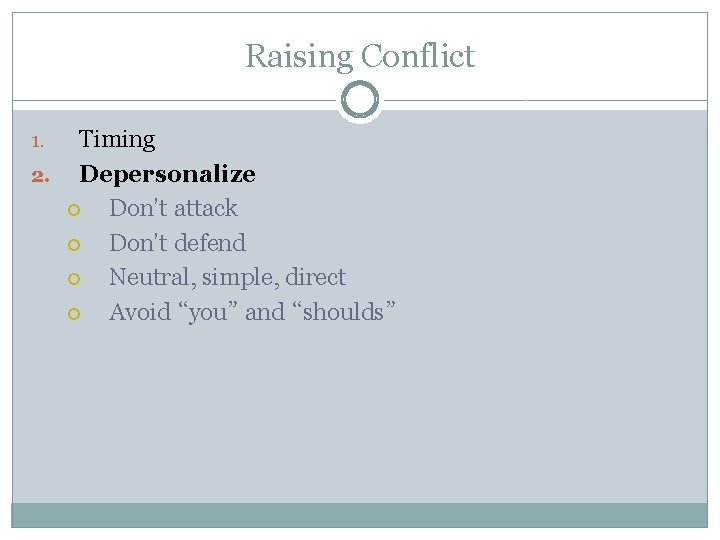
Raising Conflict Timing 2. Depersonalize Don’t attack Don’t defend Neutral, simple, direct Avoid “you” and “shoulds” 1.
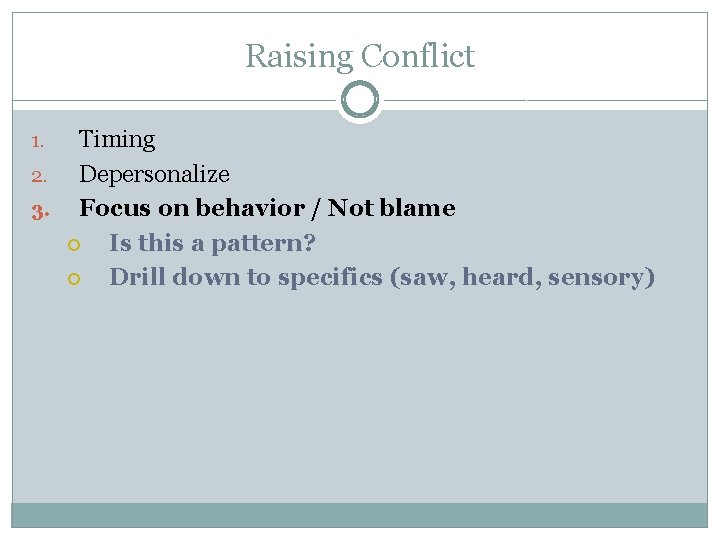
Raising Conflict Timing 2. Depersonalize 3. Focus on behavior / Not blame Is this a pattern? Drill down to specifics (saw, heard, sensory) 1.
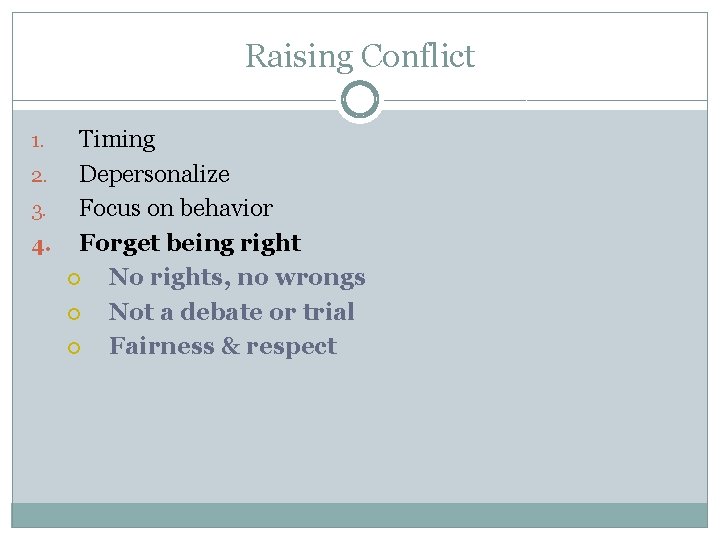
Raising Conflict Timing 2. Depersonalize 3. Focus on behavior 4. Forget being right No rights, no wrongs Not a debate or trial Fairness & respect 1.
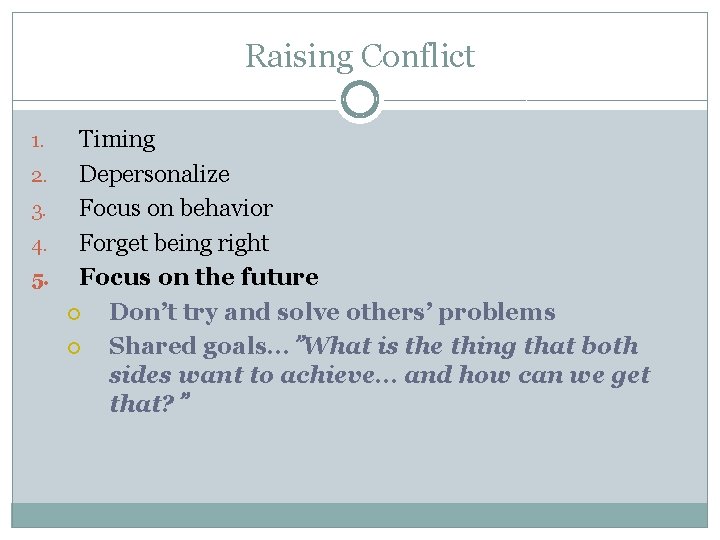
Raising Conflict 1. 2. 3. 4. 5. Timing Depersonalize Focus on behavior Forget being right Focus on the future Don’t try and solve others’ problems Shared goals…”What is the thing that both sides want to achieve… and how can we get that? ”
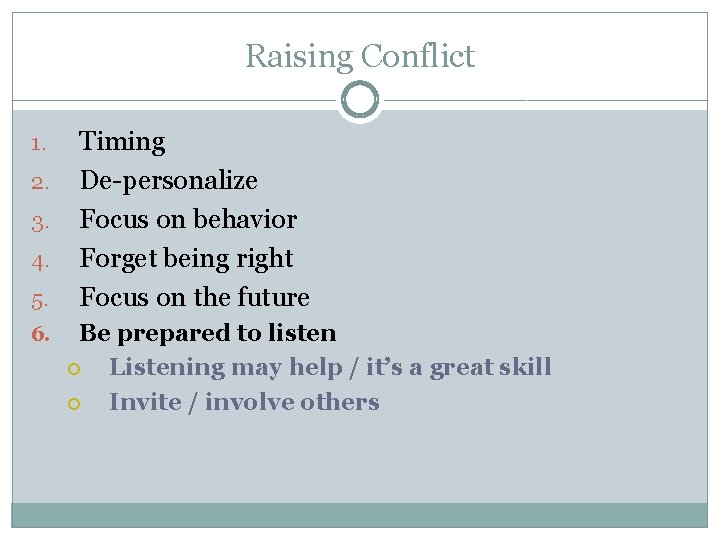
Raising Conflict 1. 2. 3. 4. 5. 6. Timing De-personalize Focus on behavior Forget being right Focus on the future Be prepared to listen Listening may help / it’s a great skill Invite / involve others
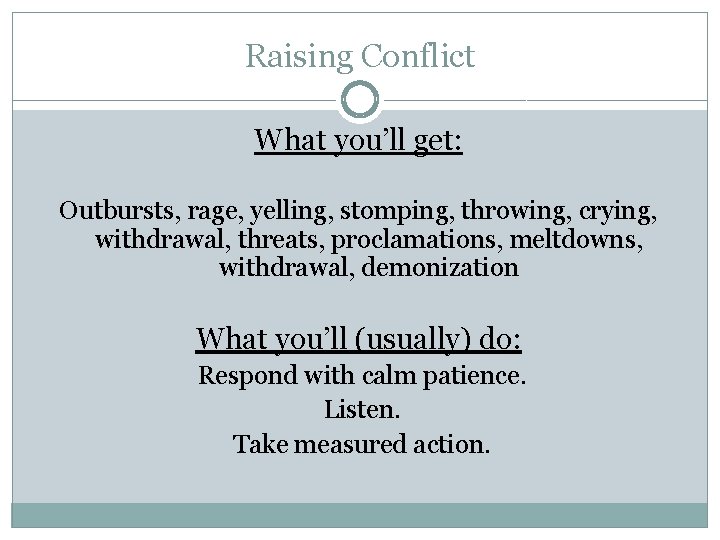
Raising Conflict What you’ll get: Outbursts, rage, yelling, stomping, throwing, crying, withdrawal, threats, proclamations, meltdowns, withdrawal, demonization What you’ll (usually) do: Respond with calm patience. Listen. Take measured action.
Back to your case �How was this conflict discussed/raised? �Who was it discussed with (who were the involved parties)? �Is there anything that could have been done differently or better when the conflict was raised or discussed? If so, how?
Conflict resolution is the ideal. Conflict management is the reality.
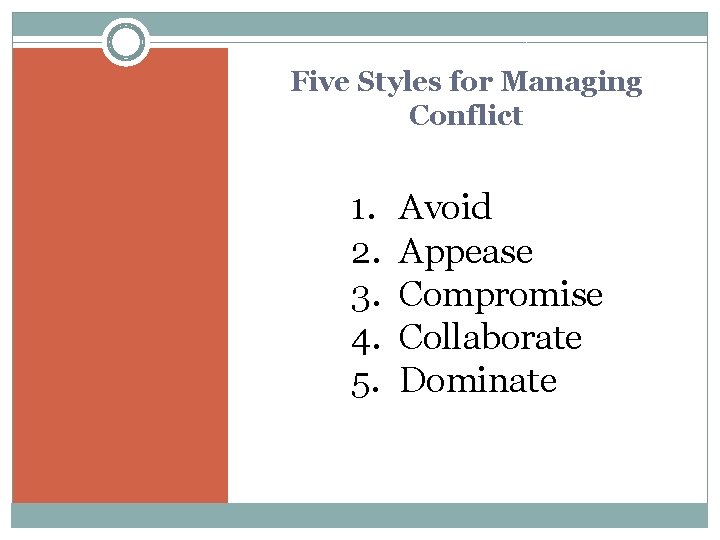
Five Styles for Managing Conflict 1. 2. 3. 4. 5. Avoid Appease Compromise Collaborate Dominate
Think of teamwork situation you have witnessed 1. How was the conflict dealt with? Avoid Appease Compromise Collaborate Dominate 2. What part of the approach worked? What didn’t work? 3. Do you have a primary or secondary style for dealing with conflict? 4. Should your style vary by situation/setting?
Four Survival Lessons from the Field
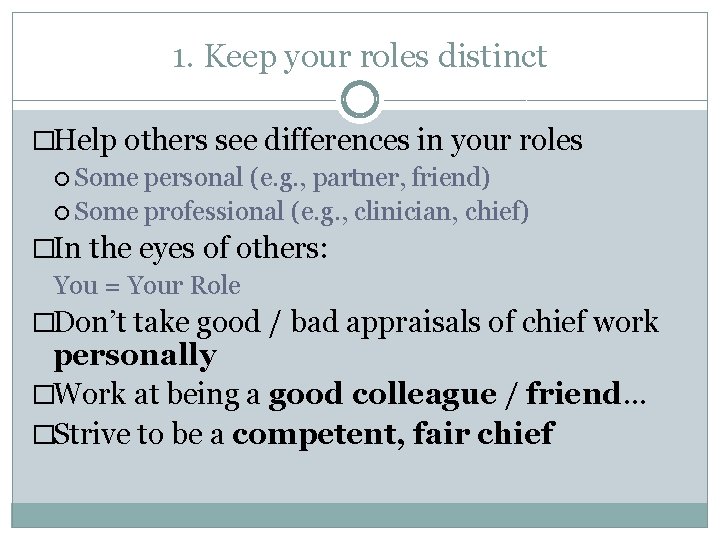
1. Keep your roles distinct �Help others see differences in your roles Some personal (e. g. , partner, friend) Some professional (e. g. , clinician, chief) �In the eyes of others: You = Your Role �Don’t take good / bad appraisals of chief work personally �Work at being a good colleague / friend… �Strive to be a competent, fair chief
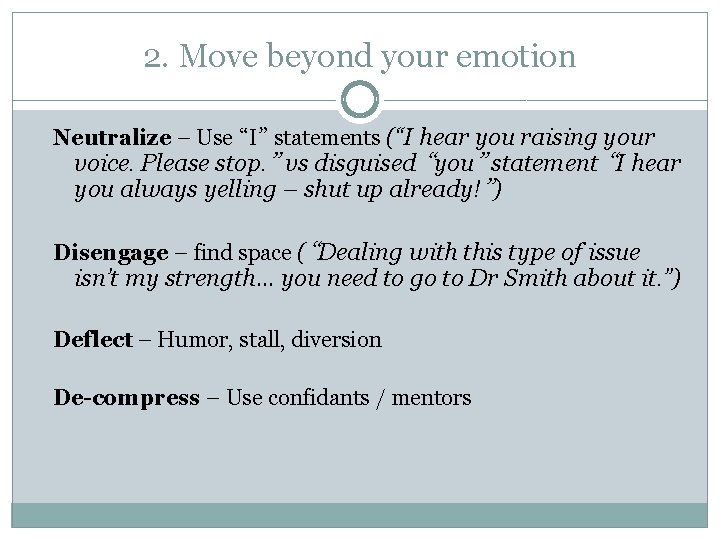
2. Move beyond your emotion Neutralize – Use “I” statements (“I hear you raising your voice. Please stop. ” vs disguised “you” statement “I hear you always yelling – shut up already!”) Disengage – find space (“Dealing with this type of issue isn’t my strength… you need to go to Dr Smith about it. ”) Deflect – Humor, stall, diversion De-compress – Use confidants / mentors
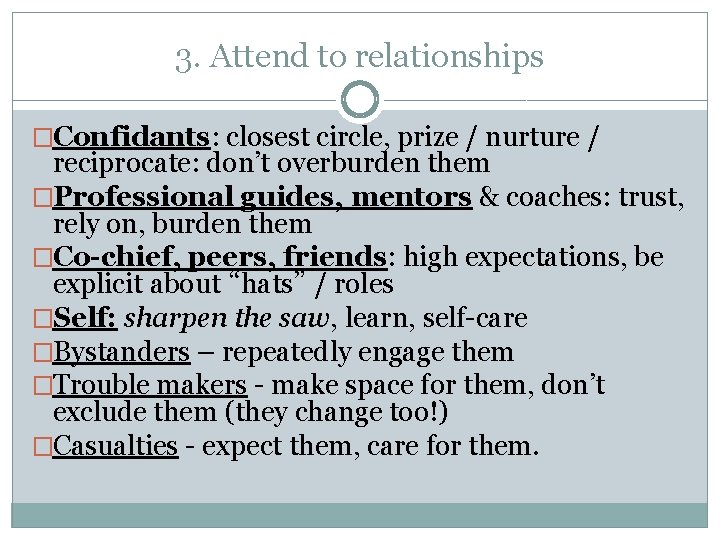
3. Attend to relationships �Confidants: closest circle, prize / nurture / reciprocate: don’t overburden them �Professional guides, mentors & coaches: trust, rely on, burden them �Co-chief, peers, friends: high expectations, be explicit about “hats” / roles �Self: sharpen the saw, learn, self-care �Bystanders – repeatedly engage them �Trouble makers - make space for them, don’t exclude them (they change too!) �Casualties - expect them, care for them.
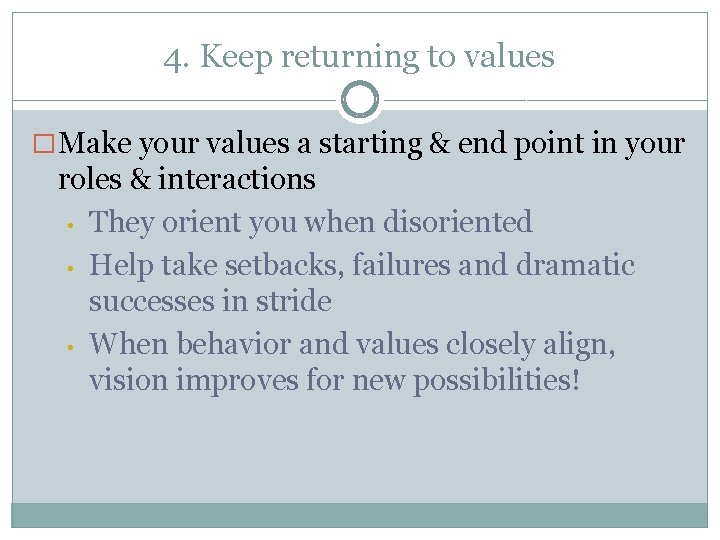
4. Keep returning to values � Make your values a starting & end point in your roles & interactions • They orient you when disoriented • Help take setbacks, failures and dramatic successes in stride • When behavior and values closely align, vision improves for new possibilities!
We discussed several themes about conflict that are likely to be useful for chiefs: Five common sources of conflict Six factors to consider when discussing/raising conflict Five styles of managing conflict We explored these themes in relation to a practical but challenging case We reviewed four survival lessons. Any final thoughts or questions? Thank you
Additional references 1. 2. 3. 4. 5. 6. Bolman LG, Deal TE. Reframing rd Organizations: Artistry, Choice and Leadership. Jossey-Bass. 1997 (3 Edition is 2003) Daloz LA. Effective Teaching and Mentoring: Realizing the transformational power of adult learning experiences. Jossey-Bass. nd 1986. (2 Edition called “Mentor” was published in 1999) Manning G, Curtis K. The Art of Leadership. Mc. Graw-Hill. 2003. Morzinski JA. Mentors, colleagues and successful health science faculty: Lessons from the field. Journal of Veterinary Medical Education, 2005; 32(1): 5 -11. Morzinski JA, Weldelberger-Marcdante K. Building administrative skills: A framework for junior faculty. Academic Medicine, 1999; 74(5): 142. Patterson K, Grenny J, Mc. Millan R, Switzler A. Crucial Conversations: Tools for talking when stakes are high. Mc. Graw-Hill. 2002. Website: vitalsmarts. com Large thanks to Kathy Oriel, MD, who initially created this presentation.