
Understanding and Getting More From The NFPA Process
- Slides: 28
Understanding and Getting More From The NFPA Process I - The standards making system II - Effectively working within the process to get what you want III - Where are we in the current cycle
Part I - NFPA’s Codes and Standards Making System
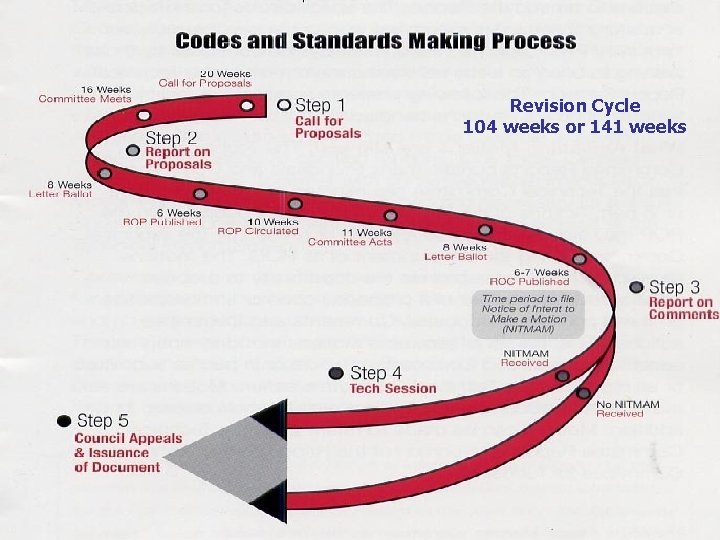
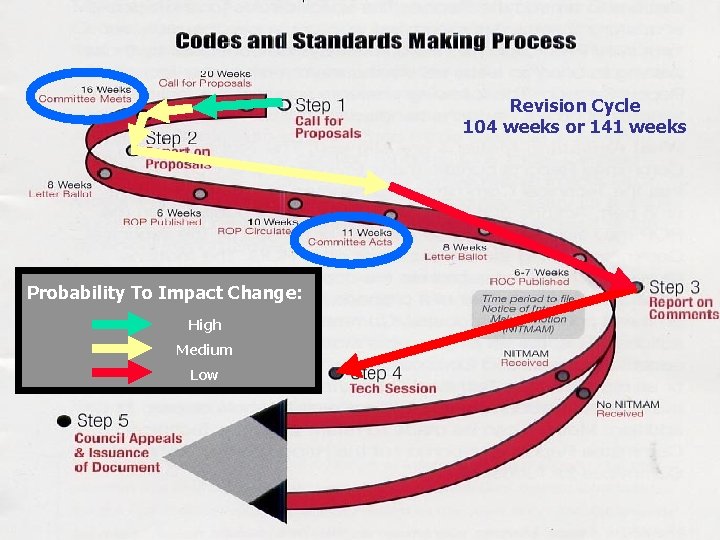
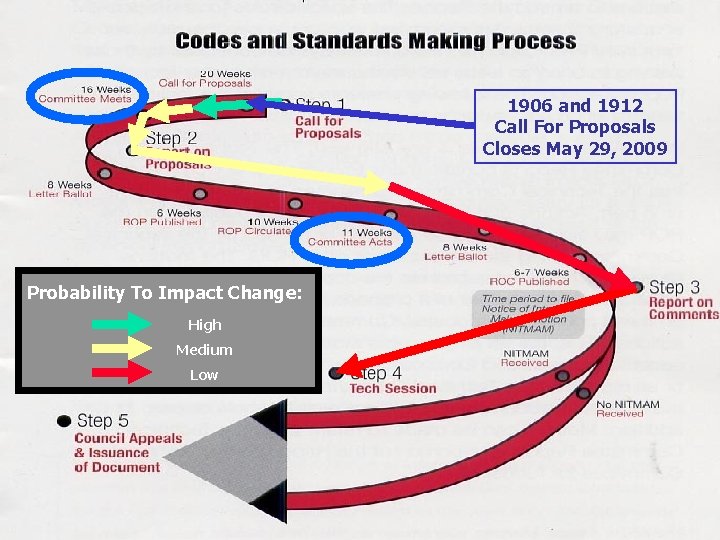
Revision Cycle 104 weeks or 141 weeks
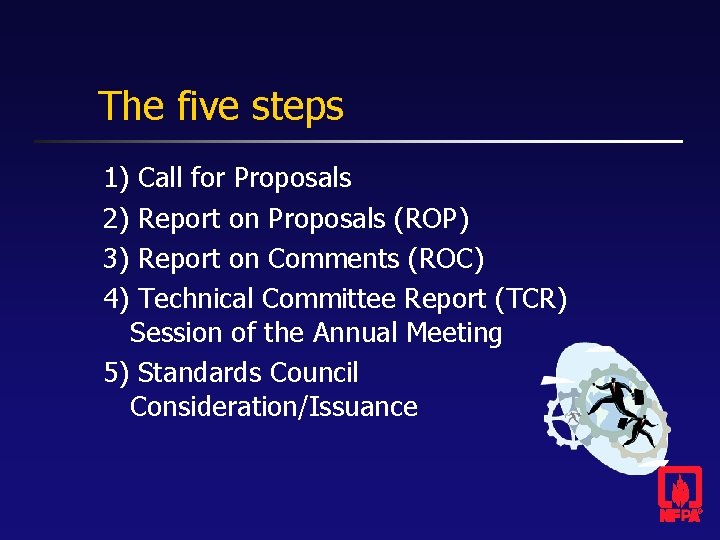
The five steps 1) 2) 3) 4) Call for Proposals Report on Proposals (ROP) Report on Comments (ROC) Technical Committee Report (TCR) Session of the Annual Meeting 5) Standards Council Consideration/Issuance
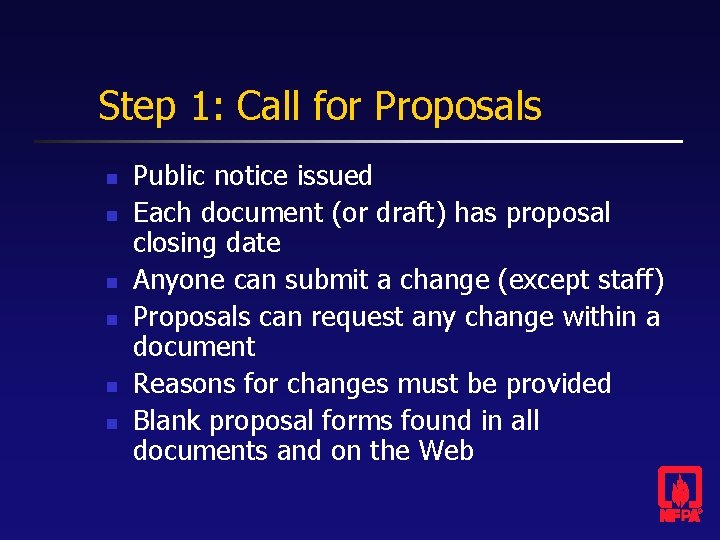
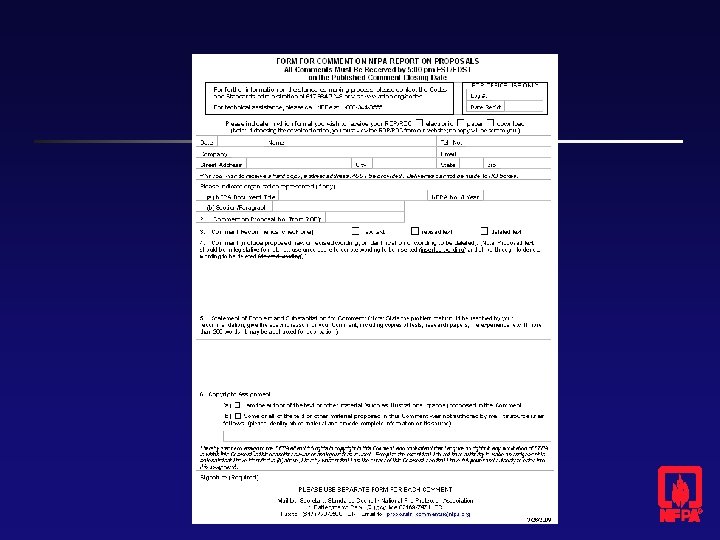
Step 1: Call for Proposals n n n Public notice issued Each document (or draft) has proposal closing date Anyone can submit a change (except staff) Proposals can request any change within a document Reasons for changes must be provided Blank proposal forms found in all documents and on the Web
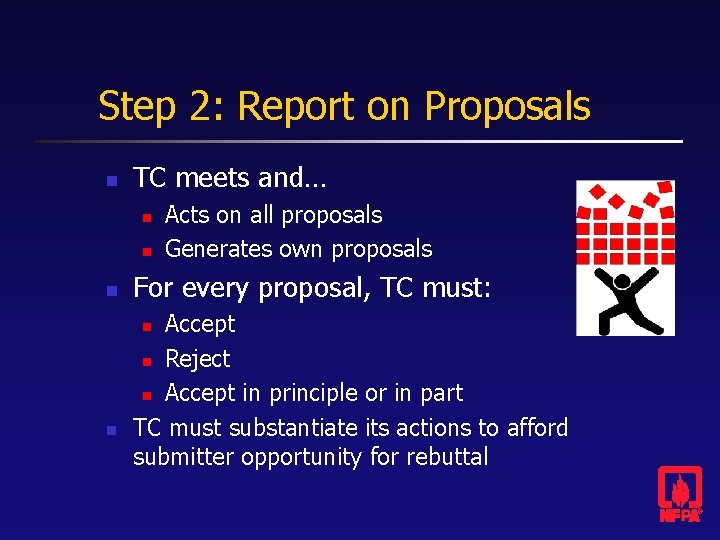
Step 2: Report on Proposals n TC meets and… n n n For every proposal, TC must: Accept n Reject n Accept in principle or in part TC must substantiate its actions to afford submitter opportunity for rebuttal n n Acts on all proposals Generates own proposals
Step 2: Report on Proposals n n n TC is letter balloted on all actions (2/3 majority required) TCC is letter balloted on all actions (3/4 majority required) All proposals published (in ROP) & widely distributed
Step 3: Report on Comments n n Anyone can comment on any proposed change (in ROP) Reasons for comments must be provided Blank comment form in each ROP and on web Deadline for submission published
Step 3: Report on Comments n TC meets and… n n n For every comment, TC must: n n n Acts on all comments Generates own comments Accept; Reject; Accept in principle / part Hold (if new material) TC must substantiate its actions to afford submitter opportunity for rebuttal
Step 3: Report on Comments n n n TC is letter balloted on all actions (2/3 majority required) TCC is letter balloted on all actions (3/4 majority required) All comments published (in ROC) & widely distributed
Step 4: TCR Session Step 5: Standards Council Issuance n Process is handed off from the Technical Committee to the Standards Council n n Out of our hands Not yet cast in concrete – but pretty much in final form
Step 4: TCR Session n n Motions Committee of SC reviews NITMAMs and certifies motions Limitations on types of motions that can be made Motions based on ROP and ROC (cannot introduce new material) Limitations on who can make a motion
Part II – Effectively Working Within The Process To Get What You Want
Must Do’s. . . n n Communication / Organization Be Involved - Early and Often Making An Effective Proposal Getting The Votes
Communication n Inter – Company n FAMA updates n n n General membership meetings Tech Committee meetings Intra – Company n n Who should attend – YOU If not you – someone who shares your vision n Discuss key issues – where you stand
Be Involved - Early and Often n Follow the process and use it to your advantage n n n Submit your comments early in the process Documentation & supporting info helpful Be actively involved n Attend and participate in all of the meetings
Revision Cycle 104 weeks or 141 weeks Probability To Impact Change: High Medium Low
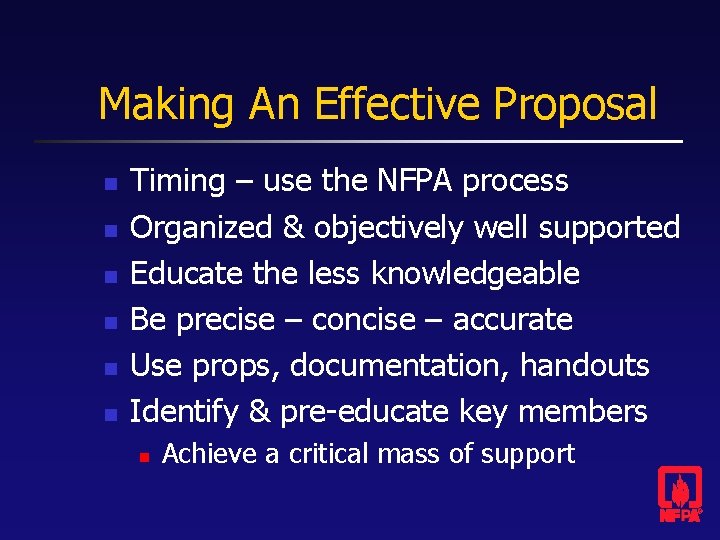
Making An Effective Proposal n n n Timing – use the NFPA process Organized & objectively well supported Educate the less knowledgeable Be precise – concise – accurate Use props, documentation, handouts Identify & pre-educate key members n Achieve a critical mass of support
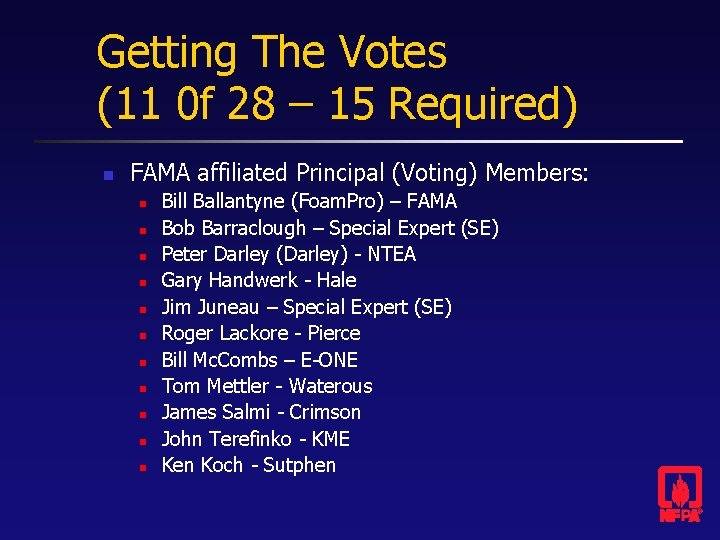
Getting The Votes (11 0 f 28 – 15 Required) n FAMA affiliated Principal (Voting) Members: n n n Bill Ballantyne (Foam. Pro) – FAMA Bob Barraclough – Special Expert (SE) Peter Darley (Darley) - NTEA Gary Handwerk - Hale Jim Juneau – Special Expert (SE) Roger Lackore - Pierce Bill Mc. Combs – E-ONE Tom Mettler - Waterous James Salmi - Crimson John Terefinko - KME Ken Koch - Sutphen
Part III – Where Are We In The Current Document Cycle
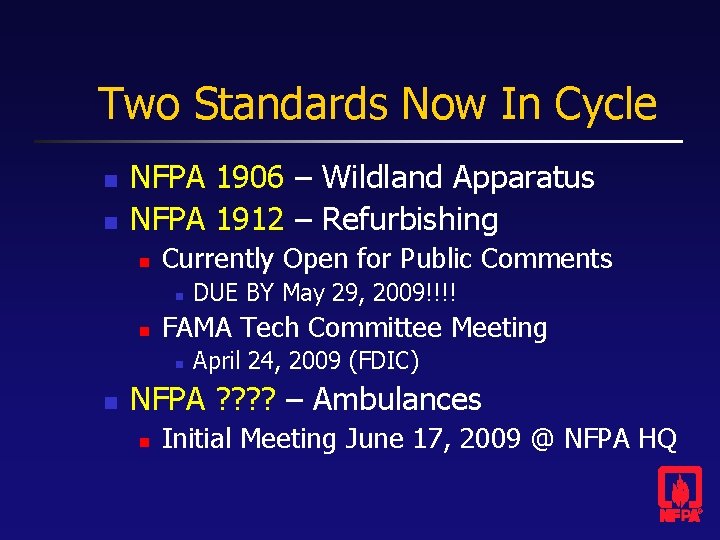
Two Standards Now In Cycle n n NFPA 1906 – Wildland Apparatus NFPA 1912 – Refurbishing n Currently Open for Public Comments n n FAMA Tech Committee Meeting n n DUE BY May 29, 2009!!!! April 24, 2009 (FDIC) NFPA ? ? – Ambulances n Initial Meeting June 17, 2009 @ NFPA HQ
1906 and 1912 Call For Proposals Closes May 29, 2009 Probability To Impact Change: High Medium Low
Questions