
Understanding and Enhancing Client Capacity for David Godfrey
![MRPC 1. 14 Comment 1 [1] The normal client-lawyer relationship is based on the](https://slidetodoc.com/presentation_image_h2/1a136bb03e0cdc8204187b7f9da3e966/image-21.jpg "MRPC 1. 14 Comment 1 [1] The normal client-lawyer relationship is based on the")
![MRPC 1. 14 Comments 2 – 3 [2] The fact that a client suffers](https://slidetodoc.com/presentation_image_h2/1a136bb03e0cdc8204187b7f9da3e966/image-22.jpg "MRPC 1. 14 Comments 2 – 3 [2] The fact that a client suffers")




- Slides: 52
Understanding and Enhancing Client Capacity for David Godfrey, JD, Senior Attorney, ABA Commission On Law And Aging Washington, DC
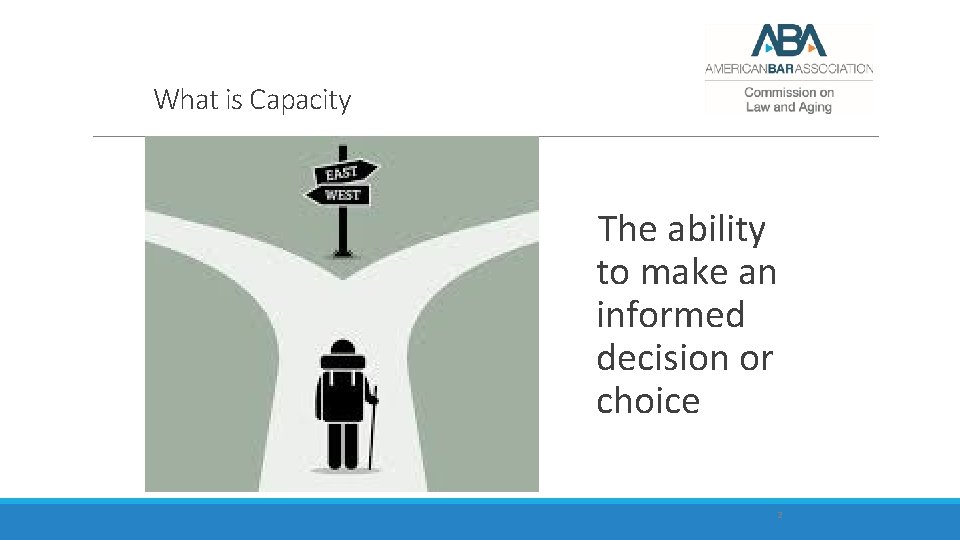
What is Capacity The ability to make an informed decision or choice 2
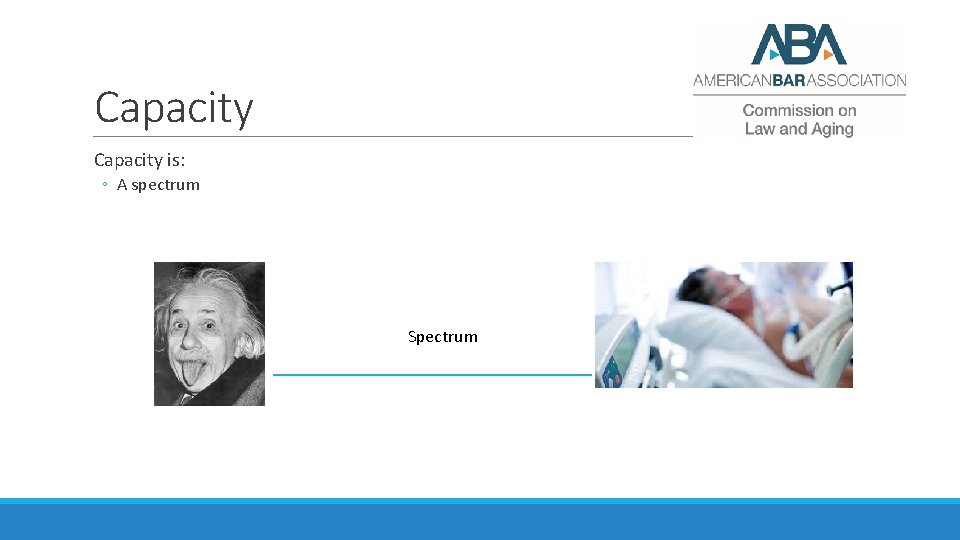
Capacity is: ◦ A spectrum Spectrum
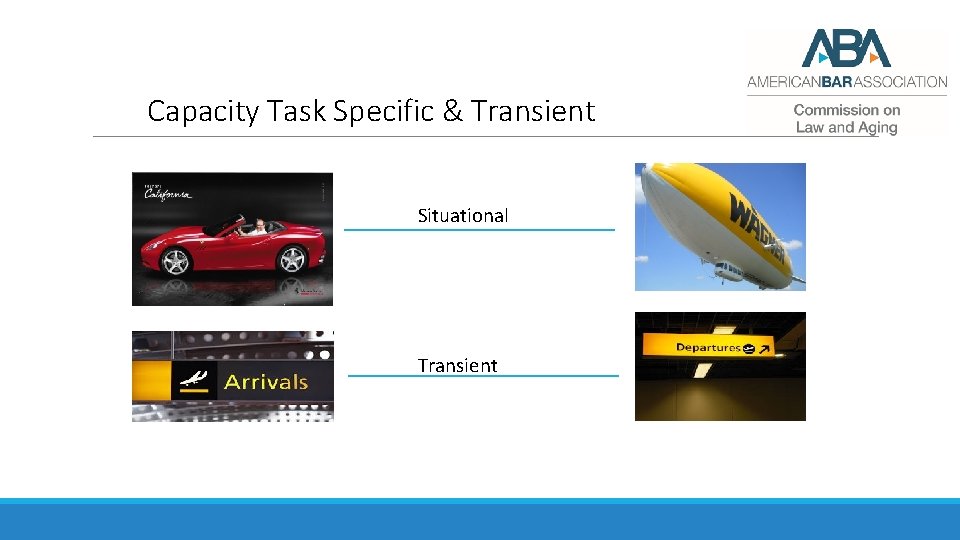
Capacity Task Specific & Transient Situational Transient
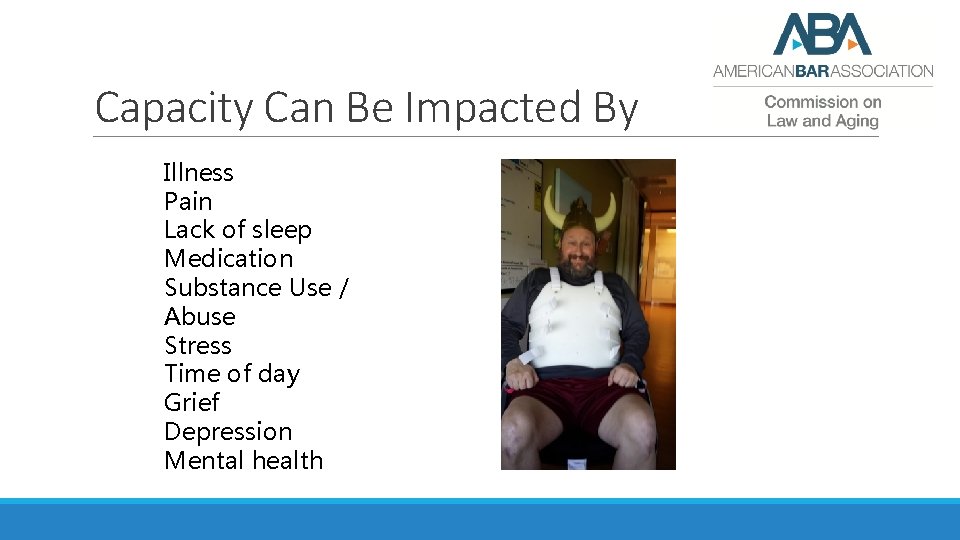
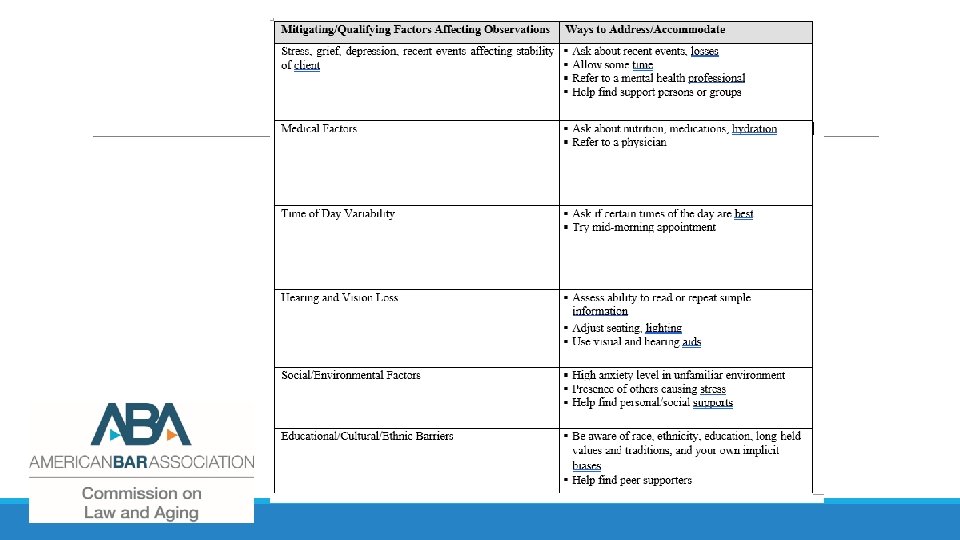
Capacity Can Be Impacted By Illness Pain Lack of sleep Medication Substance Use / Abuse Stress Time of day Grief Depression Mental health
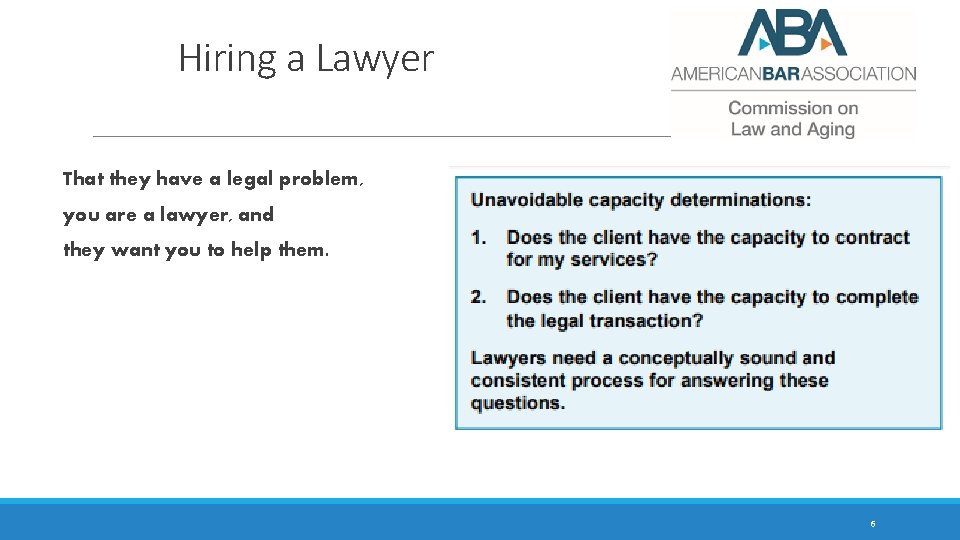
Hiring a Lawyer That they have a legal problem, you are a lawyer, and they want you to help them. 6
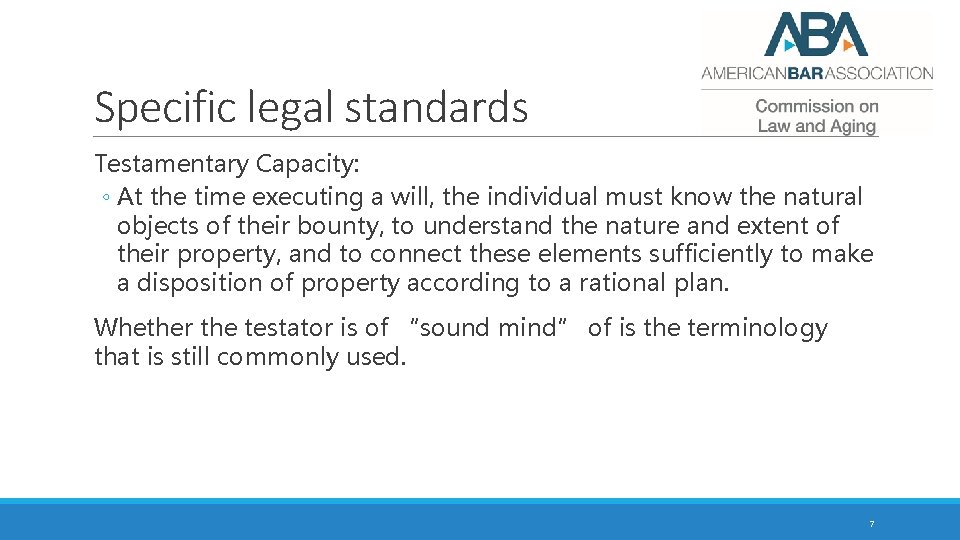
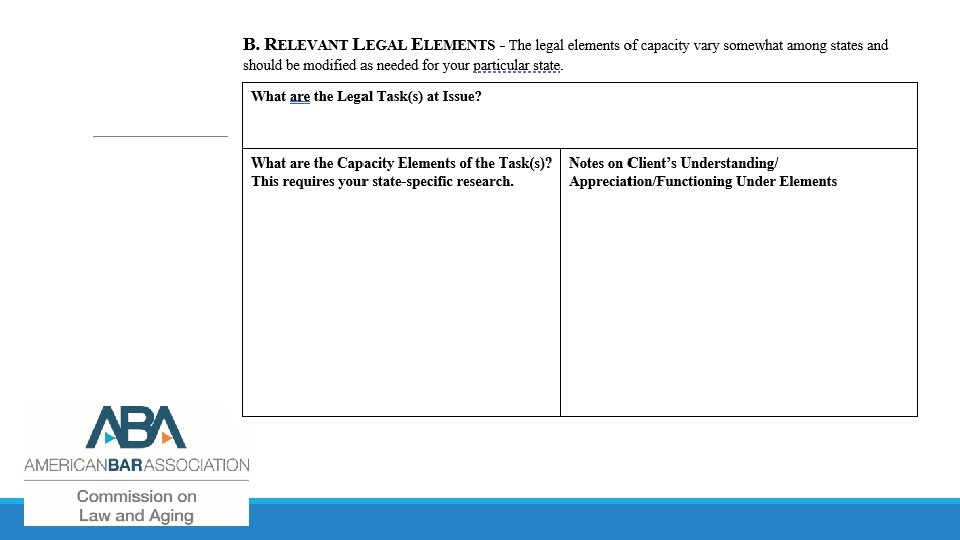
Specific legal standards Testamentary Capacity: ◦ At the time executing a will, the individual must know the natural objects of their bounty, to understand the nature and extent of their property, and to connect these elements sufficiently to make a disposition of property according to a rational plan. Whether the testator is of “sound mind” of is the terminology that is still commonly used. 7
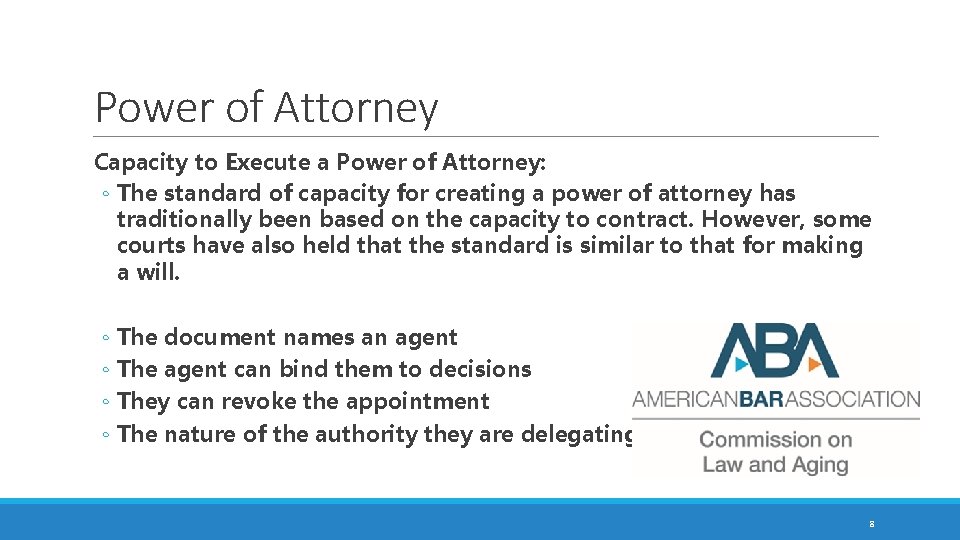
Power of Attorney Capacity to Execute a Power of Attorney: ◦ The standard of capacity for creating a power of attorney has traditionally been based on the capacity to contract. However, some courts have also held that the standard is similar to that for making a will. ◦ The document names an agent ◦ The agent can bind them to decisions ◦ They can revoke the appointment ◦ The nature of the authority they are delegating 8
Contractual Capacity Courts generally assess the party’s ability to understand the nature and effect of the act and the business being transacted. If the act or business being transacted is highly complicated, a higher level of understanding may be needed to comprehend its nature and effect. 9
Capacity to Convey Real Property To execute a deed, a grantor typically must be able to understand the nature and effect of the act at the time the conveyance is made. In other words: ◦ Transferring rights in the real property to another. ◦ No longer having the right to use or occupy. ◦ Not being able to reclaim use or occupancy. 10
Capacity, if Not Stated Understand essential legal elements Understand options Understands consequences of choice Able to make a choice 11
Case Example: Edna and Bill have been married for 62 years. They arrive for your meeting and Edna does the talking, saying that they want to leave everything to each other, then when second one dies, in equal shares to their three children. Edna wants to be named as the agent in a power of attorney and as heath care surrogate for Bill. For her power of attorney and health care surrogate Edna wants to name their oldest son. You ask Bill what he wants, he says, “whatever Edna says will be fine. ” You ask Bill the names of his children, and he responds, “ask Edna. ” You ask him what bank their life savings is in, and he turns to Edna and says, “you know that don’t you? ” 12
Poll #1: What are the Red Flags? A: Edna’s speaking for both of them B: Edna’s choice for her agents C: Bill’s deferring to Edna D: Bill’s inability to answer basic questions E: All of the above 13
What Do The Model Rules Say About Capacity?
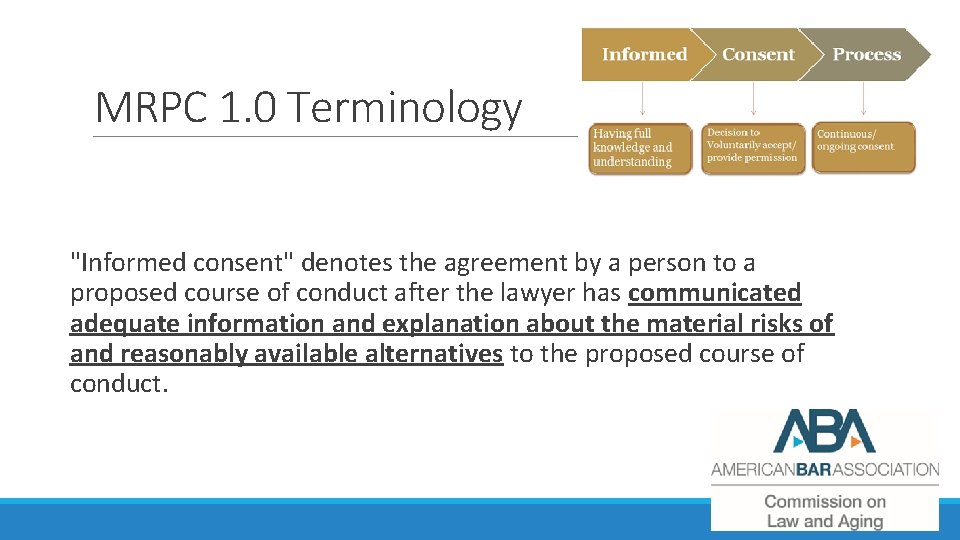
MRPC 1. 0 Terminology "Informed consent" denotes the agreement by a person to a proposed course of conduct after the lawyer has communicated adequate information and explanation about the material risks of and reasonably available alternatives to the proposed course of conduct.
Model Rules of Professional Conduct 1. 4 (a) A lawyer shall: (3) keep the client reasonably informed about the status of the matter; (b) A lawyer shall explain a matter to the extent reasonably necessary to permit the client to make informed decisions regarding the representation.
MRPC 1. 2: Scope Of Representation & Allocation Of Authority Between Client & Lawyer (a) Subject to paragraphs (c) and (d), a lawyer shall abide by a client's decisions concerning the objectives of representation and, as required by Rule 1. 4, shall consult with the client as to the means by which they are to be pursued. A lawyer may take such action on behalf of the client as is impliedly authorized to carry out the representation. A lawyer shall abide by a client's decision whether to settle a matter. In a criminal case, the lawyer shall abide by the client's decision, after consultation with the lawyer, as to a plea to be entered, whether to waive jury trial and whether the client will testify.
How do We Get To Capacity From That? A client has capacity if we are able to communicate in a way that the client can understand, to the degree necessary for the client to give informed consent regarding the objectives (goals) of the representation. If not, the client has diminished capacity. 18
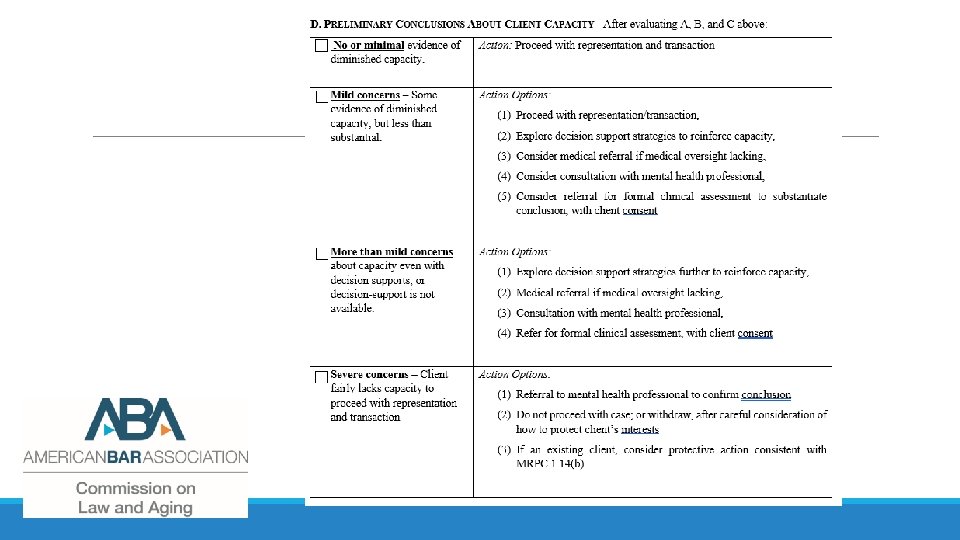
MRPC 1. 14 A Client With Diminished Capacity Client-Lawyer Relationship (a) When a client's capacity to make adequately considered decisions in connection with a representation is diminished, whether because of minority, mental impairment or for some other reason, the lawyer shall, as far as reasonably possible, maintain a normal client-lawyer relationship with the client.
Tell Me More MRPC 1. 14 (b) When the lawyer reasonably believes that the client has diminished capacity, is at risk of substantial physical, financial or other harm unless action is taken and cannot adequately act in the client's own interest, the lawyer may take reasonably necessary protective action, including consulting with individuals or entities that have the ability to take action to protect the client and, in appropriate cases, seeking the appointment of a guardian ad litem, conservator or guardian.
MRPC 1. 14 Comment 1 [1] The normal client-lawyer relationship is based on the assumption that the client, when properly advised and assisted, is capable of making decisions about important matters. When the client is a minor or suffers from a diminished mental capacity, however, maintaining the ordinary client-lawyer relationship may not be possible in all respects. In particular, a severely incapacitated person may have no power to make legally binding decisions. Nevertheless, a client with diminished capacity often has the ability to understand, deliberate upon, and reach conclusions about matters affecting the client's own wellbeing. For example, children as young as five or six years of age, and certainly those of ten or twelve, are regarded as having opinions that are entitled to weight in legal proceedings concerning their custody. So also, it is recognized that some persons of advanced age can be quite capable of handling routine financial matters while needing special legal protection concerning major transactions.
MRPC 1. 14 Comments 2 – 3 [2] The fact that a client suffers a disability does not diminish the lawyer's obligation to treat the client with attention and respect. Even if the person has a legal representative, the lawyer should as far as possible accord the represented person the status of client, particularly in maintaining communication. [3] The client may wish to have family members or other persons participate in discussions with the lawyer. When necessary to assist in the representation, the presence of such persons generally does not affect the applicability of the attorney-client evidentiary privilege. Nevertheless, the lawyer must keep the client's interests foremost and, except for protective action authorized under paragraph (b), must look to the client, and not family members, to make decisions on the client's behalf.
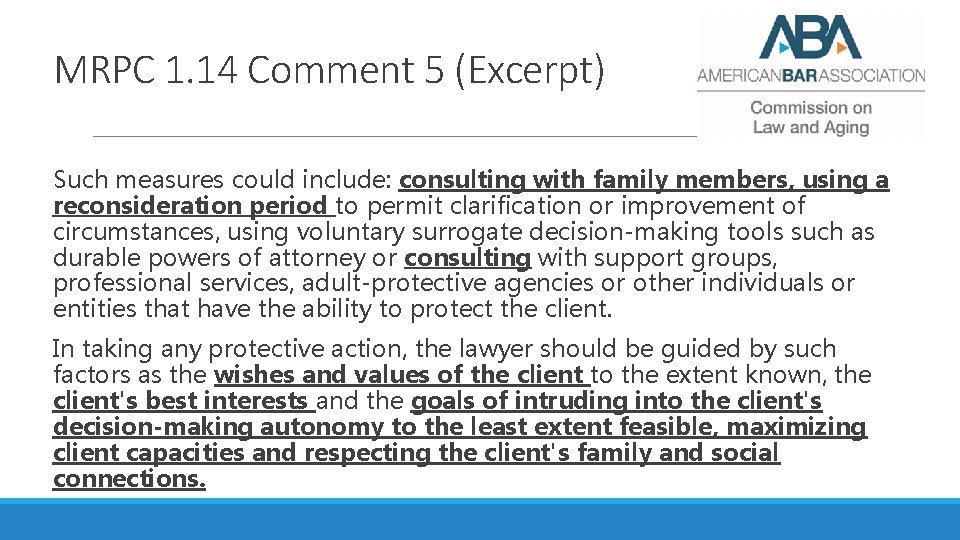
MRPC 1. 14 Comment 5 (Excerpt) Such measures could include: consulting with family members, using a reconsideration period to permit clarification or improvement of circumstances, using voluntary surrogate decision-making tools such as durable powers of attorney or consulting with support groups, professional services, adult-protective agencies or other individuals or entities that have the ability to protect the client. In taking any protective action, the lawyer should be guided by such factors as the wishes and values of the client to the extent known, the client's best interests and the goals of intruding into the client's decision-making autonomy to the least extent feasible, maximizing client capacities and respecting the client's family and social connections.
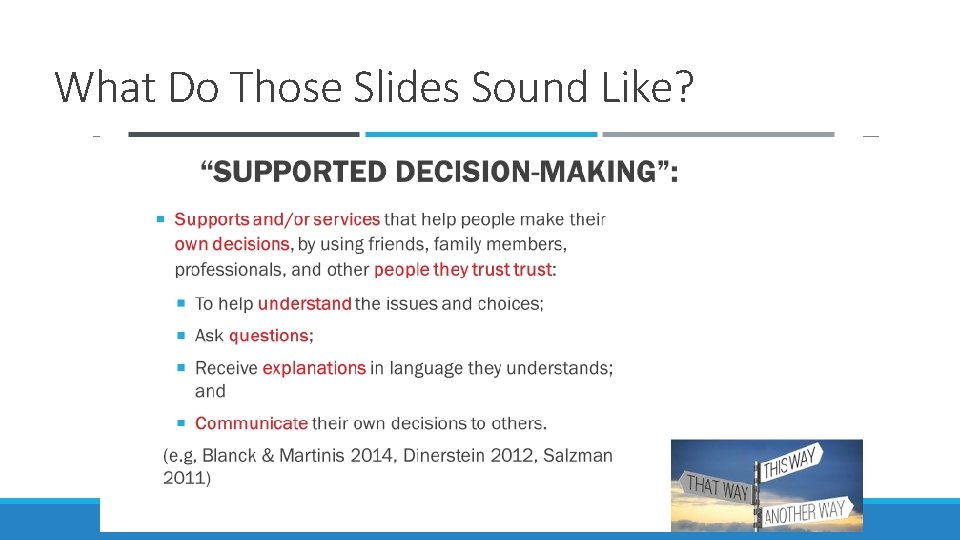
What Do Those Slides Sound Like?
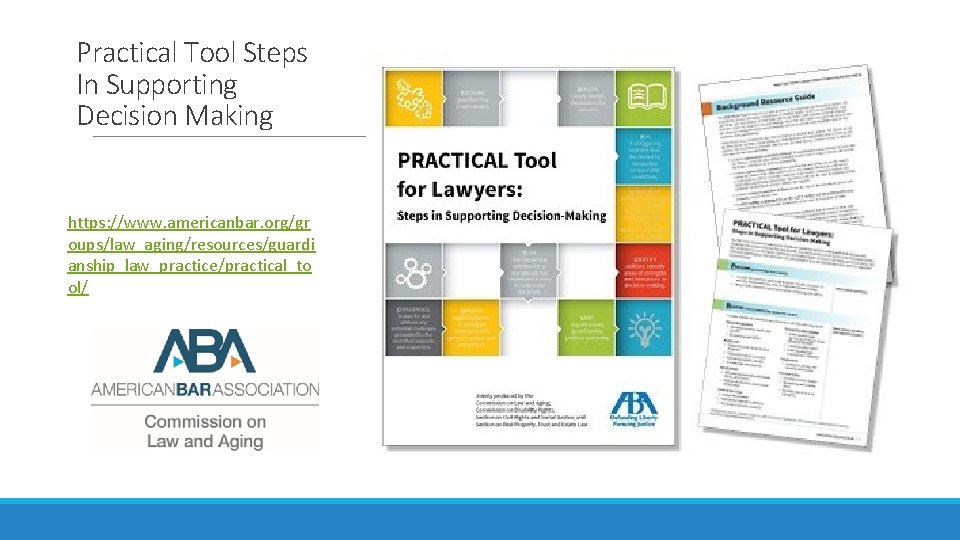
Practical Tool Steps In Supporting Decision Making https: //www. americanbar. org/gr oups/law_aging/resources/guardi anship_law_practice/practical_to ol/
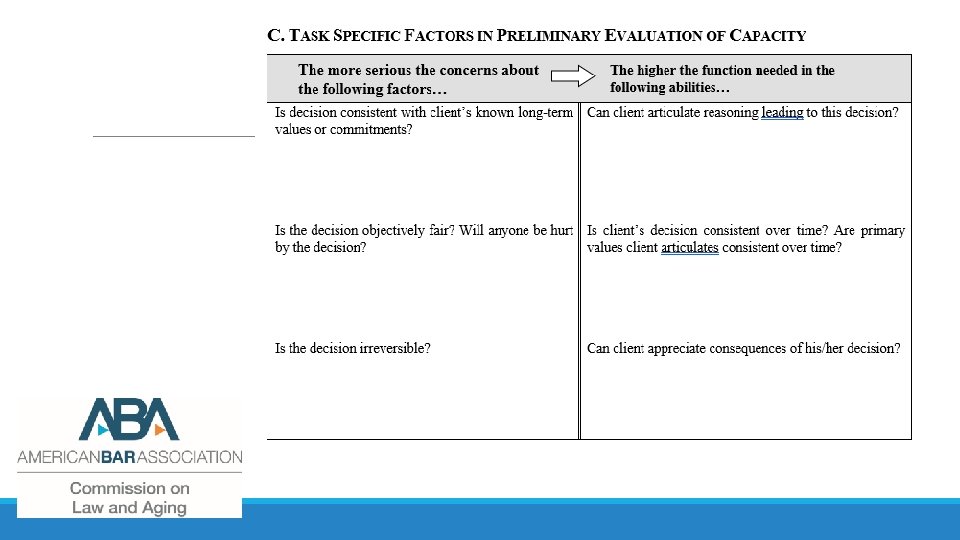
How Do We Assess Capacity? We do it every time we communicate interactively There Is No Simple Test, Look To The Totality Of The Circumstances – The Clients Ability To Communicate And Give Informed Consent When In Doubt, Seek Guidance Before Proceeding
How Lawyers need to make an independent judgement on legal capacity. ◦ To do this it is essential that you privately meet with the Client ◦ Capacity is complex, when there are concerns multiple meetings can help with understanding. ◦ Assess the client's ability to understand make informed choices. While other professionals make determinations of capacity ◦ Only a Court order, modifies or restricts legal capacity ◦ A person with a guardian or conservator, may be able to communicate choices, preferences, beliefs and values.
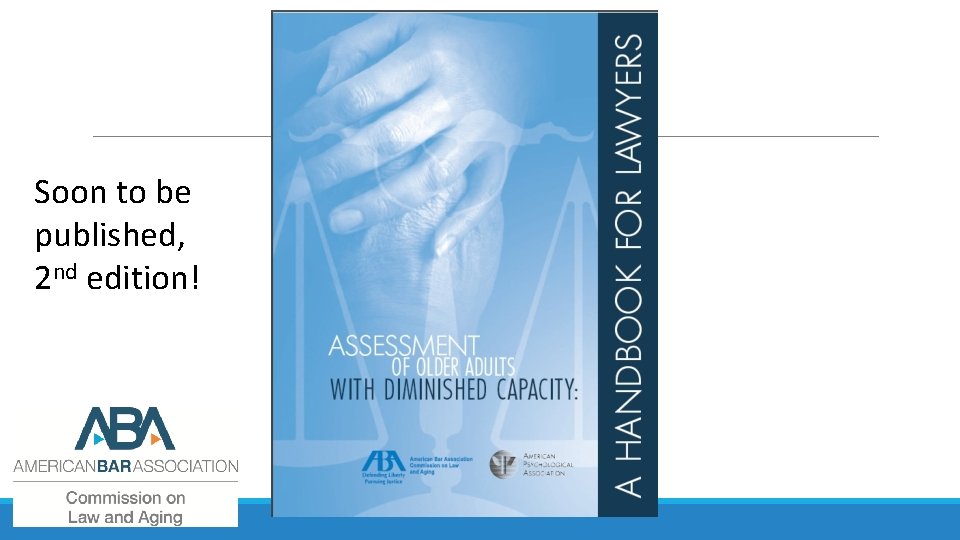
Soon to be published, 2 nd edition!
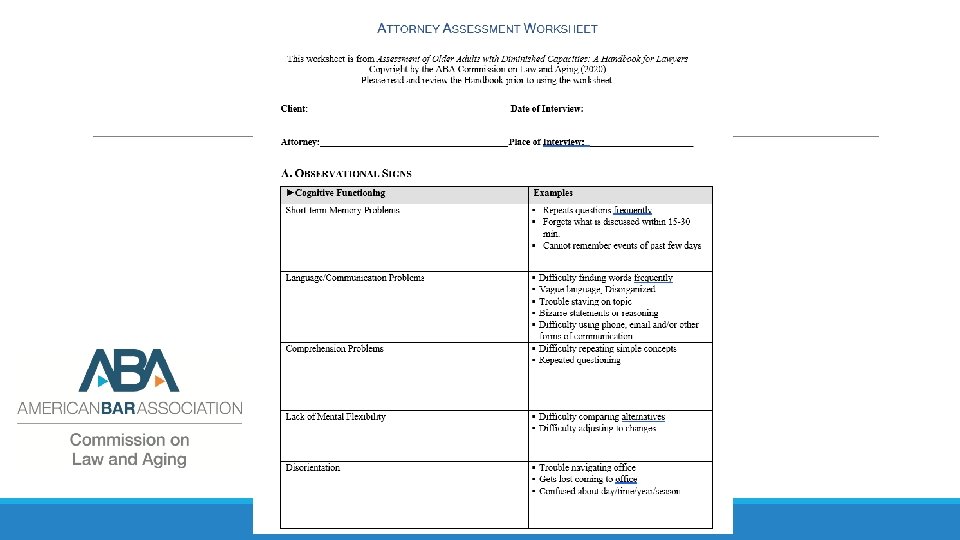
Develop a Process Meant To Structure And Record Observations Systematic In Process Accountable and Documented Standardized Intake And Interview Templates
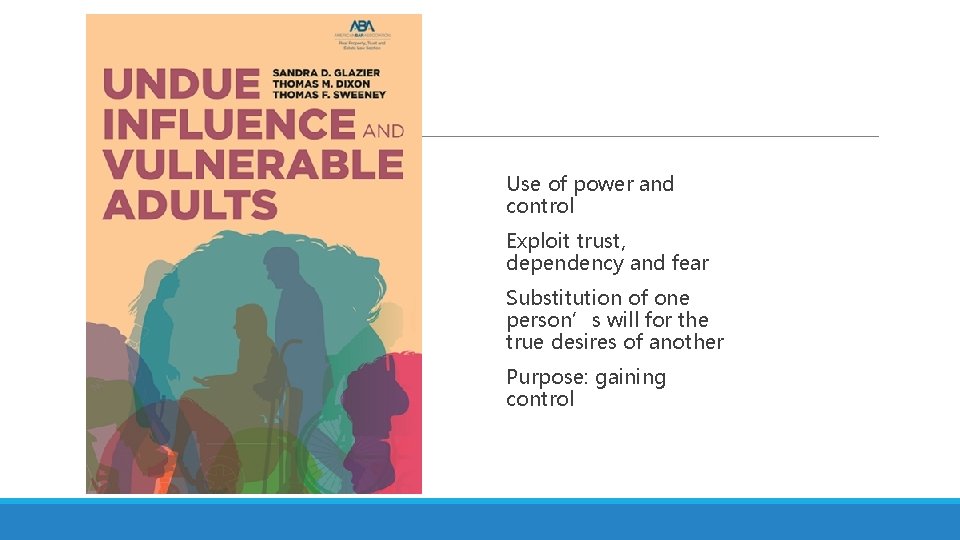
Use of power and control Exploit trust, dependency and fear Substitution of one person’s will for the true desires of another Purpose: gaining control
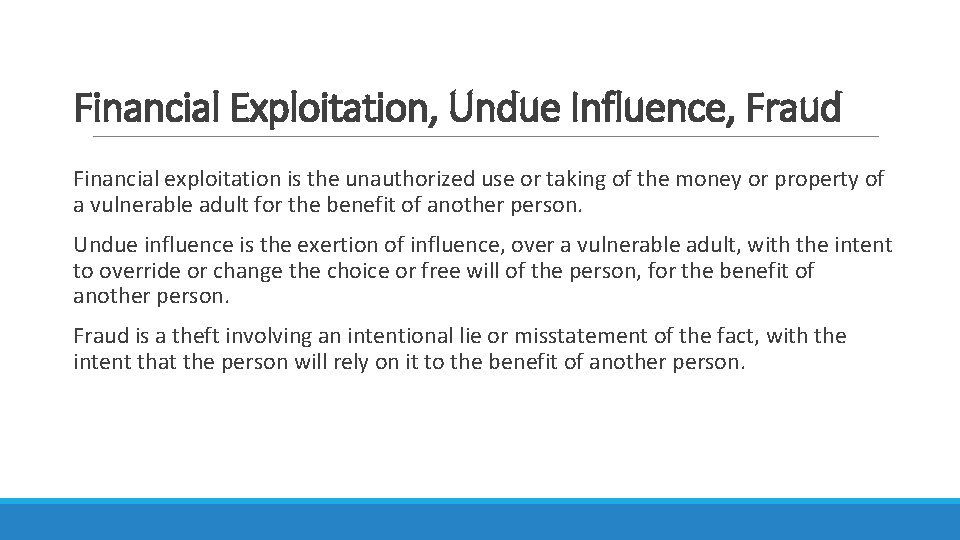
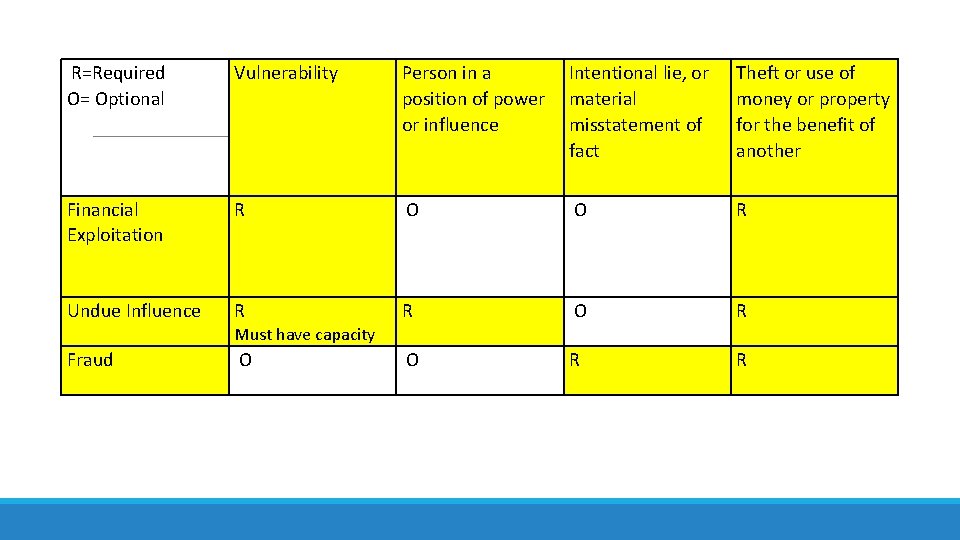
Financial Exploitation, Undue Influence, Fraud Financial exploitation is the unauthorized use or taking of the money or property of a vulnerable adult for the benefit of another person. Undue influence is the exertion of influence, over a vulnerable adult, with the intent to override or change the choice or free will of the person, for the benefit of another person. Fraud is a theft involving an intentional lie or misstatement of the fact, with the intent that the person will rely on it to the benefit of another person.
R=Required O= Optional Vulnerability Person in a position of power or influence Intentional lie, or material misstatement of fact Theft or use of money or property for the benefit of another Financial Exploitation R O O R Undue Influence R R O R R Must have capacity Fraud O
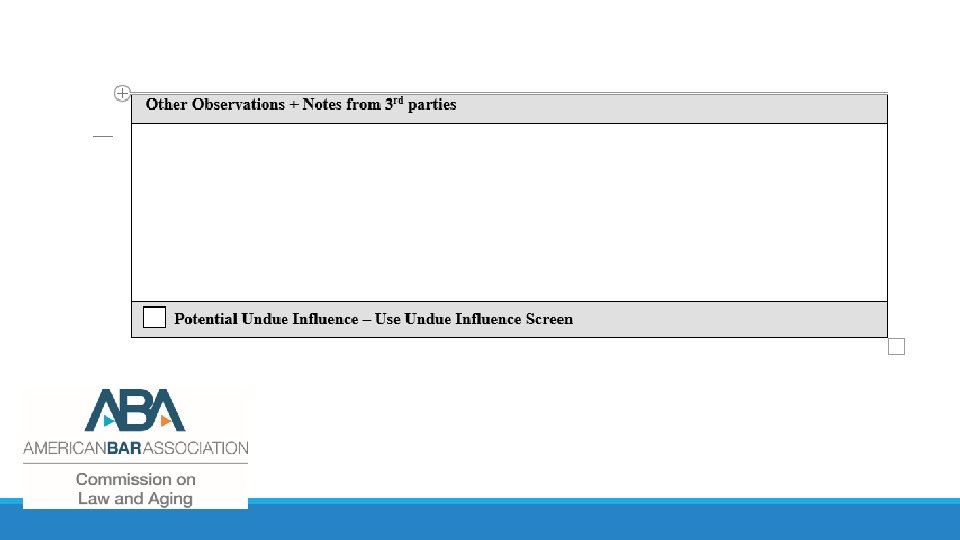
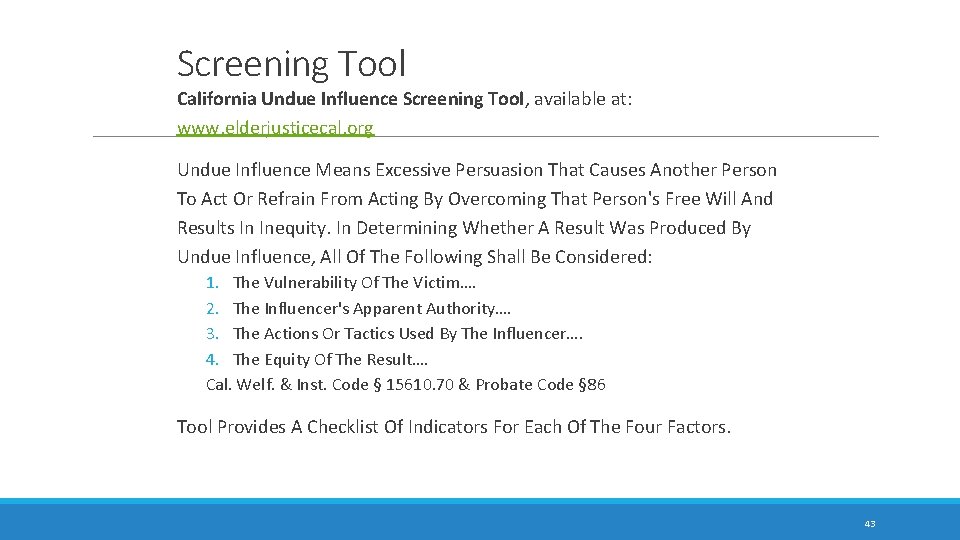
Screening Tool California Undue Influence Screening Tool, available at: www. elderjusticecal. org Undue Influence Means Excessive Persuasion That Causes Another Person To Act Or Refrain From Acting By Overcoming That Person's Free Will And Results In Inequity. In Determining Whether A Result Was Produced By Undue Influence, All Of The Following Shall Be Considered: 1. The Vulnerability Of The Victim…. 2. The Influencer's Apparent Authority…. 3. The Actions Or Tactics Used By The Influencer…. 4. The Equity Of The Result…. Cal. Welf. & Inst. Code § 15610. 70 & Probate Code § 86 Tool Provides A Checklist Of Indicators For Each Of The Four Factors. 43
Declining Or Terminating Representation MRPC 1. 16 (A) Except As Stated In Paragraph (C), A Lawyer Shall Not Represent A Client Or, Where Representation Has Commenced, Shall Withdraw From The Representation Of A Client If: (1) The Representation Will Result In Violation Of The Rules Of Professional Conduct Or Other Law;
MRPC 1. 16 (B) Except As Stated In Paragraph (C), A Lawyer May Withdraw From Representing A Client If: (1) Withdrawal Can Be Accomplished Without Material Adverse Effect On The Interests Of The Client; (2) The Client Persists In A Course Of Action Involving The Lawyer's Services That The Lawyer Reasonably Believes Is Criminal Or Fraudulent; (3) The Client Has Used The Lawyer's Services To Perpetrate A Crime Or Fraud;
Thank You! David. Godfrey@Americanbar. org
Follow Us On Social Media! facebook. com/MVLSPro. Bono/ Maryland Volunteer Lawyers Service @MVLSPro. Bono Maryland Volunteer Lawyers Service Visit www. mvlslaw. org/events for more info on upcoming training and clinics!
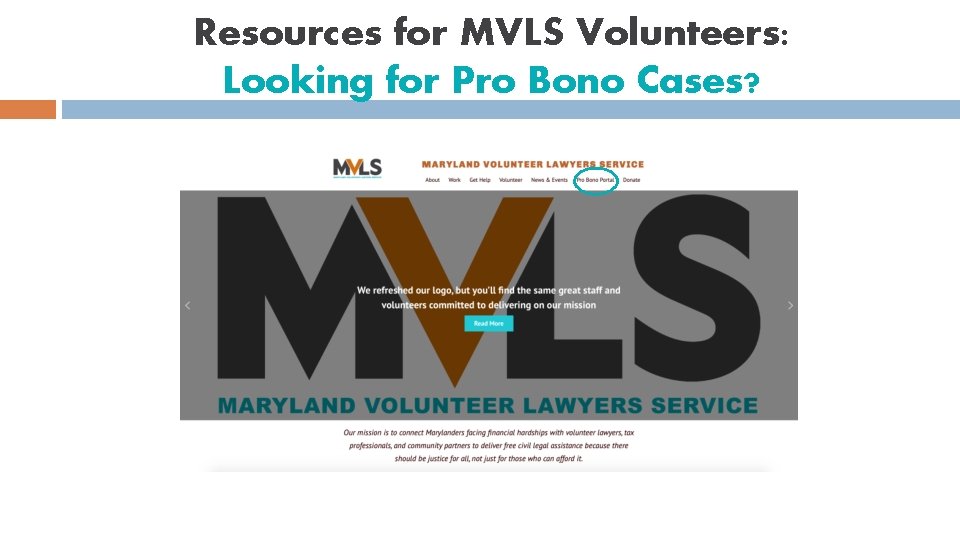
Resources for MVLS Volunteers: Looking for Pro Bono Cases?
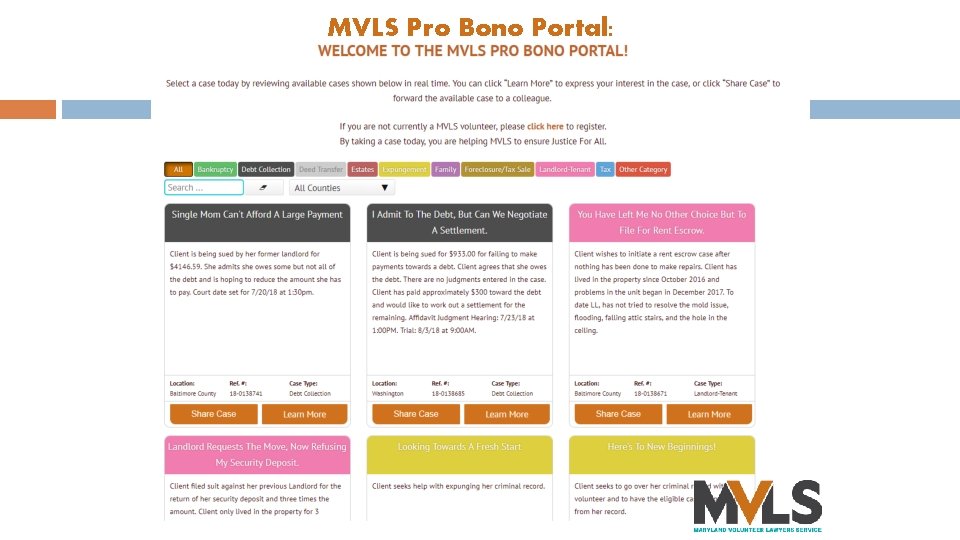
MVLS Pro Bono Portal: https: //mvlslaw. org/probonoportal
FREE Upcoming Training & Volunteer Opportunities: More info: mvlslaw. org/events Upcoming Trainings: April 14 – Guardianship of the Person and Property Appointments. Register. April 15 – Supported Decision-Making: An Alternative to Guardianship April 28 – Divorce and Tax Consequences. Register. May 21 – Tax Controversy Training for Attorneys, Law Students, CPA’s and Enrolled Agents. Register. June 14 – Offer-in-Compromise with the IRS and Maryland. Register. Third Thursday Webinars: April 15 – Supported Decision-Making – An Alternative to Guardianship. Register. Tax Twosday Webinars: April 13 – Day in the Life: IRS Chief Counsel. Register.
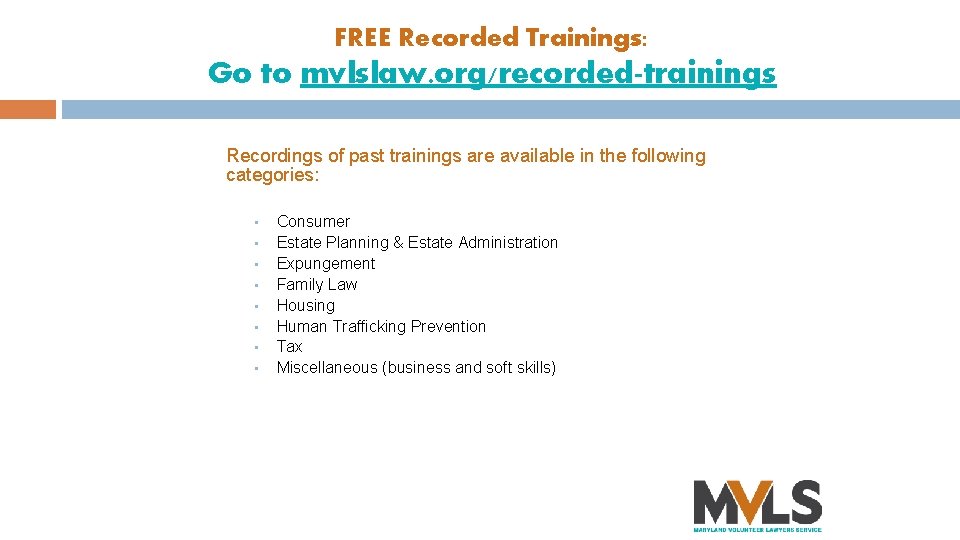
FREE Recorded Trainings: Go to mvlslaw. org/recorded-trainings Recordings of past trainings are available in the following categories: • • Consumer Estate Planning & Estate Administration Expungement Family Law Housing Human Trafficking Prevention Tax Miscellaneous (business and soft skills)
NOT AN MVLS VOLUNTEER YET? SIGN UP TODAY! https: //mvlslaw. org/availablecases/apply-to-be-a-volunteer-lawyer/