
Understanding and Capturing the Power of On Boarding
Understanding and Capturing the Power of On Boarding Done Well A discussion with BPI Senior Executive Board members – March 2013
Imagine if every new hire… ► ► ► had the opportunity to hear from and meet with leaders of the firm within their first 30 -45 days with the firm, understood the firm’s strategy, priorities and values from day one, had the opportunity to engage in meaningful experiences and build relationships with people from across the Americas, understood they are apart of something much larger than their office or business unit, could complete their year one formal learning requirements within their first 30 -45 days which would allow them to be deployed more readily onto jobs Page 2
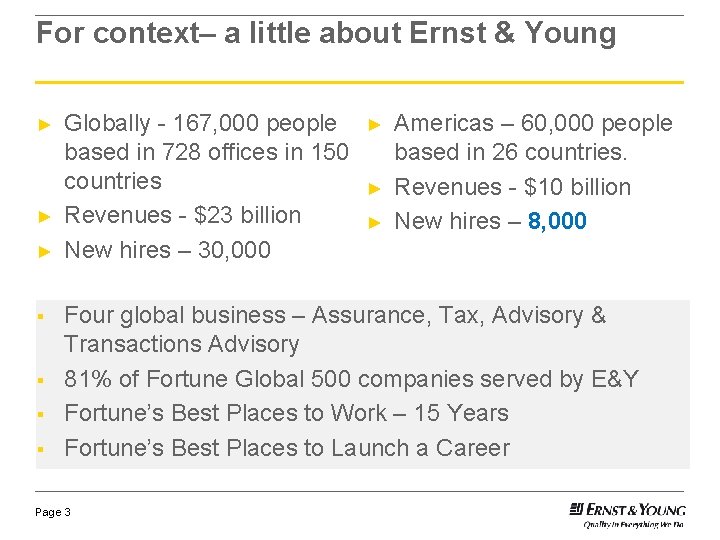
For context– a little about Ernst & Young ► ► ► § § Globally - 167, 000 people based in 728 offices in 150 countries Revenues - $23 billion New hires – 30, 000 ► ► ► Americas – 60, 000 people based in 26 countries. Revenues - $10 billion New hires – 8, 000 Four global business – Assurance, Tax, Advisory & Transactions Advisory 81% of Fortune Global 500 companies served by E&Y Fortune’s Best Places to Work – 15 Years Fortune’s Best Places to Launch a Career Page 3
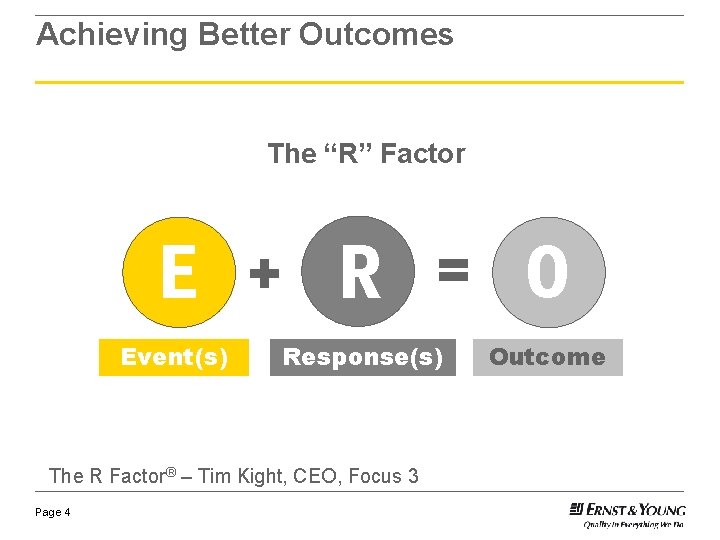
Achieving Better Outcomes The “R” Factor E Event(s) + R Response(s) The R Factor® – Tim Kight, CEO, Focus 3 Page 4 = O Outcome

Productive process… E Page 5 + R = O Events Response Outcome 1 3 2
What were the E’s facing us? ► Every Business Unit had a point of view as to what was important. ► Not all BU leaders understood the power and impact of on boarding done well or the impact if done poorly ► Some BU’s were experiencing unexpected and unwanted turnover at the one year level ► Delivering on boarding programs was costly in terms of keeping materials updated and keeping facilitators up to date. ► Costs of running disparate models were hidden within the BUs and were not visible to the BU Leaders Page 6
Understanding and defining our desired O’s E&Y’s On Boarding Vision Ensure our people feel welcome and have the tools, knowledge and the relationships necessary to be successful at EY Page 7
Additional O’s ► Anchor our firm’s cultural message early ► ► ► Our new people need to hear what the firm really values before that message gets lost in the noise of region, service line or BU messaging. If they hear it early and from the right people, our people will have a greater ability to sort through the conflicting messages that can occur. Allow our people to think more broadly about the world in which E&Y and they operate. Have our people better understand earlier in their career the potential a career with E&Y offers them. Have them experience what it means to be part of the E&Y family. Page 8
Themes from research (Potential R’s) ► Onboarding process starts prior to start ► Peer advisor plays critical role in the onboarding process ► Focus on basic needs first ► New hires prefer to be in their home office on their first day ► Focus on onboarding/offboarding together ► Re-recruit new hires throughout their first year ► Face-to-face orientation is ideal; virtual options should be considered as an alternative. ► Hearing from the Leader(s) matters. Page 9
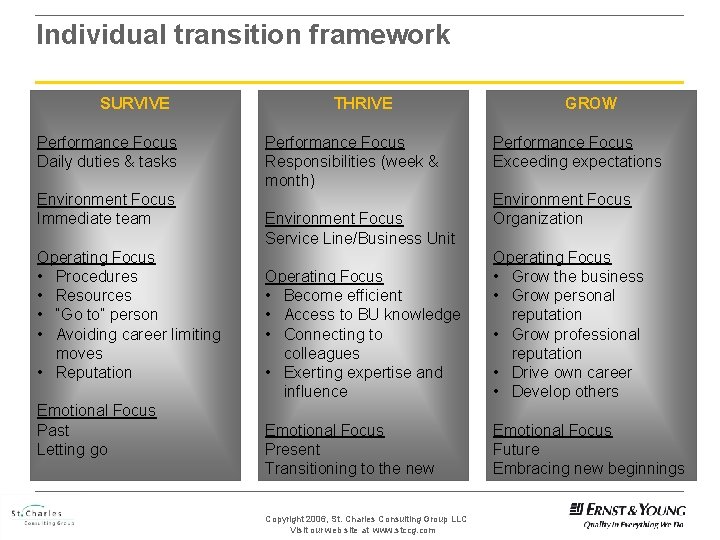
Individual transition framework SURVIVE Performance Focus Daily duties & tasks Environment Focus Immediate team Operating Focus • Procedures • Resources • “Go to” person • Avoiding career limiting moves • Reputation Emotional Focus Past Letting go Page 10 THRIVE Performance Focus Responsibilities (week & month) Environment Focus Service Line/Business Unit GROW Performance Focus Exceeding expectations Environment Focus Organization Operating Focus • Become efficient • Access to BU knowledge • Connecting to colleagues • Exerting expertise and influence Operating Focus • Grow the business • Grow personal reputation • Grow professional reputation • Drive own career • Develop others Emotional Focus Present Transitioning to the new Emotional Focus Future Embracing new beginnings Copyright 2006, St. Charles Consulting Group LLC Visit our web site at www. stccg. com
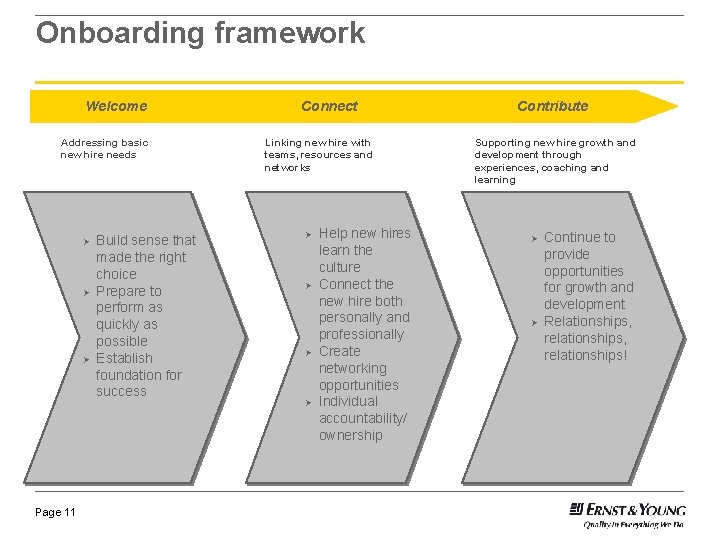
Onboarding framework Welcome Addressing basic new hire needs Ø Ø Ø Page 11 Build sense that made the right choice Prepare to perform as quickly as possible Establish foundation for success Connect Linking new hire with teams, resources and networks Ø Ø Help new hires learn the culture Connect the new hire both personally and professionally Create networking opportunities Individual accountability/ ownership Contribute Supporting new hire growth and development through experiences, coaching and learning Ø Ø Continue to provide opportunities for growth and development Relationships, relationships!
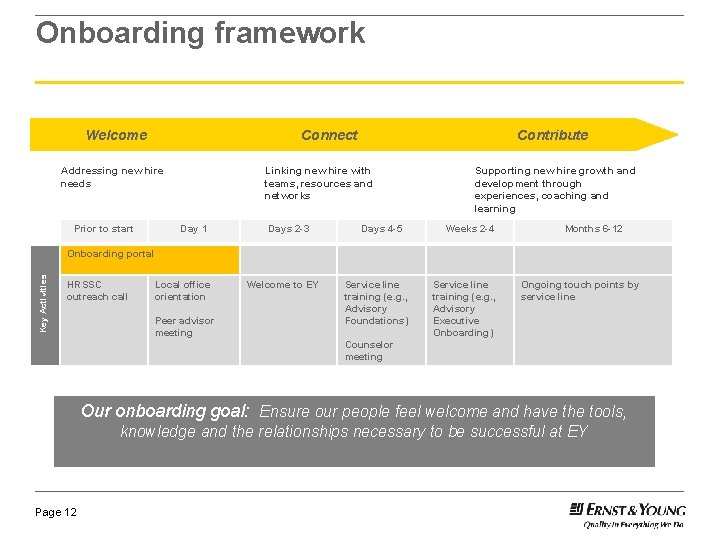
Onboarding framework Welcome Connect Addressing new hire needs Prior to start Contribute Linking new hire with teams, resources and networks Day 1 Days 2 -3 Days 4 -5 Supporting new hire growth and development through experiences, coaching and learning Weeks 2 -4 Months 6 -12 Key Activities Onboarding portal HRSSC outreach call Local office orientation Peer advisor meeting Welcome to EY Service line training (e. g. , Advisory Foundations) Service line training (e. g. , Advisory Executive Onboarding) Ongoing touch points by service line Counselor meeting Our onboarding goal: Ensure our people feel welcome and have the tools, knowledge and the relationships necessary to be successful at EY Page 12

Local office orientation and Welcome to EY
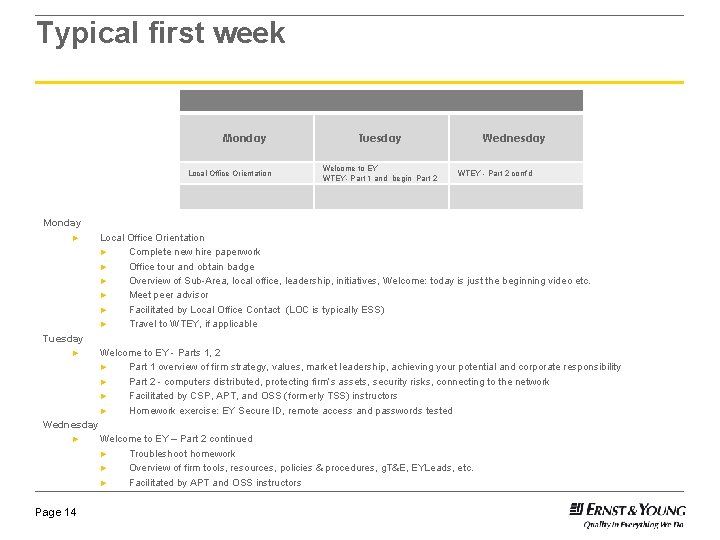
Typical first week Monday Local Office Orientation Tuesday Welcome to EY WTEY- Part 1 and begin Part 2 Wednesday WTEY - Part 2 cont’d Monday ► Local Office Orientation ► Complete new hire paperwork ► Office tour and obtain badge ► Overview of Sub-Area, local office, leadership, initiatives, Welcome: today is just the beginning video etc. ► Meet peer advisor ► Facilitated by Local Office Contact (LOC is typically ESS) ► Travel to WTEY, if applicable Tuesday ► Welcome to EY - Parts 1, 2 ► Part 1 overview of firm strategy, values, market leadership, achieving your potential and corporate responsibility ► Part 2 - computers distributed, protecting firm’s assets, security risks, connecting to the network ► Facilitated by CSP, APT, and OSS (formerly TSS) instructors ► Homework exercise: EY Secure ID, remote access and passwords tested Wednesday ► Page 14 Welcome to EY – Part 2 continued ► Troubleshoot homework ► Overview of firm tools, resources, policies & procedures, g. T&E, EYLeads, etc. ► Facilitated by APT and OSS instructors
Welcome to EY (WTEY) WTEY objective is to: ► ► ► Welcome the new hire Introduce our new hires to our leaders, our culture, and our strategy Demonstrate a clear vision that inspires our people and confirms to them that they made the right decision in joining EY Help our new hires understand how they can be successful at EY Make an impact by reinforcing the value placed on all new hires via leadership involvement Structure of WTEY ► ► Page 15 2 day program following Local Office Orientation Facilitated by APT, Client Servers and IT instructors Two distinct audiences: campus and experienced hires Offered every other week in key cities (frequency and location established by Sub. Areas to minimize travel costs)
WTEY zone approach For experienced hires only Why a zone approach was implemented for WTEY experienced hire sessions: ► ► Average class size (outside of NYC) prior to zone approach = 8 people Many classes (44%) were cancelled within 5 days of program due to low enrollment ► New hires sent to alternate location – often NYC ► Recruiters have additional admin time to move new hire to alternate city ► New hire anxiety created from last minute location change ► Last minute cancellations resulted in increased travel costs Partner/principal time in classroom not leveraged in very small classes Resources needed to prepare for and set up for each session Benefits of a zone approach: ► ► ► Reduce last minute “spot market” travel costs due to session cancellations Promotes increased class sizes – which leverages Client Serving/APT instructors and offers more opportunities for new hires to network – better participant experience Less burden on NYC as the stand-by for all sub-areas Reduces new hire confusion on where to go Less support time (APT, Client Servers, IT) for class preparations Elimination of planning and delivery costs associated with delivering 86 additional sessions a year across the US Page 16
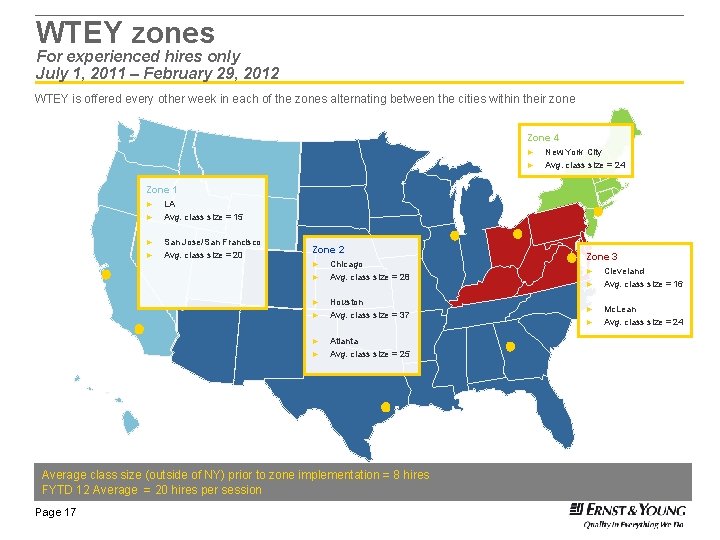
WTEY zones For experienced hires only July 1, 2011 – February 29, 2012 WTEY is offered every other week in each of the zones alternating between the cities within their zone Zone 4 ► ► New York City Avg. class size = 24 Zone 1 ► ► LA Avg. class size = 15 San Jose/San Francisco Avg. class size = 20 Zone 2 ► ► ► Chicago Avg. class size = 28 Houston Avg. class size = 37 Atlanta Avg. class size = 25 Average class size (outside of NY) prior to zone implementation = 8 hires FYTD 12 Average = 20 hires per session Page 17 Zone 3 ► ► Cleveland Avg. class size = 16 Mc. Lean Avg. class size = 24

On boarding portal
Onboarding portal objective ► Enhance the onboarding process by creating an onboarding portal designed to: ► Provide a consistent new hire experience ► Reduce time to contribution ► Drive operational efficiencies Page 19
Benefits/operational efficiencies realized to date ► ► ► Paperwork completed prior to start date Direct deposit forms automatically fed to People. Soft; no longer need to manually key information New hire paperwork fed to the Electronic Personnel File; eliminated need to print and send paperwork to Iron Mountain for scanning into EPF Recruiters spending less time triaging and researching questions; new hires post questions in the portal and call the HRSSC customer support team No longer create customized welcome emails; customized information provided in the portal Ability to more effectively monitor the onboarding process Page 20
Peer advisor program
Peer advisor program ► ► ► All new hires (including interns) are assigned a peer advisor/buddy People consultant is the primary person accountable for assignment process Peer advisor is ideally a recent hire in the same location who is at the same rank or serving in a similar role as the new hire Assignments made on the on boarding form within the on boarding portal Notification sent to peer advisor with a link to the peer advisor role description and checklist Page 22
Peer advisor expectations ► ► ► Make the new hire feel welcome Orient new hire to the office space and resources Make introductions and connect the new hire to other people who can be helpful Answer questions or point the new hire to information sources Help the new hire navigate the EY culture Page 23

On boarding survey
On boarding survey ► ► ► Purpose: to obtain feedback from new hires regarding their overall on boarding experience Sent monthly to all new hires New hires receive the survey between their 4 th & 8 th week with the firm Page 25

Discussion/Q&A
- Slides: 26