
Understanding and Appreciating Diversity and Inclusion Learning Objectives
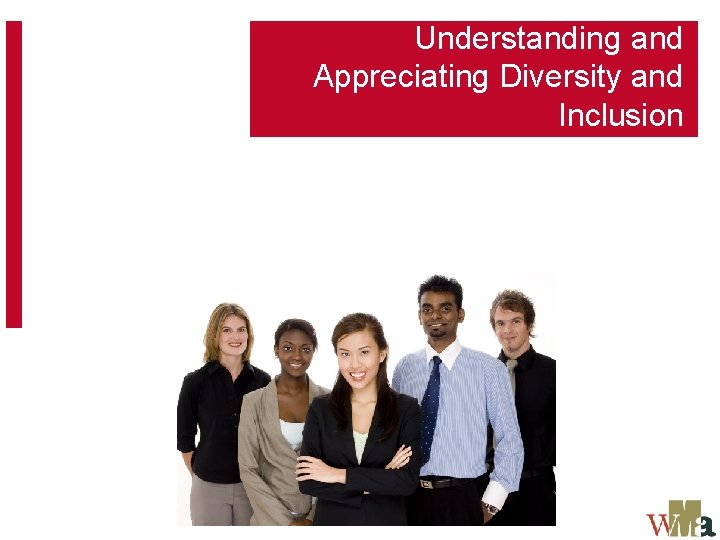
Understanding and Appreciating Diversity and Inclusion
Learning Objectives v To promote understanding of diversity v To affirm the importance of creating an environment in which employees' different identities and abilities are not only respected, but also appreciated v To highlight key practices for supporting inclusive workplace environments, relationships and interactions
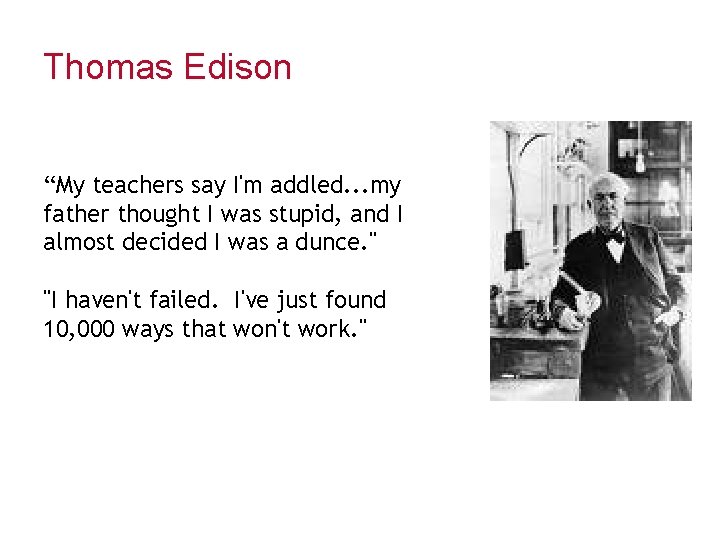
Thomas Edison “My teachers say I'm addled. . . my father thought I was stupid, and I almost decided I was a dunce. " "I haven't failed. I've just found 10, 000 ways that won't work. "
What is Diversity? v. Diversity encompasses the many ways people may differ, including: v. Gender v. Race v. Nationality v. Education v. Sexual orientation v. Learning and working styles v. Functional expertise
Understanding the Value of Diversity v. Diversity challenges uniform and homogenous thinking processes. v. When individuals with different backgrounds and experiences work together to solve problems or come up with new ideas, we challenge our norms and reach greater levels of creativity and innovation. v. Management that accepts and encourages diversity creates a more fulfilling and accepting workplace, which is more likely to reduce employee turnover and raise productivity.
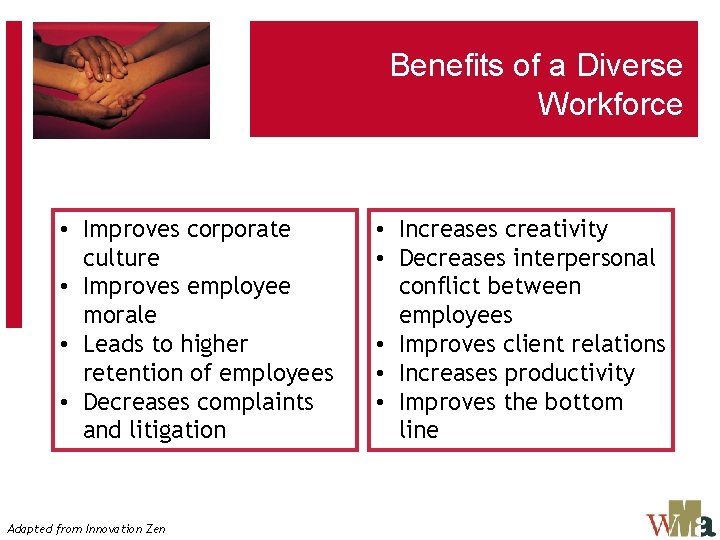
Benefits of a Diverse Workforce • Improves corporate culture • Improves employee morale • Leads to higher retention of employees • Decreases complaints and litigation Adapted from Innovation Zen • Increases creativity • Decreases interpersonal conflict between employees • Improves client relations • Increases productivity • Improves the bottom line
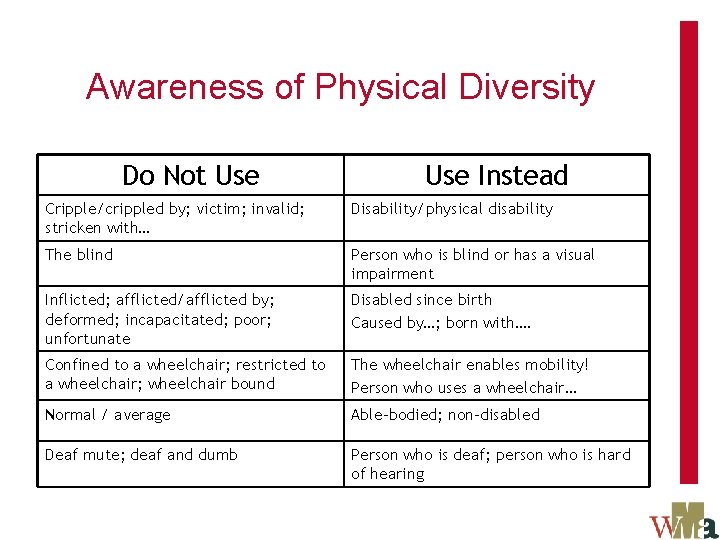
Awareness of Physical Diversity Do Not Use Instead Cripple/crippled by; victim; invalid; stricken with… Disability/physical disability The blind Person who is blind or has a visual impairment Inflicted; afflicted/afflicted by; deformed; incapacitated; poor; unfortunate Disabled since birth Caused by…; born with…. Confined to a wheelchair; restricted to a wheelchair; wheelchair bound The wheelchair enables mobility! Person who uses a wheelchair… Normal / average Able-bodied; non-disabled Deaf mute; deaf and dumb Person who is deaf; person who is hard of hearing
Working with Diverse Teams • Explore and identify team members’ areas of strength • Appreciate the abilities and ideas brought to the table • Know that team members will differ in: • How they think • How they build relationships • How patient they can be • How prepared they need to feel • What drives them • What challenges them • What their goals are
Think about… Diversity in your workplace Think about a time when a new employee joined your workplace or team, and you had an opportunity to challenge your assumptions and perceptions. How did this re-examination benefit you as a person? How did it impact your approach to diversity in either your personal or work life?
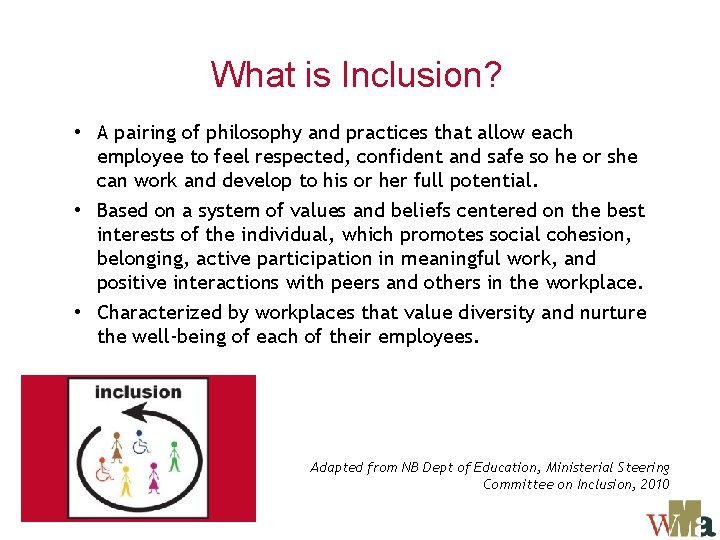
What is Inclusion? • A pairing of philosophy and practices that allow each employee to feel respected, confident and safe so he or she can work and develop to his or her full potential. • Based on a system of values and beliefs centered on the best interests of the individual, which promotes social cohesion, belonging, active participation in meaningful work, and positive interactions with peers and others in the workplace. • Characterized by workplaces that value diversity and nurture the well-being of each of their employees. Adapted from NB Dept of Education, Ministerial Steering Committee on Inclusion, 2010
Benefits of Inclusion • In order to yield benefits associated with diversity, inclusion is linked with an employee’s ability to fully and effectively contribute to a workgroup or organization (Steward & Humbred, 2008). • We define inclusion as seeking out, valuing and using the knowledge and experiences of diverse employees. • Inclusion involves recognizing, understanding, and respecting all the ways we differ, and leveraging those differences for competitive business advantage.
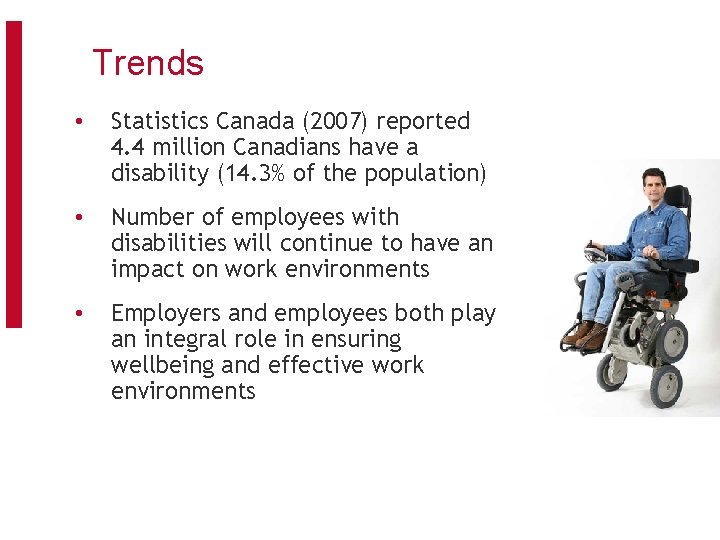
Trends • Statistics Canada (2007) reported 4. 4 million Canadians have a disability (14. 3% of the population) • Number of employees with disabilities will continue to have an impact on work environments • Employers and employees both play an integral role in ensuring wellbeing and effective work environments
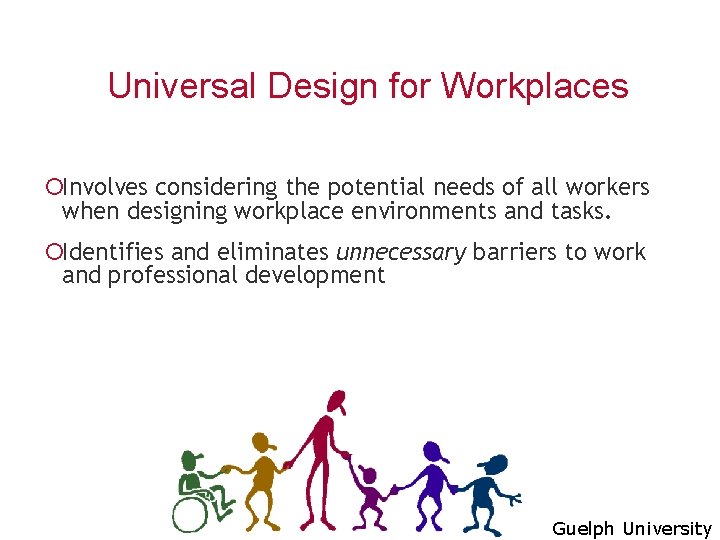
Universal Design for Workplaces ¡Involves considering the potential needs of all workers when designing workplace environments and tasks. ¡Identifies and eliminates unnecessary barriers to work and professional development Guelph University
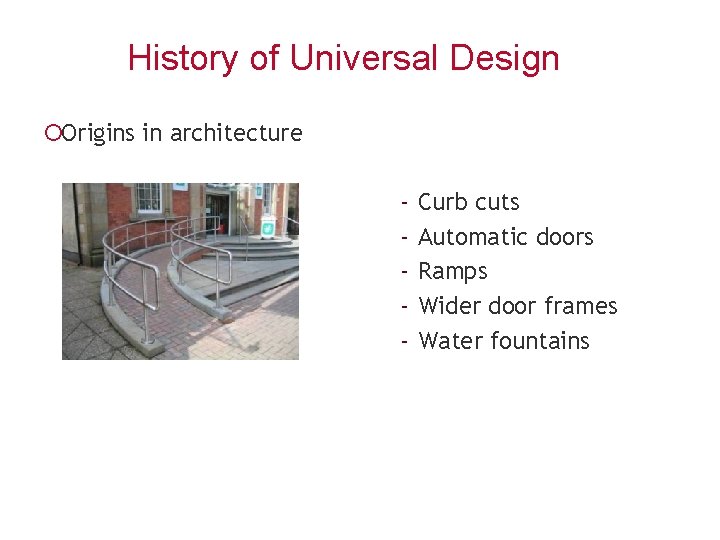
History of Universal Design ¡Origins in architecture - Curb cuts Automatic doors Ramps Wider door frames Water fountains
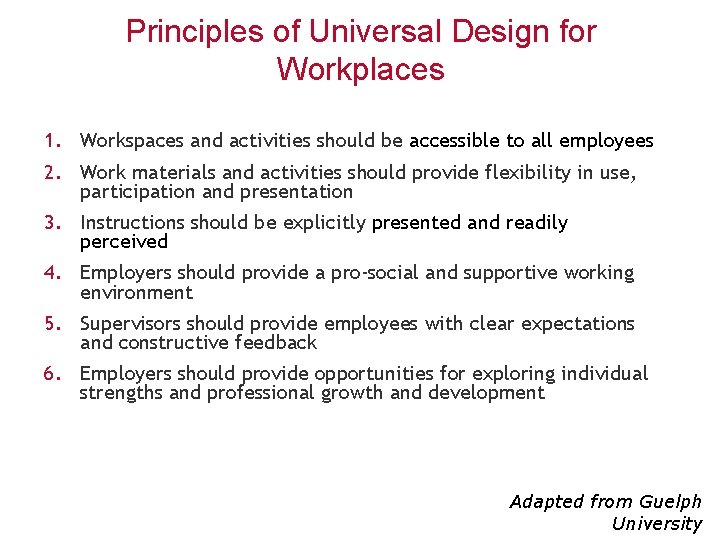
Principles of Universal Design for Workplaces 1. Workspaces and activities should be accessible to all employees 2. Work materials and activities should provide flexibility in use, participation and presentation 3. Instructions should be explicitly presented and readily perceived 4. Employers should provide a pro-social and supportive working environment 5. Supervisors should provide employees with clear expectations and constructive feedback 6. Employers should provide opportunities for exploring individual strengths and professional growth and development Adapted from Guelph University
Discussion Universal design in your workplace Provide examples in the context of your own experience where you felt that a particular employee’s needs may not have been met by: • Work environment • Supervisory method or style • Evaluation practices
Tips for Fostering Diversity and Inclusion in the Workplace 1. Implement workplace initiatives that foster the creation of safe and caring environments. Such efforts contribute to the social, emotional and professional needs of employees. 2. Apply universal design principles in the development and use of physical spaces. Such principles reinforce the importance of full inclusion and the appreciation of diversity. 3. Create opportunities for understanding and appreciating diversity in the workplace. Diversity may include a wide range of individual differences related to personal preferences, gender, sexual orientation, cultural backgrounds, and specific physical, emotional or mental health needs. 4. Explore areas of employee strength, interest and potential. Such exploration is critical for enhancing employee engagement in work tasks and relationships.
Tips for Fostering Diversity and Inclusion in the Workplace 5. Create mentorship opportunities that encourage collaborative processes for identifying employee strengths, career aspirations, training options, and long term plans. 6. Create expectations around the use of language – including humour – that is sensitive to employees’ needs, abilities and cultural identity. 7. Think about any existing barriers – physical, cultural, ideological – that might impact the inclusion of employees (new or current) of diverse backgrounds, abilities, or lifestyles. Develop a plan to address these barriers and increase awareness in the workplace. 8. Be prepared to provide multiple means of accomplishing tasks, based on employee strengths, challenges and preferences – the produced outcome stays the same; but processes allow for multiple ways to get there.
Application Activity Planning a universally-designed event Think about a social event that you could plan for your staff or work team. In designing this event, take into account the importance of valuing diversity and ensuring the inclusion of all team members. In your planning, consider the Principles of Universal Design for Workplaces.
- Slides: 19