
Understanding Aerobic Capacity LEARNING OBJECTIVES Understanding of aerobic

Understanding Aerobic Capacity

LEARNING OBJECTIVES Understanding of aerobic capacity
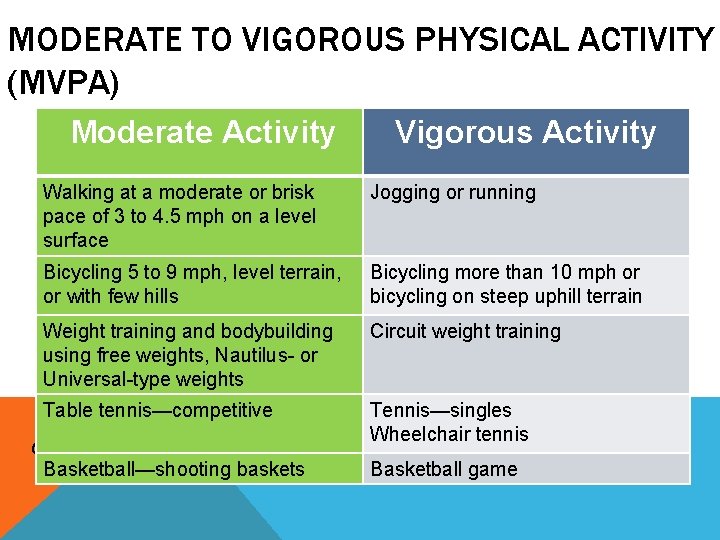
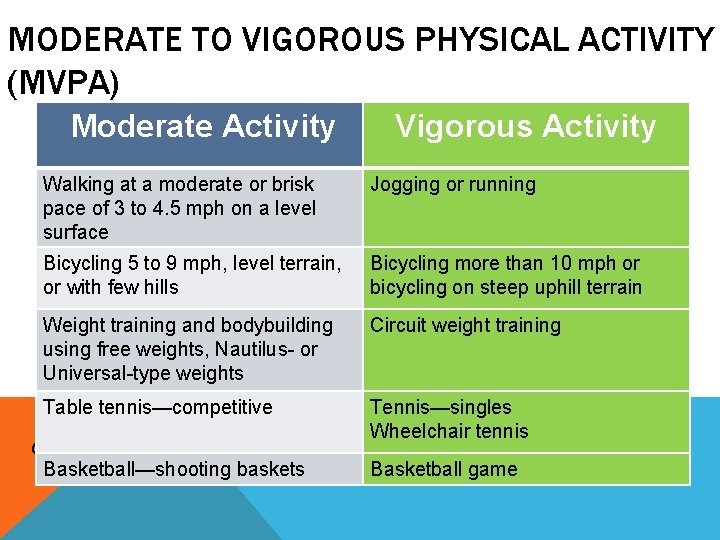
MODERATE TO VIGOROUS PHYSICAL ACTIVITY (MVPA) Moderate Activity Vigorous Activity Walking at a moderate or brisk pace of 3 to 4. 5 mph on a level surface Jogging or running Bicycling 5 to 9 mph, level terrain, or with few hills Bicycling more than 10 mph or bicycling on steep uphill terrain Weight training and bodybuilding using free weights, Nautilus- or Universal-type weights Circuit weight training Table tennis—competitive Tennis—singles In accordance to CDC and ACSM Wheelchair tennis Guidelines Basketball—shooting baskets Basketball game
MODERATE TO VIGOROUS PHYSICAL ACTIVITY (MVPA) Moderate Activity Vigorous Activity Walking at a moderate or brisk pace of 3 to 4. 5 mph on a level surface Jogging or running Bicycling 5 to 9 mph, level terrain, or with few hills Bicycling more than 10 mph or bicycling on steep uphill terrain Weight training and bodybuilding using free weights, Nautilus- or Universal-type weights Circuit weight training Table tennis—competitive Tennis—singles In accordance to CDC and ACSM Wheelchair tennis Guidelines Basketball—shooting baskets Basketball game

WHY IS IT IMPORTANT? Regular physical activity can improve the health and quality of life of Americans of all ages, regardless of the presence of a chronic disease or disability (USDHHS, 2008). Recent research indicates that physical activity has a positive impact on: • classroom behavior (Barros et al. , 2009) • brain structure (Hillman et al. , 2012) • academic achievement (CDC, 2010)
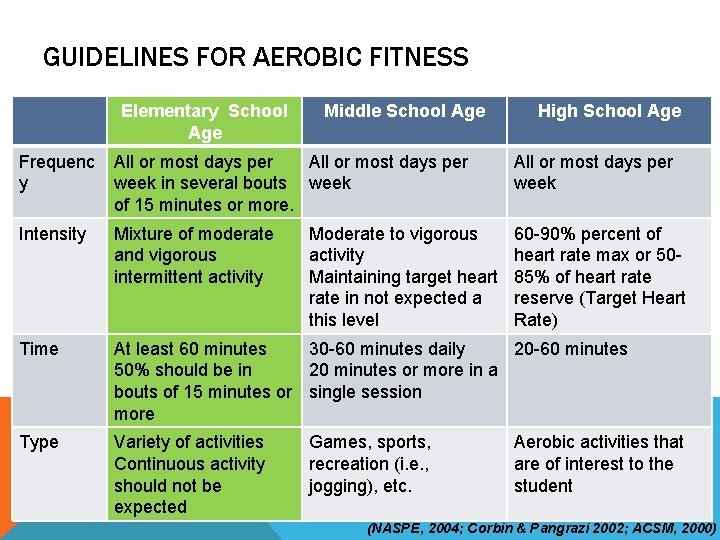
GUIDELINES FOR AEROBIC FITNESS Elementary School Age Middle School Age High School Age Frequenc y All or most days per week in several bouts week of 15 minutes or more. All or most days per week Intensity Mixture of moderate and vigorous intermittent activity 60 -90% percent of heart rate max or 5085% of heart rate reserve (Target Heart Rate) Time At least 60 minutes 30 -60 minutes daily 20 -60 minutes 50% should be in 20 minutes or more in a bouts of 15 minutes or single session more Type Variety of activities Continuous activity should not be expected Moderate to vigorous activity Maintaining target heart rate in not expected a this level Games, sports, recreation (i. e. , jogging), etc. Aerobic activities that are of interest to the student (NASPE, 2004; Corbin & Pangrazi 2002; ACSM, 2000)
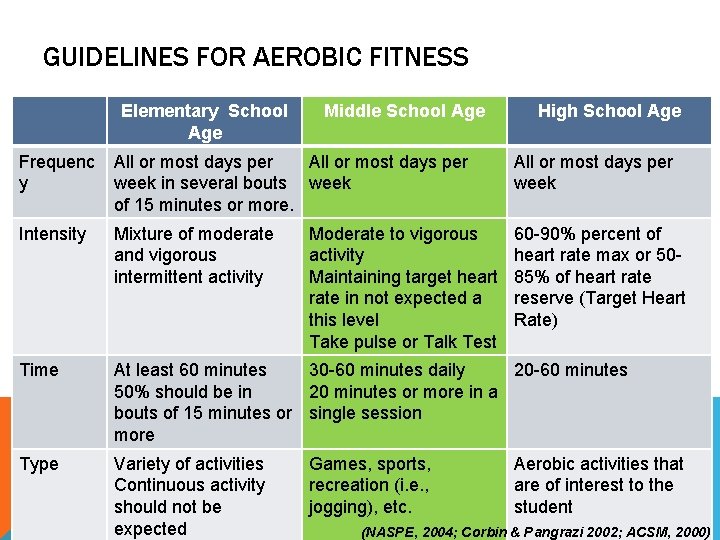
GUIDELINES FOR AEROBIC FITNESS Elementary School Age Middle School Age High School Age Frequenc y All or most days per week in several bouts week of 15 minutes or more. All or most days per week Intensity Mixture of moderate and vigorous intermittent activity 60 -90% percent of heart rate max or 5085% of heart rate reserve (Target Heart Rate) Time At least 60 minutes 30 -60 minutes daily 20 -60 minutes 50% should be in 20 minutes or more in a bouts of 15 minutes or single session more Type Variety of activities Continuous activity should not be expected Moderate to vigorous activity Maintaining target heart rate in not expected a this level Take pulse or Talk Test Games, sports, recreation (i. e. , jogging), etc. Aerobic activities that are of interest to the student (NASPE, 2004; Corbin & Pangrazi 2002; ACSM, 2000)
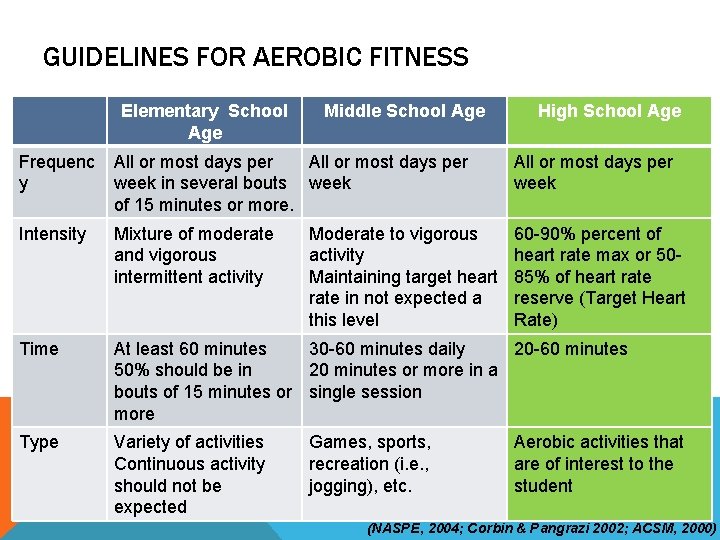
GUIDELINES FOR AEROBIC FITNESS Elementary School Age Middle School Age High School Age Frequenc y All or most days per week in several bouts week of 15 minutes or more. All or most days per week Intensity Mixture of moderate and vigorous intermittent activity 60 -90% percent of heart rate max or 5085% of heart rate reserve (Target Heart Rate) Time At least 60 minutes 30 -60 minutes daily 20 -60 minutes 50% should be in 20 minutes or more in a bouts of 15 minutes or single session more Type Variety of activities Continuous activity should not be expected Moderate to vigorous activity Maintaining target heart rate in not expected a this level Games, sports, recreation (i. e. , jogging), etc. Aerobic activities that are of interest to the student (NASPE, 2004; Corbin & Pangrazi 2002; ACSM, 2000)
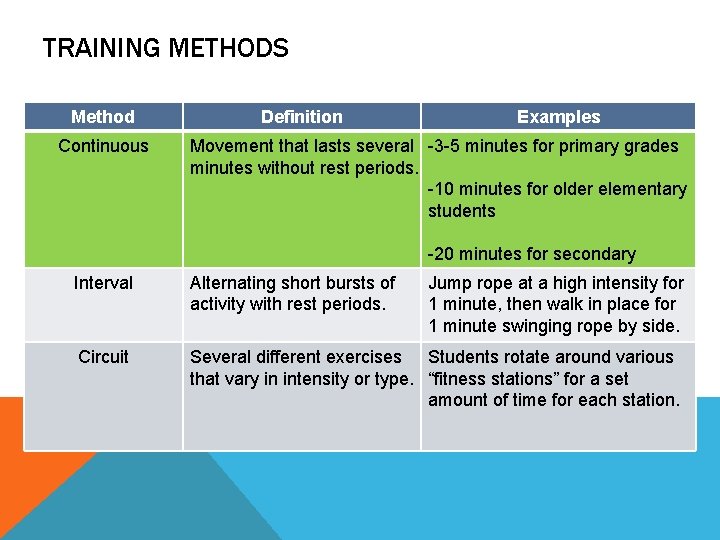
TRAINING METHODS Method Continuous Definition Examples Movement that lasts several -3 -5 minutes for primary grades minutes without rest periods. -10 minutes for older elementary students -20 minutes for secondary Interval Alternating short bursts of activity with rest periods. Jump rope at a high intensity for 1 minute, then walk in place for 1 minute swinging rope by side. Circuit Several different exercises Students rotate around various that vary in intensity or type. “fitness stations” for a set amount of time for each station.
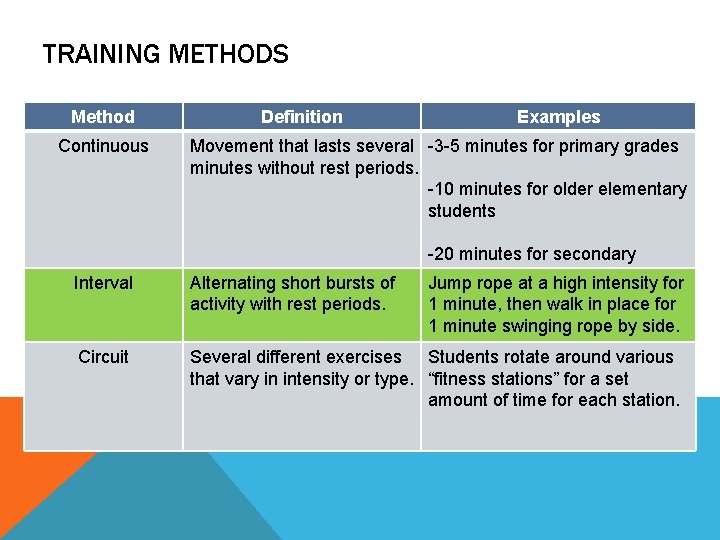
TRAINING METHODS Method Continuous Definition Examples Movement that lasts several -3 -5 minutes for primary grades minutes without rest periods. -10 minutes for older elementary students -20 minutes for secondary Interval Alternating short bursts of activity with rest periods. Jump rope at a high intensity for 1 minute, then walk in place for 1 minute swinging rope by side. Circuit Several different exercises Students rotate around various that vary in intensity or type. “fitness stations” for a set amount of time for each station.
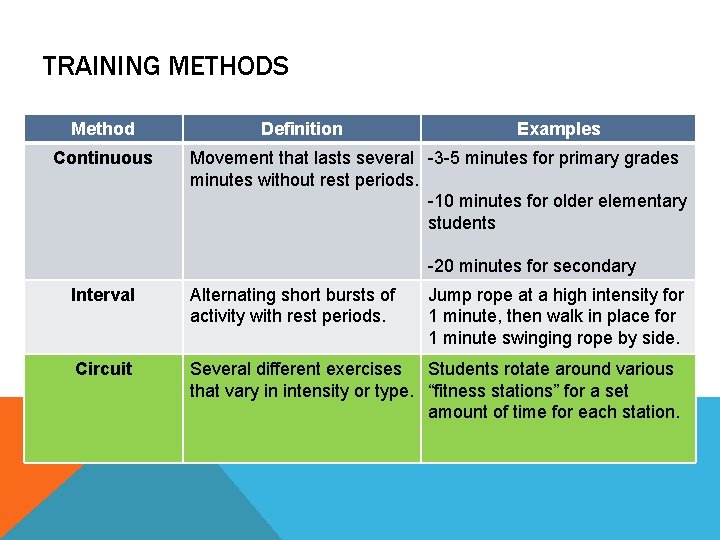
TRAINING METHODS Method Continuous Definition Examples Movement that lasts several -3 -5 minutes for primary grades minutes without rest periods. -10 minutes for older elementary students -20 minutes for secondary Interval Alternating short bursts of activity with rest periods. Jump rope at a high intensity for 1 minute, then walk in place for 1 minute swinging rope by side. Circuit Several different exercises Students rotate around various that vary in intensity or type. “fitness stations” for a set amount of time for each station.

CDC AND CHILDHOOD OBESITY To learn more, please visit http: //www. cdc. gov/healthyyouth/obesity/facts. htm

FITNESSGRAM® To learn more, please visit http: //www. fitnessgram. net
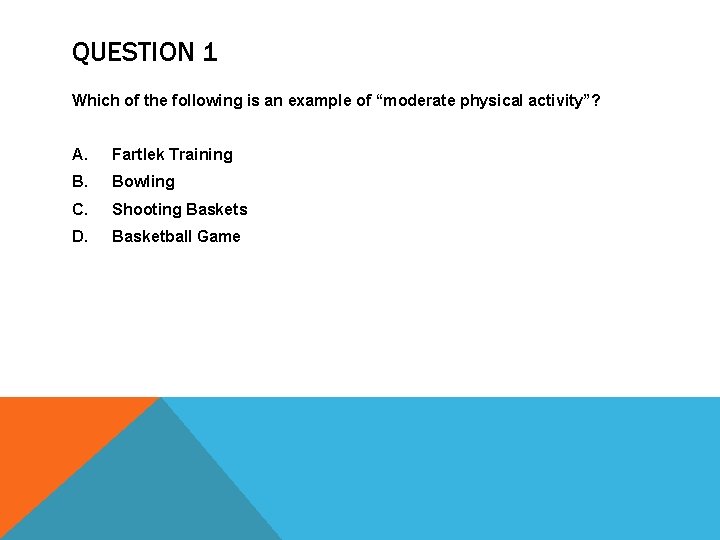
QUESTION 1 Which of the following is an example of “moderate physical activity”? A. Fartlek Training B. Bowling C. Shooting Baskets D. Basketball Game
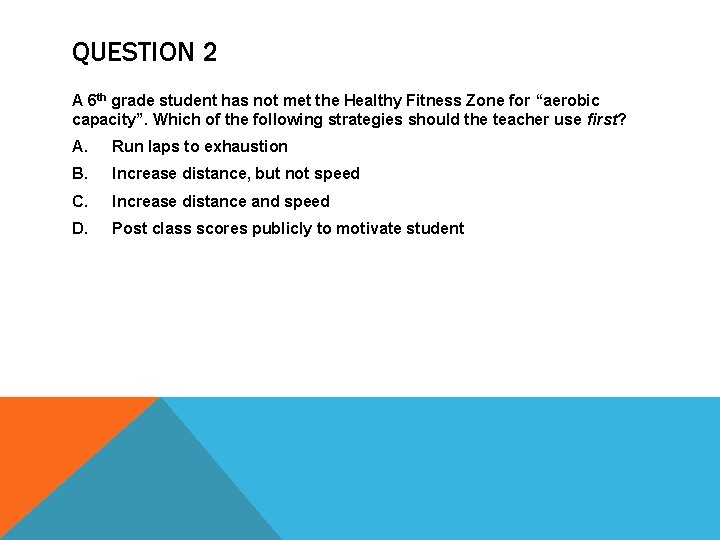
QUESTION 2 A 6 th grade student has not met the Healthy Fitness Zone for “aerobic capacity”. Which of the following strategies should the teacher use first? A. Run laps to exhaustion B. Increase distance, but not speed C. Increase distance and speed D. Post class scores publicly to motivate student
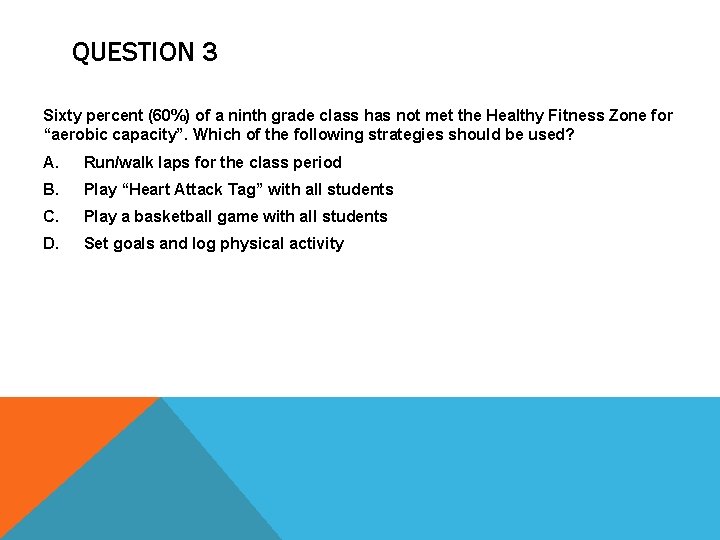
QUESTION 3 Sixty percent (60%) of a ninth grade class has not met the Healthy Fitness Zone for “aerobic capacity”. Which of the following strategies should be used? A. Run/walk laps for the class period B. Play “Heart Attack Tag” with all students C. Play a basketball game with all students D. Set goals and log physical activity

QUESTIONS?
- Slides: 17