
Understanding address accuracy an investigation of the social


- Slides: 20
Understanding address accuracy: an investigation of the social geography of mismatch between census and health service records Ian Shuttleworth, David Martin and Paul Barr
Structure • Introduction • The data and the project • The analysis – Geography – Individual factors – Property/household factors • Concluding comments, questions and ways forward
Introduction • Several “Beyond 2011” options include the use of administrative data • Health service register is most complete of the existing administrative population sources • Need to understand these admin data better • Extending earlier work on migrants aged 25‐ 74, this presentation considers spatial accuracy of health card registration in April 2001 for all age groups against the 2001 Census
The Data and the Project • The Northern Ireland Longitudinal Study (NILS) is used (c 450, 000 in the analysis), based on a 28% sample (104/365) of birthdates of the NI population taken from healthcards • The analysis compares address information from the healthcard system (individual property: XUPRN) as recorded in April 2001 compared with the 2001 Census (29 th April)
The Data and the Project • It is assumed that the 2001 address information is the ‘gold standard’ to assess spatial accuracy • These first results are a descriptive profile of matches/mismatches and will be followed by further (multivariate) analyses of the position as of April 2001, lags post 2001, and the position in 2011
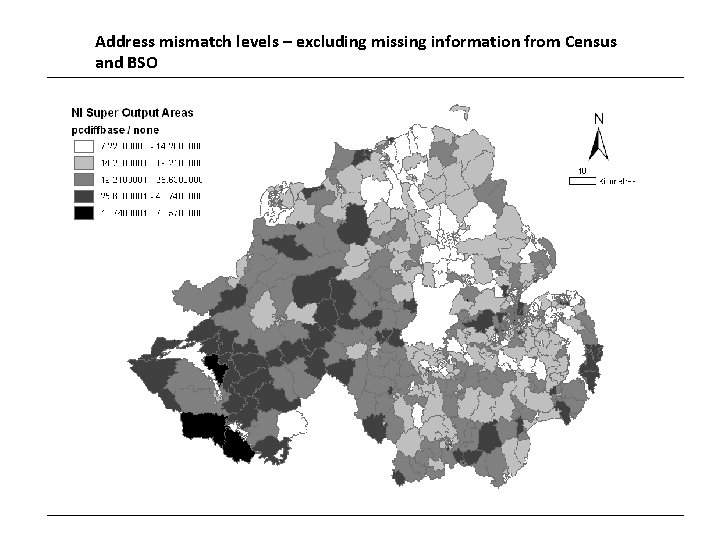
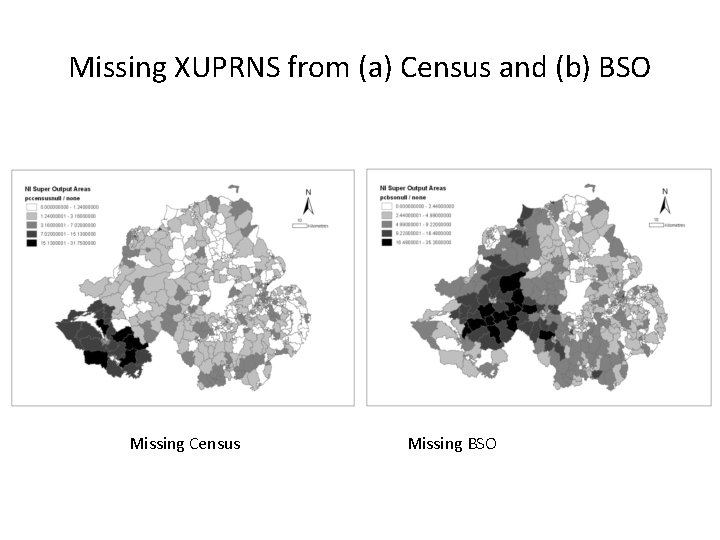
The Analysis: Geography • Maps show: (i) mismatch between valid information from Census and healthcard system and (ii) missing information from both systems • Mismatch higher in some rural areas – a feature that appears elsewhere in other parts of the analysis • Missing information on address higher in rural areas • Specific peaks of mismatch in some urban locations • These are a result of (i) types of people in different places; (ii) types of property in different places; (iii) interactions of (i) and (ii); and (iv) NI‐specific factors
Address mismatch levels – excluding missing information from Census and BSO
Missing XUPRNS from (a) Census and (b) BSO Missing Census Missing BSO
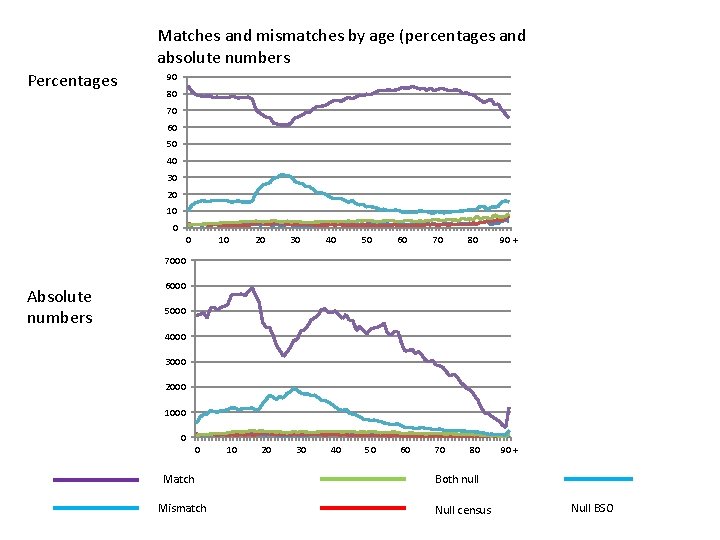
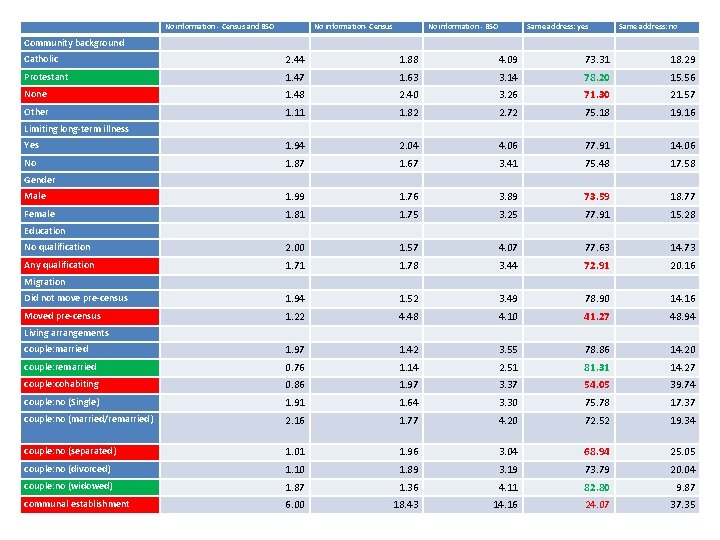
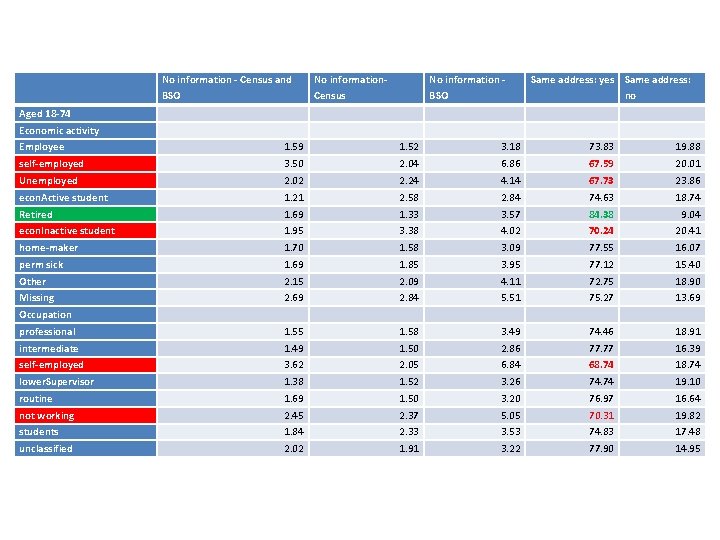
The Analysis: Individual factors • Individual social and demographic characteristics influence address matching rates • Some of these might be expected in terms of conventional ‘hard‐to‐enumerate’ categories (eg age, gender), others less so (eg education) • Lower rates of match of interest are marked in red; higher rates in green in the following two tables – social/demographic variables and labour market variables • The average match is 75. 8% • We start with two graphs of age…. and then the tables
Matches and mismatches by age (percentages and absolute numbers Percentages 90 80 70 60 50 40 30 20 10 0 0 10 20 30 40 50 60 70 80 90 + 7000 Absolute numbers 6000 5000 4000 3000 2000 1000 0 0 Match Mismatch 10 20 30 40 50 Both null Null census Null BSO
No information - Census and BSO No information- Census No information - BSO Same address: yes Same address: no Community background Catholic 2. 44 1. 88 4. 09 73. 31 18. 29 Protestant 1. 47 1. 63 3. 14 78. 20 15. 56 None 1. 48 2. 40 3. 26 71. 30 21. 57 Other 1. 11 1. 82 2. 72 75. 18 19. 16 Yes 1. 94 2. 04 4. 06 77. 91 14. 06 No 1. 87 1. 67 3. 41 75. 48 17. 58 Male 1. 99 1. 76 3. 89 73. 59 18. 77 Female 1. 81 1. 75 3. 25 77. 91 15. 28 No qualification 2. 00 1. 57 4. 07 77. 63 14. 73 Any qualification 1. 71 1. 78 3. 44 72. 91 20. 16 Did not move pre-census 1. 94 1. 52 3. 49 78. 90 14. 16 Moved pre-census 1. 22 4. 48 4. 10 41. 27 48. 94 couple: married 1. 97 1. 42 3. 55 78. 86 14. 20 couple: remarried 0. 76 1. 14 2. 51 81. 31 14. 27 couple: cohabiting 0. 86 1. 97 3. 37 54. 05 39. 74 couple: no (Single) 1. 91 1. 64 3. 30 75. 78 17. 37 couple: no (married/remarried) 2. 16 1. 77 4. 20 72. 52 19. 34 couple: no (separated) 1. 01 1. 96 3. 04 68. 94 25. 05 couple: no (divorced) 1. 10 1. 89 3. 19 73. 79 20. 04 couple: no (widowed) 1. 87 1. 36 4. 11 82. 80 9. 87 communal establishment 6. 00 18. 43 14. 16 24. 07 37. 35 Limiting long-term illness Gender Education Migration Living arrangements
No information - Census and BSO No information. Census No information BSO Same address: yes Same address: no Aged 18 -74 Economic activity Employee 1. 59 1. 52 3. 18 73. 83 19. 88 self-employed 3. 50 2. 04 6. 86 67. 59 20. 01 Unemployed 2. 02 2. 24 4. 14 67. 73 23. 86 econ. Active student 1. 21 2. 58 2. 84 74. 63 18. 74 Retired 1. 69 1. 33 3. 57 84. 38 9. 04 econ. Inactive student 1. 95 3. 38 4. 02 70. 24 20. 41 home-maker 1. 70 1. 58 3. 09 77. 55 16. 07 perm sick 1. 69 1. 85 3. 95 77. 12 15. 40 Other 2. 15 2. 09 4. 11 72. 75 18. 90 Missing 2. 69 2. 84 5. 51 75. 27 13. 69 professional 1. 55 1. 58 3. 49 74. 46 18. 91 intermediate 1. 49 1. 50 2. 86 77. 77 16. 39 self-employed 3. 62 2. 05 6. 84 68. 74 18. 74 lower. Supervisor 1. 38 1. 52 3. 26 74. 74 19. 10 routine 1. 69 1. 50 3. 20 76. 97 16. 64 not working 2. 45 2. 37 5. 05 70. 31 19. 82 students 1. 84 2. 33 3. 53 74. 83 17. 48 unclassified 2. 02 1. 91 3. 22 77. 90 14. 95 Occupation
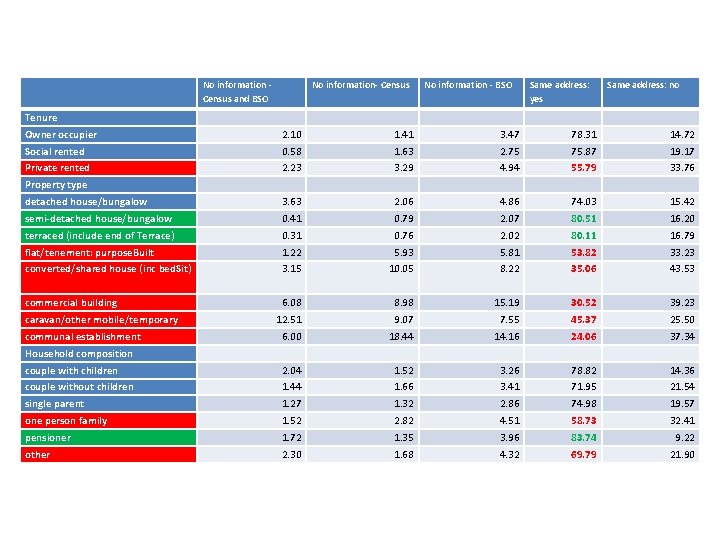
The Analysis: Property/household factors • Property/household influence address accuracy • Some of these might be expected in terms of conventional ‘hard‐to‐enumerate’ categories (tenure), others less so (eg property type) • Lower rates of match of interest are marked in red; higher rates in green in the following two tables – social/demographic variables and labour market variables • 20% of households have mismatch between the address information of members – problems reconstructing households?
No information Census and BSO No information- Census No information - BSO Same address: yes Same address: no Tenure Owner occupier 2. 10 1. 41 3. 47 78. 31 14. 72 Social rented 0. 58 1. 63 2. 75 75. 87 19. 17 Private rented 2. 23 3. 29 4. 94 55. 79 33. 76 detached house/bungalow 3. 63 2. 06 4. 86 74. 03 15. 42 semi-detached house/bungalow 0. 41 0. 79 2. 07 80. 51 16. 20 terraced (include end of Terrace) 0. 31 0. 76 2. 02 80. 11 16. 79 flat/tenement: purpose. Built 1. 22 5. 93 5. 81 53. 82 33. 23 converted/shared house (inc bed. Sit) 3. 15 10. 05 8. 22 35. 06 43. 53 commercial building 6. 08 8. 98 15. 19 30. 52 39. 23 12. 51 9. 07 7. 55 45. 37 25. 50 6. 00 18. 44 14. 16 24. 06 37. 34 couple with children 2. 04 1. 52 3. 26 78. 82 14. 36 couple without children 1. 44 1. 66 3. 41 71. 95 21. 54 single parent 1. 27 1. 32 2. 86 74. 98 19. 57 one person family 1. 52 2. 82 4. 51 58. 73 32. 41 pensioner 1. 72 1. 35 3. 96 83. 74 9. 22 other 2. 30 1. 68 4. 32 69. 79 21. 90 Property type caravan/other mobile/temporary communal establishment Household composition
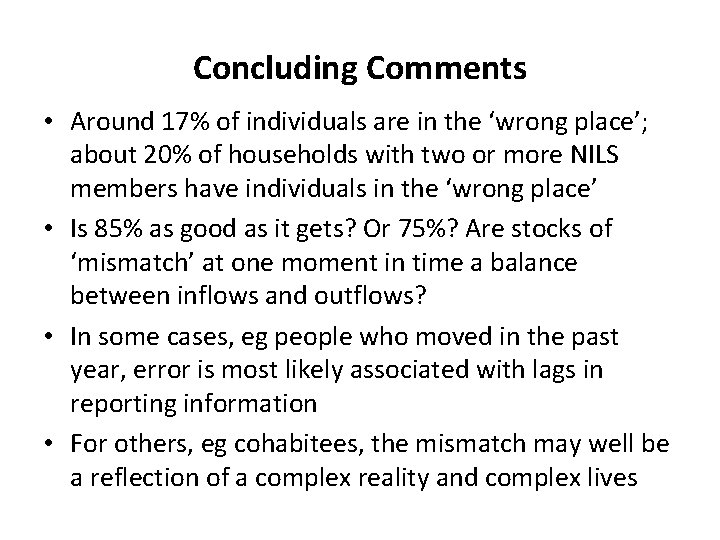
Concluding Comments • Around 17% of individuals are in the ‘wrong place’; about 20% of households with two or more NILS members have individuals in the ‘wrong place’ • Is 85% as good as it gets? Or 75%? Are stocks of ‘mismatch’ at one moment in time a balance between inflows and outflows? • In some cases, eg people who moved in the past year, error is most likely associated with lags in reporting information • For others, eg cohabitees, the mismatch may well be a reflection of a complex reality and complex lives
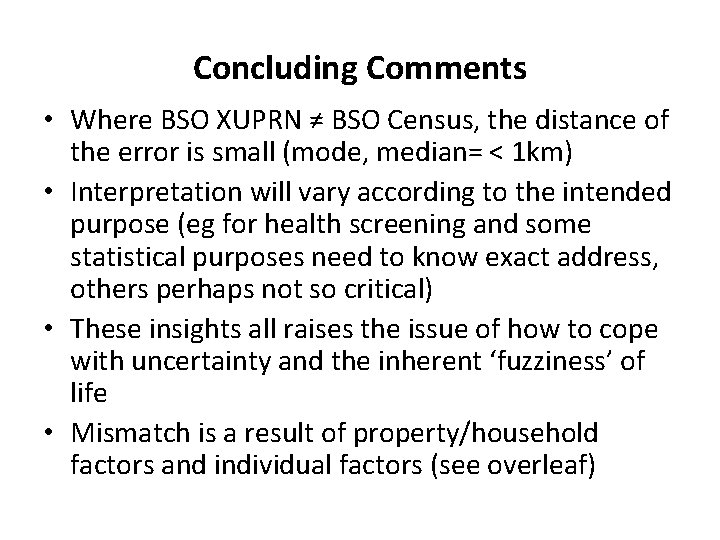
Concluding Comments • Where BSO XUPRN ≠ BSO Census, the distance of the error is small (mode, median= < 1 km) • Interpretation will vary according to the intended purpose (eg for health screening and some statistical purposes need to know exact address, others perhaps not so critical) • These insights all raises the issue of how to cope with uncertainty and the inherent ‘fuzziness’ of life • Mismatch is a result of property/household factors and individual factors (see overleaf)
An abstract place typology of types of error 120 100 80 Property factors 60 Individual factors 40 20 0 Type 1 Type 2 Type 3 Type 4
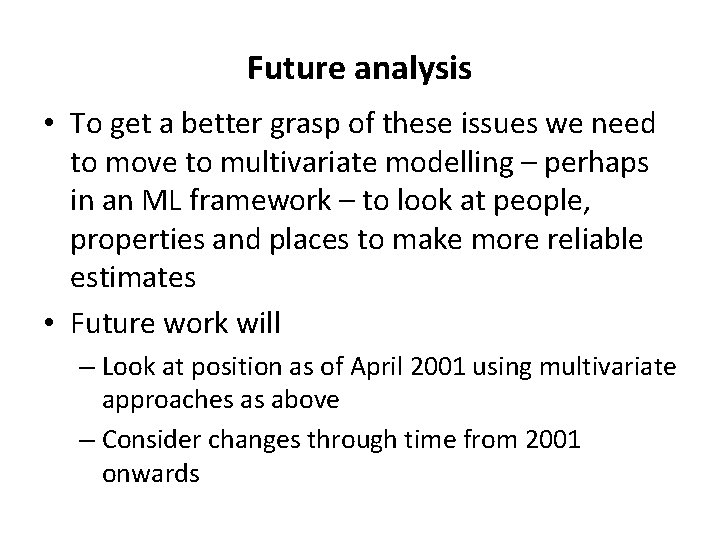
Future analysis • To get a better grasp of these issues we need to move to multivariate modelling – perhaps in an ML framework – to look at people, properties and places to make more reliable estimates • Future work will – Look at position as of April 2001 using multivariate approaches as above – Consider changes through time from 2001 onwards
Future analysis • Future work will – Update the analysis using 2011 data – have structural social changes 2001‐ 2011 made the population easier or harder to capture by the healthcard system? – Seek to add information on institutional factors (eg NILS members grouping in GP practices) – Try to transfer the NI experience to England & Wales and Scotland – what might be expected given the housing and demographic profile of localities in Britain?
Acknowledgement The help provided by the staff of the Northern Ireland Longitudinal Study/Northern Ireland Mortality Study (NILS) and the NILS Research Support Unit is acknowledged. The NILS is funded by the Health and Social Care Research and Development Division of the Public Health Agency (HSC R&D Division) and NISRA. The NILS‐RSU is funded by the ESRC and the Northern Ireland Government. The authors alone are responsible for the interpretation of the data and any views or opinions presented are solely those of the author(s) and do not necessarily represent those of NISRA/NILS.