
Understand the importance of reliability and validity 1How
Understand the importance of reliability and validity 1)How important is the ACT in getting into college? Should their be more or less emphasis on ACT scores? 2) Should their be more or less focus on the ACT in classes? 2) Is college for everyone? 3) What skills do people need to be successful in life?
3 tests we use today • Aptitude Tests- predict your ability to learn a new skill. • Achievement testsintended to reflect what you have learned. • Wechsler Adult Intelligence Scale- most widely used intelligence test today
How reliable and valid are certain tests? • Reliability- extent to which scores are consistent • Assuming someone’s basic ability has not changed, they should do the same on a retest • Validity-extent to which a test measures what it needs to. • Predictive validity= success at which a test predicts a certain behavior (aptitude) • (example: ACT scores predict how well you do in college). • Content Validity:
• Key Discussion Questions: • Do standardized tests have predictive validity? Explain, • What else should be used if not the act? • Should students with higher IQS be placed in classrooms that have the lowest IQ levels? • Does taking environmental factors into account take away from the validity of a test?
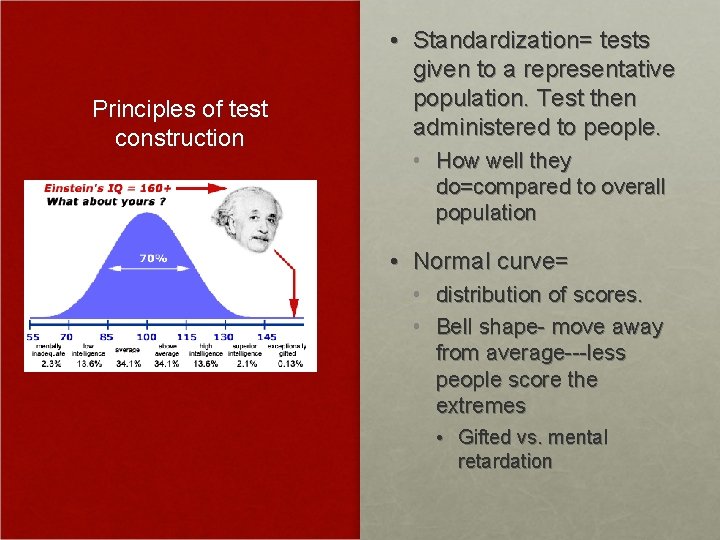
Principles of test construction • Standardization= tests given to a representative population. Test then administered to people. • How well they do=compared to overall population • Normal curve= • distribution of scores. • Bell shape- move away from average---less people score the extremes • Gifted vs. mental retardation

First Iq Tests • Alfred Binet (France- 18571911) • Created first intelligence Test • Mental Age- age level at which one performs • Lewis Terman • Stanford –Binet Test=Americanized version of test • Came up with term IQ • Bias
- Slides: 6