
Understand the Emotional and Social Development of Toddlers
- Slides: 17
Understand the Emotional and Social Development of Toddlers Objective 5. 02
Toddlers are children ages one to three, not one through three. At three, children are preschoolers.
Emotional Development Realization of being a separate person Egotism Negativity Anger and frustration Fear Jealousy Love/affection Empathy
Egotism Self-centered---seeing the world as revolving around them Self-esteem and self-image Egotistic---often expressed by frequent use of the word mine
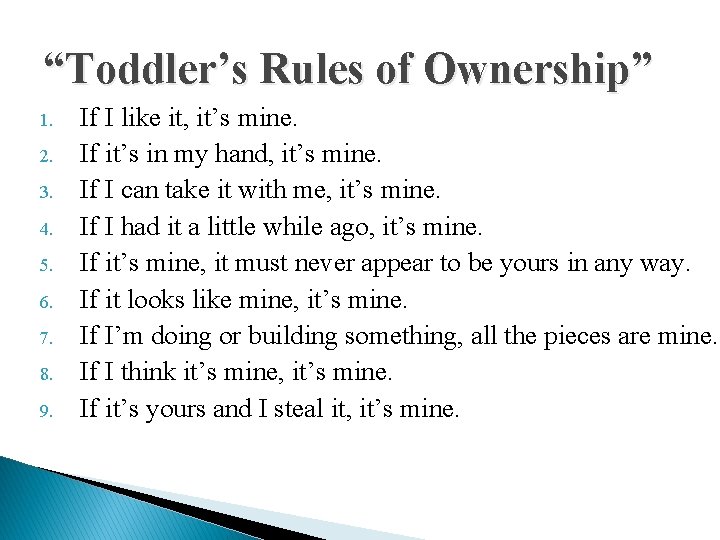
“Toddler’s Rules of Ownership” 1. 2. 3. 4. 5. 6. 7. 8. 9. If I like it, it’s mine. If it’s in my hand, it’s mine. If I can take it with me, it’s mine. If I had it a little while ago, it’s mine. If it’s mine, it must never appear to be yours in any way. If it looks like mine, it’s mine. If I’m doing or building something, all the pieces are mine. If I think it’s mine, it’s mine. If it’s yours and I steal it, it’s mine.
Negativity The way a toddler expresses his/her independence and general opposition to the world Usually expressed by doing the opposite of what others want Causes of negativism---desire for independence, frustration, realization of being a separate person
Anger and Frustration Release leads to temper tantrums Often released by screaming, kicking, hitting and sometimes holding their breath May continue through the age of four
Fear One-year-olds suffer from separation anxiety---the fear that loved ones will not return Three-year-olds with an expanding imagination may fear the dark Adults should not dismiss the fears of the toddler but should handle in a supportive way
Jealousy May begin when the child is eighteen months Peaks at the age of three Cause: The toddler cannot understand that there is enough attention or love for everyone.
Love/affection Relationships formed by toddler’s interactions forms base of ability to love/show affection Parent or other caregiver is the first person the child learns to love Later expanded to include siblings and others outside of the home
Empathy The ability to put oneself in another person’s shoes By age two, the toddler has developed the ability to empathize
Social Development Milestones of social development Socialization goals Imaginary friends Role of play
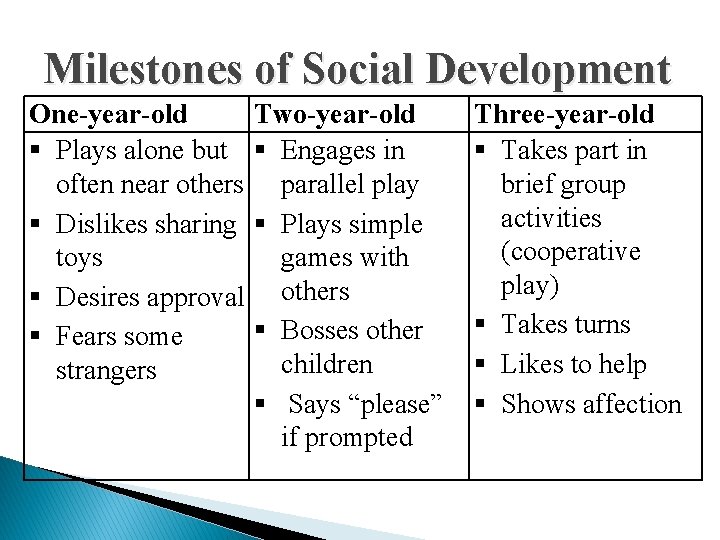
Milestones of Social Development One-year-old Plays alone but often near others Dislikes sharing toys Desires approval Fears some strangers Two-year-old Engages in parallel play Plays simple games with others Bosses other children Says “please” if prompted Three-year-old Takes part in brief group activities (cooperative play) Takes turns Likes to help Shows affection
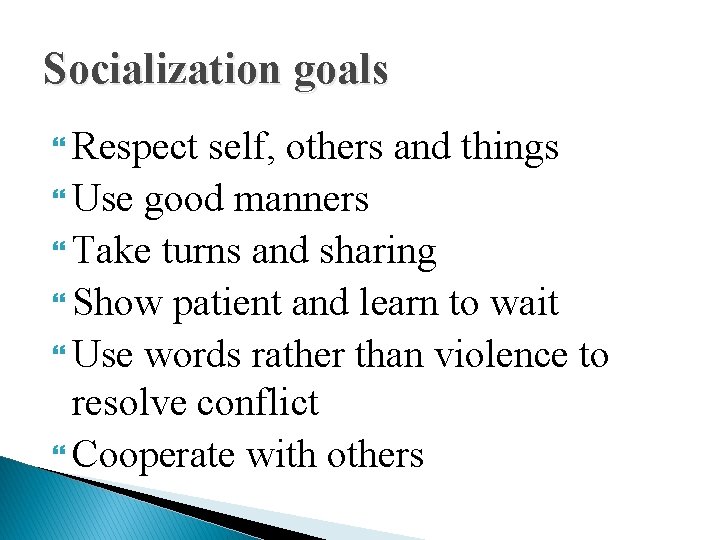
Socialization goals Respect self, others and things Use good manners Take turns and sharing Show patient and learn to wait Use words rather than violence to resolve conflict Cooperate with others
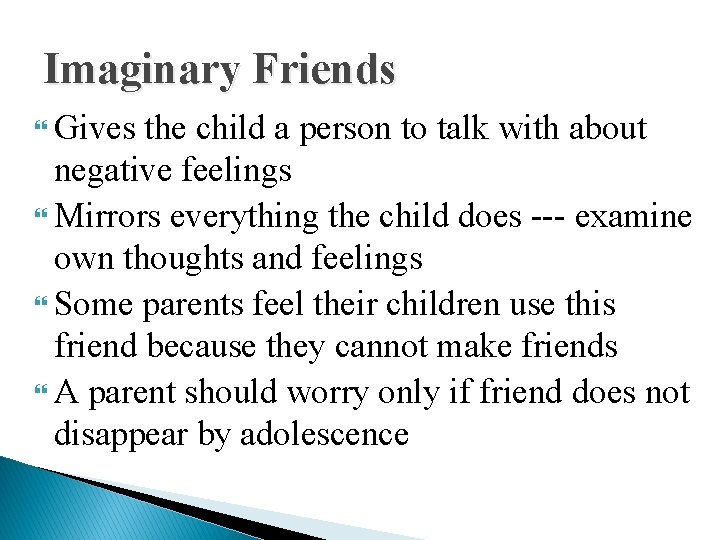
Imaginary Friends Gives the child a person to talk with about negative feelings Mirrors everything the child does --- examine own thoughts and feelings Some parents feel their children use this friend because they cannot make friends A parent should worry only if friend does not disappear by adolescence
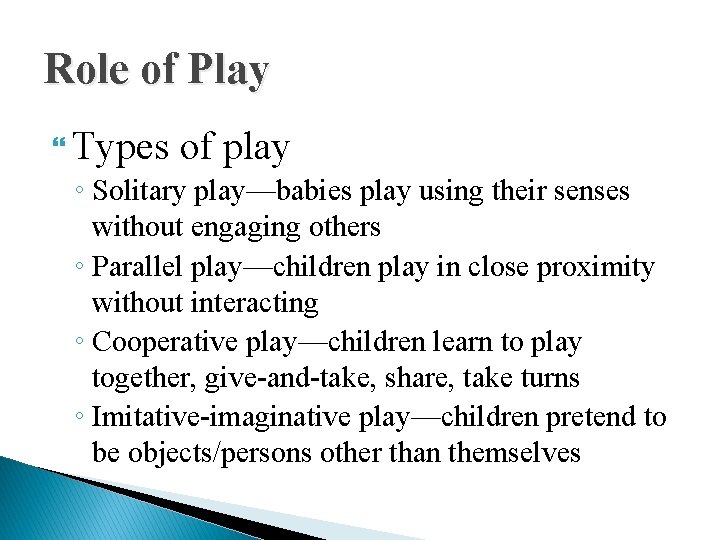
Role of Play Types of play ◦ Solitary play—babies play using their senses without engaging others ◦ Parallel play—children play in close proximity without interacting ◦ Cooperative play—children learn to play together, give-and-take, share, take turns ◦ Imitative-imaginative play—children pretend to be objects/persons other than themselves
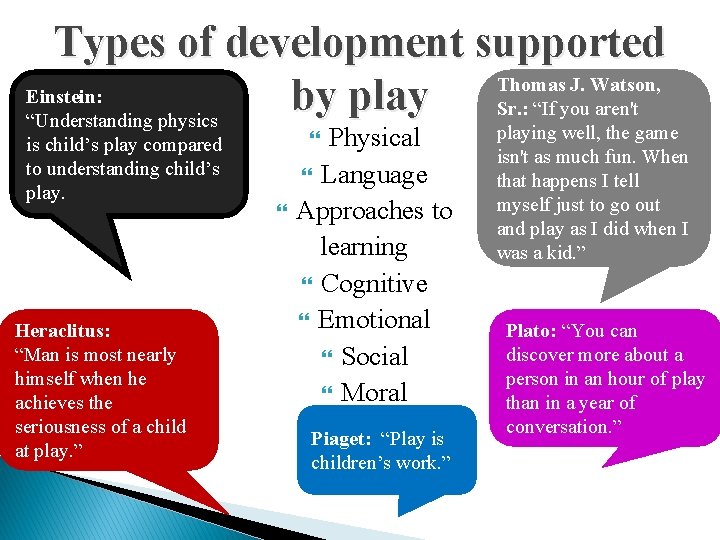
Types of development supported Thomas J. Watson, Einstein: by play Sr. : “If you aren't “Understanding physics is child’s play compared to understanding child’s play. Heraclitus: “Man is most nearly himself when he achieves the seriousness of a child at play. ” Physical Language Approaches to learning Cognitive Emotional Social Moral Piaget: “Play is children’s work. ” playing well, the game isn't as much fun. When that happens I tell myself just to go out and play as I did when I was a kid. ” Plato: “You can discover more about a person in an hour of play than in a year of conversation. ”