
Understand Socially Aware Behaviour Links between positive relationships
Understand Socially Aware Behaviour
Links between positive relationships & socially aware behaviour A recent care inquiry stated that “The relationships with people who care for and about children are the golden thread in a child's life. And the quality of a child’s relationships is the lens through which we should view what we do and what we plan to do” (care inquiry 2013)
High Quality Relationships ØThe experience of positive, safe and stable relationships helps children and young people build secure attachments, develop self-confidence, self-esteem and self-reliance and contributes to a strong sense of identity and belonging. ØFrom the perspective of children and young people, stable, significant relationships are beneficial as they provide someone to turn to at points of crisis and change, they provide encouragement and guidance and they provide endorsement at key life events
High Quality Relationships ØIn the absence of a secure attachment relationship, some children can find it difficult to trust adults in the face of previously negative and abusive encounters ØSecure attachment relationships contribute to the healthy emotional development of children, providing them with skills, competence and capacity to regulate their own emotions, understand others and to form healthy relationships
Better Relationships, Better Learning, Better Behaviour ØUnderstanding acceptable socially aware behaviour extends into schools, who are working promote positive behaviour. Research has shown: ØSchools are using a wide range of approaches to encourage positive behaviour, e. g. a curriculum focus on social and emotional wellbeing, restorative approaches, nurturing approaches, peer mentoring, solution oriented approaches ØPositive and supportive approaches are increasingly being used far more than punitive methods
Better Relationships, Better Learning, Better Behaviour ØStaff in schools feel that ‘promotion of positive behaviour, through whole school ethos and values is a helpful approach to improving behaviour ØStaged intervention models have become key components in behaviour relationships and policies
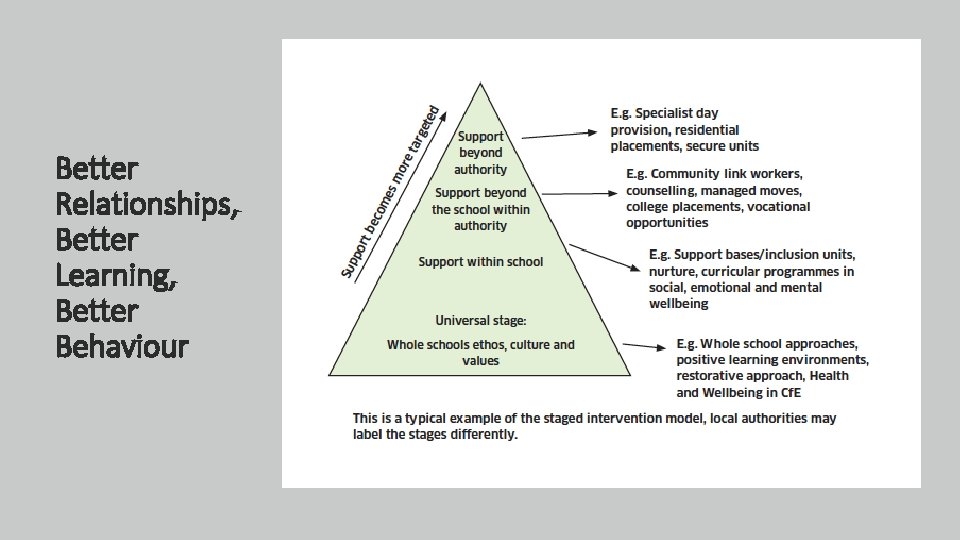
Better Relationships, Better Learning, Better Behaviour
- Slides: 7