
Undermining and Bullying in the Surgical Workplace The
Undermining and Bullying in the Surgical Workplace
The problem > Bullying happens in all walks of life, in most medical specialties, and between clinical and non-clinical staff > Whilst surgeons are not the only bullies, there is evidence to suggest that it is particularly prevalent in our specialty > Not only is this unpleasant for us, there is evidence to show it can cause harm to our patients > The aim of our campaign is to offer support to those being bullied, help identify bullying behaviour in ourselves, and to lead by example by changing the culture in the surgical workplace

Definitions GMC > ‘Undermining is behaviour that subverts, weakens or wears away confidence’ > ‘Bullying is behaviour that hurts or frightens someone who is less powerful, often forcing them to do something they do not want to do’ ACAS > ‘Victimisation is retaliatory action by an employer against an employee who has made or supported a complaint of discrimination’
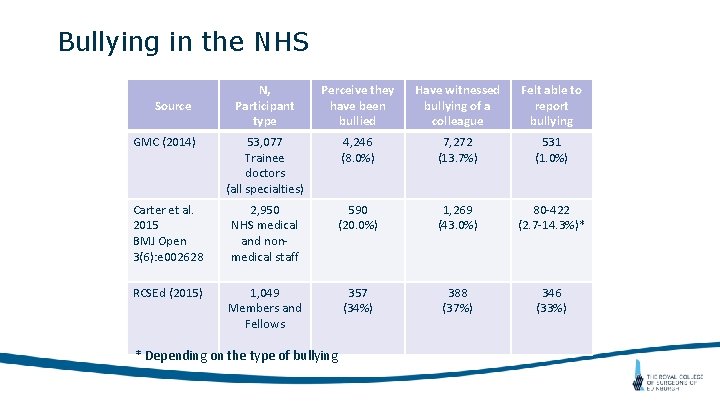
Bullying in the NHS N, Participant type Perceive they have been bullied Have witnessed bullying of a colleague Felt able to report bullying GMC (2014) 53, 077 Trainee doctors (all specialties) 4, 246 (8. 0%) 7, 272 (13. 7%) 531 (1. 0%) Carter et al. 2015 BMJ Open 3(6): e 002628 2, 950 NHS medical and nonmedical staff 590 (20. 0%) 1, 269 (43. 0%) 80 -422 (2. 7 -14. 3%)* RCSEd (2015) 1, 049 Members and Fellows 357 (34%) 388 (37%) 346 (33%) Source * Depending on the type of bullying
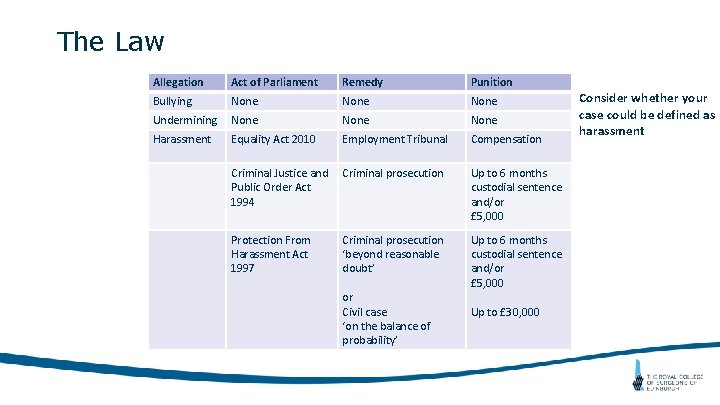
The Law Allegation Act of Parliament Remedy Punition Bullying None Undermining None Harassment Equality Act 2010 Employment Tribunal Compensation Criminal Justice and Public Order Act 1994 Criminal prosecution Up to 6 months custodial sentence and/or £ 5, 000 Protection From Harassment Act 1997 Criminal prosecution ‘beyond reasonable doubt’ Up to 6 months custodial sentence and/or £ 5, 000 or Civil case ‘on the balance of probability’ Up to £ 30, 000 Consider whether your case could be defined as harassment
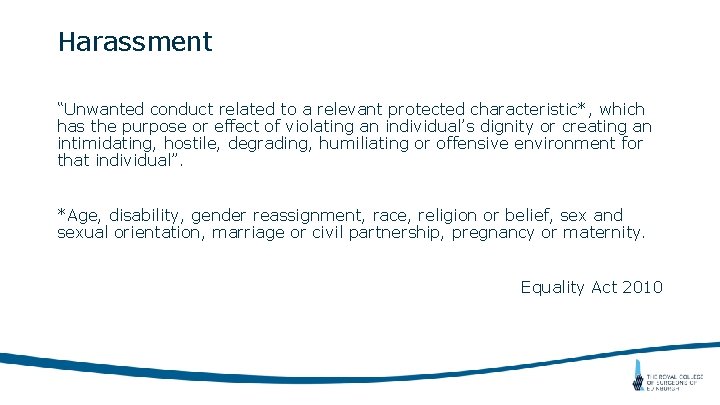
Harassment “Unwanted conduct related to a relevant protected characteristic*, which has the purpose or effect of violating an individual’s dignity or creating an intimidating, hostile, degrading, humiliating or offensive environment for that individual”. *Age, disability, gender reassignment, race, religion or belief, sex and sexual orientation, marriage or civil partnership, pregnancy or maternity. Equality Act 2010
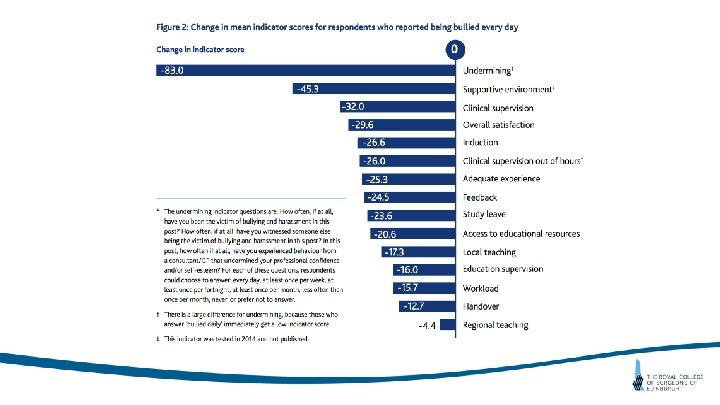
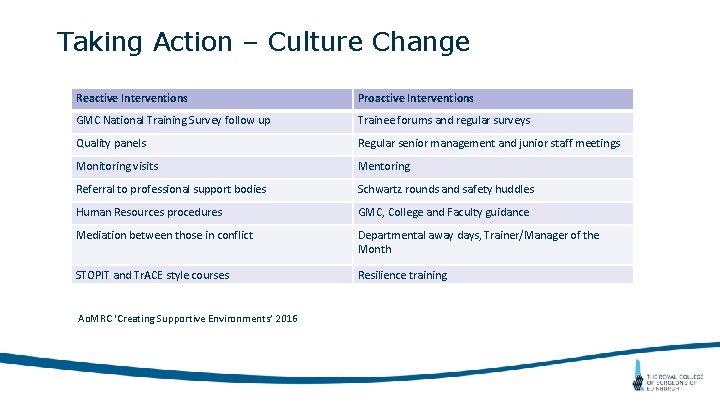
Taking Action – Culture Change Reactive Interventions Proactive Interventions GMC National Training Survey follow up Trainee forums and regular surveys Quality panels Regular senior management and junior staff meetings Monitoring visits Mentoring Referral to professional support bodies Schwartz rounds and safety huddles Human Resources procedures GMC, College and Faculty guidance Mediation between those in conflict Departmental away days, Trainer/Manager of the Month STOPIT and Tr. ACE style courses Resilience training Ao. MRC ‘Creating Supportive Environments’ 2016
Taking Action – Essentials > Document everything > Every encounter should be recorded and can be used as evidence > Remain professional > Stick to the facts > Communicate > Consider written communication if you don’t feel comfortable confronting the bully
Stepwise Approach Team > Clinical/educational Supervisor > Clinical Director Organisation > Medical Director > Human Resources External > Training Programme Director > BMA/GMC/CQC/Citizens Advice The law – as a last resort
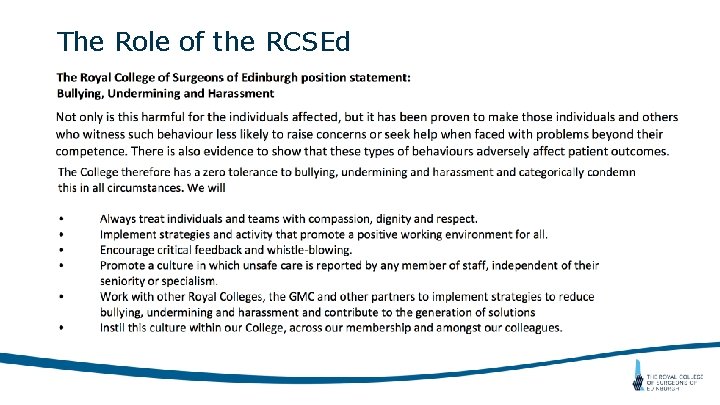
The Role of the RCSEd
Key Messages > Bullying and undermining behaviour is never acceptable > It threatens patient safety > It is not part of surgery > Report it properly – follow our guidance > RCSEd will lead a culture change
- Slides: 13