
Underground Experimental Program in Korea Sun Kee Kim



- Slides: 41
Underground Experimental Program in Korea Sun Kee Kim Seoul National Unversity ASPERA workshop, Zaragoza
Outline ¢ Y 2 L (Yang Underground Laboratory) ¢ KIMS (Korea Invisible Mass Search) p p ¢ Dark matter search with Cs. I(Tl) crystals Double beta decay search activities AMo. RE (Advanced Molybdenum based Rare process Experiment) p p p Development of Ca. Mo. O 4 crystals Development of cryogenic detector with the Ca. Mo. O 4 crystal Prospects
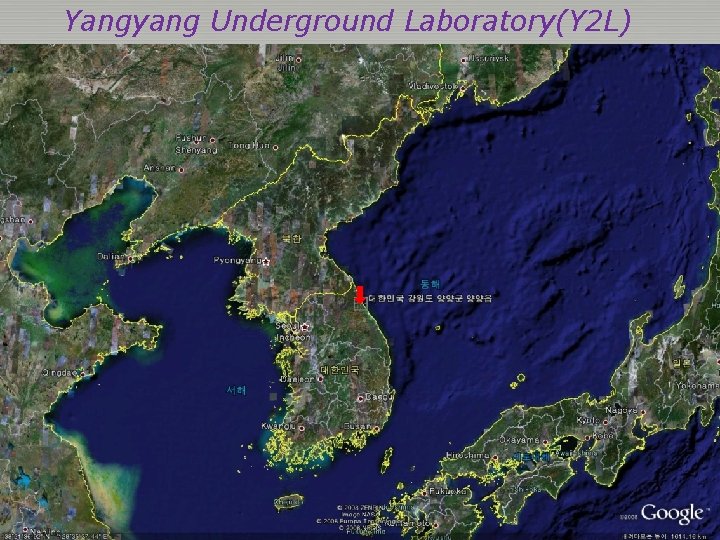
Yangyang Underground Laboratory(Y 2 L)
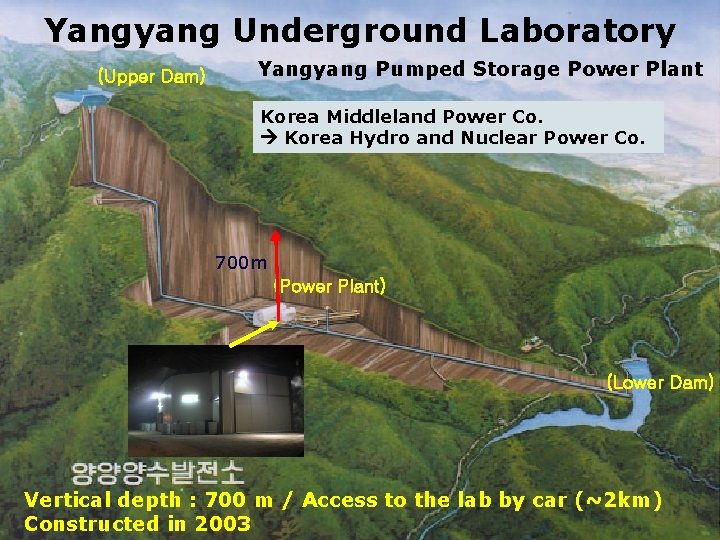
Yangyang Underground Laboratory (Upper Dam) Yangyang Pumped Storage Power Plant Korea Middleland Power Co. Korea Hydro and Nuclear Power Co. 700 m (Power Plant) (Lower Dam) Vertical depth : 700 m / Access to the lab by car (~2 km) Constructed in 2003
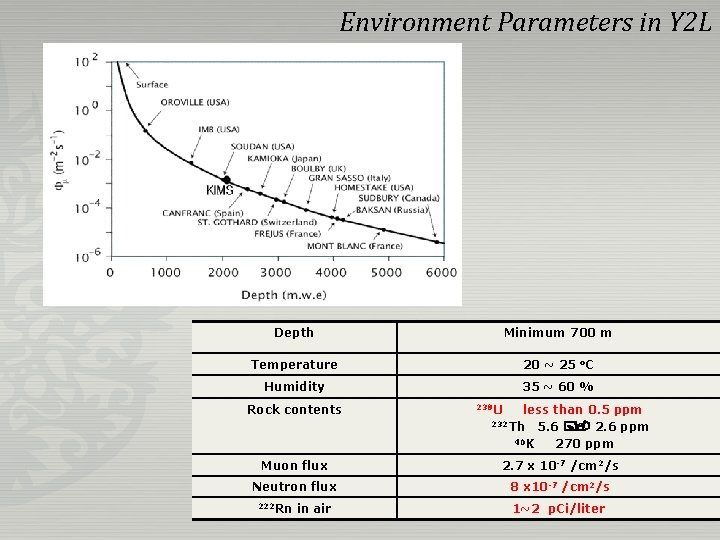
Environment Parameters in Y 2 L Depth Minimum 700 m Temperature 20 ~ 25 o. C Humidity 35 ~ 60 % Rock contents 238 U less than 0. 5 ppm 5. 6 +- 2. 6 ppm 40 K 270 ppm 232 Th Muon flux 2. 7 x 10 -7 /cm 2/s Neutron flux 8 x 10 -7 /cm 2/s 222 Rn in air 1~2 p. Ci/liter
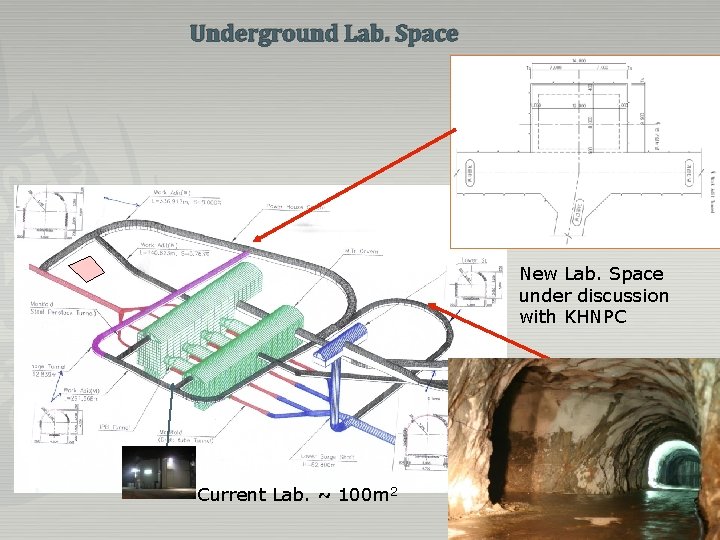
Underground Lab. Space New Lab. Space under discussion with KHNPC Current Lab. ~ 100 m 2
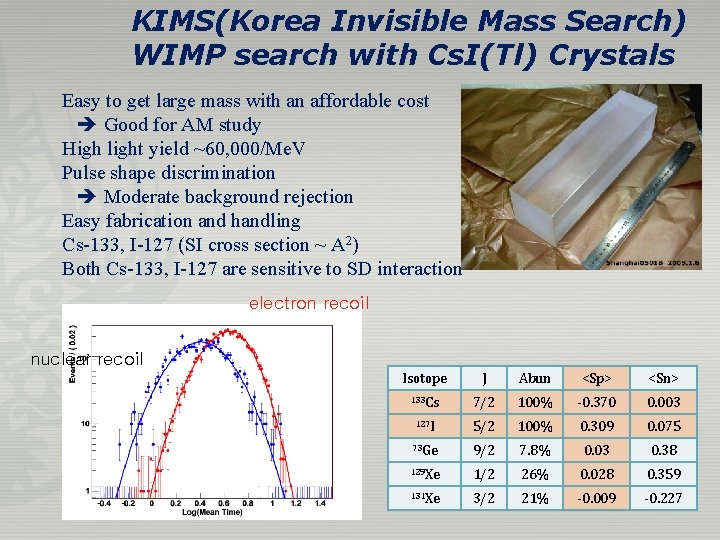
KIMS(Korea Invisible Mass Search) WIMP search with Cs. I(Tl) Crystals Easy to get large mass with an affordable cost Good for AM study High light yield ~60, 000/Me. V Pulse shape discrimination Moderate background rejection Easy fabrication and handling Cs-133, I-127 (SI cross section ~ A 2) Both Cs-133, I-127 are sensitive to SD interaction electron recoil nuclear recoil Isotope J Abun <Sp> <Sn> 133 Cs 7/2 100% -0. 370 0. 003 127 I 5/2 100% 0. 309 0. 075 73 Ge 9/2 7. 8% 0. 03 0. 38 129 Xe 1/2 26% 0. 028 0. 359 131 Xe 3/2 21% -0. 009 -0. 227
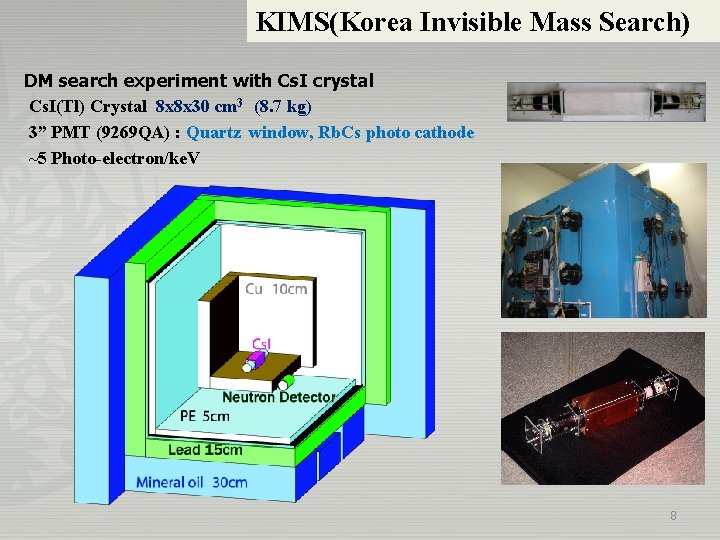
KIMS(Korea Invisible Mass Search) DM search experiment with Cs. I crystal Cs. I(Tl) Crystal 8 x 8 x 30 cm 3 (8. 7 kg) 3” PMT (9269 QA) : Quartz window, Rb. Cs photo cathode ~5 Photo-electron/ke. V 8
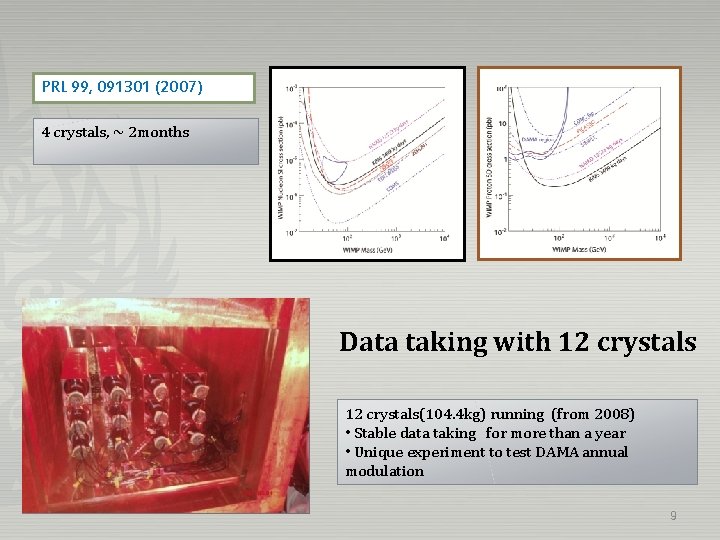
PRL 99, 091301 (2007) 4 crystals, ~ 2 months Data taking with 12 crystals(104. 4 kg) running (from 2008) • Stable data taking for more than a year • Unique experiment to test DAMA annual modulation 9
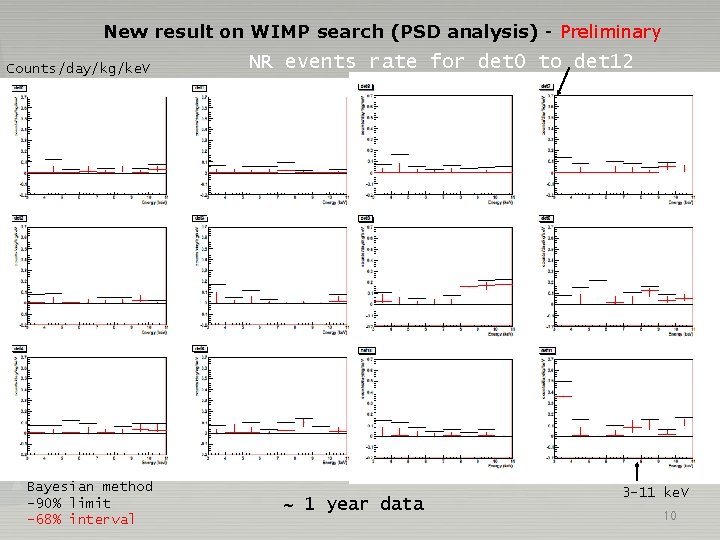
New result on WIMP search (PSD analysis) - Preliminary Counts/day/kg/ke. V Determined from Bayesian method -90% limit -68% interval NR events rate for det 0 to det 12 ~ 1 year data 3 -11 ke. V 10
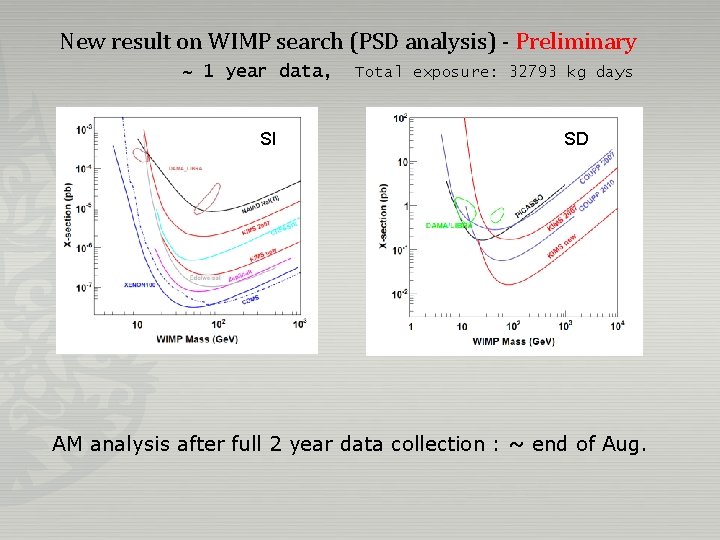
New result on WIMP search (PSD analysis) - Preliminary ~ 1 year data, SI Total exposure: 32793 kg days SD AM analysis after full 2 year data collection : ~ end of Aug.
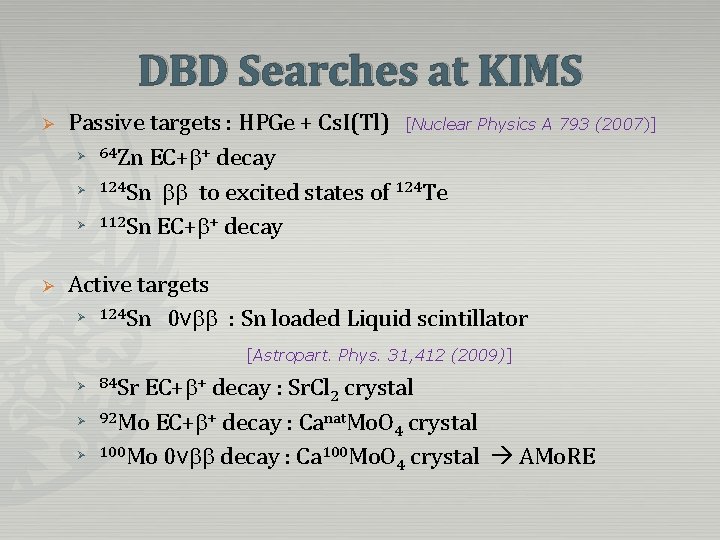
DBD Searches at KIMS Ø Passive targets : HPGe + Cs. I(Tl) [Nuclear Physics A 793 (2007)] Ø 64 Zn EC+ + decay Ø 124 Sn to excited states of 124 Te Ø 112 Sn EC+ + decay Ø Active targets Ø 124 Sn 0ν : Sn loaded Liquid scintillator [Astropart. Phys. 31, 412 (2009)] Ø Ø Ø 84 Sr EC+ + decay : Sr. Cl 2 crystal 92 Mo EC+ + decay : Canat. Mo. O crystal 4 100 Mo 0ν decay : Ca 100 Mo. O crystal AMo. RE 4
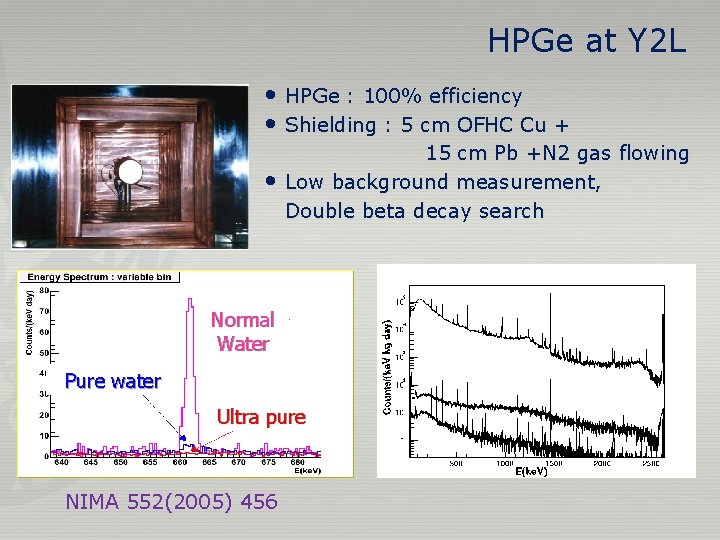
HPGe at Y 2 L • HPGe : 100% efficiency • Shielding : 5 cm OFHC Cu + • 15 cm Pb +N 2 gas flowing Low background measurement, Double beta decay search Normal Water Pure water Ultra pure NIMA 552(2005) 456
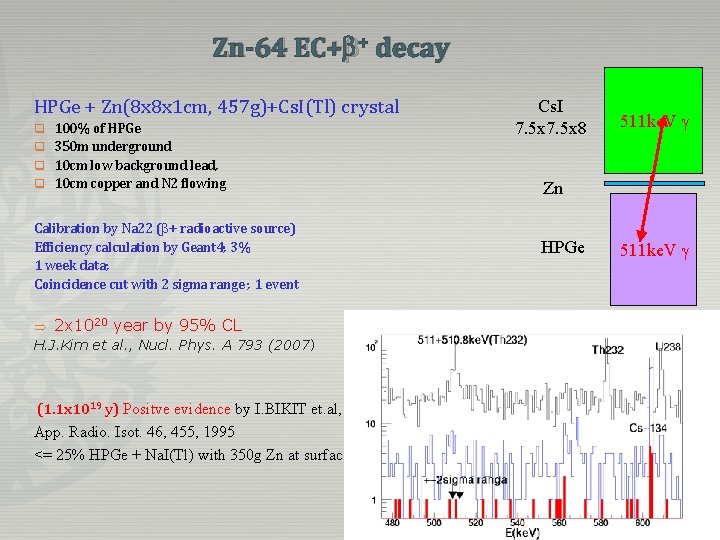
Zn-64 EC+b+ decay HPGe + Zn(8 x 8 x 1 cm, 457 g)+Cs. I(Tl) crystal q q 100% of HPGe 350 m underground 10 cm low background lead, 10 cm copper and N 2 flowing Calibration by Na 22 ( + radioactive source) Efficiency calculation by Geant 4; 3% 1 week data; Coincidence cut with 2 sigma range ; 1 event Þ 2 x 10²⁰ year by 95% CL H. J. Kim et al. , Nucl. Phys. A 793 (2007) (1. 1 x 10¹⁹ y) Positve evidence by I. BIKIT et. al, App. Radio. Isot. 46, 455, 1995 <= 25% HPGe + Na. I(Tl) with 350 g Zn at surface with shielding. Cs. I 7. 5 x 8 511 ke. V Zn HPGe 511 ke. V
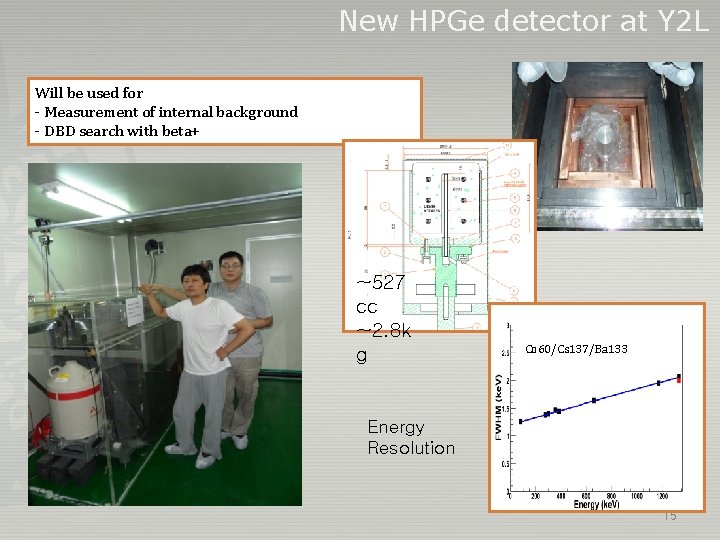
New HPGe detector at Y 2 L Will be used for - Measurement of internal background - DBD search with beta+ ~527 cc ~2. 8 k g Co 60/Cs 137/Ba 133 Energy Resolution 15
New HPGe detector at Y 2 L Black Line : ORTEC 0. 0119 Hz Red Line : Canberra 0. 0060 Hz P 1 1. 86 evt/bin 5. 08 evt/bin P 2 0. 219 evt/bin P 1 P 2 Energy resolution 0. 431 evt/bin Ra 226 K 40 Tl 208 16
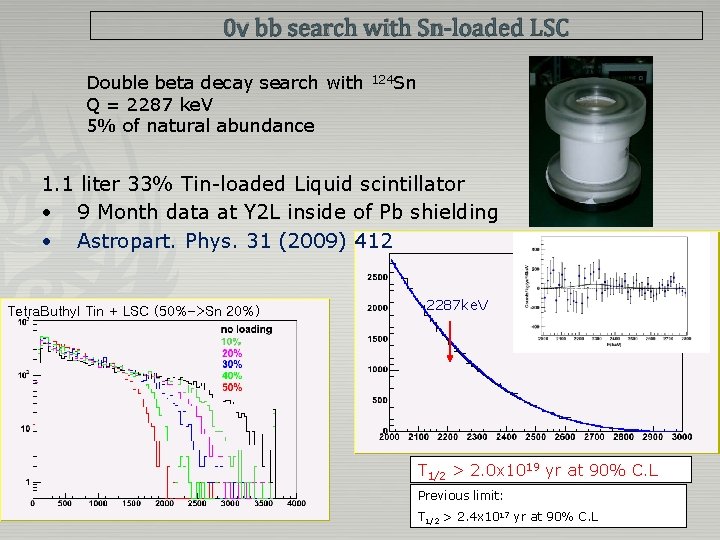
0ν bb search with Sn-loaded LSC Double beta decay search with Q = 2287 ke. V 5% of natural abundance 124 Sn 1. 1 liter 33% Tin-loaded Liquid scintillator • 9 Month data at Y 2 L inside of Pb shielding • Astropart. Phys. 31 (2009) 412 Tetra. Buthyl Tin + LSC (50%->Sn 20%) 2287 ke. V T 1/2 > 2. 0 x 1019 yr at 90% C. L Previous limit: 17 T 1/2 > 2. 4 x 10¹⁷ yr at 90% C. L
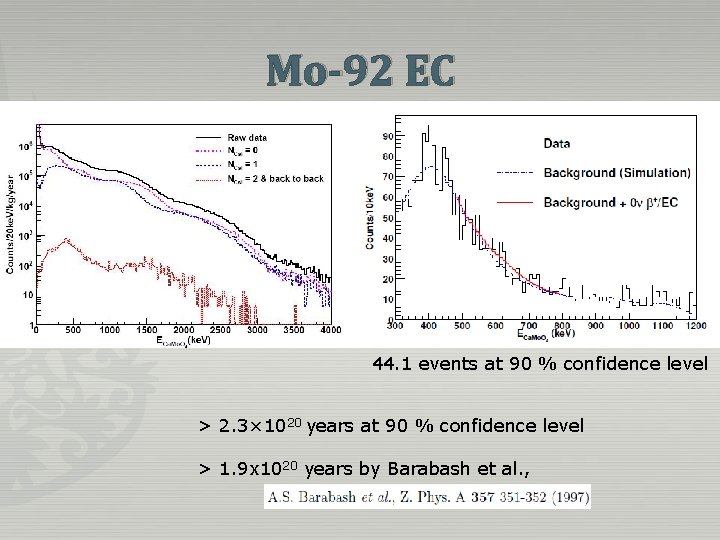
EC/β+ decay of 92 Mo • (A, Z) + e- -> (A, Z-2 ) + e+ + 628 ke. V(Qvalue) • e+ stops in active(Ca. Mo. O 4) Crystal. • back to back 511 ke. V gammas at Cs. I(Tl) • Abundance = 92 Mo: 14. 84%, 100 Mo: 9. 63% 4 pi coverage by Cs. I(Tl) crystal (not high radiopurity) Ca. Mo. O 4 crystal : 2. 2 x 6 cm (2) : 255 g
Mo-92 EC 627 ke. V for 0+/EC 8 ± 33. 4 events 44. 1 events at 90 % confidence level > 2. 3× 10²⁰ years at 90 % confidence level > 1. 9 x 10²⁰ years by Barabash et al. ,
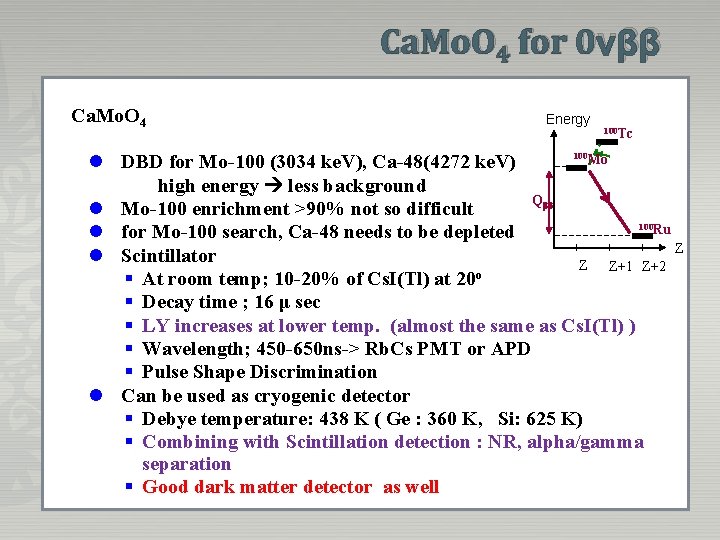
Ca. Mo. O 4 for 0νββ Ca. Mo. O 4 Energy 100 Tc 100 Mo l DBD for Mo-100 (3034 ke. V), Ca-48(4272 ke. V) high energy less background Qbb l Mo-100 enrichment >90% not so difficult 100 Ru l for Mo-100 search, Ca-48 needs to be depleted Z l Scintillator Z Z+1 Z+2 o § At room temp; 10 -20% of Cs. I(Tl) at 20 § Decay time ; 16 μ sec § LY increases at lower temp. (almost the same as Cs. I(Tl) ) § Wavelength; 450 -650 ns-> Rb. Cs PMT or APD § Pulse Shape Discrimination l Can be used as cryogenic detector § Debye temperature: 438 K ( Ge : 360 K, Si: 625 K) § Combining with Scintillation detection : NR, alpha/gamma separation § Good dark matter detector as well
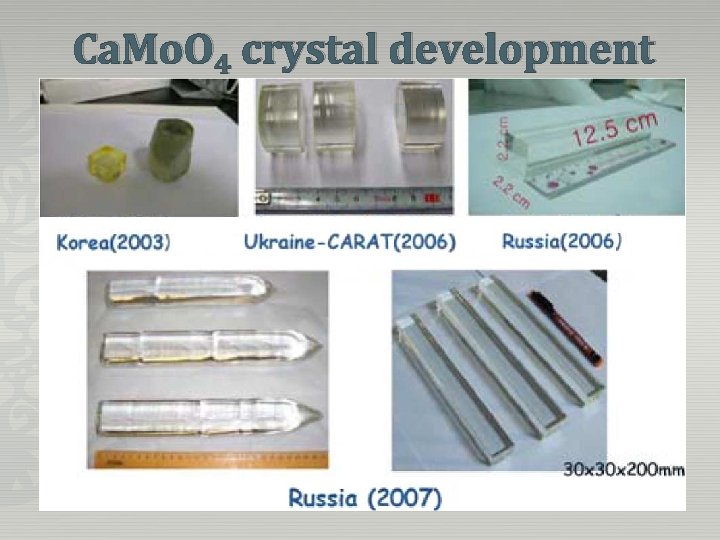
Ca. Mo. O 4 crystal development
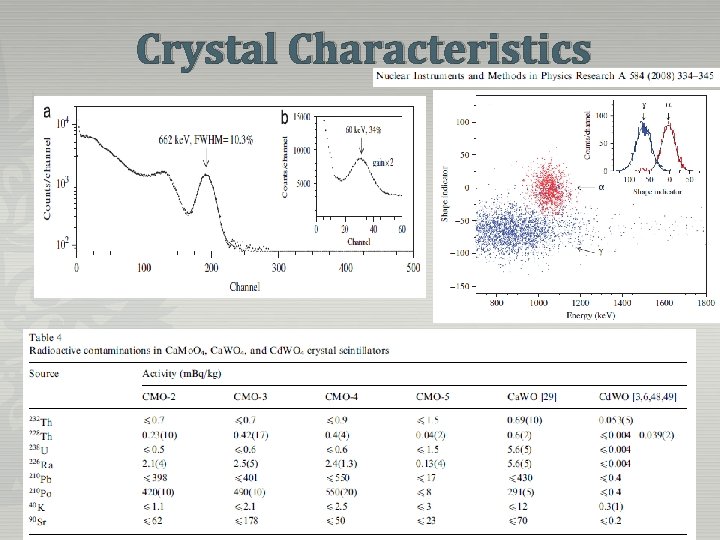
Crystal Characteristics
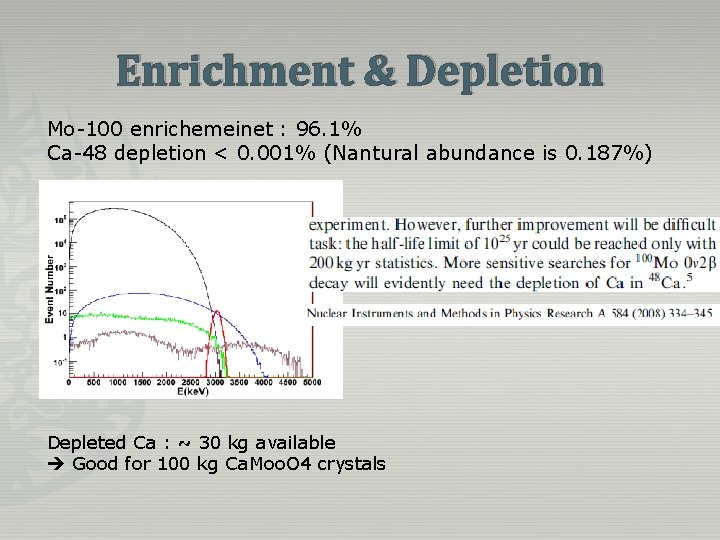
Enrichment & Depletion Mo-100 enrichemeinet : 96. 1% Ca-48 depletion < 0. 001% (Nantural abundance is 0. 187%) Depleted Ca : ~ 30 kg available Good for 100 kg Ca. Moo. O 4 crystals
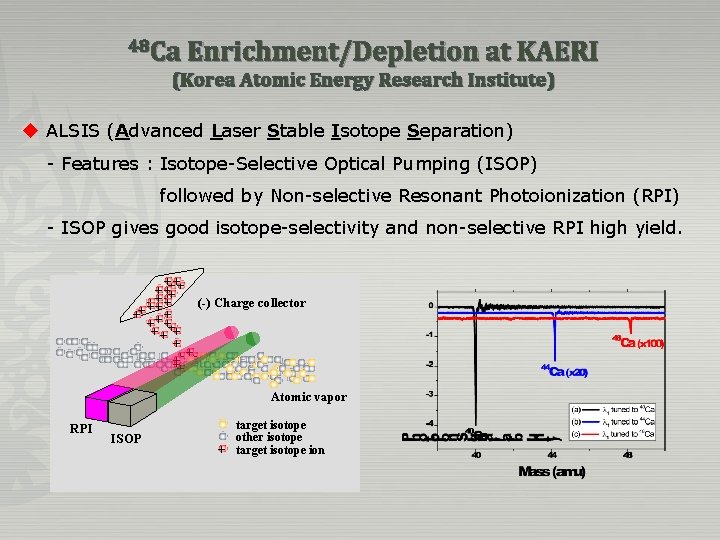
48 Ca Enrichment/Depletion at KAERI (Korea Atomic Energy Research Institute) u ALSIS (Advanced Laser Stable Isotope Separation) - Features : Isotope-Selective Optical Pumping (ISOP) followed by Non-selective Resonant Photoionization (RPI) - ISOP gives good isotope-selectivity and non-selective RPI high yield. ++ + + + + (-) Charge collector +++ ++ ++ + + Atomic vapor RPI ISOP target isotope other isotope + target isotope ion
48 Ca Enrichment/Depletion at KAERI u Special features of ALSIS - Isotope-selective optical pumping followed by resonant photo-ionization - Ideal for 48 Ca Production - Fiber-based lasers : most advanced, maintenance-free u Engineering Demonstration (2010~2012) - Production capability : 1 kg/yr u Production Demonstration for (2013 – 2014) - Production capability : 5 kg/yr
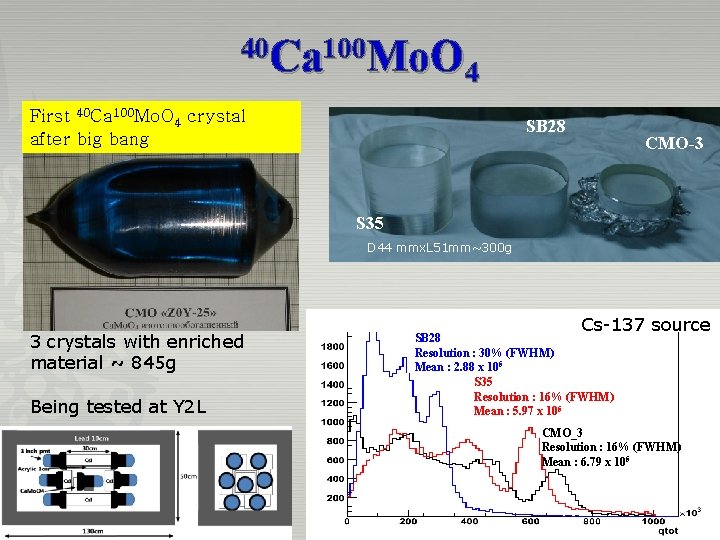
40 Ca 100 Mo. O 4 First 40 Ca 100 Mo. O 4 crystal after big bang SB 28 CMO-3 S 35 D 44 mmx. L 51 mm~300 g 3 crystals with enriched material ~ 845 g Being tested at Y 2 L Cs-137 source SB 28 Resolution : 30% (FWHM) Mean : 2. 88 x 105 S 35 Resolution : 16% (FWHM) Mean : 5. 97 x 105 CMO_3 Resolution : 16% (FWHM) Mean : 6. 79 x 105
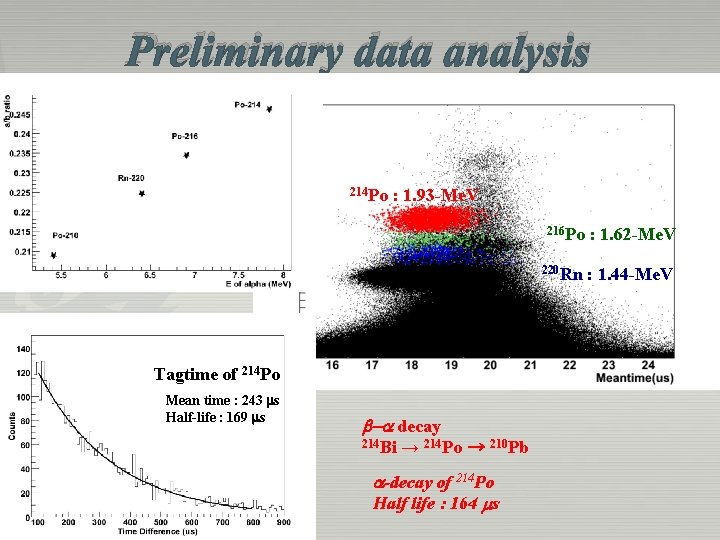
Preliminary data analysis 214 Po : 1. 93 -Me. V Tagtime of 214 Po Mean time : 243 ms Half-life : 169 ms b-a decay 214 Bi → 214 Po → 210 Pb a-decay of 214 Po Half life : 164 ms 216 Po : 1. 62 -Me. V 220 Rn : 1. 44 -Me. V
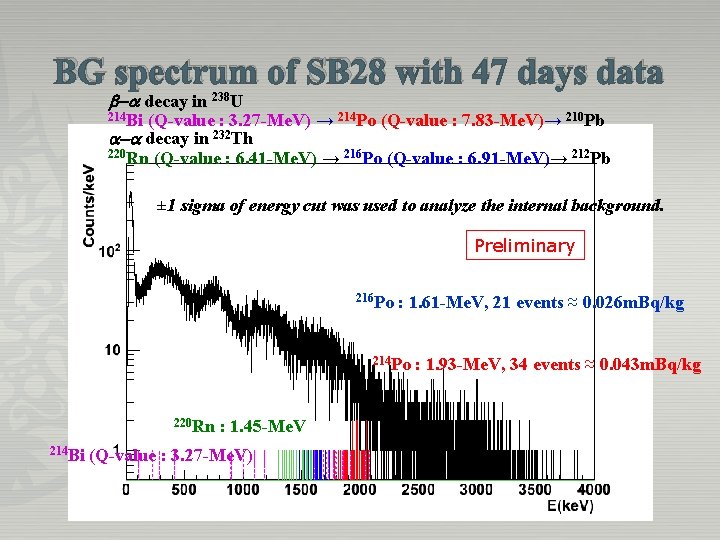
BG spectrum of SB 28 with 47 days data b-a decay in 238 U 214 Bi (Q-value : 3. 27 -Me. V) → 214 Po (Q-value : 7. 83 -Me. V)→ 210 Pb a-a decay in 232 Th 220 Rn (Q-value : 6. 41 -Me. V) → 216 Po (Q-value : 6. 91 -Me. V)→ 212 Pb ± 1 sigma of energy cut was used to analyze the internal background. Preliminary 216 Po : 1. 61 -Me. V, 21 events ≈ 0. 026 m. Bq/kg 214 Po 220 Rn 214 Bi : 1. 45 -Me. V (Q-value : 3. 27 -Me. V) : 1. 93 -Me. V, 34 events ≈ 0. 043 m. Bq/kg
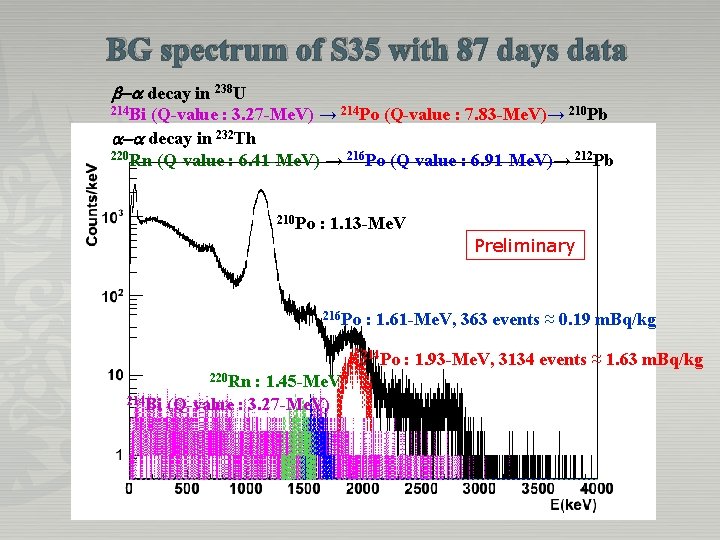
BG spectrum of S 35 with 87 days data b-a decay in 238 U 214 Bi (Q-value : 3. 27 -Me. V) → 214 Po (Q-value : 7. 83 -Me. V)→ 210 Pb a-a decay in 232 Th 220 Rn (Q-value : 6. 41 -Me. V) → 216 Po (Q-value : 6. 91 -Me. V)→ 212 Pb 210 Po : 1. 13 -Me. V Preliminary 216 Po : 1. 61 -Me. V, 363 events ≈ 0. 19 m. Bq/kg 214 Po 220 Rn : 1. 45 -Me. V 214 Bi (Q-value : 3. 27 -Me. V) : 1. 93 -Me. V, 3134 events ≈ 1. 63 m. Bq/kg
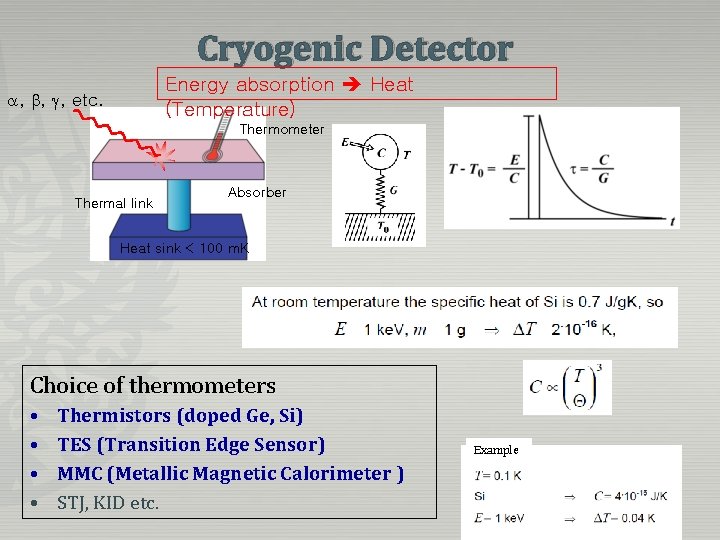
Cryogenic Detector Energy absorption Heat (Temperature) , , , etc. Thermometer Thermal link Absorber Heat sink < 100 m. K Choice of thermometers • • Thermistors (doped Ge, Si) TES (Transition Edge Sensor) MMC (Metallic Magnetic Calorimeter ) STJ, KID etc. Example
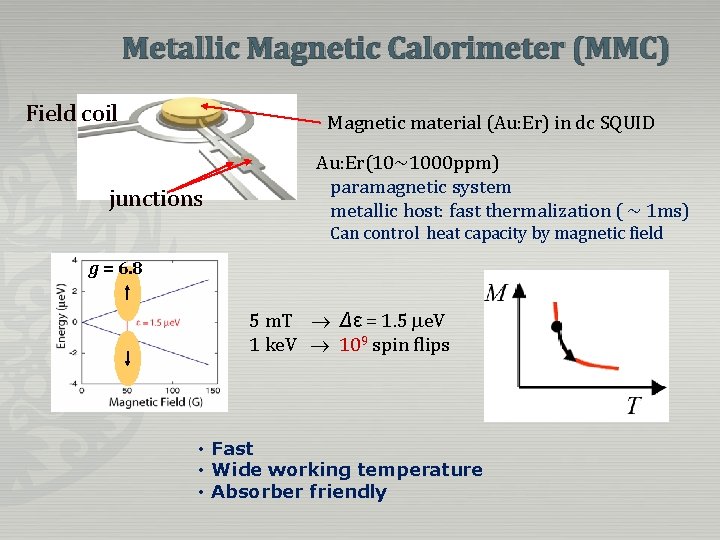
Metallic Magnetic Calorimeter (MMC) Field coil Magnetic material (Au: Er) in dc SQUID junctions Au: Er(10~1000 ppm) paramagnetic system metallic host: fast thermalization ( ~ 1 ms) Can control heat capacity by magnetic field g = 6. 8 5 m. T Δε = 1. 5 e. V 1 ke. V 109 spin flips • Fast • Wide working temperature • Absorber friendly
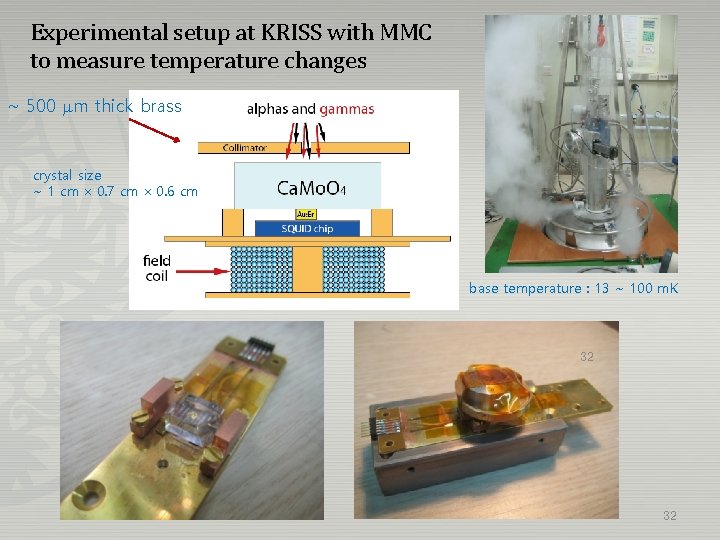
Experimental setup at KRISS with MMC to measure temperature changes ~ 500 m thick brass crystal size ~ 1 cm 0. 7 cm 0. 6 cm base temperature : 13 ~ 100 m. K 32 32
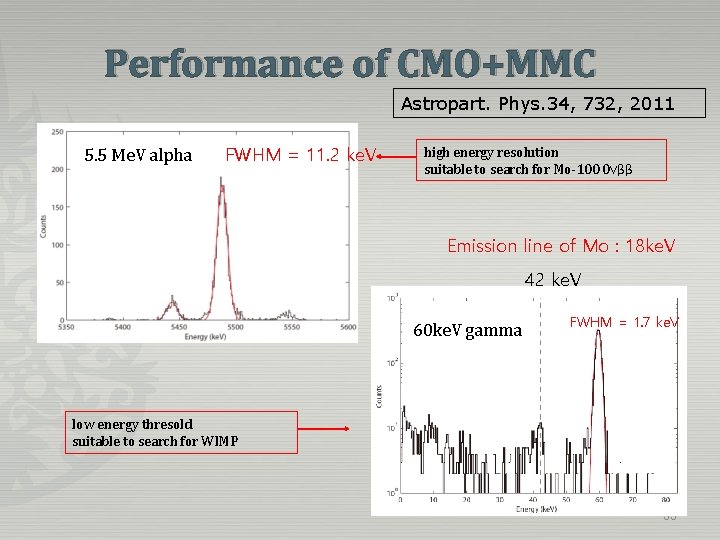
Performance of CMO+MMC Astropart. Phys. 34, 732, 2011 5. 5 Me. V alpha FWHM = 11. 2 ke. V high energy resolution suitable to search for Mo-100 0νββ Emission line of Mo : 18 ke. V 42 ke. V 60 ke. V gamma FWHM = 1. 7 ke. V low energy thresold suitable to search for WIMP 33
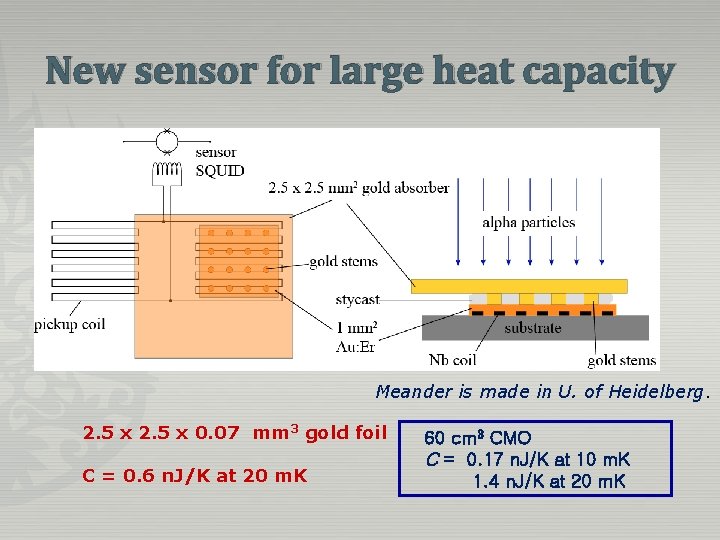
New sensor for large heat capacity Meander is made in U. of Heidelberg. 2. 5 x 0. 07 mm 3 gold foil C = 0. 6 n. J/K at 20 m. K 60 cm 3 CMO C = 0. 17 n. J/K at 10 m. K 1. 4 n. J/K at 20 m. K
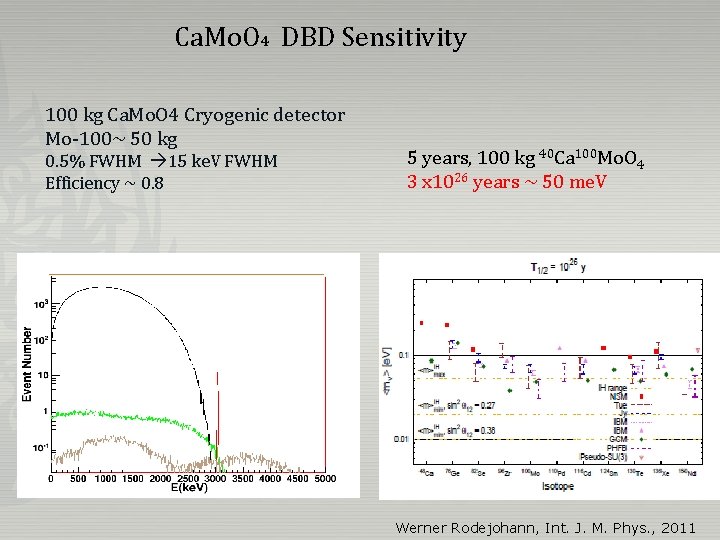
Ca. Mo. O 4 DBD Sensitivity 100 kg Ca. Mo. O 4 Cryogenic detector Mo-100~ 50 kg 0. 5% FWHM 15 ke. V FWHM Efficiency ~ 0. 8 5 years, 100 kg 40 Ca 100 Mo. O 4 3 x 1026 years ~ 50 me. V Werner Rodejohann, Int. J. M. Phys. , 2011
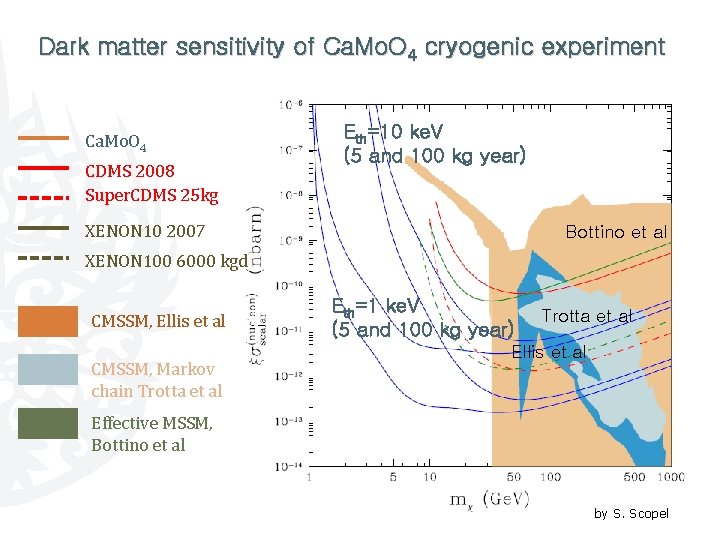
Dark matter sensitivity of Ca. Mo. O 4 cryogenic experiment Ca. Mo. O 4 CDMS 2008 Super. CDMS 25 kg Eth=10 ke. V (5 and 100 kg year) XENON 10 2007 Bottino et al XENON 100 6000 kgd CMSSM, Ellis et al CMSSM, Markov chain Trotta et al Eth=1 ke. V (5 and 100 kg year) Trotta et al Ellis et al Effective MSSM, Bottino et al by S. Scopel
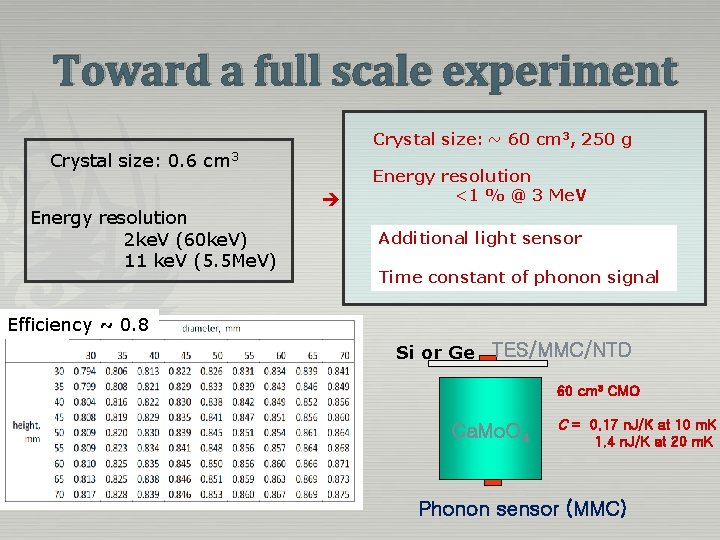
Toward a full scale experiment Crystal size: ~ 60 cm 3, 250 g Crystal size: 0. 6 cm 3 Energy resolution 2 ke. V (60 ke. V) 11 ke. V (5. 5 Me. V) Energy resolution <1 % @ 3 Me. V Additional light sensor Time constant of phonon signal Efficiency ~ 0. 8 Si or Ge TES/MMC/NTD 60 cm 3 CMO Ca. Mo. O 4 C = 0. 17 n. J/K at 10 m. K 1. 4 n. J/K at 20 m. K Phonon sensor (MMC)
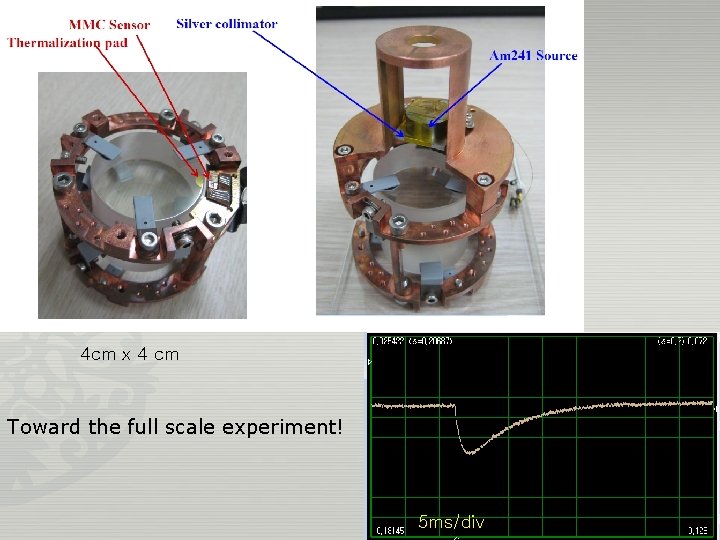
4 cm x 4 cm Toward the full scale experiment! 5 ms/div
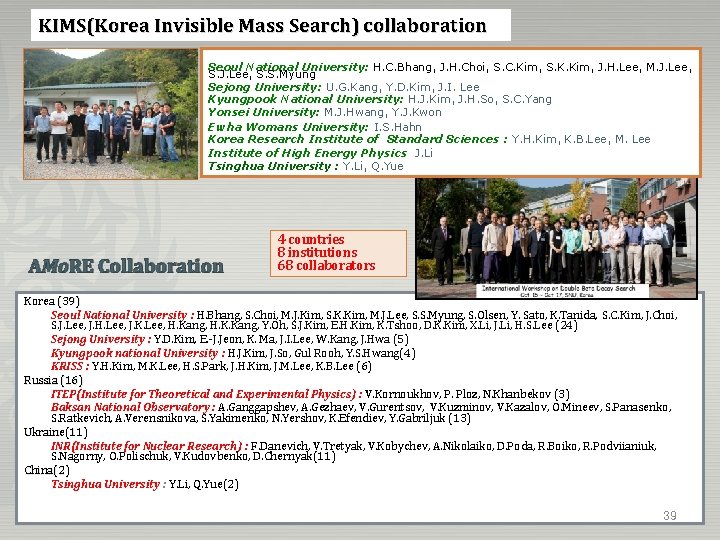
KIMS(Korea Invisible Mass Search) collaboration Seoul National University: H. C. Bhang, J. H. Choi, S. C. Kim, S. K. Kim, J. H. Lee, M. J. Lee, S. S. Myung Sejong University: U. G. Kang, Y. D. Kim, J. I. Lee Kyungpook National University: H. J. Kim, J. H. So, S. C. Yang Yonsei University: M. J. Hwang, Y. J. Kwon Ewha Womans University: I. S. Hahn Korea Research Institute of Standard Sciences : Y. H. Kim, K. B. Lee, M. Lee Institute of High Energy Physics J. Li Tsinghua University : Y. Li, Q. Yue AMo. RE Collaboration 4 countries 8 institutions 68 collaborators Korea (39) Seoul National University : H. Bhang, S. Choi, M. J. Kim, S. K. Kim, M. J. Lee, S. S. Myung, S. Olsen, Y. Sato, K. Tanida, S. C. Kim, J. Choi, S. J. Lee, J. H. Lee, J. K. Lee, H. Kang, H. K. Kang, Y. Oh, S. J. Kim, E. H. Kim, K. Tshoo, D. K. Kim, X. Li, J. Li, H. S. Lee (24) Sejong University : Y. D. Kim, E. -J. Jeon, K. Ma, J. I. Lee, W. Kang, J. Hwa (5) Kyungpook national University : H. J. Kim, J. So, Gul Rooh, Y. S. Hwang(4) KRISS : Y. H. Kim, M. K. Lee, H. S. Park, J. H. Kim, J. M. Lee, K. B. Lee (6) Russia (16) ITEP(Institute for Theoretical and Experimental Physics) : V. Kornoukhov, P. Ploz, N. Khanbekov (3) Baksan National Observatory : A. Ganggapshev, A. Gezhaev, V. Gurentsov, V. Kuzminov, V. Kazalov, O. Mineev, S. Panasenko, S. Ratkevich, A. Verensnikova, S. Yakimenko, N. Yershov, K. Efendiev, Y. Gabriljuk (13) Ukraine(11) INR(Institute for Nuclear Research) : F. Danevich, V. Tretyak, V. Kobychev, A. Nikolaiko, D. Poda, R. Boiko, R. Podviianiuk, S. Nagorny, O. Polischuk, V. Kudovbenko, D. Chernyak(11) China(2) Tsinghua University : Y. Li, Q. Yue(2) 39
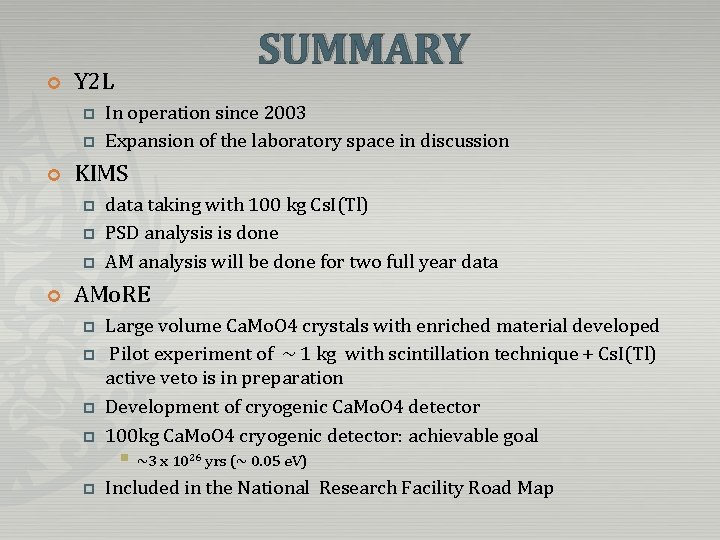
¢ Y 2 L p p ¢ In operation since 2003 Expansion of the laboratory space in discussion KIMS p p p ¢ SUMMARY data taking with 100 kg Cs. I(Tl) PSD analysis is done AM analysis will be done for two full year data AMo. RE p p Large volume Ca. Mo. O 4 crystals with enriched material developed Pilot experiment of ~ 1 kg with scintillation technique + Cs. I(Tl) active veto is in preparation Development of cryogenic Ca. Mo. O 4 detector 100 kg Ca. Mo. O 4 cryogenic detector: achievable goal § p ~3 x 1026 yrs (~ 0. 05 e. V) Included in the National Research Facility Road Map
Thank you for your attention !