
UNDERGROUND CABLES Introduction p 399 Generally electric Cables
UNDERGROUND CABLES
Introduction p. 399 • Generally electric Cables consists of Conductors : Stranded copper or aluminum conductors (as illustrated in OHTL) Insulation: to insulate the conductors from direct contact or contact with earth External protection: against ………
Overhead Lines Versus Underground Cables p. 464 1 - The insulation cost is more in case of cables as compared to O. H. T Lines and depends on operating voltage of cable. k. V : 0. 4 11 33 66 132 220 400 Cost ratio: 2 3 5 7 9 13 24 2 - The erection cost of O. H. T lines is much less than the underground cables. 3 - Inductive reactance of O. H. T. Lines is more, so the voltage regulation is better in case of underground cables (Low voltage drop).
4 - Capacitance and charging current is high in case of underground cables. C Xc = 1/ωC Charging current (Ich)= V/Xc = ωC. V For long distance power transmission, the charging current is very high results in over voltages problems. Its not recommended to transfer power for a long distance using underground cables. 5 - Current carrying capacity is more in case of O. H. T Lines conductors (better cooling conditions) for the same power transmission. Therefore, low cross sectional area and cost for O. H. T Lines conductors.
6 - Underground cables give greater safety, so it can be used in: - Big cities and densely populated area. - Submarine crossing. - Power stations and substations. - Airports.
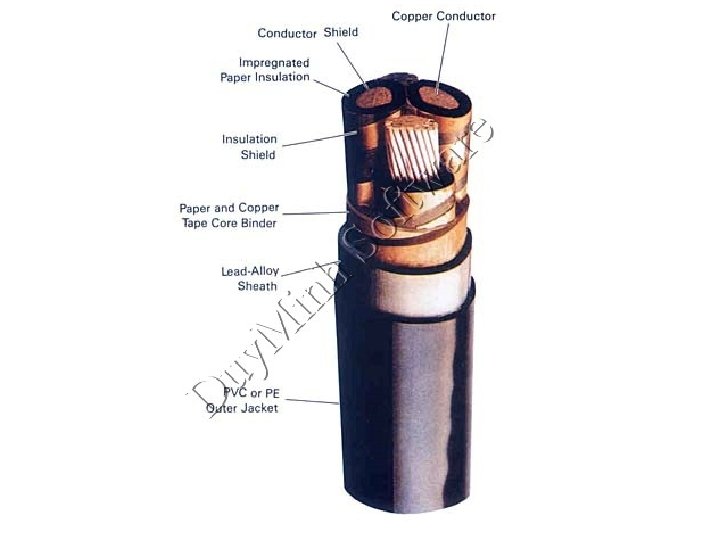
Cable Construction 1 - Conductors (Cores) ● Stranded aluminum or copper conductors ● Conductors with high conductivity and low resistance. 2 - Insulation: to insulate the conductors from direct contact or contact with earth. 3 - Screening (Insulator shielding): semi-conductor material to uniformly distribute the electric field on insulator.
4 - filling material. 5 - Metallic sheath: A sheath made of lead or aluminum or cupper is applied over the insulation to prevent moisture or chemicals from entering the insulation. 6 - Armour: ( )ﺩﺭﻉ Bars of steel to increase the mechanical strength of cable. 7 - Outer cover to protect the metal parts of cables ( rubber).
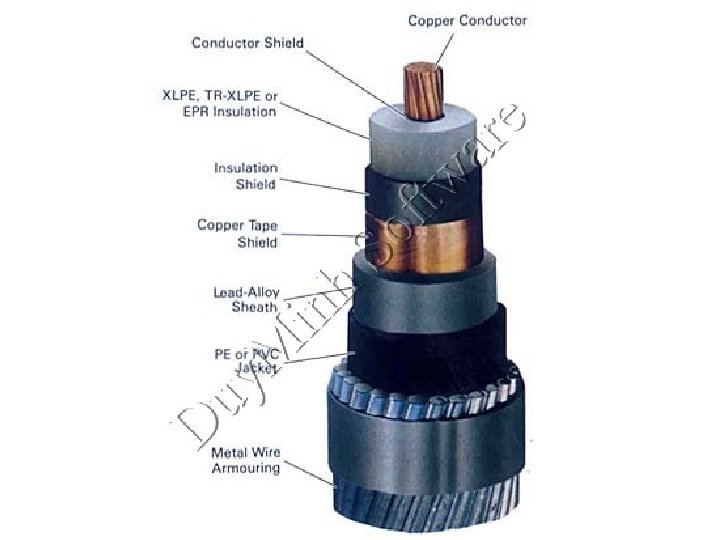
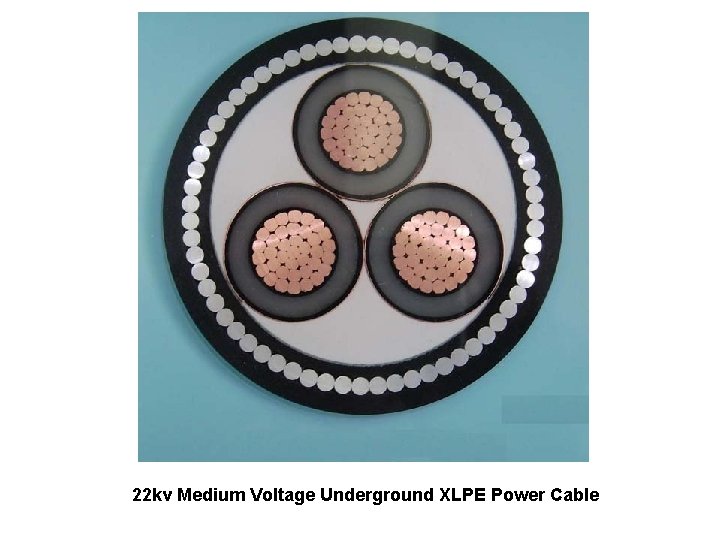
22 kv Medium Voltage Underground XLPE Power Cable
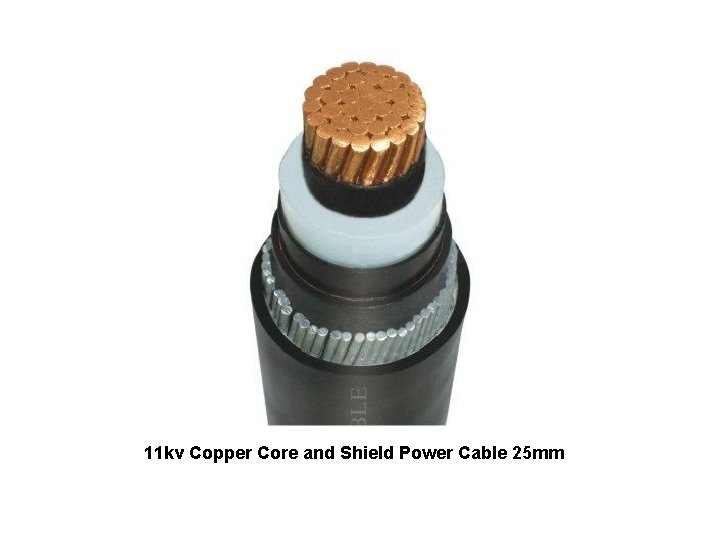
11 kv Copper Core and Shield Power Cable 25 mm http: //jpcable 99. en. made-in-china. com/product/KMVEou. LAh. BRW/China-11 kv. Copper-Core-and-Shield-Power-Cable-25 mm. html

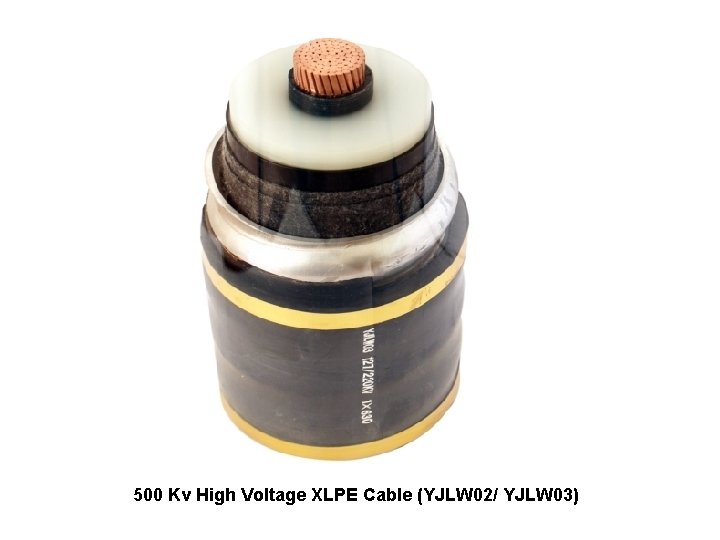
500 Kv High Voltage XLPE Cable (YJLW 02/ YJLW 03)
Types of Cables Insulating materials Performance p. 400 Insulator material should have: - High insulation resistance (MΩ-GΩ). - High dielectric strength. - Good mechanical strength. - High moisture resistance (non-hygroscopic) - Withstand temperature rise. - Not affected by chemical
Types p. 400 1 - Vulcanized Rubber Insulations: Rubber is used in cables with rated voltage 600 - 33 k. V. Two main groups: General Purpose Special Purpose Four Main Types: Butyl rubber Silicon rubber Neoprene rubber Styrene rubber
2 - Polymer Insulations: 2. 1 PVC (Poly Vinyl Chloride) - rated voltage 3. 3 k. V. - Grades of PVC: General Purpose Type Hard Grade Type Heat resisting Type 2. 2 Polythene (Polyethylene) - XLPE ( )ﺍﻟﺒﻮﻟﻰ ﺍﻳﺜﻠﻴﻦ ﺍﻟﺘﺸﺎﺑﻜﻰ rated voltage up to 275 k. V.
3 - Paper insulated : 3. 1 Paper insulator: rated voltage V up to 66 k. V 3. 2 Oil- impregnated paper is used in solid type cables up to 69 k. V and in pressure cables (gas or oil pressure ) up to 345 k. V.
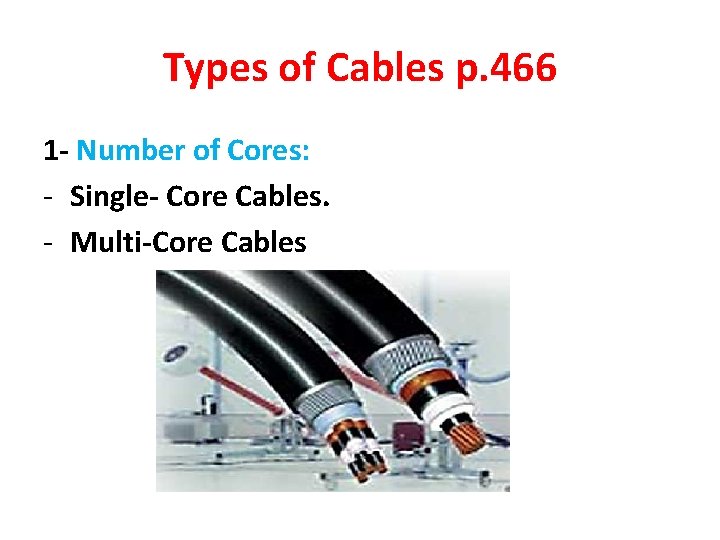
Types of Cables p. 466 1 - Number of Cores: - Single- Core Cables. - Multi-Core Cables
2 - According to Insulating Material - Paper Cables - Polymer Cables PVC – XLPE - Rubber Cables EPR - PR
3 - According to Voltage Level - High and Extra High voltage Cables H. V: 33 – 230 k. V EHV: V > 230 k. V - Medium Voltage Cables V: 1 - 33 k. V - Low Voltage Cables V up to 1 k. V.
4 - According to Utilization of Cables - Transmission and Distribution Cables XLPE Cables- Paper cables - Installation Cables ﺍﻟﺘﻤﺪﻳﺪﺍﺕ PVC - Submarine Cables ﺍﻟﺒﺤﺮﻳﺔ Rubber cables -Industrial Cables ﺍﻟﻤﻨﺸآﺖ ﺍﻟﺼﻨﺎﻋﻴﺔ ●PVC up to 3. 3 k. V ● XLPE up to 11 k. V
Electrical Characteristics of Cables p. 408
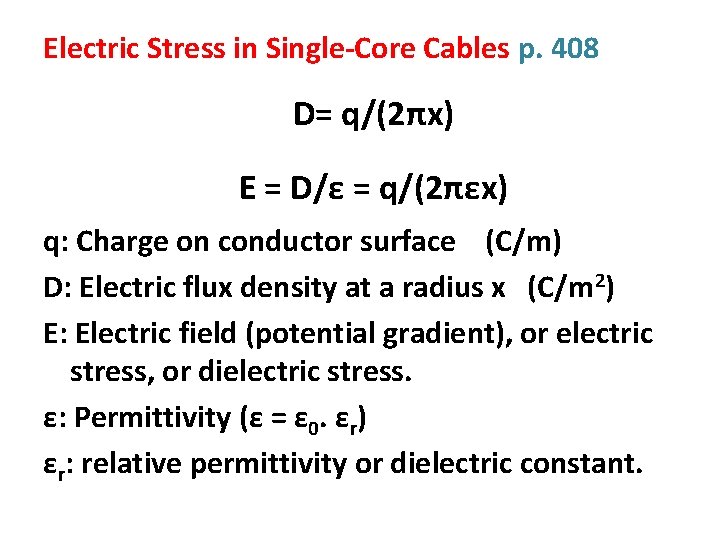
Electric Stress in Single-Core Cables p. 408 D= q/(2πx) E = D/ε = q/(2πεx) q: Charge on conductor surface (C/m) D: Electric flux density at a radius x (C/m 2) E: Electric field (potential gradient), or electric stress, or dielectric stress. ε: Permittivity (ε = ε 0. εr) εr: relative permittivity or dielectric constant.

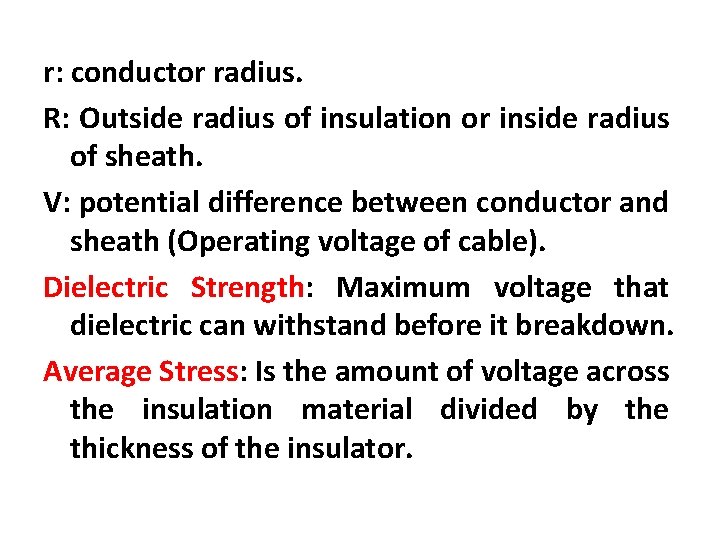
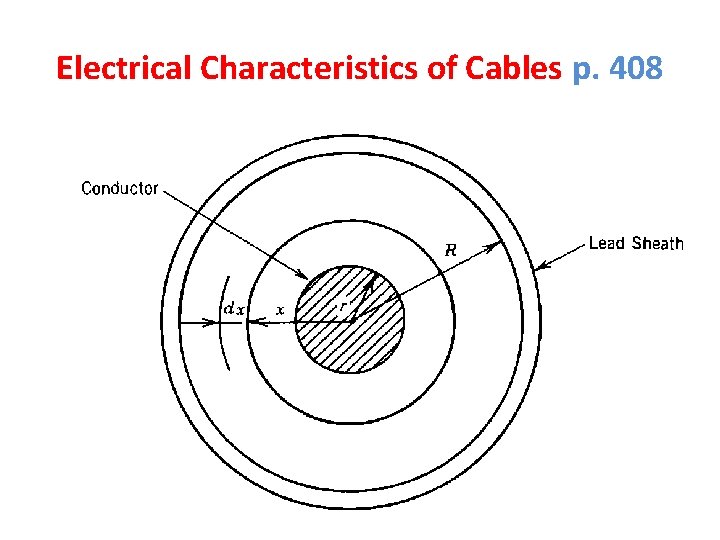
r: conductor radius. R: Outside radius of insulation or inside radius of sheath. V: potential difference between conductor and sheath (Operating voltage of cable). Dielectric Strength: Maximum voltage that dielectric can withstand before it breakdown. Average Stress: Is the amount of voltage across the insulation material divided by the thickness of the insulator.
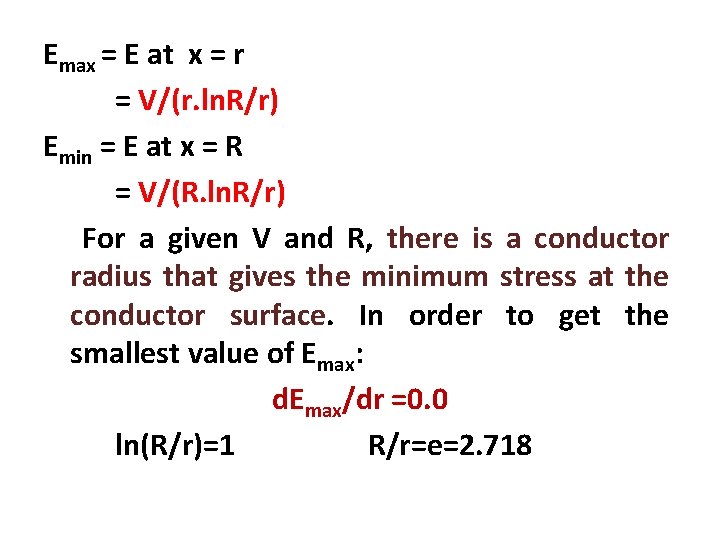
Emax = E at x = r = V/(r. ln. R/r) Emin = E at x = R = V/(R. ln. R/r) For a given V and R, there is a conductor radius that gives the minimum stress at the conductor surface. In order to get the smallest value of Emax: d. Emax/dr =0. 0 ln(R/r)=1 R/r=e=2. 718
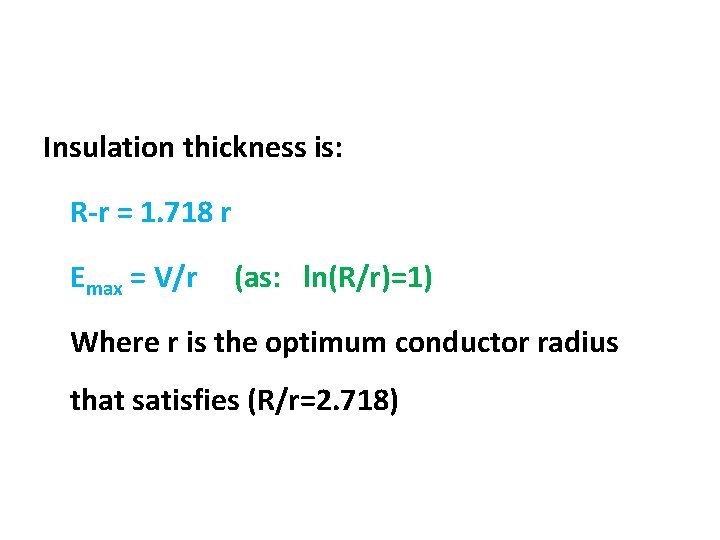
Insulation thickness is: R-r = 1. 718 r Emax = V/r (as: ln(R/r)=1) Where r is the optimum conductor radius that satisfies (R/r=2. 718)
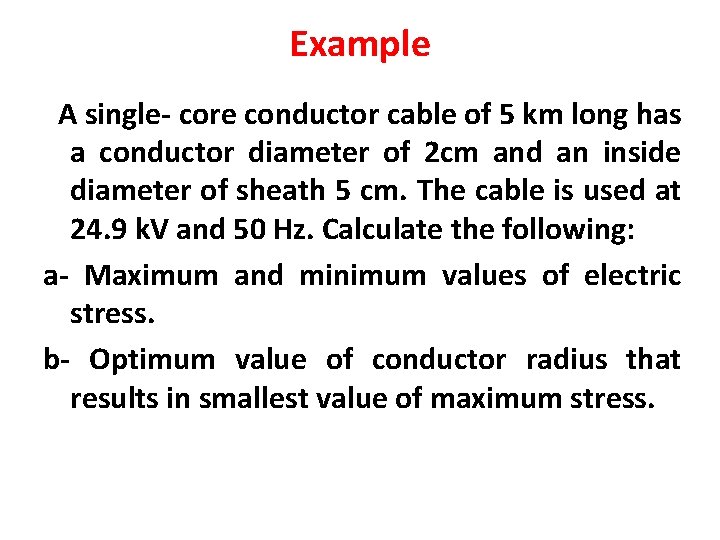
Example A single- core conductor cable of 5 km long has a conductor diameter of 2 cm and an inside diameter of sheath 5 cm. The cable is used at 24. 9 k. V and 50 Hz. Calculate the following: a- Maximum and minimum values of electric stress. b- Optimum value of conductor radius that results in smallest value of maximum stress.
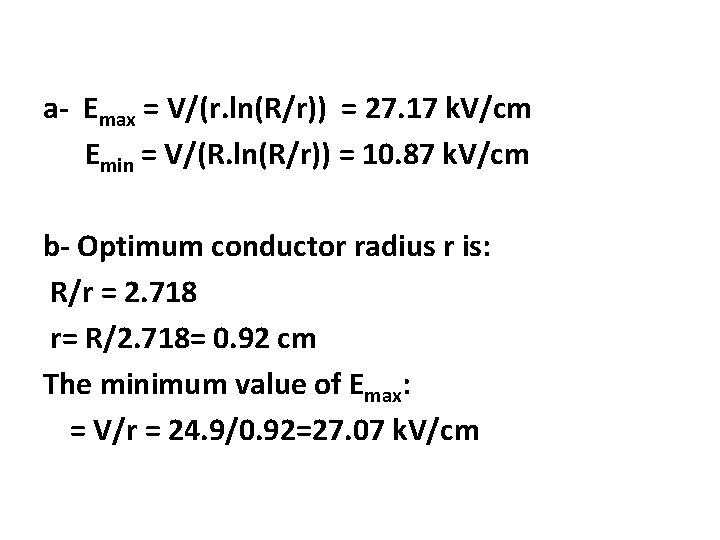
a- Emax = V/(r. ln(R/r)) = 27. 17 k. V/cm Emin = V/(R. ln(R/r)) = 10. 87 k. V/cm b- Optimum conductor radius r is: R/r = 2. 718 r= R/2. 718= 0. 92 cm The minimum value of Emax: = V/r = 24. 9/0. 92=27. 07 k. V/cm
- Slides: 29