
UNDERGROUND ASSET MAPPING IN THE UK FROM PROJECT
- Slides: 13
UNDERGROUND ASSET MAPPING IN THE UK – FROM PROJECT ICEBERG Andy Ryan Senior Technical Product Manager, Ordnance Survey Great Britain 24 th April 2017
What is Iceberg? A collaborative R&D project (Future Cities Catapult, Ordnance Survey and British Geological Survey) to paint a picture of the subsurface – • what is there, • who holds data about it, • who needs to accesses that data, and • how a (BIM-ready) single digital subsurface platform could drive radical efficiencies in workflow. Purpose: to generate material that will be used for shared business development activities for • engaging with potential commercial clients and CR&D partners to develop paid-for demonstrator projects • the creation of a combined above/below ground data model. Current status: In progress This presentation summarises what OS has learnt from the programme so far, it is not the views of the project or the other parties to the project.
A common problem that costs: • Roadworks and congestion: road works account for 38% of the most serious and severe traffic disruptions in London: total cost of £ 752 M 1. • Cable strikes: Est 60, 000 incidents per year (Cognisco 2015) • Excessive surveying and digging prior to new development: Including abortive digging (unfound asset), or extended digging (crossing the whole road rather than a portion). • Physical ground constraints: Late stage awareness of ground properties and physical constraints to planned development is costly. • • Ground risks are one of main causes of project delay (50%), and of Insurance claims on completed projects. Alignment of Crossrail was influenced by need to avoid over 200 existing obstructions Crossrail 2 re-routed via Balham due to geological concerns. Access to a robust geological model estimated to deliver +£ 160 M 3 cost-savings to London construction projects. • Infiltration from the water supply network: Infiltration of groundwater into underground assets is believed to costs the water industry £M annually. • In 2013/14, three water companies in the UK spent an additional £ 80 million responding to impacts of groundwater infiltration. • Leakage from the water supply network is significant due to aging infrastructure: for Thames Water’s = 641 ML/d (about ~25% of daily supply).
It’s been looked at before in the UK • Accessing Subsurface Knowledge (ASK) (2012) a data and knowledge exchange network between public and private sectors developed by BGS and Glasgow City Council (GCC) – more than just utilities but not national • National Underground Assets Group (NUAG) 2005 agreed it’s a good idea but not rolled out. Work fed into new BSI document PAS 256 ▪ Greater London Authority Networked Utilities 2014 includes non-utility bodies, reported • little evidence of stakeholder consensus for change, • utility owners perceive minimal financial/business reasons as they meet statutory requirements • efficiency and safety benefits not realised/effectively communicated by various parties • need for regulatory change for wider industry and societal benefits from improved data and its distribution
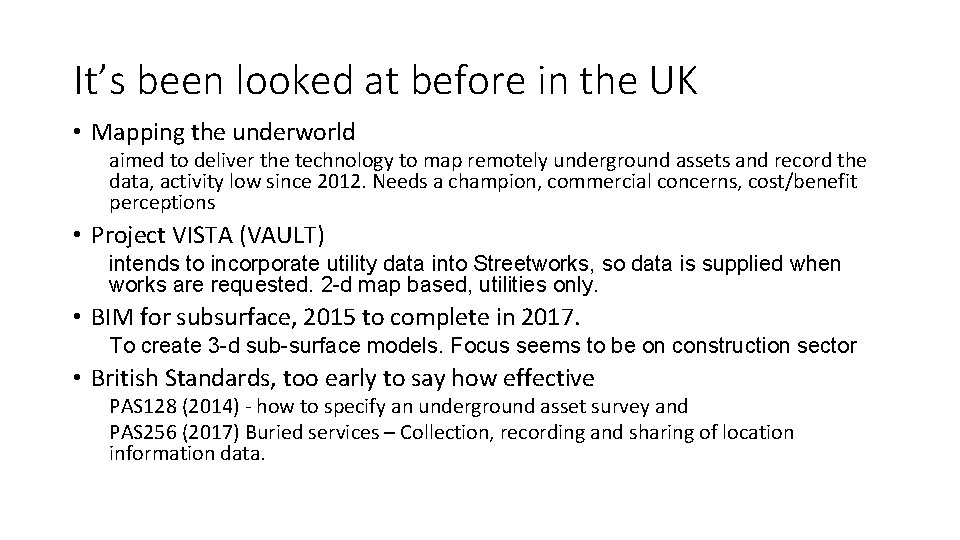
It’s been looked at before in the UK • Mapping the underworld aimed to deliver the technology to map remotely underground assets and record the data, activity low since 2012. Needs a champion, commercial concerns, cost/benefit perceptions • Project VISTA (VAULT) intends to incorporate utility data into Streetworks, so data is supplied when works are requested. 2 -d map based, utilities only. • BIM for subsurface, 2015 to complete in 2017. To create 3 -d sub-surface models. Focus seems to be on construction sector • British Standards, too early to say how effective PAS 128 (2014) - how to specify an underground asset survey and PAS 256 (2017) Buried services – Collection, recording and sharing of location information data.
So why has the problem not been reduced? • The regulatory framework for the management of the subsurface is fragmented • There are large numbers of stakeholders and multiple regulators
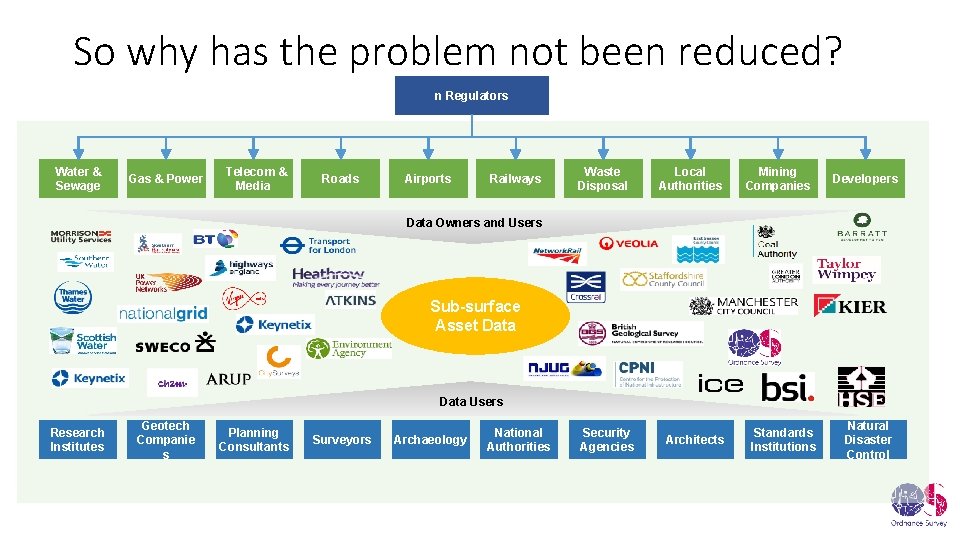
So why has the problem not been reduced? n Regulators Water & Sewage Gas & Power Telecom & Media Roads Airports Railways Waste Disposal Local Authorities Mining Companies Developers Data Owners and Users Sub-surface Asset Data Users Research Institutes Geotech Companie s Planning Consultants Surveyors Archaeology National Authorities Security Agencies Architects Standards Institutions Natural Disaster Control
So why has the problem not been reduced? • The regulatory framework for the management of the subsurface is fragmented. • There are large numbers of stakeholders and multiple regulators • ‘Universal’ and accepted data standards do not exist • Expectation that data sharing is hard and has unacceptable risks – liability as well as commercial and security sensitivities • Legislation on capture and sharing has evolved but generally not applied retrospectively • Upfront costs of data capture and improvement are large
Operators • > 300 organisations are allowed to lay assets in UK • Nationalised services privatised, fragmented, distribution and local supply split, mergers across sectors • Significant pressures on costs • Legacy assets dating back many years – London’s sewer system started in 19 th century • Original paper records from those epochs digitised
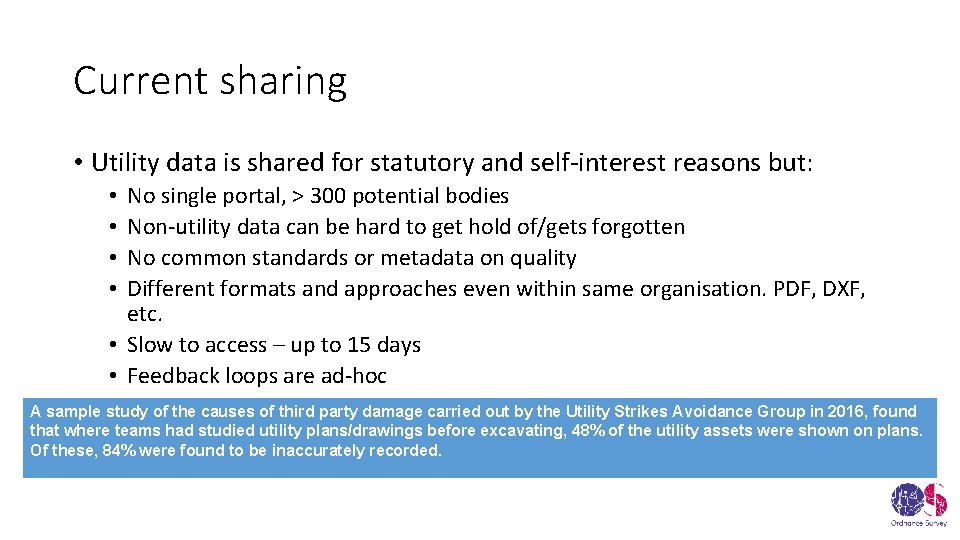
Current sharing • Utility data is shared for statutory and self-interest reasons but: No single portal, > 300 potential bodies Non-utility data can be hard to get hold of/gets forgotten No common standards or metadata on quality Different formats and approaches even within same organisation. PDF, DXF, etc. • Slow to access – up to 15 days • Feedback loops are ad-hoc • • A sample study of the causes of third party damage carried out by the Utility Strikes Avoidance Group in 2016, found that where teams had studied utility plans/drawings before excavating, 48% of the utility assets were shown on plans. Of these, 84% were found to be inaccurately recorded.
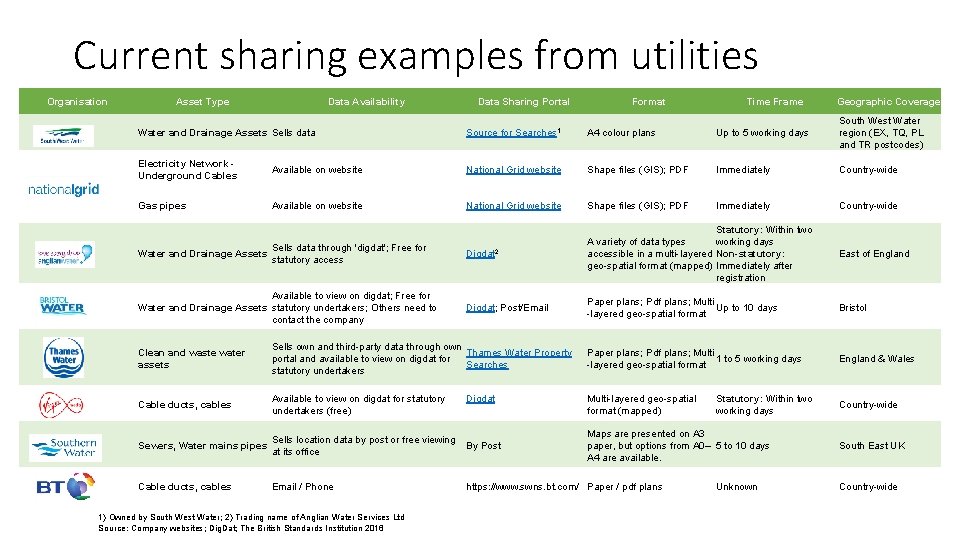
Current sharing examples from utilities Organisation Asset Type Data Availability Data Sharing Portal Format Time Frame Geographic Coverage Water and Drainage Assets Sells data Source for Searches 1 A 4 colour plans Up to 5 working days South West Water region (EX, TQ, PL and TR postcodes) Electricity Network Underground Cables Available on website National Grid website Shape files (GIS); PDF Immediately Country-wide Gas pipes Available on website National Grid website Shape files (GIS); PDF Immediately Country-wide Digdat 2 Statutory: Within two A variety of data types working days accessible in a multi-layered Non-statutory: geo-spatial format (mapped) Immediately after registration East of England Digdat; Post/Email Paper plans; Pdf plans; Multi Up to 10 days -layered geo-spatial format Bristol Water and Drainage Assets Sells data through 'digdat'; Free for statutory access Available to view on digdat; Free for Water and Drainage Assets statutory undertakers; Others need to contact the company Clean and waste water assets Sells own and third-party data through own Thames Water Property portal and available to view on digdat for Searches statutory undertakers Paper plans; Pdf plans; Multi 1 to 5 working days -layered geo-spatial format England & Wales Cable ducts, cables Available to view on digdat for statutory undertakers (free) Multi-layered geo-spatial format (mapped) Country-wide Sewers, Water mains pipes Sells location data by post or free viewing By Post at its office Cable ducts, cables Email / Phone 1) Owned by South West Water; 2) Trading name of Anglian Water Services Ltd Source: Company websites; Dig. Dat; The British Standards Institution 2016 Digdat Statutory: Within two working days Maps are presented on A 3 paper, but options from A 0– 5 to 10 days A 4 are available. https: //www. swns. bt. com/ Paper / pdf plans Unknown South East UK Country-wide
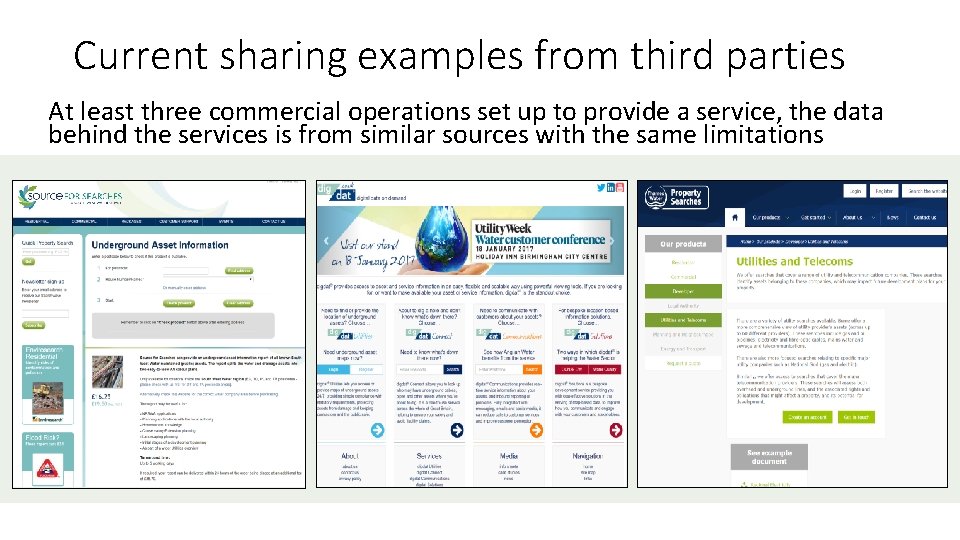
Current sharing examples from third parties At least three commercial operations set up to provide a service, the data behind the services is from similar sources with the same limitations
Views on how can this get better? • If standards can be developed/accepted and proven to be practical to work with • If sharing architectures can be developed and proven to work • If data capture/improvement techniques can reduce the costs of data capture and improvement • Cross sector implementations to cover a full range data should yield larger benefits • But implementations within countries or sector or application specific may be more achievable, if less efficient in the long term • Regulation may be required to encourage a fragmented communities to realise the benefits