
Under the Lens of Midprogram Benchmark Assessment AACTE
Under the Lens of Mid-program Benchmark Assessment AACTE Annual Conference – March 2, 2014 – Indianapolis, IN Beverly Reitsma, Angelia Ridgway, Deborah Sachs, John Somers, & Nancy Steffel University of Indianapolis
Program Outcomes 1. Learn about our process to assess candidate readiness to enter student teaching that can apply to varied programs within a teacher education department. 2. Discuss the characteristics of a single common mid-program benchmark assessment and rubric that allows for flexibility across programs. 3. Create recommendations for development, implementation, and scoring of a mid-point program benchmark assessment.
A little bit about you… Photo accessed on 2/26/14 from: http: //innovations 2010 unco. pbworks. com/w/page/25157139/Classroom%20 Response%20 Systems%20%28 Clickers%29
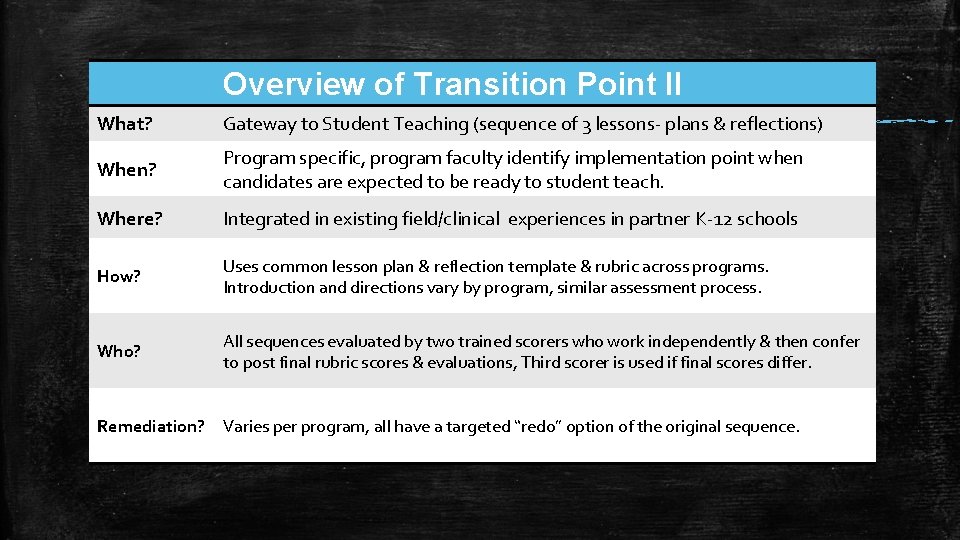
Overview of Transition Point II What? Gateway to Student Teaching (sequence of 3 lessons- plans & reflections) When? Program specific, program faculty identify implementation point when candidates are expected to be ready to student teach. Where? Integrated in existing field/clinical experiences in partner K-12 schools How? Uses common lesson plan & reflection template & rubric across programs. Introduction and directions vary by program, similar assessment process. Who? All sequences evaluated by two trained scorers who work independently & then confer to post final rubric scores & evaluations, Third scorer is used if final scores differ. Remediation? Varies per program, all have a targeted “redo” option of the original sequence.
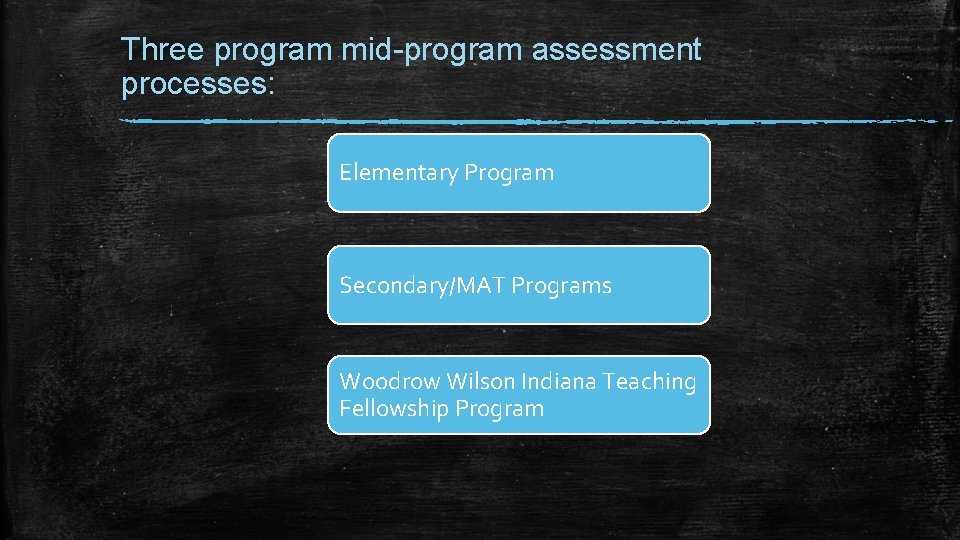
Three program mid-program assessment processes: Elementary Program Secondary/MAT Programs Woodrow Wilson Indiana Teaching Fellowship Program
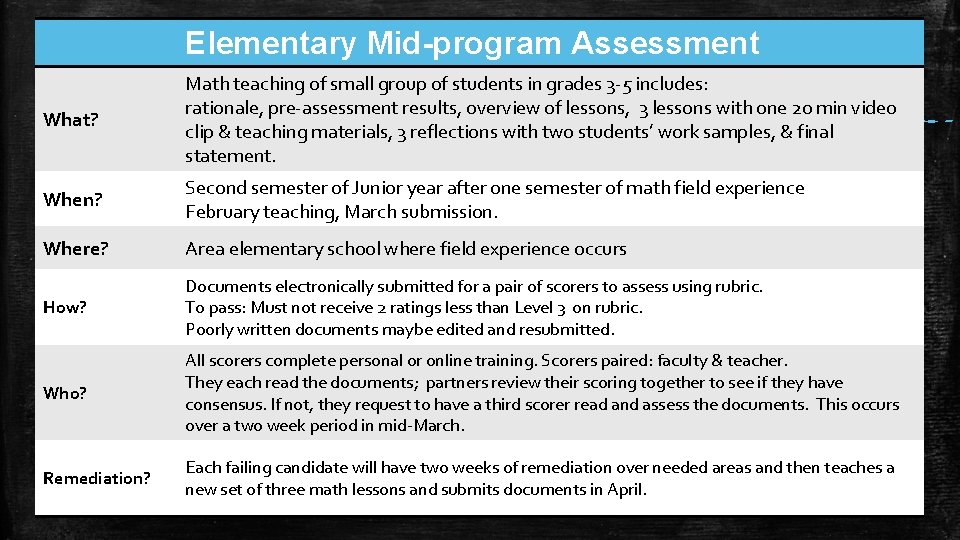
Elementary Mid-program Assessment What? Math teaching of small group of students in grades 3 -5 includes: rationale, pre-assessment results, overview of lessons, 3 lessons with one 20 min video clip & teaching materials, 3 reflections with two students’ work samples, & final statement. When? Second semester of Junior year after one semester of math field experience February teaching, March submission. Where? Area elementary school where field experience occurs How? Documents electronically submitted for a pair of scorers to assess using rubric. To pass: Must not receive 2 ratings less than Level 3 on rubric. Poorly written documents maybe edited and resubmitted. Who? All scorers complete personal or online training. Scorers paired: faculty & teacher. They each read the documents; partners review their scoring together to see if they have consensus. If not, they request to have a third scorer read and assess the documents. This occurs over a two week period in mid-March. Remediation? Each failing candidate will have two weeks of remediation over needed areas and then teaches a new set of three math lessons and submits documents in April.
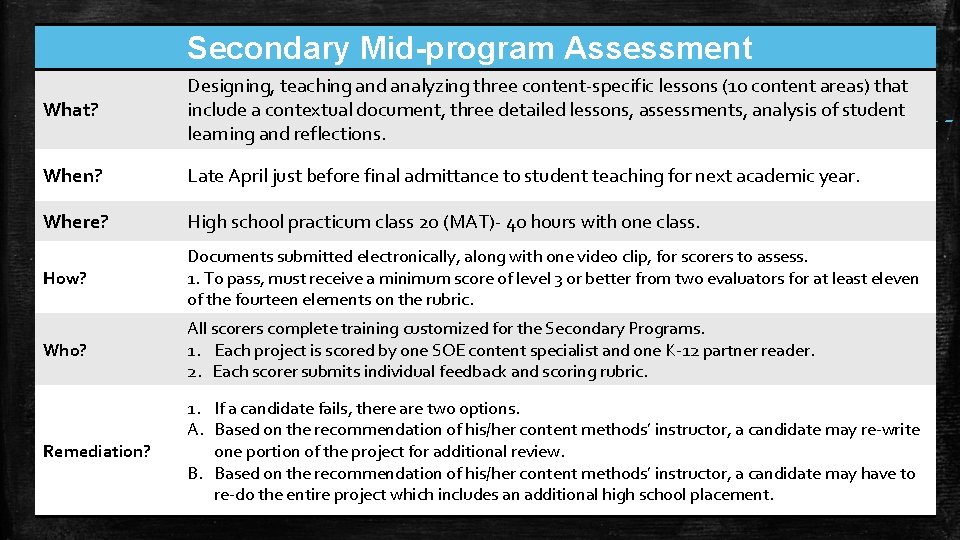
Secondary Mid-program Assessment What? Designing, teaching and analyzing three content-specific lessons (10 content areas) that include a contextual document, three detailed lessons, assessments, analysis of student learning and reflections. When? Late April just before final admittance to student teaching for next academic year. Where? High school practicum class 20 (MAT)- 40 hours with one class. How? Documents submitted electronically, along with one video clip, for scorers to assess. 1. To pass, must receive a minimum score of level 3 or better from two evaluators for at least eleven of the fourteen elements on the rubric. Who? All scorers complete training customized for the Secondary Programs. 1. Each project is scored by one SOE content specialist and one K-12 partner reader. 2. Each scorer submits individual feedback and scoring rubric. Remediation? 1. If a candidate fails, there are two options. A. Based on the recommendation of his/her content methods’ instructor, a candidate may re-write one portion of the project for additional review. B. Based on the recommendation of his/her content methods’ instructor, a candidate may have to re-do the entire project which includes an additional high school placement.
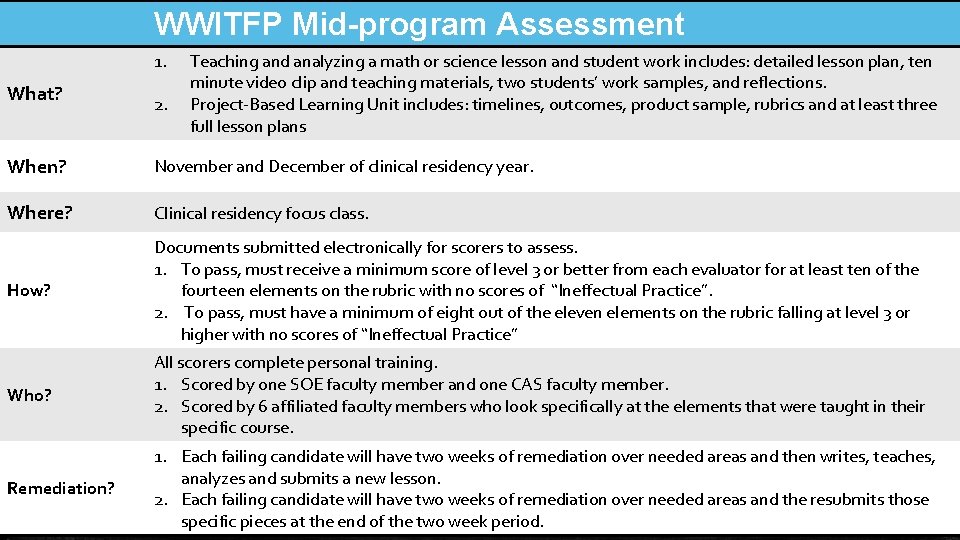
WWITFP Mid-program Assessment 1. What? 2. Teaching and analyzing a math or science lesson and student work includes: detailed lesson plan, ten minute video clip and teaching materials, two students’ work samples, and reflections. Project-Based Learning Unit includes: timelines, outcomes, product sample, rubrics and at least three full lesson plans When? November and December of clinical residency year. Where? Clinical residency focus class. How? Documents submitted electronically for scorers to assess. 1. To pass, must receive a minimum score of level 3 or better from each evaluator for at least ten of the fourteen elements on the rubric with no scores of “Ineffectual Practice”. 2. To pass, must have a minimum of eight out of the eleven elements on the rubric falling at level 3 or higher with no scores of “Ineffectual Practice” Who? All scorers complete personal training. 1. Scored by one SOE faculty member and one CAS faculty member. 2. Scored by 6 affiliated faculty members who look specifically at the elements that were taught in their specific course. Remediation? 1. Each failing candidate will have two weeks of remediation over needed areas and then writes, teaches, analyzes and submits a new lesson. 2. Each failing candidate will have two weeks of remediation over needed areas and the resubmits those specific pieces at the end of the two week period.
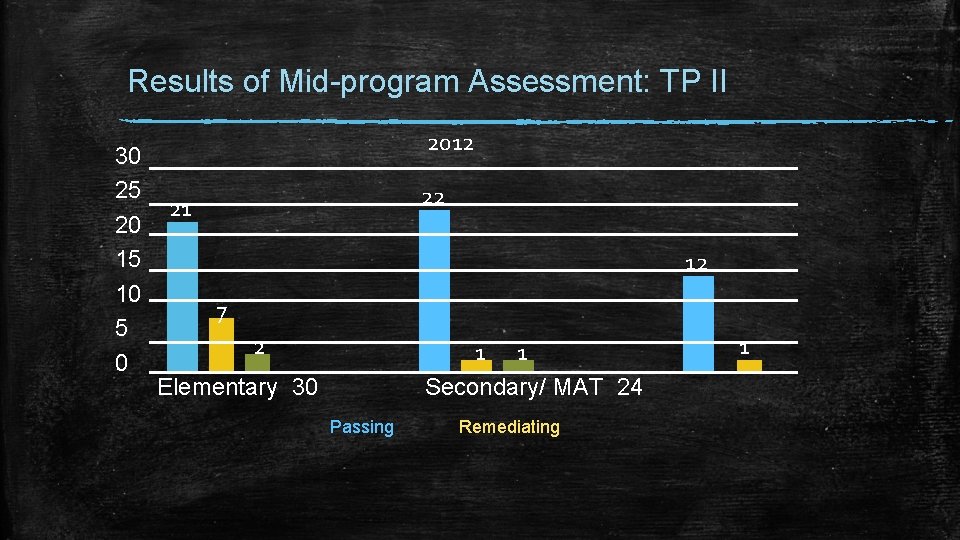
Results of Mid-program Assessment: TP II 30 25 20 15 10 5 0 2012 22 21 12 7 2 1 1 Secondary/ MAT 24 Elementary 30 Passing Remediating 1
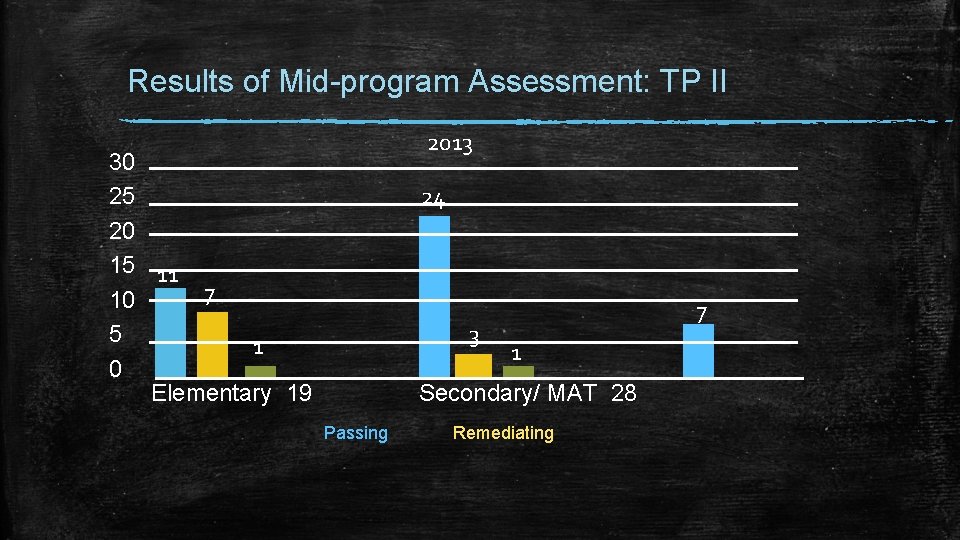
Results of Mid-program Assessment: TP II 2013 30 25 20 15 11 7 10 5 1 0 Elementary 19 24 3 7 1 Secondary/ MAT 28 Passing Remediating
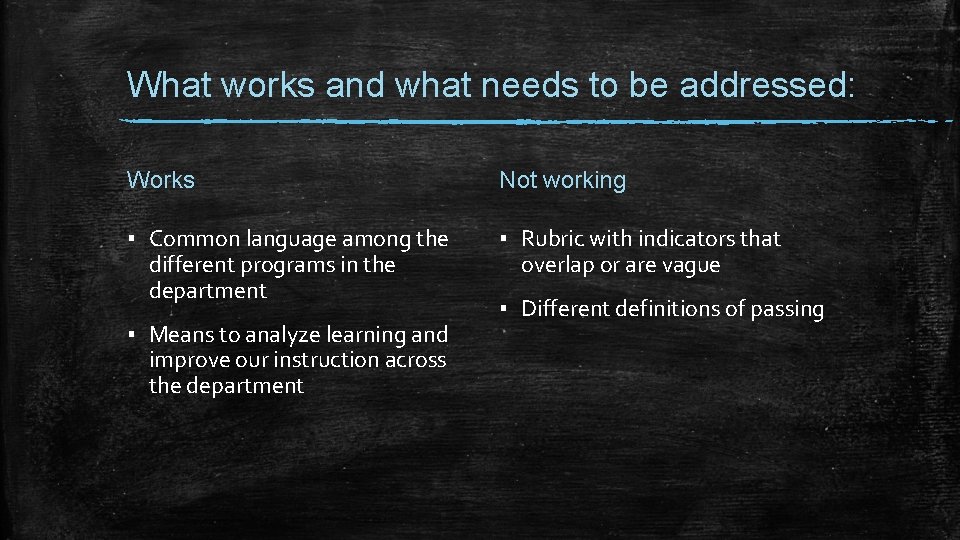
What works and what needs to be addressed: Works Not working ▪ Common language among the different programs in the department ▪ Rubric with indicators that overlap or are vague ▪ Means to analyze learning and improve our instruction across the department ▪ Different definitions of passing
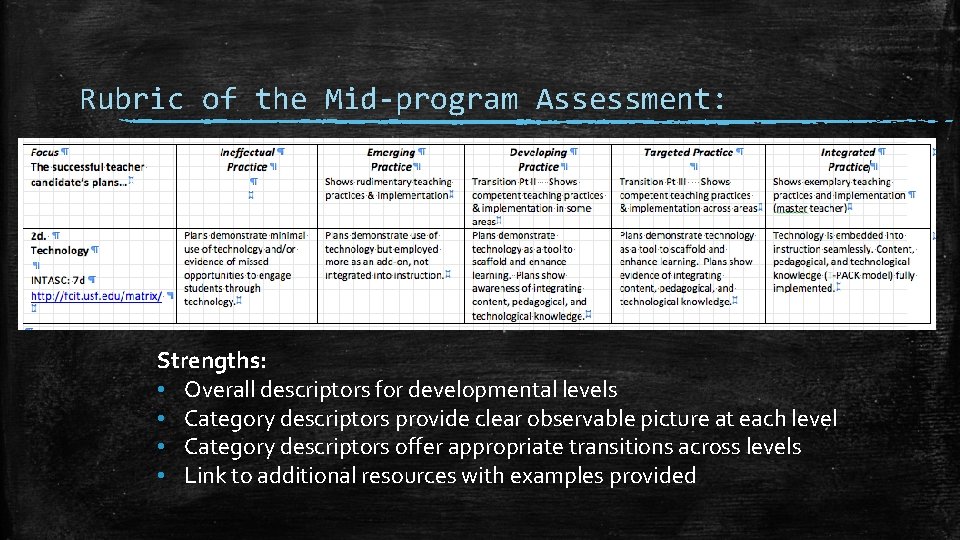
Rubric of the Mid-program Assessment: Strengths: • Overall descriptors for developmental levels • Category descriptors provide clear observable picture at each level • Category descriptors offer appropriate transitions across levels • Link to additional resources with examples provided
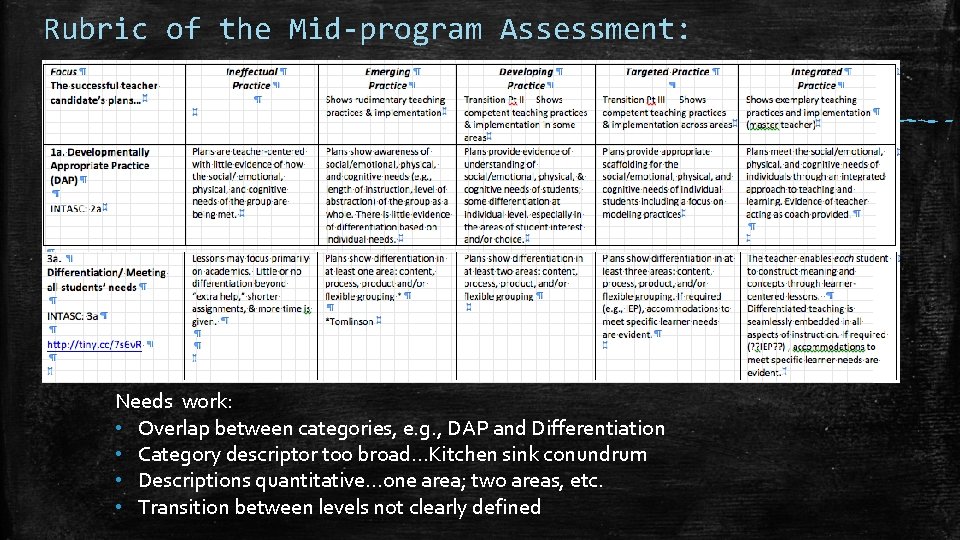
Rubric of the Mid-program Assessment: Needs work: • Overlap between categories, e. g. , DAP and Differentiation • Category descriptor too broad…Kitchen sink conundrum • Descriptions quantitative…one area; two areas, etc. • Transition between levels not clearly defined
Discussion in small groups: 1. What are your thoughts and questions about our model?
Discussion in small groups: 1. What are your thoughts and questions about our model? 2. How do you see your assessments changing in the future?
Discussion in small groups: 1. What are your thoughts and questions about our model? 2. How do you see your assessments changing in the future? 3. How might you apply our discussion to your own program?

Contact us if you have ideas or questions: aridgway@uindy. edu bretitsma@uindy. edu dsachs@uindy. edu jsomers@uindy. edu nsteffel@uindy. edu
Wrap-up: Out the Door Write, on a post it note, one of the following: • A new idea you have as a result of this session. • Something you are considering trying as a result of this session • A thought you’d like to share with us after participating in this session. • A question you have for us. If you choose this option, please include your e-mail address so we can contact you. Picture accessed on 2. 26. from: http: //www. sodahead. com/fun/how-many-doors-are-in-your-house-which-one-is-used/question-2632459/? link=ibaf&q=&esrc=s
- Slides: 18