
Under the bonnet of ETF structures price mechanisms
Under the bonnet of ETF structures & price mechanisms Robin Bowerman Vanguard
Agenda • The good, the bad and the ugly about ETFs – The media swirl – Global and domestic trends • Under the bonnet - how ETFs work – The role of the market maker – ETF costs & spreads – Managed Index Funds vs. ETFs • ETF Applications • Myths & misconceptions 2
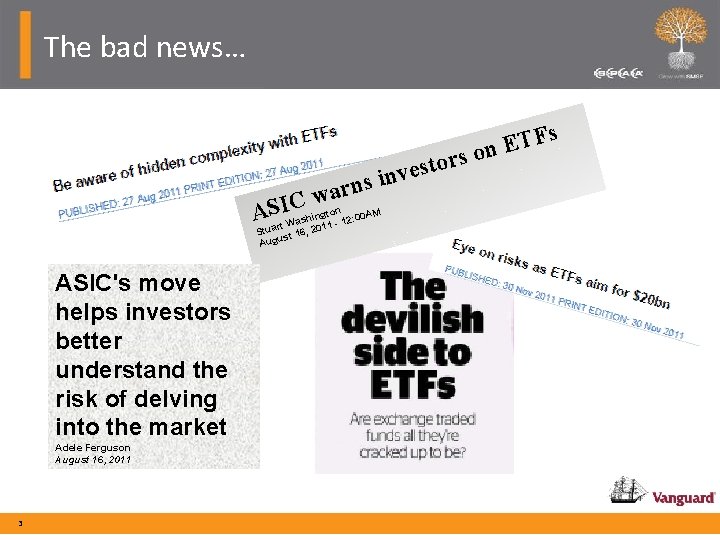
The bad news… s n r a SIC won rs o t s e inv A art Washin 0 g 1 t 1 - 12: 00 AM Stu st 16, 2 u Aug ASIC's move helps investors better understand the risk of delving into the market Adele Ferguson August 16, 2011 3 Fs T E on
What is an ETF? An ETF is an Exchange Traded Fund. It is generally a diversified portfolio of securities constructed using an index approach that can be readily traded on a securities exchange like the ASX. Investors need to understand the benefits of indexing to understand how ETFs can be powerful tools in portfolio construction 4
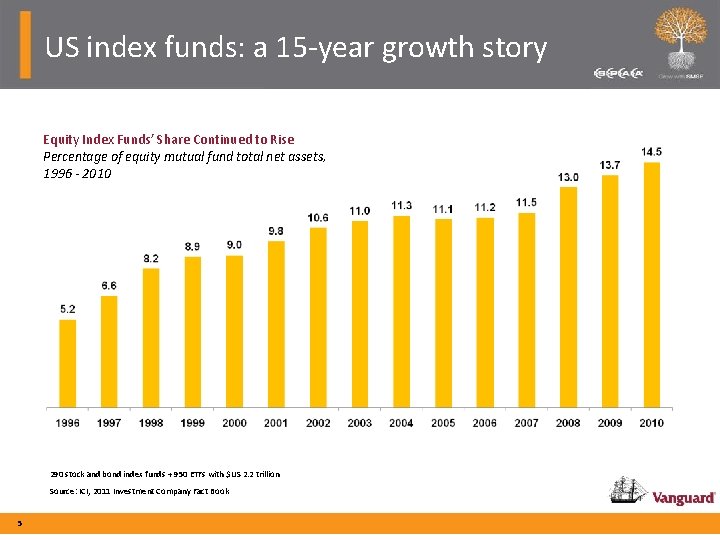
US index funds: a 15 -year growth story Equity Index Funds’ Share Continued to Rise Percentage of equity mutual fund total net assets, 1996 - 2010 290 stock and bond index funds + 950 ETFs with $US 2. 2 trillion Source: ICI, 2011 Investment Company Fact Book 5
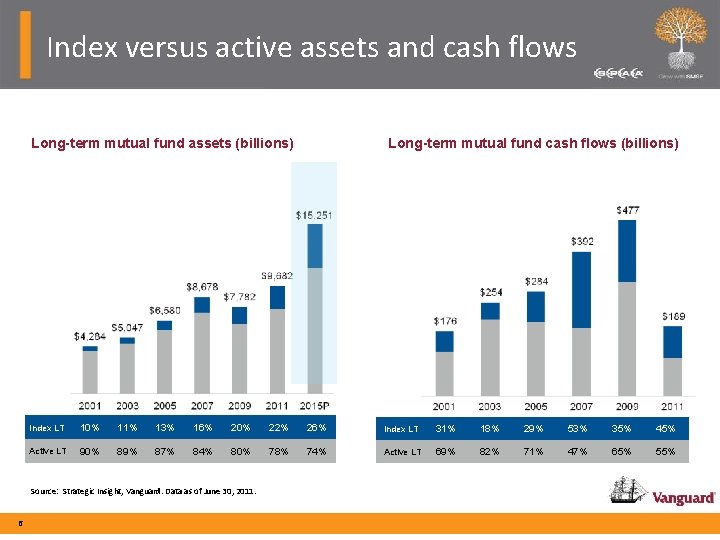
Index versus active assets and cash flows Long-term mutual fund assets (billions) Index LT 10% 11% 13% 16% 20% 22% 26% Index LT 31% 18% 29% 53% 35% 45% Active LT 90% 89% 87% 84% 80% 78% 74% Active LT 69% 82% 71% 47% 65% 55% Source: Strategic Insight, Vanguard. Data as of June 30, 2011. 6 Long-term mutual fund cash flows (billions)
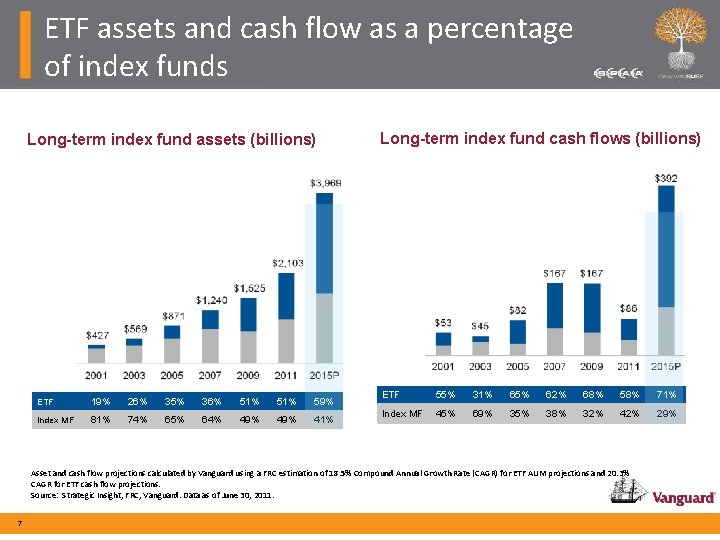
ETF assets and cash flow as a percentage of index funds Long-term index fund assets (billions) ETF 19% 26% 35% 36% 51% 59% Index MF 81% 74% 65% 64% 49% 41% Long-term index fund cash flows (billions) ETF 55% 31% 65% 62% 68% 58% 71% Index MF 45% 69% 35% 38% 32% 42% 29% Asset and cash flow projections calculated by Vanguard using a FRC estimation of 18. 5% Compound Annual Growth Rate (CAGR) for ETF AUM projections and 20. 3% CAGR for ETF cash flow projections. Source: Strategic Insight, FRC, Vanguard. Data as of June 30, 2011. 7
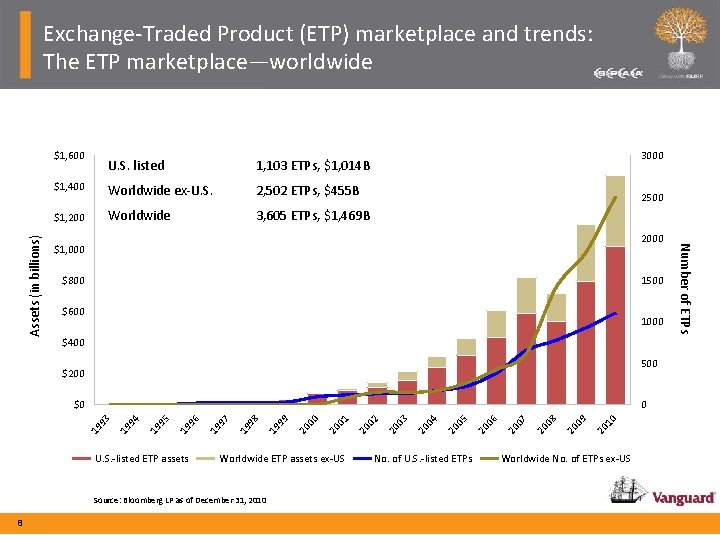
Exchange-Traded Product (ETP) marketplace and trends: The ETP marketplace—worldwide U. S. listed 1, 103 ETPs, $1, 014 B $1, 400 Worldwide ex-U. S. 2, 502 ETPs, $455 B $1, 200 Worldwide 3, 605 ETPs, $1, 469 B 3000 2500 2000 $1, 000 $800 1500 $600 1000 $400 500 $200 U. S. -listed ETP assets No. of U. S. -listed ETPs 10 20 09 20 08 20 07 20 06 20 05 20 04 20 03 20 02 20 01 20 00 Worldwide ETP assets ex-US Source: Bloomberg LP as of December 31, 2010 8 20 99 19 98 19 97 19 96 19 95 19 19 19 94 0 93 $0 Worldwide No. of ETPs ex-US Number of ETPs Assets (in billions) $1, 600
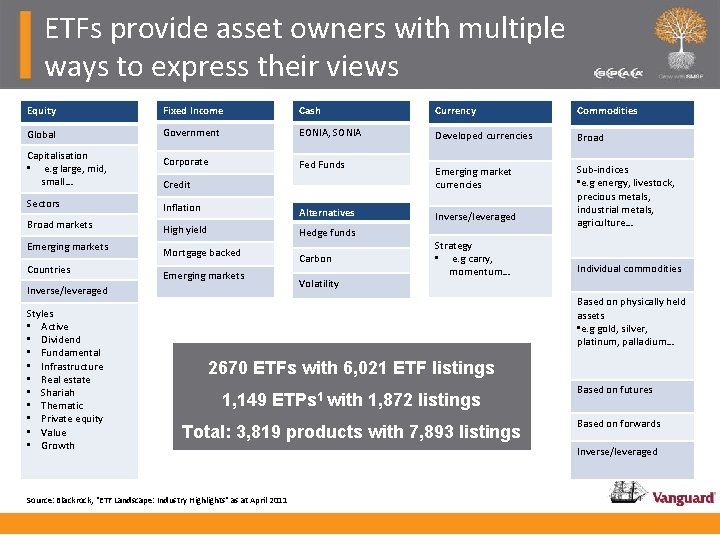
ETFs provide asset owners with multiple ways to express their views Equity Fixed Income Cash Currency Commodities Global Government EONIA, SONIA Developed currencies Broad Corporate Fed Funds Emerging market currencies Sub-indices • e. g energy, livestock, precious metals, industrial metals, agriculture… Capitalisation • e. g large, mid, small… Credit Sectors Inflation Broad markets Alternatives High yield Hedge funds Emerging markets Countries Mortgage backed Emerging markets Inverse/leveraged Styles • Active • Dividend • Fundamental • Infrastructure • Real estate • Shariah • Thematic • Private equity • Value • Growth Carbon Volatility Inverse/leveraged Strategy • e. g carry, momentum… Individual commodities Based on physically held assets • e. g gold, silver, platinum, palladium… 2670 ETFs with 6, 021 ETF listings 1, 149 ETPs 1 with 1, 872 listings Total: 3, 819 products with 7, 893 listings Source: Blackrock, "ETF Landscape: Industry Highlights" as at April 2011 Based on futures Based on forwards Inverse/leveraged
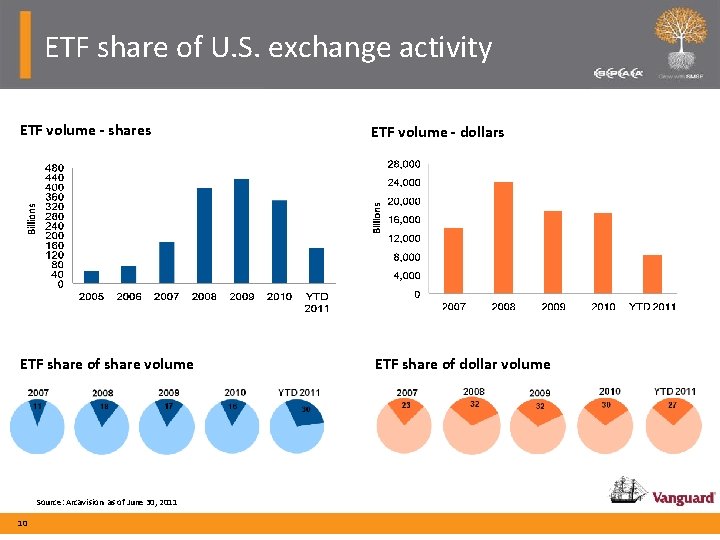
ETF share of U. S. exchange activity ETF volume - shares ETF volume - dollars ETF share of share volume ETF share of dollar volume Source: Arcavision as of June 30, 2011 10
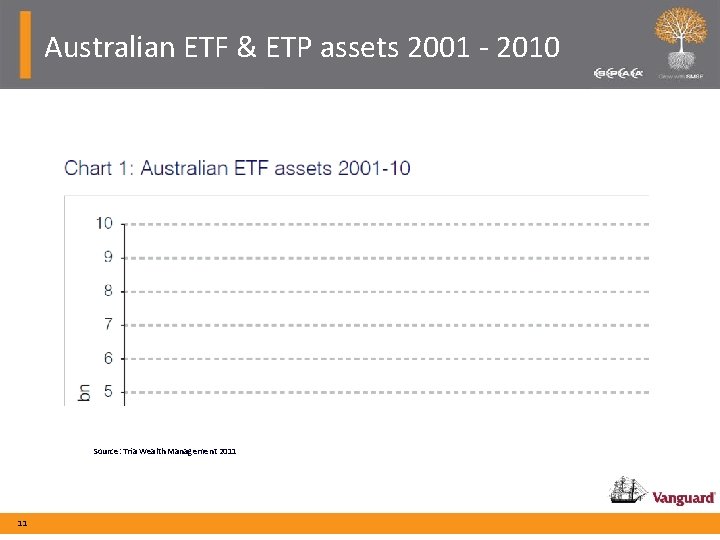
Australian ETF & ETP assets 2001 - 2010 Source: Tria Wealth Management 2011 11
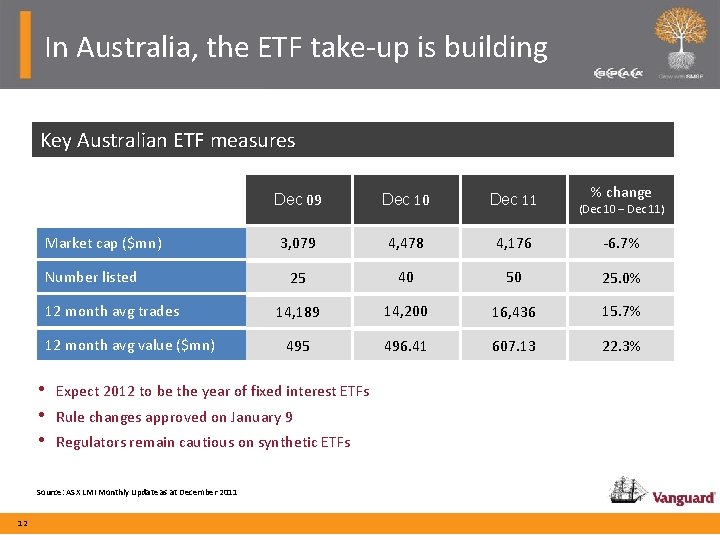
In Australia, the ETF take-up is building Key Australian ETF measures Market cap ($mn) Number listed 12 month avg trades 12 month avg value ($mn) • • • 12 Dec 10 Dec 11 3, 079 4, 478 4, 176 -6. 7% 25 40 50 25. 0% 14, 189 14, 200 16, 436 15. 7% 495 496. 41 607. 13 22. 3% Expect 2012 to be the year of fixed interest ETFs Rule changes approved on January 9 Regulators remain cautious on synthetic ETFs Source: ASX LMI Monthly Update as at December 2011 % change Dec 09 (Dec 10 – Dec 11)
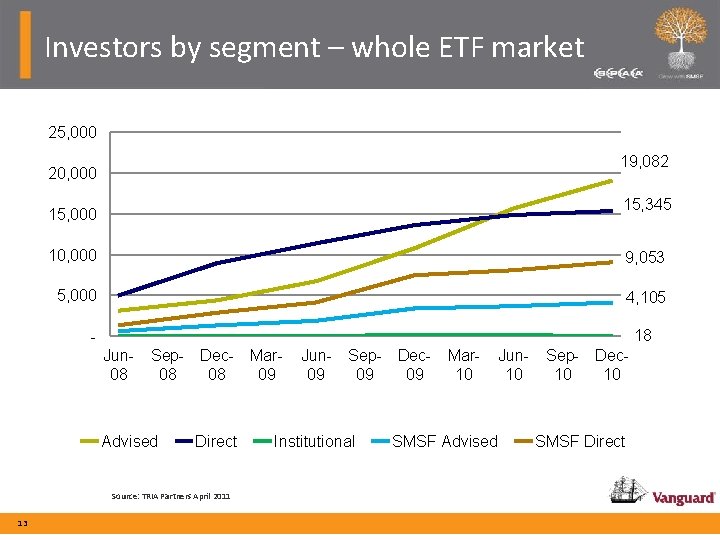
Investors by segment – whole ETF market 25, 000 19, 082 20, 000 15, 345 15, 000 10, 000 9, 053 5, 000 4, 105 18 Jun 08 Sep- Dec 08 08 Advised Direct Source: TRIA Partners April 2011 13 Mar 09 Jun 09 Sep- Dec 09 09 Institutional Mar 10 SMSF Advised Jun 10 Sep- Dec 10 10 SMSF Direct
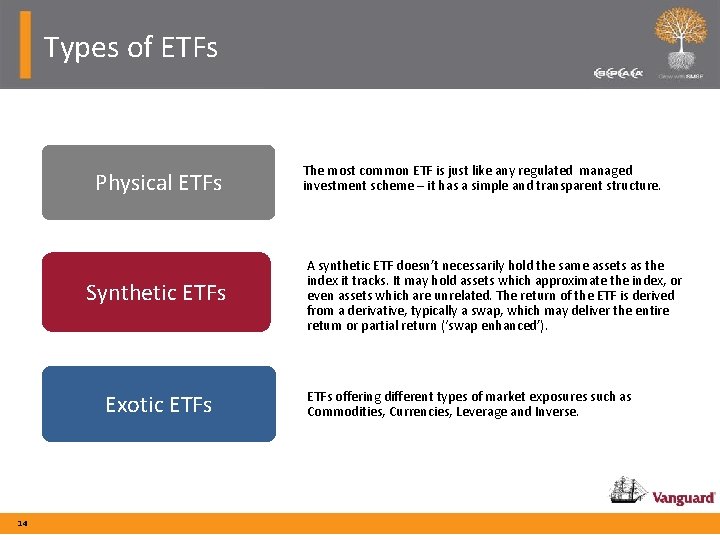
Types of ETFs Physical ETFs Synthetic ETFs Exotic ETFs 14 The most common ETF is just like any regulated managed investment scheme – it has a simple and transparent structure. A synthetic ETF doesn’t necessarily hold the same assets as the index it tracks. It may hold assets which approximate the index, or even assets which are unrelated. The return of the ETF is derived from a derivative, typically a swap, which may deliver the entire return or partial return (‘swap enhanced’). ETFs offering different types of market exposures such as Commodities, Currencies, Leverage and Inverse.
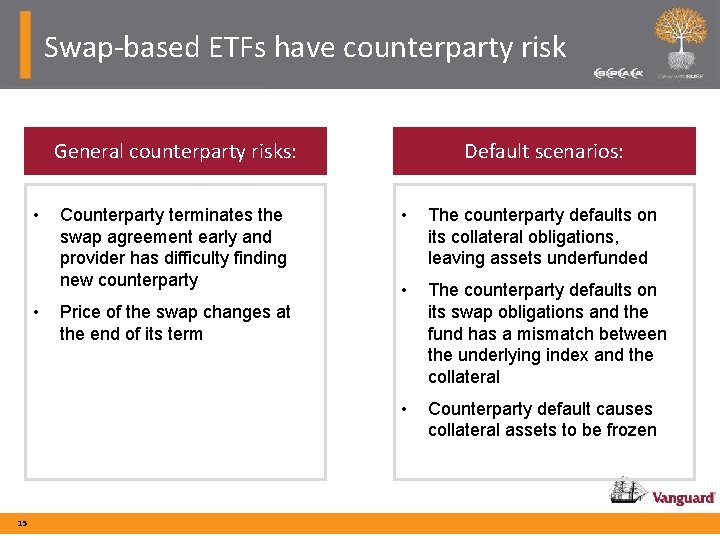
Swap-based ETFs have counterparty risk General counterparty risks: • • 15 Counterparty terminates the swap agreement early and provider has difficulty finding new counterparty Default scenarios: • The counterparty defaults on its collateral obligations, leaving assets underfunded • The counterparty defaults on its swap obligations and the fund has a mismatch between the underlying index and the collateral • Counterparty default causes collateral assets to be frozen Price of the swap changes at the end of its term
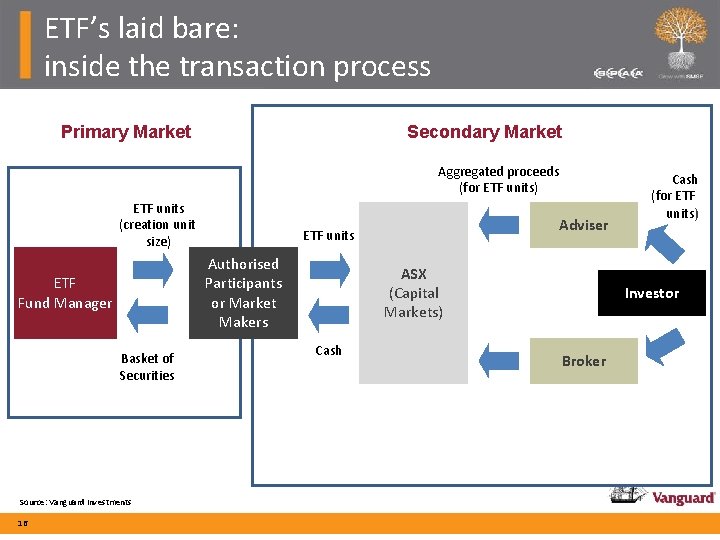
ETF’s laid bare: inside the transaction process Primary Market Secondary Market Aggregated proceeds (for ETF units) ETF units (creation unit size) Authorised Participants or Market Makers ETF Fund Manager Basket of Securities Source: Vanguard Investments 16 Adviser ETF units ASX (Capital Markets) Cash (for ETF units) Investor Broker
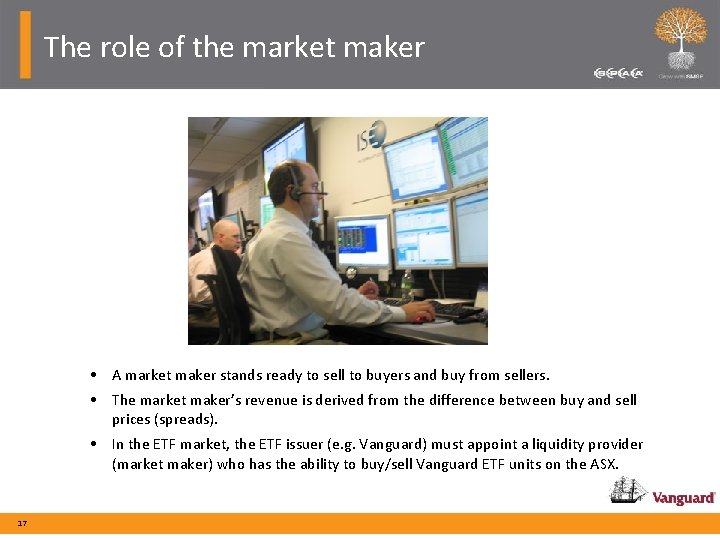
The role of the market maker • A market maker stands ready to sell to buyers and buy from sellers. • The market maker’s revenue is derived from the difference between buy and sell prices (spreads). • In the ETF market, the ETF issuer (e. g. Vanguard) must appoint a liquidity provider (market maker) who has the ability to buy/sell Vanguard ETF units on the ASX. 17
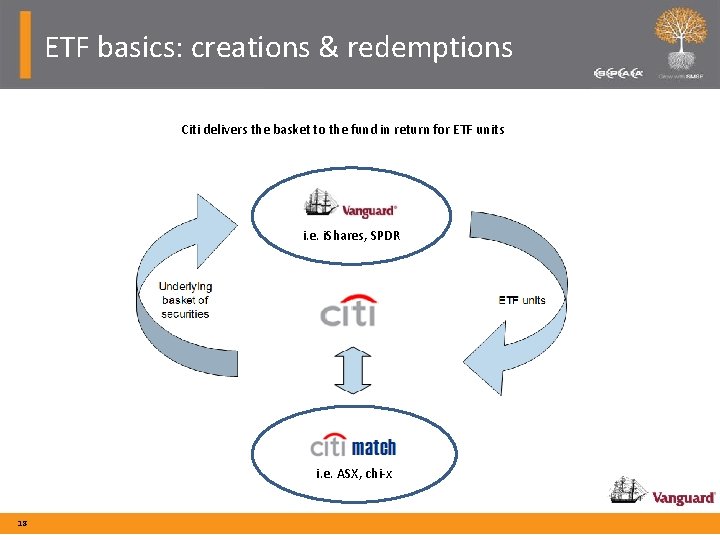
ETF basics: creations & redemptions Citi delivers the basket to the fund in return for ETF units i. e. i. Shares, SPDR i. e. ASX, chi-x 18
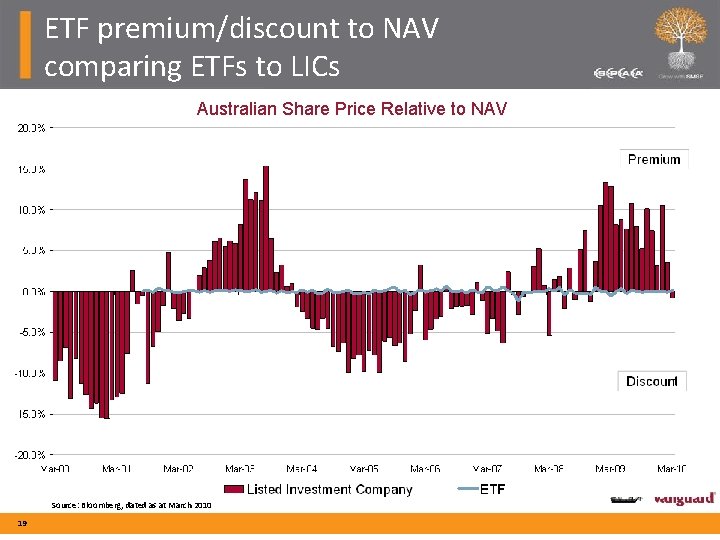
ETF premium/discount to NAV comparing ETFs to LICs Australian Share Price Relative to NAV Source: Bloomberg, dated as at March 2010 19
ETF liquidity – the broader picture • There are 2 levels of liquidity to think about with ETFs: – – On screen; and Liquidity of underlying holdings • The ability for the authorised participant to create new units or cancel units on a daily basis to meet the demand or supply on the market means that ETFs have an additional depth of liquidity. • The ETF will generally trade around the Net Asset Value (‘NAV’) due to the ETF having an ‘open ended’ rather than ‘closed ended’ structure. • If the market price moves away from the NAV, arbitrage by one or more of the trading participants will bring the price back to NAV 20
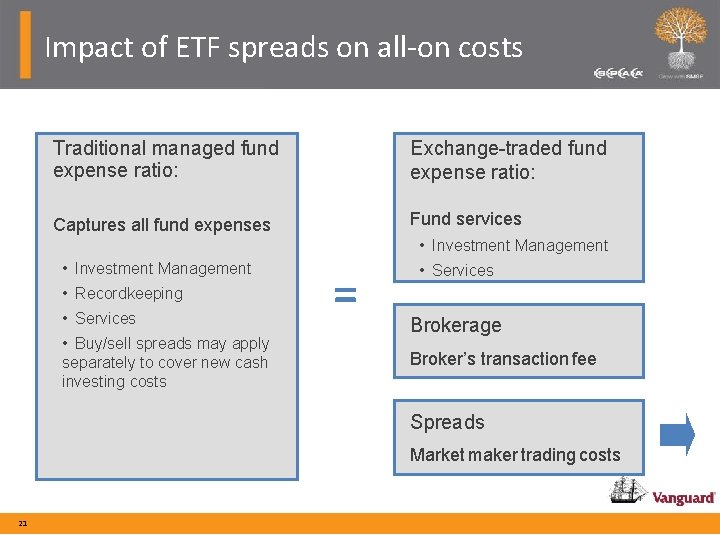
Impact of ETF spreads on all-on costs Traditional managed fund expense ratio: Exchange-traded fund expense ratio: Captures all fund expenses Fund services • Investment Management • Recordkeeping • Services • Buy/sell spreads may apply separately to cover new cash investing costs = • Services Brokerage Broker’s transaction fee Spreads Market maker trading costs 21
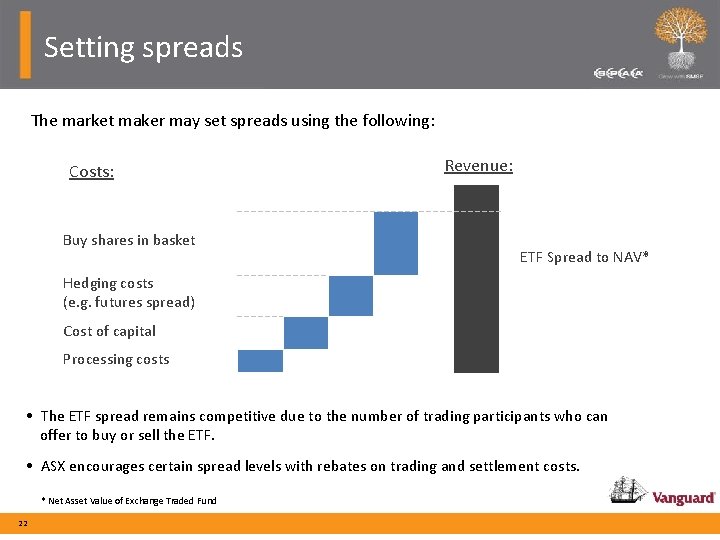
Setting spreads The market maker may set spreads using the following: Costs: Buy shares in basket Revenue: ETF Spread to NAV* Hedging costs (e. g. futures spread) Cost of capital Processing costs • The ETF spread remains competitive due to the number of trading participants who can offer to buy or sell the ETF. • ASX encourages certain spread levels with rebates on trading and settlement costs. * Net Asset Value of Exchange Traded Fund 22
Back to basics What are key drivers of portfolio performance? The two most important portfolio decisions an investor makes are: 1) Asset Allocation 2) Costs 23
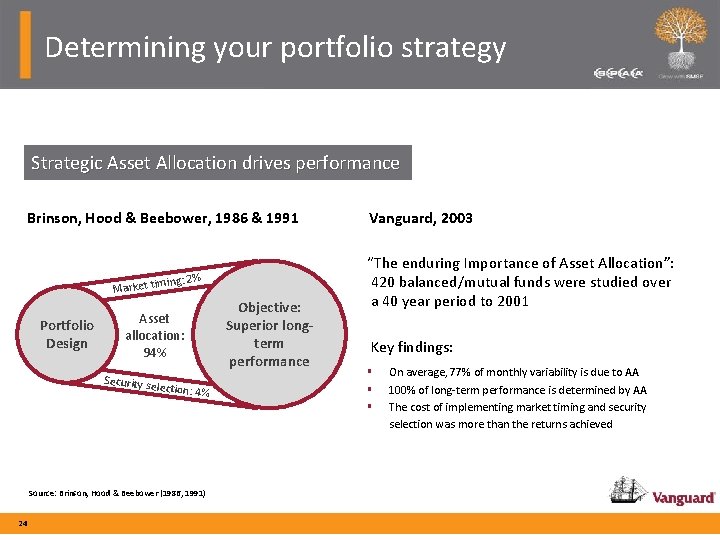
Determining your portfolio strategy Strategic Asset Allocation drives performance Brinson, Hood & Beebower, 1986 & 1991 ing: 2% Market tim Portfolio Design Objective: Superior longterm performance Asset allocation: 94% Security s election: 4 % Source: Brinson, Hood & Beebower (1986, 1991) 24 Vanguard, 2003 “The enduring Importance of Asset Allocation”: 420 balanced/mutual funds were studied over a 40 year period to 2001 Key findings: § § § On average, 77% of monthly variability is due to AA 100% of long-term performance is determined by AA The cost of implementing market timing and security selection was more than the returns achieved
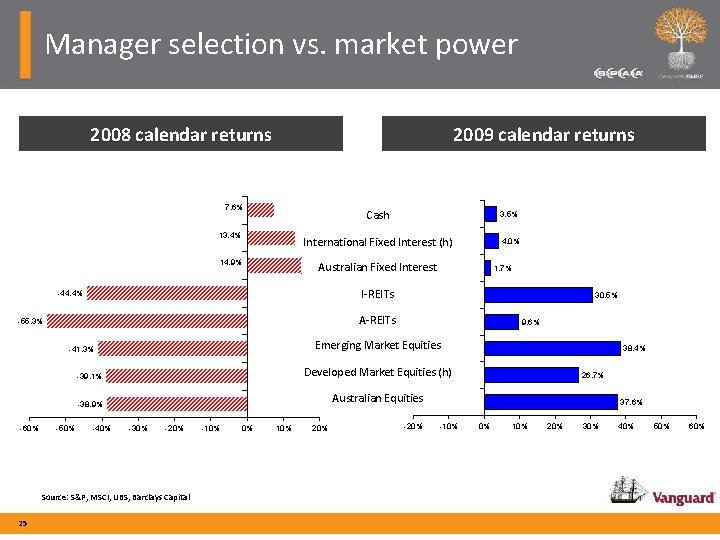
Manager selection vs. market power 2008 calendar returns 2009 calendar returns 7. 6% 13. 4% 14. 9% Cash 3. 5% International Fixed Interest (h) 4. 0% Australian Fixed Interest I-REITs -44. 4% -50% 9. 6% Emerging Market Equities -41. 3% -39. 1% Developed Market Equities (h) -38. 9% Australian Equities -40% -30% -20% Source: S&P, MSCI, UBS, Barclays Capital 25 30. 5% A-REITs -55. 3% -60% 1. 7% -10% 0% 10% 20% -20% 38. 4% 26. 7% 37. 6% -10% 0% 10% 20% 30% 40% 50% 60%
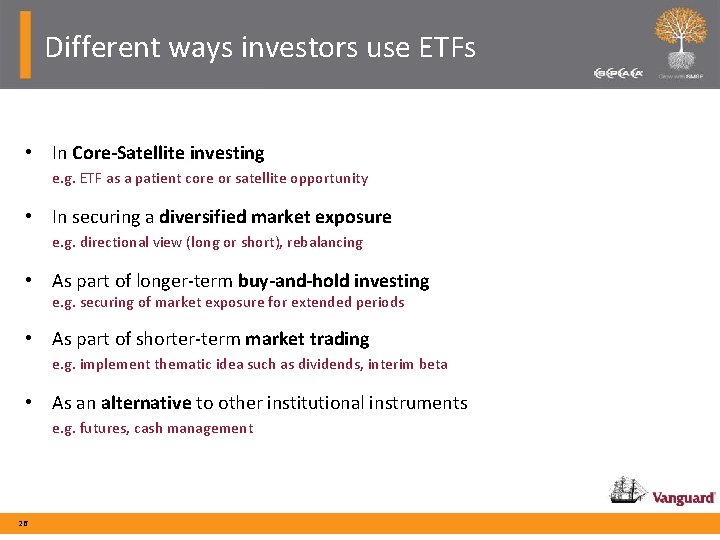
Different ways investors use ETFs • In Core-Satellite investing e. g. ETF as a patient core or satellite opportunity • In securing a diversified market exposure e. g. directional view (long or short), rebalancing • As part of longer-term buy-and-hold investing e. g. securing of market exposure for extended periods • As part of shorter-term market trading e. g. implement thematic idea such as dividends, interim beta • As an alternative to other institutional instruments e. g. futures, cash management 26
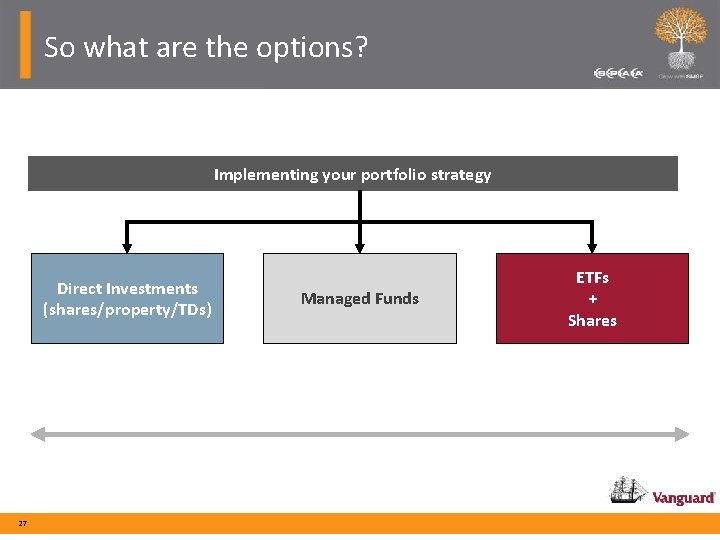
So what are the options? Implementing your portfolio strategy Direct Investments (shares/property/TDs) 27 Managed Funds ETFs + Shares
Case study Core-Satellite strategy for international shares • What? – A core-satellite strategy – Combining ETFs with actively managed funds, LICs or directly held shares • Why? – Provides investors with the opportunity for additional performance from their active positions but lowers the overall cost of the portfolio from a full active approach. – Also suits investors who seek moderate risk to the benchmark – Achieves diversification within your portfolio 28
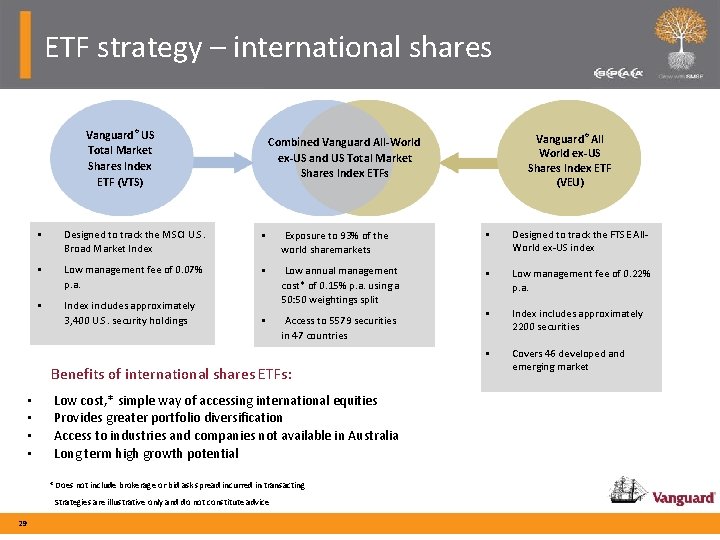
ETF strategy – international shares Vanguard® US Total Market Shares Index ETF (VTS) • Designed to track the MSCI U. S. Broad Market Index • Exposure to 93% of the world sharemarkets • Designed to track the FTSE All. World ex-US index • Low management fee of 0. 07% p. a. • • Low management fee of 0. 22% p. a. • Index includes approximately 3, 400 U. S. security holdings Low annual management cost* of 0. 15% p. a. using a 50: 50 weightings split • Access to 5579 securities in 47 countries • Index includes approximately 2200 securities • Covers 46 developed and emerging market Benefits of international shares ETFs: • • Low cost, * simple way of accessing international equities Provides greater portfolio diversification Access to industries and companies not available in Australia Long term high growth potential * Does not include brokerage or bid ask spread incurred in transacting Strategies are illustrative only and do not constitute advice 29 Vanguard® All World ex-US Shares Index ETF (VEU) Combined Vanguard All-World ex-US and US Total Market Shares Index ETFs
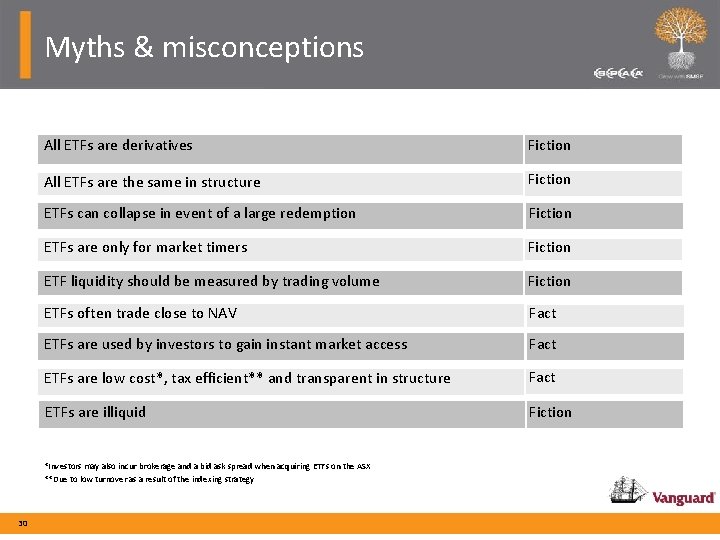
Myths & misconceptions All ETFs are derivatives Fiction All ETFs are the same in structure Fiction ETFs can collapse in event of a large redemption Fiction ETFs are only for market timers Fiction ETF liquidity should be measured by trading volume Fiction ETFs often trade close to NAV Fact ETFs are used by investors to gain instant market access Fact ETFs are low cost*, tax efficient** and transparent in structure Fact ETFs are illiquid Fiction *Investors may also incur brokerage and a bid ask spread when acquiring ETFs on the ASX **Due to low turnover as a result of the indexing strategy 30
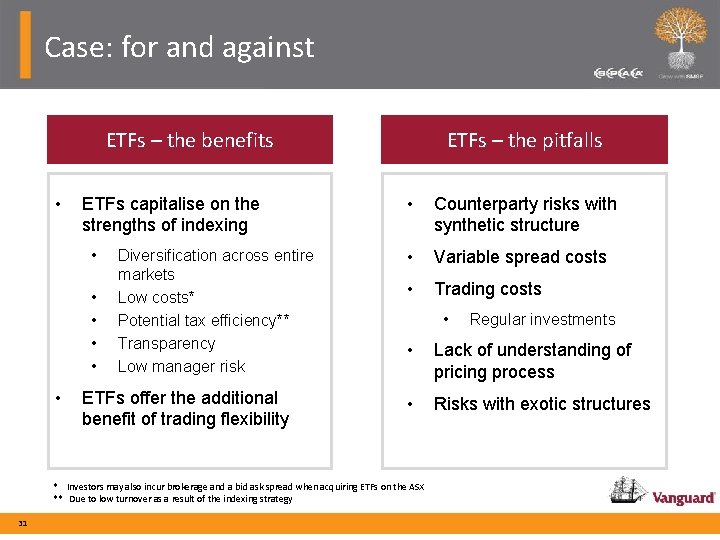
Case: for and against ETFs – the benefits • ETFs capitalise on the strengths of indexing • • • Diversification across entire markets Low costs* Potential tax efficiency** Transparency Low manager risk ETFs offer the additional benefit of trading flexibility ETFs – the pitfalls • Counterparty risks with synthetic structure • Variable spread costs • Trading costs • • Lack of understanding of pricing process • Risks with exotic structures * Investors may also incur brokerage and a bid ask spread when acquiring ETFs on the ASX ** Due to low turnover as a result of the indexing strategy 31 Regular investments
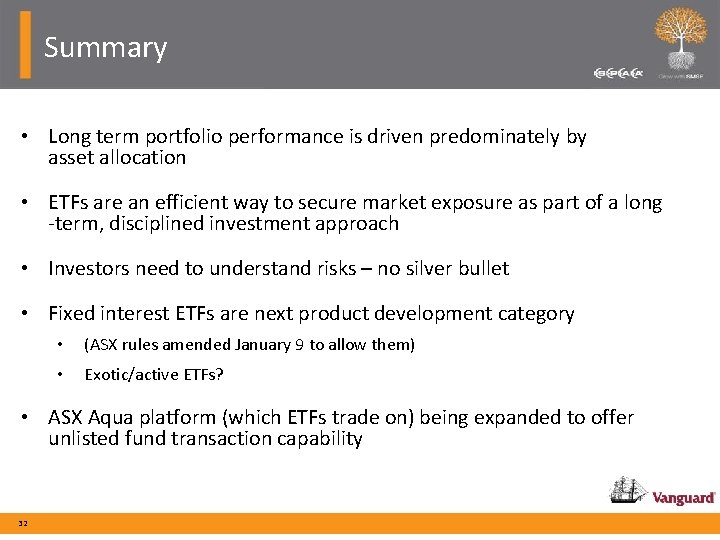
Summary • Long term portfolio performance is driven predominately by asset allocation • ETFs are an efficient way to secure market exposure as part of a long -term, disciplined investment approach • Investors need to understand risks – no silver bullet • Fixed interest ETFs are next product development category • (ASX rules amended January 9 to allow them) • Exotic/active ETFs? • ASX Aqua platform (which ETFs trade on) being expanded to offer unlisted fund transaction capability 32
Important information This presentation contains general information and is intended to assist you. We have not taken anybody's circumstances into account so the information may not be applicable to your circumstances. Before making an investment decision, you should consider your clients circumstances and whether the information is applicable to their situation. Past performance is not an indication of future performance. All ETF products are subject to market risk, which may result in the loss of principal. International ETFs involve additional risks, including currency fluctuations and the potential for adverse developments in specific countries or regions. Vanguard Investments Australia Ltd (ABN 72 072 881 086 / AFS Licence 227263 / RSE Licence L 0001335) (“Vanguard”) is the issuer of the Vanguard ETFs. Vanguard is the issuer of the Prospectus on behalf of the US listed ETFs described in the Prospectus. Vanguard has arranged for interests in the US ETFs to be made available to Australian investors via CHESS Depositary Interests that are quoted on the AQUA market of the Australian Securities Exchange (“ASX”). Vanguard ETFs will only be issued to Authorised Participants, that is persons who have been authorised as trading participants under the ASX Operating Rules. Retail investors can transact in Vanguard ETFs through a stockbroker or financial adviser on the secondary market. Investors should consider the Prospectus and Product Disclosure Statement (“PDS”) in deciding whether to acquire Vanguard ETFs. Retail investors can only use the Prospectus and PDS for informational purposes. You can access the PDS and Prospectus at vanguard. com. au This information is intended for investors in Australia only. Information regarding the US-registered products does not constitute an offer or solicitation and may not be treated as an offer or solicitation in any jurisdiction where such an offer or solicitation is against the law or to anyone to whom it is unlawful to make such an offer or solicitation, or if the person making the offer or solicitation is not qualified to do so. Standard & Poor’s® and S&P® are registered trademarks of Standard & Poor's Financial Services LLC ("S&P") and ASX® is a registered trademark of the Australian Securities Exchange Limited (“ASX”). These trademarks have been licensed for use by The Vanguard Group, Inc. Vanguard's ETF(s) are not sponsored, endorsed, sold or promoted by S&P, or ASX, and S&P and ASX make no representation, warranty or condition regarding the advisability of buying, selling or holding units/shares in the Vanguard ETF(s). The funds or securities referred to herein are not sponsored, endorsed, or promoted by MSCI, and MSCI bears no liability with respect to any such funds or securities. For any such funds or securities, the PDS or Prospectus contains a more detailed description of the limited relationship MSCI has with Vanguard any related funds. ”FTSE®” is a trade mark jointly owned by the London Stock Exchange Plc and The Financial Times Limited and is used by FTSE International Limited under licence. “All-World” is a trade mark of FTSE International Limited. “ASFATM” is a trade mark of The Association of Superannuation Funds of Australia (“ASFA”). The FTSE All-World ex-US Index are calculated by FTSE International Limited. FTSE and ASFA do not sponsor, endorse or promote this product and is not in any way connected to it and does not accept any liability in relation to its issue, operation and trading. ‘Vanguard’, ‘Vanguard Investments’ and the ship logo are the trademarks of The Vanguard Group, Inc. © 2012 Vanguard Investments Australia. All rights reserved. 33
- Slides: 33