
Under Development 2 way coupling between ocean and
Under Development • 2 -way coupling between ocean and atmosphere circulation models – put the O in COAMPS • Couple wave models with ocean and atmospheric circulation models • Automate flow of data and model results from one model to another – DIOPS for waves • Integrate sediment transport models with coastal circulation models • And I haven’t even talked about ice modeling!
Distributed Integrated Ocean Prediction System Slides courtesy of Dean Wakeham DIOPS/SWAN Scientist Neptune Sciences, Inc.
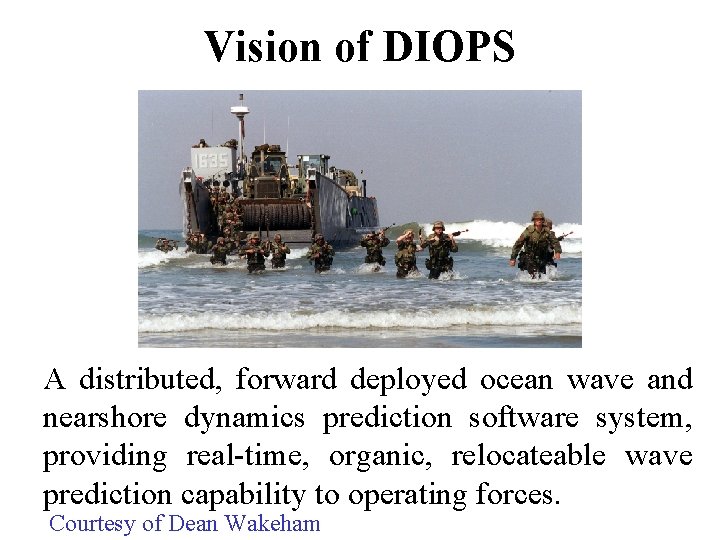
Vision of DIOPS A distributed, forward deployed ocean wave and nearshore dynamics prediction software system, providing real-time, organic, relocateable wave prediction capability to operating forces. Courtesy of Dean Wakeham
COMPONENTS • WAve Model (WAM) • STeady-state WAVE Model (STWAVE) • Combined REFraction/DIFfraction Model (REF/DIF) • Navy Relocatable Tide/Surge Modeling System (PCTIDES) • Navy SURF 3. 1 Courtesy of Dean Wakeham
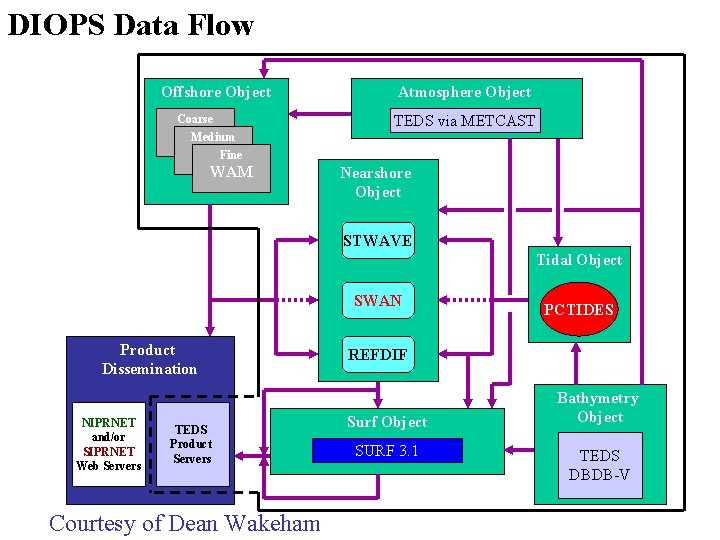
DIOPS Data Flow Offshore Object Coarse Atmosphere Object TEDS via METCAST Medium Fine WAM Nearshore Object STWAVE Tidal Object SWAN Product Dissemination NIPRNET and/or SIPRNET Web Servers TEDS Product Servers Courtesy of Dean Wakeham PCTIDES REFDIF Surf Object SURF 3. 1 Bathymetry Object TEDS DBDB-V
Project 01 A-2: Littoral Turbidity and Surface Drift Modeling Richard P. Signell NATO/SACLANT Undersea Research Centre La Spezia, Italy Photo: NRL-SSC Photo: SACLANTCEN
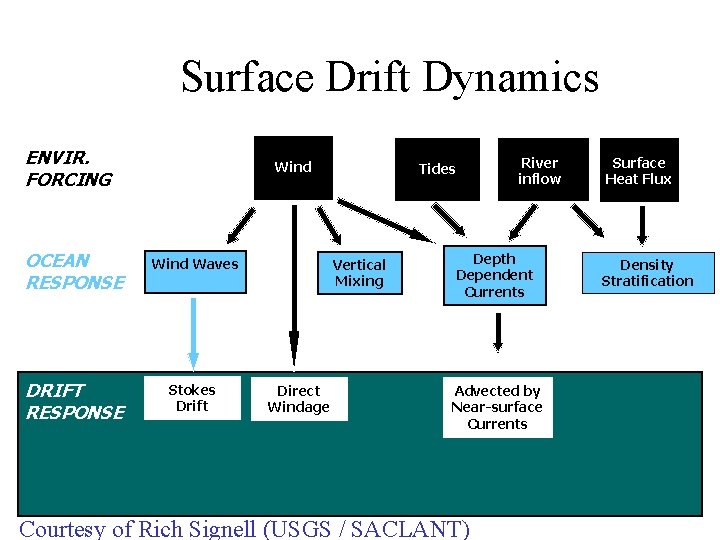
Surface Drift Dynamics ENVIR. FORCING Wind OCEAN RESPONSE Wind Waves DRIFT RESPONSE Stokes Drift Vertical Mixing Direct Windage River inflow Tides Depth Dependent Currents Advected by Near-surface Currents Courtesy of Rich Signell (USGS / SACLANT) Surface Heat Flux Density Stratification
Surface Drift Modeling • Coupled operational models for wind, waves and 3 D currents now exist, and we can now build (and assess!) an operational surface drift model. • COAMPS, WAM/SWAN, and NCOM models GNOME (Generalized NOAA Oil Modeling Environment) • NAVO Persian Gulf Drift Forecast Courtesy of Rich Signell (USGS / SACLANT)
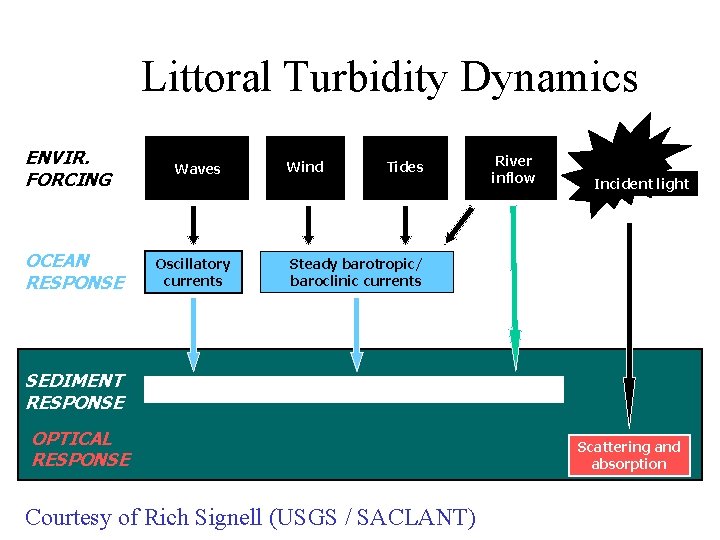
Littoral Turbidity Dynamics ENVIR. FORCING OCEAN RESPONSE SEDIMENT RESPONSE Waves Oscillatory currents Wind Tides Incident light Steady barotropic/ baroclinic currents Sediment entrainment/transport OPTICAL RESPONSE (Keen, NRL) River inflow Courtesy of Rich Signell (USGS / SACLANT) Scattering and absorption
- Slides: 9