
Undecidability and The Halting Problem CS 130 Theory
Undecidability and The Halting Problem CS 130 Theory of Computation HMU Textbook: Chap 9
Problems and Languages n n Decision problems can be captured as languages Example: n n The problem of determining whether a number is divisible by 7 corresponds to the language of all strings that form numbers divisible by 7 The finite automaton (or turing machine) for divisibility by 7 solves the problem and represents the language
Using a TM to solve a problem n n Recall the two possible interpretations of “solving” a problem through Turing Machines Device a TM so that acceptable (input) strings in the corresponding language are those that end up in a final state n n When not acceptable, we don’t need to care if the TM halts Device a machine so that it leaves YES on the tape when the string is acceptable, NO if not n Note: steeper requirement than the first option
Undecidable problems n A decision problem (or language) is decidable if there is a Turing Machine that solves that problem n n n Leaves a YES on the tape when the string is acceptable, leaves a NO when it is not A problem (or language) is undecidable if there is no Turing Machine that solves (or decides) that problem The terms solvable/unsolvable are sometimes used instead of decidable/undecidable
The halting problem n n The Halting Problem (HP): Given a TM P and input i, does P halt on i? HP is undecidable That is, there is no program (turing machine) that solves HP If there was such a program n n Its input will have two portions, P and i It outputs either a YES or a NO depending on whether P halts on input i
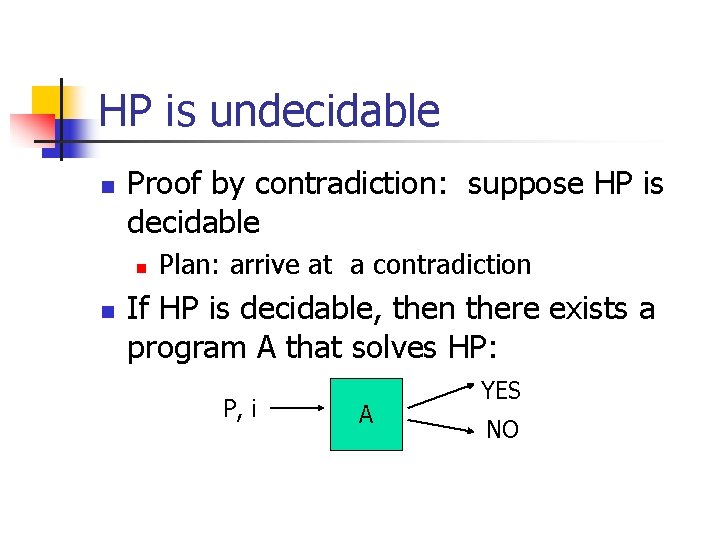
HP is undecidable n Proof by contradiction: suppose HP is decidable n n Plan: arrive at a contradiction If HP is decidable, then there exists a program A that solves HP: P, i A YES NO
HP is undecidable n Create a program B based on A as follows: n n n B takes in a program P In B, P is duplicated so that there are now two portions on the input tape Feed this new input into A When it is about to print NO, print YES instead When it is about to print YES, send the program to an infinite loop
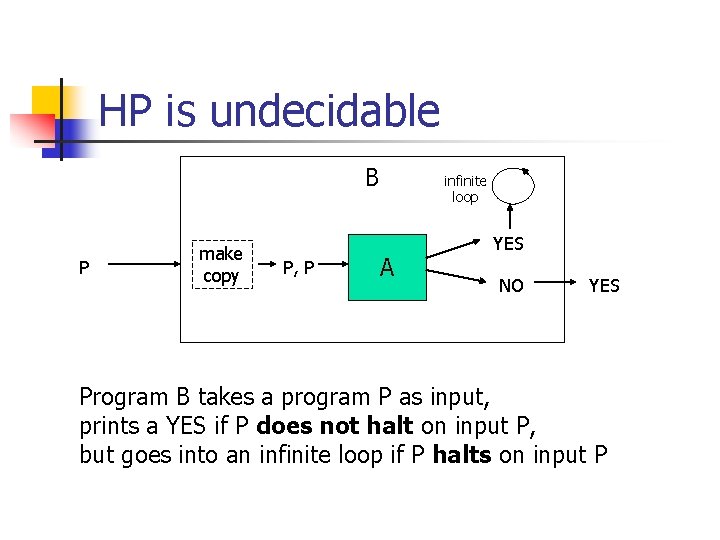
HP is undecidable B P make copy P, P infinite loop A YES NO YES Program B takes a program P as input, prints a YES if P does not halt on input P, but goes into an infinite loop if P halts on input P
HP is undecidable n n Consider feeding program B to itself Consequence (two possibilities) n It prints a YES n n It goes to an infinite loop n n B halts on input B if B does not halt on input B a contradiction B does not halt on input B if B halts on input B a contradiction Therefore the supposition cannot hold, and HP is undecidable
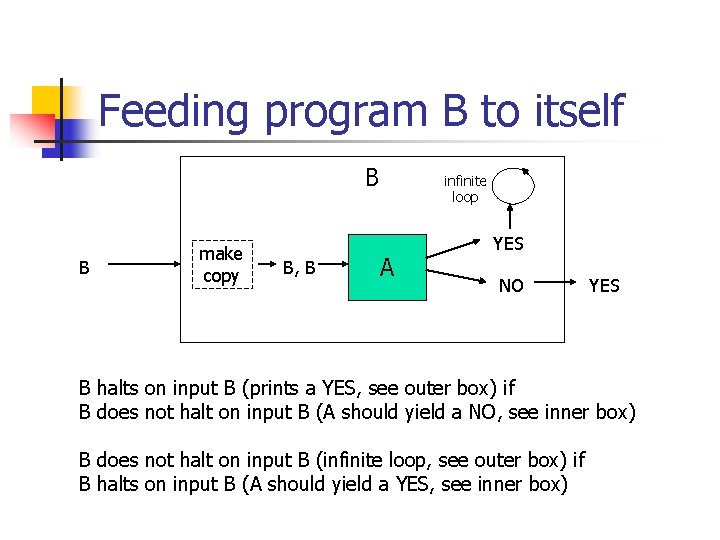
Feeding program B to itself B B make copy B, B infinite loop A YES NO YES B halts on input B (prints a YES, see outer box) if B does not halt on input B (A should yield a NO, see inner box) B does not halt on input B (infinite loop, see outer box) if B halts on input B (A should yield a YES, see inner box)
Notes and Conclusions n n There are problems such as HP that cannot be solved Actually, HP is semidecidable, that is if all we need is print YES when P on i halts, but not worry about printing NO if otherwise, a TM machine exists for the halting problem n n Just simulate P on i, print YES (or go to a final state) when the simulation stops This means that HP is not recursive but it is recursively enumerable
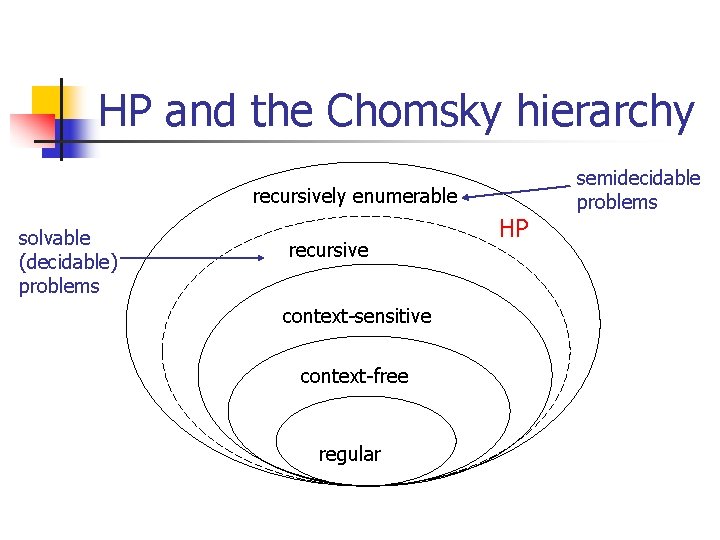
HP and the Chomsky hierarchy recursively enumerable solvable (decidable) problems recursive context-sensitive context-free regular HP semidecidable problems
- Slides: 12